
The Seven Star Maidens: Chilseong and Celestial Worship in Korean Tradition
The Seven Star Maidens weave Korean spirituality with the night sky itself. Chilseong worship shaped household rituals, artistic tradition, and how ordinary people imagined fortune for centuries.
Contents
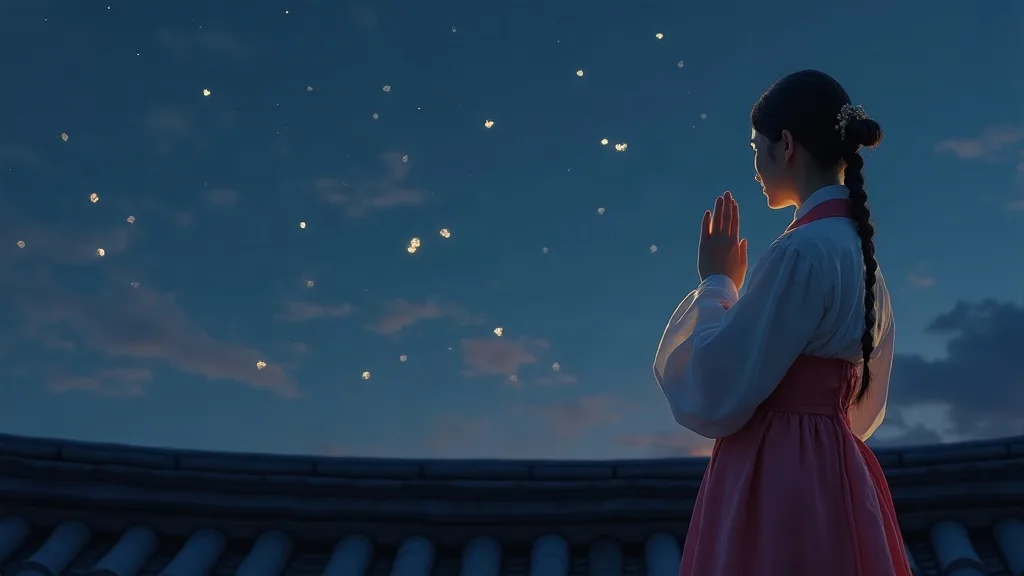
In a Korean home centuries ago, a woman would bow before a small shrine on a summer evening, eyes lifted toward seven pinpricks of light. She was not praying to distant abstractions. She spoke to the Seven Star Maidens, the Chilseong, who lived in those exact stars and watched over her children, her marriage, her lifespan. This was not theology written in temples. This was living practice in the kitchen, the bedroom, the garden.
The Seven Star Maidens represent one of Korea's most intimate celestial traditions, woven so deeply into family life that Koreans spoke of them the way they spoke of aunts or protective spirits living in the roof beams. They were visible. They were real. And they could be asked for help.
Origins in the Pleiades and Beyond
The Chilseong are rooted in the Pleiades star cluster, known in Korean as Subong, the "gathered stars" or "bunch of stars." Ancient Koreans did not need telescopes to see seven distinct points of light in that cluster. They named them Chilseong, the Seven Stars, and built an entire cosmology around them.
The mythic genealogy blends several strands. In some accounts, the Seven Stars are goddesses who descended to earth as maidens and later ascended back to the heavens. In others, they were always celestial beings who chose to manifest in human form at moments of crisis or blessing. Unlike Dangun, the founder-king of Gojoseon, the Chilseong had no singular epic origin narrative written in court documents. Instead, they lived in fragments: folk songs, household rituals, regional variations, the spoken memory of grandmothers.
One version, preserved in Korean folklore collections, describes the Seven Stars as the daughters of a celestial king. They were granted permission to visit earth once a year on the seventh day of the seventh lunar month. During that single night, they became vulnerable to human touch, human love, human longing. The most famous among them was said to have married a mortal man and borne children before returning to the sky. That legend echoes across East Asia: the Tanabata (Weaver Star) tradition in Japan, the Qixi Festival in China. But in Korea, the Chilseong retained their own character: less tragic romance, more steady protection.
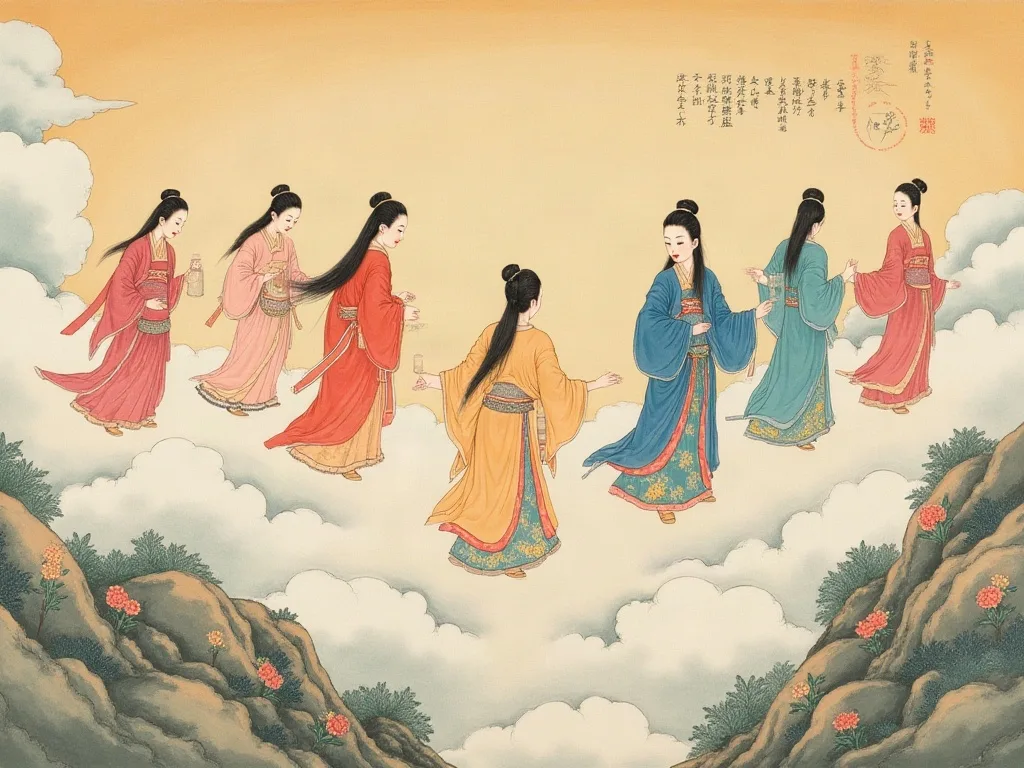
Another strand links the Chilseong to shamanic cosmology. In Korean mudang (shamanic) traditions, the Seven Stars are not distant deities but accessible presences. A shaman in trance could speak with them, negotiate on behalf of her client, ask for blessing on a child or a marriage. The Chilseong became the most democratic of celestial beings: they answered to the poor as readily as the rich, to the rural village as readily as the court.
The Cult of the Seven Stars in Household Ritual
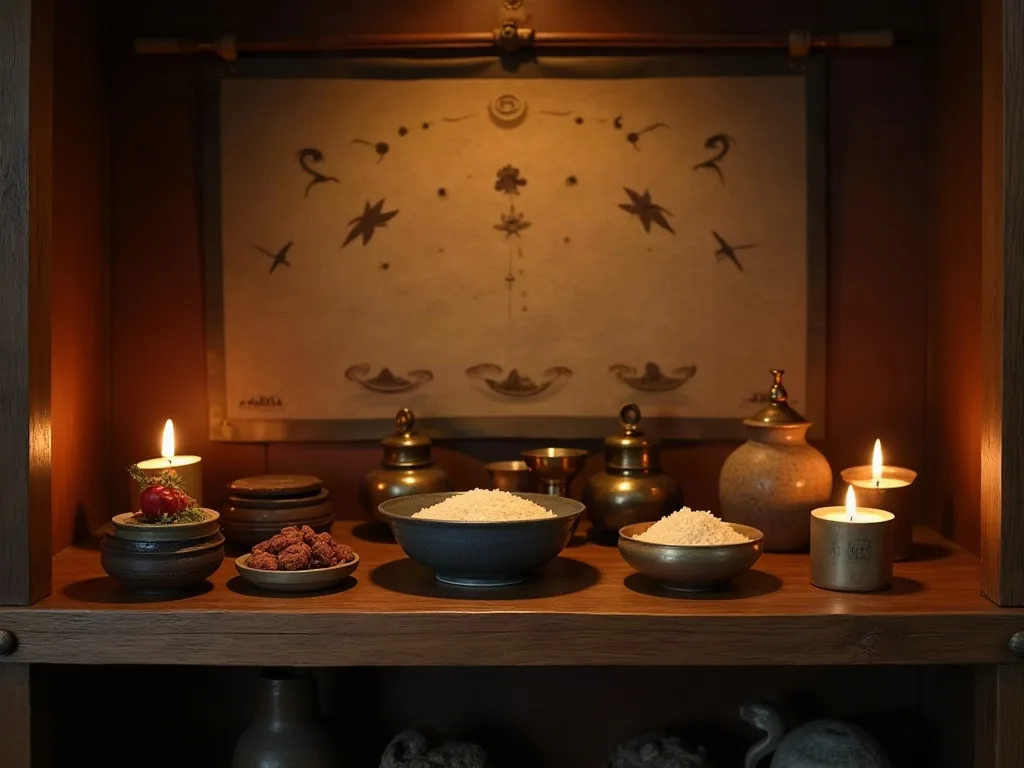
What made the Seven Star Maidens truly unique in Korean spirituality was their foothold in the home. No priest was required. No temple. A mother could build a shrine from rice, fruits, and flowers, place it in an upper room or on a high shelf, and speak directly to the Chilseong.
The most sacred moment was Chilseong-kut, the ritual honoring of the Seven Stars. Performed typically on the first or seventh day of the seventh lunar month (sometimes called Chilseok), it involved offerings of rice cake, sesame, fruit, and a cup of grain wine or sujeonggwa (cinnamon punch). The woman of the house would bow seven times, once for each star, and state her prayers aloud: for the health of her son, for a good harvest, for the safe return of a family member on a journey.
The ritual was not elaborate. That was its power. Any woman could do it. A widow alone in her room could offer up a prayer as valid as a noble's formal ceremony. This democratization of celestial worship marks a sharp difference from state-sponsored cosmology, where celestial deities were often the province of kings and their appointed astronomers.
The Chilseong shrine itself was modest. Sometimes it was simply a high shelf where a mother placed a brass or ceramic bowl filled with offerings. Sometimes it was a painted image on paper hung on the wall. In wealthier households, there might be a small wooden altar with the names of the Seven Stars written or carved. The North Star, Bukbu, held a special place in these shrines, often positioned centrally, with the six sisters arranged around it.
Over time, Chilseong worship blended with Buddhist and Daoist elements. The seven stars came to represent not only protection but also longevity, prosperity, and harmony. A woman praying to the Chilseong was not merely asking for intercession. She was aligning herself with cosmic order, placing her household inside the same sacred geometry that governed the heavens.
The Mythology of Individual Stars
While the Chilseong function as a collective, Korean tradition also preserved names and personalities for individual stars within the cluster. These were not rigid divine profiles written in stone. Instead, they shifted with region, with telling, with the emotional needs of the person praying.
The North Star, Bukbusseong, was considered the supreme among the seven. It represented longevity, stability, and the anchor point of all celestial motion. A mother praying for her aging parent would direct special reverence to Bukbusseong, asking it to extend the parent's lifespan.
The Eastern Star, associated with spring and new beginnings, was invoked for fertility and the birth of sons. The Western Star was linked to autumn, harvest, and completion. The Central Star, at the heart of the cluster, was sometimes identified as the mother of the others, the eternal protector presiding over her sisters.
These correspondences were not universally standardized. A village in Jeolla province might assign different attributes than a community in Gangwon. This variation was not a weakness of the tradition; it was its flexibility. The Chilseong belonged to whoever spoke to them. There was no orthodoxy to violate.
Some accounts describe the seven stars as sisters bound by affection and mutual duty. Others present them as a queen and her attendants. Still others, particularly in shamanic contexts, name them as seven independent goddesses who happen to share a common purpose: the welfare of human families. This multiplicity reflects the truth that mythology is not static doctrine but a living conversation between the human need for meaning and the visible cosmos.
Chilseong Worship Across Korean History
The earliest written references to Chilseong worship appear in medieval Korean texts, particularly in records from the Goryeo and Joseon dynasties. Court astrologers documented the movements of the Pleiades as part of their responsibilities to the crown. But the parallel household cult developed entirely beyond official documentation.
By the Joseon period (1392-1910), Chilseong worship had become standard practice. Even as Neo-Confucian ideology tightened its grip on Korean thought, elevating patriarchal structure and state ritual, the Chilseong persisted. A Joseon gentleman might compose poetry about the Seven Stars. A Joseon lady, confined to the inner quarters, might offer rice and fruit to them in quiet devotion. The tradition survived because it existed in the gap between official ideology and lived experience.
Travelers and scholars who visited Korea noted the prevalence of Chilseong shrines. They remarked on how ordinary it was to encounter women at their evening prayers, bowing to the stars. The practice seemed exotic to outsiders but utterly natural to Koreans. The Chilseong were not superstition; they were the fabric of daily spiritual life.
The Japanese colonial period (1910-1945) saw attempts to suppress Korean folk traditions, including Chilseong worship. But the cult was too distributed, too embedded in household practice, to be fully eradicated. Women continued to honor the Seven Stars in secret, in the privacy of the home. The tradition became a quiet act of cultural persistence.
In the modern era, Chilseong worship has declined among urban, highly educated Koreans, though it persists in rural areas and among older generations. Korean-American and Korean-diaspora communities sometimes maintain the tradition as a connection to ancestral practice. Recent scholarship and cultural revival movements have rekindled academic and artistic interest in the Chilseong, positioning them as a uniquely Korean contribution to East Asian cosmology.
The Chilseong in Art and Literature
The Seven Star Maidens have inspired centuries of artistic representation, from folk paintings to contemporary installations.
In minhwa, Korean folk painting, the Chilseong appear often as seven women dressed in bright silks, posed in celestial gardens or descending through clouds. These images were not mere decoration. They were talismans. A family would hang a Chilseong minhwa in their home as both a charm and a reminder of the stellar protectors watching from above. The paintings typically showed the seven figures in a balanced, symmetrical composition, emphasizing harmony and order.
The stylization varied by region and artist. Some minhwa depicted the Chilseong as young maidens with delicate features. Others showed them as mature, authoritative women of middle age. Some included symbolic objects: a peach of immortality, a scroll, a crown. These details were drawn from a shared visual vocabulary but executed with enough variation to give each work personality.
Korean poetry, particularly from the Joseon period, frequently invoked the Chilseong. A poet might address them directly, asking for insight or blessing. The stars became a metaphor for constancy, for guidance, for the benevolent gaze of the divine turned toward human struggle. The Chilseong appear in both courtly verse and popular song, a sign of their cultural penetration across class boundaries.
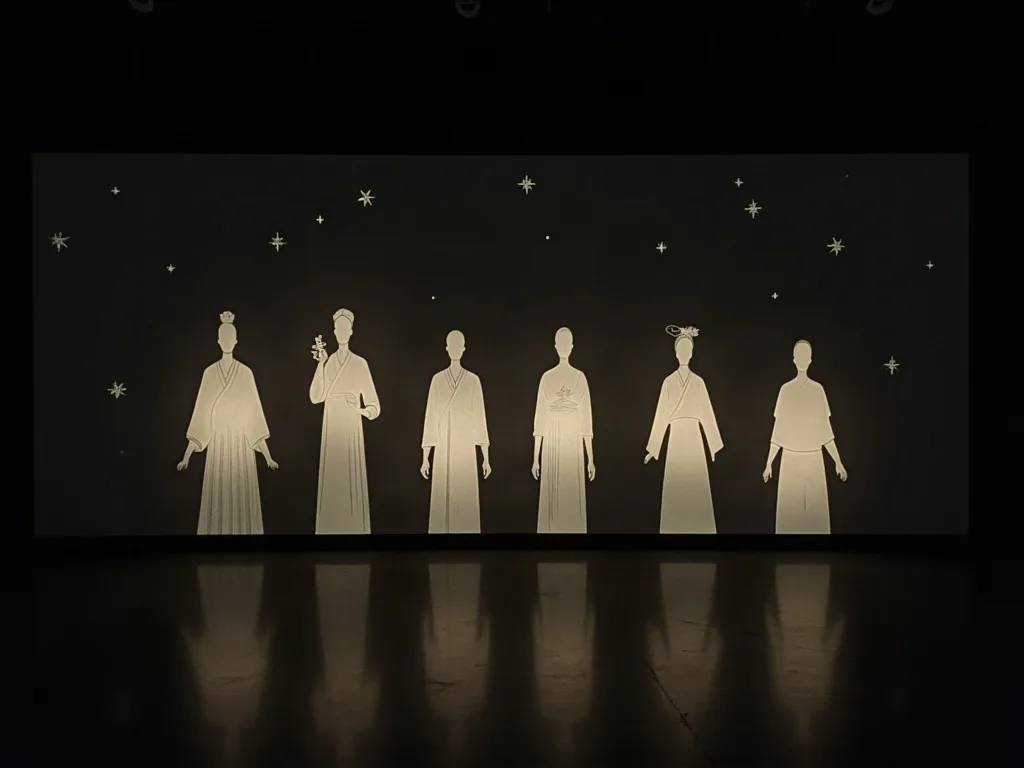
In modern times, the Chilseong have been reimagined in contemporary Korean art and literature. Novelists have woven them into stories about Korean identity and continuity. Visual artists have created installations that play with the relationship between earthly prayer and celestial distance. A 2015 Seoul exhibition featured a darkened room where visitors could write prayers and watch them projected onto a starfield. The concept was contemporary, but the impulse was ancient: the human need to reach upward and be heard.
Chilseong and Cosmic Order
The worship of the Chilseong reflects a distinct Korean understanding of cosmic order and humanity's place within it. Unlike traditions that imagine the divine as wholly separate from the material world, Korean cosmology sees a continuous spectrum from earth to heaven. The stars are not infinitely remote. They are relatives, neighbors, presences that can be addressed.
This vision draws from several sources. Chinese Daoist thought, transmitted into Korea, emphasized harmony with celestial cycles and the flow of cosmic energy (qi). Korean shamanism, preceding Chinese influence but also adapting to it, imagined a cosmos populated with spirits and ancestors as accessible as living relatives. Buddhism contributed the idea of bodhisattvas, celestial beings whose compassion extends downward to suffering humanity.
The Chilseong synthesis these influences without subordinating any of them to a single orthodoxy. A woman honoring the Seven Stars was simultaneously engaging with Daoism, shamanism, Buddhism, and a distinctly Korean vision of the sacred. She was not confused or syncretic in a haphazard way. She was operating within a coherent system in which multiple truths could coexist.
The cosmos, in this view, is not indifferent. It is organized for the benefit of human life. The Chilseong are embedded in that cosmos not as remote judges but as advocates. They stand between the supreme celestial order and human vulnerability, translating prayer into cosmic action.
Chilseong and Gender
One of the most striking aspects of Chilseong worship is its association with female agency. In a society shaped by Confucian patriarchy, where women's public religious roles were severely constrained, the Chilseong cult provided a space of spiritual autonomy.
The ritual specialists for Chilseong worship were overwhelmingly women. Mothers performed the rites. Grandmothers taught the traditions to granddaughters. Shamans, often female, integrated Chilseong veneration into their healing and blessing work. The Chilseong themselves were female beings, making them uniquely suited as objects of devotion for women whose access to male-dominated priesthoods was limited or forbidden.
This is not to say that men did not honor the Chilseong. Educated men wrote poetry about them. But the daily, practical, binding relationship was forged by women. The Chilseong responded to women's prayers because women could speak to them without intermediaries. A mother did not need permission from a male priest to ask the stars for her child's health. She simply bowed and spoke.
The Chilseong worship thus functioned as a subtle counter-narrative to official patriarchal ideology. While Confucianism prescribed female submission and silence, the Chilseong enabled a woman to take direct spiritual action, to assert her agency in prayer, to believe that the cosmos was listening to her voice. This was revolutionary, even if performed in whispers, in the privacy of the home.
Frequently asked questions about the Seven Star Maidens and celestial worship?
Frequently asked questions
Are the Chilseong the same as the Pleiades in Greek mythology?
Both cultures observed the same star cluster, but they created different mythologies around it. The Greek Pleiades are seven sisters transformed into stars to escape the hunter Orion. The Chilseong are protector goddesses accessible through household prayer. The stars are the same; the meanings are distinct.
Did Chilseong worship require a priest or temple?
No. The Chilseong were unique in Korean spirituality for being accessible directly from the home. Any woman could perform a Chilseong ritual by offering fruit, grain, and flowers on a simple altar. This made the tradition far more democratic than state-sponsored or temple-centered religious practices.
What is the connection between Chilseong and shamanism?
Korean shamans (mudang) incorporated Chilseong worship into their healing and blessing rituals. A shaman in trance could communicate with the Seven Stars and negotiate blessings on behalf of clients. The Chilseong became part of the broader shamanic cosmos of accessible spiritual allies.
Is Chilseong worship still practiced in Korea today?
The tradition has declined in urban and secular contexts but persists, especially among older generations and in rural areas. Cultural revival initiatives and academic scholarship have sparked renewed interest. The Chilseong remain recognized symbols of Korean cultural identity.
Why were the Seven Star Maidens associated with women rather than men?
Because the household ritual did not require priestly authority or institutional access, women could practice Chilseong devotion independently. In a patriarchal society that restricted women's religious roles, the Chilseong provided a sanctioned space for female spiritual agency and direct communication with the divine.
How did Chilseong worship survive the Japanese colonial period?
Because it was embedded in household practice and required no temples or official infrastructure, Chilseong worship could persist in the private sphere even as colonial authorities attempted to suppress Korean traditions. Women continued to honor the stars quietly at home, preserving the practice through an era of cultural suppression.
The Chilseong in Contemporary Korean Identity
Today, the Seven Star Maidens hold a unique place in Korean cultural consciousness. They are not central to mainstream religion as it is practiced in modern Korea (Buddhism, Christianity, and secular worldviews dominate). Yet they persist in memory, in art, in the literature of identity and belonging.
For many Koreans, the Chilseong represent something deeper than a discrete myth. They embody a specifically Korean way of imagining the cosmos: intimate rather than distant, accessible rather than hierarchical, feminine rather than patriarchal, rooted in lived experience rather than institutional doctrine. To honor the Chilseong is, for many, to honor Korea itself.
Contemporary Korean artists and writers have taken up the Chilseong as metaphors for resilience, continuity, and quiet power. A novelist writing about a grandmother preserving family memory might invoke the image of the Seven Stars as silent witnesses. A visual artist might juxtapose ancient minhwa images with modern installations, asking viewers to feel the weight of centuries. The Chilseong become a bridge between past and present, between the rural and the urban, between the celestial and the intimate.
In diaspora communities, the Chilseong sometimes function as a symbol of Korean-ness, a way of maintaining connection to ancestral practice across distance and generations. A Korean-American mother teaching her daughter about the Seven Stars is not merely transmitting a folk tradition. She is asserting that Korean spirituality, in its most domestic and democratic form, belongs to her and her child as much as it belonged to her grandmother.
The Seven Star Maidens remain a testament to a vision of the sacred in which the cosmos listens, in which prayer spoken from the heart reaches upward, and in which the most powerful spiritual act is often the quietest one: a woman's voice in the darkness, speaking to the stars.
Read the full book
Want the whole story?
The complete edition is an instant PDF download here, with a paperback on Amazon for selected titles.
Korean
The Korean Mythology Book: Dangun, Bari, the Dokkaebi Tricksters, and the Shamanic Stories of the Peninsula
From Hwanin's Heaven to the Underworld and Back
The shamanic mythology of Korea: Dangun the founder, Bari the death-walker, the Yongwang Dragon Kings, the dokkaebi goblins, and the gumiho fox spirits.
More from Korean
All articles
Korean
Hwanung: The Heavenly Prince Who Descended to Earth
Hwanung, the celestial prince of Korean myth, descended from heaven to establish human civilization. His union with a bear-woman bore Tangun, founder of Gojoseon, Korea's first kingdom. Discover how this cosmic descent shaped Korean identity and continues to echo through the nation's cultural memory.
Korean
Mago Halmi: The Primordial Creatrix Goddess
Mago Halmi shaped existence itself before time began. The Korean primordial goddess stands at the root of all creation, a force older than the heavens, wiser than fate itself.

Korean
Jumong: The Archer Hero and Founder of Goguryeo
Jumong, a legendary archer and divine prince, fled a deadly throne and established Goguryeo, one of Korea's greatest kingdoms. His story of exile, resurrection, and martial mastery shaped a nation.

Korean
Baekdu Mountain: The Sacred Peak of Korean Cosmology
Baekdu Mountain rises at the heart of Korean myth as the birthplace of the first kingdom and the cosmic axis binding earth to heaven. Discover how this real volcano became the sacred peak where gods walked and legends were born.