
Hwanung: The Heavenly Prince Who Descended to Earth
Hwanung, the celestial prince of Korean myth, descended from heaven to establish human civilization. His union with a bear-woman bore Tangun, founder of Gojoseon, Korea's first kingdom. Discover how this cosmic descent shaped Korean identity and continues to echo through the nation's cultural memory.
Contents
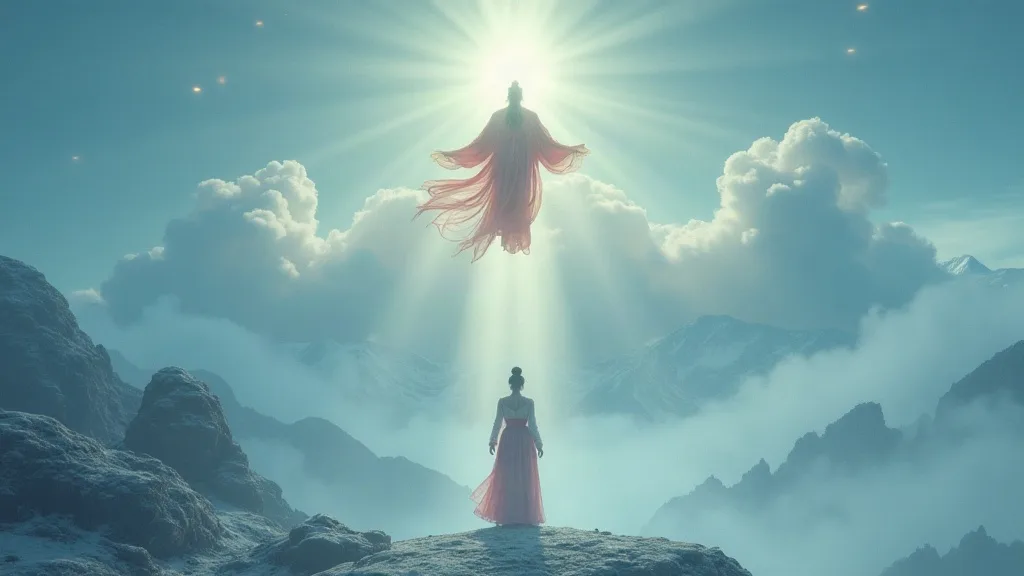
The sky parts. Light floods down. From the heavens rides a prince on five clouds, trailing silk and starlight. His name is Hwanung. He has abandoned the palace of his father, Hwanung leaves behind the celestial throne to walk the earth, and in doing so, he transforms the boundary between heaven and human into something tangible, permeable, alive with meaning.
This is the moment Korean civilization begins.
Hwanung does not arrive as a distant god demanding worship from afar. He comes down. He marries. He has a son. He teaches humanity the arts of survival and virtue. In the founding myth of Gojoseon, Korea's first kingdom, Hwanung is not a remote deity but a bridge between two worlds, a prince who chose humanity over immortality. That choice, and the bloodline it created, would define what it means to be Korean for thousands of years.
The Heavenly Palace and Hwanung's Choice
Before the descent, there was order in the cosmos. At the top sat Hananim, the supreme sky god of Korean cosmology (also known as Okhwangnehun or the Jade Emperor in some traditions, though distinct from Chinese sources). Beneath him ruled the celestial realm, where Hwanung's father, Hwanung (also sometimes called Hwanin in older texts), held dominion. This father-god oversaw the heavens and all earthly domains from above, distant but absolute.
Hwanung the prince, however, grew restless in that palace of perfection. The Korean texts do not explain his exact motivation, but they hint at something deeper than boredom. He gazed down upon the earth and saw a world full of potential, inhabited by humans struggling without divine guidance, without structure, without the knowledge to thrive. Compassion pulled at him. Purpose called.
He approached his father with a request. The heaven-king granted it. Hwanung would descend to Gung Gung, the earthly realm, and would bring three divine treasures: a heavenly seal, a heavenly mirror, and a heavenly sword. These objects were more than symbols. They represented legitimacy, self-knowledge, and the power to bring order. With these tools, Hwanung would establish a kingdom on earth that mirrored the perfect order of heaven.

The Descent to Mount Taebaek
Hwanung chose Mount Taebaek (also written as Mount Baekdu or Paektu in some sources) as his landing place. This mountain, one of the highest peaks on the Korean peninsula, stands at the border between what is now Korea and Manchuria. It was not random terrain. In Korean cosmology, high mountains served as bridges between the celestial and earthly realms. Mount Taebaek was sacred space, the kind of place where divine will could take root.
The prince descended with his retinue: three thousand divine beings, celestial attendants who would help establish the new order. Some texts describe them as devas or heavenly servants; others simply call them "divine beings." Together, they arrived at a great tree near Mount Taebaek. Some accounts name this tree a sandalwood; others call it a divine willow. The tree itself became sacred ground, the first temple of the new civilization.
This descent happened, according to traditional Korean chronology, in the year that corresponds to 2333 BCE in the Gregorian calendar (though modern scholars treat this date as legendary rather than historical). The Korean calendar itself, known as the Tangun calendar, counts time from this moment forward. Hwanung's arrival, in other words, marked year zero for Korean civilization in the collective memory.
The Meeting with the Bear-Woman
Here the myth takes a turn that reveals something profound about Korean thought. Near Mount Taebaek lived two animals who shared human desires: a bear and a tiger. Both wished to become human. They asked Hwanung for help.
The prince set a test. He told them to remain in a cave for one hundred days, consuming only mugwort and garlic. This trial was deliberate. Mugwort and garlic are humble, common plants, the foods of struggle and hardship. Those who chose the divine path would endure.
The tiger gave up quickly. This detail matters. The tiger, fierce and impatient, could not sustain the discipline required. It abandoned the cave and vanished into the mountains. But the bear persisted. Day after day, in darkness, the bear ate only the mugwort and garlic. The bear endured hardship. The bear chose patience over pride.
When the hundred days ended, the bear emerged transformed. She had become a woman, beautiful and gentle. The Korean texts name her Ungnyeo (literally "bear-woman"). Some traditions add that she emerged as a fully formed woman; others suggest a gradual transformation. Either way, the bear-woman stood before Hwanung, and he saw in her not a strange creature but a person worthy of love and partnership.
The two married. Their union was not presented as strange or transgressive in the original texts, but as natural, even fated. The bear had proven herself through discipline and suffering. She had earned humanity through virtue, not accident. When Hwanung and Ungnyeo came together, they did so as equals entering a sacred covenant.

Tangun: The Child of Two Worlds
From this marriage was born a son: Tangun. The name means "cinnamon altar" or "divine altar." In Korean tradition, Tangun represents something extraordinary. He was neither purely human nor purely divine, but a synthesis. His father was a celestial prince; his mother was a being who had undergone transformation and suffering. Tangun carried both worlds in his blood.
The birth of Tangun occurred in the year that corresponds to 2333 BCE (in the traditional Korean count). Some accounts place it on the first full moon of spring; others specify the eighth lunar month. The timing itself was sacred. Tangun was born into auspiciousness, into a moment aligned with cosmic order.
As Tangun grew, he inherited knowledge from both parents. From Hwanung, he received the celestial gifts: the seal of heaven, the mirror of truth, the sword of power. From his mother, Ungnyeo, he inherited something equally vital: the connection to the land itself, the understanding of struggle and endurance, the bond with the earth. This dual inheritance made Tangun uniquely suited to rule not in the distant heavens, but here, on the peninsula where his family had chosen to dwell.
The Founding of Gojoseon
Armed with this heritage, Tangun founded a kingdom. He established Gojoseon (literally "Old Joseon" or "Ancient Joseon") with Asadal as its capital. Though the exact location of Asadal remains debated among scholars, tradition places it somewhere on the Korean peninsula, possibly near Mount Taebaek itself, or in what is now Pyongyang.
This kingdom, according to Korean historical tradition, lasted for over two thousand years. From Tangun's reign until the second century BCE, Gojoseon stood as the first organized Korean state. It established the foundations of Korean law, agricultural practice, and spiritual tradition. More importantly, it established the principle that Korean rulers derived their legitimacy not from distant heaven alone, but from a commitment to their people, to the land, and to the balance between the celestial and the earthly.
Hwanung did not vanish after Tangun's birth. The myths describe him retiring, sometimes to Mount Taebaek, sometimes to a hidden celestial realm, watching over his son and grandson and the dynasty that grew from that first union. He became less an active participant in earthly affairs and more a founding principle, a guarantee that the heavens and earth remained connected through the bloodline of the Korean royal house.

Hwanung in the Korean Sacred Texts
The primary source for the Hwanung myth is the Samguk Yusa (also written Samguk Yusa), a 13th-century Korean historical text compiled by the Buddhist monk Iryeon. This work, whose title means "Memorabilia of the Three Kingdoms," weaves together mythology, history, and spiritual teaching. The Hwanung narrative appears early in the text, framed as the mythic foundation from which all Korean history flows.
Another source, the Dangun Wanggeom Gi (Record of Dangun the Great King), also preserved Hwanung's story, though with variations in detail. These variations reflect the oral nature of the myth before its written codification. Different regions, different periods, different storytellers added nuances. What remains consistent across versions is the core: descent, choice, marriage, and the birth of civilization through synthesis.
Iryeon and other medieval Korean scholars were not simply recording old tales. They were constructing a national memory in a moment when Korea faced cultural pressure from neighboring powers. By anchoring Korean identity in the figure of Hwanung and his chosen descent, by emphasizing that civilization arose from divine will meeting human effort, they were making a profound claim: Korea was not a copy of China or any other power, but a unique nation with its own cosmic mandate.
Hwanung and Dangun's Tangun National Foundation Day
The myth of Hwanung and his son Tangun remains alive in Korean national consciousness in ways few mythologies still command in the modern world. Every October 3rd, Koreans celebrate Gaecheonjeol (literally "Opening of Heaven Day"), also known as Tangun National Foundation Day. This holiday marks the traditional founding of Gojoseon, and by extension, honors Hwanung's descent and the beginning of Korean civilization.
On this day, traditional ceremonies are held. Families visit historical sites. The Korean flag flies. The holiday is not relegated to academic study or museum display but remains part of the lived calendar, embedded in national rhythm. Schools teach the story. Textbooks include it. The myth, in other words, never became merely ancient. It continues to function as a source of collective identity and spiritual belonging.
This persistence reflects something the original myth understood: that a nation needs to know where it came from, not just geographically or politically, but spiritually. It needs to believe that its founding arose from some noble principle, some cosmic alignment. Hwanung's descent served that need. It said: Korea began when heaven chose to come down. Korea began in an act of compassion and choice. Korea began in a marriage between the divine and the earthbound, the celestial and the transformed, the prince and the bear-woman who proved herself worthy of transformation.
Hwanung and Comparative Mythology
The figure of Hwanung echoes across the mythologies of East Asia and beyond, though always in distinctly Korean form. Similar descent myths appear in Japanese mythology (the descent of Ninigi-no-Mikoto from the heavenly realm to establish the imperial line), in Chinese mythology (various celestial princes establishing earthly dynasties), and even in Mesoamerican traditions (Quetzalcoatl's return to the earth realm).
What distinguishes Hwanung's story is its emphasis on equality and transformation. Unlike many descent myths where a god simply imposes divine rule upon passive humans, Hwanung marries. He chooses a partner who has undergone her own trial. He does not simply hand down law from on high, but establishes a kingdom through relationship and compromise. The bear-woman is not conquered; she is transformed through her own effort and then chosen as an equal.
This reflected a particular Korean understanding of cosmic order. Where Confucian thought (which deeply influenced Korea) emphasized hierarchy and proper relations, the Hwanung myth added an element of horizontal connection. The prince comes down not to rule from distance, but to live among the people. The resulting king, Tangun, carries the authority of heaven but is rooted in the earth through his mother's sacrifice and endurance.
Hwanung in Temple and Ritual
Throughout Korean history, temples and shrines dedicated to Hwanung sprang up across the peninsula. Mount Taebaek itself became a pilgrimage site, a place where the boundary between heaven and earth felt thin enough to cross. Shamanic traditions in Korea incorporated Hwanung into their cosmology, treating him as a protective celestial force, a guardian of the land and the people.
In Korean shamanism, known as mudang practice, the Hwanung myth provided a template for understanding divine intervention in human affairs. If a celestial prince could descend and care for earthly beings, then other divine forces might also draw near. The rituals and ceremonies of Korean shamanism often referenced Hwanung's descent, using it as a model for invoking heavenly aid and protection.
Even in Buddhist Korea, where the imported religion initially might have seemed to displace native mythology, Hwanung persisted. Buddhist monks like Iryeon incorporated the myth into their historical works, treating it as a valid part of Korean sacred history. This coexistence reflected a Korean religious flexibility, an ability to hold multiple mythic systems in mind simultaneously without demanding that one completely replace the other.
The Legacy of a Heavenly Choice
What Hwanung chose, ultimately, was not power for its own sake, but presence. He abandoned the security of the celestial palace to come down to a world full of hardship, where animals struggled to become human and humans struggled to survive. He married someone transformed through suffering. He fathered a son who would bridge two realms. He established a lineage that would rule a kingdom for millennia.
The myth says something profound about Korean values and Korean memory. It says that civilization begins not with conquest but with descent, not with domination but with marriage, not with the imposition of order from above but with the commitment to live among a people and share their struggles. It says that the highest achievement is not to remain in perfection but to come down and build something real, something rooted, something that will endure.
In the modern world, Hwanung may seem like a figure from a distant past. But every October 3rd, millions of Koreans remember his choice. They remember the prince who came down. They remember the marriage that united heaven and earth. They remember that Korea began not as an accident of geography or conquest, but as an intentional act of cosmic will choosing to invest itself in a small peninsula and a people who would, over centuries, build a civilization worthy of that investment.
Frequently asked questions about Hwanung
Frequently asked questions
Why did Hwanung need to descend to earth if he was already a divine prince?
According to the Korean texts, Hwanung was moved by compassion for humanity struggling without guidance. His descent was voluntary, an act of choice rather than exile or punishment. The myth emphasizes that the highest form of divinity involves choosing to engage with the human world rather than remaining isolated in perfection. This reflects a core Korean value: that true power shows itself through commitment to others.
What does the bear-woman transformation mean in the context of Korean mythology?
The bear's transformation through discipline and endurance reflects the Korean concept of spiritual growth through suffering and perseverance. The bear chose patience over pride and was rewarded with humanity not as a gift but as the fruit of her effort. This emphasizes that in Korean thought, transformation is earned through virtue, not granted arbitrarily. The tiger's failure to endure teaches the inverse lesson.
Is Tangun a historical figure or purely mythological?
Modern scholars generally treat Tangun as a mythological founder figure rather than a historical person. The dates given in Korean tradition (2333 BCE) far predate reliable historical records. However, the myth of Tangun and Hwanung served a crucial function in establishing Korean national identity and legitimacy. For Koreans, the mythological status does not diminish Tangun's real cultural and spiritual significance as a founding principle.
How does Hwanung differ from other heavenly descent myths in Asia?
While similar descent myths exist in Japan and China, Hwanung's story emphasizes reciprocity and marriage rather than unilateral rule. Where some descent myths present the heavenly being imposing order on passive earthlings, Hwanung marries his partner as an equal. This reflects a distinctly Korean approach to cosmology, one that values horizontal connection and shared effort alongside vertical hierarchy.
Why is Tangun National Foundation Day still celebrated in modern Korea?
The myth of Hwanung and Tangun remains central to Korean national identity. Celebrating it on October 3rd keeps alive a core narrative about Korean origins and values. The holiday reconnects modern Koreans to ancestral memory and reinforces the idea that Korean civilization arose from unique cosmic principles. In a region historically pressured by larger powers, maintaining this mythic foundation has been culturally vital.
The Heavenly Prince in Modern Memory
The story of Hwanung continues to shape how Koreans understand themselves. In literature, film, and popular culture, the figure of the heavenly prince who chose to come down reappears, often reimagined for contemporary contexts. Korean artists and writers return to this myth not because they mistake it for history, but because it contains truths about choice, sacrifice, and the meeting of ideals with the real world.
The myth also carries ecological significance that feels newly relevant. Hwanung chose Mount Taebaek, a mountain of dramatic beauty. The bear-woman represented animal life undergoing transformation, suggesting a kinship between human and animal realms that Korean shamanic traditions emphasized. In a modern context where environmental destruction looms, the Hwanung myth's emphasis on the sacred earth and human responsibility to it has taken on renewed weight.
What remains most striking is how Hwanung represents a different model of the sacred than many world religions offer. He is not a lawgiver standing apart from creation. He is not a judge to be feared or a distant ideal to aspire to. He is someone who came down, who married, who lived among people, who established order through presence rather than proclamation. That model still has the power to move people thousands of years after the first fires were lit at Mount Taebaek.
Read the full book
Want the whole story?
The complete edition is an instant PDF download here, with a paperback on Amazon for selected titles.
Korean
The Korean Mythology Book: Dangun, Bari, the Dokkaebi Tricksters, and the Shamanic Stories of the Peninsula
From Hwanin's Heaven to the Underworld and Back
The shamanic mythology of Korea: Dangun the founder, Bari the death-walker, the Yongwang Dragon Kings, the dokkaebi goblins, and the gumiho fox spirits.
More from Korean
All articles
Korean
Mago Halmi: The Primordial Creatrix Goddess
Mago Halmi shaped existence itself before time began. The Korean primordial goddess stands at the root of all creation, a force older than the heavens, wiser than fate itself.

Korean
Jumong: The Archer Hero and Founder of Goguryeo
Jumong, a legendary archer and divine prince, fled a deadly throne and established Goguryeo, one of Korea's greatest kingdoms. His story of exile, resurrection, and martial mastery shaped a nation.
Korean
The Seven Star Maidens: Chilseong and Celestial Worship in Korean Tradition
The Seven Star Maidens weave Korean spirituality with the night sky itself. Chilseong worship shaped household rituals, artistic tradition, and how ordinary people imagined fortune for centuries.

Korean
Baekdu Mountain: The Sacred Peak of Korean Cosmology
Baekdu Mountain rises at the heart of Korean myth as the birthplace of the first kingdom and the cosmic axis binding earth to heaven. Discover how this real volcano became the sacred peak where gods walked and legends were born.