
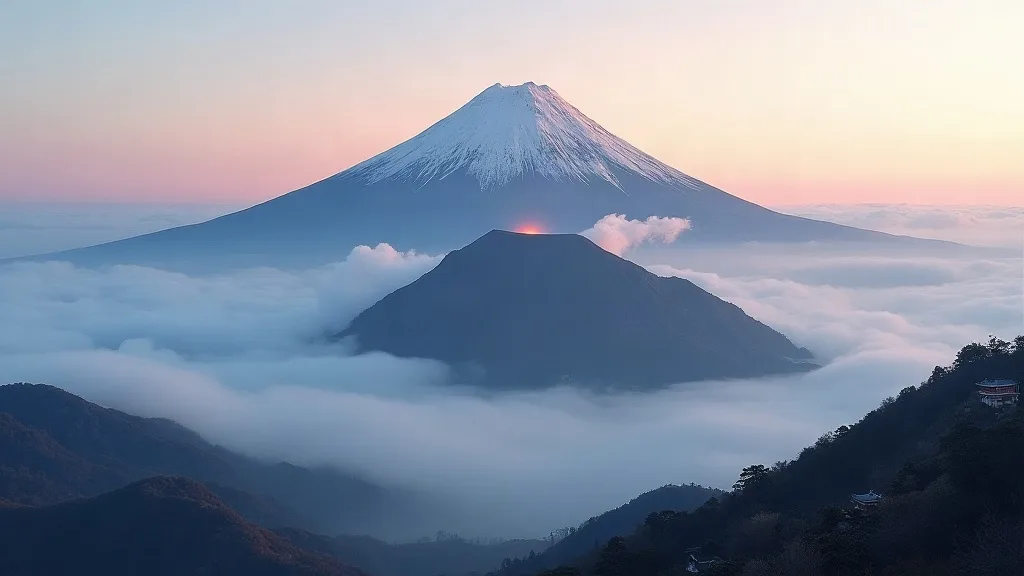
Baekdu Mountain: The Sacred Peak of Korean Cosmology
Baekdu Mountain rises at the heart of Korean myth as the birthplace of the first kingdom and the cosmic axis binding earth to heaven. Discover how this real volcano became the sacred peak where gods walked and legends were born.
Contents
At the border between Manchuria and Korea, on the spine of the Changbai range, a volcanic mountain breaks the clouds. Its slopes are scarred by ancient lava flows. At its summit sits a crater lake so pristine and cold that locals call it "Cheonji," the Heavenly Lake. This is Baekdu Mountain, and for over two thousand years it has anchored Korean mythology, drawing a direct line from the realm of gods to the kingdom of humans below.
The name itself carries weight. Baekdu means "white head," and in winter the peak glows with snow so bright it seems to touch the sky. But the mountain's significance runs far deeper than its appearance. In Korean cosmology, Baekdu Mountain stands as the world axis, the hinge between the celestial realm and the mortal realm, the place where heaven touches earth. Every major founding myth in Korean tradition leads back to this peak. Kings traced their legitimacy to it. Shamans made pilgrimage to it. Even today, separated by borders and ideology, both North and South Koreans revere it as the spiritual heart of their nation.
The Cosmic Mountain in Korean Cosmology
In the mythological geography of Korea, Baekdu Mountain occupies the role that Yggdrasil holds in Norse tradition or Mount Meru in Hindu cosmology. It is the pillar of the world. According to the ancient histories preserved in texts like the Samguk Yusa (Memorabilia of the Three Kingdoms), written by the Buddhist monk Iryeon in the 13th century, the mountain was the birthplace of the Korean people themselves.
The Samguk Yusa tells that a divine being named Hwanung, son of the Heavenly King, descended from the celestial realm to Earth and chose Baekdu Mountain as his dwelling place. Hwanung was not merely a god but a culture-bringer, a shaman-king who taught humans the arts of civilization. He did not descend by accident or caprice. The mountain itself called to him. It was the natural gateway between worlds.
This cosmological role gave Baekdu Mountain a permanence no ordinary place could claim. It was not mythical in the sense of "invented" or "purely symbolic." The mountain was real, visible, towering on the horizon. But the real mountain and the mythical mountain were one. When ancient Korean shamans performed rituals at the foot of the peak, or when kings of the early kingdoms made pilgrimage, they were not visiting a symbol of the sacred. They were entering the sacred itself.

Hwanung and the Foundation of Gojoseon
The most sacred myth attached to Baekdu Mountain is the descent of Hwanung, a figure central to Korean identity across centuries and both modern nations. In the mythology preserved in the Samguk Yusa, the narrative unfolds like this:
Hwanung, troubled by the suffering of the world below, asked his father, the Heavenly King, for permission to descend and rule the human realm. His father granted it, and Hwanung chose Baekdu Mountain as the pivot point of his descent. He arrived with three thousand divine assistants, and beneath a sacred sandalwood tree, he established his court on Earth. The tree itself became holy ground. Shamans would later claim that certain trees on the mountain slopes were descendants of this primordial sandalwood, and touching them brought divine favor.
Hwanung's purpose was not conquest but transformation. He taught humans agriculture, medicine, music, and law. He was the bridge-builder between divine knowledge and human limitation. But his most consequential act was his union with a tiger woman. In one version of the myth, a tiger and a bear both pray to Hwanung to become human. Hwanung sets them a test: stay in a cave for one hundred days, consuming only mugwort and garlic. The bear succeeds and becomes a woman; the tiger fails and remains a beast. Hwanung marries the bear-woman, and their son is Dangun, the legendary founder of Gojoseon, Korea's first kingdom.
This myth, preserved in both the Samguk Yusa and the earlier Gojoseon Records, makes Baekdu Mountain the literal birthplace of the Korean nation. Dangun, born at the mountain's foot or in its caves, went on to establish Gojoseon around 2333 BCE (by traditional Korean chronology), with its capital at Asadal. The kingdom's legitimacy flowed directly from Baekdu Mountain. Dangun was not merely a human king but a semi-divine being, born of a god and shaped by the sacred mountain.
This genealogy proved enduring. Kings of every subsequent Korean dynasty invoked their descent from Dangun, and therefore their connection to Baekdu Mountain and Hwanung. To rule Korea was to inherit divine authority mediated through the mountain itself.
The Mountain as Axis Mundi and Shamanic Landscape
Beyond the founding myth, Baekdu Mountain functioned in Korean religious practice as an axis mundi, a term borrowed from comparative mythology to describe the world's center. The mountain connected three realms: the heavens above (where Hwanung came from), the earthly middle realm (where humans dwell), and the underworld below (the realm of spirits and the dead).
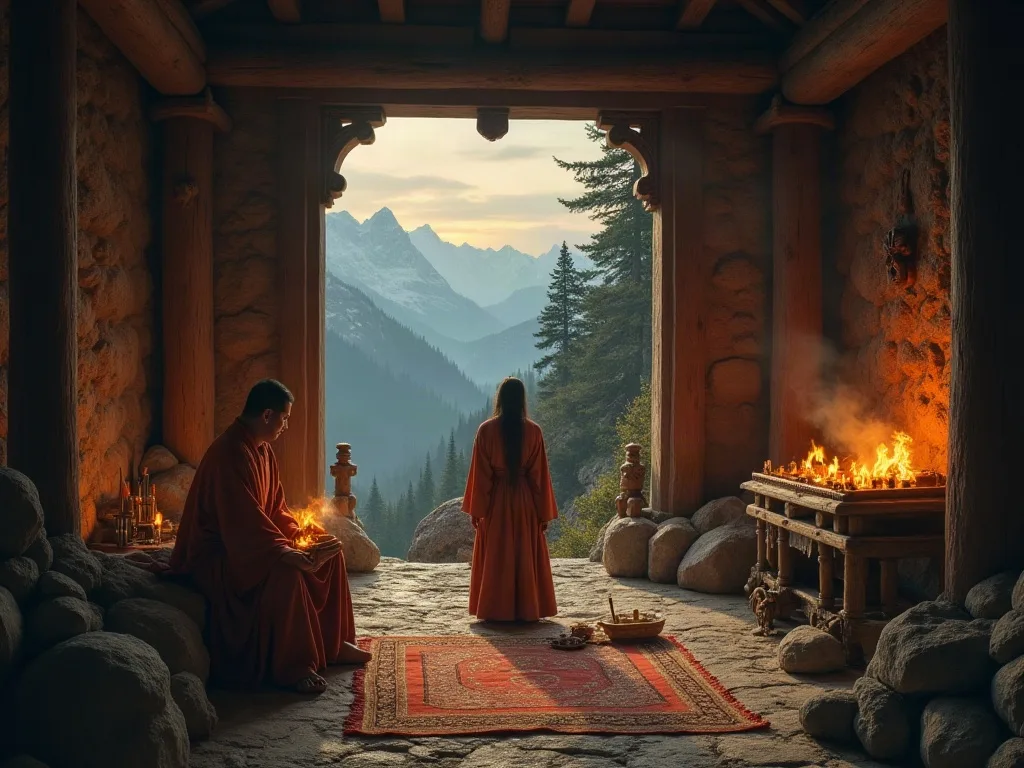
For shamans, Baekdu Mountain was the supreme place of power. Shamanic practice in Korea, particularly in the northern regions historically closer to the mountain, involved ritual ascent and communication with the gods. Shamans would perform elaborate ceremonies at shrines built on the mountain's slopes or at sacred sites believed to be in supernatural contact with it. They would enter trance states, ascending a symbolic or spiritual mountain to reach the realm of divine beings. The real mountain reinforced and sanctified this practice. A shaman who climbed Baekdu itself gained immense prestige and power. The physical ascent became inseparable from spiritual ascent.
Ancient Korean sources describe sacred groves and temples on the mountain where priests and shamans maintained contact with the divine. These were not passive monuments but active centers of ritual. They were places where offerings were made, where the boundary between worlds grew thin, where a skilled practitioner might speak directly with Hwanung or other celestial beings.
The mountain's crater lake, the Heavenly Lake or Cheonji, held particular significance. In shamanic cosmology, water, especially water at high elevations, conducted spiritual power. The lake was not simply water but a mirror connecting earth to heaven. Some traditions held that the lake was itself divine, a physical manifestation of Hwanung's presence on Earth.
Baekdu Mountain in Three Kingdoms Period Buddhism
When Buddhism arrived in Korea during the Three Kingdoms period (57 BCE - 935 CE), it did not displace Baekdu Mountain from its sacred role. Instead, Buddhist monks and teachers incorporated the mountain into Buddhist cosmology. They recognized parallels between Hwanung's descent and the Bodhisattva ideal: a divine being choosing to come to Earth to ease the suffering of sentient beings. The mountain became a destination for Buddhist pilgrims as well as shamans.
Buddhist temples were built on the mountain's slopes. Monks composed poetry and wrote accounts praising its majesty. In the Samguk Yusa, the very text that preserves the Hwanung myth, we find Buddhist monks treating the mountain and its founding legends with reverence, even while interpreting them through Buddhist categories. This was not syncretism imposed by force but a genuine recognition that multiple traditions could honor the same sacred place.
The mountain drew seekers of all kinds: shamans seeking power, Buddhist monks seeking enlightenment, scholars seeking wisdom. Baekdu Mountain was large enough in the sacred imagination to hold them all.
Political Symbolism in the Unified Kingdom and Joseon Dynasty
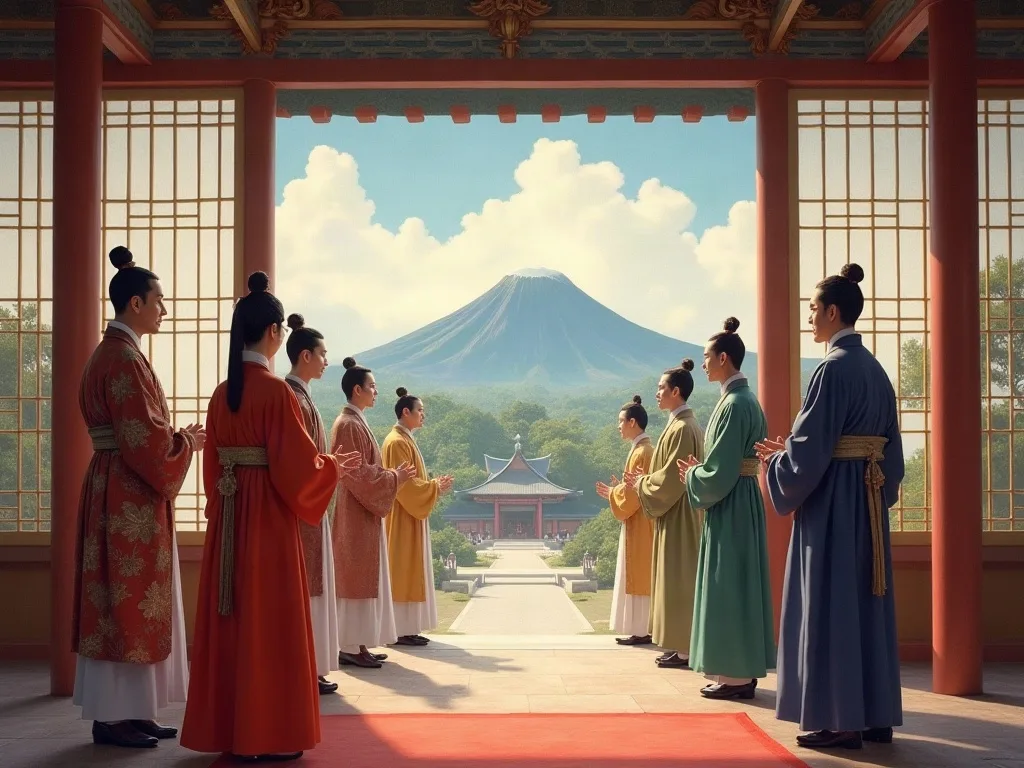
As Korean kingdoms unified and centralized, Baekdu Mountain shifted from a pilgrimage destination to a symbol of national legitimacy. Kings made formal journeys to the mountain or established shrines in the capital that represented it symbolically. The mountain became a guarantor of the right to rule.
This reached its fullest expression during the Joseon Dynasty (1392-1910), Korea's longest-lasting unified state. Joseon kings, particularly those in the early period, commissioned works celebrating Baekdu Mountain as the eternal source of Korean identity. The mountain appeared in court poetry, in official histories, in the royal ideology that justified the dynasty's power. To govern Korea was to be granted rule by Hwanung through the medium of Baekdu Mountain. The mountain was eternal; dynasties rose and fell; but the mountain remained, a constant reminder of a divine origin that no human power could alter.
The Sacred Peak Across Borders
In the modern era, Baekdu Mountain became a site of profound complexity. When the peninsula was divided in 1945, the mountain's northern slopes fell under the jurisdiction of North Korea and China. Yet both South Korea and North Korea claimed the mountain as their spiritual birthplace. The division did not erase the mountain's hold on Korean consciousness; if anything, it intensified it. The mountain became a symbol of an imagined reunification, a sacred place that belonged to no government but to the Korean people as a whole.
South Korean poets, writers, and religious figures composed works celebrating Baekdu Mountain as a symbol of national aspirations and cultural continuity. North Korea, despite its official atheism, also invoked the mountain's symbolic weight in propaganda and national mythology. The mountain transcended ideology. Both nations understood that whoever could claim connection to Baekdu Mountain claimed a deeper legitimacy than any government could grant.
In contemporary practice, the mountain draws pilgrims and tourists from both the South Korean diaspora and international visitors. North Korean authorities permit limited tourist access to the northern slopes. Some South Koreans speak of a future pilgrimage to the peak as a physical and spiritual act of reunification. The mountain waits, indifferent to borders, eternal as the myth that gave it meaning.
The Mountain's Living Religion
What distinguishes Baekdu Mountain from purely mythological sites is that it remains a living place of worship and spiritual significance. It is not an ancient ruin preserved in a museum. Shamanic practitioners still visit it (where access permits) seeking spiritual power. Buddhist monks still study and meditate on its slopes. Ordinary Koreans who make the journey speak of a palpable sense of connection to something transcendent and fundamentally Korean.
This living dimension gives the myth a different weight. The story of Hwanung and Dangun is not a dead text studied in classrooms alone. It is a narrative that continues to shape how Korean people understand themselves, their history, and their place in the cosmos. When a contemporary shaman performs a ritual invoking Hwanung, they are not role-playing history. They are participating in a continuous tradition that reaches back two thousand years and, through the mountain itself, to the gods.
Baekdu Mountain and Comparative Sacred Geography
In the global landscape of sacred mountains, Baekdu Mountain occupies a unique position. Like Mount Sinai in Jewish and Christian tradition, it is associated with the descent of divine law and knowledge. Like Mount Sumeru in Buddhism and Hinduism, it is an axis connecting realms. Like Mount Fuji in Japanese tradition, it carries profound national significance, the spiritual heart of an entire people's identity.
Yet Baekdu Mountain differs from these in its emphasis on human-divine genealogy. While other sacred mountains often mark the transmission of laws or cosmological principles, Baekdu Mountain is the place where the divine lineage of a people begins. Korean mythology does not simply say the gods blessed this land. It says that a god came to this mountain, took a human lover, and fathered a nation. The mountain is not a monument to divine power but a birthplace, a womb of national identity.
This genealogical weight has given the mountain a peculiar power in Korean culture. To invoke Baekdu Mountain is not merely to appeal to the sacred. It is to claim membership in an ancient family, to assert that Korean-ness is not a political accident but a sacred inheritance stretching back to the age of gods.
Frequently Asked Questions About Baekdu Mountain
Frequently asked questions
Is Baekdu Mountain a real place or purely mythological?
Baekdu Mountain is entirely real, a massive volcano on the China-Korea border standing 2,744 meters high with an active crater lake at its summit. What is mythological is the sacred meaning layered onto it over centuries. The real mountain and the sacred mountain are one; the myth does not replace geology but adds a layer of spiritual significance that coexists with it.
Why did Hwanung choose Baekdu Mountain specifically?
In the mythology, the mountain was recognized as the cosmic axis, the place where heaven and earth most nearly touch. Hwanung did not choose an arbitrary location; he descended to the point where his divine authority could be most effectively expressed. The mountain's height, its visibility from vast distances, and its volcanic activity (visible in ancient times as signs of divine presence) made it the natural gateway between realms.
How have North and South Korea related to Baekdu Mountain's mythology since the division?
Both nations claim the mountain as their spiritual birthplace, regardless of the political border. South Korea emphasizes it as a symbol of cultural continuity and aspirational reunification. North Korea has promoted it as a revolutionary symbol while maintaining the nationalist mythology of Dangun and Gojoseon. The mountain itself remains a powerful shared reference point that transcends the division, though access varies based on political conditions.
Do shamans and Buddhist practitioners still visit Baekdu Mountain?
Yes, where access is permitted. South Korean shamans and pilgrims visit the southern slopes during specific seasons. North Korean authorities allow limited tourism on the northern side. The mountain remains a living place of spiritual practice, not merely a historical site. Practitioners report profound experiences of connection to the sacred lineage Hwanung represents, treating the physical ascent as inseparable from spiritual transformation.
How does the Baekdu mythology compare to other East Asian origin myths?
Unlike Japanese mythology, which centers on the creation of islands by divine couple Izanagi and Izanami, or Chinese tradition, which emphasizes the Yellow Emperor's succession of dynasties, Korean mythology uniquely stresses direct divine lineage through a single mountain. Hwanung's descent to Baekdu Mountain and his offspring founding Gojoseon creates a continuous sacred genealogy that legitimizes the entire Korean nation as descended from the gods, not merely blessed by them.
The Mountain's Eternal Presence in Korean Consciousness
Baekdu Mountain endures not because of scholarly preservation or religious institution alone, but because it answers a fundamental need in Korean culture: the need to anchor identity in something sacred and eternal. Governments fall. Borders shift. But the mountain stands. In invoking Baekdu Mountain, Koreans invoke continuity with the age of gods, legitimacy deeper than any constitution, and a hope that their nation, like the mountain itself, will survive all human chaos.
The myth of Hwanung and Dangun could have been forgotten, preserved only in antiquarian texts. Instead, it remains alive, woven into the songs and stories and spiritual practices of millions. The reason is simple: the mountain is there. You can climb it. You can see the Heavenly Lake. You can feel the wind that touches the clouds. The myth is not abstract. It is rooted in stone, snow, and ice. And as long as the mountain stands, the gods who descended to it remain present in Korean memory and devotion.
Read the full book
Want the whole story?
The complete edition is an instant PDF download here, with a paperback on Amazon for selected titles.
Korean
The Korean Mythology Book: Dangun, Bari, the Dokkaebi Tricksters, and the Shamanic Stories of the Peninsula
From Hwanin's Heaven to the Underworld and Back
The shamanic mythology of Korea: Dangun the founder, Bari the death-walker, the Yongwang Dragon Kings, the dokkaebi goblins, and the gumiho fox spirits.
More from Korean
All articles
Korean
Hwanung: The Heavenly Prince Who Descended to Earth
Hwanung, the celestial prince of Korean myth, descended from heaven to establish human civilization. His union with a bear-woman bore Tangun, founder of Gojoseon, Korea's first kingdom. Discover how this cosmic descent shaped Korean identity and continues to echo through the nation's cultural memory.
Korean
Mago Halmi: The Primordial Creatrix Goddess
Mago Halmi shaped existence itself before time began. The Korean primordial goddess stands at the root of all creation, a force older than the heavens, wiser than fate itself.

Korean
Jumong: The Archer Hero and Founder of Goguryeo
Jumong, a legendary archer and divine prince, fled a deadly throne and established Goguryeo, one of Korea's greatest kingdoms. His story of exile, resurrection, and martial mastery shaped a nation.
Korean
The Seven Star Maidens: Chilseong and Celestial Worship in Korean Tradition
The Seven Star Maidens weave Korean spirituality with the night sky itself. Chilseong worship shaped household rituals, artistic tradition, and how ordinary people imagined fortune for centuries.