

The Bear Woman Myth: Ungnyeo's Transformation
Ungnyeo the bear woman endured 100 days in a cave to become human and mother a nation. Here is the full myth, its shamanic roots, and why it still echoes in Korea today.
Contents
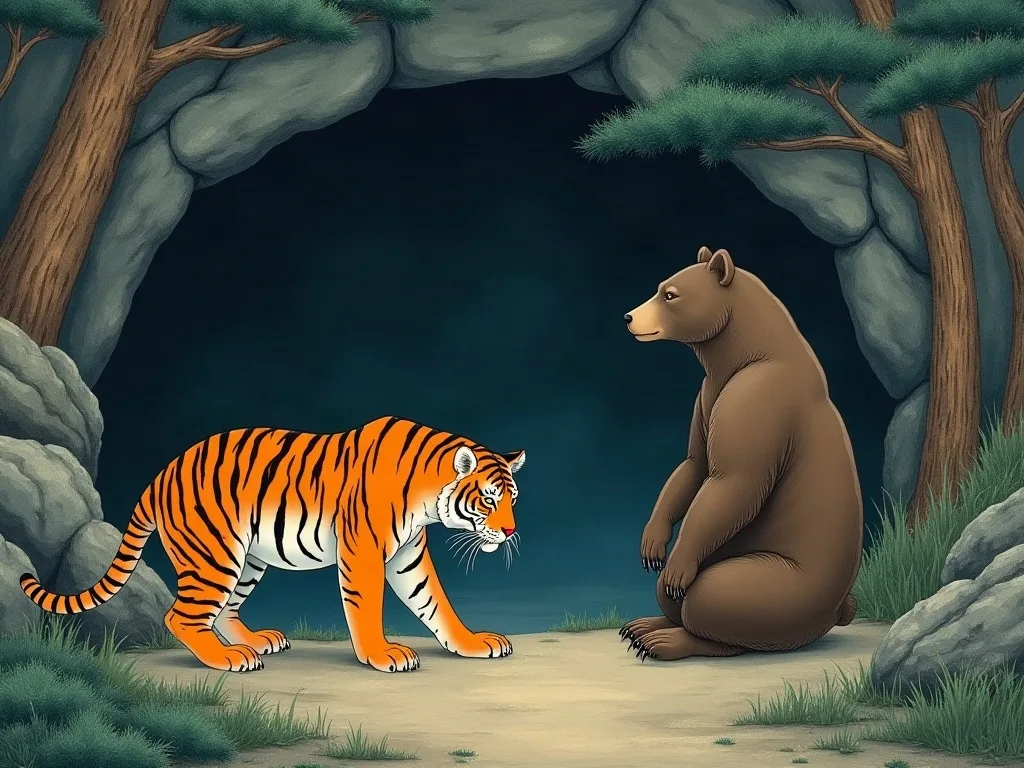
A bear walks into a dark cave carrying nothing but a bundle of mugwort and twenty cloves of garlic. Outside, a tiger does the same. The god Hwanung has promised them both: survive one hundred days without sunlight, eat only these plants, and you will become human. The tiger bolts after twenty-one days. The bear stays.
This is not a fairy tale decorated with animal magic. It is one of the oldest creation stories in Korean civilization, preserved in the Samguk Yusa (a 13th-century chronicle of ancient Korean legends compiled by the Buddhist monk Iryeon) and pointing to a world several thousand years older than the text itself. The bear who stayed is Ungnyeo, the Bear Woman, and her endurance is the founding act of the Korean people.
Who Hwanung Was, and Why He Came to Earth
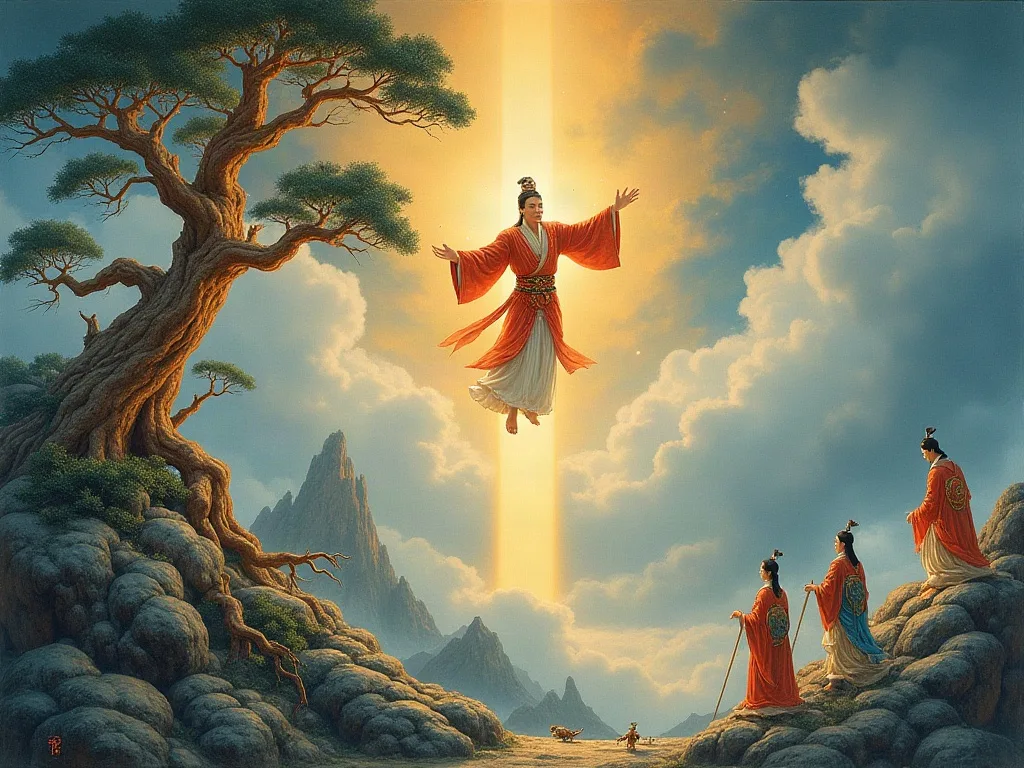
Before Ungnyeo, there is Hwanung. He is the son of Hwanin, the Lord of Heaven, the supreme deity in this cosmology. Hwanung does not want to rule the sky. He wants the human world below, specifically the broad slopes of Mount Baekdu (the sacred peak that straddles the border of what is now North Korea and China). He looks down at the valleys, the rivers, the people, and he wants to be among them.
Hwanin reads his son's heart. He grants permission and sends Hwanung down with three thousand followers and three celestial ministers: the Earl of Wind, the Master of Rain, and the Master of Clouds. These three control the natural forces that determine whether crops grow or fail, whether the valley floods or dries. Hwanung arrives on a sandalwood tree beneath Mount Baekdu and founds a divine city called Sinsi, the City of God.
From Sinsi, Hwanung rules over 360 areas of human concern. The Samguk Yusa is specific: he oversees grain, disease, justice, virtue, and evil. This is not a god who stands apart from daily life. He is embedded in it, governing the granary and the courtroom alike.
The Cave, the Garlic, and the Hundred Days
Into this ordered divine world come two animals, a bear and a tiger. They have heard of Hwanung's power. Both arrive at his city and both ask for the same thing: they want to become human.
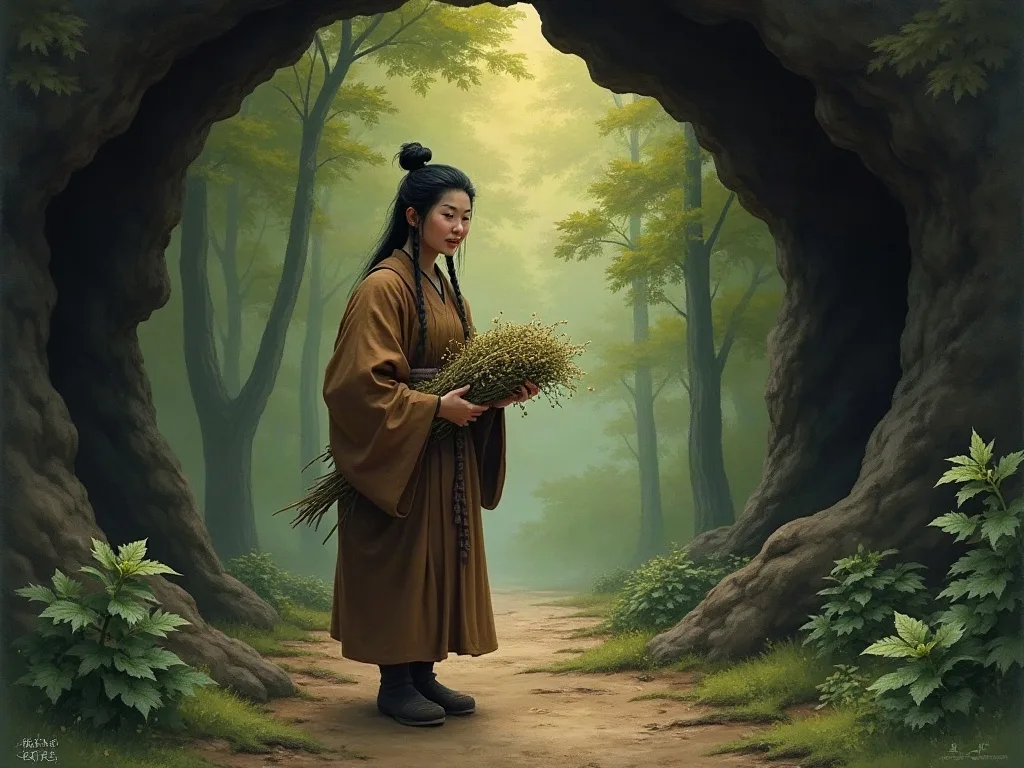
Hwanung gives them a single set of instructions. Take twenty cloves of garlic and a bundle of ssukgat (mugwort, a bitter herb used in Korean cooking and medicine to this day). Retreat into a cave. Eat only these things. Avoid sunlight for one hundred days. If you do this, you will become human.
The tiger cannot manage it. The tiger is powerful, restless, built for open land and sudden speed. Confinement is against its nature. After twenty-one days, it breaks and runs back into the forest. The Samguk Yusa notes this without judgment: the tiger simply cannot endure.
The bear endures.
On the twenty-first day, a woman rises where the bear was. She has survived the darkness, the hunger, the stillness. Scholars who study Korean shamanism, including the anthropologist Laurel Kendall in her work on Korean ritual life, have noted that this kind of ritual seclusion, marked by fasting, darkness, and symbolic death before rebirth, mirrors the initiation rites of mudang (Korean shamans). The cave is not just a cave. It is a womb. What emerges is something new.
This woman is Ungnyeo. Ung means bear in Sino-Korean. Nyeo means woman. She stands at the mouth of the cave as a human being.
From Bear Woman to Mother of the Nation
Ungnyeo's transformation solves one problem and creates another. She is human now, but she is alone. There is no man for her to marry. No human community has accepted her yet. She stands under the sandalwood tree and prays, asking for a child.
Hwanung sees her. He takes human form and comes to her. Their union produces a son: Dangun Wanggeom, the founder of Gojoseon, the first Korean kingdom.
Dangun is a compound figure. Dan relates to sandalwood or altar; gun means ruler or king. Wanggeom suggests a shaman-king, a leader whose authority is both political and sacred. Some scholars, including Gari Ledyard in comparative studies of early Korean historiography, have read Dangun as the archetype of the ancient Korean priest-king, someone who bridges the divine and the human in a single person.
Dangun rules Gojoseon for a very long time. The Samguk Yusa gives him 1,500 years of reign, after which he becomes a mountain god (sanshin) on Mount Asadal, a site many historians associate with a peak in the Pyongyang region. He never truly dies; he transforms, which is exactly what his mother did before him.
Ungnyeo's transformation is therefore not an isolated miracle. It establishes transformation as the founding logic of Korean identity: the movement from animal to human, from human to divine, from suffering to belonging.
The Shamanic Layer Beneath the Myth
Strip away the state-founding narrative and the myth reads as a shamanic initiation in coded form. Korean shamanism, one of the oldest continuous religious traditions in East Asia, has at its center the mudang: a spirit medium, almost always a woman, who undergoes a spiritual crisis (the sinbyeong, or "divine illness") before being reborn as a channel between the human and spirit worlds.
The parallels with Ungnyeo are hard to miss. She is female. She undergoes a period of structured suffering in darkness. She consumes only ritual substances: garlic (a plant associated in Korean folk medicine with purification and protection against evil spirits) and mugwort (used in moxibustion treatments and shamanic cleansing rituals to this day). She dies as one thing and is reborn as another.
The tiger's failure is just as meaningful. In Korean shamanism, tigers are honored as the Mountain God's messenger, fierce and sacred, but tigers move through the world with raw power. They do not submit. The bear's ability to submit, to wait, to hunger without fleeing, is precisely what makes her worthy of transformation.
Folklorist Barre Toelken's comparative work on transformation myths across cultures argues that such myths consistently encode social values about endurance, community, and sacrifice. Ungnyeo's bear embodies exactly what the founding culture of Gojoseon wanted to celebrate: the willingness to change, to suffer willingly, to remain.
Garlic and Mugwort: The Sacred Plants
The specific plants Hwanung chooses are not arbitrary props. Both carry deep symbolic weight in Korean culture.
Garlic (maneul in Korean) has been central to Korean cuisine and medicine for at least two millennia. In shamanistic and folk-religious contexts, garlic is considered a liminal substance: it repels malevolent spirits and strengthens the vital energy (gi) of the body. Eating it in the cave is not punishment. It is pharmacological and spiritual preparation.
Mugwort (ssuk) is used in moxibustion, the ancient practice of burning the dried herb near acupuncture points to stimulate healing. In ritual contexts, mugwort smoke is used to cleanse a space before a shamanic ceremony. Korean mothers still make ssuk soup for postpartum recovery; the herb is understood to warm the womb and purify the blood. That this is the plant the Bear Woman eats before becoming a mother is not coincidence.
Together, garlic and mugwort represent a kind of pre-natal preparation. The cave is a womb. The diet is a prescription for what the womb produces.
Why the Tiger Matters (and Why It Fails)
The tiger's failure is brief in the text but loud in meaning. The Samguk Yusa names both animals without elaborating on why they wanted to be human, which is itself interesting: both are credited with a desire that we might call spiritual aspiration.
In the Korean mythological imagination, the tiger (horangi) is the guardian of mountains, the companion of the Mountain God (Sanshin), and a figure of enormous power. Tigers appear in hundreds of Korean folk tales, proverbs, and paintings. They are respected but also feared, associated with sudden force and wild nature.
The contrast with the bear is precise. The bear (gom) in Korean folklore is less glamorous: slower, associated with endurance, winter, hibernation, the ability to wait out hardship. Bears do not dominate the folk imagination the way tigers do. But in this myth, the bear's unglamorous patience is exactly the quality that transforms.
Scholars of Siberian and Northeast Asian shamanism, including Mihail Popescu in studies of circumpolar bear cults, have noted that bear worship was widespread across the region, from the Ainu of Japan to the Evenki of Siberia. The bear is the shaman's animal in many of these traditions, the creature that descends into the earth (hibernation as a metaphor for death and rebirth) and returns. Ungnyeo's bear heritage places her squarely in that broader circumpolar religious tradition.
Gojoseon, the Nation Born from the Cave
Dangun Wanggeom founds Gojoseon in 2333 BC, according to traditional Korean chronology. This date is taken seriously in Korean cultural memory even if modern historians treat it as legendary rather than historical. The founding of the kingdom is the political payoff of Ungnyeo's transformation: without her endurance, there is no Dangun, and without Dangun, there is no Korea.
Gojoseon ("Old Joseon," to distinguish it from the later Joseon dynasty of 1392-1897) is described in the Samguk Yusa as centered near what is now Pyongyang in North Korea. Its authority extended across the northern Korean peninsula and parts of Manchuria. Whether Gojoseon was a unified state or a loose confederation of tribal polities remains an open question in Korean archaeology, but its symbolic importance is beyond dispute.
Every subsequent Korean dynasty traced its legitimacy, at least in part, back to Dangun. The modern North Korean government has taken this further: in 1993, it announced the "discovery" of Dangun's tomb near Pyongyang, a claim archaeologists outside North Korea have not been able to verify. Ungnyeo's son is not only a founding myth but an active political symbol in the 21st century.
The myth also connects to Dangun and the founding of Gojoseon, which Mythologis covers as part of its broader Korean mythology archive.
Cross-Cultural Echoes: Bear Mothers Around the World
Ungnyeo is not alone among bear-women in world mythology. The Greek goddess Artemis kept sacred bears at her sanctuary at Brauron, where young Athenian girls called arktoi ("little bears") underwent initiation rites before marriage. The Roman equivalent, Artemis, shared this bear connection through her identification with the Arcadian figure Callisto, a woman transformed into a bear by Zeus.
In Norse mythology, the concept of the berserker warrior, literally "bear-shirt," links the bear's nature to a kind of ecstatic transformation: the warrior who wears the bear's skin takes on its ferocity. This is transformation running in the opposite direction from Ungnyeo's, but it uses the same animal as its medium.
Further east, among the Ainu people of Hokkaido, the bear (kimun kamuy, "mountain god") is the most sacred of animals, ritually hunted and ritually released so that its spirit can carry prayers back to the spirit world. The bear is the bridge between worlds.
What makes Ungnyeo's myth distinct is the direction of the transformation: not human becoming animal (as in many shamanic traditions), but animal choosing to become human, and succeeding through an act of will and endurance. The bear does not need a shaman to mediate. It presents itself, it listens, it obeys, it waits.
The Legacy of Ungnyeo in Korean Culture
The Bear Woman myth is not archived and forgotten. It remains active. Dangun's founding date, October 3rd, is celebrated in South Korea as Gaecheonjeol (National Foundation Day, literally "Heaven-Opening Day"), a public holiday. The myth is in school textbooks. Mount Baekdu, where Hwanung descended and where Ungnyeo's transformation began, is revered by Koreans on both sides of the border as the sacred origin point of the nation.
In Korean art, Ungnyeo appears in mural paintings, illustrated books, and, more recently, in films and graphic novels that reimagine the myth for contemporary audiences. The Netflix series and various Korean webtoons have drawn from the Dangun narrative, though they often foreground Ungnyeo's choice as a distinctly modern act of female agency.
That reading is not wrong. Ungnyeo is never forced into the cave. She walks in. She chooses to change. And when the change is complete, she again takes agency: she prays for a child. She does not wait to be found. She asks, directly, under the tree.
Frequently Asked Questions About the Bear Woman Myth and Ungnyeo's Transformation
Frequently asked questions
What is the primary source for the Ungnyeo myth?
The main written source is the Samguk Yusa, compiled by the Buddhist monk Iryeon around 1281 AD during the Goryeo dynasty. The Samguk Yusa (which translates roughly as "Memorabilia of the Three Kingdoms") drew on much older oral traditions and earlier texts, some of which have not survived. A parallel account appears in the Jewang Ungi, a verse chronicle compiled around the same period.
Is the Bear Woman myth connected to Korean shamanism?
Very directly. Scholars of Korean shamanism, including Laurel Kendall and Hyun-key Kim Hogarth, have identified Ungnyeo's cave ordeal as structurally parallel to shamanic initiation: the period of ritual seclusion, fasting, darkness, and symbolic death followed by rebirth into a new identity. The plants she consumes, garlic and mugwort, are both used in Korean shamanistic cleansing rituals. Some researchers read Dangun himself as the archetypal musok (shamanic) king, whose authority rested on a sacred lineage that began with his mother's ordeal.
Why did the tiger fail where the bear succeeded?
The Samguk Yusa does not give a psychological explanation, but the symbolic logic is consistent. In Korean and broader Northeast Asian tradition, tigers represent raw, uncontainable power, while bears are associated with endurance, withdrawal, and the capacity to wait. Hibernation is the bear's natural mode: the ability to slow down, go inward, survive on reserves. The myth valorizes this inward endurance over outward strength, encoding a specific cultural value about what it takes to change fundamentally.
What does Ungnyeo's name mean?
Ung (熊) is the Sino-Korean character for bear. Nyeo (女) means woman. Her name is literally "Bear Woman," which is both a description of her origin and her identity after transformation. She is not given a new "human" name after leaving the cave; her bear nature remains part of her identity, woven into the name of the dynasty's founding mother.
Is the myth still culturally significant in modern Korea?
Yes. October 3rd is Gaecheonjeol (National Foundation Day) in South Korea, commemorating Dangun's founding of Gojoseon in 2333 BC. Ungnyeo is covered in primary and secondary school curricula. Mount Baekdu, the site of Hwanung's descent and Ungnyeo's transformation, holds near-sacred status for many Koreans. North Korea has additionally built political mythology around Dangun, claiming to have found his tomb in 1993. The myth functions as a live cultural identity marker, not just a historical relic.
Are there similar bear-transformation myths in neighboring cultures?
Yes. Among the Ainu of Hokkaido (Japan), the bear is the supreme spirit-animal (kimun kamuy) and the center of elaborate ritual. In Siberian shamanic traditions documented by Mircea Eliade in Shamanism: Archaic Techniques of Ecstasy, the bear is one of the primary spirit allies of the shaman, associated with death and rebirth. The Greek myth of Callisto involves a woman transformed into a bear by divine intervention. Ungnyeo's myth is distinctive in reversing the direction: an animal chooses and achieves human form through disciplined will.
The Myth That Refused to Stay Ancient
There is something quietly radical about Ungnyeo's story when you sit with it long enough. Every origin myth asks: what is the founding act? For the Roman tradition, it is fratricide (Romulus kills Remus). For many Mesopotamian myths, the cosmos is built from the body of a slain monster. For the Korean tradition anchored in the Samguk Yusa, the founding act is an animal choosing to sit in the dark and change.
No violence. No conquest. A cave, two plants, and a hundred days of patience.
Ungnyeo's transformation established a template that Korean culture returned to again and again: the idea that the most significant change happens through endurance, that suffering chosen voluntarily is generative, that the being willing to wait in darkness will eventually walk into the light as something new. You can trace that template through the aesthetics of Korean Buddhist practice, through the ritual austerities of mudang shamans, through modern Korean cultural touchstones like the han (a complex emotional concept blending grief, patience, and resilience that many Korean scholars consider central to national identity).
The tiger that ran made its choice too. It stayed a tiger. It lives in the mountain paintings and the proverbs and the shamanic altars, honored and wild and unchanged. Ungnyeo chose differently, and her choice built a nation.
Both choices are remembered. That may be the deepest thing the myth is saying: that transformation and nature are both sacred, but only one of them founds civilizations.
Read the full book
Want the whole story?
The complete edition is an instant PDF download here, with a paperback on Amazon for selected titles.
Korean
The Korean Mythology Book: Dangun, Bari, the Dokkaebi Tricksters, and the Shamanic Stories of the Peninsula
From Hwanin's Heaven to the Underworld and Back
The shamanic mythology of Korea: Dangun the founder, Bari the death-walker, the Yongwang Dragon Kings, the dokkaebi goblins, and the gumiho fox spirits.
More from Korean
All articles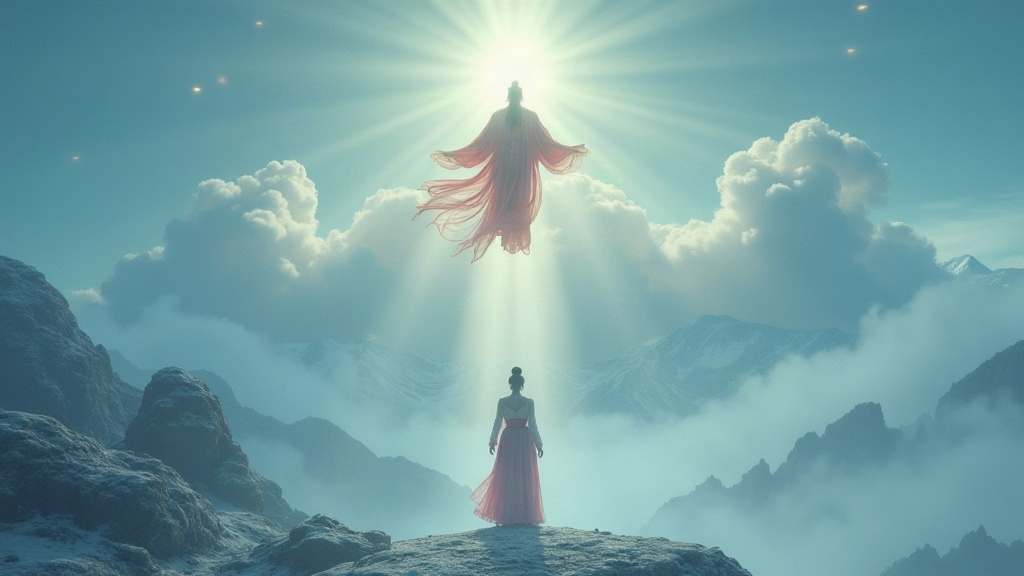
Korean
Hwanung: The Heavenly Prince Who Descended to Earth
Hwanung, the celestial prince of Korean myth, descended from heaven to establish human civilization. His union with a bear-woman bore Tangun, founder of Gojoseon, Korea's first kingdom. Discover how this cosmic descent shaped Korean identity and continues to echo through the nation's cultural memory.

Korean
Mago Halmi: The Primordial Creatrix Goddess
Mago Halmi shaped existence itself before time began. The Korean primordial goddess stands at the root of all creation, a force older than the heavens, wiser than fate itself.

Korean
Jumong: The Archer Hero and Founder of Goguryeo
Jumong, a legendary archer and divine prince, fled a deadly throne and established Goguryeo, one of Korea's greatest kingdoms. His story of exile, resurrection, and martial mastery shaped a nation.
Korean
The Seven Star Maidens: Chilseong and Celestial Worship in Korean Tradition
The Seven Star Maidens weave Korean spirituality with the night sky itself. Chilseong worship shaped household rituals, artistic tradition, and how ordinary people imagined fortune for centuries.