
Gut: The Ecstatic Heart of Korean Shamanic Ritual
Gut are multi-day Korean shamanic ceremonies where a mudang (shaman) enters trance, dances with spirits, and heals community wounds through music, possession, and gift-offering. Rooted in ancient shamanistic traditions and woven into Korean identity for millennia, gut rituals survive today as living cultural practice and UNESCO-recognized heritage.
Contents
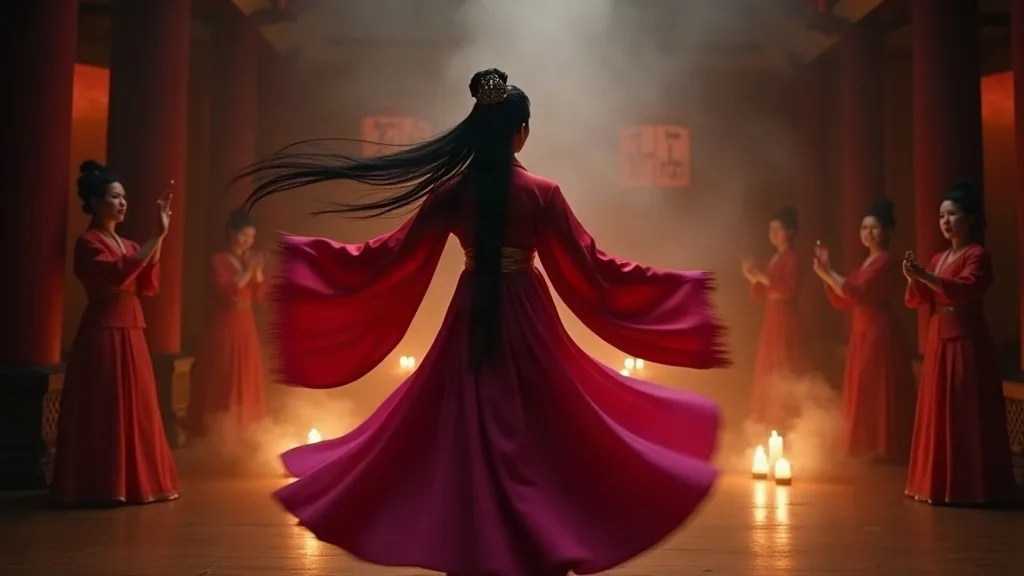
A woman in a crimson chogori (jacket) and a voluminous magenta skirt leaps and spins, her long black hair swinging in arcs as drums pound in the darkness. Her eyes roll back. A spirit voice, not her own, erupts from her throat. The audience gasps, sways, weeps. This is a gut, a Korean shamanic ceremony where the living world and the spirit realm collide in ecstatic dance, possession, and healing. For hours or days, the mudang (shaman) becomes a vessel for ancestors, household gods, vengeful ghosts, and nature spirits. The boundary between performer and supernatural dissolves. The community watches, participates, feeds, and hopes for restoration: of household fortune, of a trapped soul, of social harmony fractured by death or misfortune.
Gut rituals are among the oldest continuous spiritual practices in East Asia. Archaeologists point to shamanic figurines and ecstatic imagery in Korean Neolithic pottery. Historical records from the Three Kingdoms period (57 BC - 668 AD) document mudang conducting ceremonies for rain, healing, and appeasement of the dead. Today, despite centuries of Confucian orthodoxy, Japanese colonial suppression, and modern urbanization that dismissed shamanism as superstition, gut persists in villages, urban neighborhoods, and ceremonial spaces. In 2009, UNESCO recognized Gut as a Masterpiece of the Oral and Intangible Heritage of Humanity. To witness or participate in a gut is to step into a living continuum of Korean spiritual life that has survived emperors, occupations, and rapid modernization.
The Origins of Gut in Korean Shamanic Tradition
Korean shamanism (mugyo or sinism) reaches back to the Bronze Age hunter-gatherer societies of the Korean peninsula. Unlike religions with written dogma and hierarchical clergy, shamanism centered on ecstatic specialists, usually women, who communicated directly with spirits through trance, dream, and possession. The earliest gut rituals likely emerged from animistic belief: the conviction that all phenomena (mountains, rivers, household objects, ancestors, illnesses) house spirits that must be honored, appeased, or expelled.
The Samguk Sagi (History of the Three Kingdoms), compiled in the 12th century, records mudang performing kut (an early spelling of gut) to summon rain during droughts, to cure illnesses deemed spiritual in origin, and to guide the souls of the dead into the afterlife. These accounts normalize shamanic practice as a recognized social institution, not a fringe superstition. During the Goryeo Dynasty (918-1392), mudang held official status at court and in regional administration. Kings consulted them before hunts and battles. Widows and the bereaved sought their services.
The arrival of Neo-Confucianism in the Joseon Dynasty (1392-1910) shifted power dramatically. Confucian scholars viewed mudang as morally suspect, spiritually fraudulent, and a threat to patriarchal family hierarchy (since most were women). Shamanic practice was discouraged, sometimes banned, but never fully eradicated. Village communities and lower classes continued to sponsor gut in secret or semi-public settings. Mudang adapted: they adopted Buddhist elements, masked their rituals in festivals, and operated in a twilight between legal acceptance and social stigma that persists today.
By the colonial period under Japan (1910-1945), gut was increasingly framed as primitive folklore, a relic of an unenlightened past. Many mudang were driven underground. Yet even as modern urbanization accelerated after the Korean War (1950-1953), gut ceremonies were preserved, especially in the Jeolla provinces and among rural communities. In the 1960s-70s, as Korea industrialized, folklorists and cultural activists began documenting gut with academic rigor, shifting its status from superstition to heritage. The 1980 designation of major mudang as Living National Treasures (later UNESCO recognition) reframed gut as a priceless spiritual art form worthy of preservation and respect.
The Mudang: The Shaman Who Becomes the Bridge
The mudang stands at the center of any gut. She is a spiritual specialist, almost always a woman, trained through apprenticeship, hereditary calling, or spontaneous spiritual crisis (called sinbyung or "spirit sickness"). A woman seized by unexplained illness, visions, or a compulsion to dance and sing might be diagnosed by an elder mudang as possessing the calling. If she accepts initiation, she undergoes years of training in mythology, songs, dance steps, drumming patterns, and the genealogies of local spirits.
Not all mudang are born into shamanic families. Some are called later in life, after personal trauma or loss. Others inherit the role from a mother or grandmother, learning ritual vocabulary from childhood. Regardless of origin, the mudang must develop the ability to enter and exit trance states voluntarily, to interpret the voice and presence of spirits channeled through her body, and to maintain audience trust and participation. She is healer, performer, priestess, counselor, and artist in one person.
The mudang's costume signals her liminal status. She wears bright silks: the chogori, full skirts (chima), and a decorated duram (shaman's skirt) adorned with mirrors, ribbons, and bells. Many mudang drape themselves in long hair pieces or let their own hair flow unbound, a direct violation of Confucian propriety (which demanded married women bind their hair). The costume marks her as neither fully integrated into normal society nor fully outside it. She belongs to the spirit realm as much as the human one.
A skilled mudang reads the room. She observes which audience members weep, which resist, which call out to specific ancestors. During possession sequences, she channels not generic spirits but recognizable figures: the client's dead mother, a drowned fisherman, a child who died unbaptized. The precision of detail (the mother's favorite foods, her manner of speaking, her unfinished business) creates the conviction that the spirit truly speaks through the mudang. Whether one interprets this as literal possession, skilled improvisation, or psychological channeling, the lived effect is the same: the mudang becomes a voice for the voiceless dead.
The Structure and Unfolding of a Gut Ceremony
Gut ceremonies vary widely, but most follow an underlying architecture that can span one night to three days or longer. The complexity and length depend on the client's circumstances, the mudang's renown, the household's resources, and the regional tradition.
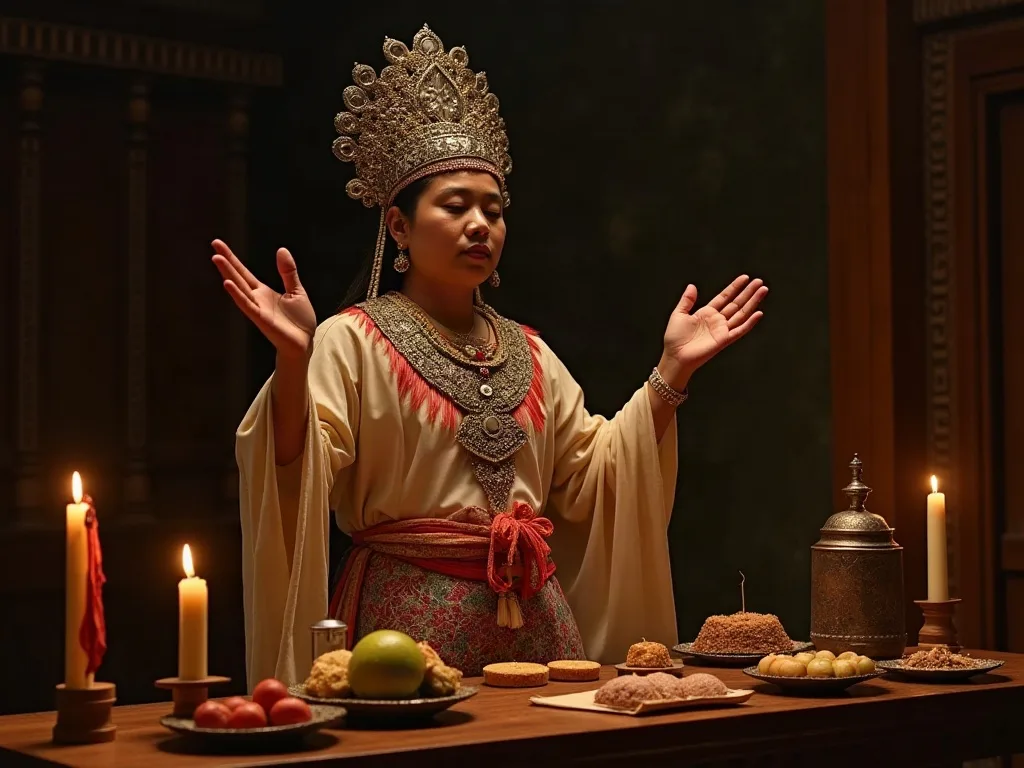
The Opening: Inviting the Spirits begins with music and the lighting of candles or incense. A band of musicians (typically including a drummer, a piri (bamboo pipe) player, and singers) establishes the rhythmic foundation. The mudang bows before a small altar holding offerings: rice cakes, fruit, alcohol (usually soju), meat, and flowers. She may pour libations or light incense while chanting an invocation (kosa or salbim). The opening addresses the household gods (jesa spirits), local land deities, and the specific spirit or ancestor the gut aims to address.
The mudang begins to move. Initially, her motion is controlled, almost meditative. She sways, steps, and traces ritual patterns. The drumming accelerates. Her breathing deepens. Other participants may begin to clap in rhythm. The boundary between her consciousness and the spirit realm grows thin.
Possession and Channeling follows as the mudang enters fuller trance. Her body jerks involuntarily. Her voice changes pitch and timbre. She may speak in an archaic dialect or address the audience in the first person as the spirit inhabiting her. During the "spirit interview," family members approach the mudang and ask questions: Why did grandmother die so young? What does she need to find peace? Why is the household cursed? The mudang, now the medium, responds with wisdom, comfort, or stern warnings. She may perform actions associated with the spirit: if a soldier's ghost possesses her, she may mime combat; if a bride, she may perform a mock marriage ritual.
This phase can last hours. The mudang's physical exertion is extreme. She sweats profusely, her breathing becomes ragged, and her movements grow more frenzied. Observers sometimes offer her water or gently support her. The drumming never stops. It is the heartbeat that keeps the ceremony moving, the rhythm that anchors the mudang's trance.
The Narrative Dances and Mythological Re-enactments punctuate possession with structured performance. Major gut ceremonies include dances that tell mythological stories or enact social roles. The saenam-gut (shaman's gut) performed in Seoul and Gyeonggi province includes dances honoring Mago (the primordial mother goddess), the kitchen god (sojae), the toilet god, and the ancestral lineage. Each dance has a recognizable costume, musical motif, and narrative arc. The kitchen god's dance, for example, celebrates the nourishment and care of the household. The mudang may don a special headdress, move in a stylized manner, and sing a traditional verse specific to that deity.
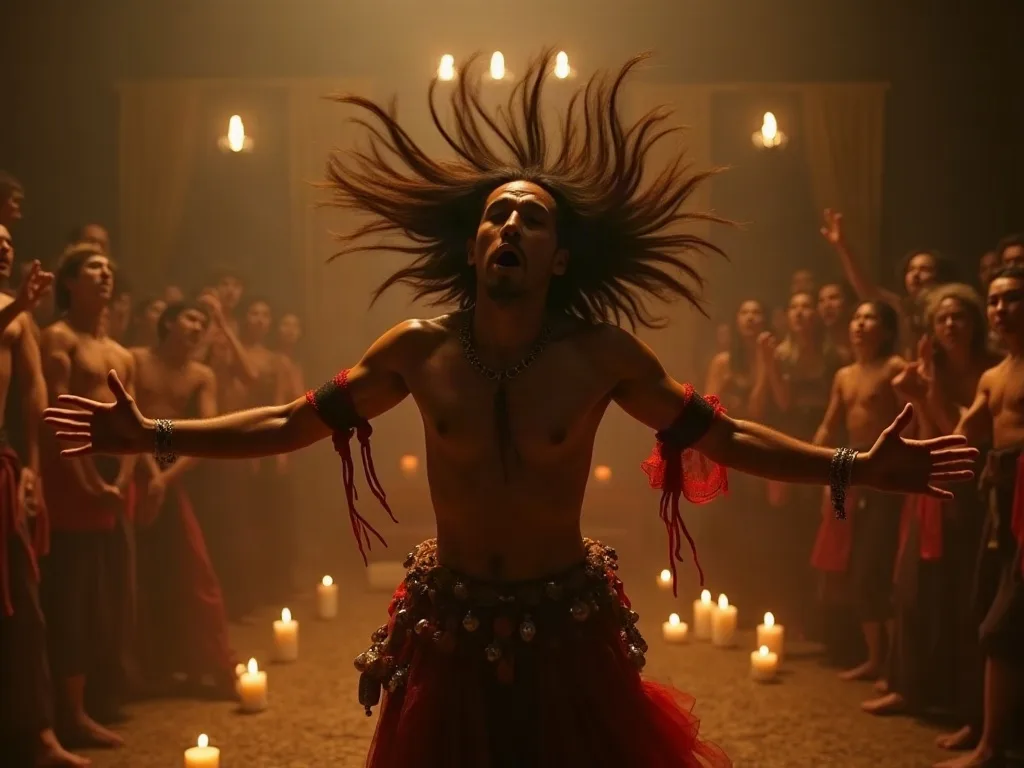
The Gift-Offering and Climax occurs when the mudang leads a formal presentation of gifts to the spirits. Rice cakes shaped like lotus flowers, alcohol, meat, and coins are arranged in ritual patterns. These offerings (guguri) are material expressions of gratitude and appeasement. The mudang may distribute them to audience members, creating a sense of shared blessing. The energy peaks. The drumming reaches a crescendo. The mudang may perform a final ecstatic dance, spinning with arms extended, hair flying, embodying the presence of multiple spirits at once.
The Closing and Integration allows the mudang to return to normal consciousness. The spirits are formally asked to depart and return to their domains. The mudang is given water and food to "cool" her body and restore her ordinary awareness. She may sit quietly for a period, reintegrating her normal personality. Audience members often approach to thank her, to leave monetary gifts (hojap), and to seek final counsel. The ceremony ends not with abruptness but with gradual transition back to the everyday world.
The Spirits Addressed in Gut: A Cosmology of the Unseen
Korean shamanism addresses a vast pantheon of spirits, each with distinct personality, jurisdiction, and needs. Understanding gut requires familiarity with this unseen world.
Household Gods are the most frequently propitiated in everyday gut. The sojae (kitchen god) oversees nourishment, fertility, and family prosperity. The anbang (inner room god) protects the marriage and children. The madang (courtyard god) guards the threshold and protects from evil spirits. These deities are not distant or abstract but intimate presences woven into the fabric of daily life. A woman who burns the rice risks the kitchen god's displeasure. A marriage that grows cold invites the bedroom god's sorrow.
Ancestral Spirits (dangsin) are deceased family members whose presence remains active in the living world. Unlike Christian notions of ancestors at rest in heaven, Korean ancestral spirits need regular feeding, entertainment, and reassurance that their living descendants remember them. A gut to honor a mother who died far from home allows her spirit to finally rest. A ceremony for a child who died without proper funeral rites frees that child's restless ghost from limbo.
Vengeful or Trapped Spirits (gutsin) are the dead whose deaths were violent, shameful, or incomplete. A woman who drowned, a slave who was murdered, a soldier who died on a foreign battlefield, a bride who died before consummating her marriage; these spirits remain tethered to the living world by unfinished business or injustice. A gwisin-gut (ghost-releasing ceremony) addresses such spirits, allowing them to voice their grievance, receive recognition, and be guided toward peace.
Natural and Territorial Deities (dangsin) include mountain gods, river spirits, and tree deities. In agricultural villages, farmers might sponsor a ceremony to appease the mountain god before logging or to thank the water spirit after a good harvest. These spirits are neither good nor evil but powerful and demanding of respect. Neglect them at your peril; honor them and they grant abundance.
The Great Shamans of Myth, figures like the legendary Dangun (founder of Gojoseon) or Chilsong (the seven-star deity), are invoked in larger, more elaborate gut. These semi-divine beings bridge the human and celestial realms. Their stories are reenacted through ritual dances that both entertain and teach.
This cosmos is not hierarchical in the Western monotheistic sense. There is no single creator god, no cosmic judge. Instead, spirits coexist in networks of obligation, power, and reciprocity. The mudang's role is to maintain harmony among these invisible populations and between them and the living.
The Sacred Music and Rhythmic Foundation of Gut
Music is not accompaniment in gut; it is the ceremony itself. The nongak (farmers' percussion ensemble) forms the backbone of most rural gut, while urban ceremonies may include more elaborate ensembles with string instruments and wind players.
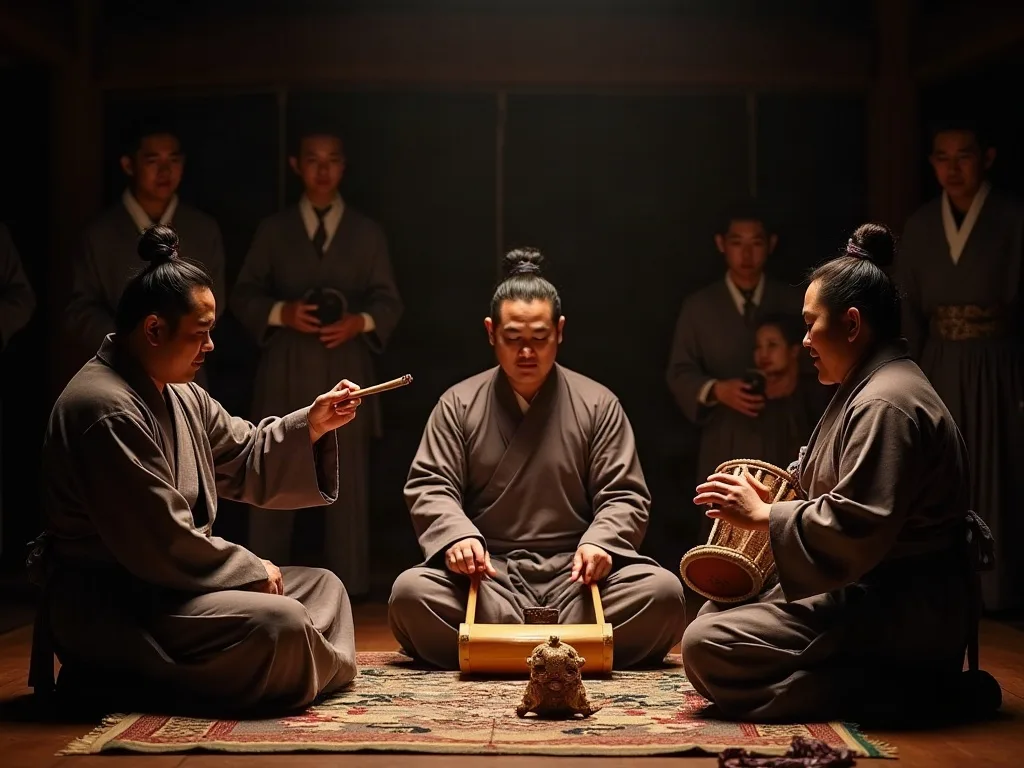
The janggu (double-headed drum) is the primary instrument. The drummer sits cross-legged, one head struck with a stick, the other with the bare hand. The resulting sound, a conversation between high and low tones, is hypnotic and propulsive. The rhythm accelerates and decelerates in patterns that can last minutes or hours, driving the mudang deeper into trance. Experienced drummers and mudang develop an almost telepathic synchronization; the drummer reads the mudang's body and anticipates her transitions, while she moves in response to his accelerations.
The piri (bamboo reed pipe) provides melodic lines that are often haunting and complex. The piri's sound is associated with liminality and transition; it is played at weddings, funerals, and shamanic ceremonies. Its wail is said to open passages between worlds.
Singing in gut is not operatic but narrative and participatory. The mudang may sing traditional sijo (poems) or pansori (narrative songs) adapted for the ceremony. Audience members sometimes join in refrains or respond with cries of encouragement (jinja, meaning "that's right"). The singing is an invitation for the audience to become part of the ritual, not merely witnesses.
The rhythm itself is therapeutic. Recent ethnomusicological and medical studies suggest that the steady, accelerating beat of a gut ceremony can induce measurable changes in brain wave activity, heart rate, and stress hormones. What communities have always known intuitively, that rhythm heals, is now validated by science. The music is not psychological placebo but a profound physiological intervention.
Regional Variations and Lineage Traditions
Korean shamanism is not monolithic. Major regional styles have developed distinct musical vocabularies, spirit pantheons, and ritual emphases.
The Kyonggi-style gut, prevalent in the Seoul-Incheon region and surrounding provinces, tends toward urban adaptation and shorter duration. These ceremonies often integrate elements of Buddhism and Taoism, reflecting the region's history of cultural synthesis. The saenam-gut, the most elaborate form, can nonetheless last multiple days and draws large audiences.
The Jeolla-style (Honam) traditions, especially strong in South and North Jeolla provinces, are considered more "authentic" by many scholars because they preserve older musical forms and more elaborate mythological narratives. The Jeolla mudang are often part of extended families or guilds that pass down secret liturgical texts (yambun) and training methods across generations.
The Busan-style and other coastal traditions incorporate maritime spirits and the mythology of fishermen. Ceremonies may address the spirits of drowned sailors or invoke sea deities for protection and good catches.
The Shamanic Dance-Drama traditions (mugak or "shaman music") in regions like Kangnung developed distinct aesthetic approaches, sometimes borrowing from court dance forms or folk theatre. These performances, while deeply spiritual, also serve as entertainment and cultural transmission.
Individual mudang also develop personal variations. A renowned mudang in Jeonju may be famous for her mastery of possession, while another in Gwangju may be celebrated for her narrative dances and historical knowledge. Clients sometimes travel significant distances to engage a specific mudang whose style or spiritual authority resonates with them.
The Social Function of Gut: Healing, Catharsis, and Community
Gut serves multiple simultaneous functions in Korean society, some explicit and some implicit.
Medical and Psychological Healing is a primary stated goal. Illnesses classified as shinbyung ("spirit sickness") or attributed to spirit attack, ancestral displeasure, or the evil eye were traditionally addressed through gut. Symptoms might be psychosomatic (depression, hysteria, paralysis, infertility) or manifestly physical (persistent rashes, fever, pain). Whether one interprets gut as shamanic healing, psychotherapy, or placebo effect, the outcomes reported by participants are often significant: relief of symptoms, restored emotional equilibrium, renewed sense of purpose.
Grieving and Commemoration for the dead is deeply embedded in gut practice. Korean culture emphasizes the continuing relationship between the living and the dead. A saenam-gut may be commissioned to ensure that an elderly parent, recently deceased, reaches the afterlife safely and remains connected to the family's spiritual welfare. The ceremony allows surviving family members to voice their love, regret, and continued connection. The public nature of the ritual, witnessed by neighbors and friends, transforms private grief into communal acknowledgment.
Conflict Resolution and Social Harmony are achieved through the "spirit interview" phase. When a mudang channels a family member's grievance or a household spirit's anger, the underlying tension is brought into the open and addressed in a sacred context. A daughter-in-law's resentment toward her mother-in-law, normally suppressed by Confucian hierarchy, can be voiced safely if attributed to an ancestor's spirit. The ceremony becomes a socially sanctioned space for emotional authenticity that everyday life does not permit.
Entertainment and Aesthetic Experience are equally important. Gut is visually spectacular, musically intricate, and narratively rich. People attend for the sheer pleasure of watching a skilled mudang perform, of hearing beautiful music, of participating in collective rhythm and emotion. The boundary between "sacred" and "entertainment" is porous in gut, as it is in many folk rituals globally. A ceremony can be both profoundly spiritual and genuinely fun.
Female Empowerment is a subtle but persistent subtext. In a Confucian patriarchal system that severely restricted women's public roles, mudang claimed authority, mobility, and voice. A mudang could address kings and nobles, travel freely, own property, and earn considerable income. She was often economically independent and socially powerful despite her marginalization as morally suspect. For many women, becoming a mudang was a path to agency otherwise closed to them.
Modern Gut: Persistence and Transformation in Contemporary Korea
After the Korean War, rapid industrialization and urbanization seemed poised to erase shamanic traditions. Young people fled to cities. Confucian and Christian institutions gained cultural prestige. Mudang were still regarded with suspicion by the educated elite.
Yet gut did not disappear. Instead, it transformed. Urban mudang adapted to apartment living, shortened ceremonies to accommodate working schedules, and increasingly integrated Buddhist and Christian symbolism to appeal to clients from diverse faith backgrounds. The 1980s cultural nationalism and the growth of folklore studies reframed shamanism as precious heritage rather than backward superstition. Government support, UNESCO recognition, and academic interest created new legitimacy.
Today, major cities like Seoul host regular gut ceremonies, often at dedicated shamanic centers or temples. Clients range from rural elderly people maintaining traditional practice to urban professionals seeking therapeutic or spiritual experiences outside mainstream religion. Some gut are commissioned by families for specific purposes (healing illness, honoring the dead, ensuring household prosperity). Others are performed as cultural exhibitions, drawing tourists and students of Korean tradition. The largest ceremonies still occur in villages during seasonal festivals or in response to collective crisis (drought, epidemic, political upheaval).
The COVID-19 pandemic forced further adaptation. Some shamanic centers moved ceremonies online or created hybrid formats combining in-person ritual with broadcast elements. The flexibility that has always characterized gut, its ability to adapt form while maintaining essential function, proved crucial to its survival in rapid social change.
Yet challenges persist. Many mudang are aging, and young people rarely take up the profession. The costs of training, the time required to develop skill, and the stigma that persists in educated circles discourage new initiates. Some oral traditions and regional styles face extinction as the mudang who carried them pass away without apprentices. Conservation efforts by cultural organizations and renewed academic interest aim to reverse these trends, but the future of gut as a living practice (rather than merely a museum piece) remains uncertain.
The Ritual and the Divine: What Gut Reveals About Korean Spirituality
Gut embodies a fundamentally different approach to the sacred than monotheistic religions offer. There is no dogma to believe, no doctrine to accept. Instead, ritual action creates relationship. Offering food to spirits, inviting them to speak, dancing in their honor, and receiving their guidance constitute the core of religious practice.
This relational model extends to the human community as well. Gut is never a solitary experience. Even when a single person seeks healing, the ritual is public, participatory, and collective. Neighbors may attend, contribute money or food, and share in the emotional and spiritual work. The individual's crisis becomes communal concern. The mudang is not priest dispensing sacraments from on high but fellow community member channeling forces that concern everyone.
The ecstatic dimension of gut, the possession, the trance, the sweat, the frenzied dance, also distinguishes Korean shamanism from more cerebral or meditative spiritual paths. It privileges embodied experience over intellectual belief. The mudang's body becomes evidence of the spirit's presence. Her transformation is visible, visceral, undeniable. For observers, especially those who already accept the shamanic worldview, the possession is convincing proof that the invisible world is real and present.
Gut also manages ambiguity and paradox in ways monotheistic ethics do not. Spirits can be benevolent and demanding, ancestors can be beloved and dangerous, and the same ceremony can address healing, entertainment, and social conflict simultaneously. There is no need to resolve these contradictions into a coherent system. Gut accommodates multiplicity and the messy reality of human experience.
Frequently Asked Questions About Gut and Korean Shamanic Ritual
Frequently asked questions
Can anyone attend a gut ceremony, or are they only for Koreans?
Most gut ceremonies are open to interested observers and participants, regardless of nationality or religion. Rural village ceremonies may be family-centered, but urban mudang often welcome tourists and students. The experience of witnessing possession, music, and community participation is available to anyone, though full understanding of the mythology and spiritual context deepens with familiarity with Korean tradition. Some mudang offer shorter, tourist-oriented versions of gut; others conduct full multi-day ceremonies for clients. Respectful attendance, removing shoes, sitting quietly during the ceremony, making small contributions, is expected.
Is gut shamanism the same as other shamanic traditions globally?
Shamanism shares universal features across cultures: ecstatic trance, spirit possession, and the shaman as healer and intermediary between worlds. However, Korean gut is historically and aesthetically distinct. The musical sophistication, the incorporation of Confucian and Buddhist elements, the emphasis on household and ancestral spirits, and the predominance of female practitioners mark Korean shamanism as regionally specific. Comparative study reveals both universal patterns and unique adaptations shaped by Korean history and philosophy.
Do educated Koreans still believe in gut and shamanism today?
Attitudes among educated urban Koreans are mixed. Some dismiss shamanism as superstition. Others respect it as cultural heritage and artistic practice while remaining agnostic about its spiritual claims. A significant number engage gut therapeutically or aesthetically without necessarily accepting all its cosmological assumptions. Among rural populations, belief in the efficacy of gut remains strong. Importantly, "belief" is complicated in Korea; the same person might participate in gut, attend church, and celebrate Buddhist holidays without seeing contradiction. Shamanic practice is often framed as practical and cultural rather than demanding exclusive faith.
What is the relationship between gut and Buddhism in Korea?
Buddhism and shamanism coexist in Korean spiritual life rather than compete for monopoly. Many mudang incorporate Buddhist elements: recitation of sutras, statues of bodhisattvas on the altar, and references to karma and rebirth. In the Goryeo Dynasty, shamans and Buddhist monks often collaborated. A Buddhist temple might employ a mudang for certain rituals. This synthesis reflects a flexible pluralism where different spiritual resources address different needs. Gut addresses practical, immediate concerns (healing, household prosperity, ancestral appeasement), while Buddhism offers philosophical depth and promise of ultimate liberation.
Are there male shamans in Korean shamanism?
Yes, though the mudang profession is overwhelmingly female. Male shamans (often called baksu or mansin) exist but are rare, typically serving in specific regions or ritual contexts. The gender composition of Korean shamanism may reflect the gendered division of labor in Confucian society, where women's restricted social mobility made shamanism one of few paths to public authority and economic independence. Some historians argue that the female predominance is ancient, rooted in pre-Confucian shamanistic practice, though this remains debated among scholars.
How long does a typical gut ceremony take?
Gut ceremonies vary significantly in duration. A simple household gut for a single ancestor might last 4-6 hours. A more elaborate saenam-gut addressing multiple spirits and including extensive narrative dances can span a full night or multiple days. The longest and most comprehensive ceremonies, commissioned by wealthy families or municipalities, may continue for three days with multiple mudang, large musical ensembles, and hundreds of visitors. The duration depends on the ceremony's purpose, the mudang's style, the client's resources, and regional tradition. Modern urban ceremonies are often compressed to 6-12 hours due to time constraints and venue availability.
Gut as Living Archive: What the Future Holds for Korean Shamanic Ritual
Gut endures in the twenty-first century because it fills persistent human needs: for healing that addresses the whole person, not merely symptoms; for connection to the dead; for community ritual in an increasingly atomized world; for female voice and power in cultures that still struggle to grant them; for aesthetic experience that transforms the body and the spirit at once.
Yet the mudang profession faces real precarity. Government support and UNESCO designation provide some protection, but they cannot guarantee transmission of living knowledge from elder to younger practitioner. Recording a ritual on video is not the same as learning to become a mudang through years of apprenticeship and spiritual development. As older mudang age without apprentices, their particular lineages and secrets die with them.
Paradoxically, globalization and the internet have created new interest in Korean shamanism outside Korea. International scholars study gut with respect previously withheld. Young Koreans rediscovering their heritage as a counterweight to Americanization and homogenization are revisiting shamanic traditions. Some contemporary artists, musicians, and theatre makers are drawing on gut aesthetics and mythology for creative work. These currents cannot substitute for the practical support of communities that actually commission and participate in ceremony, but they contribute to broader cultural valuation.
The future of gut will likely involve further adaptation rather than preservation of an unchanging tradition. Urban mudang will continue innovating ritual forms suited to modern life. Younger practitioners may blend shamanic practice with psychology, body work, or contemporary art. Some ceremonies will be performed primarily for cultural and tourism purposes rather than addressing genuine community crises. These transformations might be read as dilution or as the healthy evolution that all living traditions undergo. The most resilient shamanic traditions globally have always been those willing to change while maintaining essential function.
What seems certain is that the gut will not vanish entirely. The needs it addresses, for healing, for remembrance, for connection across the boundary between living and dead, for female voice and power, for community, remain constant across human societies. As long as Koreans experience illness, loss, and the yearning to honor their ancestors, some will seek out the mudang and the rhythmic, ecstatic space of the gut ceremony. The spirits, it seems, will not release their claim on the living so easily.
Read the full book
Want the whole story?
The complete edition is an instant PDF download here, with a paperback on Amazon for selected titles.
Korean
The Korean Mythology Book: Dangun, Bari, the Dokkaebi Tricksters, and the Shamanic Stories of the Peninsula
From Hwanin's Heaven to the Underworld and Back
The shamanic mythology of Korea: Dangun the founder, Bari the death-walker, the Yongwang Dragon Kings, the dokkaebi goblins, and the gumiho fox spirits.
More from Korean
All articles
Korean
Hwanung: The Heavenly Prince Who Descended to Earth
Hwanung, the celestial prince of Korean myth, descended from heaven to establish human civilization. His union with a bear-woman bore Tangun, founder of Gojoseon, Korea's first kingdom. Discover how this cosmic descent shaped Korean identity and continues to echo through the nation's cultural memory.

Korean
Mago Halmi: The Primordial Creatrix Goddess
Mago Halmi shaped existence itself before time began. The Korean primordial goddess stands at the root of all creation, a force older than the heavens, wiser than fate itself.

Korean
Jumong: The Archer Hero and Founder of Goguryeo
Jumong, a legendary archer and divine prince, fled a deadly throne and established Goguryeo, one of Korea's greatest kingdoms. His story of exile, resurrection, and martial mastery shaped a nation.
Korean
The Seven Star Maidens: Chilseong and Celestial Worship in Korean Tradition
The Seven Star Maidens weave Korean spirituality with the night sky itself. Chilseong worship shaped household rituals, artistic tradition, and how ordinary people imagined fortune for centuries.