
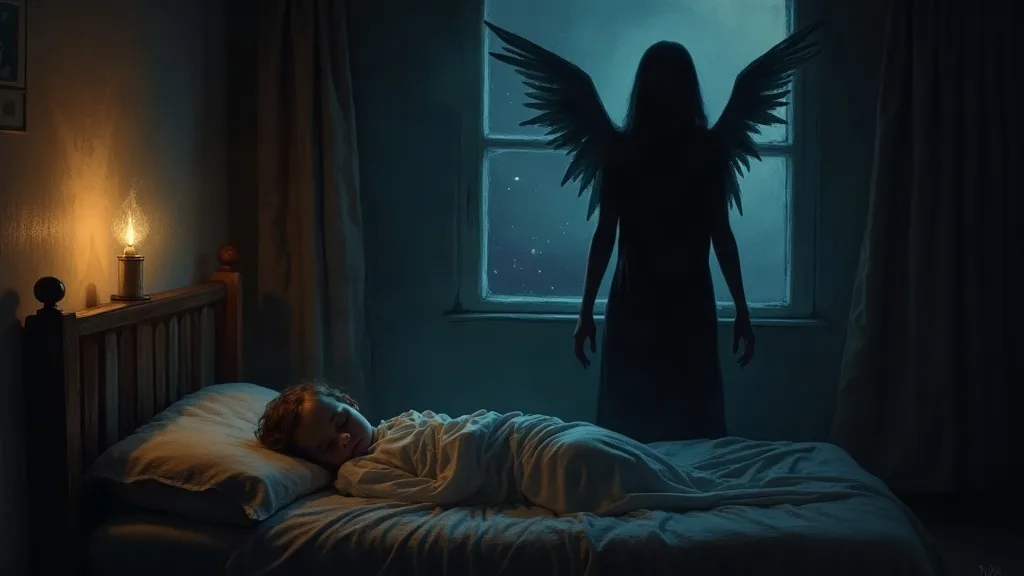
The Shtriga: Witch-Vampire of Albanian Folklore
The Shtriga is a witch-vampire hybrid from Albanian folklore who feeds on the life force of sleeping children. Part demon, part woman, entirely dangerous, she embodies the fears of a culture caught between Christianity, Islam, and older Balkan beliefs.
Contents
In the mountains and villages of Albania, mothers would hang charms above their children's cradles and whisper prayers before sleep. They were not warding off simple nightmares. They were protecting their sons and daughters from the Shtriga, a creature that stalks the dark hours seeking the warm breath of infants.
The Shtriga (pronounced "SHTREE-gah") is one of southeastern Europe's most compelling supernatural hybrids: neither fully vampire nor fully witch, but something that borrows the hungers of both. Unlike the corpse-vampires of Romania or Serbia, the Shtriga often walks in daylight as an ordinary woman, indistinguishable from neighbors and friends. At night, she sheds her human form and becomes something leaner, darker, more predatory. She drinks the vitality of children, leaving them pallid, wasting, sometimes dead.
What makes the Shtriga distinct is her embodiment of a specific cultural anxiety: the woman who seems respectable but harbors malice, the neighbor who might be more than she appears. In a region where multiple faiths and older pagan traditions collided for centuries, the Shtriga became the perfect monster: a figure that absorbed Christian fears of witchcraft, Islamic ideas about djinn and hidden spirits, and pre-Islamic Balkan beliefs in shape-shifting demons.
The Shtriga in Albanian Belief and Witness
The Shtriga was not confined to fireside tales. Village people reported encounters. Parents described children who wasted away from no known illness. Local healers and priests developed specific rituals to combat her. The creature occupied the space between pure folklore and lived experience, between myth and what people genuinely believed they had witnessed.
According to Albanian tradition, the Shtriga is born one of two ways. The most common account holds that any woman can become a Shtriga if she is marked by misfortune, jealousy, or malice. Some versions say she must die while pregnant, her anger so intense that her spirit refuses rest. Others claim she is born that way: an illegitimate child of a Shtriga mother, cursed to repeat the cycle. Certain accounts suggest that women who die excommunicated or who commit suicide may be transformed into Shtrigue by malevolent forces.
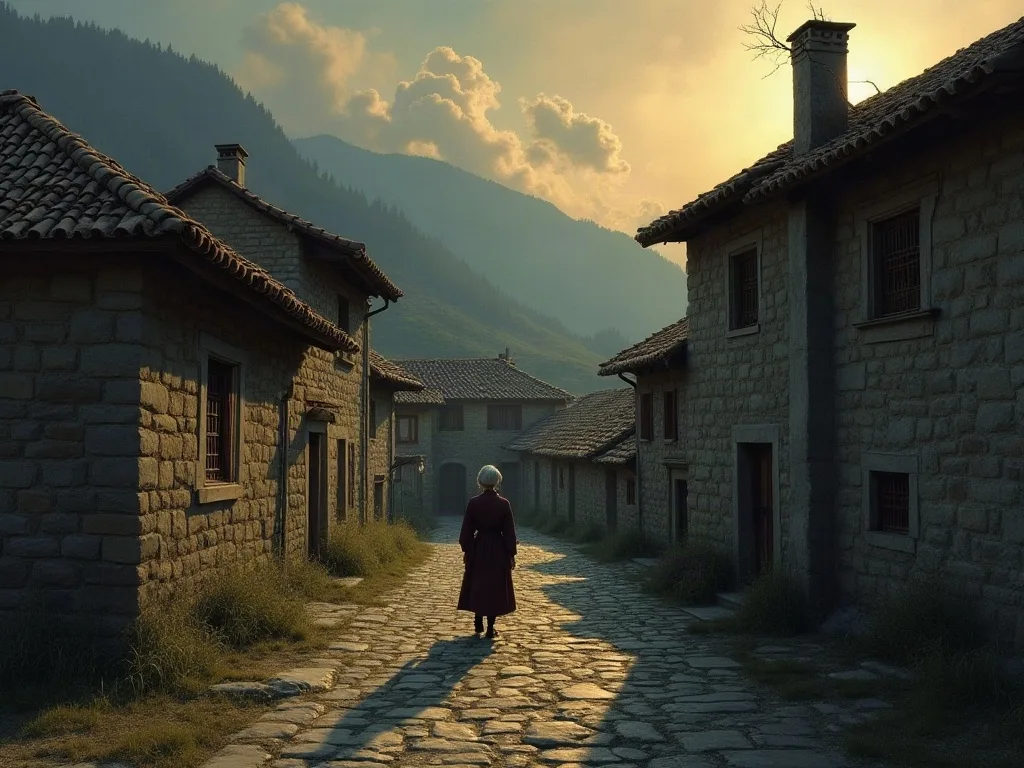
Once transformed, she is trapped in a half-state: not dead, not fully alive. By day, she may appear as an ordinary woman in her village, perhaps a widow, perhaps a spinster, perhaps a woman whose children have all died (a detail that fits a certain tragic logic: if she lost her own children, the story goes, perhaps she hungers for the life force of others). She may tend animals, work in fields, attend church. No one suspects.
As night falls, her true form emerges. She sheds her skin or takes on a new shape: a creature with leathery wings, a bare female torso with a serpent or animal body, sometimes a form so ambiguous that witnesses struggle to describe it. The Shtriga then flies to homes, seeking infants and young children. She finds her way through keyholes, under doors, through any crack in the threshold. Some accounts say she suffocates the child with her presence, draining their warmth and vitality. Others describe her drawing the child's life force like a nurse extracts milk from a wound.
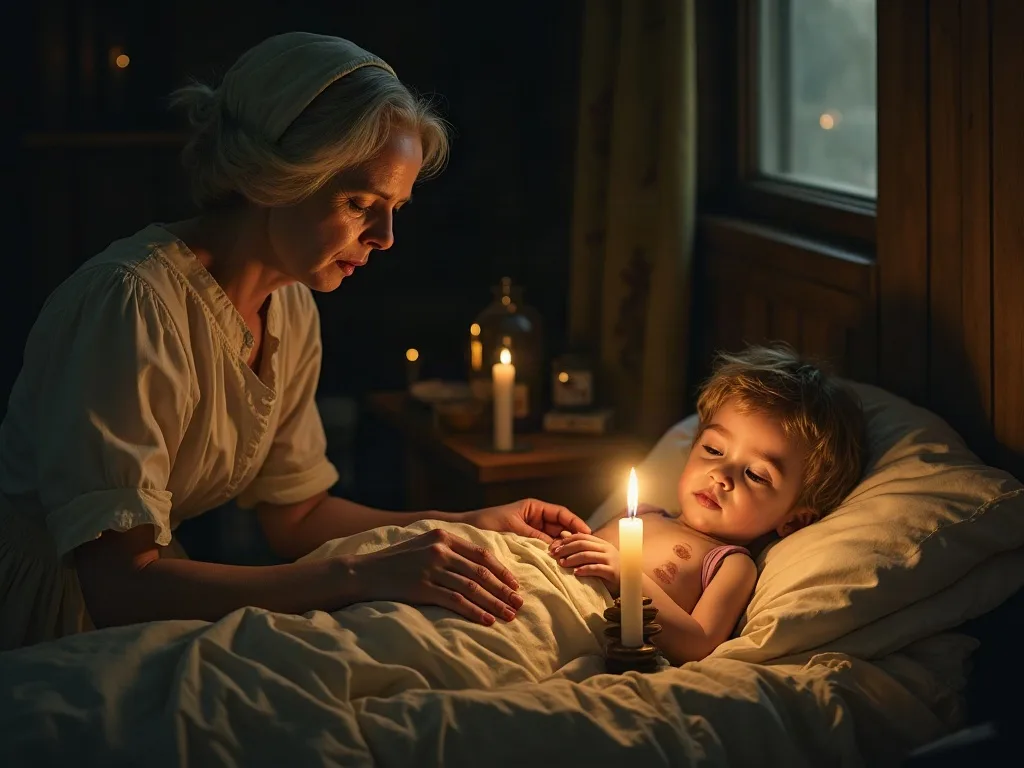
The victim does not wake. By morning, the child remains asleep but changed. Over days or weeks, the child wastes. Cheeks hollow. The infant stops nursing. Fever may come. Parents call for priests and doctors, but neither understands what they face. The child simply fades, as though something essential has been stolen.
The Shtriga's Nature and Hunger
The Shtriga is not a corpse-vampire like Dracula. She does not drink blood, or not primarily. Instead, she consumes what nineteenth-century folklorist Edith Durham, who documented Albanian customs extensively, described as the child's vital essence, their warmth, their promise of life. In some accounts, the child experiences terrible nightmares during the attack; the Shtriga enters dreams and feeds there, leaving the dreamer weakened upon waking.
What distinguishes her from a simple witch is her compulsion, her hunger. A witch uses magic as a tool. The Shtriga is driven by hunger as a wolf is driven, as a fever is driven. She must feed or she perishes. Some traditions say she can only feed once a week; others claim she hunts nightly. Some accounts give her a specific season of hunting, often winter when children are indoors and vulnerable. Others insist she hunts year-round, that her need never sleeps.
The motive behind the hunting varies in the folklore. Some versions suggest simple malice: the Shtriga hates mothers and children because she was wronged, because she lost her own family, because she is consumed by envy. Other accounts hint at something more biological, more necessary: she hunts because her cursed state demands it, because feeding on the young is the only way she can maintain her semi-existence. A few stories suggest she hunts to try to steal fertility itself, to somehow recover the power to bear children that was taken from her when she became what she is.
Identifying and Defeating the Shtriga
Albanian folklore developed practical methods to identify a suspected Shtriga and, more importantly, to protect against her or destroy her.
The most telling sign was the unexplained wasting of children. When an infant began to fade despite appearing to sleep soundly, without fever or other visible cause, suspicion fell on the Shtriga. Some accounts describe the child's cries on certain nights, almost supernatural in their distress, and the sighting of a strange shadow or presence at the window or door.
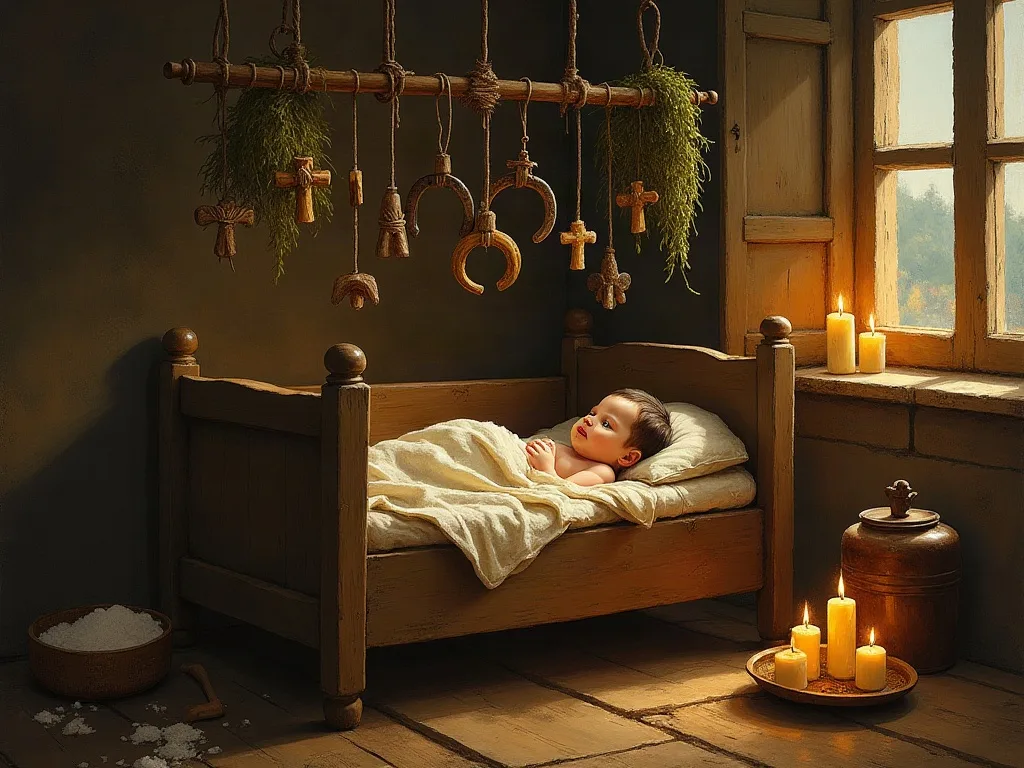
Communities had defenses. The simplest was prevention: herbs hung above the cradle or tied around the child's neck. Bay leaves, salt, iron, and crosses of woven grass were considered effective. Some villages placed a knife under the child's pillow, the blade pointing toward the door. The logic was not to harm a human intruder but to repel a supernatural one; iron and steel were thought to burn such creatures. In some regions, families kept a beeswax candle burning all night, the theory being that the Shtriga, like certain vampires, could not cross the light or preferred not to.
If a Shtriga was identified, more direct action was possible. Because the Shtriga wears a human form by day, she could theoretically be confronted, restrained, or forced to confess. Some accounts describe villagers surrounding a suspected woman's home at night and watching for her to transform or to leave. If caught in the act of hunting, or if she could be forced to return before dawn to her sleeping form, she might be forced to restore the child's stolen vitality by some ritual reversal.
The most permanent solution, however, reflected the vampire-killing practices of southeastern Europe more broadly. If a Shtriga could not be reformed or stopped, she had to be killed. Because she was not fully dead, ordinary death was insufficient. Some accounts describe staking or beheading, the methods used against corpse-vampires elsewhere in the Balkans. Others speak of fire, burning her at the threshold of her own home or in a crossroads to prevent her spirit from wandering. A few traditions hold that forcing her to drink blessed wine or water would destroy her, that the sacred would burn through her from the inside.
The ritual of katune, a kind of exorcism or cleansing ceremony, was sometimes performed by priests or elders. The exact details varied by region, but the principle was the same: the community gathered to ritually bind the Shtriga, often involving the recitation of prayers, the creation of a sacred boundary, and the forced restoration of the stolen life force to the child through ritual inversion.
The Shtriga and Cultural Synthesis
What makes the Shtriga particularly rich is that she is not a purely Albanian invention. She is a synthesis, a creature born from collision.
The witch tradition comes partly from Mediterranean antiquity. The ancient Greeks had the lamia, a female demon who preyed on children and infants (later tradition associated her with Lamia, a former lover of Zeus driven mad by Hera's jealousy, who took revenge on the children of others). Roman folklore included similar figures. The image of a woman who hunts at night, who is dangerous to children and mothers, echoes across classical sources.
The vampire aspects, the need to feed, the connection to death and resurrection, the vulnerability to iron and sacred objects: these point toward the broader vampire traditions that swept through southeastern Europe, particularly after the late medieval period. The cases of the Serbian vampire Arnold Paole (reported in the 1700s) and others documented by eighteenth-century clergy and physicians created a framework for understanding the Shtriga. She could be explained within that growing European discourse about the undead, even as she remained distinctly local.
But the Shtriga also carries older, pre-Christian Balkan elements. The shape-shifting, the fluid boundary between human and animal, the connection to fertility and the consumption of life force (not mere blood, but essence): these resonate with shamanic and pre-Indo-European traditions that persisted in the Balkans long after Christianization. The Shtriga may preserve echoes of an older category of spirit or demon that existed in the region before the words "witch" and "vampire" were applied to her.
The religious context matters too. Albania, by the Ottoman period, had Christian regions (mostly Catholic in the north, Orthodox in some areas) and Muslim regions (the Ottoman conversion reached deep into the Albanian interior). The Shtriga appears in both Christian and Muslim Albanian folklore, though the rituals and explanations for her vary. In Christian villages, priests were called to perform exorcisms or blessings. In Muslim areas, she might be understood through the lens of Islamic demonology, related to the djinn or ifrit, spirits that could inhabit women and drive them to consume human life force.
Women, Motherhood, and the Shadow
It is difficult to discuss the Shtriga without acknowledging the gendered dimensions of the folklore. The Shtriga is always female. Her victims are always children, with a particular emphasis on infants and the young. Her threat is located in the liminal space of night, sleep, and the nursery, all domains traditionally associated with mothers and female caregivers.
Some folklorists have interpreted the Shtriga legend as an expression of postpartum anxiety, the fears that attend early motherhood: the terror that one's child might be stolen, harmed, or die despite one's vigilance. Others read her as a projection of fear about female power unchecked by domesticity or marriage. The Shtriga is typically not a wife; she is a widow, a spinster, a woman outside the normative structure of family. In her exclusion, she becomes monstrous.
There is also a shadow reading that folklorists have noted but rarely emphasized: the Shtriga might represent a kind of blame placed on women for infant mortality. In a premodern context, when childhood death was common, when no one understood germ theory or malnutrition or the hundred hidden causes of infant death, the Shtriga offered an explanation. It was not accident or God's will (though that framing was always available). It was malice, specifically female malice, directed at the innocent. The Shtriga made infant death comprehensible through the lens of witchcraft and supernatural agency. This reframing, while terrifying, also provided a framework for action: unlike chance or divine will, a Shtriga could be identified, confronted, and stopped.
The Shtriga legend also potentially served another function: it provided a cautionary narrative about women who did not conform to expected roles. A woman who was too old to marry, too strange, too solitary, too embittered, was at risk of becoming a Shtriga, or of being accused of being one. The legend thus enforced conformity to female roles: motherhood, marriage, service to family. A woman outside that structure was not just unfortunate; she was dangerous.
The Shtriga in Modern Albanian Culture
The Shtriga has not disappeared from Albanian consciousness. She appears in twentieth and twenty-first century Albanian literature, art, and film. Contemporary Albanian writers have drawn on the figure to explore themes of alienation, female rage, displacement, and the collision between traditional village life and modernity.
The Shtriga also remains alive in the folklore of diaspora communities. Albanians who emigrated to North America, Western Europe, and elsewhere carried the legend with them. In these contexts, the Shtriga sometimes transforms, becoming less a supernatural threat and more a cultural marker, a symbol of Albanianness, a touchstone of heritage. She appears in folk horror traditions, in contemporary paranormal discussions, and in cultural expressions by diaspora artists reclaiming or reinterpreting their traditions.
Academic interest in the Shtriga has grown with the expansion of folklore studies and the particular attention paid to Balkan supernatural traditions. Scholars have examined her through lenses of gender, postcolonial theory, the history of medicine and childhood, and the study of how communities process trauma through supernatural narratives. The fact that the Shtriga appears in historical documents, in oral traditions, in contemporary art, and in living belief (some people still report encountering her, still take precautions against her) makes her a rare creature: a figure that spans the boundary between folklore and lived experience.
The Shtriga and Comparative Demonology
To understand the Shtriga fully requires placing her within the broader landscape of Balkan and Mediterranean supernatural beings.
Shtriga (Albanian)
The Shtriga typically wears a human form by day and transforms at night. She hunts primarily by consuming the life force or warmth of children, draining their vitality without necessarily bloodshed. She is often a living woman who was cursed or transformed, not a reanimated corpse. Killing her requires ritual and often the community's direct involvement.
Strigoiu (Romanian)
The Strigoiu (similar name, possibly shared roots) is typically a reanimated corpse, the restless dead who must feed on blood to maintain their form. The Strigoiu emerges from the grave at night and returns before dawn. The process of becoming a Strigoiu is often determined by circumstances of death (suicide, excommunication, violent death) rather than by personal corruption. Killing a Strigoiu requires desecration and destruction of the corpse.
The similarities suggest a shared cultural inheritance. Both the Shtriga and the Strigoiu inhabit the nighttime world. Both hunt the vulnerable (the Strigoiu may prey on cattle or family members; the Shtriga focuses on children). Both can be defeated through ritual and community action. Both embody anxieties about the boundary between the living and the dead, the sacred and the profane.
The differences, however, are instructive. The Shtriga retains a kind of agency and malice that the Strigoiu may lack. The Strigoiu is often pitied; the Shtriga is often despised. The Shtriga is a living person who chooses (or is driven by malice) to hunt. The Strigoiu is a corpse compelled by hunger, almost mechanical in her need. The Shtriga can be reformed or stopped by ritual; the Strigoiu must be destroyed. These differences point to distinct cultural concerns: the Shtriga embodies anxieties about malicious women and hidden evil within the community. The Strigoiu embodies anxieties about death itself, about the boundary between life and death, about whether the dead can truly be contained.
The Shtriga also bears comparison to the Greek lamia, the Italian strega, the Germanic hexe. What is distinctive is not the core concept (a predatory female figure, a consumer of children, a creature of the night) but the specific configuration, the particular emphasis on the draining of life force, the possibility of identifying her in daylight, the possibility of reform through ritual, and the specific set of defenses that proved effective.
Frequently asked questions about the Shtriga
Frequently asked questions
Is the Shtriga a real creature, or purely folklore?
The Shtriga belongs entirely to the realm of folklore, oral tradition, and cultural belief. No physical evidence of her existence has been documented. However, the fact that many people genuinely believed in her, that entire communities had defenses against her, and that some people still report encounters with her today means she is real in the sense that she shaped behavior, shaped child-rearing practices, and shaped how people understood unexplained infant illness. In that sense, the Shtriga is as real as any belief system that organizes how a culture responds to fear and loss.
Could the Shtriga legend be based on a misunderstanding of real diseases?
Almost certainly, in part. Sudden infant death, failure to thrive, infections that presented with no obvious cause, and malnutrition could all mimic the symptoms attributed to the Shtriga (the child fades, wastes, dies despite appearing to sleep). The Shtriga legend offers an explanation for these devastating phenomena in a time when germ theory did not exist and medical knowledge was limited. Whether the legend arose from particular cases of sudden death or from a more general anxiety about childhood mortality, it provided a narrative framework that made sense of the senseless.
Does belief in the Shtriga persist in modern Albania?
Yes, though it has transformed. In rural and traditional communities, some older people still take precautions, still tell the stories, still warn about the Shtriga. In urban contexts and among younger generations, the Shtriga is more likely to be treated as a cultural artifact, a symbol of heritage, or a subject of artistic and literary exploration rather than a present danger. Among diaspora communities, the Shtriga often functions as a cultural marker, a way of maintaining connection to the homeland. Some contemporary horror and paranormal communities in Western countries have adopted the Shtriga as a figure of folk horror, sometimes with little understanding of her original cultural context.
What is the connection between the Shtriga and other Balkan vampires?
The Shtriga belongs to the broader family of Balkan supernatural creatures that share vampire-like characteristics: the need to feed on life force, the connection to death or the boundary between life and death, the vulnerability to sacred objects and iron, the ability to be stopped or killed through ritual. However, the Shtriga is distinct from corpse-vampires like the Romanian Strigoiu or the Serbian vampire. She is a living person who becomes supernatural, often through curse or malice, rather than a reanimated dead body. The Shtriga legend likely influenced, and was influenced by, the broader European vampire discourse that intensified in the seventeenth and eighteenth centuries, but she retains a distinctly Albanian character.
Are there any primary sources documenting the Shtriga in historical records?
The Shtriga appears in ethnographic and folkloric documentation beginning in the nineteenth and early twentieth centuries, when European scholars began systematically collecting Balkan folklore. Edith Durham's work on Albanian customs includes descriptions of the Shtriga and the defenses against her. Ottoman records, depending on the period and region, occasionally mention supernatural beliefs and witchcraft accusations, though the Shtriga is not always explicitly named. The clearest documentation comes from folklorists and anthropologists rather than from official historical records, which suggests the Shtriga was primarily a folk tradition, not a matter of institutional concern (though local priests and healers certainly engaged with cases attributed to the Shtriga).
The Shtriga as a Mirror of History
The Shtriga legend reveals patterns that extend far beyond Albania. She is evidence of how cultures process anxiety, loss, and the limits of their own knowledge. She shows how communities create explanations for suffering when no other explanation is available. She demonstrates how folklore can persist even as the conditions that generated it change. And she reveals how the boundary between human and inhuman, between the natural and supernatural, between acceptable and monstrous behavior, can be constructed and maintained through narrative.
The Shtriga also remains a window into the specific history of the Balkans: a region where Christianity, Islam, and older traditions collided, where Ottoman rule extended for centuries, where rural communities maintained practices and beliefs that urban centers had abandoned, where the oral culture was often the primary means of making sense of the world.
Discover more about Albanian traditions through the broader mythological context of the region. The Shtriga does not stand alone; she is part of a constellation of spirits, demons, and divine figures that shaped Albanian understanding of the sacred and the dangerous. Her story is woven into the deeper narrative of how Albanian culture, through centuries of change and pressure, maintained its identity and its way of making sense of the world.
Read the full book
Want the whole story?
The complete edition is an instant PDF download here, with a paperback on Amazon for selected titles.
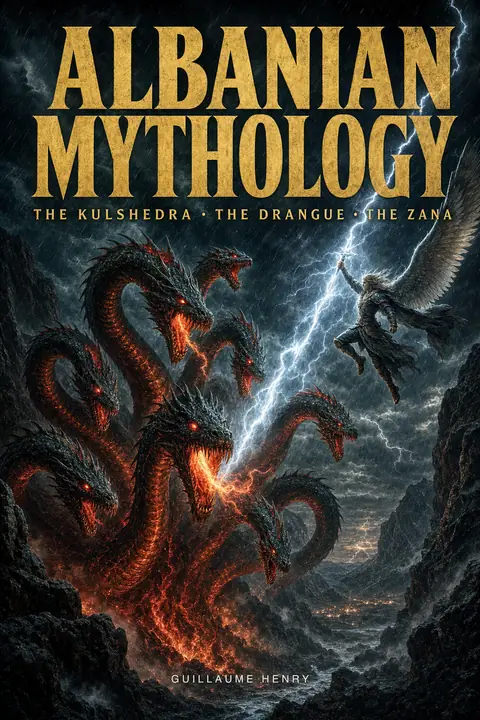
Albanian
The Albanian Mythology Book: The Kulshedra, the Drangue, and the Spirits of the Mountains
The Kulshedra, the Drangue, and the Zana
The mythology of the Albanian highlands: the Kulshedra, a fire-belching dragon-hag who hoards the rains, the Drangue, winged heroes born to fight her, and the Zana, mountain nymphs who bless and curse. A pagan world that survived in the songs of the highland warriors.
More from Albanian
All articles
Albanian
Muji and Halili: The Epic Heroes of Albanian Legend
Muji and Halili are the legendary twin heroes of Albanian epic poetry, warriors bound by blood and honor who defend their land against mythical monsters and foreign invasion. Discover how their deeds shaped Albanian cultural identity for centuries.
Albanian
The Besa: Sacred Code of Honor in Albanian Culture
The Besa is Albania's oldest unwritten law: a sacred pledge of honor, protection, and hospitality that has shaped Albanian identity for centuries. Discover how this ancient code binds community, defies conquest, and survives in modern Albania.
Albanian
E Bukura e Dheut: The Earthly Beauty and Goddess of Nature in Albanian Mythology
E Bukura e Dheut embodies the earthly beauty and goddess of nature in Albanian mythology, representing fertility, growth, and the sacred landscape. Discover how this ancient figure shaped Albanian spiritual life and persists in folk tradition today.

Albanian
The Zana: Mountain Nymphs and Warrior Maidens of Albanian Folklore
The Zana embody the wild spirit of Albanian mountains: supernatural maidens who heal the wounded, challenge warriors to combat, and guard their domains with ferocity. Learn how these mountain nymphs shaped centuries of Balkan folklore.