
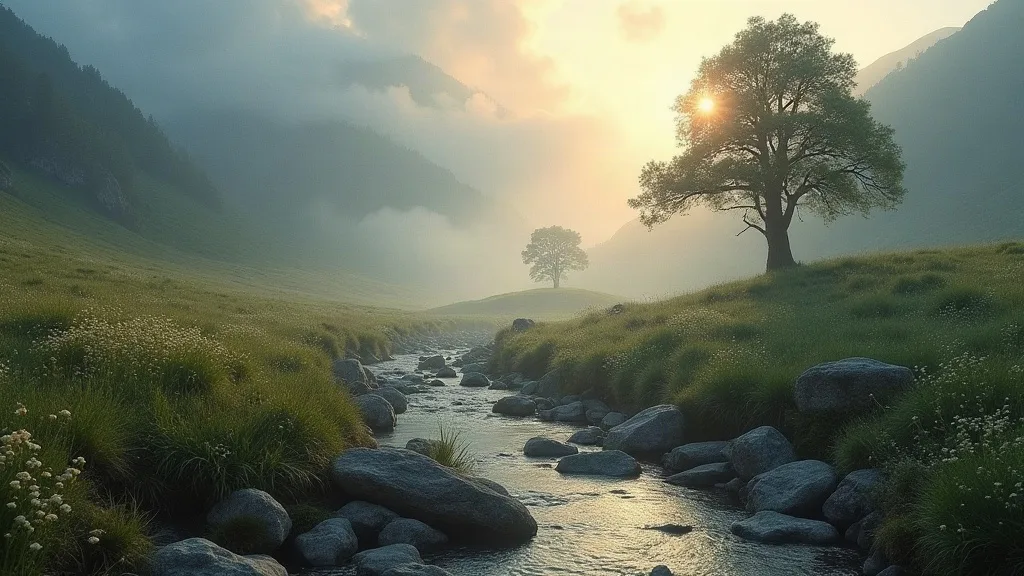
E Bukura e Dheut: The Earthly Beauty and Goddess of Nature in Albanian Mythology
E Bukura e Dheut embodies the earthly beauty and goddess of nature in Albanian mythology, representing fertility, growth, and the sacred landscape. Discover how this ancient figure shaped Albanian spiritual life and persists in folk tradition today.
Contents
In the highlands of Albania, shepherds once whispered prayers to a figure they could not fully name. She moved through forests and across meadows. She was the reason crops grew in spring and animals found water in drought. Her name meant simply "the Earthly Beauty", but she was far more than that: E Bukura e Dheut was the living presence of the natural world itself, a goddess whose domain encompassed every growing thing and every sacred place where humans and land met.
E Bukura e Dheut remains one of the most elusive yet vital figures in the Albanian mythological tradition. Unlike the gods of the Mediterranean or the Norse pantheon, her story survives not in epic poems or codified texts, but in scattered folk practices, place names, and the oral memory of rural communities that still inhabit the Balkans. She represents a layer of Albanian spirituality that bridges the pre-Christian world with centuries of Christian overlay, emerging most clearly in the reverence for natural sites and the personification of earth's bounty.
Origins in the Pre-Christian Landscape
The roots of E Bukura e Dheut run deep into the animistic traditions of the ancient Balkans. Before Christianity arrived in Albania, the land itself was sacred. Mountains, springs, ancient trees, and fields were not merely physical features but manifestations of divine power. E Bukura e Dheut embodied this principle: she was the consciousness and vitality of the earth, the reason fertility existed, the force that made life possible.
Scholars studying Albanian mythology, including ethnographer Eqrem Çabej and folklorist Mark Tirta, have traced her origins to pre-Indo-European mother-goddess traditions shared across the Mediterranean and Balkan regions. Like the Greek Gaia (the earth itself, born before the Olympians) or the Roman Terra, E Bukura e Dheut represented earth as a living, animate being. Yet her character was distinctly Albanian: she was not distant or cosmic, but intimate and present in the landscape people inhabited daily.
The name itself carries profound meaning. "E Bukura" means "the beautiful one"; "e Dheut" means "of the earth" or "of the land." Together, the name suggests that beauty and earth are inseparable, that the visible world is inherently divine. This reflects a worldview where aesthetics and spirituality merge, where a flowering meadow is not decoration but evidence of the goddess's presence.
The Goddess in Folk Practice and Ritual
E Bukura e Dheut did not command temples or organized priesthoods in the way classical deities did. Instead, her worship was woven into the rhythms of agricultural and pastoral life. Rural communities across Albania maintained rituals and practices associated with her, often without consciously naming them as such. The goddess operated in the gaps and continuities of folk practice, surviving Christian conversion by hiding in custom.
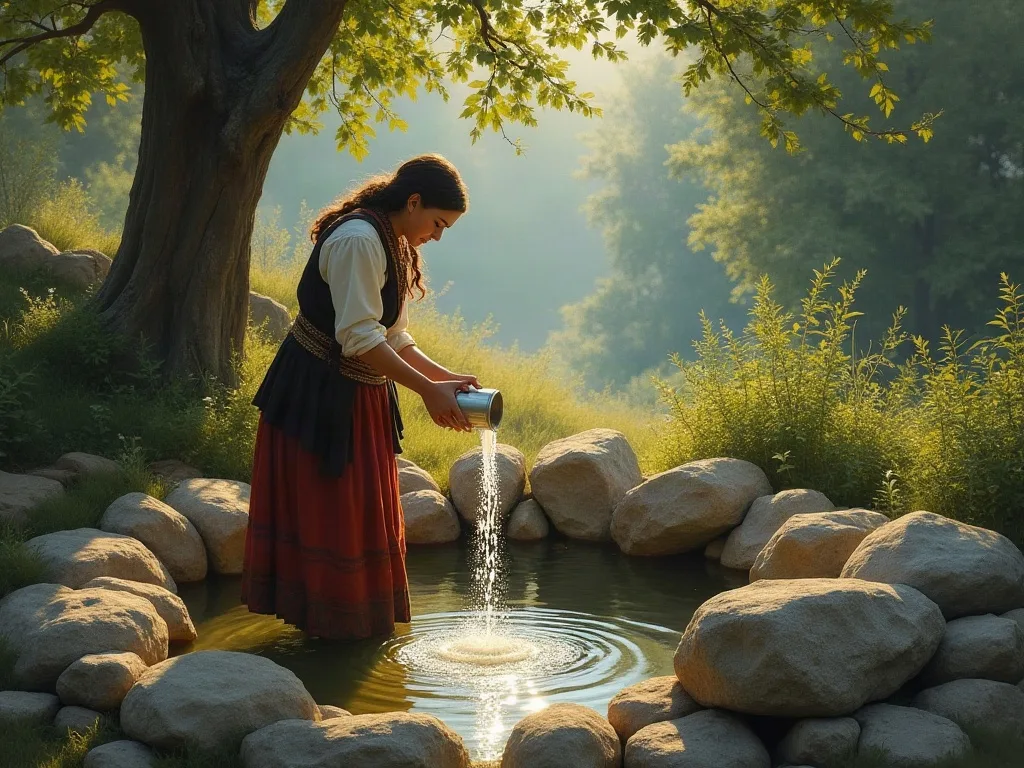
Spring rituals were her domain. When shepherds drove flocks to high pastures after winter, they would leave small offerings at sacred stones or springs: bread, milk, or honey left at dawn. Women tending fields would pour libations of milk or water at the first plowing. These acts were understood as communication with the earth itself, requests for a good harvest, acknowledgment of the force that made all growth possible. Over centuries, some of these practices became abstracted into "custom" or "superstition," their origins forgotten, but their structure remained intact.
The goddess was particularly associated with water sources. Springs and fountains throughout Albania held sacred significance, often marked by standing stones or small shrines. These were believed to be places where E Bukura e Dheut was especially present, where her blessing could be accessed directly. Childless women would visit sacred springs seeking fertility. Sick animals would be brought to drink from certain wells. Communities would perform rituals of gratitude when a new spring appeared or an old one did not run dry during drought.
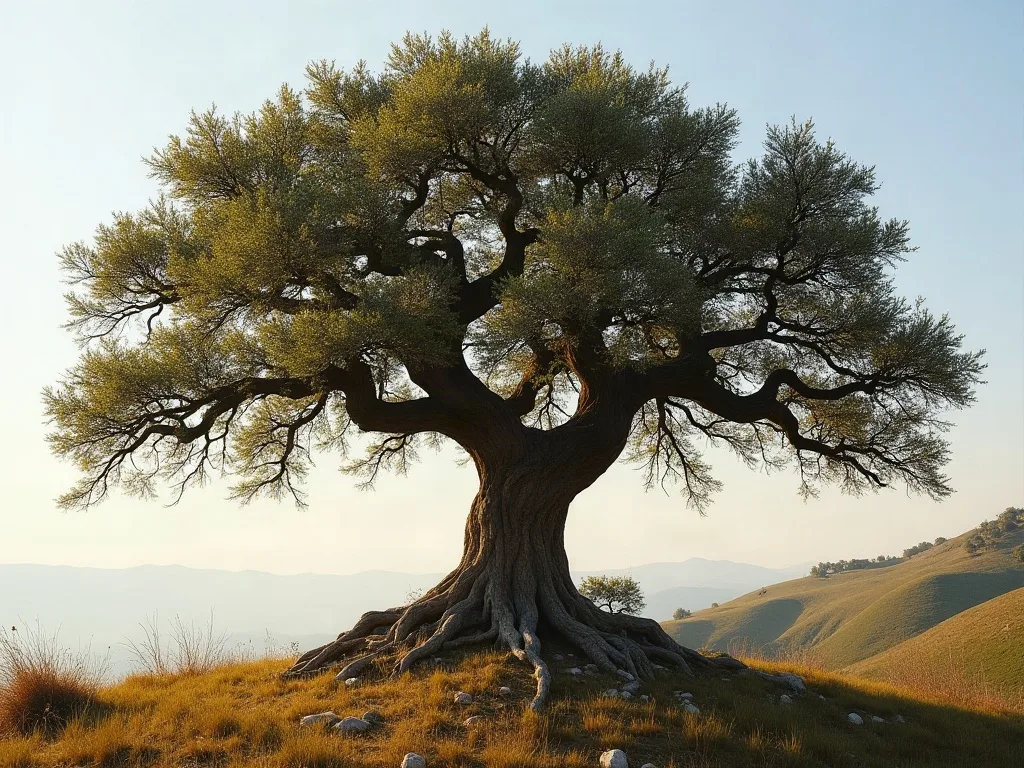
One particularly enduring practice involved the reverence of old trees. Oak trees in particular were considered sacred to E Bukura e Dheut. These ancient oaks, often growing in isolation on hillsides or at the boundaries of villages, served as local landmarks and spiritual centers. People would leave offerings at their bases or simply place their hands on the bark as an act of blessing or healing. The practice persisted well into the modern era, adapting to Christian contexts by eventually being reframed as devotion to saints rather than to the goddess.
Connection to Agricultural Cycles and Fertility
The most visible expression of E Bukura e Dheut's power lay in her intimate connection to agriculture. She was not a distant cosmic force but the energy present in seed germination, plant growth, and animal reproduction. Farmers understood her as essential to survival itself.
The agricultural calendar was structured partly around acknowledgment of her presence. At planting time, special care was taken to work with respect toward the earth. At harvest, a portion of crops was left in the field, understood as payment to the goddess. Grain was not simply taken; it was received with gratitude. Practices varied by region, but the underlying principle remained consistent: the earth gives, and the community reciprocates with acknowledgment and respect.
In the Dibër highlands of northeastern Albania, for instance, village women documented by mid-twentieth-century ethnographers would kneel at the field's edge before the first seed went in and speak directly to the soil. In the Labëria region of the south, harvest rituals included binding the last sheaf of wheat and leaving it standing in the field through winter, understood as shelter for the spirit of the grain. These regional variations reflect the same underlying logic of reciprocity with the earth, expressed in the particular accent of each landscape.
Animal fertility fell under her domain as well. Herds that thrived were blessed by the goddess. When livestock declined or sickened, it was understood as a sign that the relationship with E Bukura e Dheut had been broken. Remedies involved ritual actions: returning to proper observances, offering gifts to sacred places, or performing cleansing ceremonies. This was not superstition in the sense of magic divorced from reality, but practical spirituality integrated with knowledge of land management, seasonal timing, and animal husbandry.
Childbirth and female fertility were also sacred to the goddess. Women in labor would invoke her. Barren women seeking pregnancy would make pilgrimages to her sacred sites. The goddess was not separate from human reproduction but seen as an extension of the same force that made earth fertile. This connection created a spiritual understanding in which female bodies and fertile land were linked, both expressions of the same divine principle.
The Goddess Beneath Christian Overlay
Christianity arrived in Albania gradually, and its presence varied by region and era. Yet rather than erasing E Bukura e Dheut, many of her functions were absorbed into the veneration of Christian saints or reframed within new theological structures. This syncretism created a complex spiritual landscape that scholars continue to map.
In many regions, veneration of the earth and its fertility was redirected toward Mary, the mother of Jesus, or toward local saints associated with land and harvest. Saint George, who appears prominently in Albanian Christian tradition, took on some protective functions previously associated with male fertility deities. Yet E Bukura e Dheut's essence did not disappear; it persisted in the underlying respect for natural sacred sites and in folk practices that maintained their pre-Christian logic even as they adopted Christian language.
The sacred springs and trees survived the Christian conversion because they were too embedded in daily survival and local identity to fully abandon. Instead, new explanations were provided. A spring might be credited with healing power because a saint had blessed it, yet the reverence offered it remained identical to what would have been offered to E Bukura e Dheut centuries before. The practice lived on while its explicit religious context shifted.
This pattern of continuity-through-adaptation appears throughout Albanian folk Christianity. Scholars including Anton Caragani and Gennady Litavrin have noted that Albanian Christianity, particularly in rural regions, maintained stronger threads of pre-Christian belief than in many other European contexts. The rugged terrain, the dispersed settlement patterns, and the relative independence of mountain communities meant that formal church control was never absolute. Folk practice maintained its own logic, its own calendar, its own sacred geography.
Ottoman administrative records from the 17th and 18th centuries, particularly the defterleri (tax and population registers) compiled in regions of what is now central and northern Albania, occasionally document sites described as places of popular gathering and offering that predate mosque or church. These marginal notations, studied by Albanian historian Injac Zamputi, point to the persistence of pre-Islamic, pre-Christian sacred sites that local communities continued to use regardless of the official religion of the moment. The springs and trees associated with E Bukura e Dheut were durable enough to be noticed, counted, and occasionally taxed.
Sacred Landscape and Geographic Identity
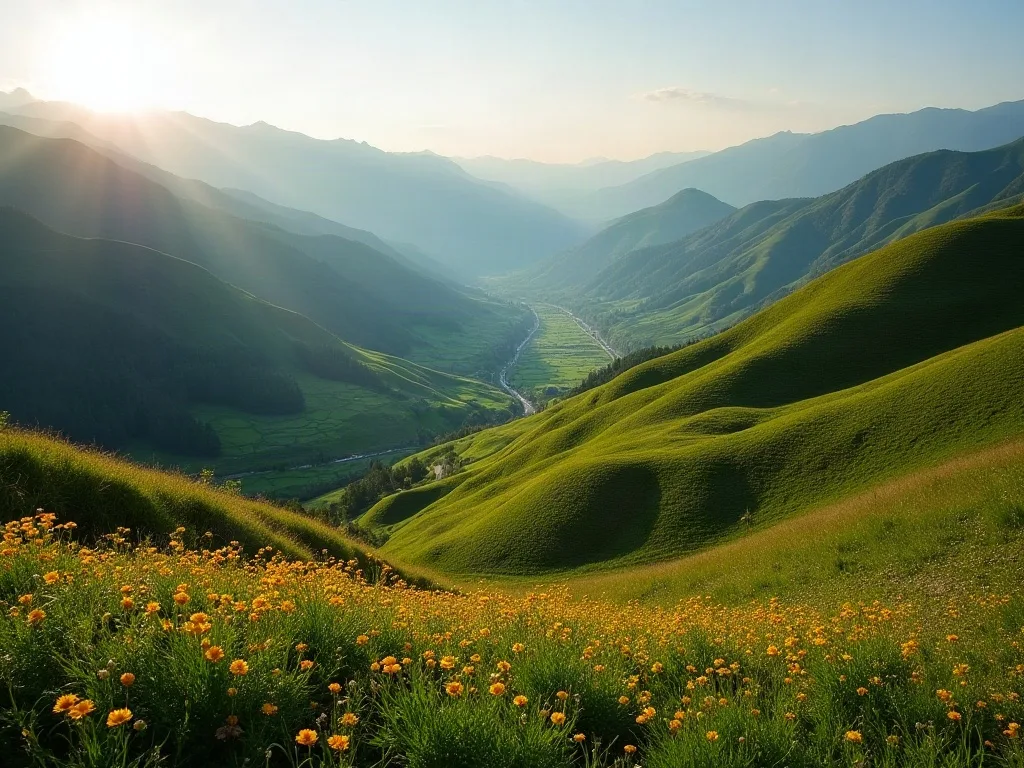
In Albanian mythology and spirituality, E Bukura e Dheut was not conceived as a figure separate from the landscape. She was the landscape, or more precisely, she was its animate principle. Specific mountains, valleys, and springs carried her presence more intensely in certain places.
The high plateaus of northern Albania held particular sacred significance. Mount Korab, one of the highest peaks in the region, was understood as a place of special power. The fertile river valleys of the Drin and Shkumbin were seen as manifestations of the goddess's blessing, their green corridors cutting through limestone karst as if the earth itself had opened a path for life. Lake Prespa and Lake Ohrid, shared with neighboring territories, held sacred significance across communities. These were not merely geographical features but sacred landmarks where the goddess's presence was tangible.
Place names across Albania preserve this sacred geography. Many locations carry names referencing fertility, beauty, or the divine feminine. Springs are often named for zanë (the protective female spirits of Albanian folklore) or other female figures of protection and provision. This naming practice reflects the underlying understanding that the landscape itself is alive with presence, that specific places hold spiritual significance because the goddess is particularly near. The zanë themselves, those spirits who guard mountain springs and high pastures, are best understood as local expressions of the same fertile energy that E Bukura e Dheut embodies on a cosmic scale.
For Albanian communities displaced during Ottoman occupation and modern conflicts, this sacred geography became a form of spiritual anchoring. Even in diaspora, the memory of specific springs, trees, and mountains in the Albanian homeland carried profound significance. The goddess was not separated from place; she was place. To remember the landscape was to remember the goddess.
Comparisons to Other Balkan and Mediterranean Deities
E Bukura e Dheut sits within a broader network of earth goddesses found across the Mediterranean and Balkans. Her closest parallels appear in traditions neighboring Albanian lands.
The Greek Gaia represents perhaps the most direct conceptual parallel. Both are earth itself personified, both predate the formal pantheon of their respective mythologies, both represent the foundational principle of fertility and life. Yet Gaia appears in written epic and philosophical texts, including Hesiod's Theogonia (roughly 700 BCE), as part of a structured cosmology. E Bukura e Dheut exists almost entirely in oral tradition and folk practice, remaining closer to lived religious experience than to literary mythology. You can read more about this distinction in the Origins of Greek Cosmology.
The Slavic Mokosh (also rendered Mokoš, a goddess of moist earth and spinning) presents another parallel. Like E Bukura e Dheut, this figure embodies earth as a living, fertile principle. The reverence for sacred springs and trees appears in both traditions. The integration into folk practice and the survival of pre-Christian beliefs within Christian contexts mirrors the Albanian pattern closely.
The Albanian sky deity Zojz, a thunder god whose name traces to the same Indo-European root as Zeus and Dyaus Pita, complements E Bukura e Dheut in the same way sky deities across the ancient world complement earth goddesses: they are the two poles of a cosmological pair, sky and earth, rain and soil, storm and harvest. Together they frame the Albanian mythological world more completely than either does alone.
Turkish and Ottoman cultural influences in Albania, persisting from the 15th through 20th centuries, did not erase the goddess but further syncretized her. Sufi mysticism, with its own reverence for sacred landscape and divine presence in nature, found some compatibility with the underlying logic of E Bukura e Dheut worship. This created another layer of cultural adaptation while the core concept endured.
The Goddess in Modern Scholarship and Revival
Academic study of E Bukura e Dheut remains limited compared to better-documented mythological traditions. This reflects partly the conditions of Albanian scholarship itself: the discipline developed later than in Western Europe, political disruptions interrupted research programs, and the dispersion of Albanian communities limited access to oral sources.
Yet scholars in recent decades have worked to recover and document her presence. Ethnographers and folklorists studying Albanian mountain communities have identified consistent patterns of earth-goddess veneration. Research by academics including Përparim Kraja and Afërdita Paçarizi has documented surviving folk practices and their underlying mythological logic. The work of restoring her to the Albanian mythological record remains ongoing. Their findings echo the broader field of Balkan comparative religion, which places Albanian pre-Christian traditions alongside the ancient beliefs of neighboring Illyrian peoples as a single living system.
Contemporary Albanian cultural movements have also begun recovering explicit awareness of E Bukura e Dheut. Environmental movements in Albania have drawn on her image as a symbol of ecological responsibility and land stewardship. Some writers and artists have reframed her in modern contexts, recovering the goddess as a figure relevant to contemporary concerns about environmental degradation and the loss of traditional connection to land.
This revival is not a simple return to ancient practice. Rather, it represents a conscious recovery of a figure whose presence never fully disappeared but whose explicit religious context had been obscured. Modern invocations of E Bukura e Dheut often blend historical awareness with contemporary concerns, creating a form of spiritual continuity that honors the past while addressing present needs.
E Bukura e Dheut in Folk Poetry and Cultural Memory
The goddess appears in Albanian folk poetry and oral tradition, though often obliquely. Traditional songs about planting and harvest invoke the earth's blessing without always naming the goddess directly. Love songs and wedding rituals incorporate language and practices rooted in fertility magic and earth veneration. Even when the explicit mythological framework is absent, the underlying spiritual concepts persist.
In the lahuta tradition, the Albanian epic song form performed by a bard on a single-stringed instrument of the same name, references to earth's blessing and natural forces carry embedded invocations of earth-goddess principles. The lahuta bards of the northern Albanian highlands, documented most thoroughly by Milman Parry and Albert Lord in the 1930s, sang of landscapes where springs speak and mountains remember. The beauty praised in landscape descriptions carries spiritual significance rooted in E Bukura e Dheut's presence. The landscape in these songs is never merely scenery but a character in the narrative, a living participant in human events.
The rhythm and metaphoric structure of Albanian folk poetry often reflects the animistic worldview in which the goddess functioned. Nature responds to human action. The earth is not passive but active. Springs and mountains are not mere locations but participants in community life. This poetic sensibility preserves mythological logic even when mythological narratives themselves have been lost or transformed. You can trace a similar animism in the way the Albanian hero Muji moves through landscapes that respond to his deeds, where rivers rise in mourning and forests fall silent at a warrior's death.
Unanswered Questions and Scholarly Debate
The study of E Bukura e Dheut reveals significant gaps in our historical knowledge. No written texts survive from pre-Christian Albanian religion comparable to the Eddas or the Vedas. This means scholars must reconstruct her character from fragments: folk practices, place names, comparative mythology, and the testimony of anthropologists who documented Albanian communities in recent centuries.
One ongoing debate concerns the relationship between E Bukura e Dheut and the zanë (the protective female spirits of Albanian tradition) who appear in folklore. Are these separate entities, or variations of the same underlying figure? Did different regions develop distinct versions of the earth goddess, or were regional differences in naming and practice based on a common prototype? The evidence suggests a spectrum: a central concept of earth fertility manifesting in locally specific forms.
Another question involves the extent of her pre-Indo-European versus Indo-European roots. Albanian language and culture contain both strata. Did the concept of E Bukura e Dheut originate in the pre-Indo-European populations of the Balkans and persist through Indo-European migrations? Or did Indo-European and pre-Indo-European traditions merge to create her? The answer likely involves both processes, but the precise historical sequence remains uncertain.
The relationship between documented Christian Albanian spirituality and underlying pre-Christian foundations is also debated. How much of modern Albanian folk Christianity represents genuine persistence of ancient beliefs, and how much represents post-Christian reinterpretation of folk practices? Scholars disagree about the depth and authenticity of the continuity, though most acknowledge that it is real rather than imagined.
The Goddess Beyond Albania
While E Bukura e Dheut is distinctively Albanian, the concept she represents, a living earth, a goddess of fertility and landscape, a presence sustained through folk practice across cultural upheaval, appears in related forms across the Balkans and Mediterranean. Understanding her within this regional context enriches both her own story and our understanding of how goddess religions adapted to patriarchal religions and how ancient belief persists in modernity.
The goddess's story is also relevant to contemporary conversations about environmentalism, land stewardship, and the recovery of non-Western spiritual traditions. As modern societies reckon with environmental crisis, the logic underlying E Bukura e Dheut's veneration, that the earth is alive, sacred, and deserving of respect rather than exploitation, takes on new urgency. This is not mysticism divorced from practical consequences, but a framework for understanding human responsibility toward the living world.
For Albanian communities, whether in the homeland or in diaspora, E Bukura e Dheut represents a connection to place, history, and a form of spirituality that survived despite extraordinary pressures to disappear. Her recovery in modern consciousness is also a recovery of identity and a reassertion of cultural continuity across rupture and displacement.
Frequently asked questions about E Bukura e Dheut
Frequently asked questions
Is E Bukura e Dheut documented in ancient texts like Greek or Roman sources?
E Bukura e Dheut does not appear in surviving Greek, Roman, or Byzantine texts, which rarely documented the religious practices of interior Balkan populations. Her existence and significance are known through Albanian folk tradition, ethnographic documentation, and the analysis of surviving practices by modern scholars. This is not unusual: many indigenous European deities vanished from written record while persisting in folk memory.
How does E Bukura e Dheut relate to the zana figures in Albanian folklore?
The relationship between E Bukura e Dheut and the zanë (protective female spirits in Albanian tradition) remains debated by scholars. Some view zanë as localized manifestations of the earth goddess, while others see them as distinct figures that coexist in the same spiritual landscape. The zanë are often guardians of specific places, mountains, springs, and forests, in ways consistent with how E Bukura e Dheut was venerated, suggesting possible overlap or evolution from the same root.
What evidence connects E Bukura e Dheut to pre-Christian Albanian religion rather than Christian folk practice?
The clearest evidence comes from the specific practices documented among rural Albanian communities: the reverence for springs and ancient trees, the offerings at the beginning of planting season, the connection between female fertility and earth fertility. These practices follow patterns found in pre-Indo-European Mediterranean and Balkan goddess religions and differ from Christian devotional structures, suggesting deep pre-Christian roots that adapted to Christian contexts. Ottoman-era administrative records noting persistent sacred sites also support continuity predating both Christianity and Islam in these highland communities.
Are there modern religious or spiritual movements that venerate E Bukura e Dheut?
Contemporary Albanian cultural and environmental movements have begun consciously recovering the goddess as a symbol of ecological responsibility and cultural continuity. Some spiritual practitioners blend historical awareness of Albanian traditions with modern environmental concerns. However, organized religious devotion to E Bukura e Dheut remains marginal; her primary existence is in folk practice and cultural memory rather than formal religious communities.
How did E Bukura e Dheut survive the transition to Christianity and Ottoman rule?
The goddess survived through absorption into folk practice and Christian syncretism. Her functions were sometimes redirected toward Mary or local saints, her sacred sites were rededicated but still honored, and her underlying principles persisted in daily rituals of agricultural life. Ottoman tax registers occasionally noted pre-Islamic sacred gathering sites in Albanian territories, inadvertently documenting that these places, rooted in earth-goddess veneration, remained active across religious changes. The dispersed, mountainous settlement patterns of Albanian communities also meant that folk practice maintained greater independence from formal religious authority than in more centralized contexts.
The Persistence of the Sacred Landscape
E Bukura e Dheut endures not as a figure in narrative texts or formal theology, but as a presence in land itself. The springs that still draw visitors seeking blessing or healing, the ancient trees that still inspire reverence, the understanding that the earth is alive and sacred rather than inert and exploitable: these are the modern form of her existence.
Albanian communities, whether maintaining traditional lifeways or navigating diaspora and displacement, carry her memory in their relationship to landscape and place. The recovery of her story in contemporary scholarship and cultural work is not an archaeology of a dead past but a recognition of a presence that never actually disappeared, only became invisible to those who stopped listening for it.
The greatest lesson E Bukura e Dheut offers is not about ancient religion as historical curiosity, but about a different way of understanding the world: one in which the earth is a conscious presence, in which human survival depends on reciprocal relationship rather than exploitation, in which beauty and spirituality are inseparable from the material conditions of living on land. In this sense, she speaks directly to contemporary moments, offering a perspective where ancient and modern concerns meet on common ground.
Read the full book
Want the whole story?
The complete edition is an instant PDF download here, with a paperback on Amazon for selected titles.
Albanian
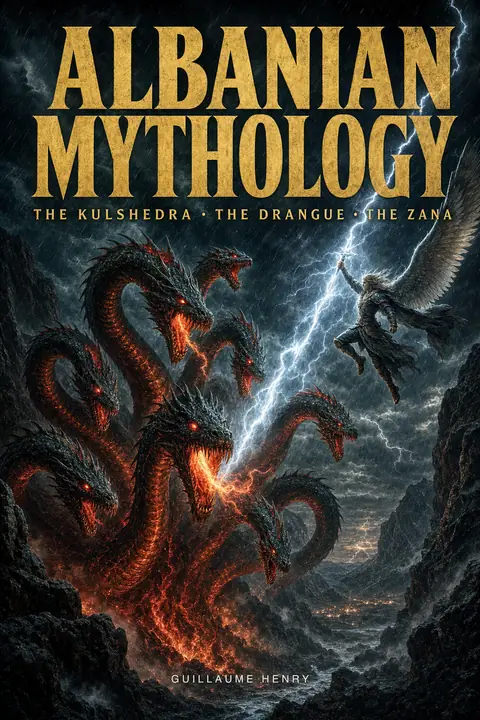
The Albanian Mythology Book: The Kulshedra, the Drangue, and the Spirits of the Mountains
The Kulshedra, the Drangue, and the Zana
The mythology of the Albanian highlands: the Kulshedra, a fire-belching dragon-hag who hoards the rains, the Drangue, winged heroes born to fight her, and the Zana, mountain nymphs who bless and curse. A pagan world that survived in the songs of the highland warriors.
More from Albanian
All articles
Albanian
The Shtriga: Witch-Vampire of Albanian Folklore
The Shtriga is a witch-vampire hybrid from Albanian folklore who feeds on the life force of sleeping children. Part demon, part woman, entirely dangerous, she embodies the fears of a culture caught between Christianity, Islam, and older Balkan beliefs.

Albanian
Muji and Halili: The Epic Heroes of Albanian Legend
Muji and Halili are the legendary twin heroes of Albanian epic poetry, warriors bound by blood and honor who defend their land against mythical monsters and foreign invasion. Discover how their deeds shaped Albanian cultural identity for centuries.
Albanian
The Besa: Sacred Code of Honor in Albanian Culture
The Besa is Albania's oldest unwritten law: a sacred pledge of honor, protection, and hospitality that has shaped Albanian identity for centuries. Discover how this ancient code binds community, defies conquest, and survives in modern Albania.

Albanian
The Zana: Mountain Nymphs and Warrior Maidens of Albanian Folklore
The Zana embody the wild spirit of Albanian mountains: supernatural maidens who heal the wounded, challenge warriors to combat, and guard their domains with ferocity. Learn how these mountain nymphs shaped centuries of Balkan folklore.