Albanian
Pre-Christian beliefs, Illyrian roots, and the survival of oral cosmology through centuries of syncretism. The gods, spirits, and heroes.
Albanian mythology survives not in temple inscriptions or codified scripture, but in the memories of singers, the warnings of grandmothers, and the oaths sworn under open sky. It is a tradition shaped by geography: mountain passes that isolated clans for centuries, invasions that brought new gods but never quite erased the old ones, and an oral culture that treated memory as both archive and act of resistance. The cosmology that emerges is pre-Christian at its core, Illyrian in its oldest strata, and stubbornly persistent through fourteen centuries of overlay.
What makes Albanian mythology distinct is not exoticism but endurance. Where neighbouring traditions were systematically recorded by Christian monasteries or Islamic scholars, Albanian cosmology remained largely unwritten until the nineteenth century. By then, collectors found a living tradition: epic cycles still sung in mountain villages, protective rituals still observed, and a pantheon of spirits whose names predated both the Bible and the Quran.
The essentials
- Albanian mythology preserves an Illyrian substrate, predating Slavic, Roman, and Greek influence in the region.
- Oral epics, particularly the Këngë Kreshnikësh cycle, are the primary sources; no written canon existed before the nineteenth century.
- The cosmology divides into sky, earth, and underworld, with Zojz as sky father and E Bukura e Dheut as earth goddess.
- Syncretism with Christianity and Islam reshaped but did not erase the tradition; saints replaced gods, but the ritual structure persisted.
- Creatures like the Kulshedra and Shtriga link Albanian tradition to broader Balkan and European broader catalogue of mythological creatures.
Origins and the Illyrian Question
The Illyrian Substrate
The Illyrians occupied the western Balkans from at least the second millennium BCE, leaving behind fortifications, burial mounds, and a language known only through fragmentary inscriptions and place names. By the time Rome absorbed Illyria in the second century BCE, the culture had already begun to fracture under pressure from Greek colonies to the south and Celtic migrations from the north. What survived was not a written theology but a network of practices: ancestor veneration, oath-taking rituals, and a cosmology centred on sky and earth.
Albanian, the sole surviving descendant of the Illyrian language family, preserves linguistic fossils. The word zot, meaning lord or god, appears in the theonym Zojz, the sky father. Dhé, earth, anchors the name of E Bukura e Dheut, the Earthly Beauty. These are not borrowings from Latin, Greek, or Slavic; they are indigenous terms, pointing to a cosmology that predates the arrival of Mediterranean and Balkan neighbours.
The question of continuity is vexed. No Illyrian myth survives in written form. What we call Albanian mythology is a reconstruction based on oral epics collected in the nineteenth and twentieth centuries, ethnographic fieldwork conducted between the two world wars, and the stubborn persistence of ritual practice in isolated mountain communities. Scholars debate how much is genuinely Illyrian and how much is later accretion. The honest answer is that we cannot always tell.
Oral Transmission and the Absence of Written Canon
Albanian mythology was never written down by its own practitioners until modernity. The Këngë Kreshnikësh, the Songs of the Frontier Warriors, were transmitted by rhapsodes and village bards, memorised across generations. These are not literary compositions but living performances, subject to variation but remarkably stable in their core narratives. Collectors in the nineteenth century, including Maximilian Lambertz and Giuseppe Schirò, found singers who could recite cycles spanning thousands of lines.
The absence of a written canon is not a deficiency. It is a feature. Oral transmission allowed the tradition to adapt without breaking. When Christianity arrived in the fourth century, saints replaced gods in name but not in function. When Islam spread under Ottoman rule, Allah became the ultimate authority, but the spirits of mountain and hearth remained. The singers adjusted the framing but kept the structure. This is why Albanian mythology feels older than its sources: it is.
Did you know
The Kanuni i Lekë Dukagjinit, a fifteenth-century customary law code, preserves pre-Christian ritual obligations, including oaths sworn by sun and earth, suggesting continuity of cosmological practice even after formal conversion.
The Cosmology: Sky, Earth, and Underworld
The Cosmology: Sky, Earth, and Underworld
Albanian cosmology divides the universe into three realms. The sky is the domain of Zojz, the father god, associated with thunder, oaths, and sovereignty. The earth belongs to E Bukura e Dheut, the goddess of beauty, fertility, and the living world. The underworld, less clearly defined in surviving sources, is the realm of the dead and of chthonic spirits who guard treasure and punish oath-breakers.
The sky and earth are not static. They interact through storms, through the growth of crops, through the birth of heroes. Zojz sends rain; E Bukura e Dheut receives it. This is not metaphor. In the oral epics, the gods are actors, not abstractions. They intervene in battles, bless marriages, and curse those who violate hospitality.
The underworld is less prominent in the surviving material, but it is not absent. The dead are honoured with offerings, and certain spirits, particularly the Ora, are said to dwell at the boundary between life and death. The cosmology is not dualistic in the Christian sense. There is no cosmic battle between good and evil. There is balance, obligation, and the consequences of breaking it.
Major Deities and Spirits
Zojz and the Sky Father
Zojz is the Albanian sky father, cognate with Zeus, Jupiter, and the Proto-Indo-European *Dyēus. His name appears in oaths, in prayers for rain, and in the epithet Zot i Madh, the Great Lord. He is not a distant creator but a present force: the thunder that splits the oak, the storm that waters the fields, the witness to oaths sworn under open sky.
Christian syncretism folded Zojz into the figure of God the Father, but the older associations persisted. Peasants in northern Albania, documented by Margaret Hasluck in the 1920s, still swore oaths by the sky and addressed prayers to the thunder during droughts. The name changed; the function did not.
E Bukura e Dheut: The Earthly Beauty
E Bukura e Dheut, the Earthly Beauty, is the goddess of the living world. She appears in the Këngë Kreshnikësh as a figure of surpassing beauty, sometimes benevolent, sometimes dangerous. She is not a passive fertility symbol. She tests heroes, offers gifts, and punishes those who fail her trials. In some versions, she is the sister or consort of the hero Muji; in others, she is an independent power who grants or withholds her favour.
Her name links her directly to the earth, dhé. She is not the underworld but the surface: the fields, the forests, the places where humans live and labour. She is the goddess you might actually meet, walking a mountain path or standing at the edge of a spring. This immediacy is characteristic of Albanian mythology. The gods are not remote.
The Ora and Fate
The Ora are spirits of fate, assigned to each person at birth. They are sometimes described as three women, sometimes as a single guardian spirit. They determine the span of life, the quality of fortune, and the manner of death. They are not cruel, but they are implacable. Once the Ora have spoken, not even the gods can alter the outcome.
The Ora survive in modern Albanian as a folk belief. Mothers speak of a child's orë, their luck or destiny. Oaths are sworn by the Ora, and certain rituals are performed to appease them. This is one of the clearest examples of pre-Christian cosmology persisting in daily practice, long after the names of the gods have been forgotten or Christianised.
Legendary Heroes and Epic Cycles
Muji and Halili
Muji and Halili are the central heroes of the Këngë Kreshnikësh. They are brothers, warriors of the frontier, defenders of their people against foreign invaders and supernatural threats. The cycle is vast, encompassing dozens of songs, and the narrative is episodic: raids, duels, quests for brides, battles with dragons and witches.
Muji is the elder, the strategist, the one who negotiates with spirits and gods. Halili is the younger, the warrior, the one who charges into battle. Together they embody the dual virtues of the kreshnik, the frontier hero: intelligence and courage, cunning and strength. The cycle is not a single story but a tradition, and different singers emphasise different episodes.
The historical setting is vague, deliberately so. The enemies are sometimes Slavs, sometimes Turks, sometimes unnamed invaders. The geography is recognisable but mythologised. What matters is the structure: the hero's obligation to kin, the code of honour, the willingness to face death rather than dishonour. These are the values encoded in the Kanuni i Lekë Dukagjinit, and they are the values the epics celebrate.
Rozafa and the Foundation Sacrifice
The legend of Rozafa is one of the most widely known Albanian myths, centred on the construction of Rozafa Castle in Shkodër. Three brothers are building the fortress, but each night the walls collapse. A wise man tells them that the structure will stand only if a human sacrifice is made: one of their wives must be immured in the foundation.
The brothers agree to send their wives to the site the next day, and whichever arrives first will be the sacrifice. The two elder brothers warn their wives; the youngest, Rozafa, is not told. She comes to the site with her infant son, and she is walled into the foundation. She asks that her right breast, her right eye, and her right hand be left exposed, so that she can nurse her child, see him, and caress him. The request is granted. The castle stands.
The story is attested across the Balkans, but the Albanian version is the most detailed and the most widely performed. It encodes the logic of foundation sacrifice, a practice attested in archaeological contexts across Europe and the Near East. The myth does not celebrate the sacrifice; it mourns it. Rozafa is not a willing victim but a woman betrayed by the silence of her husband and brothers-in-law.
Creatures and Supernatural Beings
Creatures and Supernatural Beings
The Shtriga and Vampiric Witches
The Shtriga is a witch who transforms into an insect, usually a moth or fly, and drinks the blood of children at night. She is not undead in the manner of the Slavic vampire; she is a living woman who has acquired the power through a pact or through inherited curse. The transformation is nocturnal and secret. By day, the Shtriga appears as an ordinary woman, often elderly, often solitary.
Protection against the Shtriga involves a range of apotropaic measures: garlic hung over the cradle, iron nails driven into the doorframe, prayers recited at dusk. If a child sickens and wastes, the Shtriga is suspected. The cure is to identify the witch and force her to vomit the stolen blood, or to kill her outright. Edith Durham, travelling through northern Albania in 1909, recorded multiple accounts of Shtriga accusations and the violence that followed.
The Shtriga links Albanian tradition to the broader network of vampiric figures in the Balkans, but she is distinct. She is not a corpse but a living predator. Her power is not contagious; it is personal. She is feared not as an omen of death but as a specific, identifiable threat.
Kulshedra: The Multi-Headed Dragon
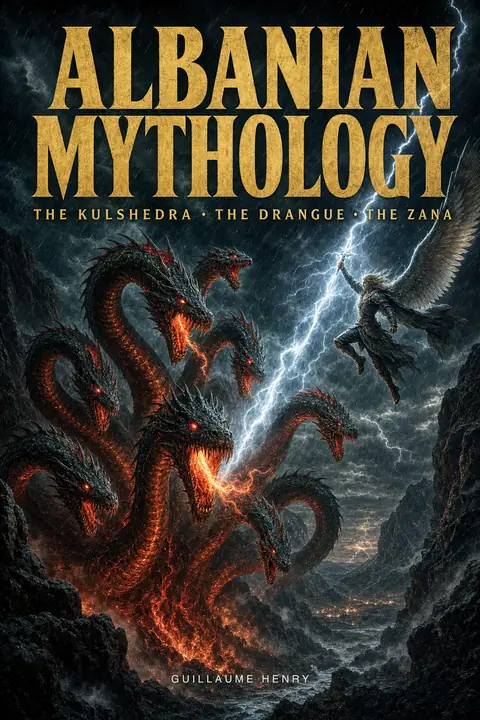
The Kulshedra is a serpent or dragon, often described as having multiple heads, sometimes seven, sometimes nine, sometimes twelve. She dwells in rivers, lakes, or mountain caves, and she is a bringer of drought and plague. The Kulshedra blocks the flow of water, and the land withers. Only a hero, often aided by the Zana, can slay her and restore the rains.
The Kulshedra is female, a detail that distinguishes her from many dragon traditions across Europe. She is not a hoarder of gold but a guardian of water, and her death is an ecological event, not merely a personal victory. In some versions, the hero must drink her blood or bathe in it to gain invulnerability, a motif shared with Sigurd and Siegfried in Germanic tradition.
The Kulshedra's multiple heads link her to multi-headed serpents like Jörmungandr and the Hydra, but her function is distinct. She is not a cosmic enemy but a local catastrophe. She is the drought that kills the crops, the flood that destroys the village. The hero who slays her is not saving the world; he is saving his people.
Zana: Mountain Spirits and Protectors
The Zana are female spirits of the mountains, forests, and waters. They are beautiful, sometimes benevolent, sometimes capricious. They protect warriors, heal the wounded, and punish those who violate the natural world. They are not goddesses in the formal sense, but they are more than fairies. They have agency, power, and a moral code.
The Zana appear frequently in the Këngë Kreshnikësh, often as allies of the heroes. They provide weapons, counsel, and sometimes direct intervention in battle. They are associated with specific locations: a particular mountain, a sacred spring, a forest glade. To offend a Zana is to invite disaster; to honour her is to gain protection.
The Zana are sometimes compared to mermaid-like water spirits or to nymphs in Greek tradition, but the comparison is inexact. The Zana are not seductresses or passive beauties. They are warriors, healers, and judges. They are the spirits of the land itself, and they demand respect.
Practical note
The Zana are still invoked in rural Albania, particularly by shepherds and hunters. Offerings of bread, salt, or milk are left at springs or mountain passes to ensure safe passage.
Syncretism: Christianity, Islam, and Survival
Christian Overlay and Saint Substitution
Christianity arrived in Albania in the fourth century, brought by Roman missionaries and later reinforced by Byzantine and Latin churches. The process of conversion was slow and incomplete. Mountain communities, isolated by geography and suspicious of foreign authority, retained older practices even as they adopted Christian names and rituals.
The strategy of the Church was substitution. Zojz became God the Father. E Bukura e Dheut was folded into the Virgin Mary or local female saints. The Zana became angels or, in some cases, demons. The structure of the cosmology remained: sky, earth, underworld; protector spirits; oaths sworn by natural forces. The names changed, but the logic persisted.
Saint George, the dragon-slayer, became a particularly popular figure, absorbing the role of the hero who defeats the Kulshedra. His feast day, 23 April, is still celebrated with rituals that predate Christianity: animal sacrifice, communal feasting, oaths sworn at dawn. The Church tolerated these practices because suppressing them would have alienated the population. The result was a hybrid tradition, Christian in name but pre-Christian in structure.
Ottoman Period and Islamic Influence
The Ottoman conquest of Albania in the fifteenth century introduced Islam, and over the following centuries, a majority of Albanians converted, particularly in the central and southern regions. Conversion was often pragmatic: it brought tax relief, legal advantages, and access to Ottoman institutions. But it did not erase the older cosmology.
Islamic practice in Albania was notably syncretic. Sufi orders, particularly the Bektashi, incorporated pre-Islamic elements: veneration of saints, pilgrimage to sacred springs, rituals that resembled older offerings to the Zana. The Bektashi tekkes became centres of cultural continuity, preserving oral epics and ritual practices that might otherwise have been lost.
The Këngë Kreshnikësh continued to be sung, even as the heroes were reframed as defenders of Islam against Christian invaders. The cosmology remained: the same spirits, the same oaths, the same moral code. The religious framing shifted, but the mythological substrate did not.
Modern Collection and Scholarship
Systematic collection of Albanian oral tradition began in the nineteenth century, driven by nationalist movements seeking to establish a distinct Albanian identity. Collectors like Giuseppe Schirò and Maximilian Lambertz travelled through mountain villages, recording epics from singers who had memorised thousands of lines. The work was urgent; the tradition was fragile, threatened by modernisation, urbanisation, and the decline of oral performance.
Margaret Hasluck, a British anthropologist, conducted fieldwork in Albania in the 1920s and 1930s, documenting not only myths but the living context in which they were performed: the rituals, the social structures, the legal codes. Her work, published posthumously, remains one of the most detailed ethnographic accounts of Albanian culture before the Second World War.
Under communist rule, from 1944 to 1991, the study of Albanian mythology was complicated. The regime promoted a sanitised version of folklore, stripped of religious content and reframed as proletarian culture. The oral epics were collected and published, but the cosmological context was suppressed. It was only after the fall of communism that scholars could again approach the tradition as a living religious and mythological system.
Today, Albanian mythology is studied as part of the broader field of Indo-European comparative mythology, as a Balkan tradition with links to Slavic, Greek, and Romanian folklore, and as a unique survival of pre-Christian cosmology. The challenge remains the same: how to reconstruct a tradition that was never written down, that survived through memory and performance, and that adapted to centuries of overlay without losing its core.