
The Dragon in Anglo-Saxon Tradition: Fire, Greed, and Gold
Dragons haunted the Anglo-Saxon imagination as creatures of chaos and boundless appetite. From Beowulf's hoard-guarding serpent to the red and white dragons of historical prophecy, these beasts embodied the threats that heroes must face. Explore how Anglo-Saxon culture transformed the dragon from a pagan symbol into a Christian adversary.
Contents
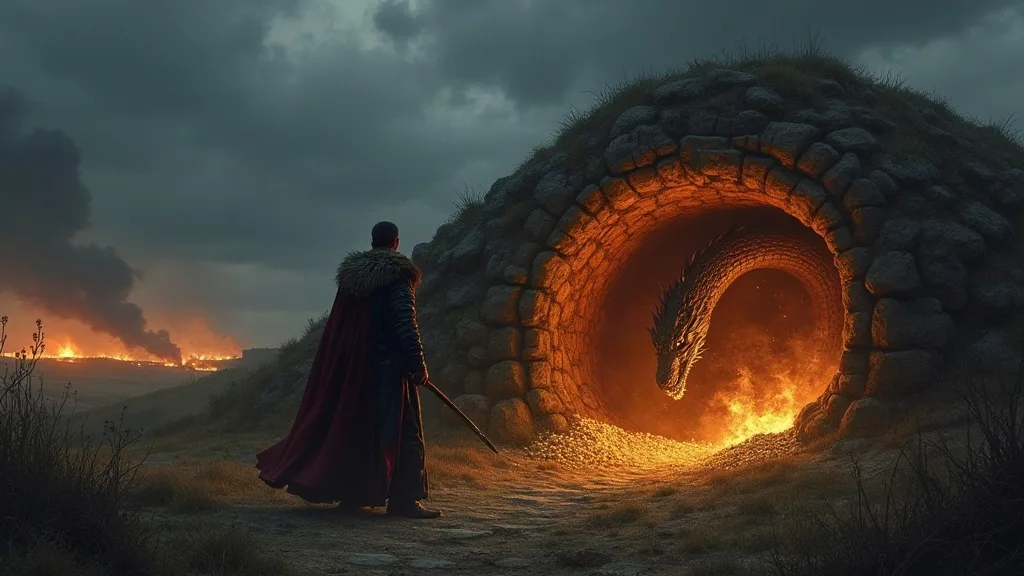
Beowulf stands in the dark outside the dragon's barrow. The creature has already set three fires across his kingdom, turning farmsteads and timber halls to ash. Now, at an age when most men rest, the old king prepares to step into the mountain and face the serpent that guards more gold than a dozen chieftains could spend in a lifetime. This final confrontation, told in the Beowulf manuscript around the year 1000 CE, captures something essential about the dragon in Anglo-Saxon tradition: a creature that tests heroes not through cunning or magic, but through sheer appetite for wealth and the absolute refusal to stop burning.
The dragon in Anglo-Saxon culture walks the line between myth, history, and symbol. These serpents are not mere monsters confined to pagan tales. They appear in historical records, in place names, on battlefield standards, in religious visions, and woven throughout the literature that survived the conversion to Christianity. No Anglo-Saxon writer or king could ignore them. They demanded respect, fear, and a certain grim fascination.
The Dragon as Serpent of the Pagan World
Before the Anglo-Saxons committed their stories to parchment, they shared the Germanic inheritance of the serpent-dragon. The creature they knew was not the jeweled, intelligent wyrm of later medieval romance. It was rawer, closer to the primal chaos that existed before order.
Germanic tradition spoke of serpents as cosmic beings. The most famous echoes in surviving Norse literature: Jörmungandr, the world serpent, wrapped around the earth itself, so enormous that it holds its own tail in its mouth. When it releases that tail at Ragnarök, the world ends. The Anglo-Saxon peoples, who migrated from what is now Germany and southern Jutland in the 5th and 6th centuries, carried versions of this mythology with them across the North Sea to Britain. The serpent was not local. It was cosmological.
But the Anglo-Saxon dragon was also something else: a guardian. In pagan burials and hoards, archaeologists have uncovered evidence that treasures were sometimes protected by ritual or even by living reptiles in captive spaces. The dragon came to embody the principle that the greatest riches demand the greatest risk. To claim treasure meant confronting hunger itself, made flesh and fire.
The Anglo-Saxons worshipped gods whose names still echo in English weekdays: Woden (Wednesday), Thunor (Thursday), Tiw (Tuesday). These deities appear rarely in Anglo-Saxon documents. Most of what we know comes from place names, calendar days, and a few scraps of genealogy claiming kings descended from gods. But nowhere in the surviving Anglo-Saxon sources does a god ride to battle against a dragon. Instead, heroic humans step forward. The dragon is a test of the mortal world, not a creature to be settled by divine intervention.
Beowulf's Dragon: The Ultimate Hoard-Keeper
The Beowulf manuscript preserves the most vivid Anglo-Saxon dragon we possess. This creature guards a burial mound filled with ancient gold. The poem never names the dragon. It is draca (the dragon), wyrm (the serpent), or ealdor (the ancient one). It has existed in the mound for three hundred winters, watching the gold with single-minded focus. When a slave steals a cup from the hoard to escape his master's cruelty, the dragon's reaction is immediate and catastrophic.
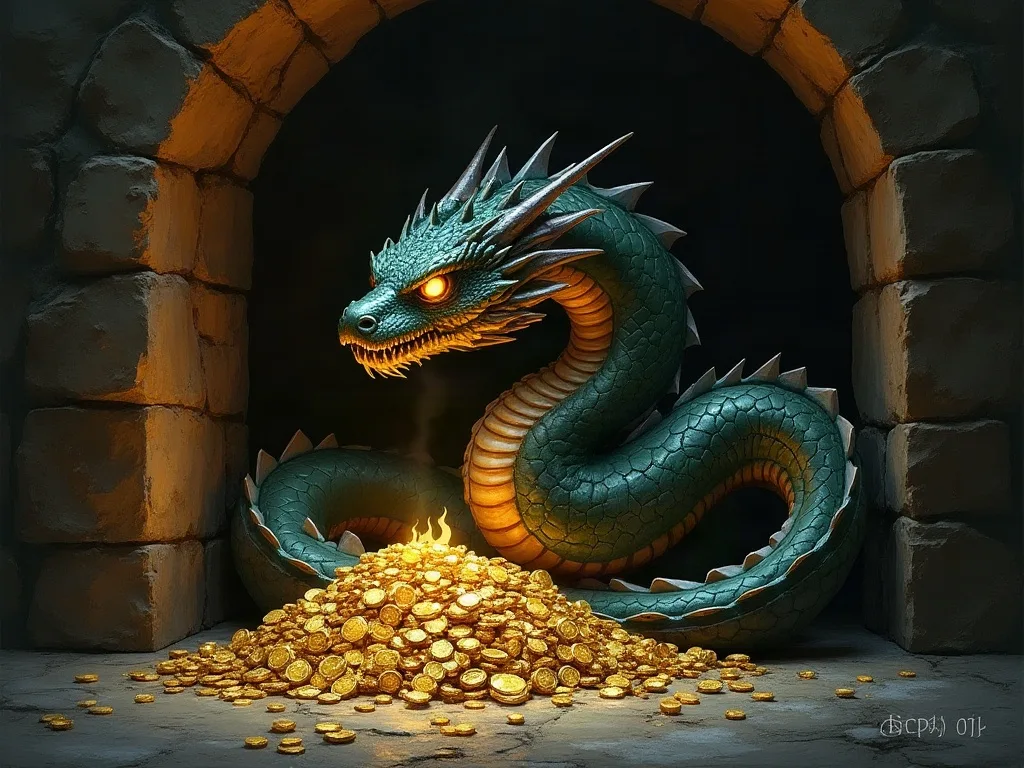
The poet describes the serpent's rage with technical precision. It is about fifty feet long. Its scales cannot be pierced by ordinary weapons. It breathes fire that spreads across entire valleys. It attacks at night, burning homesteads, killing warriors. Most crucially: it returns to the mound every dawn, confident in its treasure, confident in its immortality.
Beowulf, king of the Geats (a people who lived in what is now southern Sweden), decides to fight. His companions flee. Only one young warrior, Wiglaf, stands with him. The fight that follows is the most brutal passage in the poem. The dragon's fire burns Beowulf's shield. The old king's sword fails. He is bitten, poisoned. But Wiglaf drives his blade into the serpent's skull, and Beowulf manages to strike a final cut. The dragon dies.
Beowulf, mortally wounded, crawls to the hoard and sees it before he expires. The gold has meant nothing to him personally. He wanted it only to know that his people were safe, that the fire would stop. The dragon hoards wealth not from desire for use or beauty, but from pure compulsion. This is the Anglo-Saxon dragon's defining trait: it is appetite without wisdom, fire without mercy, possession without purpose.
Dragons in Battle and History
Beyond the Beowulf manuscript, dragons in Anglo-Saxon tradition took on historical and political weight. Kings and warlords adopted dragon imagery on their standards. The dragon became a symbol of power, kingship, and military might. When a soldier marched under the dragon standard, he was claiming kinship with that cosmic, primal force.
The Anglo-Saxon Chronicle, a year-by-year record of English history compiled from the 9th century onward, mentions dragons appearing in the sky as omens. In the year 793, monks at Lindisfarne recorded terrifying portents: dragons in the air, unusual storms, and famine. These omens preceded the Viking raid that destroyed the monastery. A dragon in the sky meant change was coming, often violence. It meant the old order was breaking.
The legendary King Vortigern, who ruled Britain before the Anglo-Saxon invasions, supposedly saw two dragons (one white, one red) fighting in a prophecy or vision. This tale survives in Historia Brittonum, written by the Welsh historian Nennius around 830 CE. The red dragon represented the native Britons; the white, the Saxon invaders. The red dragon falls. This vision, though recorded by a Welsh writer and set in a pre-Saxon context, was known to Anglo-Saxon readers and fit into their sense of dragon-imagery as tied to fate and kingship.
The dragon on standards likely connected to older, pagan significance. Archaeology has revealed dragon-headed brooches and decorative metalwork in Anglo-Saxon graves from the 5th and 6th centuries, before Christianity took hold. The creature was already woven into the Anglo-Saxon visual language of power.
Christian Reinterpretation: The Dragon as Evil
When Christianity arrived in the late 6th and 7th centuries, the Anglo-Saxon dragon was recast. The pagan serpent-guardian became explicitly diabolic.
In Christian theology inherited from late Rome, the dragon was already identified with Satan himself. The Book of Revelation (written in the 1st century CE and widely read in Anglo-Saxon monasteries) describes a great red dragon with seven heads, an image that sent medieval interpreters into elaborate symbolic analysis. Saints, too, were dragon-slayers. Saint George (a martyred Roman soldier whose cult spread through the Eastern Empire and eventually into Western Europe) became the archetypal dragon-fighter. Saints Dunstan, Edmund, and others in the Anglo-Saxon calendar were described as confronting dragons or serpents.
The most dramatic reframing came through the story of Saint George and the Dragon, which, though not originally Anglo-Saxon, became deeply embedded in English and Norman consciousness. A dragon, usually described as a wyrm, plagued a city. A virgin must be sacrificed. George arrives, fights the monster, and conquers it. The dragon becomes not a guardian, not a test, but pure evil to be destroyed. The hero does not accept a wound or die in the struggle (as Beowulf does). George wins cleanly, converting the pagans, rescuing the princess.
Anglo-Saxon monks, copying manuscripts, illustrating margins, and preaching sermons, integrated dragon-slaying into Christian heroism. The pagan test became a theological one: can the Christian warrior, armed with faith, overcome the ancient enemy? The hoard the dragon guarded was reframed as temptation itself. Gold-lust became diabolical pride.
Yet the old Beowulf manuscript survived this reinterpretation. No monastic scribe erased it. Instead, monks in the scriptoriums of Southwick or somewhere in the Southwest preserved the poem in a single, fragile vellum codex. Why? Perhaps because the poem's moral was already compatible with Christian teaching: greed destroys; the hoard itself is spiritually empty; the hero finds meaning not in wealth but in protecting others. A Christian reader could see Beowulf's final act as analogous to Christ's sacrifice.
Dragons in Place Names and Local Tradition
The Anglo-Saxon dragon left marks on the English landscape itself. Draca appears in place names: Drayton (the farm or settlement associated with a dragon, drac + tun). The River Tavy in Devon was sometimes called the dragon's river in local lore. Worm, from the Old English wyrm, also marks the map: Wormley, Wormhall, Wormington. The worm and the dragon were interchangeable creatures in the Anglo-Saxon mind.
Local legends preserved in later sources (often medieval compilations but drawing on older traditions) speak of worms, serpents, guarding springs, living in lakes, or protecting burial sites. A white serpent might guard a sacred well. A black one might haunt a stretch of moorland. These creatures were smaller, more regional than the cosmic dragon of Beowulf, but they shared the fundamental trait: they were forces that demanded respect, that could not be ignored, that embodied danger in the landscape.
Some of these place-linked dragons may have had pre-Christian, local religious significance. A serpent-shrine, a place of propitiation or taboo, might be remembered as "where the worm lived." When Christianity arrived, such places were sometimes rededicated to saints or simply absorbed into Christian folklore as the haunts of demons or dragons that saints had conquered.
The Dragon and Kingship
Beowulf's Dragon
Hoard-guardian, non-intelligent, driven by pure appetite and compulsion. Burns indiscriminately. No personality or speech. Death brings release and peace to the kingdom. Represents the force of destruction that must be met by aged heroism. The hero pays a mortal price.
Medieval Romance Dragons
Often intelligent, conversant, given names and motivations. Hoards gold from vanity or greed. May be outwitted rather than merely killed. Magic and cunning play large roles. The hero often survives and claims the hoard. Represents an obstacle to wealth and status rather than a cosmic threat.
Anglo-Saxon kings used dragon imagery to assert their authority over territory and people. The symbol was old enough to carry pagan prestige, but Christian enough by the 7th and 8th centuries to be incorporated into royal seals and standards without scandal. A king who carried the dragon standard was, in some sense, claiming he could control the very force that burned harvests and killed warriors. He was saying: this ancient power serves me.
The Wyvern (a two-legged dragon variant that became more common in heraldry later) eventually became a key royal emblem. The red dragon of Wales, the white dragon of the Saxons, the dragons of Wessex and Northumbria: each kingdom claimed the serpent as its own. The creature that in pagan times may have represented cosmic chaos was domesticated into a tool of dynastic legitimacy.
Surviving Manuscripts and Literary Echoes
The Beowulf manuscript is our primary source. Written down in the 10th or early 11th century, it preserves a poem likely composed orally in the 6th or 7th centuries (though scholars debate this endlessly). The dragon-episode occupies the final third of the work, and it is the only dragon that survives in substantial detail from Anglo-Saxon literature.
Other Anglo-Saxon texts mention dragons or serpents in passing: in genealogies, as divine wrath, as symbols. But Beowulf stands alone as a coherent narrative centered on a dragon. The poem was rediscovered and studied seriously only in the 19th century after centuries of near-total obscurity. Medieval writers in Norman and later English times knew it only through fragments or hearsay. Its full power was invisible to the medieval romance-tradition that invented talking, intelligent dragons. The Anglo-Saxon dragon remained largely frozen in time, hidden in a single manuscript until modern scholarship brought it into light.
Dragons in Anglo-Saxon Burial and Ritual
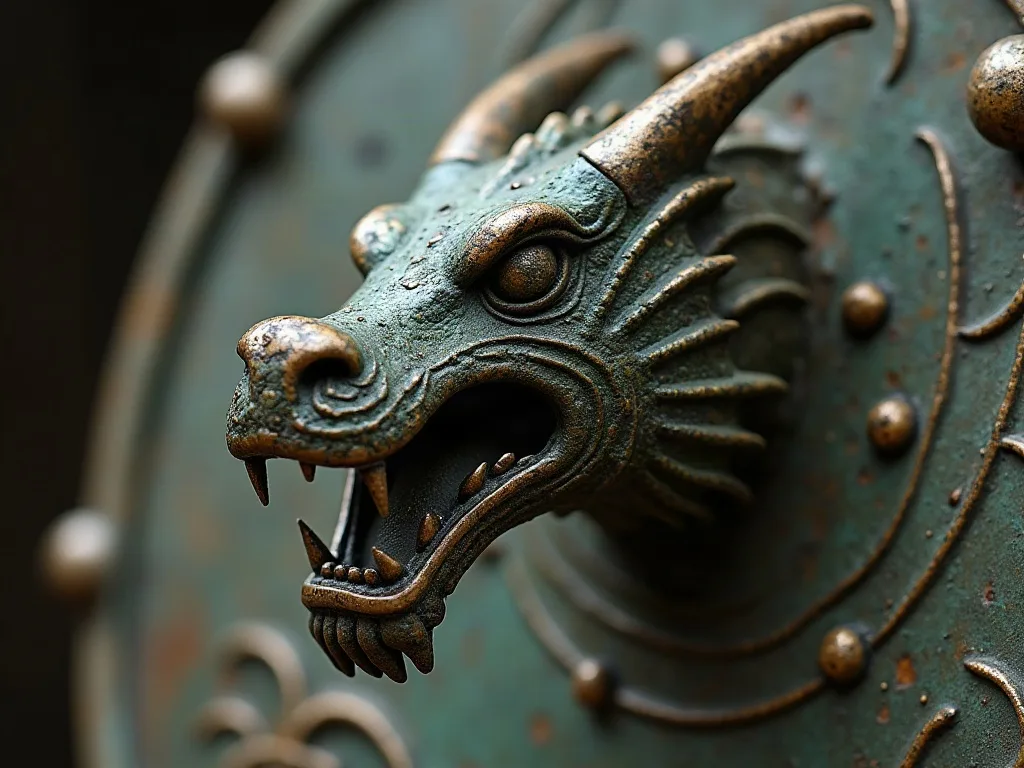
Archaeological evidence hints at dragon-imagery in death and burial. Cremation burials from the 5th and 6th centuries sometimes contained grave goods that included serpent-shaped brooches or shield-bosses decorated with reptilian designs. These may indicate that the warrior was being sent to the afterlife with symbols of strength, danger, or cosmic power.
Some burial mounds themselves may have been seen as dragon-lairs. The mound in Beowulf where the dragon lives is described as ancient, pre-dating the Germanic tribes, possibly referencing the mysterious barrows and hill-forts that dotted the English landscape. An Anglo-Saxon might associate such places with dragons not out of literal belief that a serpent actually inhabited them, but because the mound itself seemed like a dragon's den: dark, old, potentially holding treasure, dangerous to disturb.
The ritual killing of animals in sacrifice (attested in pagan Scandinavian contexts and hinted at in Anglo-Saxon place names like pīceworpe, the sacrifice-farm) may have included serpents or reptilian effigies. If so, the dragon-figure was not only a guardian or threat, but a ritual object through which power was conveyed or malice was turned aside.
The Dragon in Conversion-Era Missionary Art
As Christianity spread through Anglo-Saxon kingdoms in the 6th and 7th centuries, missionaries and local craftspeople began to create illuminated manuscripts and stone carvings that blended Christian symbols with inherited Germanic imagery. Dragons appear on crosses, in borders of Gospel manuscripts, and in the intricate designs of Anglo-Saxon art.
Often, the dragon is shown being trampled or defeated by a saint or by Christ himself. This visual language spoke directly to a population transitioning from pagan to Christian belief. The old powers were not being erased; they were being conquered by the new faith. A pagan warrior who understood the dragon as a cosmic force would look at a cross with a dragon beneath it and understand that Christianity claimed victory over even that primal enemy.
The Lindisfarne Gospels (created around 700 CE in the monastery at Lindisfarne) contain intricate geometric designs that sometimes resemble serpents. Whether intentional or not, they show how the artistic vocabulary of the Germanic peoples was being absorbed into Christian manuscript culture. The dragon-motif was too deeply embedded in Anglo-Saxon visual thought to simply vanish.
Beowulf's Legacy and the Transformation of the Dragon
After the Norman Conquest of 1066, the dragon in English literature began to shift. The Norman invaders brought with them the romance tradition from France, where dragons were often intelligent, sometimes noble creatures with distinct personalities. The Anglo-Saxon dragon, the inarticulate, burning, hoard-guarding serpent, began to seem primitive. Medieval romance writers created dragons who spoke, who possessed wisdom, who could be negotiated with.
Yet the Beowulf dragon never entirely disappeared. When J.R.R. Tolkien (himself a medieval scholar deeply versed in Anglo-Saxon literature) created Smaug in The Hobbit, he drew explicitly from the Beowulf dragon: a creature of pure appetite, possessive of its hoard to the point of madness, killed only because its obsession makes it vulnerable. The intelligence Tolkien gave Smaug was a concession to literary convention, but the core remained Anglo-Saxon: the dragon as burning hunger, the hoard as curse rather than prize.
Modern English-speaking fantasy has largely inherited the Anglo-Saxon vision of the dragon, even if readers do not realize it. The dragon that sits on gold, that kills indiscriminately, that must be faced by the aging hero at terrible cost: this is Beowulf's gift to literature, channeled through centuries of English letters.
Dragons and the Anglo-Saxon Worldview
The dragon in Anglo-Saxon tradition embodied a particular view of the world. It was not nature to be domesticated or understood. It was not a symbol of nobility or ancient wisdom (as it sometimes is in Asian traditions). The Anglo-Saxon dragon was chaos: the fire that consumes, the appetite that never stops, the power that age and kingship cannot prevent, only briefly delay.
This vision emerged from a culture that lived close to fire and water. Thatch-roofed halls burned easily. Ships sank. Winters killed livestock. The dragon, burning and destroying, was not a fantasy of threat. It was a memory made mythological. And the hero who faced it was not a young prince with modern weapons, but an old king with a sword, walking into the dark knowing he would not walk out.
The Anglo-Saxon dragon was real in the way myths are real: not as a fact of nature, but as a true expression of how the world felt to the people who told stories about it. The beast still teaches what those ancient storytellers knew: that some things cannot be negotiated with, that some appetites cannot be satisfied, and that meaning comes not from the hoard you leave behind, but from the fire you stopped.
Frequently asked questions about the dragon in Anglo-Saxon tradition?
Frequently asked questions
Did Anglo-Saxons actually believe dragons existed?
Probably not as literal creatures that lived in English forests, though some undoubtedly believed in the supernatural and demonic. More likely, the dragon was a symbol for real threats (fire, invasion, plague) and a way to explore ethical questions about greed, bravery, and sacrifice. The Beowulf dragon was meant to be taken seriously as a moral and narrative force, even if no one had ever seen a live serpent three hundred feet long.
Is Beowulf's dragon based on a real creature?
Probably not a single creature, but possibly inspired by knowledge of large reptiles (crocodiles or monitor lizards) that reached Northern Europe through trade or legend. The description of the dragon's anatomy and fire-breathing seems designed to be fearsome rather than zoologically accurate. What matters is that the Anglo-Saxons understood the dragon as a plausible supernatural evil, not a fairy-tale invention.
Why did Anglo-Saxon kings use the dragon as their symbol?
The dragon carried prestige from pagan tradition while being reinterpreted in Christian terms as a force to be conquered. A king bearing the dragon standard was claiming both the primal power it represented and his authority over that power. It asserted kingship as something beyond ordinary human authority: a ruler who could command even the chaos the dragon embodied.
What is the difference between the Anglo-Saxon dragon and later medieval dragons?
The Anglo-Saxon dragon (as seen in Beowulf) is non-intelligent, driven purely by appetite and instinct, and inarticulate. Medieval romance dragons became intelligent, conversant, often given names and personalities. The Anglo-Saxon dragon is primal chaos; the medieval dragon is an obstacle or antagonist that can be outwitted. This shift reflects a broader cultural change from viewing nature as untamable to viewing it as puzzles to be solved.
Why did the Beowulf dragon survive when other Anglo-Saxon myths did not?
The manuscript was preserved in a monastic library and copied at least once. But more importantly, the dragon-story was already compatible with Christian morality: it warned against greed, demonstrated the emptiness of treasure, and showed an aging hero choosing sacrifice for his people. A Christian reader could see the poem as compatible with their faith, which may have saved it from deliberate erasure.
Are there any Anglo-Saxon dragon place names still in use today?
Yes. Drayton (meaning dragon-farm or dragon-settlement) appears in several English place names. Wormley, Wormhall, and other compounds with worm (the Old English word for serpent or dragon) dot the map. These names preserve the memory that particular places were associated with serpent-creatures, often in local tradition or legend.
The Dragon's Shadow in Modern Anglo-Saxon Recovery
Modern scholars and fiction-writers have increasingly looked back to Anglo-Saxon sources as foundational to English and British identity. The dragon in Beowulf has become an emblem of that recovery. Unlike the intelligent, aristocratic dragons of medieval romance, the Anglo-Saxon dragon is raw, elemental, and philosophically weighty. It asks hard questions: What is worth dying for? What does a kingdom owe its king? Why do we hoard wealth we cannot use?
This rediscovery is not mere nostalgia. The Anglo-Saxon dragon, filtered through Tolkien, through modern fantasy, and through contemporary scholarship, has become a cultural reference-point in English-speaking literature and imagination. When a modern writer invents a dragon that is driven by greed, inarticulate, and defeated only at great cost, they are working within the tradition the Anglo-Saxons established. The dragon that burned across the screen in the final season of Game of Thrones, indiscriminate in its fury, un-negotiable in its nature, owes more to Beowulf than to any other literary ancestor.
The dragon in Anglo-Saxon tradition endures not because it is primitive, but because it is true. The serpent that cannot be reasoned with, that embodies appetite without wisdom, that can only be faced and stopped, not understood and befriended: this remains the most honest image of certain forces in human experience. The Anglo-Saxons knew this. They encoded it in their most important surviving poem. And nearly a thousand years later, we are still learning from what they saw in the dark outside that barrow, where the fire burned and the gold lay waiting.
Read the full book
Want the whole story?
The complete edition is an instant PDF download here, with a paperback on Amazon for selected titles.
Anglo-Saxon
The Anglo-Saxon Mythology Book: Woden, Thunor, Beowulf, and the Lost Gods of Pre-Christian England
The Sacred Stories Before Christianity Buried Them
The mythology of pre-Christian England: Woden's ravens, Thunor's thunder, Beowulf's monsters, and the Wyrd sisters who wove fate. Recovered from Beowulf, royal genealogies, and the grave goods.
More from Anglo-Saxon
All articles
Anglo-Saxon
Hengist and Horsa: Legendary Founders of Anglo-Saxon England
Two brothers from Germanic lands, Hengist and Horsa led the first English settlers across the North Sea. Their arrival around 449 CE marks the beginning of Anglo-Saxon England, though history and legend now blur beyond recognition.
Anglo-Saxon
The Wild Hunt in Anglo-Saxon Belief: Spectral Riders and the Hunt for Souls
The Wild Hunt in Anglo-Saxon belief was a ghostly procession across the night sky, led by divine or demonic riders who hunted both the living and the dead. Discover how this ancient vision shaped English folklore for over a thousand years.

Anglo-Saxon
The Sutton Hoo Ship Burial: Archaeology and Myth
In 1939, archaeologists uncovered a 27-meter ship buried in Suffolk, England, holding treasures and weapons from the 6th century. The Sutton Hoo ship burial bridges Anglo-Saxon reality and the epic worlds of Beowulf, revealing how real kings were sent to their gods.

Anglo-Saxon
Eostre: Goddess of Spring and Dawn
Eostre is the Anglo-Saxon goddess of spring, dawn, and fertility, known through a single historical mention by the Venerable Bede. Discover how this shadowy deity shaped the season of renewal and inspired the modern holiday of Easter.