

The Sutton Hoo Ship Burial: Archaeology and Myth
In 1939, archaeologists uncovered a 27-meter ship buried in Suffolk, England, holding treasures and weapons from the 6th century. The Sutton Hoo ship burial bridges Anglo-Saxon reality and the epic worlds of Beowulf, revealing how real kings were sent to their gods.
Contents
In the summer of 1939, a farmer's plough turned up unusual soil near the village of Sutton Hoo in Suffolk, England. That autumn, a team of archaeologists began digging into a grassy mound. They found something that would rewrite the history of early medieval England: a 27-meter ship, buried beneath the earth for 1,400 years, loaded with gold, weapons, and the remnants of a royal burial. No bones remained, only shadows in the soil. Yet the artifacts told a vivid story of power, trade, and the pagan cosmology of Anglo-Saxon kings.
The Sutton Hoo ship burial connects two worlds that seem impossibly far apart. One is the hard, measurable world of archaeology: the actual objects, the metallurgical evidence, the dating. The other is the mythic landscape we know from texts like Beowulf, the epic poem that describes a hero's funeral as a ship sent out to sea. For decades, scholars debated whether ship burials were real practices or literary fantasy. Sutton Hoo settled the question. The ship was real. The myth was grounded in lived ritual.
This site sits at the crossroads of history and legend, showing how Anglo-Saxon kings commanded the cosmos through burial, trade, and display of wealth.
Who Was Buried at Sutton Hoo?
The ship lies in what was the Kingdom of East Anglia, one of the Anglo-Saxon kingdoms that dominated 6th-century Britain. The royal cemetery at Sutton Hoo contained several mounds, but the largest ship, known as Mound 1, held the richest deposit. Most scholars agree the burial dates to the early 7th century, around 620-640 CE, placing it in the reign of King Redwald or shortly after.
Redwald was a powerful East Anglian king who, according to the Ecclesiastical History of the English People by the monk Bede (written around 731 CE), ruled with such influence that he was once called the bretwalda, a term meaning "wide-ruler" or high king over multiple kingdoms. Bede recorded that Redwald was baptized as a Christian but later reverted to pagan worship, keeping both altars in his hall. This religious ambiguity mirrors some of the artifacts found in the burial: Christian and pagan objects lying side by side.
Whether Redwald himself lay in the ship or a successor remains debated. The acidic soil of East Anglia dissolved bone completely, leaving only voids and chemical traces. But the scale of the burial, the objects chosen, and the ritualistic care suggest a figure of supreme authority. The ship itself was a statement: this man commanded enough wealth and labor to bury a vessel the size of a small warship, loaded with treasure, underground.
The Ship and Its Journey to the Afterlife
The vessel was clinker-built, a technique in which overlapping wooden planks were sewn together with cord. The original structure no longer remained, but the excavators could trace its shape by the rust shadows left by iron rivets and the slight depression in the earth. Modern reconstructions estimate the ship was about 27 meters long and 4 meters wide, shallow-drafted enough to navigate the coastal rivers of East Anglia but robust enough for ocean voyages.
The decision to bury a ship speaks directly to Anglo-Saxon funeral practices and their roots in older Germanic traditions. Across the North Sea, in what is now Scandinavia, ship burials are well-documented in the archaeological record. The Oseberg ship burial in Norway, dated to around 834 CE, is the most famous example: a 22-meter Viking ship containing a high-status woman, a wealth of textiles, tools, and animals. Yet Sutton Hoo predates most recorded Viking ship burials by centuries, suggesting that the custom had deep roots in earlier Germanic culture, carried westward by the very Anglo-Saxons who invaded Britain in the 5th and 6th centuries.
In Norse mythology, ships carry the dead to other realms. Naglfar, a ship made from the fingernails of the dead, carries giants at the end of the world. Baldr, the god of light, is given a ship burial in the Prose Edda after he dies, his body placed on a pyre inside his ship Ringhorn, which is set aflame. These texts were written down centuries after the Sutton Hoo burial, yet they preserve much older oral traditions. What the Norse texts celebrate in myth, the Sutton Hoo king enacted as ritual: the belief that a ship carries the dead past the boundaries of the living world.
The Treasures: Gold, Silver, and Symbols of Power
The burial chamber was not a single enclosed space but rather a wooden structure built inside the ship's hull, positioned near the prow. When archaeologists carefully excavated this chamber, they found artifacts that speak of a king whose power extended across vast networks of trade and alliance.
Among the most striking objects were metalwork items of extraordinary skill. A great gold buckle, weighing over 400 grams, was inlaid with garnets and millefiori glass (colored glass set into metal cells). The buckle's geometric interlace design mirrors the style seen in Beowulf and other Anglo-Saxon art: intricate, balanced, almost hypnotic. Such a buckle would have held a wide leather belt, a symbol of authority visible to anyone in the king's presence.
There were Byzantine coins, some copper bowls from the Mediterranean, and what is believed to be a lyre, a stringed instrument of Roman origin. These objects prove that East Anglian kings were not isolated chieftains but players in a vast early medieval economy stretching from the Mediterranean to the North Sea. Goods flowed from Frankia, Byzantium, and Scandinavia into the treasuries of Anglo-Saxon kings.
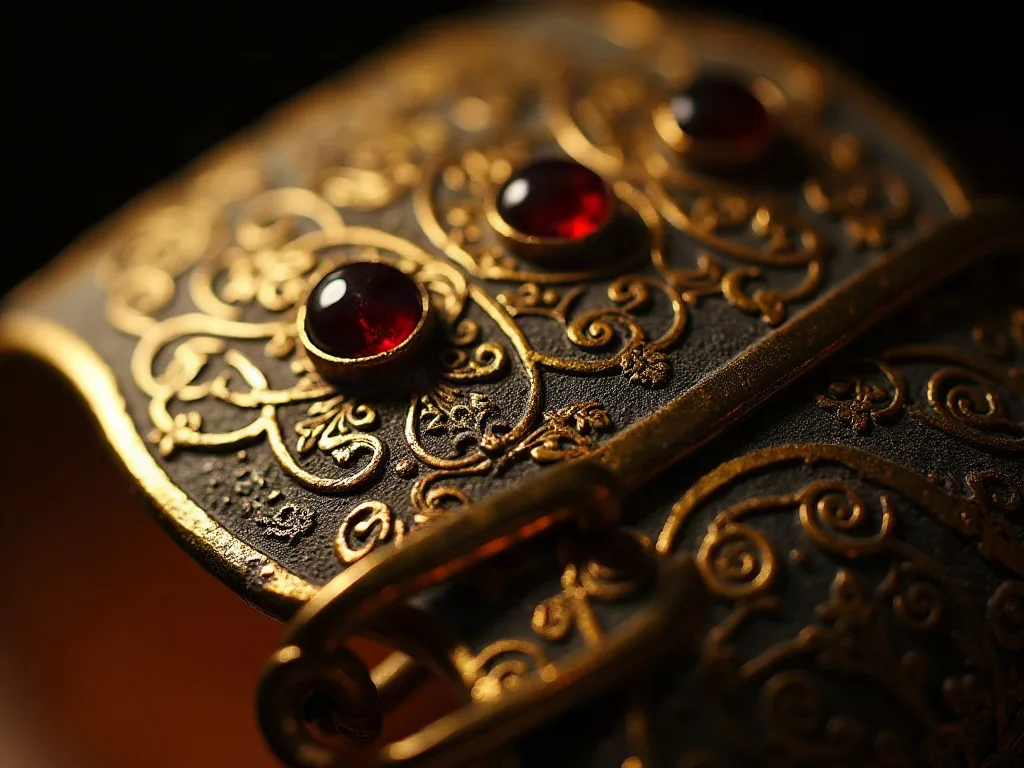
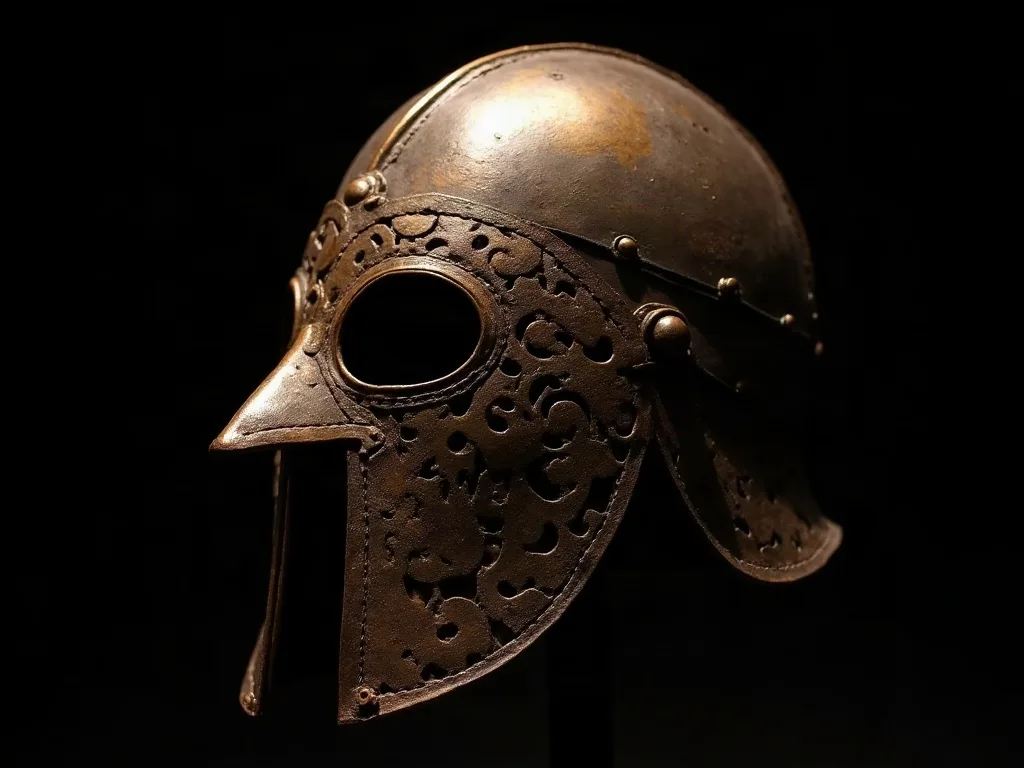
Weapons filled the chamber: a war spear, a sword with jeweled gold and garnet fittings, a shield decorated with bronze and iron. These were not mere tools but treasured heirlooms, made by craftsmen whose names are lost. A helmet, reconstructed from fragments, shows the intricate metalwork of the period: faceplates, neck guards, and a design that would have made the wearer look almost otherworldly in battle.
The presence of silver spoons marked with Greek letters, possibly inscribed with Christian references, underscores the religious complexity of the era. Anglo-Saxon kings in this period stood at a crossroads between pagan Germanic traditions and the Christian faith spreading from the Mediterranean and Celtic lands. Some scholars interpret these spoons as baptismal gifts, while others see them as simple prestigious imports. The ambiguity is historically apt: the men and women of Sutton Hoo's era were navigating this spiritual transition, not always choosing one path or the other.
The Pagan Cosmos in Grave Goods
What binds these objects together is not their monetary value alone but their symbolic meaning in a pagan worldview. The Anglo-Saxons who buried the Sutton Hoo king were heirs to Germanic religious traditions that would eventually be preserved, fragmentarily, in Norse mythology. They believed in a cosmos ordered by divine powers, in the necessity of exchange between the living and the dead, and in the power of wyrd, a fate that could not be escaped but could be honored through ritual and display.
The gold and silver in the chamber were not intended for use in the afterlife as a merchant's ledger. Rather, they were offerings, payment to the otherworld, a demonstration that this king had accumulated the wealth necessary to command both the living and the dead. In Germanic tradition, a king's power rested not only on military strength but on his ability to distribute treasure to his followers, to conduct trade, and to perform the rituals that kept the cosmos in balance.
The presence of feasting implements, including drinking vessels, hints at funerary feasting practices. In Anglo-Saxon and Norse customs, the funeral was an opportunity for the living community to gather, remember the dead, and reinforce their bonds. These vessels may have been used in such a feast before being placed in the grave, or they may have been intended for use in the otherworld.
One of the most enigmatic objects is a metal stag sculpture, a sophisticated work of abstract design. Stags appear frequently in Celtic and Germanic art and mythology, often associated with kingship and the otherworldly realms. Whether this stag was a decorative item, a religious symbol, or something else entirely, it speaks to a shared visual language across the pagan cultures of early medieval Europe.
Beowulf Made Archaeology
No discussion of Sutton Hoo can ignore Beowulf, the Old English epic composed sometime between the 7th and 11th centuries. The poem contains one of the most famous descriptions of a royal burial: the funeral of Scyld Scefing, the legendary founder of the Scylding dynasty.
In Beowulf, Scyld is placed in a ship loaded with treasure and sent out to sea. The poem reads: "They laid him down in the stern, amidships, the great ring-giver. Far-fetched treasures were piled upon him, and precious objects from distant lands." The description is vivid and ceremonial, presenting the ship burial as a fitting end for a king of immense power.
For centuries, scholars treated this passage as pure invention, a literary device with no basis in actual practice. Ship burials seemed too fantastical, too expensive, too impractical to be real. But when the Sutton Hoo burial was excavated and the scale of the operation became clear, the literary and the archaeological suddenly converged. Here was a real ship. Here were real treasures. Here was a ritual that matched the epic's description.
The Beowulf poet did not invent the ship burial. He preserved it in verse, transforming actual Anglo-Saxon practice into timeless narrative. This is how mythology works: it takes the rituals and beliefs of a people and casts them in epic form, elevating them to the level of heroic truth. Sutton Hoo proves that such truth need not be incompatible with historical reality.
Ritual, Death, and the Liminal Threshold
Sutton Hoo represents a moment of profound transition. Archaeologically, it marks the shift from pagan Anglo-Saxon practice toward a Christianizing society. The 7th century was the period when missionaries arrived in England, converting kings and peoples. Yet the Sutton Hoo burial is decidedly pagan in its cosmology: a ritual designed to send a king beyond the boundaries of the living world, loaded with precious objects meant to assert his power in the afterlife.
The ship itself occupies a liminal space. Ships are threshold vessels, carrying people between shores, between the living world and the realm of the dead. In Germanic and Norse mythology, the ocean itself is often a boundary space, dangerous and sacred. The ship burial combines the practicality of transport with the symbolism of passage. It is both a real object and a mythic symbol.
The absence of a visible grave marker in the final form of the mound is significant. Unlike later Christian burials, which are marked with stone crosses or monuments meant to preserve memory, the Sutton Hoo king was buried under a mound of earth, a tumulus that muted rather than displayed the grave. This concealment may reflect a belief that the king's true residence was no longer in the earthly mound but in the otherworld, accessed via the ship. The mound itself becomes less a monument to the dead than a boundary marker, a threshold between the visible and invisible worlds.
Excavation and Modern Interpretation
The initial 1939 excavation was led by Basil Brown, a local archaeologist and plumber, along with C.W. Phillips from Cambridge. They worked with minimal equipment and great care, recognizing the site's importance almost immediately. The finds were catalogued and eventually housed in the British Museum, where they remain today.
A second major excavation occurred in 1965-67, using more refined archaeological techniques. Teams re-examined the mounds and discovered that Sutton Hoo was not a single burial but a cemetery of multiple mounds, some containing inhumations (full bodies), others cremations, and still others containing grave goods without visible human remains. This context changed interpretation. Mound 1 was revealed to be exceptional but not unique; it belonged to a larger tradition of high-status burial that spanned generations.
Modern analysis has brought new precision to the finds. X-ray fluorescence has identified the origins of metals and glass. Pollen analysis has reconstructed the landscape. DNA analysis of animal bones found in the chamber (including the remains of a horse and dogs) has clarified their species and origin. Yet the fundamental mystery remains: was the king's body ever in the grave, or was this a cenotaph, an empty tomb honoring a king whose body lay elsewhere?
The acidic East Anglian soil dissolved all bone. The excavators found only voids and iron oxide stains, chemical shadows of wood and metal. These can be interpreted as the remains of a burial, or as evidence that the king was buried or cremated elsewhere, and the ship was merely a symbolic offering. Both readings are defensible. The ambiguity is genuine, not a failure of archaeology.
The Bridge Between Worlds
What makes Sutton Hoo remarkable is not that it proves mythology was real (myths are not photographs; they are symbolic truths), but that it shows how ritual and narrative are interwoven in human culture. The Anglo-Saxon king at Sutton Hoo was buried according to practices that appear in Beowulf because both the burial and the poem express the same worldview: a cosmos in which kings command power, wealth flows as an assertion of status, and death is a transition that must be ritualized, honored, and celebrated with symbols that carry meaning across the boundary between worlds.
The ship was made of wood and iron, but it carried a king who believed in the old gods, in fate, in the necessity of exchange with powers beyond the living world. The treasures were gold and silver, but they were offerings, meant to assert dominion in a realm the living can only access through imagination and faith. The burial is historical fact; the mythology embedded in it is spiritual truth.
Sutton Hoo connects the epic of Beowulf to the archaeological layers of East Anglia. It shows that the lines between myth and history are not as firm as modern scholarship has sometimes assumed. A ship burial can be both a historical practice and a mythic symbol, both an archaeological fact and a narrative device. The king who rested there, his name now lost, commanded the visible world through his accumulated treasure and his authority. In death, his burial commanded the invisible world through ritual, through the ship that would carry him beyond the boundaries of the known.
Frequently asked questions about the Sutton Hoo Ship Burial?
Frequently asked questions
Was a body actually found in the Sutton Hoo burial chamber?
No intact body was found. The acidic soil of East Anglia dissolved all bone material, leaving only voids and chemical traces. Excavators found iron oxide stains that may indicate where a body once rested, but no skeletal remains. The burial may have contained a body that decomposed entirely, or it may have been a cenotaph, a symbolic grave honoring a king buried elsewhere. Both interpretations remain plausible.
How do we know the Sutton Hoo burial dates to around 620-640 CE?
The dating relies on several lines of evidence: Byzantine coins found in the chamber (which can be dated precisely), the style of metalwork and weaponry (which matches 7th-century Anglo-Saxon craftsmanship), and the historical context of the East Anglian royal line. King Redwald, the most likely candidate for the burial, reigned during this period according to Bede. Radiocarbon dating of wood samples has corroborated these estimates.
How does Sutton Hoo connect to Norse mythology and Viking ship burials?
Sutton Hoo predates most documented Viking ship burials by centuries, suggesting that the practice had deeper roots in common Germanic traditions shared by both Anglo-Saxons and Norse peoples. The mythological treatment of ship burials in Norse sources (such as Baldr's funeral in the Prose Edda) likely preserves much older oral traditions that were enacted in burial practice, as Sutton Hoo demonstrates.
Why did Anglo-Saxon kings bury treasure with the dead?
In pagan Germanic worldview, wealth and treasure were not static possessions but symbols of power and instruments of exchange. Burying treasure with the dead was an act of gift-giving to the otherworld, asserting the king's dominion over both the living realm (through accumulated wealth) and the realm of the dead (through ritual and offering). It also prevented the wealth from being scattered or contested after the king's death.
Is Beowulf describing an actual historical practice in its account of Scyld's funeral?
Yes. For centuries, scholars debated whether ship burials were real or purely literary invention. Sutton Hoo provided archaeological confirmation that ship burials were genuine Anglo-Saxon practice, validating the Beowulf poet's description. The poet was not inventing but preserving actual customs, elevated into heroic narrative. This demonstrates how mythology can encode historical truth while remaining symbolically true.
The Enduring Mystery of Sutton Hoo
More than eighty years after its discovery, Sutton Hoo continues to generate scholarly debate and public fascination. Recent excavations have expanded the known cemetery, revealing other burials and new insights into East Anglian royal practices. Yet the central mysteries persist: the identity of the buried king, the precise ritual functions of the grave goods, the spiritual beliefs that animated the act of burial.
This ambiguity is not a weakness but a strength of the site. Sutton Hoo demonstrates that archaeology cannot always resolve every question, and that this incompleteness mirrors the nature of myth itself. Myths do not answer all questions; they hold questions open, allowing each generation to find new meaning in old symbols.
The ship lies in a museum now, fragmented and displayed under glass. Yet in the landscape of Suffolk, the mounds remain, visible from the road, archaeological ghosts of a vanished power. To stand at Sutton Hoo is to stand at a threshold: between the pagan past and the Christian future, between historical fact and imaginative myth, between the concrete artifacts archaeologists can unearth and the spiritual truths they carried for people long dead. The king who rested there once commanded both shores of that divide. His burial remains a bridge between the two.
Read the full book
Want the whole story?
The complete edition is an instant PDF download here, with a paperback on Amazon for selected titles.
Anglo-Saxon
The Anglo-Saxon Mythology Book: Woden, Thunor, Beowulf, and the Lost Gods of Pre-Christian England
The Sacred Stories Before Christianity Buried Them
The mythology of pre-Christian England: Woden's ravens, Thunor's thunder, Beowulf's monsters, and the Wyrd sisters who wove fate. Recovered from Beowulf, royal genealogies, and the grave goods.
More from Anglo-Saxon
All articles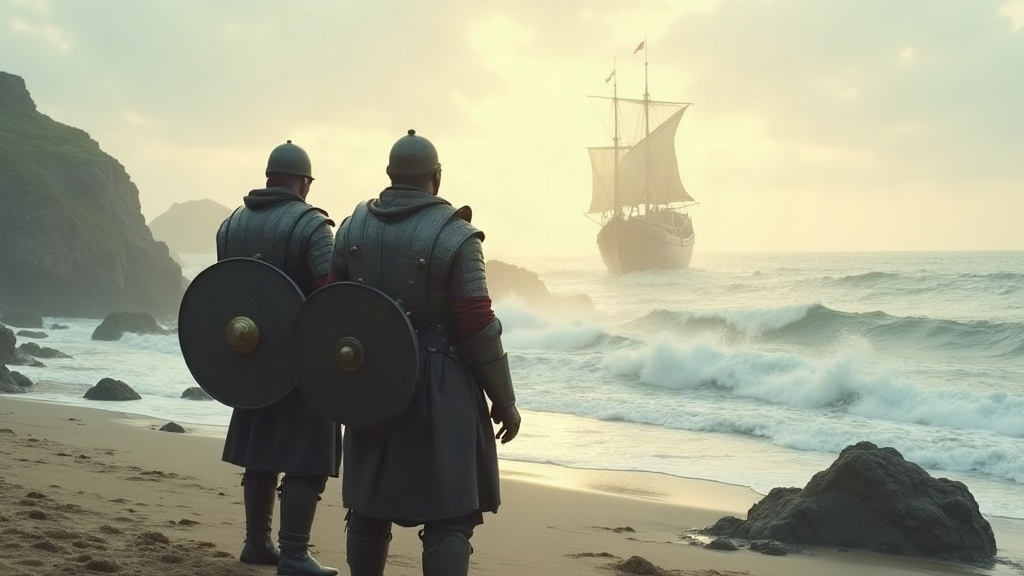
Anglo-Saxon
Hengist and Horsa: Legendary Founders of Anglo-Saxon England
Two brothers from Germanic lands, Hengist and Horsa led the first English settlers across the North Sea. Their arrival around 449 CE marks the beginning of Anglo-Saxon England, though history and legend now blur beyond recognition.
Anglo-Saxon
The Wild Hunt in Anglo-Saxon Belief: Spectral Riders and the Hunt for Souls
The Wild Hunt in Anglo-Saxon belief was a ghostly procession across the night sky, led by divine or demonic riders who hunted both the living and the dead. Discover how this ancient vision shaped English folklore for over a thousand years.

Anglo-Saxon
Eostre: Goddess of Spring and Dawn
Eostre is the Anglo-Saxon goddess of spring, dawn, and fertility, known through a single historical mention by the Venerable Bede. Discover how this shadowy deity shaped the season of renewal and inspired the modern holiday of Easter.
Anglo-Saxon
The Dragon in Anglo-Saxon Tradition: Fire, Greed, and Gold
Dragons haunted the Anglo-Saxon imagination as creatures of chaos and boundless appetite. From Beowulf's hoard-guarding serpent to the red and white dragons of historical prophecy, these beasts embodied the threats that heroes must face. Explore how Anglo-Saxon culture transformed the dragon from a pagan symbol into a Christian adversary.