
The Wild Hunt in Anglo-Saxon Belief: Spectral Riders and the Hunt for Souls
The Wild Hunt in Anglo-Saxon belief was a ghostly procession across the night sky, led by divine or demonic riders who hunted both the living and the dead. Discover how this ancient vision shaped English folklore for over a thousand years.
Contents
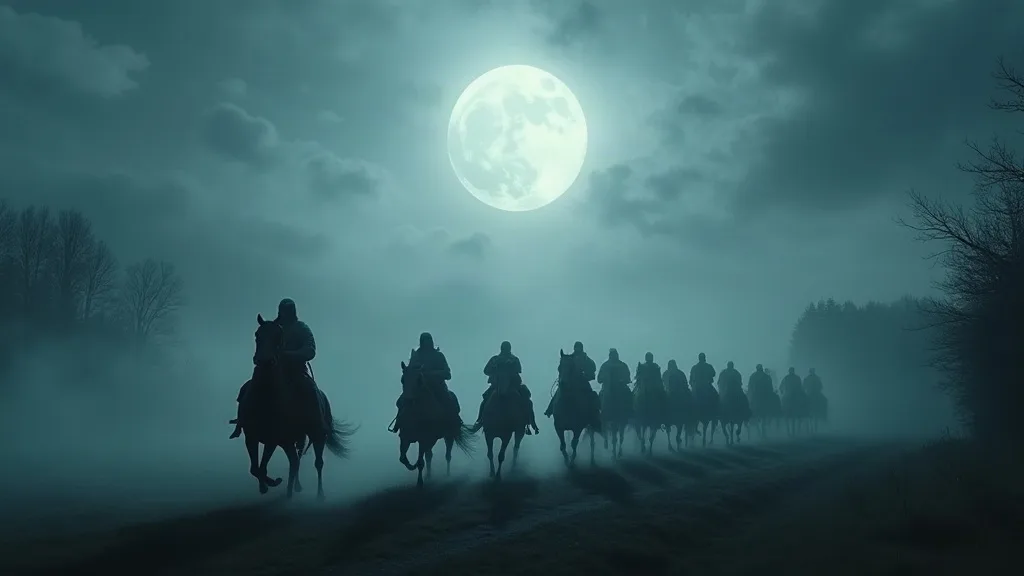
A horn sounds across the dark. Hoofbeats shake the earth. Riders stream through the sky like clouds unraveled, hunting something the living cannot name. For Anglo-Saxon peoples, this was the Wild Hunt in Anglo-Saxon belief: a primal force that crossed from the divine world into human territory, taking souls, announcing death, and leaving witnesses changed.
This spectral procession haunted the imagination of Anglo-Saxon England from the 5th century onward, tangled with both pagan memory and Christian reinterpretation. It shaped how these people understood fate, the boundary between living and dead, and the terrifying power of forces beyond human control. The Hunt survived the Christian conversion, mutating into new forms, but its essence remained: unstoppable movement, cosmic consequence, and the certainty that some things must be fled and never questioned.
Origins in Germanic Pagan Practice
The roots of the Wild Hunt in Anglo-Saxon belief run deep into Germanic tradition. The Anglo-Saxons came from what is now Germany, Denmark, and southern Scandinavia, bringing with them a worldview in which gods and giants moved through human space without warning. The Hunt itself was not unique to Anglo-Saxon England; similar visions appear in Norse sagas, Old High German texts, and Welsh mythological cycles. But each culture gave it distinctive shape.
In pre-Christian Anglo-Saxon England, the Hunt likely connected to sacred kingship and the autumn festivals. The Anglo-Saxons marked the year in halves: summer and winter, with liminal periods when the boundaries between worlds grew thin. The Hunt rode most often at these thresholds, particularly at Samhain (the Celtic name preserved in the tradition) or the midwinter festivals that the Anglo-Saxons observed. These were not mere dates but ritual windows when death could walk, ancestors could speak, and divine forces took physical form.
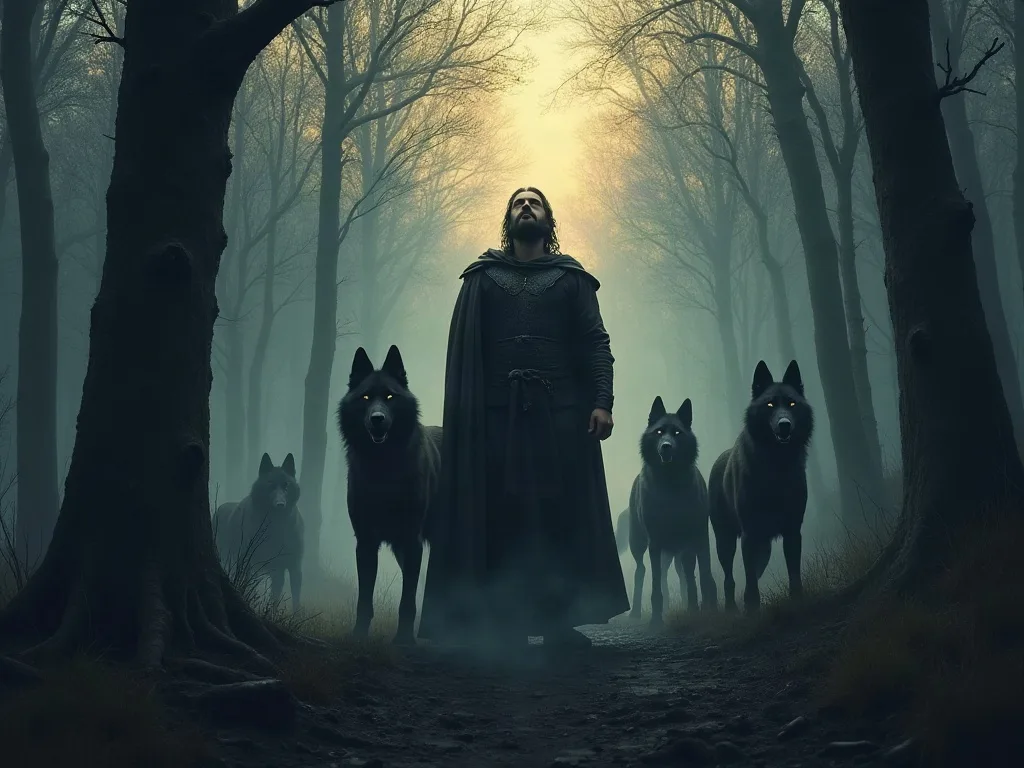
The leader of the Hunt was fluid. In some Anglo-Saxon accounts, it was Woden, the chief god of the Anglo-Saxon pantheon, a figure of wisdom, war, death, and magic all at once. Woden hung himself on the world-tree to gain knowledge; he wandered the earth in disguise, gathering secret names and the souls of the slain. To encounter Woden's hunt meant to glimpse the god's true function: not a friendly father but a collector of souls, a walker between the world of the living and the realm of death. Other traditions named different leaders: local heroes, former kings deified by violence, or demons added later by Christian writers trying to make sense of the phenomenon through a clearer moral lens.
The Hunt was not merely a vision. Chronicles and surviving folk testimony suggest Anglo-Saxons believed it genuinely rode across the sky and through the forests. The sound was real to them. The wind that carried it. The uncanny silence that followed. A person who saw the Hunt and lived carried a secret weight. Some were said to have been touched by it, marked for death within the year.
The Christian Transformation
When Christianity came to Anglo-Saxon England in the 6th and 7th centuries (beginning with Augustine's mission in 597), the missionaries faced a problem: how to handle the Wild Hunt. They could not erase it from the collective imagination. It was too vivid, too woven into seasonal ritual, too powerful a symbol of fate and the unseen world.
Instead, the Church reframed it. The Hunt became demonic. Its riders were devils, not gods. The leader was not Woden but a pagan phantom, a damned soul condemned to eternal flight. This reinterpretation did something subtle: it acknowledged that the Hunt existed and was real, but shifted its moral meaning. It was no longer a sacred mystery but a warning. To see the Hunt was to glimpse damnation. To hear it was to be reminded that the pagan past was alive but fallen, stripped of holiness and locked into endless punishment.
This rebranding was remarkably successful. By the 8th century, Anglo-Saxon chroniclers and ecclesiastical writers were recording Hunt sightings as portents. The Anglo-Saxon Chronicle, that great collage of records kept by monks, mentions strange hunts in the sky, often paired with comets or the death of kings. These were interpreted as divine warnings, but they retained the ancient structure: sudden sound, motion across the sky, a sense of cosmic power moving outside human law.
The Christianized Hunt became an omen of plague, war, or the death of rulers. When Halley's Comet appeared in 1066, Anglo-Saxon writers again invoked the language of celestial hunts and spectral riders. The old and new interpretations had fused so completely that it was impossible to say where pagan memory ended and Christian theology began.
Figures and Forms in the Hunt
The Wild Hunt in Anglo-Saxon belief was not a single entity but a crowd, a procession with a distinct internal structure. At its head rode the leader, often identified in later medieval texts as a wild huntsman or, in some accounts, a woman riding sidesaddle with a pack of hounds. Behind came the hunters, sometimes described as warriors or the souls of the recently dead. Then the hunted: game animals, but also human souls, sometimes identified as unbaptized infants or suicides who had forfeited Christian burial.
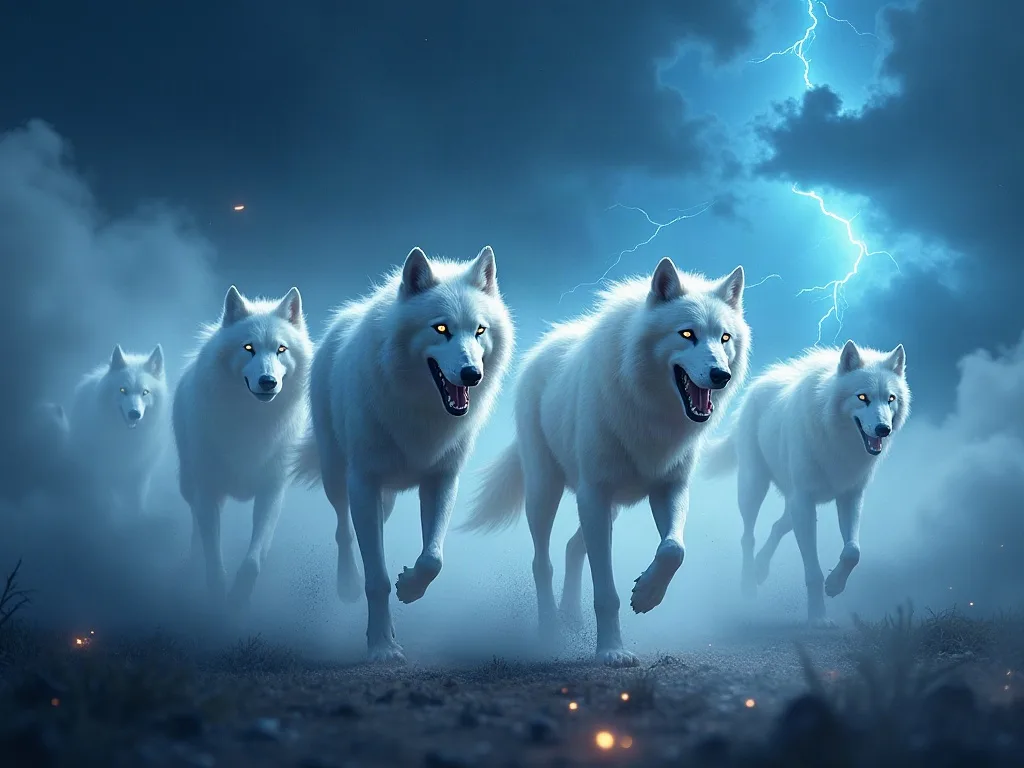
The hounds were particularly fearsome. These were not ordinary dogs but creatures of the spirit world, often white or pale, with the eyes of men or the gaze of demons. In Anglo-Saxon contexts, hunting hounds were a marker of royal power; the king's hunt was a display of sovereignty and dominion over the land. The Hunt's hounds inverted this: they belonged to no human master, answered only to their supernatural leader, and hunted according to laws the living could not comprehend.
What the Hunt pursued shifted depending on the account and the season. Autumn hunts pursued the souls of the newly dead, escorting them from the world of light into shadow. Winter hunts sometimes hunted animals; other accounts suggest they pursued human souls marked for death. Some Anglo-Saxon texts describe the Hunt seeking out sinners or those who had broken sacred oaths. Others claim it simply hunted for the sake of hunting, that the act itself was eternal and the prey mattered less than the motion, the sound, the cosmic order being reasserted through violent pursuit.
A person who encountered the Hunt faced a choice, though not always a real one. Some accounts advised that you should not look at the riders, not speak to them, and most importantly, not try to flee. Movement attracted their notice. Sound summoned them. The safest course was to become stone, to stand still and silent and invisible until the Hunt passed. But other tales suggest that some were taken by the Hunt and returned days or weeks later, aged strangely or speaking in voices that were not their own, having seen the land of the dead and lived to tell of it.
The Hunt as Boundary Marker
What made the Wild Hunt in Anglo-Saxon belief culturally significant was not just its spectacle but its function. It marked the boundary between the known world and the unknown. Between summer and winter. Between the realm of the living and the realm of the dead. Between the human order and the cosmic forces that existed outside it.
The Hunt appeared when those boundaries were thin or threatened to collapse. It rode when a drought came and the land seemed to be dying. It appeared when plague came to a settlement. It hunted at the death of a great king, as if his passing created an opening in the sky that the supernatural had to rush through. It was not punishment exactly, but consequence. Order was being reasserted. The cosmic machine was turning, and human beings were caught in it.
This is why the Hunt was dangerous but also necessary. It could not be stopped or defeated. It could only be endured. A community that saw the Hunt understood something about itself: that their order existed only at the sufferance of larger forces, that death was always just outside their walls, that the world was not as solid as it seemed. The Hunt was a constant teaching, renewed whenever it appeared.
In Anglo-Saxon social imagination, the Hunt was also a mirror of earthly hierarchy. The leader commanded; the hunters obeyed. The hunted were pursued with a logic that transcended individual will. This structure echoed the organization of Anglo-Saxon kingdoms themselves: a war leader, his retainers, and those subject to the outcome of the fight. The Hunt was what happened when those structures were revealed as eternal rather than human, when the cosmic version of kingship and submission became visible.
Regional Variation and Survival
The Wild Hunt did not survive with uniform character across Anglo-Saxon England. Different regions developed different traditions. In the east, where the Danelaw brought Norse influence, the Hunt's character could shift toward the Norse Furious Horde, a connection between Woden and the berserker tradition. In the west, particularly in areas with stronger Celtic contact, the Hunt sometimes merged with native British traditions of the Tylwyth Teg (the Fair Folk) or the wild cavalcades of local deities.
Essex and East Anglia preserved particularly vivid Hunt traditions through the medieval period, likely because these regions remained culturally more pagan longer. When the monk Bede writes about Anglo-Saxon England in the early 8th century, he includes accounts of strange lights and hunts that suggest living memory, not merely literary borrowing.
By the High Middle Ages, the Hunt's character had become more literary and less experiential. It appeared in romances, in chronicles, in sermons as a warning. The Anglo-Norman conquest of 1066 brought French traditions into contact with English ones; French versions of the Wild Hunt (the Chasse Sauvage) merged with Anglo-Saxon memory, creating something hybrid. By the late medieval period, the Hunt had become a legend, a thing told about rather than feared.
But the shape of the ancient memory remained. The Hunt still rode at threshold times. It still announced death or great change. It still represented a force that could not be resisted, only witnessed. In village folklore, in folk practices meant to protect against the Hunt (iron, salt, prayer), in the lingering fear of certain roads at certain times of year, the Anglo-Saxon Wild Hunt lived on long after its pagan theology had been forgotten.
The Hunt in Modern Understanding
Scholars have long debated what the Wild Hunt actually was. Some argue it was a genuine ecstatic experience, a vision induced by seasonal ritual or hallucinogenic plants. Others propose it was a way of explaining real phenomena: meteors, auroras, unusual wind patterns. Still others view it as pure mythology, a metaphor given narrative form.
The most compelling evidence suggests the Hunt was experienced as real by Anglo-Saxons and medieval English people. Whether that reality was psychological, spiritual, or literal matters less than recognizing that it had genuine force in their lives. The Hunt functioned as a teaching about mortality, cosmic order, and human limitation. It made abstract concepts vivid and immediate.
Modern folklorists have traced the Wild Hunt through European traditions, finding versions in German, Scandinavian, Welsh, and Celtic sources. This suggests it was a shared inheritance of the Germanic and Indo-European peoples, adapted differently in each region but recognizable as the same fundamental image: spectral riders, supernatural hounds, unstoppable motion, cosmic consequence. The Wild Hunt belongs to a family of visions that humans have imagined when confronting death, fate, and the limits of their own power.
In contemporary culture, the Wild Hunt in Anglo-Saxon belief has become a symbol in fantasy literature, in neopagan reconstruction, and in horror. But these modern uses often miss the original force of the image: its quality as neither simply evil nor simply divine, but as a force that human categories do not quite contain. The Hunt did not come to save or to damn in any simple sense. It came as a fact of existence, the way seasons come, the way death comes. That unavoidable quality is what gave it its power.
Frequently Asked Questions About the Wild Hunt in Anglo-Saxon Belief
Frequently asked questions
Was the Wild Hunt based on a real phenomenon that Anglo-Saxons witnessed?
Possibly. Scholars propose various explanations: meteors, unusual atmospheric displays, or psychological experiences during seasonal rituals. But what matters is that Anglo-Saxons experienced and recorded it as real. Whether the Hunt was a physical phenomenon, a vision, or a cultural memory given narrative form, it shaped how they understood death, fate, and cosmic order.
Was Woden always the leader of the Wild Hunt, or did other gods lead it?
Woden was a prominent leader in some accounts, but the Hunt's leader was fluid. Different regions and periods named different figures: local heroes, deified kings, demons, or women riders. The consistency was the function (collecting souls, marking cosmic boundaries) rather than a single identity. Christian reinterpretation often demoted the leader to a demon or damned soul.
What was the difference between the Wild Hunt and the fairy folk processions mentioned in Anglo-Saxon tradition?
The boundary was not always clear. Both involved supernatural beings moving through human space at certain times. The Hunt emphasized violence, pursuit, and cosmic order; fairy processions emphasized temptation, transformation, and the supernatural world's parallel existence. Over time, some traditions merged these images, particularly in areas with strong Celtic influence.
How did the Christian conversion change beliefs about the Wild Hunt?
Christianity reframed the Hunt from a sacred mystery into a demonic warning. Instead of representing a necessary cosmic force or a visit from the gods, it became a vision of damnation and punishment. This reinterpretation allowed the Hunt to survive; it was acknowledged as real but stripped of its pagan holiness and recast as a threat to Christian souls.
Did Anglo-Saxon people believe they could be taken by the Wild Hunt and survive?
Yes. Several accounts describe people who encountered the Hunt and were carried away, only to return days or weeks later. These survivors often reported strange changes: unnatural aging, gaps in memory, or knowledge of the dead they should not possess. Whether literal or metaphorical, these accounts suggest the Hunt could mark or transform the living.
What was the purpose of the Wild Hunt in Anglo-Saxon cosmology?
The Hunt functioned as a manifestation of cosmic law: the inevitable movement of forces larger than human will. It reasserted the order of the universe by crossing through human space at threshold times, collecting souls, and reminding the living of their mortality. It was not punishment but necessity, the way the cosmos maintained itself.
The Hunt's Shadow in English Memory
The Wild Hunt in Anglo-Saxon belief never fully disappeared. It transformed and softened, but it persisted in the English imagination in ways both obvious and subtle. The fear of certain roads at certain seasons. The old injunction not to speak when you hear hounds hunting in the night. The legends of the Barghest and other monstrous dogs that retained the Hunt's character but lost its cosmic grandeur. The folktales of fairy cavalcades and supernatural processions that echoed the old structure without the old theology.
What endured most deeply was not the specific image but the conceptual space the Hunt occupied: the acknowledgment that human order is fragile, that supernatural forces move through the world, and that death and cosmic transformation are not distant abstractions but always at the edge of perception, ready to break through. The Hunt was a language for talking about what could not be controlled, what must be endured, what reminds human beings of their place in a larger machinery.
In that sense, the Wild Hunt in Anglo-Saxon belief was not a relic but a permanent shadow cast across English culture, visible in folklore, in literature, in the texture of how English people imagined the boundaries between the living and the dead, the known and the unknowable, the human order and the cosmic one. The riders have long since vanished from the sky. But the space they carved out in the imagination remains open.
Read the full book
Want the whole story?
The complete edition is an instant PDF download here, with a paperback on Amazon for selected titles.
Anglo-Saxon
The Anglo-Saxon Mythology Book: Woden, Thunor, Beowulf, and the Lost Gods of Pre-Christian England
The Sacred Stories Before Christianity Buried Them
The mythology of pre-Christian England: Woden's ravens, Thunor's thunder, Beowulf's monsters, and the Wyrd sisters who wove fate. Recovered from Beowulf, royal genealogies, and the grave goods.
More from Anglo-Saxon
All articles
Anglo-Saxon
Hengist and Horsa: Legendary Founders of Anglo-Saxon England
Two brothers from Germanic lands, Hengist and Horsa led the first English settlers across the North Sea. Their arrival around 449 CE marks the beginning of Anglo-Saxon England, though history and legend now blur beyond recognition.

Anglo-Saxon
The Sutton Hoo Ship Burial: Archaeology and Myth
In 1939, archaeologists uncovered a 27-meter ship buried in Suffolk, England, holding treasures and weapons from the 6th century. The Sutton Hoo ship burial bridges Anglo-Saxon reality and the epic worlds of Beowulf, revealing how real kings were sent to their gods.
Anglo-Saxon
Eostre: Goddess of Spring and Dawn
Eostre is the Anglo-Saxon goddess of spring, dawn, and fertility, known through a single historical mention by the Venerable Bede. Discover how this shadowy deity shaped the season of renewal and inspired the modern holiday of Easter.
Anglo-Saxon
The Dragon in Anglo-Saxon Tradition: Fire, Greed, and Gold
Dragons haunted the Anglo-Saxon imagination as creatures of chaos and boundless appetite. From Beowulf's hoard-guarding serpent to the red and white dragons of historical prophecy, these beasts embodied the threats that heroes must face. Explore how Anglo-Saxon culture transformed the dragon from a pagan symbol into a Christian adversary.