
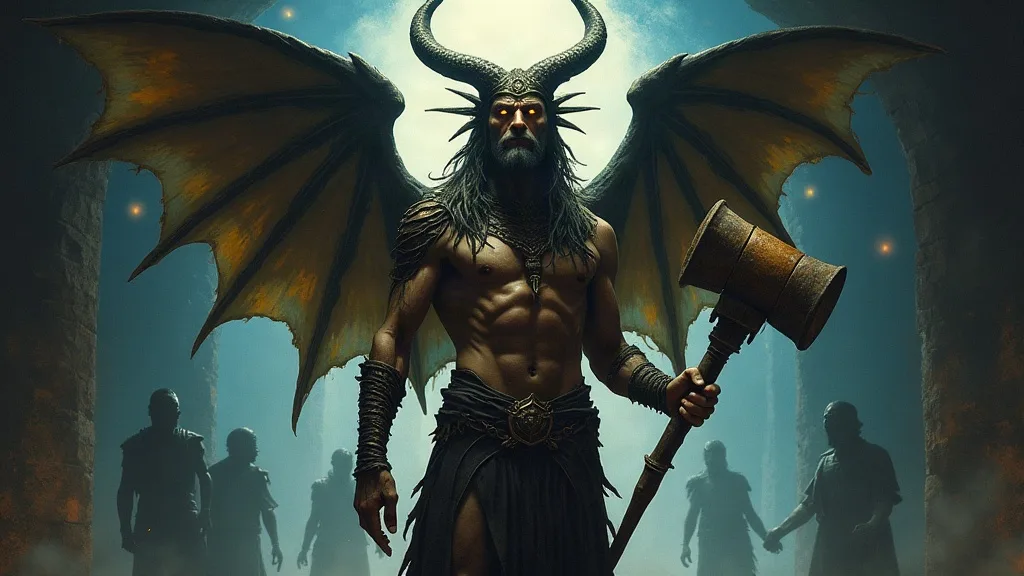
Charun: The Etruscan Demon of Death and the Underworld Guardian
Meet Charun, the fearless Etruscan demon who guards the gates between life and death. Winged, serpent-haired, and armed with a hammer, this creature shows how the ancient Etruscans imagined the passage into the afterlife, and why later Romans borrowed him into their own mythology.
Contents
A figure waits at the boundary between breath and silence. Serpents writhe where hair should be. Wings unfold from his shoulders, ragged and restless. In one hand, a wooden hammer heavy with purpose. His eyes fix on the newly dead. This is Charun, the Etruscan demon of death, not an evil spirit to be conquered, but a guardian stationed at the threshold, waiting to escort souls into the underworld they will inherit.
The Etruscans, who ruled central Italy from roughly 900 to 27 BC before Rome absorbed their culture, left no surviving written myths like the Greeks did. They left art. Tomb walls, mirrors, urns, and sarcophagi decorated with scenes from the afterlife reveal a people obsessed with what came next. And in painting after painting, Charun appears, the character who makes the transition real.
Origins and Roots of an Etruscan Underworld Guardian
The name Charun likely derives from charu, an Etruscan root referring to a ravine or gorge; the ancient word carries the sense of a threshold, a place where worlds meet. Unlike Charon, the Greek ferryman who rows the dead across the river Styx and demands a coin for passage, Charun operates differently. He is less a merchant of the crossing and more a custodian, a functionary of the boundary itself.
The Etruscans absorbed and reshaped Greek ideas. Trade routes brought Hellenic pottery, stories, and religious concepts to the peninsula. Yet Charun is distinctly Etruscan. Where Charon is an old man, gray and weary, Charun is a demon of tremendous physical presence. The word "demon" (daemon in Greek) originally meant a divine agent or spirit, neither inherently good nor evil. Charun embodies this neutrality: he is not cruel, nor is he merciful. He simply is the underworld made manifest.
The earliest images of Charun appear in Etruscan tomb paintings and funerary sculpture from roughly the 5th to 3rd centuries BC. As Roman power grew and the Etruscan city-states fell, the Romans encountered Charun in the tombs of conquered peoples and in the artifacts they plundered. Over time, Roman culture absorbed and renamed him, transforming him into Orcus, the god of the underworld, and later into the more familiar Pluto. But in Etruscan frescoes, he remains unmistakably himself.
Appearance and Iconography
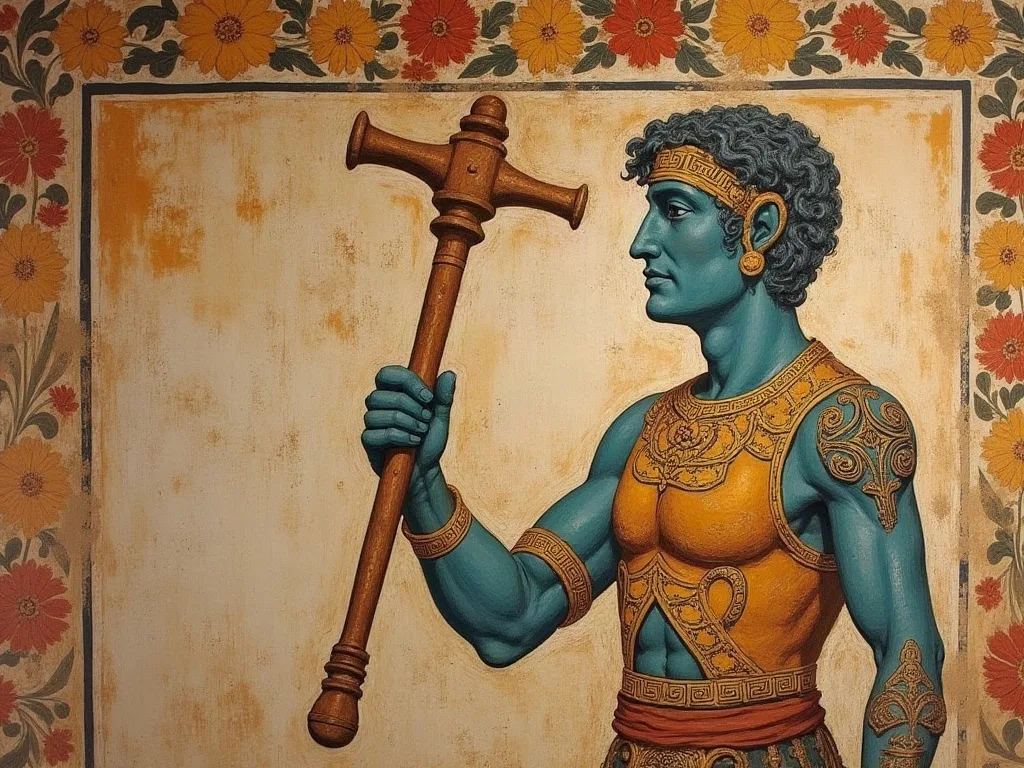
Charun's image is instantly recognizable and unmistakable. He is depicted as a blue or green-skinned figure, his color a departure from the natural human palette and a signal that he belongs to a different realm. His most distinctive feature is his hair: instead of ordinary locks, serpents writhe and coil where tresses should grow. This visual language echoes the Greek Medusa and other monstrous figures, yet it serves a different purpose. The serpents are not a punishment; they are a crown, marking him as an agent of transformation and the chthonic powers that dwell beneath the earth.
Charun wears armor: a breastplate and sometimes a helmet. He carries a wooden hammer, thick and blunt, an instrument of power rather than destruction. The hammer is both a symbol of authority and a tool of transition. Some scholars interpret it as a weapon that strikes the boundary between life and death; others see it as a ceremonial implement used to mark the passage of souls. In some depictions, he also carries a serpent or a torch, further linking him to the mysteries of the underworld.
His wings are perhaps his most unsettling feature. They are not the graceful, symmetrical wings of Winged Victory. Instead, they appear ragged, sometimes bat-like, sometimes feathered in an irregular manner. These wings allow him to move between worlds, to fly over the divide that separates the living from the dead. They suggest a creature of liminality, of borders and thresholds, always in motion between two states.
The artists who painted Charun onto tomb walls did not render him as a monster meant to terrify the living. Instead, they depicted him with a kind of austere dignity. His facial expressions are often composed, even stern. He gazes outward or downward, watchful, attentive. The living who viewed these frescoes during funeral rites were not encouraged to fear Charun but to acknowledge him, to accept his presence as an inevitable part of the journey ahead.
Charun's Role in the Afterlife
The Etruscans envisioned the underworld, or Aiil, as a real place with geography, architecture, and inhabitants. It was not a place of infinite punishment like Tartarus in Greek mythology, nor was it a neutral shadow-realm like the Hades of Homer. Rather, it was another Italy, another country, where the dead continued to exist in a form of shadowy life. Some tombs were furnished with miniature furniture, bread, and wine, suggesting that the Etruscans believed the dead would need sustenance and comfort.
Charun's role in this realm is to move the dead along, to guide them past the gates and into their new dwelling place. Etruscan tomb frescoes often show Charun alongside other underworld figures. Sometimes he stands near Vanth, a female demon with wings and serpents, who also worked as a guide of souls. Together, or sometimes in opposition, these figures presided over the orderly passage of the dead.
In some depictions, Charun is shown striking the dying with his hammer as they cross the boundary. This is not understood as a violent act but as a formal gesture, a ceremonial blow that marks the transition from one state of being to another. It echoes later European traditions where a bishop strikes a bell at the moment of death, or where a death-knell marks the passing of a soul. Charun's hammer is both weapon and ceremonial tool, concrete and symbolic at once.
The frescoes also reveal a hierarchical underworld. Charun attends not only ordinary people but the aristocratic dead. Wealthy Etruscans were buried in rock-cut tombs decorated with scenes of their feasts, their dances, and their journeys into the underworld. Charun appears at these scenes not as a threat to the noble dead but as a figure of protocol, a guardian ensuring the proper order of things. In death, as in life, there was a correct way to pass, and Charun enforced it.
Charun and the Greek Transformation
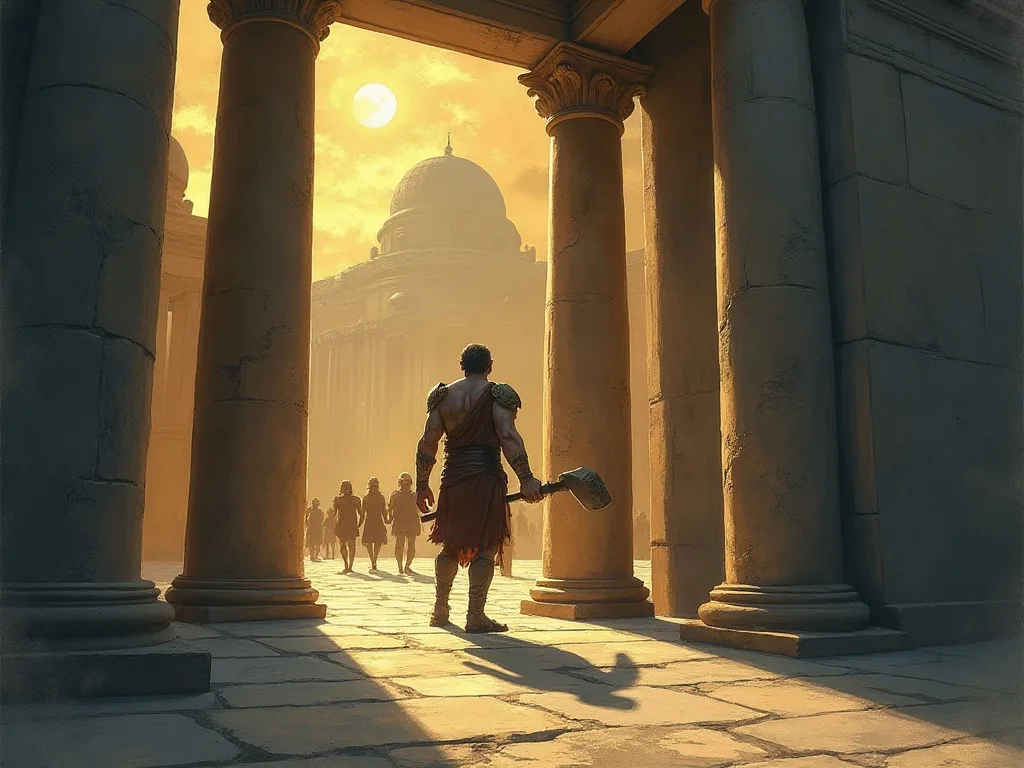
The Romans encountered Charun when they conquered Etruscan territory and absorbed Etruscan religious practices. Roman generals performed Etruscan rites; Roman nobility learned to read Etruscan auguries from animal entrails. Yet Rome needed to fit Etruscan gods and demons into its own theological system. The result was a kind of syncretism, a blending of identities.
Charun and Charon, the Greek ferryman, occupied similar thresholds in their respective mythologies. Both guarded the boundary between life and death. Both demanded something of the dead: Charon demanded a coin; Charun demanded acknowledgment of his authority. Yet they were not identical. The Romans, ever practical, began to conflate them, to see in Charun an Etruscan variant of a broader Mediterranean archetype.
Over centuries, Charun faded from active worship. His name lingered in Roman texts, but his image, so vivid in Etruscan tombs, grew distant. Later Christian writers, encountering descriptions of Charun in Roman sources, sometimes identified him with demons and devils of their own cosmology. Medieval manuscripts occasionally referenced him as a devil of the classical underworld, a figure consigned to the realm of pagan superstition. Yet in the painted tombs of northern Italy, Charun remained exactly as he had always been: watchful, present, undeniable.
Charun in Tomb Art and Ritual
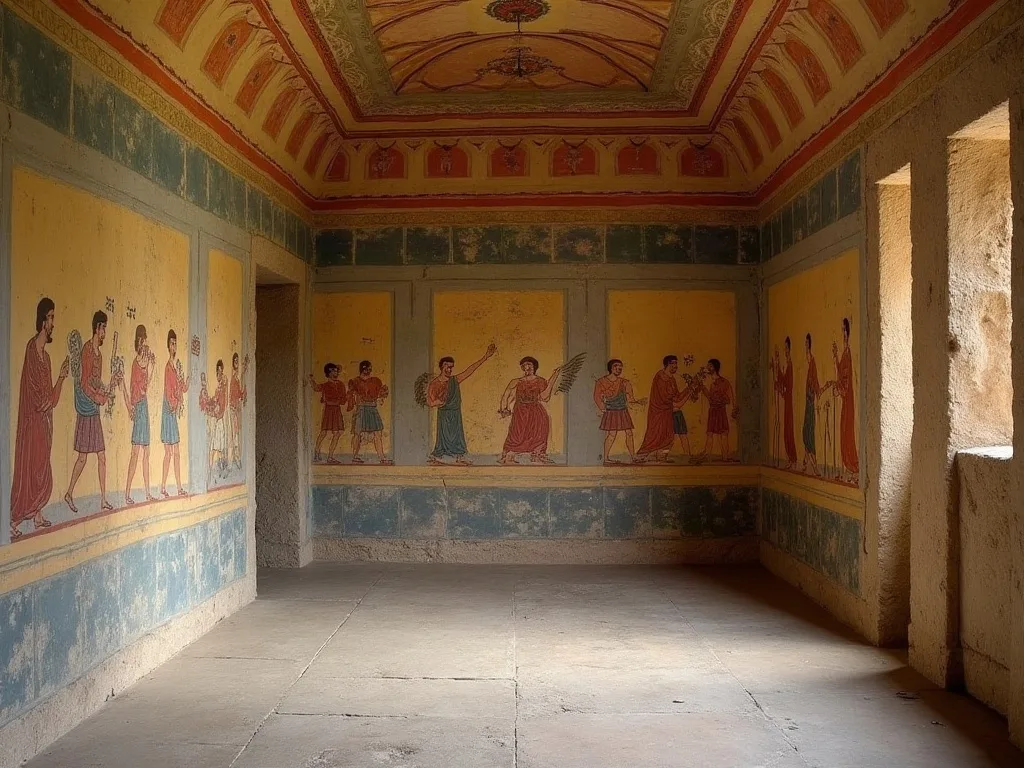
The surviving depictions of Charun come almost entirely from Etruscan tombs, particularly those of the wealthy. The tombs themselves were rock-cut chambers, often family vaults, painted and decorated to suggest the homes the dead would inhabit. The walls were not meant only for the dead but for the living who entered during funeral rites, who came to remember and to honor. The presence of Charun in these painted spaces was a constant reminder of the transition that all would face.
One famous example appears in the Tomb of Orcus (named by Romans, though the original occupant was Etruscan) near Orvieto. Here, Charun appears alongside a woman depicted as Persephone or a local equivalent, a figure of authority in the underworld. Charun stands guard, his hammer ready, his expression impassive. The scene suggests a hierarchy of power: the underworld is not chaos but an ordered realm with rulers and functionaries.
In another tomb, the Tomb of the Jugglers, Charun appears among scenes of Etruscan life: dancers, musicians, a juggler performing. Even in scenes of celebration, of the vitality the Etruscans valued, Charun is present in the margins or in the next chamber, a fact acknowledged without fanfare. This integration of Charun into scenes of life and activity suggests that the Etruscans did not see him as purely morbid or fearful, but as a natural part of existence.
The artistic conventions used to depict Charun suggest something important about Etruscan psychology. While the living figures in the frescoes are rendered with proportion, color, and individual detail, Charun is often painted in a more stylized manner, his blue-green skin and serpent hair marking him as categorically different. Yet this stylization is not crude; it is deliberate and refined. The Etruscans were skilled artists who could render naturalism when they chose. Their choice to render Charun in a more abstract or symbolic mode suggests intention: he is a force, a principle, a type rather than an individual.
Scholarly Interpretations and Mysteries
Historians and archaeologists have long debated Charun's exact function and meaning. Was he a demon in the sense of a supernatural spirit, or was he more like a personified concept, the underworld itself given a visible form? Did the Etruscans believe Charun was literally present at death, or was he a symbolic figure meant to aid the living in imagining the transition?
Some scholars, influenced by Neoplatonic philosophy and later Christian theology, have read Charun as an evil figure, a demon in the modern sense. Yet this interpretation imposes later frameworks onto Etruscan thought. The Etruscan concept of a divine agent or spirit did not carry inherent moral judgment. Charun was powerful, alien, and operated according to principles the living could not fully comprehend. But this made him fearsome in the way weather is fearsome, not in the way a moral enemy is fearsome.
Other scholars emphasize Charun's bureaucratic function. He is less a force of nature and more a cosmic functionary, part of a machinery of the afterlife that operates with regularity and order. This reading aligns with what we know of Etruscan culture more broadly. The Etruscans developed elaborate systems of divination, of reading the will of the gods in entrails and bird flight. They believed the universe operated according to patterns and rules that could be understood and interpreted. Charun fits this worldview: he is a rule-maker, a rule-enforcer, a figure of cosmic order.
The meaning of Charun's hammer has sparked particular debate. Some propose it was a weapon used to strike down the living, a symbol of the violent seizure of life. Others suggest it was a tool for crafting or building, linking Charun to creation and destruction as paired forces. Still others see it as purely ceremonial, a symbol of judicial or religious authority. The truth likely encompasses multiple layers: in Etruscan thought, these meanings may not have been separate at all.
The relative scarcity of written sources on Charun frustrates modern scholars. The Etruscans left few texts beyond funerary inscriptions and magical formulas. Much of what we know about their theology comes from Roman writers who encountered Etruscan beliefs after absorption into the empire, or from the interpretation of visual art. This gap between image and text, between what the frescoes show and what ancient writers describe, means that any reconstruction of Charun's meaning is necessarily incomplete.
Charun's Legacy and Later Forms
As Etruscan independence faded and Roman culture dominated, Charun's distinct identity blurred. The Romans adopted many Etruscan religious practices, and in doing so, they encountered Charun. Roman writers like Virgil, drawing on Etruscan lore as mediated through Roman sources, incorporated elements of Charun into their descriptions of the underworld. When Aeneas descends into the realm of the dead in the Aeneid, he passes through landscapes that echo Etruscan underworld topography.
The name Charun appeared in Roman texts, but the Romans increasingly identified him with Orcus, their own god of the underworld, or with Plutus and later Pluto. This was not a simple replacement but a gradual reinterpretation. What had been a distinctive Etruscan figure became absorbed into a broader Greco-Roman framework. The specific qualities that made Charun unique, his serpent hair, his ragged wings, his wooden hammer, were gradually forgotten in favor of more familiar classical imagery.
In medieval and Renaissance Italy, scholars rediscovered Etruscan tomb frescoes. Artists and antiquarians were struck by the alien, unsettling quality of Charun. Medieval Christian scholars sometimes identified him with devils and demons of Christian cosmology, a misreading that projected Christian moral categories onto a pagan figure. Yet Renaissance humanists, with their passion for classical revival, began to see in Charun a window into a lost civilization.
In later European art and literature, traces of Charun may linger in depictions of death as a demoniac or demonic figure. Yet these later incarnations are mediated through Greco-Roman sources and Christian theology. The specific Etruscan understanding of Charun, as a powerful, amoral, orderly agent of transition, was largely lost to the ancient world itself and only recovered in modern times through archaeology and art history.
Frequently asked questions about Charun, Etruscan demon of death?
Frequently asked questions
How do we know about Charun if the Etruscans left no written myths?
Charun appears repeatedly in Etruscan tomb paintings, frescoes, and funerary sculptures from the 5th to 3rd centuries BC. These visual depictions are our primary source. Roman writers like Virgil and Livy also referenced Etruscan religious beliefs and underworld topography, which provide secondary confirmation. Scholars interpret Etruscan visual culture alongside Roman accounts to reconstruct Charun's role and significance.
What is the difference between Charun and Charon, the Greek ferryman?
Both guarded the boundary between life and death, but they operated differently. Charon was an old ferryman who rowed souls across the river Styx in exchange for a coin placed under the tongue. Charun was a demonic figure with serpent hair and wings who functioned as a custodian and guide in the underworld itself. The Romans later conflated the two, but they were distinct in Etruscan and Greek traditions.
Did the Etruscans fear Charun, or did they see him as benevolent?
Neither fear nor kindness quite captures the Etruscan relationship with Charun. He was a powerful, amoral agent of cosmic order. The Etruscans seemed to accept him as inevitable and necessary, the way one might accept a force of nature. He was not kind, but he was not arbitrary either. Tomb frescoes suggest that the living acknowledged Charun's authority without apparent dread or reverence.
What did Charun's hammer represent?
Scholars debate this. The hammer may have been a ceremonial tool marking the transition from life to death, a weapon that struck the boundary between worlds, a symbol of judicial authority, or all three simultaneously. In Etruscan thought, these meanings may not have been separate categories. The hammer was certainly a symbol of power and a tool of passage.
Why did Charun disappear from later European culture?
As Rome conquered the Etruscan city-states, Roman religious practices absorbed Etruscan elements. Charun was identified with Roman figures like Orcus and Pluto, and his distinct identity was gradually lost. By the time Rome fell and the medieval period began, Charun was a footnote in classical texts. He was "rediscovered" only in the Renaissance and later through archaeological study of Etruscan tombs.
Was Charun worshipped, or was he only a mythological figure?
Charun occupied a liminal space. He was not a god with temples and regular cults like Jupiter. Yet he was a powerful being who demanded acknowledgment and respect. The Etruscan tombs suggest that Charun was integrated into funeral rites and afterlife beliefs. People did not pray to Charun, but they painted his image where the dead would pass, suggesting a form of ritual engagement beyond simple mythological narrative.
Charun and the Etruscan Vision of Death
The persistence of Charun in Etruscan tomb art over centuries suggests something profound about how the Etruscans understood mortality. Death was not an ending to be denied but a threshold to be acknowledged. The boundary between life and afterlife was a real place with its own geography, its own rules, and its own guardians. Charun embodied this boundary; he made it concrete and undeniable.
The Etruscan afterlife was not the Greek Hades, a gray, diminished copy of life. Nor was it the Christian heaven or hell, divided sharply into reward and punishment. Instead, it was another existence, continuous with life yet separate, where the dead maintained identity and connection to family. Tombs were painted as dwellings for this afterlife; funerary games celebrated the dead as if they were still present; inscriptions recorded names and lineages for eternity. Charun was part of this system, the functionary who ensured the proper transition and order.
The Etruscan civilization vanished, absorbed into Rome, its language forgotten, its texts lost. Yet in the rock-cut tombs of Tuscany and Umbria, Charun remains, painted and repainted, a figure from another world gazing outward across more than two millennia. He is a reminder that different peoples imagined death and the afterlife in profoundly different ways, and that the boundary between life and what comes after was not always a place of terror but sometimes of order, acknowledgment, and passage.
Read the full book
Want the whole story?
The complete edition is an instant PDF download here, with a paperback on Amazon for selected titles.
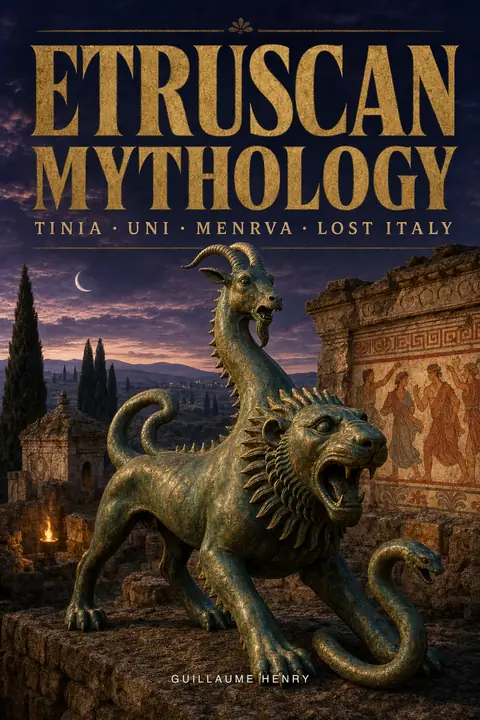
Etruscan
The Etruscan Mythology Book: Tinia, Uni, Menrva, and the Lost Religion of Italy
Tinia, Uni, Menrva, and Lost Italy
Before Rome, Italy belonged to the Etruscans: a people who read the future in lightning and livers, buried their dead in painted cities, and whose gods Rome quietly adopted. A mythology recovered from tombs, bronze mirrors, and the discipline of the haruspex.
More from Etruscan
All articles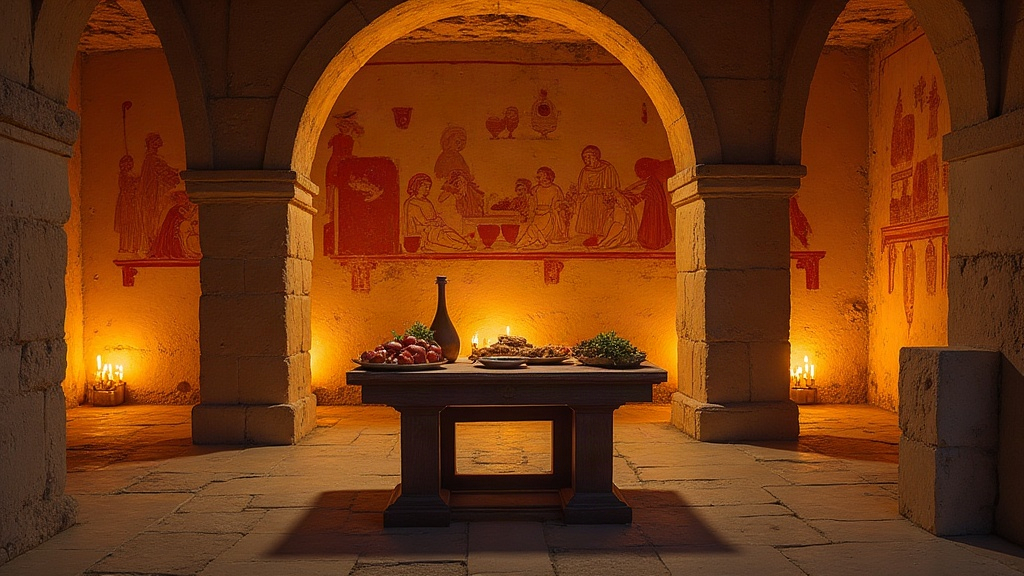
Etruscan
Etruscan Tomb Banquets: Feasting with the Dead
In Etruscan tombs, the dead reclined at eternal banquets. Through painted walls and grave goods, archaeologists recover a ritual that bound living and dead in a single meal. Discover how the Etruscans fed their ancestors and what it reveals about their afterlife beliefs.
Etruscan
The Etruscan Disciplina: Sacred Books and Ritual Knowledge
The Etruscan Disciplina preserved the cosmos in ritual codes and sacred texts. Explore how haruspicy, augury, and divine protocol shaped an entire civilization and influenced Rome itself.
Etruscan
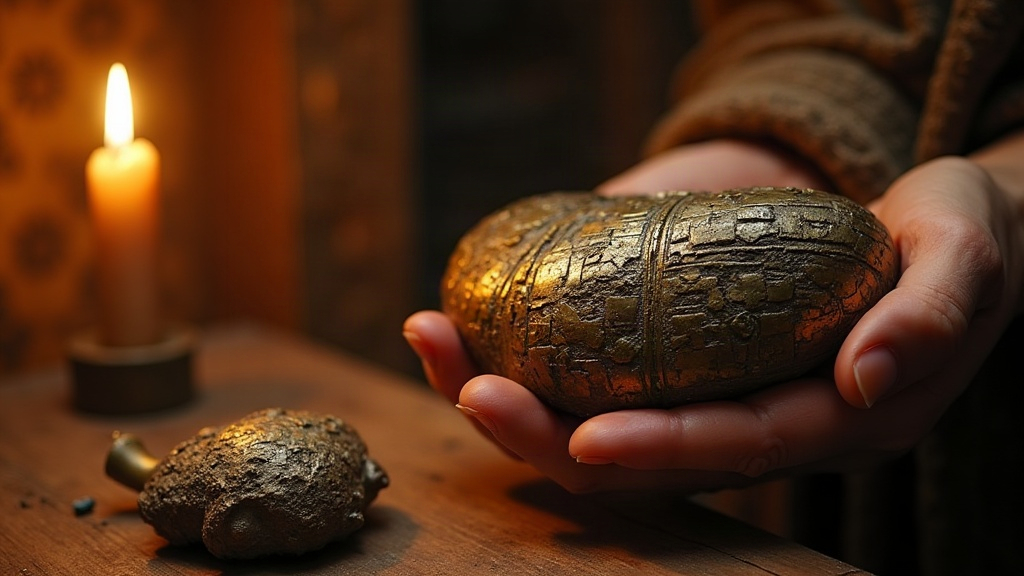
The Liver of Piacenza: Bronze Divination Model of the Etruscans
Discover how the Etruscan priests read fate itself: the Liver of Piacenza is a bronze model showing exactly where to look on a real liver for messages from the gods. It reveals the ancient art of haruspicy in bronze.
Etruscan
Tages: The Divine Child Prophet of Etruscan Divination
A child emerged from the earth to teach an Etruscan farmer the art of reading divine will. Tages, the Divine Child Prophet, became the source of all Etruscan divination knowledge, a figure so powerful that Roman priests carried his teachings for centuries.