
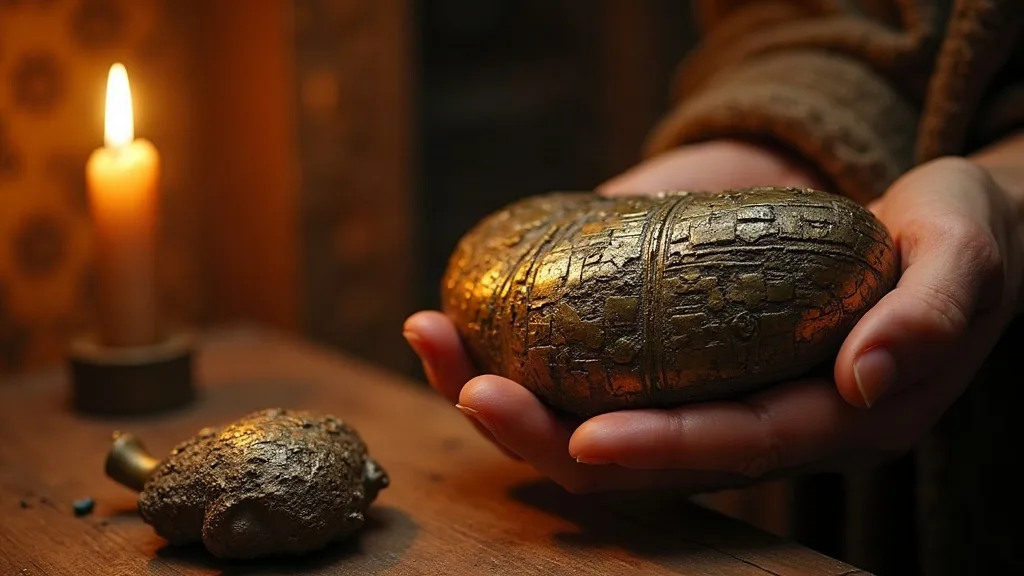
The Liver of Piacenza: Bronze Divination Model of the Etruscans
Discover how the Etruscan priests read fate itself: the Liver of Piacenza is a bronze model showing exactly where to look on a real liver for messages from the gods. It reveals the ancient art of haruspicy in bronze.
Contents
A bronze liver lies in a museum in Piacenza, Italy. It is smaller than your hand, yet it holds the entire system of how the Etruscans spoke with gods. No text, no formula, just the organ itself divided into distinct regions, each marked with the names of gods and spirits. When an Etruscan priest needed to know whether a battle should begin, whether a marriage would prosper, or what the future held, they did not consult a crystal or throw bones. They killed an animal, opened its body, and looked at the liver. This bronze model was their map.
The Liver of Piacenza: Bronze Divination Model is the most complete surviving guide to haruspicy, the Etruscan art of reading entrails. It is also a window into how the ancients believed fate spoke to them, and how they built systems to decode it. The model shows us that the Etruscans did not see divination as guesswork. It was a precise language. Every mark, every region, every name carved into bronze told the priest: here is what to watch for; here is where the gods leave their marks.
The Artifact Itself: Bronze and Geography
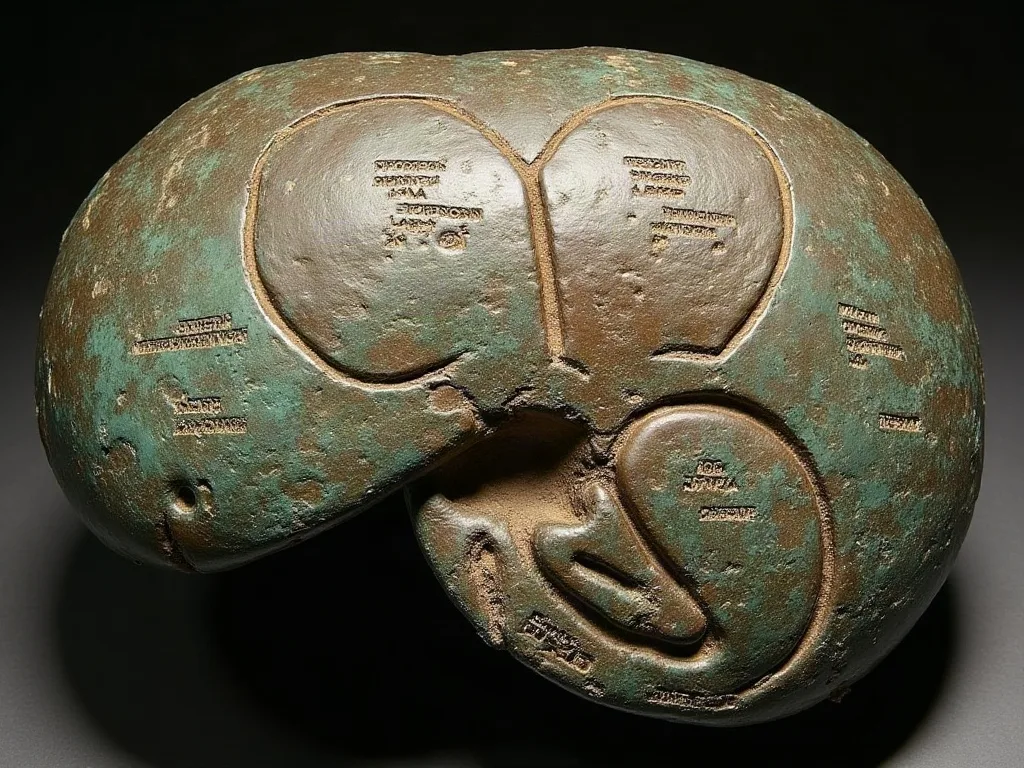
The Liver of Piacenza is a bronze model roughly 5 inches long and 3 inches wide (about 12 by 8 centimeters). It dates to the second century BC, late in Etruscan history, long after Rome had begun absorbing Etruscan territories. The model is hollow and divided into regions by raised ridges. Each region bears an Etruscan inscription naming a deity or spirit. Some names are recognizable even now: Tinia (the Etruscan king of gods, equivalent to Jupiter), Uni (the queen goddess, equivalent to Juno), Menrva (wisdom and craft, equivalent to Minerva). Others remain mysterious or fragmentary after two thousand years of weathering.
The organ is divided into roughly forty distinct fields. Imagine the bronze as a map of the cosmos itself. The upper portion corresponds to the heavens and the realm of the gods. The lower portion represents the underworld and forces of darkness. The sides mark the cardinal directions and the spirits that dwell in each quarter. A priest holding this model in one hand could hold a real liver in the other and match shape to shape, region to region. If the liver showed unusual marks, discoloration, or swelling in the region marked "Tinia," the message was clear: Jupiter has spoken. If a region marked for an ominous spirit showed damage or abnormality, the priest could read it as a warning.
Haruspicy: The Science of Reading Entrails
The Etruscans did not invent haruspicy. The practice existed in older Near Eastern cultures and in Greece. But the Etruscans elevated it to an art form and surrounded it with theology. They called it haruspicina or extispicium in Latin, the reading of the exta, the entrails. It was not mere prediction. It was a dialogue with the divine.
The process began with a choice of animal. Cattle were favored, especially oxen and cows. Sheep were also used. The animal had to be healthy, unblemished, suitable as a sacrifice. The priest would perform a ritual killing. As the animal fell, attendants would open the body with a knife. The Etruscan priest would then examine several organs in sequence. The liver came first, and it was the most important. The lungs (pulmones) came second. The heart (cor) was examined for any sign of unusual form or color. The intestines were sometimes consulted as well.
The priest was trained. This was not an amateur's work. Young men from noble Etruscan families underwent years of instruction in haruspicy, learning to recognize thousands of variations in shape, color, size, and texture. They studied the natural forms of healthy organs. They learned how disease, fear, or the animal's diet could alter an organ's appearance. They memorized the meanings assigned to each region and each anomaly.
The Liver of Piacenza was their textbook, their reference manual, their proof that the system was rational and repeatable. A priest in one Etruscan city could consult the same model as a priest in another city, and both would read the same liver the same way. Divination, under the Etruscan system, aspired to be universal.
The Gods and the Liver's Divisions
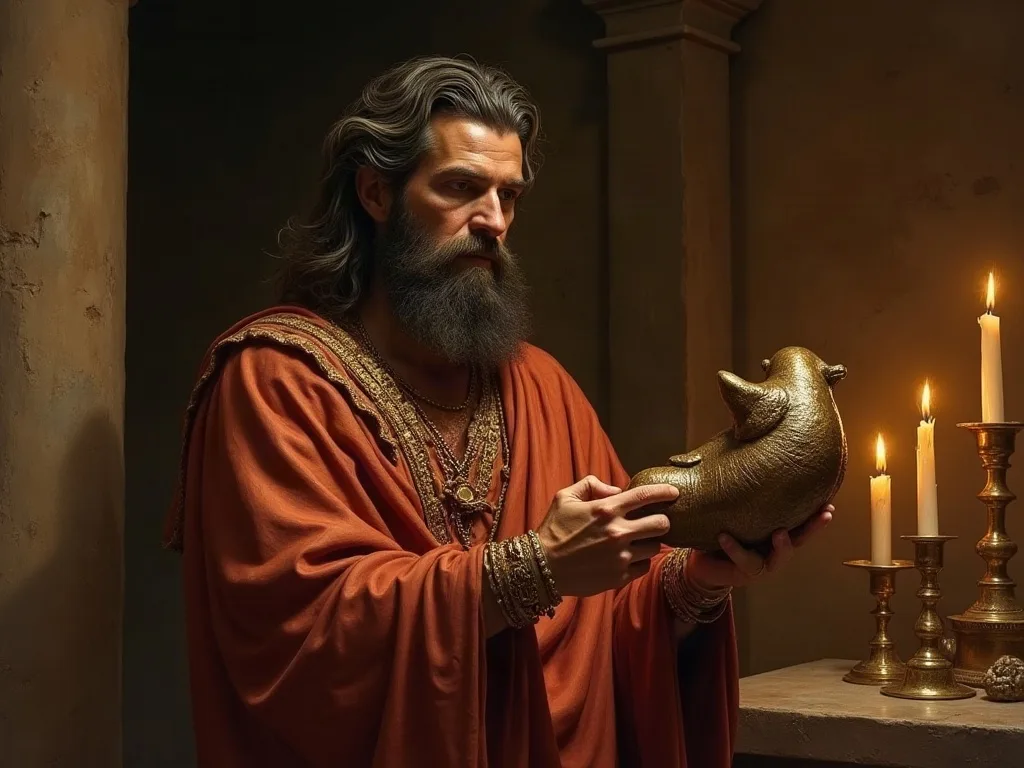
To understand what a priest saw when holding the Liver of Piacenza, we must first understand the Etruscan divine order. The Etruscans believed in a structured cosmos ruled by gods who remained engaged with human affairs. The chief god was Tinia, shown at the top of the model, in the position of honor. Beside him stood Uni, the queen. Their presence on the liver's upper surface reflects the Etruscan theology: the great gods occupy the highest regions. Their favor brings fortune. Their displeasure brings calamity.
Below the major deities sat lesser gods and spirits. Menrva watched over wisdom and the work of craftsmanship. Turia (possibly a storm god) held sway over conflict and weather. Voltumna (or Vortumna), the god of turning seasons and change, had influence over fate itself. Then came the spirits of the underworld: Mania, the spirits of the dead; Catha, spirits of darkness; the Lares, protective spirits who could turn dangerous if offended. Each had a region. Each could speak through the liver.
The positioning was deliberate. The northern edge of the liver corresponded to the northern sky, home to certain deities. The southern edge to southern sky. The eastern edge to the rising sun and benevolent forces. The western edge to the setting sun and the realm toward death. A skilled priest could stand before a liver and read it like a geographic map. If an omen appeared in the region of Tinia, the question was answered by the will of the king god. If it appeared in a region marked for a lesser spirit, the message came with less absolute authority. If it appeared in the underworld section, it carried a warning.
Reading the Signs: What Made an Omen
Not every discoloration or irregular shape meant something. The Etruscan priest had learned to distinguish between natural variation and significant sign. A liver that was slightly pale from an animal that had eaten certain fodder was unremarkable. A liver that was black or purple in a region normally ruddy was cause for grave attention.
The most feared omen was caput anserinum, the "head of the goose," a shriveled or missing lobe in certain critical regions. This could mean defeat in war or the death of a leader. Some sources suggest a completely absent lobe was considered so ominous that a planned action would be abandoned entirely. Other significant signs included unusual ridges on the organ's surface, holes or perforations, fluid collections, or masses of hardened tissue.
Position mattered as much as appearance. A discoloration in the region of a benevolent god was often read as a favorable omen, a confirmation that the god approved the planned action. The same mark in the region of an underworld spirit might mean delay or caution. If a mark appeared precisely on the boundary between two divine regions, the reading became complex. It meant the gods were in contention. The priest would need to read further into the lungs and heart to clarify which deity had stronger influence.
The Romans, who absorbed Etruscan knowledge, adopted many of these same practices. Later Latin texts by authors like Livy and Pliny describe haruspicy in ways that echo the system encoded in the Liver of Piacenza. Roman generals before major battles consulted haruspices. The practice endured well into the Christian era, though eventually condemned as superstition and idolatry.
Manufacture and Purpose
The Liver of Piacenza was cast in bronze using the lost-wax process, a technique perfected by Etruscan smiths. The maker would create a clay core carved into the shape of a liver. Around this core, they would model beeswax, building up the organ's external features and adding the raised ridges that divide the regions. Then the labels were carved into the wax: the names of the gods, written in right-to-left Etruscan script. The whole wax model was then encased in clay, heated so the wax melted out, leaving a mold. Molten bronze was poured in. Once cool, the outer mold was broken away, revealing the bronze liver within.
This was not a quick process. It was expensive. Bronze was valuable. The care taken to inscribe each region and name each deity shows that this was a prestigious object. It likely belonged to a temple or to a wealthy family of haruspices. Some scholars have suggested that the Liver of Piacenza may have been a teaching model, used to train younger priests. Others propose it was an offering made to a shrine to commemorate the craft. A few theorize it was buried with a haruspex as a sign of his status.
What is certain is that it was preserved, packed away, and lost in antiquity. It remained buried for nearly two thousand years before being discovered in Piacenza (the city in northern Italy, in the region of Emilia-Romagna) in the late nineteenth century. It now rests in the Museo Civico di Piacenza, where it has become one of the most studied and discussed artifacts of Etruscan civilization.
The Afterlife of the Model: From Etruscan to Roman to Modern
By the time the Liver of Piacenza was cast, in the second century BC, the independent Etruscan nation had ceased to exist. Etruscan cities had been absorbed into the Roman Republic, their nobility integrated into the Roman aristocracy, their religions syncretized with Roman practice. The Liver of Piacenza: Bronze Divination Model represents a late moment in Etruscan autonomy, a kind of summation of a practice that would soon pass into Roman hands.
The Romans initially viewed Etruscan haruspices with a mixture of respect and foreignness. They were the specialists, the keepers of disciplina Etrusca, the Etruscan teaching. Roman generals and magistrates employed them. But gradually, as Rome spread across the Mediterranean, haruspicy became Romanized. The gods kept their names changed to Latin. The practice itself adapted to Roman theology and Roman strategic needs. What had been an Etruscan way of speaking with the divine became a Roman tool of statecraft.
In the medieval period, the practice of haruspicy faded as Christianity grew. The Church condemned it as pagan superstition. Yet it lingered. Medieval Europe never entirely lost knowledge of the Etruscan and Roman practices. Manuscripts preserved what ancient authors had written. The Liver of Piacenza itself, though buried and lost, was never entirely forgotten in folk tradition or in the collections of curious medieval scholars.
The modern recovery of the Liver of Piacenza in the nineteenth century sparked intense scholarly interest. What was this object? How was it used? Archaeologists, classicists, and historians have spent over a century debating its meaning. The inscriptions, though partially worn and difficult to read, have been translated and retranslated. Scholars have mapped the regions and tried to match them to known Etruscan and Roman theological concepts. The result is that we now understand Etruscan haruspicy far better than we would have without this single bronze object.
The Liver of Piacenza has also inspired modern artists and writers. It appears in novels about ancient Rome and Etruria. It has been featured in museum exhibitions on Etruscan culture. It has become iconic, a symbol of the Etruscan civilization itself. And in a deeper sense, it represents something universal in human spirituality: the attempt to read meaning in the natural world, to find a language by which the sacred and the secular can communicate.
Unresolved Questions and Ongoing Scholarship
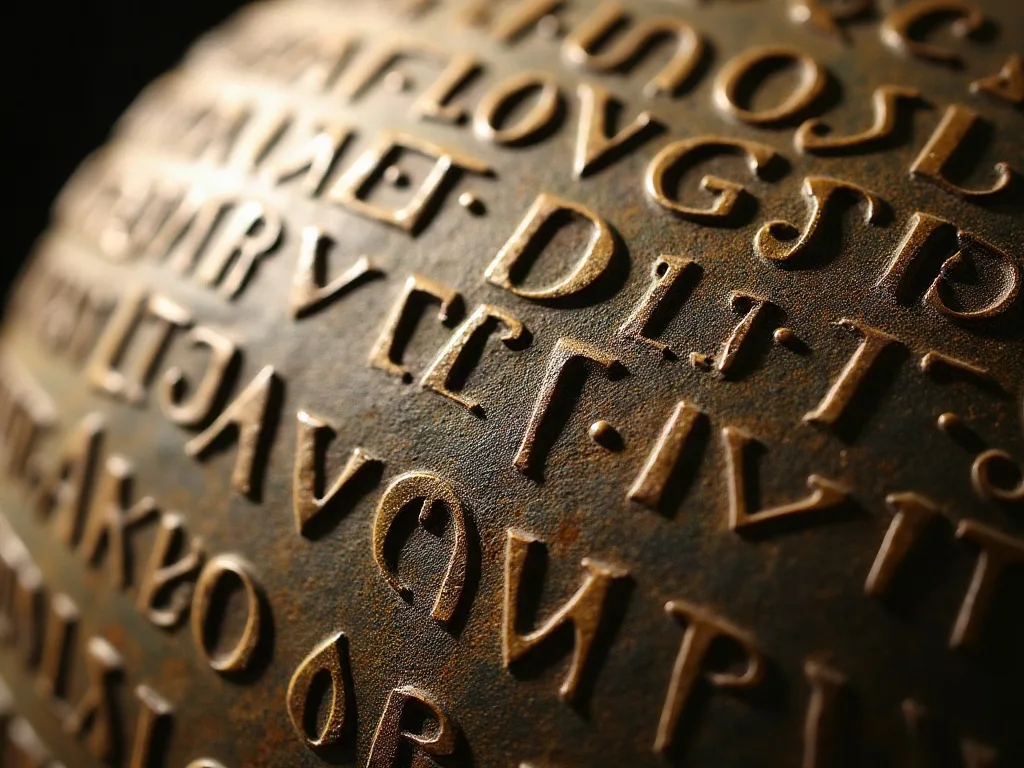
Despite centuries of study, mysteries remain. Some of the Etruscan inscriptions on the Liver of Piacenza are damaged or ambiguous. Scholars debate the exact meaning of certain terms and the exact functions of certain regions. Was every marked region consulted during a divination, or only specific regions depending on the question asked? Did the priest use the model as a strict template, or as a guide allowing for interpretation? How much did individual variation exist among haruspices, or was the practice entirely standardized?
The theological geography of the liver also raises questions. Why were certain gods assigned to certain positions? Did the placement reflect Etruscan astronomy, with gods positioned to match their constellations in the sky? Or was it purely symbolic, with the upper regions simply representing "superior" divine forces and the lower regions representing chthonic or dangerous powers? Some scholars have proposed that the Liver of Piacenza reflects a cosmology tied to the Etruscan system of dividing the sky into sixteen or more regions, each associated with a deity. Others argue the connection is less direct.
The discovery of other haruspicy texts and models in recent decades has added new data. Fragments of bronze livers have been found in other Etruscan sites. Roman literary descriptions of the practice can be compared against the physical evidence of the Piacenza model. Yet each new finding raises new questions. The Liver of Piacenza remains central to our understanding of Etruscan divination, but it also reminds us of how much we cannot know with certainty about a civilization whose texts are mostly lost and whose religious thought survives only in scattered fragments.
Frequently asked questions about the Liver of Piacenza and Etruscan haruspicy
Frequently asked questions
Was the Liver of Piacenza actually used to divine the future?
Scholars debate whether the Liver of Piacenza itself was an active divination tool or a teaching model and reference manual. Its pristine condition, lack of wear marks, and formal inscription suggest it may have been kept in a temple or as an educational tool for training haruspices, rather than handled regularly during actual sacrifices. However, the detailed anatomical divisions and god names carved into it were certainly meant to guide the interpretation of real animal livers used in divination rituals.
How did Etruscan haruspices train to read omens from livers?
Haruspices underwent years of formal education, likely beginning in childhood for members of noble or priestly families. They memorized the divisions and divine assignments shown on models like the Liver of Piacenza, studied thousands of examples of animal livers to recognize normal variation versus significant marks, and learned the theological principles that connected each organ region to specific deities and forces. The training was specialized and systematic, not mystical guesswork.
Did the Romans adopt the Etruscan system of haruspicy directly?
Yes, but with adaptation. As Rome conquered Etruscan territories, it absorbed haruspicy as a legitimate and prestigious form of divination. Roman generals continued to consult haruspices before major military actions. However, the Romans gradually Romanized the practice, renaming gods, adjusting interpretations to fit Roman theology, and integrating it into Roman state religion. By the Imperial period, haruspicy was officially recognized as one of several legitimate forms of divination.
What happened to haruspicy after the fall of the Etruscan civilization?
Haruspicy persisted under Roman rule and remained a recognized practice well into the Imperial period and even into the Christian era, though increasingly condemned by the Church. The specialty of the haruspex, the trained priest-diviner, gradually declined as Christianity spread and pagan divination practices were suppressed. Yet knowledge of haruspicy was preserved in classical texts and medieval manuscripts, allowing modern scholars to reconstruct the system from literary and physical evidence like the Liver of Piacenza.
Are there other Etruscan divination models like the Liver of Piacenza?
Yes, though the Liver of Piacenza is the most complete and famous example. Fragments of other bronze livers have been found in Etruscan sites, and Roman authors describe the use of bronze models (called tutulum) in haruspicy training. There are also references to models of other organs, including lungs and hearts. However, most of these objects are lost or fragmentary, making the Liver of Piacenza our most valuable direct evidence of how Etruscan divination systems were structured.
What did the different regions on the Liver of Piacenza represent?
Each region was marked with the name of an Etruscan deity or spirit. The upper portions corresponded to the higher gods like Tinia and Uni, representing favorable divine forces. The lower portions and edges corresponded to lesser gods, underworld spirits, and potentially ominous forces. The positioning created a map of the divine cosmos, so a haruspex could read a real liver's conditions region by region and match them to specific gods and their intentions.
The Liver as Cosmos
The Liver of Piacenza is ultimately more than an ancient object. It is a diagram of how the Etruscans understood the relationship between the divine and the mortal. The liver became a stage on which the gods performed their will. Every spot, every color, every unusual texture was a word in a language the trained ear could understand. To read a liver was to read the mind of heaven itself.
In modern times, we might study weather patterns or economic data to predict what comes next. We scan genetic codes or brain scans to understand hidden truths. The ancient haruspex performed a similar function with the tools and understanding available to them. They believed, with conviction backed by tradition and training, that the gods left marks in the bodies of animals. To see these marks clearly and interpret them correctly was wisdom. The Liver of Piacenza was their technology. It embodied the belief that the future was not hidden, only waiting to be read by those with the right map and the right understanding.
Read the full book
Want the whole story?
The complete edition is an instant PDF download here, with a paperback on Amazon for selected titles.
Etruscan
The Etruscan Mythology Book: Tinia, Uni, Menrva, and the Lost Religion of Italy
Tinia, Uni, Menrva, and Lost Italy
Before Rome, Italy belonged to the Etruscans: a people who read the future in lightning and livers, buried their dead in painted cities, and whose gods Rome quietly adopted. A mythology recovered from tombs, bronze mirrors, and the discipline of the haruspex.
More from Etruscan
All articles
Etruscan
Etruscan Tomb Banquets: Feasting with the Dead
In Etruscan tombs, the dead reclined at eternal banquets. Through painted walls and grave goods, archaeologists recover a ritual that bound living and dead in a single meal. Discover how the Etruscans fed their ancestors and what it reveals about their afterlife beliefs.
Etruscan
The Etruscan Disciplina: Sacred Books and Ritual Knowledge
The Etruscan Disciplina preserved the cosmos in ritual codes and sacred texts. Explore how haruspicy, augury, and divine protocol shaped an entire civilization and influenced Rome itself.
Etruscan
Tages: The Divine Child Prophet of Etruscan Divination
A child emerged from the earth to teach an Etruscan farmer the art of reading divine will. Tages, the Divine Child Prophet, became the source of all Etruscan divination knowledge, a figure so powerful that Roman priests carried his teachings for centuries.
Etruscan
Vanth: Etruscan Winged Death Goddess
Meet Vanth, the Etruscan winged death goddess who guarded the threshold between life and the underworld. Discover how this fierce divine figure shaped Etruscan beliefs about mortality, judgment, and the afterlife.