
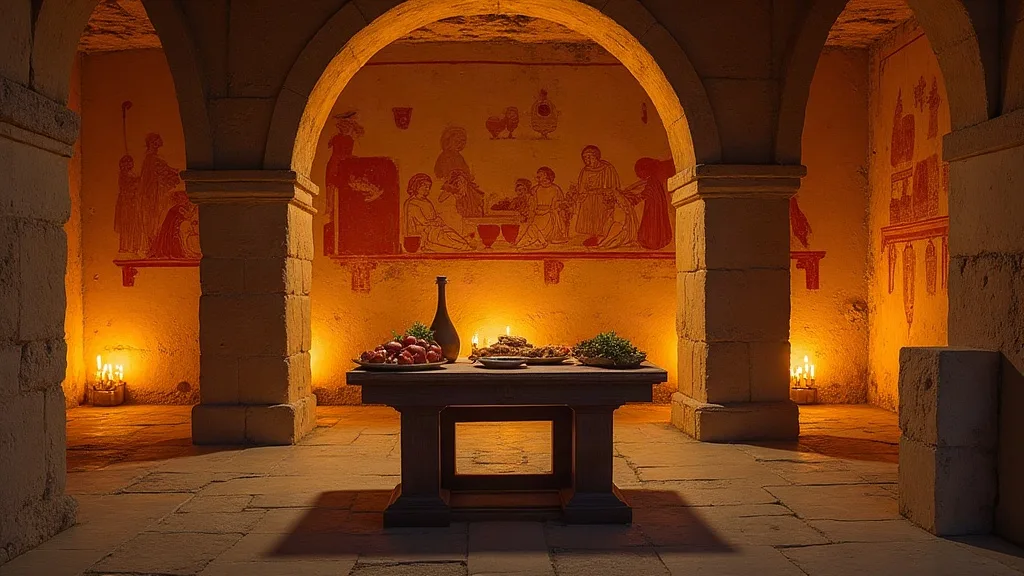
Etruscan Tomb Banquets: Feasting with the Dead
In Etruscan tombs, the dead reclined at eternal banquets. Through painted walls and grave goods, archaeologists recover a ritual that bound living and dead in a single meal. Discover how the Etruscans fed their ancestors and what it reveals about their afterlife beliefs.
Contents
The Etruscans painted their tombs as if setting a table for eternity. In the dark chambers carved into Tuscan limestone, figures reclined on couches with platters of food between them. Wine cups sat ready. Musicians played. The dead were not meant to fade into silence. They were meant to dine forever, and their living descendants kept the meal alive.
This was not mere decoration. Etruscan tomb banquets were a living ritual, not an ancient myth or distant legend. For centuries, the Etruscans of central Italy (what is now Tuscany) used the grave to continue a conversation begun in life. Food, drink, music, and company did not end at death. They were simply moved to a painted room underground.
The Etruscans and the Architecture of the Afterlife
The Etruscans inhabited the Italian peninsula from roughly the 8th to the 1st century BC, long before Rome absorbed their culture. They built cities like Tarquinia, Vulci, and Chiusi, each a center of commerce, art, and ritual life. Unlike the Greeks, who left their dead in cemeteries outside the city walls, the Etruscans hollowed their tombs directly into the living rock beneath their towns. The grave was not a final resting place in the modern sense. It was a home.
Etruscan funerary architecture reflects this belief. Tomb chambers mimic domestic space: they have walls, doors, windows, and furnishings. Some tombs have multiple rooms, arranged as if they were a house split across the underworld. The dead did not lie alone. They lay with family members in adjacent chambers, their corpses positioned on stone benches or in carved recesses called loculi. The living could visit them, leave offerings, and, on certain occasions, sit down and eat with them.
The practice is documented across nearly a thousand years. The earliest painted tombs at Tarquinia date to the 7th century BC. The latest, to the 1st century BC, as Etruscan power waned and Rome's grip tightened. That span of continuity is remarkable. It speaks to a cultural commitment so deep that it survived conquest.
The Painted Evidence: What the Walls Tell Us
The best record of Etruscan tomb banquets comes not from texts, the Etruscans left few written records that survived, but from paint. The walls of the richest tombs, especially those at Tarquinia, preserve scenes of the banquet in vivid color: ochre, black, red, white, and blue pigments still visible after 2,500 years.
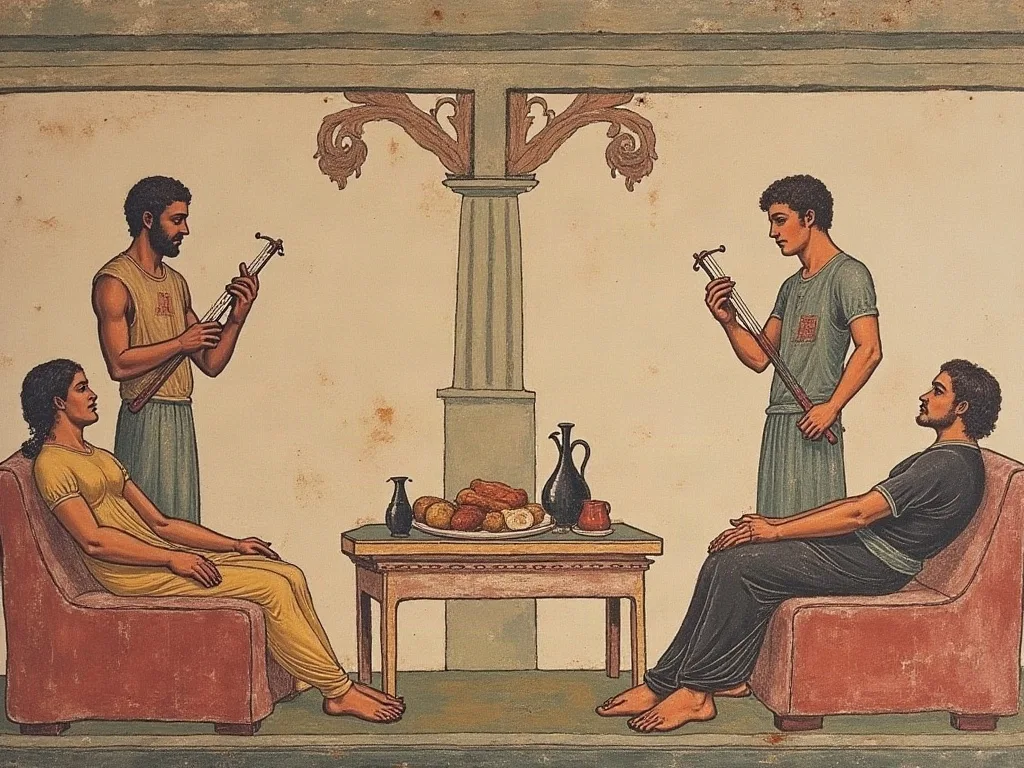
The scenes follow a recurring formula. Figures recline on a kline, a dining couch angled at 45 degrees. The posture is not unique to the Etruscans; Greek and Roman banqueters also reclined. But the Etruscan version carries a distinct tone. The figures on these couches are not feasting in an open hall. They are in a tomb. Many are naked or draped lightly. Some embrace one another. Others turn to offer food or wine to their companions. A table sits between them, laden with dishes: bread, fruits, fish, meat. Musicians stand nearby, playing the lyre, the double flute (aulos), or the pipes. Dancers move across the wall with an almost balletic grace.
One of the most famous examples is the Tomb of the Leopards at Tarquinia, dated to around 480 BC. On the rear wall, two couples recline at dinner. A young man on the left faces a young woman on the right. Both pairs gesture toward the table between them. Above, two leopards flank a painted window. The imagery is casual, intimate, almost tender. This is not a scene of sacrifice or formal rite. It is a moment of companionship.
Another striking image comes from the Tomb of the Triclinium (also at Tarquinia, early 5th century BC). Here, three couches are arranged in a U-shape, the Greek triclinium layout. Men and women recline together without separation by gender, another detail that sets the Etruscan banquet apart from its Greek and Roman counterparts. Musicians and servants move between the couches. Food is piled high on the table. The scene radiates abundance and ease.
The Ritual Practice: Who Feasted and When
Scholars have long debated whether these painted scenes show the dead feasting, or whether they depict the living bringing food to the tomb for the ancestors to consume spiritually. The truth is likely both. Etruscan tomb banquets served multiple purposes, collapsed into a single ritual act.
The archaeological evidence suggests that the living did descend into the tombs for communal meals. The tombs were not sealed after burial. Entrances remained open. Some tombs show traces of repeated use: multiple burials, successive generations of the same family laid to rest in the same chambers, sometimes centuries apart. The stone benches inside were worn smooth, suggesting many people sat there over time.
Excavations have uncovered remnants of the feast itself. Broken pottery vessels, cups, plates, bowls, jugs, litter the floors of many tombs, along with charred animal bones. Wine amphorae, some still bearing the marks of their origin (many come from the Greek east), suggest that libations were poured or drunk. The residue and debris indicate that food and drink were brought into the chamber, consumed, and left behind.
The occasions for these banquets were likely multiple. Some may have coincided with the funeral itself, in the period immediately after death, when the living family gathered to mourn and honor the deceased. Others probably occurred on regular festivals or anniversaries. The Etruscans believed in a calendar of such observances. As the religious texts the later Romans copied from Etruscan sources show, there were prescribed days to appease the dead, to make offerings, and to renew the bond between the living and the underworld.
The participants were not confined to the immediate family. Tomb inscriptions, though often fragmentary, record the names of multiple people, sometimes spanning several generations. Some tombs were family vaults, used by a single kin group for centuries. The feast was a family affair, but the broader community may have attended at certain moments. The spectacle of the banquet, the painted walls, the music, the food, created a shared space where collective identity was reinforced.
Food, Drink, and the Communion with the Dead
What was actually eaten and drunk at these Etruscan tomb banquets? The painted walls offer clues. Figs, pomegranates, bread, fish, and meat appear regularly. Wine is ubiquitous. The images sometimes show specific cuts of meat: ribs, haunches, possibly seafood. Wheat cakes and loaves sit stacked on tables.
Wine held special significance. The Etruscans were wine drinkers and wine traders, with access to both local production and imported varieties from Greece and beyond. Wine was not ordinary nutrition. It was a substance of transformation, linking the drinker to the divine and the ancestral. Pouring wine, a libation, was a formal act of communication with the dead. The wine touched their lips, so to speak, even if only in the symbolic sense.
The food was real. Archaeologists have identified the remains of cattle, sheep, pigs, fish, and wild game in tomb deposits. This was not cheap fare. The families that could afford to paint their tombs and provision them with such abundance were the elite: the landowners, the magistrates, the priests, the merchants. The feast was an assertion of status as much as a ritual to honor the dead.
There is also evidence of a more intimate, ongoing form of nourishment. Some tombs contain small niches or shelves carved specifically for offerings. These may have held grain, oil, wine, or fruit, simple sustenance left for the departed, replenished over time. This practice suggests a more domestic, less ceremonial relationship with the dead. The ancestor in the tomb was not so much a god to be honored from a distance, but a family member to be cared for, fed, and remembered in ordinary gestures.
Symbols and Meaning: Why the Banquet?
Why did the Etruscans insist on this image of perpetual feasting? What did the Etruscan tomb banquet mean to them?
The answer lies in their concept of the afterlife. Unlike later Christian traditions, which often imagined the afterlife as ethereal, weightless, and bodiless, the Etruscans saw the dead as remaining fundamentally embodied. The dead reclined, ate, drank, conversed, and made love in the underworld just as they had on earth. The boundary between life and death was not absolute. It was permeable, maintained by ritual and remembrance.
The banquet was a moment of that permeability. When the living sat down in the tomb and ate with the dead, they were not performing a metaphor. They were enacting a literal communion. The dead ancestor was present, not as a ghost to be feared, but as a family member to be included. The meal was both a feed for the body (the ancestor's spiritual essence, which the Etruscans believed required nourishment) and a declaration of family unity across the boundary of death.
The presence of women at these meals is significant. In many ancient Mediterranean societies, women were segregated from men during public feasts. The Etruscan tomb paintings show men and women reclining together, sometimes as couples, sometimes in mixed groups. This suggests a different ideology. The afterlife, as the Etruscans imagined it, was not a hierarchical masculine space. It was domestic, familial, and intimate. Death did not alter the bonds of marriage or kinship. If anything, it crystallized them.
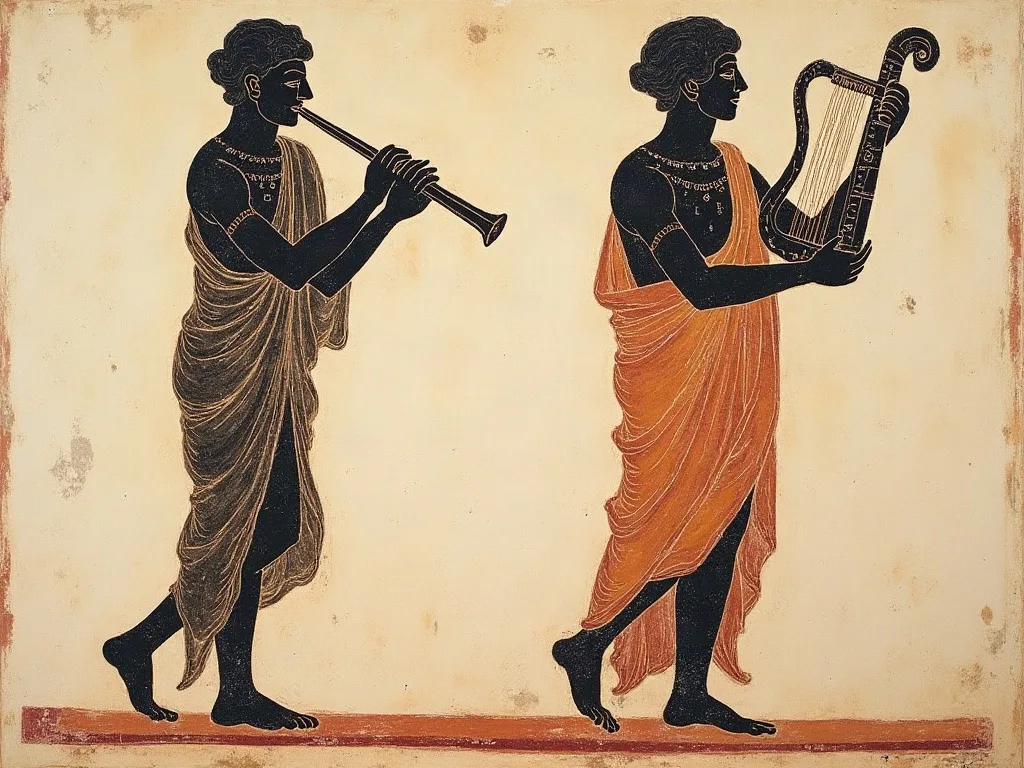
The musicians and dancers painted on the walls add another layer. The banquet was not silent. It was accompanied by music, song, and movement. The Etruscans believed in the power of music to mediate between worlds. The double flute player, the lyre player, the acrobat, these figures were not mere entertainers. They were ritual specialists who kept the feast in motion, sustaining the connection between living and dead through rhythm and sound.
The Decline and the Roman Inheritance
As Rome expanded and absorbed Etruscan territory over the 3rd and 2nd centuries BC, the practice of Etruscan tomb banquets did not disappear immediately. It evolved and merged with Roman customs. The Romans, too, held funeral feasts, the silicernium, after a burial. They, too, left offerings at tombs and visited the graves of ancestors on set occasions.
But the painted tomb, the domestic burial chamber, the intimate afterlife, these belonged to a specifically Etruscan vision. As Latin supplanted Etruscan as the language of administration and daily life, and as Roman architectural and religious styles became dominant, the older practice faded. By the 1st century BC, painted Etruscan tombs were no longer being created. The Etruscans themselves, as a distinct ethnic and cultural group, had been absorbed into the Roman state.
Yet the memory lingered. Roman writers of later centuries, including Livy and Dionysius of Halicarnassus, recorded details about Etruscan funeral rites. They noted the significance of the banquet, the role of musicians, and the belief that the dead required provisioning. Some of these details may have been drawn from earlier Etruscan texts or priestly traditions that the Romans preserved.
The painted tombs of Tarquinia, Chiusi, Vulci, and other Etruscan cities remained underground, sealed and hidden, until the 18th and 19th centuries, when European archaeologists began systematic excavation. These discoveries revealed a civilization far more sophisticated, colorful, and psychologically complex than Roman sources had suggested. The tomb paintings in particular transformed understanding of ancient Italy. They offered direct evidence of how the Etruscans lived, what they wore, what they ate, what they valued, and, most strikingly, how they imagined the moment after death.
The Scholarly Debate: Feasting or Funerary Imagery?
Archaeologists and historians have proposed different interpretations of Etruscan tomb banquets. Were these scenes purely symbolic and didactic, meant to show the ideal afterlife without representing an actual ritual? Or do they depict a practice that the living regularly performed?
The evidence supports a middle ground. The painted images are stylized and formulaic. They follow conventions. But the material remains, the pottery vessels, the food residue, the arrangement of benches for seating, strongly suggest that actual meals were held in these spaces. The practice may not have been as frequent or elaborate as the paintings imply, but it was real.
Some scholars argue that the banquet imagery served an aspirational function. For the elite families who could afford such tombs, the painted feast was a statement of wealth, stability, and control over the afterlife. It was a way of saying: "We are so secure, so rooted, that even death is merely a continuation of our prosperity." For families of lesser means, who could not afford painted tombs, the afterlife was perhaps understood differently. We simply lack the visual record.
Others point to the uniformity of the scenes across time and space as evidence of a cultural practice so embedded that it needed no explanation. The formulae recurred because they captured something essential to Etruscan identity: the conviction that the family extended beyond death, and that ritual actions, feasting, music, the presence of the living, could keep that family intact.
The Tombs as Archive: What Archaeology Reveals
The painted Etruscan tombs are among the most intact archaeological records of daily life in the ancient Mediterranean. They function as an archive in paint. Because the tombs were sealed and protected from sunlight and weather for over two millennia, the colors have remained remarkably vivid. The scenes preserve details of furniture, clothing, hairstyles, food, musical instruments, and body language that would otherwise be lost.
Scholars have used these images to reconstruct Etruscan domestic life. We can see how they arranged their dining rooms, how they reclined on couches, how they gestured and moved. We can observe the relationships between men and women, old and young. We can study the objects they valued and kept near them: bronze mirrors, jewelry, weapons, vessels.
The inscriptions carved into the tomb walls, though often fragmentary and in an ancient script that has not been fully deciphered, provide names and genealogies. By matching these names across tombs and comparing them with inscriptions on moveable objects found in the tombs, archaeologists have begun to reconstruct Etruscan family histories. They can follow a name and lineage across several generations, watching as tombs are reused, as family property passes down, as branches of the family settle in new locations.
The banquet paintings, then, are not simply artistic flourishes. They are historical documents. They record a ritual that defined Etruscan civilization: the feeding of the dead, the renewal of family bonds, the affirmation that life and death were not opposites but phases of a continuous existence.

Etruscan Afterlife Beliefs and Religious Framework
Understanding Etruscan tomb banquets requires grasping their broader religious worldview. The Etruscans were not monotheistic. They worshipped many deities, some borrowed or adapted from Greek sources (Tinia the sky god, Uni the queen of heaven), and others uniquely Etruscan. They believed in fate, in the signs the gods sent through the flight of birds and the livers of sacrificed animals, and in the existence of an underworld that was not a realm of torment but a shadowy mirror of the world above.
The dead inhabited this underworld. They did not cease to exist. They did not dissolve into nothingness. Instead, they were translated into a different mode of being, one in which they retained their appetites, their social relationships, and their connection to the living. The Etruscans performed rituals to manage this relationship. They made offerings. They called on the dead to protect the living. They believed that if the dead were neglected, they might grow restless or vengeful.
The tomb banquet was the highest expression of this relationship. It was an acknowledgment that the dead were not forgotten, that they were valued, that they belonged to the family still. The banquet also had a practical purpose: it was believed to sustain the dead, to give them nourishment in a realm where such substance was harder to come by.
This belief system was not unique to the Etruscans. Similar ideas appear in other Mediterranean and Near Eastern cultures. But the Etruscans expressed these beliefs with particular eloquence through the painted tomb. They created spaces where the boundary between living and dead was not a barrier but a threshold, and where the ritual of eating and drinking was the key that opened the passage.
Comparative Echoes: Feasting Rituals in Other Ancient Cultures
The practice of feasting with the dead was not confined to the Etruscans. Similar rituals appear in cultures across the ancient world, suggesting a deep human impulse to maintain bonds with the deceased through food and shared space.
The ancient Greeks held public funeral feasts (deipna) in honor of the dead, and they made regular food offerings at tombs on commemorative days. The Romans practiced the silicernium, a funeral feast held at the grave, and they left food and wine on the tombs of ancestors during the Parentalia festival. The ancient Egyptians filled tombs with food and drink to sustain the ka, the vital force believed to remain in the grave. Celtic cultures left feasts for the dead. Even in later European folk tradition, the wake, the vigil over the corpse, often included eating and drinking, a practice with roots reaching back to antiquity.
What distinguishes the Etruscan approach is the visual and spatial commitment. The Etruscans did not simply leave offerings at a grave or hold a feast outside it. They painted the tomb interior as a domestic space and decorated it with the image of an ongoing feast. They treated the grave as a room to be furnished, decorated, and revisited. This suggests a unique conception of the afterlife as not merely a destination but a continued dwelling.
The Legacy: Etruscan Influence on Later Mediterranean Religion
The fall of Etruscan independence did not erase Etruscan religious practices. The Romans, who had long admired and feared Etruscan priests and their knowledge of divination, incorporated much of Etruscan religious expertise into their own state religion. They consulted Etruscan soothsayers. They adopted Etruscan methods of reading omens. Some of the most solemn Roman religious offices carried Etruscan titles and protocols.
Funeral practices in Roman Italy show signs of Etruscan influence. The arrangement of tombs in necropolises, the use of painted chambers, the provision of grave goods, and the belief in the need to maintain relationships with the dead, these elements, some of Etruscan origin, became embedded in Roman practice. When Romans conquered and absorbed Etruscan lands, they did not erase the tombs. Many remained visible, some were reopened, and the insights they offered into proper burial and ancestral respect were preserved.
This legacy, though often unacknowledged, flowed into the religious frameworks of later Christian and medieval Europe. The idea of communing with the dead, of making offerings at graves, and of believing that the deceased require nourishment and remembrance, these notions, articulated in the Etruscan painted tombs, persisted and evolved through subsequent historical periods.
Frequently asked questions about Etruscan tomb banquets?
Frequently asked questions
Did Etruscan tomb banquets actually happen, or are they just painted images?
Both. The paintings in tombs depict scenes of feasting and are artistically stylized, but archaeological evidence, broken pottery vessels, food residue, charred bones, and the worn surfaces of stone benches, indicates that the living did descend into tombs to eat and drink. The paintings documented a real ritual practice, not pure fantasy. The banquets may not have been as frequent or elaborate as the paintings suggest, but they were genuine.
What did the Etruscans believe happened to the dead?
The Etruscans believed the dead inhabited an underworld that was a shadowy mirror of the world above. The dead retained their appetites, their social ties, and their need for nourishment. They did not cease to exist or become incorporeal spirits. Instead, they transitioned into a different mode of being, one in which they still belonged to the family and community. Regular ritual feeding, through tomb banquets and offerings, kept them satisfied and benevolent.
Why did the Etruscans include both men and women at tomb banquets?
The tomb paintings show men and women reclining together at banquets, sometimes as couples. This suggests that the Etruscan afterlife, as imagined through these rituals, was not hierarchical or separated by gender as some public feasts were in Greece and Rome. Instead, it was domestic and familial. Death did not dissolve marriage or kinship bonds. The afterlife was an extension of family life, with the same intimacy and mixed company.
What food and drink were provided at Etruscan tomb banquets?
Archaeological evidence and painted images show bread, figs, pomegranates, fish, and meat on the tables. Wine was especially important, with jars sometimes imported from Greece. The families that maintained elaborate tomb banquets were the elite, so the food was high quality and abundant. Regular offerings to the dead may also have included simpler provisions like grain and oil, left in small niches carved into the tomb walls.
How long did the practice of Etruscan tomb banquets continue?
The practice spanned from at least the 7th century BC until the 1st century BC. The earliest painted tombs with banquet scenes date to around 700 BC. The latest examples come from the final century of Etruscan independence, before Rome absorbed Etruscan territory fully. After that, the distinctively Etruscan painted tomb with banquet imagery fell out of use, though some funeral practices influenced later Roman traditions.
How do we know so much about Etruscan tomb banquets if the Etruscans left few written records?
The painted walls of tombs are the primary source. These images, preserved in chambers sealed for over 2,000 years, capture scenes of feasting, music, and social interaction in vivid detail. Archaeologists also study the physical remains inside tombs: pottery vessels, food residue, and inscriptions on the walls listing the names of family members buried there. Together, these sources, visual, material, and inscriptional, create a detailed record of the practice and its meaning.
The Persistence of Ancestor Veneration
The Etruscan tomb banquet vanished as a distinct ritual, but the impulse behind it, the conviction that the dead remain part of the family, that they need remembering and nourishment, that ritual feasting is a way to honor them, persisted long after Rome absorbed Etruscan civilization. This impulse appears in medieval tomb sculpture, in Renaissance chapel frescoes, in modern practices like visiting graves on anniversaries and leaving flowers. The specifics changed, but the core insight endured: that death does not sever kinship, and that the living and dead can meet across the boundary through shared meals, music, and remembrance.
The painted Etruscan tombs remain one of the clearest windows into how an ancient people understood mortality and continuity. They show a civilization that did not fear the dead or exile them to a distant underworld. Instead, the Etruscans welcomed them home, set a place at the table, and kept the conversation alive.
Read the full book
Want the whole story?
The complete edition is an instant PDF download here, with a paperback on Amazon for selected titles.
Etruscan
The Etruscan Mythology Book: Tinia, Uni, Menrva, and the Lost Religion of Italy
Tinia, Uni, Menrva, and Lost Italy
Before Rome, Italy belonged to the Etruscans: a people who read the future in lightning and livers, buried their dead in painted cities, and whose gods Rome quietly adopted. A mythology recovered from tombs, bronze mirrors, and the discipline of the haruspex.
More from Etruscan
All articles
Etruscan
The Etruscan Disciplina: Sacred Books and Ritual Knowledge
The Etruscan Disciplina preserved the cosmos in ritual codes and sacred texts. Explore how haruspicy, augury, and divine protocol shaped an entire civilization and influenced Rome itself.
Etruscan
The Liver of Piacenza: Bronze Divination Model of the Etruscans
Discover how the Etruscan priests read fate itself: the Liver of Piacenza is a bronze model showing exactly where to look on a real liver for messages from the gods. It reveals the ancient art of haruspicy in bronze.
Etruscan
Tages: The Divine Child Prophet of Etruscan Divination
A child emerged from the earth to teach an Etruscan farmer the art of reading divine will. Tages, the Divine Child Prophet, became the source of all Etruscan divination knowledge, a figure so powerful that Roman priests carried his teachings for centuries.
Etruscan
Vanth: Etruscan Winged Death Goddess
Meet Vanth, the Etruscan winged death goddess who guarded the threshold between life and the underworld. Discover how this fierce divine figure shaped Etruscan beliefs about mortality, judgment, and the afterlife.