
Tinia: Supreme Sky God of the Etruscans
Tinia ruled the Etruscan sky with three thunderbolts and a sovereignty no other god could match. Learn how this enigmatic deity shaped one of antiquity's most underrated civilizations.
Contents
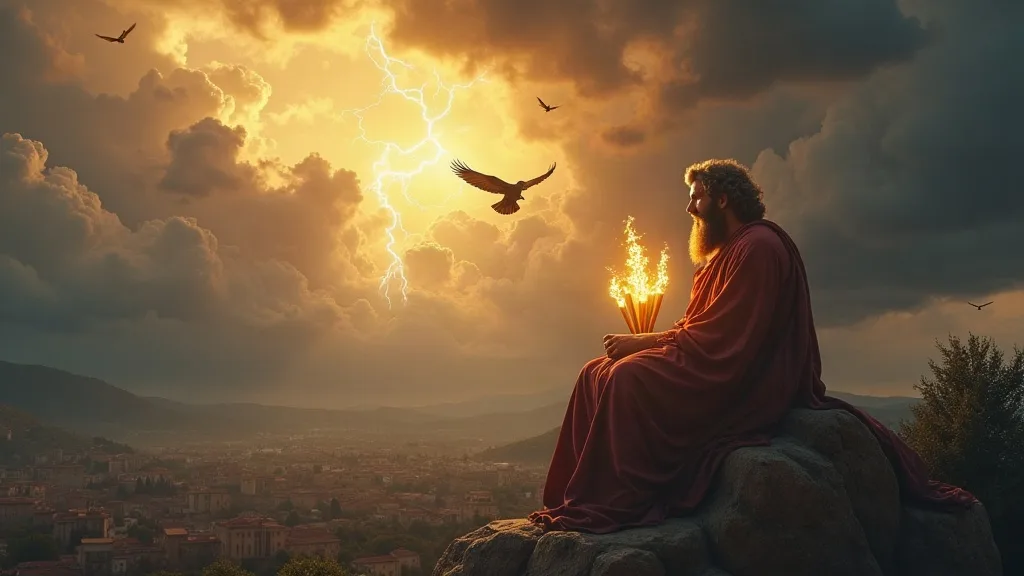
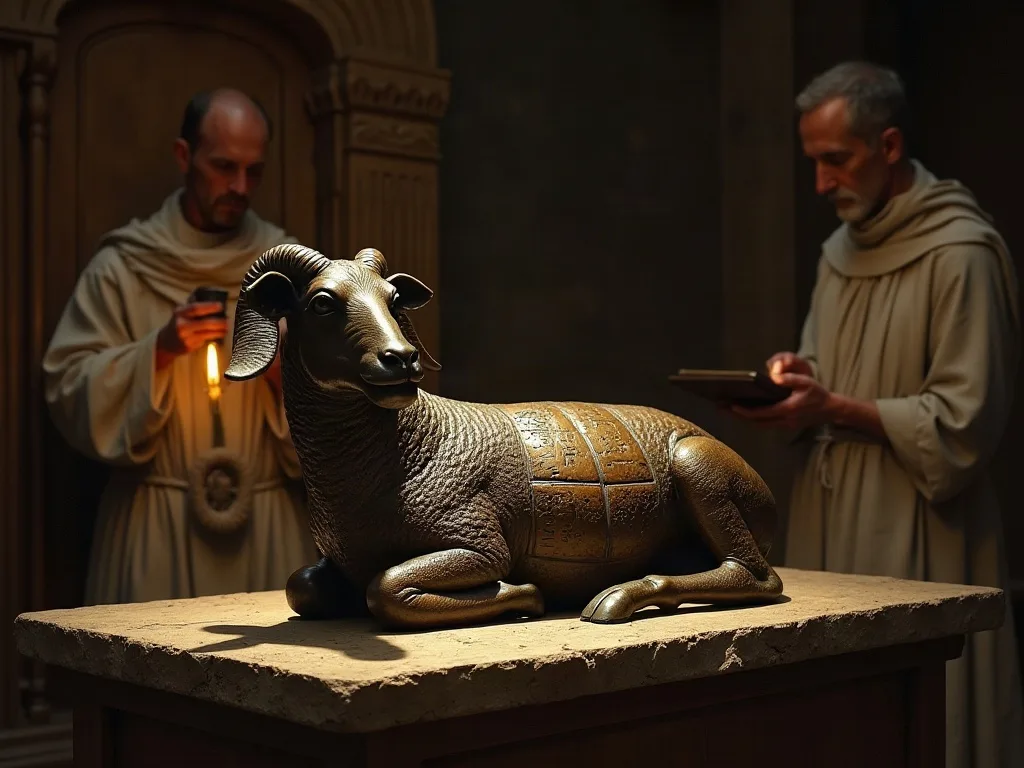
The bronze liver of Piacenza sits in a museum today, a sheep's liver cast in metal and divided into sections, each labeled with the name of an Etruscan deity. At the very top, holding the most exalted region of the heavens, sits one name above all others: Tinia. Not Jupiter. Not Zeus. Tinia: supreme sky god of the Etruscans, lord of thunder, ruler of the celestial canopy, and the axis around which Etruscan religion turned for nearly a thousand years.
He held three separate thunderbolts. That detail alone tells you something. Greek Zeus carried one. Roman Jupiter carried one. Tinia had three, each with a different purpose and a different weight of consequence. The first he could throw on his own authority. The second required the counsel of the twelve great gods, the Dii Consentes Etrusci. The third, the most terrible, demanded the agreement of a secret higher assembly whose names no priest spoke aloud. Power, in Etruscan thought, was layered and deliberated. Even the king of heaven could not simply destroy.
This is not the mythology of brute Olympian force. It is something more considered, more civic, and in many ways more unsettling.
Who Was Tinia? Origins and Name
Tinia (sometimes spelled Tin or Tins in archaic inscriptions) stands at the top of the Etruscan divine hierarchy, which scholars call the Disciplina Etrusca, the collected religious science that governed Etruscan ritual life. The name itself is debated. Many linguists connect it to the Proto-Indo-European root meaning "day" or "bright sky," the same root that gives Latin its dies (day) and feeds into the name of Roman Jove. If that etymology holds, Tinia's name is essentially "the bright one," "the sky itself made personal."
The Etruscans, who flourished across central Italy from roughly the 8th century BC to their absorption by Rome around the 1st century BC, left no narrative mythology in the way Homer or Hesiod did. No Etruscan Iliad survives. What remains is material: tomb paintings, bronze mirrors engraved with mythological scenes, terracotta votives, temple foundations, and inscribed objects like that liver at Piacenza. From these fragments, scholars have reconstructed a theology that is unmistakably its own, even when it borrows Greek images.
Tinia appears in hundreds of inscriptions and images. On engraved bronze mirrors, he sits enthroned with a scepter, sometimes draped in a royal mantle, often bearded in the manner of Greek Zeus, whose iconography the Etruscans adopted while keeping their own theological logic entirely intact. The borrowing of visual grammar did not mean a borrowing of identity.
The Three Thunderbolts: A Theology of Constrained Power
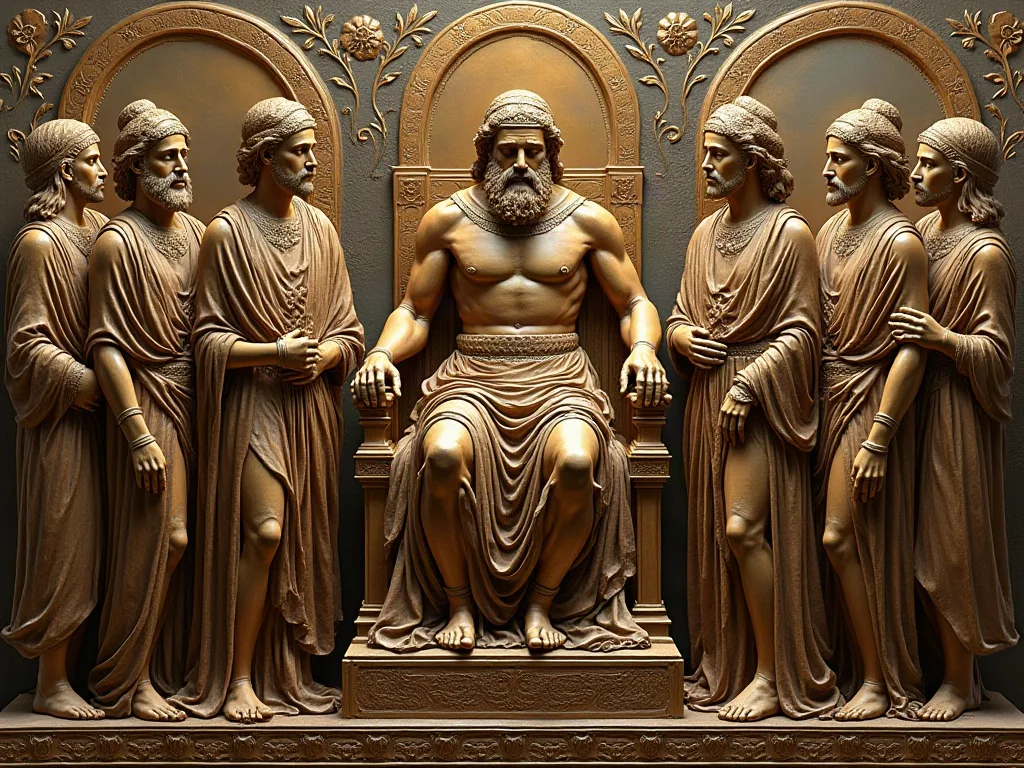
The three-bolt doctrine is the single most distinctive feature of Etruscan theology, and it survives because Roman authors found it worth recording. The scholar Nigidius Figulus, writing in the 1st century BC and cited by the Latin grammarian Lydus several centuries later, preserved the clearest account: Tinia wielded three fulmina, or lightning bolts, of fundamentally different characters.
The first bolt was persuasive: a warning, a sign, a nudge toward correct behavior. Tinia could release it based solely on his own divine will.
The second was corrective and destructive but recoverable in meaning. Before this bolt could fly, Tinia had to convene the council of the Dii Consentes, the twelve gods whose names appeared on golden tablets kept at the sanctuary of Voltumna (the great Etruscan national deity of the earth and change). This council structure mirrors something deeply Etruscan about religion: no single god acts in pure isolation. Even sovereignty requires community ratification.
The third bolt was apocalyptic. It could reshape fates, overturn cities, and alter the structure of time itself. It required consent from an even higher, unnamed assembly, sometimes called the Dii Involuti, "the veiled gods" or "the wrapped gods," beings so powerful and so alien to human comprehension that their names were deliberately kept secret. Even the priests who studied the Libri Fulgurales (books of lightning interpretation) did not claim to know all their names.
This structure reflects something profound about Etruscan civic philosophy. The Etruscans built city-states, the Dodecapolis, a loose confederation of twelve cities. Power was distributed, negotiated, federated. Their supreme sky god operated the same way. He was sovereign, yes. But sovereignty had procedures.
Tinia (Etruscan)
- Three thunderbolts of escalating power
- Must consult the Dii Consentes before using the second bolt
- Third bolt requires secret divine council approval
- Theology embedded in civic, federated structures
- No surviving narrative mythology; known through ritual texts and material culture
- Associated with the Disciplina Etrusca and fate interpretation
Zeus (Greek)
- Single thunderbolt, symbol of unilateral divine authority
- Consults other gods occasionally but acts largely alone
- Unlimited use of divine force in mythology
- Theology shaped by aristocratic Homeric narrative
- Extensive narrative mythology in Homer and Hesiod
- Associated with cosmic order (dike) but not structured procedural governance
Tinia and the Etruscan Triad: Uni, Menvra, and the Sky King
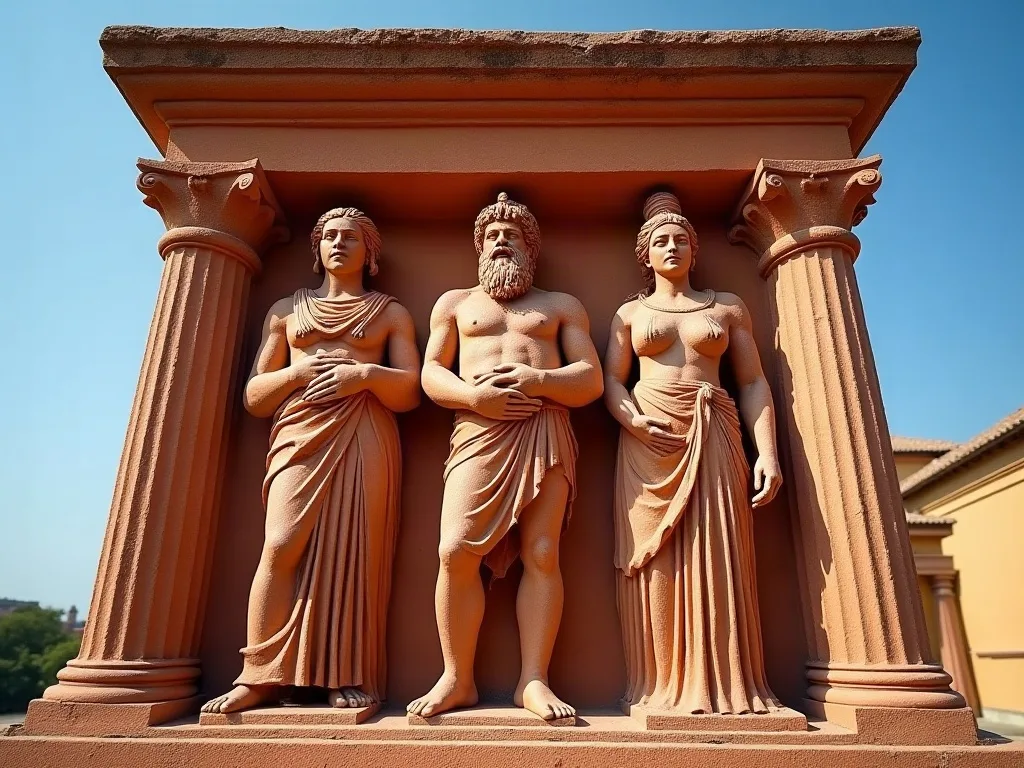
Tinia did not rule alone in the Etruscan sacred imagination. He stood at the head of a divine triad whose other members were Uni (the great goddess of sovereignty and protection, corresponding broadly to Juno) and Menvra (goddess of craft, wisdom, and the arts of civilization, corresponding to Minerva). Together, the three presided over Etruscan cities' most important temples. At Veii, the great Etruscan city north of Rome, a terracotta statue of the god Apollo once shared a roofline with figures associated with this triad.
The triad structure itself was borrowed from Etruscan theology by Rome, not the other way around. Rome's Capitoline Triad of Jupiter, Juno, and Minerva almost certainly derives from Etruscan religious practice, adopted when Rome was still partly under Etruscan cultural dominance during the 6th century BC. The great Capitoline temple, tradition says, was begun under the Etruscan Tarquin kings. When the Romans dedicated it to Jupiter Optimus Maximus, Juno, and Minerva, they were working from an Etruscan blueprint.
Tinia in this triad held the sky, the rain, the crops' welfare, the welfare of armies. Uni held the city walls. Menvra held the workshop and the school. Together they held civilization itself, which is precisely what the Etruscans understood themselves to be: a civilized people with a divinely-ordered state.
Tinia in Etruscan Art: What the Mirrors and Tombs Tell Us
Because no Etruscan prose mythology survives, engraved bronze mirrors are among the richest sources we have. These mirrors, often placed in women's tombs as luxury goods, carry mythological scenes on their backs, engraved with surprising sophistication. Tinia appears in several key scenes.
On one famous mirror from Vulci (now in the Vatican Museums), Tinia is shown assisting at the birth of Menrva, who emerges from his head in a scene directly parallel to the Greek myth of Athena's birth from Zeus. The Etruscan artists knew the Greek story but rendered it in their own visual idiom: the figures wear Etruscan dress, the inscriptions beside them name them in Etruscan, and the spatial composition follows Etruscan conventions of sacred space.
On other mirrors, Tinia appears with an eagle, the great raptor sacred to sky gods across the ancient world, a bird the Romans would carry on their legionary standards. The eagle in Etruscan augury (the art of reading bird signs, which Rome learned directly from Etruria) was the highest sign. An eagle flying right from a priest's left was among the most auspicious omens possible. The connection between this bird and Tinia is not decorative. The eagle was his eye crossing the sky.
In tomb paintings, particularly from the great necropolis of Tarquinia, the underworld figures and the heavenly figures sometimes appear together, and Tinia's presence is marked by lightning symbols and by his position of height. The Etruscans believed the sky and the underworld communicated. The liver of Piacenza maps both celestial and chthonic regions because, for the Etruscans, heaven and the deep earth were two faces of one sacred geography.
The Disciplina Etrusca: Tinia's Priests and the Science of Heaven
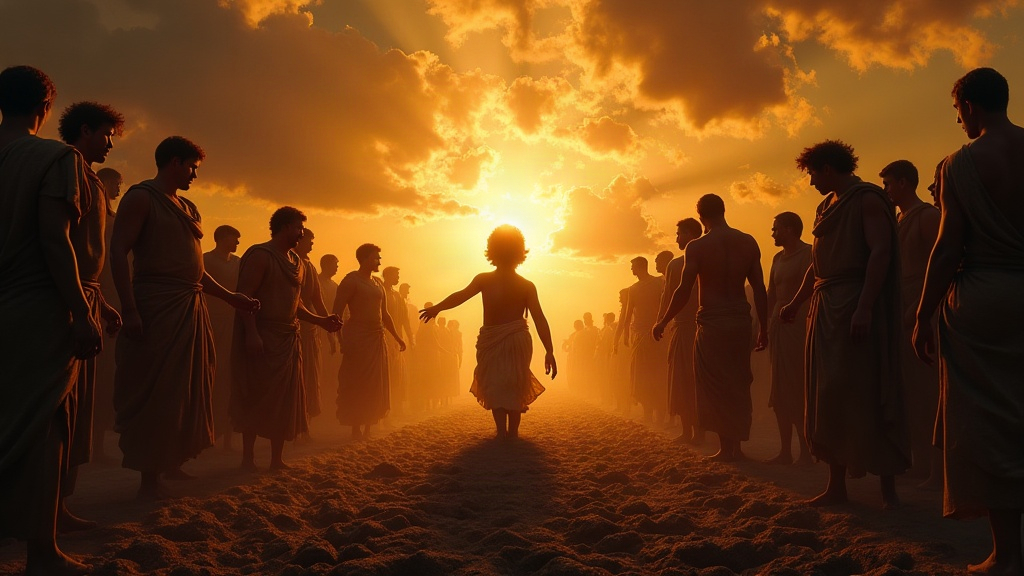
To understand Tinia, you have to understand the Disciplina Etrusca, the body of religious knowledge the Etruscans believed had been revealed to them directly by a divine child named Tages, who emerged from a plowed field near Tarquinia and dictated the rules of divine interpretation before disappearing. This "discipline" covered three main arts:
- Haruspicy: reading the entrails of sacrificed animals, particularly the liver, to interpret divine messages. The Piacenza liver is a training model for this practice.
- Fulgural science: interpreting lightning, including Tinia's three thunderbolts, their direction, their color, their time of day, and which god of the sixteen regions of heaven had sent them.
- Ostentaria: reading prodigies and portents, including unusual births, floods, eclipses, and the appearances of strange creatures.
Tinia sat at the center of fulgural science. The Libri Fulgurales, books of lightning interpretation, were among the most sacred Etruscan texts. Roman authors mention them with reverence. Cicero, in his work De Divinatione, treats Etruscan haruspicy and lightning science with a mixture of intellectual skepticism and genuine respect for their antiquity and internal consistency.
Etruscan priests specialized in reading Tinia's messages. Different types of lightning had different authors among the gods, but lightning originating in the highest celestial regions, the zones associated with the supreme sky god, carried the weight of ultimate divine communication. When a Tinia-bolt struck, it was not random. It was a sentence.
Tinia and Fate: The Etruscan God Who Could Not Override Destiny
Here is the paradox at the heart of Tinia's nature: despite being the supreme sky god, he was not omnipotent over fate. The Etruscans had a concept of fatum (fate), and they took it seriously in ways that even affected their supreme deity. Etruscan theological thought held that the universe operated within a fixed temporal structure, a series of saecula (ages or centuries), each of a determined length. When a saeculum ended, no divine will, not even Tinia's, could extend it.
The Etruscans believed their own civilization had a fixed lifespan, revealed to their ancestors by the divine child Tages. When the tenth Etruscan saeculum ended, Etruria would cease. This was not tragedy in the Etruscan reading. It was the shape of sacred time. Tinia governed within that time. He did not govern the time itself.
This sets Etruscan theology apart from both Greek and Roman religious thinking in a striking way. Zeus can be tricked and defied; fate in Greek myth is often a wrestling match. Tinia acknowledges a structure above even him. The procedural constraints on his thunderbolts are one expression of this. The ultimate authority is not personal divinity but the ordered cosmos itself, the disciplina woven into the fabric of existence before any god spoke.
Janus, the Roman god of beginnings and thresholds, offers a useful comparison from the neighboring tradition: both Janus and Tinia suggest that the Roman religious imagination was shaped by contact with a theology far more concerned with structure and time than Greek religion tended to be.
From Tinia to Jupiter: What Rome Inherited and What It Lost
When Rome absorbed Etruria across the 3rd and 2nd centuries BC, Tinia effectively became Jupiter. The names merged in function, in iconography, in temple architecture. Roman Jupiter took the eagle, took the thunderbolt, took the summit of the Capitoline Hill. But Rome took only one bolt.
The three-bolt doctrine faded. The Dii Involuti, the veiled gods above even Tinia's unilateral action, became a curiosity noted by scholars rather than a living theology shaping political decisions. What Rome gained was a sky god of enormous civic prestige. What it lost, arguably, was the philosophical complexity of a deity who embodied the idea that even supreme power must answer to something higher.
Roman emperors would come to identify directly with Jupiter, claiming divine unilateral authority. It is hard to imagine any Etruscan ruler claiming to embody Tinia, because Tinia himself did not act alone.
The haruspices, Etruscan priests who read entrails and lightning, continued to operate in Rome for centuries after Etruria's political absorption. As late as the 4th century AD, the Emperor Julian consulted them. The practice carried the ghost of Tinia's theology long after his name had been forgotten by the general population.
Frequently Asked Questions About Tinia, Etruscan Sky God
Frequently asked questions
Is Tinia the same as Jupiter or Zeus?
Tinia shares a broad category with Jupiter and Zeus as a sky deity and king of the gods, and the Romans eventually equated him with Jupiter. But the theological mechanics are different in important ways. Tinia's three-bolt system, his dependence on divine councils, and his subordination to cosmic fate (fatum) give him a character that is distinctly Etruscan. The visual borrowing from Greek Zeus iconography in Etruscan art was a matter of artistic convention, not theological identity.
What are the primary sources for Tinia's mythology?
Because the Etruscans left no narrative texts, the sources are mainly material (bronze mirrors, the Piacenza liver, tomb paintings, temple dedications) and Roman literary references. Nigidius Figulus' account of the three thunderbolts is preserved in the writings of John Lydus (6th century AD). Cicero's De Divinatione gives a Roman intellectual's view of Etruscan religious science. Modern scholarship draws heavily on the work of Massimo Pallottino, the 20th-century Italian archaeologist who systematized Etruscan studies.
What was the Piacenza liver, and what does it tell us about Tinia?
The Piacenza liver is a bronze model of a sheep's liver, dating to around 100 BC, used to train Etruscan priests in haruspicy (liver divination). Its outer rim and inner sections are divided into regions corresponding to different deities. Tinia occupies the most exalted celestial zone at the top. The liver demonstrates that Etruscan religion mapped divine space onto the body of a sacrificed animal, treating the liver as a microcosm of the heavens and earth.
Why did the Etruscans give Tinia three thunderbolts instead of one?
The three-bolt system reflects Etruscan civic values and their theology of constrained power. In a culture organized around federated city-states and collective decision-making, even the supreme deity could not act alone in matters of great consequence. The three bolts encoded a scale of divine intervention, from individual divine will to communal divine council to a hidden supreme authority, mirroring the political structures of the Etruscan Dodecapolis itself.
Did Tinia have a consort or family in Etruscan religion?
Yes. Tinia's primary consort was Uni, the goddess of sovereignty and protection who corresponds broadly to Juno. Together with Menvra (Minerva), they formed the Etruscan divine triad that presided over the most important city temples. Tinia also appears in scenes connected to other deities: on bronze mirrors he assists at the birth of Menvra, and he interacts with figures from the Greek mythological world (like Hercle, the Etruscan Heracles) that the Etruscans absorbed into their visual repertoire.
How did Tinia influence Roman religion?
The influence was substantial and often underacknowledged. The Capitoline Triad of Jupiter, Juno, and Minerva almost certainly derives from the Etruscan triad of Tinia, Uni, and Menvra, introduced when Etruscan kings ruled Rome in the 6th century BC. The Roman practice of haruspicy (consulting Etruscan-trained priests for lightning interpretation and liver reading) kept Etruscan theological ideas alive in Rome for centuries. Even the Roman eagle on legionary standards traces back to the bird sacred to Tinia.
Tinia's Quiet Survival: Echoes in Modern Understanding of Ancient Power
Tinia never became a household name the way Zeus or Jupiter did. He has no Hollywood adaptation, no popular retelling, no children's book version of his myths. The Etruscans themselves left no Iliad to carry his story forward. What remains is stranger and, in some ways, more thought-provoking than the familiar Olympian narratives.
The idea at the core of Tinia's theology, that supreme authority operates within structures it did not create and cannot override, is not primitive. It is sophisticated. It anticipates constitutional thinking. It encodes in religious form something that democratic societies have spent centuries trying to build into law: that even the most powerful actor must answer to a process larger than personal will.
Scholars like Larissa Bonfante and Jean-René Jannot, who dedicated careers to Etruscan religion, have argued consistently that Etruria deserves to be read as an original theological civilization, not merely a bridge between Greece and Rome. Tinia supports that reading. He is not Zeus with an Italian accent. He is the product of a people who took divinity seriously enough to put constraints on it, who looked at the sky and saw not a king with infinite power but a power embedded in procedure, in consultation, in the acknowledgment that something lies beyond even heaven's reach.
The Etruscans knew their civilization would end. Tinia knew, on some level encoded in his theology, that even he would eventually bow to the structure of time. When Rome took the eagle and the thunderbolt and left the councils behind, something genuinely original passed out of the world. What we can still do, reading the bronze mirrors and the marked liver, is trace the outline of what it was.
Read the full book
Want the whole story?
The complete edition is an instant PDF download here, with a paperback on Amazon for selected titles.
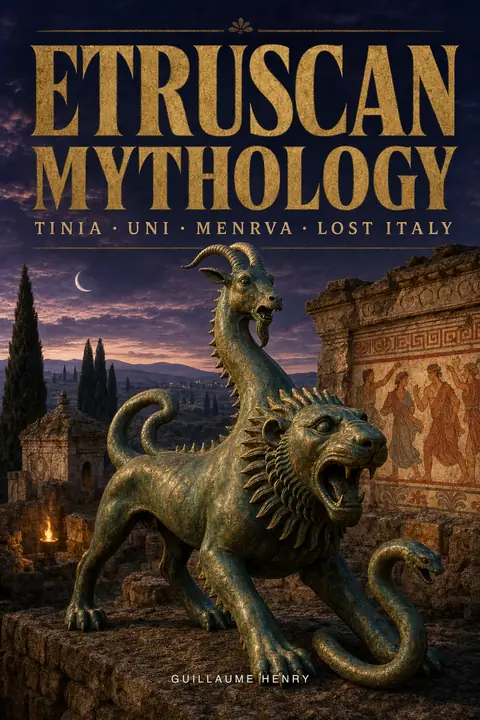
Etruscan
The Etruscan Mythology Book: Tinia, Uni, Menrva, and the Lost Religion of Italy
Tinia, Uni, Menrva, and Lost Italy
Before Rome, Italy belonged to the Etruscans: a people who read the future in lightning and livers, buried their dead in painted cities, and whose gods Rome quietly adopted. A mythology recovered from tombs, bronze mirrors, and the discipline of the haruspex.
More from Etruscan
All articles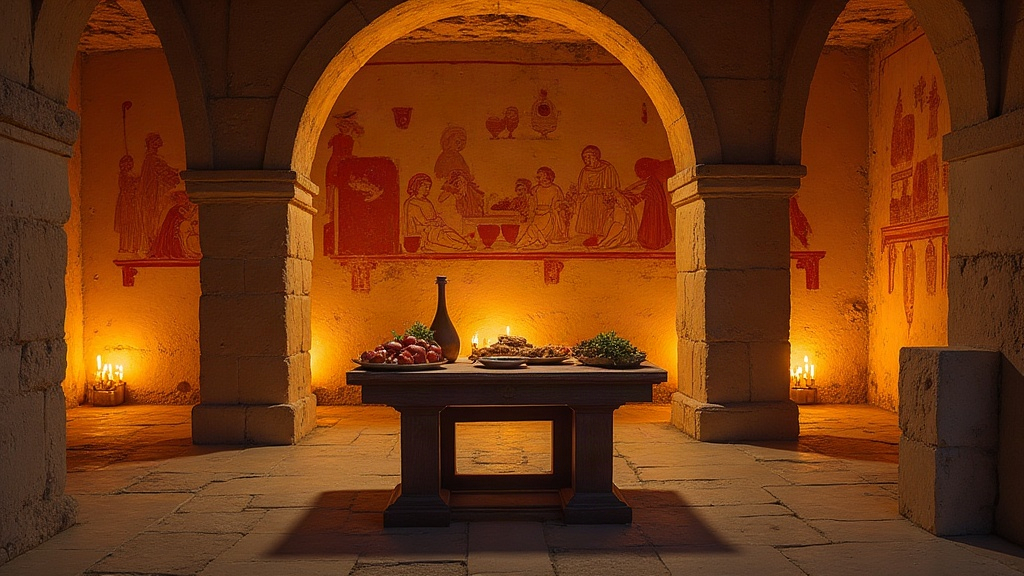
Etruscan
Etruscan Tomb Banquets: Feasting with the Dead
In Etruscan tombs, the dead reclined at eternal banquets. Through painted walls and grave goods, archaeologists recover a ritual that bound living and dead in a single meal. Discover how the Etruscans fed their ancestors and what it reveals about their afterlife beliefs.
Etruscan
The Etruscan Disciplina: Sacred Books and Ritual Knowledge
The Etruscan Disciplina preserved the cosmos in ritual codes and sacred texts. Explore how haruspicy, augury, and divine protocol shaped an entire civilization and influenced Rome itself.
Etruscan
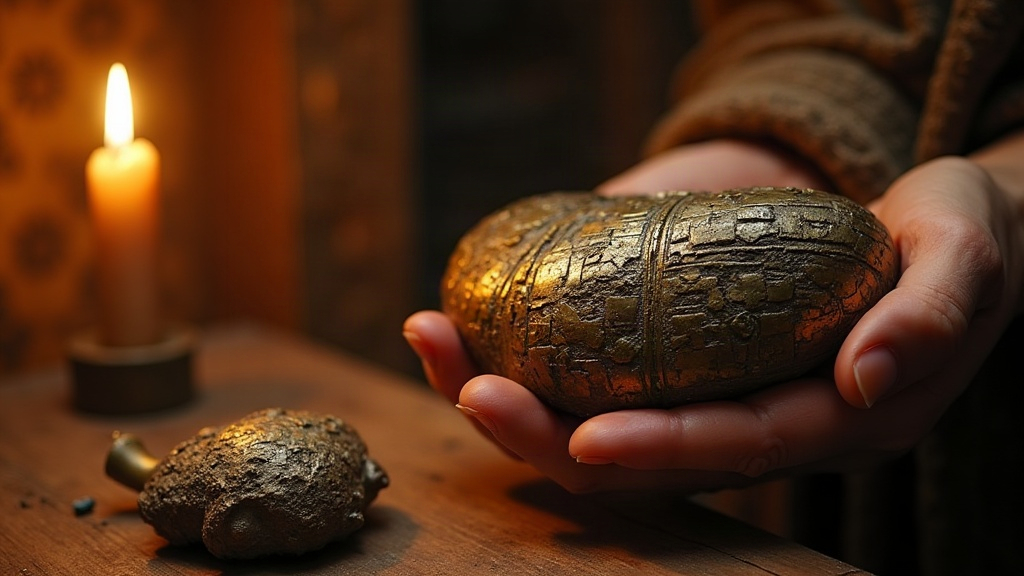
The Liver of Piacenza: Bronze Divination Model of the Etruscans
Discover how the Etruscan priests read fate itself: the Liver of Piacenza is a bronze model showing exactly where to look on a real liver for messages from the gods. It reveals the ancient art of haruspicy in bronze.
Etruscan
Tages: The Divine Child Prophet of Etruscan Divination
A child emerged from the earth to teach an Etruscan farmer the art of reading divine will. Tages, the Divine Child Prophet, became the source of all Etruscan divination knowledge, a figure so powerful that Roman priests carried his teachings for centuries.