
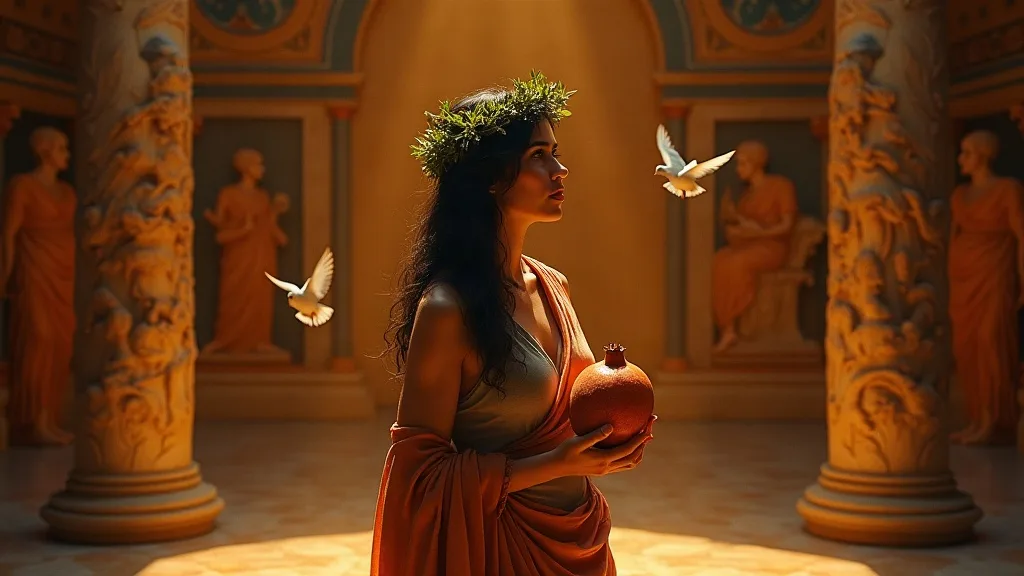
Turan: Etruscan Goddess of Love and Vitality
Turan stands at the heart of Etruscan life as the goddess who brings desire, fertility, and the power that binds community together. Discover how this ancient deity shaped an entire civilization's understanding of beauty, pleasure, and sacred sensuality.
Contents
A woman emerges from the sea foam, crowned with myrtle, her presence transforming mortals and immortals alike. Flowers bloom where she walks. Men and women feel the pull of her gaze like gravity. This was not Aphrodite in the Greek imagination alone. In the tombs and temples of ancient Etruria, centuries before Rome absorbed the peninsula, a darker-eyed goddess held this same power. Her name was Turan, and she animated the Etruscan world with the force that makes life move forward: desire itself.
The Etruscans, who ruled the Italian peninsula from roughly the 8th to the 1st century BC, left us mirrors and jewelry, frescoed tomb walls and terracotta figurines. They left us almost no written mythology. What survives comes fragmented through Roman authors, through the presence of her image on Etruscan artifacts, through the way she appears in the margins of later texts. And yet from these traces, a portrait emerges of a goddess as essential to her civilization as Athena was to Athens or Ishtar to Mesopotamia. Turan: Etruscan Goddess of Love and Vitality was not some distant, punitive force. She was intimate, tangible, woven into daily ritual and private devotion.
She ruled fertility, sexual pleasure, and the generative power that kept families and lineages alive. But she also carried dimensions her Greek counterpart often lacked. To the Etruscans, Turan was bound to prosperity itself, to the flourishing of herds and harvests, to the vigor of the body and the continuation of the household. Her worship was not confined to temples but lived in the domestic sphere, in the hands of women who invoked her protection over children and marriage.
The Origins of Turan: An Etruscan Deity Apart
The question of Turan's origins sits at one of mythology's most tangled crossroads. The Etruscans were not Indo-European in speech or custom. Their language, written in an adaptation of the Greek alphabet, remains only partially understood. They did not inherit their pantheon wholesale from Indo-European stock the way the Greeks did. Instead, they built a theological system influenced by Near Eastern practices, by Greek contact, and by native Italic religion, yet stubbornly their own.
Turan likely emerged from older Italic fertility cults, traditions that predated even Etruscan dominance of the region. Some scholars suggest links to the Umbrian goddess Tursa and to pre-Etruscan fertility rites tied to the Italian peninsula itself. The name itself resists easy translation. Unlike many Etruscan deities who bore transparent connections to Greek gods, Turan's etymology remains disputed among classicists. She was not, in the beginning, simply a copy of Aphrodite.
Yet contact with Greece, intensifying from the 7th century BC onward, reshaped how the Etruscans conceived her. Greek traders brought images, stories, and religious ideas. Over time, Turan absorbed attributes of Aphrodite. The iconography shifted. She began to appear with the winged figure who would later be called Eros, holding mirrors and adorned in the luxurious dress of the Greek goddess. By the later Etruscan period, the two goddesses shared a conceptual space, though Turan retained her distinct personality and her native constituency.
This blending was not replacement but synthesis. The Etruscans were sophisticated enough to recognize a kindred force and integrated it into their existing framework. Turan kept her ties to the land, to the household, to the prosperity of the living community. She simply gained new aesthetic and narrative dimensions in the process.
Turan in the Etruscan Pantheon
The Etruscan gods were not structured in a family drama the way the Greeks imagined theirs. Instead, they organized themselves around cosmic principles and divine functions. The great trio of Jupiter, Juno, and Minerva held supreme power. Below them, arrayed in the heavens, sat lesser deities who governed aspects of human life and nature.
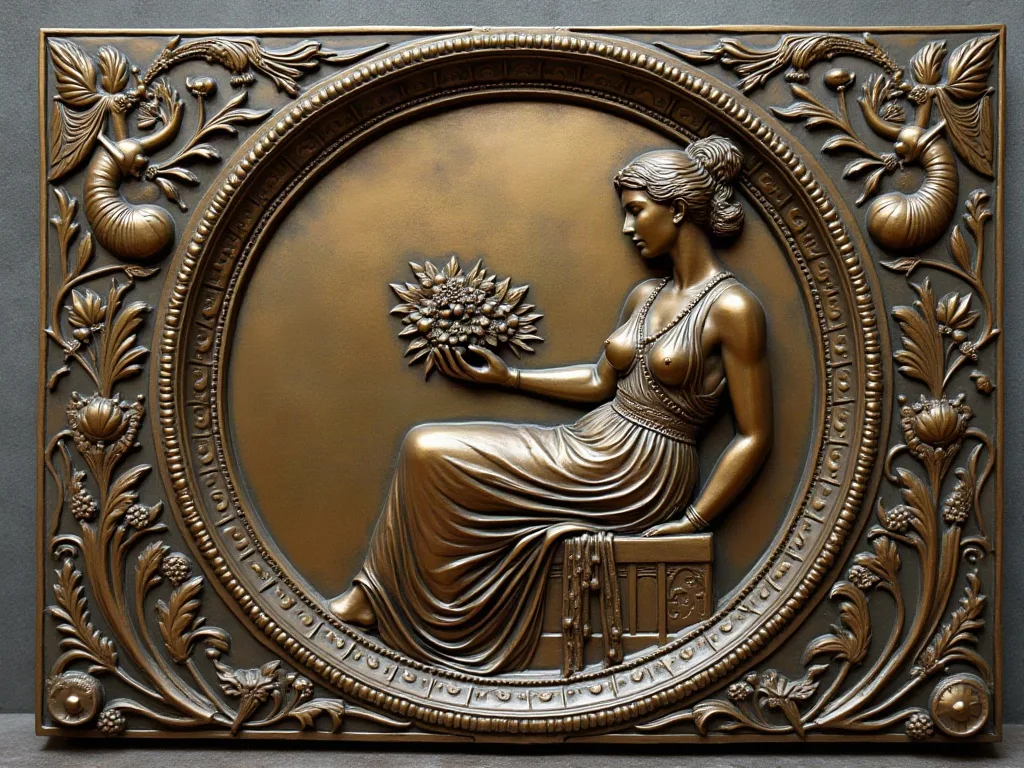
Turan occupied a unique position. She was not the equal of the Capitoline triad, yet she was far from marginal. In the Etruscan theological imagination, she represented one of the essential forces that kept the world from collapsing into chaos. Where Mars governed war and its destructive fury, Turan governed the creative impulse that overcame fear and isolation. Where Saturn ruled the past, Turan animated the future by ensuring new life.
The Etruscans understood divinity through relationships and hierarchies more complex than simple power rankings. Turan stood alongside other vital forces: Tinia, the sky father who wielded thunder; Uni, the queen of heaven and protector of cities; and Menrva, the goddess of wisdom and craft. Each held a necessary place. Each was invoked in proper ritual, at proper times, with proper offerings.
Turan's influence extended into the household, where Etruscan women held a freedom and visibility remarkable for the ancient Mediterranean. Unlike Greek women, who were often confined to the domestic interior, Etruscan women attended feasts, took part in athletic games, even traveled freely. Turan was their patroness in these activities. She blessed the bride entering a new household. She watched over childbirth and nursing. She was the power behind the fertility rites that marked the seasonal turnings of the agricultural year.
The Etruscan Understanding of Love and Desire
To read Turan only as a goddess of erotic love would flatten her into a cliche. The Etruscans possessed a more nuanced understanding of the forces her name invoked. Turan, which scholars often render as "the giving one" or "she who offers," encompassed desire, yes, but also the gift of prosperity, the granting of children, the blessing of abundance that flowed from proper relationship.
In Etruscan thought, sexuality was not inherently sinful or shameful. The famous frescoes of the Tomb of the Leopards at Tarquinia show embracing couples, dancing figures, scenes of symposium and pleasure. These were not marginal, secretive acts but central to how Etruscans imagined the good life. They were also sacred. An erotic embrace could be an act of devotion, a participation in the creative power that Turan embodied.
This does not mean the Etruscans were hedonistic in the later Roman sense. Rather, they saw pleasure as one valid expression of divine will. The body mattered. Sensation mattered. The continuation of lineage mattered. Turan was the goddess who made all three possible.
Women invoked her for easy childbirth. Young people invoked her before marriage. Families invoked her to bless the marriage bed and ensure fertility. She was not distant or abstract. The archaeological record shows terra cotta figurines, mirrors engraved with her image, votive offerings left at her shrines. She was part of daily practice, woven into the rituals that marked passage and transition.
Turan in the Sacred Calendar
The Etruscans marked their year with religious festivals tied to agricultural and celestial cycles. Turan had her place in this calendar, particularly at moments when fertility was at stake or celebrated.
Spring brought the renewal of life, and Turan was invoked as the power that stirred growth. Farmers would have offered to her as seeds went into the ground. Herds were blessed in her name as animals came into breeding season. These were not quaint folklore but central religious obligations, commanded by the priestly class that held enormous power in Etruscan society.
Spring also marked a season of marriages. Young couples would be wed under signs favorable to Turan. The bride would make offerings at her altar, seeking protection and the ability to bear children. These ceremonies were public events, witnessed by family and community, embedded in a theological framework that made marriage not a mere legal transaction but a sacred contract involving the gods.
The harvest season brought another complex of rituals. Turan was thanked for the prosperity granted. Wine and grain, the products of fertile earth and human labor, circulated in festivals that blended religious obligation with celebration. Later Roman writers, viewing Etruscan festivals with a mixture of fascination and disapproval, noted how openly sensual these celebrations were. But to the Etruscans, they were the proper way to acknowledge the divine forces that sustained them.
The Iconography of Turan: What the Artifacts Tell
Etruscan art is one of the few direct windows into how they visualized their gods. Turan appears on mirrors, comb handles, figurines, and frescoed walls. Her image evolved over time as Greek influence deepened, but certain features remained consistent.
She wore elaborate dress: draped garments, jeweled ornaments, sandals of refined make. The Etruscans loved luxury goods, and Turan embodied that aesthetic. She was often shown with attendants or with winged figures associated with desire and pleasure. Later, under Greek influence, she appeared more regularly with a small winged boy (Eros or his Etruscan equivalent) who shot arrows of desire or held flowers.
The most striking Etruscan representation of Turan comes on the mirrors found in tombs. These mirrors were not functional objects but treasured items, often buried with women of status. On one side, polished bronze showed the user her own face. On the reverse, engraved scenes depicted divine encounters: Turan meeting her divine husband or lover, receiving gifts, being crowned by attendants. The boundary between the user and the goddess blurred. A woman looking into the mirror saw herself in the presence of Turan's power.
One remarkable mirror shows Turan with wings, suggesting a divine capacity to move between worlds, to visit mortals in their dreams or moments of heightened emotion. This hybrid image, neither purely Greek nor purely Etruscan, shows how the civilization synthesized foreign influence with local tradition.
Flowers and plants associated with Turan included roses, myrtles, and pomegranates. These appear in tomb frescoes and on votive objects. They were offerings, sacred plants, reminders of her generative power. A bride would have worn myrtle in her hair. A mother would have carried pomegranate seeds as a charm against miscarriage.
Turan and the Etruscan Afterlife
The Etruscans believed in an afterlife populated by gods and spirits, a realm both terrifying and beautiful. Their tombs, which survive as some of the richest sources for understanding their civilization, are painted with scenes of the banqueting gods and the journeys of the dead.
Turan appears in these afterlife scenes, though not always as a welcoming figure. She seems to have held responsibility for guiding certain souls, particularly women, into the next world. The goddesses and spirits who helped guide the deceased often included Turan or figures associated with her power. The frescoes sometimes show processions where divine women welcome the dead woman to her eternal home.
This function did not contradict her role as a life-giver. Death and birth, in Etruscan cosmology, were linked passages. Both involved transition. Both involved divine intervention. The same goddess who blessed the woman giving birth might later welcome her soul when her time came. This cyclical view of existence gave Turan a role that extended across the entire arc of a woman's life.
Turan Under Rome: Absorption and Persistence
As Rome conquered Etruria in the 3rd and 2nd centuries BC, Etruscan civilization did not vanish overnight. Instead, it was absorbed. The Roman gods incorporated Etruscan deities. Roman ritual borrowed Etruscan practice. Yet much was lost in the process.
Turan became identified with Venus, the Roman goddess of love and fertility. The identification was natural but imperfect. Venus was subtly different: more martial in her aspect (she was the mother of Aeneas and patron of Rome's destiny), more tied to political power, more urban in her associations. Turan, rooted in household and harvest, became a footnote in Roman tradition.
However, Turan did not disappear entirely. References to her appear in later classical writers. Pliny and other Roman naturalists mention Etruscan practices and beliefs. She persisted in folk memory among the peoples of Italy who had worshipped her. And she survived in the archaeological record, waiting for modern scholars to piece together her story from mirror engravings and tomb paintings.
The Romans' adoption of Etruscan religious practices, particularly haruspicy (the reading of animal entrails for omens), shows that Etruscan theological sophistication was recognized and respected. If Turan herself faded from prominence, it was not because the Romans saw her as inferior but because Rome imposed its own divine hierarchy, centered on Jupiter and Mars and the ancestral deities that legitimated Roman power.
Turan's Attributes and Sacred Animals
In the religious imagination of the Etruscans, gods were associated with specific animals, plants, and natural phenomena that embodied their essential nature. For Turan, these attributes reveal how deeply her influence ran.
The dove was sacred to her, a connection inherited from Mediterranean goddess cults generally. But the Etruscans also associated her with the hare, an animal known for its fertility. Pigeons cooed in her sanctuaries. Spices and perfumes, luxury imports that the Etruscans valued highly, were sacred to her. Frankincense and myrrh appeared in rituals invoking her protection and blessing.
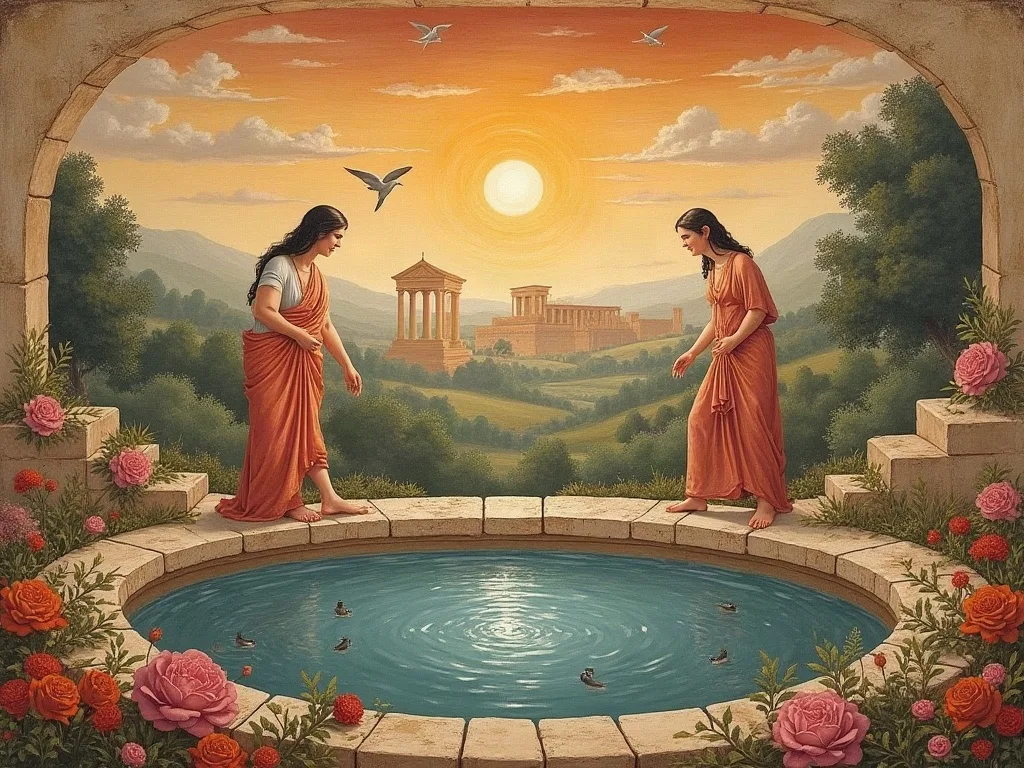
Springs and bodies of fresh water held special significance. Turan was invoked at springs considered sacred to fertility and healing. Women would bathe in these waters before conception, seeking her aid. The rituals surrounding these springs blended practical knowledge (minerals in the water did have medicinal properties) with religious belief (the water itself was animated by divine presence).
Gold and precious stones associated with Turan included amber, which the Etruscans imported at great expense from the Baltic; lapis lazuli, brought from Afghanistan; and gold itself. These materials were not merely valuable but sacred. A woman wearing gold jewelry in the presence of Turan's altar was making an offering, displaying devotion through beauty and expense.
The Decline of Turan and the Loss of Etruscan Religion
By the 1st century BC, Etruscan religion had largely faded. Rome's expansion and the imposition of Roman religious authority, combined with the gradual Romanization of the Italian peninsula, erased most living practice. The priests who had maintained Turan's cults either converted to Roman practice or saw their authority superseded.
The few remaining Etruscan priests, haruspices who survived into the Roman imperial period, held onto fragmentary knowledge. But the full theology, the complex calendar of festivals, the household rituals, the personal devotions, all these dissolved into the larger Roman system. Turan's name survived in references to Venus. Her essence did not.
What remained were artifacts: the mirrors, the tomb paintings, the terracotta figurines. These objects, voiceless as they are, became the primary record of her existence. Archaeologists of the 19th and 20th centuries excavated them, puzzled over inscriptions, compared images with what little textual evidence survived. Slowly, a portrait of Turan reassembled itself, not perfect or complete, but real enough to recognize the goddess who had animated an entire civilization.
Frequently asked questions about Turan?
Frequently asked questions
Was Turan the same as the Greek goddess Aphrodite?
Not originally. Turan likely developed from older Italic fertility traditions distinct from Greek religion. However, as Etruscan civilization encountered Greek traders and ideas from the 7th century BC onward, Turan absorbed attributes of Aphrodite. By the later Etruscan period, the two goddesses shared similar iconography and domains, though Turan retained her distinctive connection to household, harvest, and the prosperity of living communities. When Rome absorbed Etruscan culture, Turan became fully identified with Venus, Aphrodite's Roman equivalent.
How did Etruscan women worship Turan differently than Greek women worshipped Aphrodite?
Etruscan women had far more public freedom than Greek women. They attended feasts, participated in athletic competitions, and moved freely in society. Worship of Turan reflected this agency. Women made direct personal offerings at her shrines, invoked her protection over their households and children, and practiced devotional rituals that were embedded in daily life rather than confined to festival occasions. The intimacy and accessibility of Turan worship reflected the relatively elevated status of women in Etruscan culture.
What primary sources describe Turan and her worship?
Direct Etruscan textual sources are extremely limited because so little Etruscan writing survives and most of it remains only partially understood. Our knowledge of Turan comes primarily from artifacts: mirrors, figurines, frescoed tomb walls, and votive offerings. We also rely on references in Roman and Greek authors who encountered Etruscan civilization. The most vivid evidence comes from tomb paintings at sites like Tarquinia and Chiusi, which show scenes of feasting, celebration, and divine presence that illuminate how Turan functioned in Etruscan religious life.
Did male Etruscans worship Turan, or was she exclusively a female deity?
Turan was primarily invoked by and for women, particularly in contexts of marriage, childbirth, and fertility. However, the Etruscan pantheon was not strictly gendered in its appeal. Men would have respected her power and acknowledged her role in the cosmic order. Young men before marriage may have sought her blessing. Fathers would have invoked her protection for their children and lineage. But the deepest, most personal relationship to Turan belonged to women, reflecting her essential role in reproduction and household prosperity.
What happened to Turan when Rome conquered Etruria?
As Roman power expanded over the Italian peninsula in the 3rd and 2nd centuries BC, Etruscan civilization was gradually absorbed into the Roman system. Turan was identified with Venus, the Roman goddess of love and fertility. The identification allowed her name to survive in the historical record, but it also transformed her. Venus was more martial, more tied to Roman political destiny, more urban in character. Turan's original dimensions, especially her deep connection to household and agricultural fertility, faded from active practice. Her former temples were rededicated or fell silent, and the priesthoods that maintained her cults disappeared into Roman religious structures.
What the Loss of Turan Reveals About Religious Continuity
The story of Turan is also the story of how religious traditions vanish. We live in an age where the major world religions have extensive textual records, institutional continuity, and millions of followers. Turan had none of these protections. Within a few generations, the knowledge of how to invoke her, when to invoke her, what offerings pleased her, all this evaporated.
Yet Turan's presence in the archaeological record shows something important: that she mattered deeply to the people who worshipped her. The time and resources invested in her cults, the artistry lavished on objects bearing her image, the space given to her in tomb scenes and household shrines, the frequency of her name in inscriptions, all testify to her centrality in Etruscan life.
Her story suggests that the gods we remember, the ones with thousand-year traditions and millions of devotees, owe their survival not to objective truth but to historical luck. The Greeks and Romans had the advantage of writing, of institutional stability, of military and cultural power that made their religious traditions portable and persistent. The Etruscans did not. Turan: Etruscan Goddess of Love and Vitality deserves remembrance not as a footnote to Aphrodite or Venus, but as a fully realized divine figure whose loss represents an entire way of understanding the sacred that the world can no longer access directly.
The mirrors on which her image was engraved are silent now. No priestess invokes her name. No bride wears myrtle in her hair to honor her before marriage. Yet in the frescoed tombs of Etruria, she still gazes outward with the composure of a goddess secure in her power. And in that gaze, we recognize something timeless: the force that draws beings toward each other, that makes life possible, that transforms solitude into connection. The form changes; the force endures.
Read the full book
Want the whole story?
The complete edition is an instant PDF download here, with a paperback on Amazon for selected titles.
Etruscan
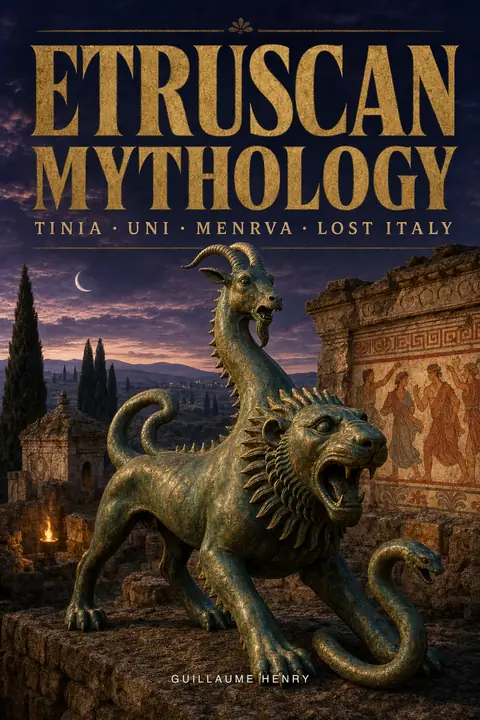
The Etruscan Mythology Book: Tinia, Uni, Menrva, and the Lost Religion of Italy
Tinia, Uni, Menrva, and Lost Italy
Before Rome, Italy belonged to the Etruscans: a people who read the future in lightning and livers, buried their dead in painted cities, and whose gods Rome quietly adopted. A mythology recovered from tombs, bronze mirrors, and the discipline of the haruspex.
More from Etruscan
All articles
Etruscan
Etruscan Tomb Banquets: Feasting with the Dead
In Etruscan tombs, the dead reclined at eternal banquets. Through painted walls and grave goods, archaeologists recover a ritual that bound living and dead in a single meal. Discover how the Etruscans fed their ancestors and what it reveals about their afterlife beliefs.
Etruscan
The Etruscan Disciplina: Sacred Books and Ritual Knowledge
The Etruscan Disciplina preserved the cosmos in ritual codes and sacred texts. Explore how haruspicy, augury, and divine protocol shaped an entire civilization and influenced Rome itself.
Etruscan
The Liver of Piacenza: Bronze Divination Model of the Etruscans
Discover how the Etruscan priests read fate itself: the Liver of Piacenza is a bronze model showing exactly where to look on a real liver for messages from the gods. It reveals the ancient art of haruspicy in bronze.
Etruscan
Tages: The Divine Child Prophet of Etruscan Divination
A child emerged from the earth to teach an Etruscan farmer the art of reading divine will. Tages, the Divine Child Prophet, became the source of all Etruscan divination knowledge, a figure so powerful that Roman priests carried his teachings for centuries.