
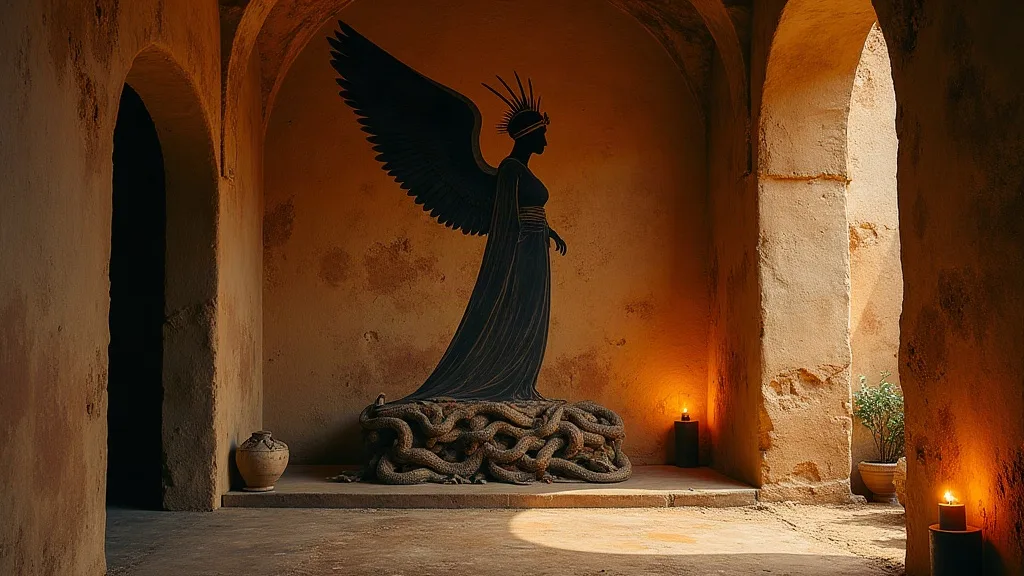
Vanth: Etruscan Winged Death Goddess
Meet Vanth, the Etruscan winged death goddess who guarded the threshold between life and the underworld. Discover how this fierce divine figure shaped Etruscan beliefs about mortality, judgment, and the afterlife.
Contents
She appears on tomb walls with dark wings spread wide, serpents coiling at her sides, her face stern and unforgiving. Vanth is the Etruscan winged death goddess, a figure who met the dying at the moment of their final breath and guided them into the realm beyond. Unlike gentle psychopomps in other mythologies, Vanth carried an air of severity. She was not cruel, but she was not kind either. She was the necessary witness to mortality itself.
The Etruscans, a sophisticated civilization that flourished in what is now Tuscany from roughly the 8th century BC until Rome absorbed them around the 1st century BC, built a rich mythology around death and the afterlife. While Greek and Roman sources preserve only fragments of their beliefs, the Etruscans themselves left behind a visual record carved into stone and painted onto the walls of their tombs. In these images, Vanth stands as one of the most recognizable and powerful divine figures, a constant reminder that death was not an ending to fear in silence, but a transition that required a guide and a witness.
Her mythology opens a window into how an ancient Mediterranean people understood the boundary between the living world and what lay beyond.
Origins and Divine Role
Vanth's name appears in Etruscan inscriptions on funerary objects and tomb paintings, a consistent presence in scenes of the afterlife journey. The Etruscans did not leave behind a literary tradition like Homer's epics or Hesiod's Theogony (a Greek poem from around 700 BC that tells where the gods come from), so what we know of Vanth comes almost entirely from visual art and the occasional written reference by Greek and Roman authors who encountered Etruscan culture.
Her role was unambiguous: she was a guardian of transition. When a person died, Vanth was believed to appear. She did not judge the dead in the way that later Christian theology imagined judgment. Rather, she stood as a divine witness to the act of passing over. Her presence on tomb paintings reassured the living that their departed did not cross into the underworld alone or unguarded. A goddess was there to meet them.
The name "Vanth" itself has been the subject of scholarly debate. Some scholars propose connections to Latin venter (belly, womb), suggesting a cyclical meaning related to the eternal return or regeneration. Others link it to Indo-European roots suggesting "to vanish" or "to go." The etymology remains uncertain, but the visual identity is unmistakable: Vanth is always winged, always present at the moment of death or in the company of the dead.
Iconography and Appearance
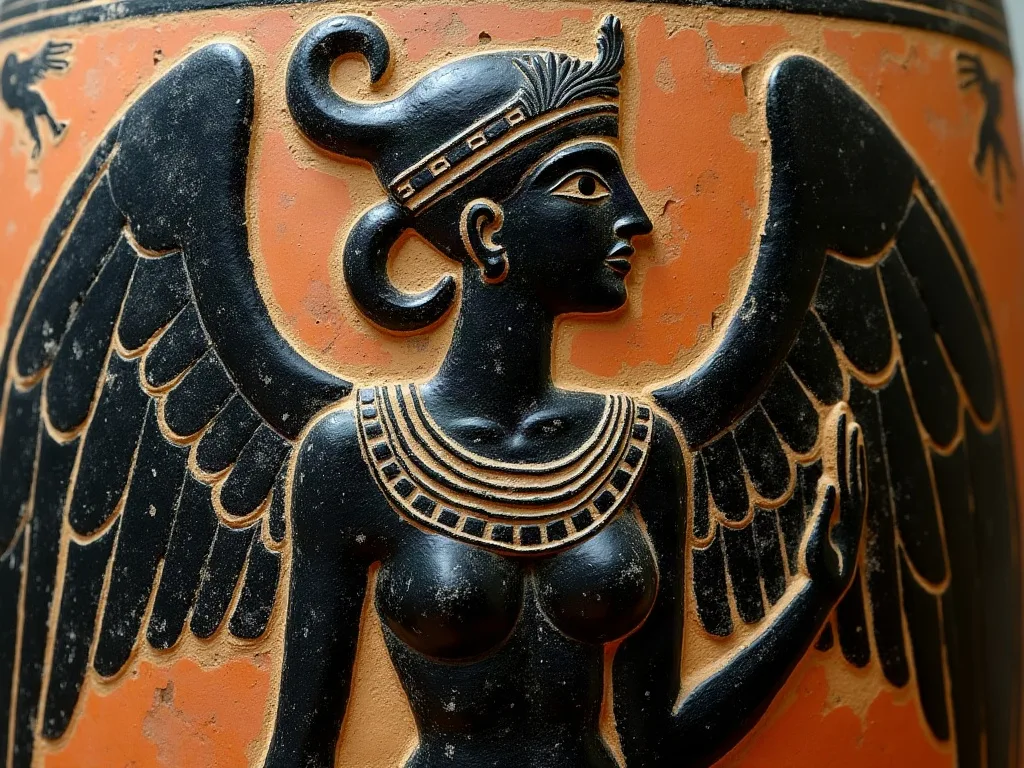
In Etruscan tomb paintings and carved funerary reliefs, Vanth appears with a consistent visual vocabulary that made her immediately recognizable to any Etruscan viewer. Her most striking feature is her massive dark wings, often depicted in black or deep blue, spread wide as if ready to embrace or carry away the dying. These wings mark her as a being who moves between worlds, who can traverse the boundary that mortals cannot cross alone.
She typically wears a short chiton, the garment of a warrior or active divinity, rather than the elaborate robes of a mother goddess. This practical dress underscores her function: she is not a figure of comfort or nurture, but of purposeful action. Her hair is usually long and dark, sometimes crowned with a diadem or decorated with a formal headdress that signals her divine status.
What distinguishes Vanth from gentle guide figures in other traditions is the absence of softness. Her expression is serious, even stern. Sometimes she carries serpents, which in Mediterranean mythology symbolized knowledge of the underworld, healing, regeneration, and the wisdom that comes from proximity to death. The serpents coiling around her body or held in her hands were not threats to the dying but emblems of her deep connection to the powers of the underworld itself.
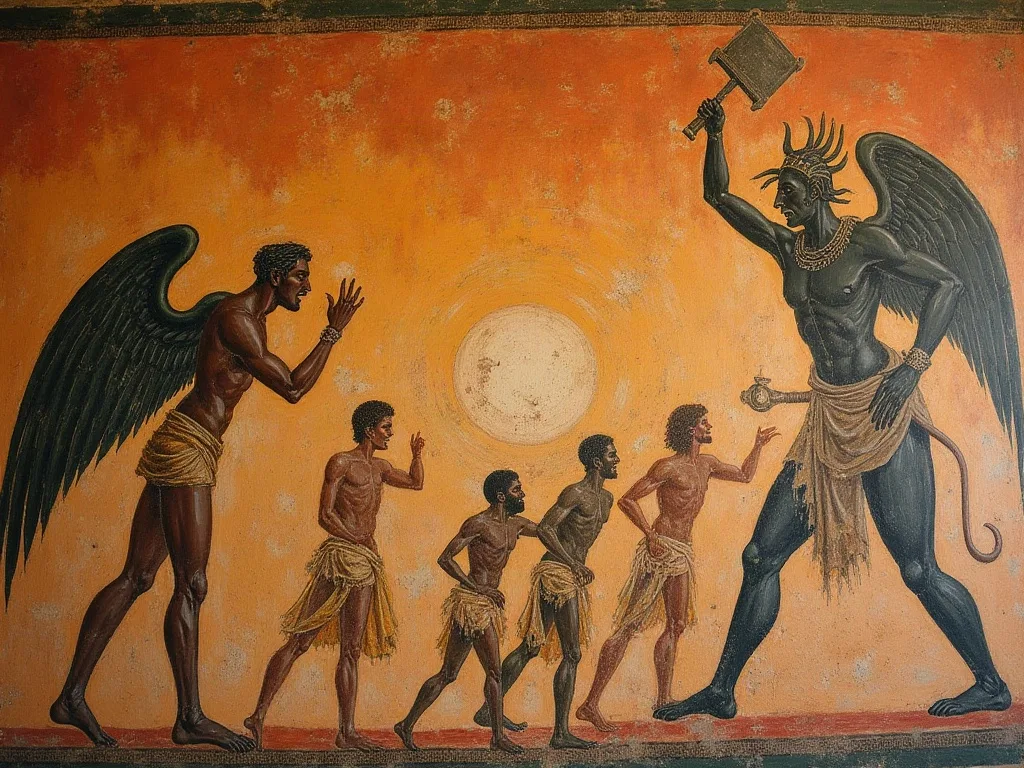
In some depictions, she holds a torch or appears accompanied by other underworld figures, including the male death demon Charun (sometimes spelled Charu), a fearsome figure with a hammer and wings of his own. While Charun could be violent and punishing, Vanth's role was different. She was the witness and guide, the presence that made death a comprehensible transition rather than a chaotic terror.
Vanth in the Etruscan Afterlife Journey
The Etruscans imagined the afterlife not as a distant, abstract heaven, but as a continuation of existence in a realm parallel to the living world. They called this place Aita (sometimes Aita Hus), a dark underworld kingdom ruled by a king and queen and populated by both honored ancestors and punished spirits. The journey to Aita was not instantaneous or automatic. It required passage through a threshold, a moment of recognition and transition, and this is where Vanth's role became crucial.
When a person died, Vanth was believed to meet them at that threshold. She would confirm their passing, witness their departure from the living world, and guide or accompany them into the realm below. Tomb inscriptions and paintings suggest that her presence was not meant to be terrifying, despite her stern appearance. Rather, she was a reassurance: death would not be solitary. A divine figure recognized the moment of passing. The dead would not wander in confusion.
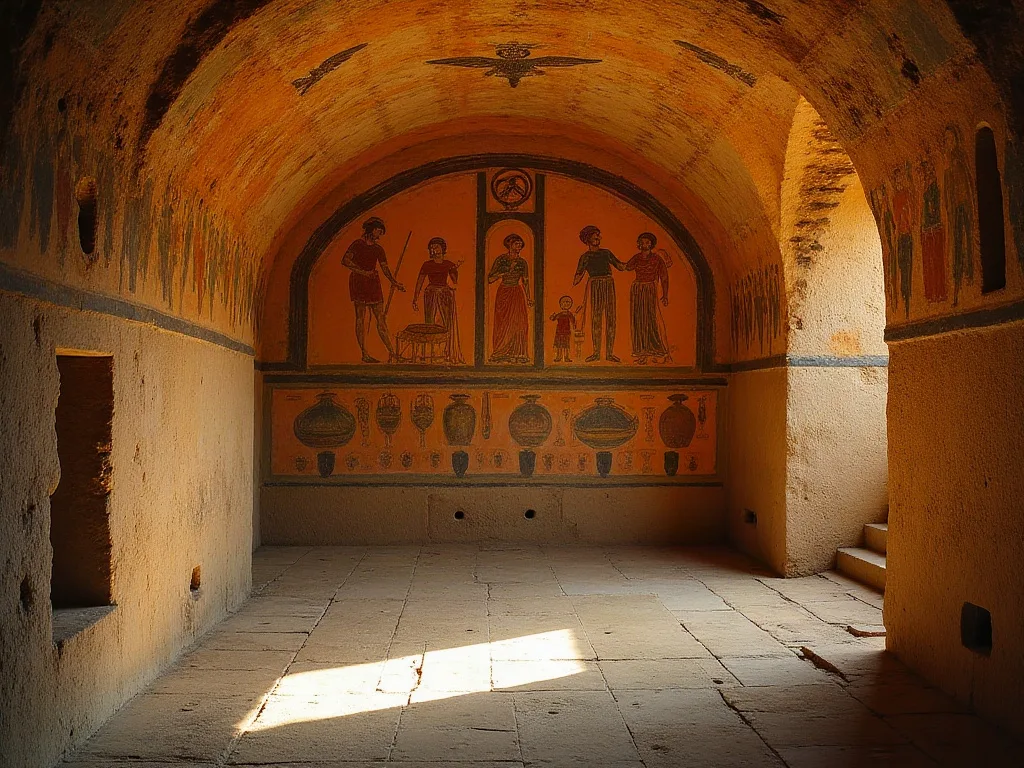
This belief appears vividly in several surviving tomb paintings, particularly in the Tomb of the Typhon and the Tomba dell'Orco (Tomb of the Ogre) at Tarquinia, where scenes of the dead meeting underworld deities are rendered in detail. In these images, Vanth appears as one of several figures who receive and direct the deceased. She stands alongside Charun, the fearsome underworld demon, and other divine beings. The contrast between her and Charun is revealing: where Charun embodies punishment and the terror of divine retribution for the wicked, Vanth represents the simple, inevitable fact of mortality itself. She is the acknowledgment that death comes to all, good and wicked alike, and that the passage is real and irrevocable.
Comparison with Other Psychopomps
Vanth belongs to a family of divine guides found across Mediterranean and near-Eastern mythologies, but her character is distinct. Hermes (called Mercury by the Romans) served as a psychopomp in Greek and Roman religion, guiding souls to the underworld with his caduceus. Hermes was a trickster and a merchant god, associated with boundaries and transitions, but he was not bound to death specifically. He moved between worlds as part of a broader divine portfolio.
Vanth
Vanth: Entirely devoted to death and the underworld transition. Never appears outside scenes of dying or the afterlife. Stern, formal, always present at the moment of passage. Associated with witness and acknowledgment rather than protection or cunning.
Hermes
Hermes: Multi-purpose god of commerce, communication, theft, and travel who happens to guide souls as one of many duties. Clever and shape-shifting. Often portrayed with humor and wit. Associated with safe passage and clever navigation.
Charon, the boatman of the River Styx in Greek mythology, is closer in function to Vanth, though his role was to ferry souls across water rather than to greet them at the threshold. The Greek afterlife, as described in sources like Virgil's Aeneid and Homer's accounts, required payment (an obol coin placed on the tongue) and involved specific geographic locations (the river, the underworld entrance, the judgment halls). The Etruscan vision, as far as Vanth's role reveals it, was more intimate and immediate. She simply appeared, witnessed, and guided.
In Egyptian mythology, Anubis (called Inpu in Egyptian) was the god who presided over mummification and the transition of souls, often depicted with the head of a jackal. Like Vanth, Anubis was intimately connected to death, but his role encompassed the preservation and preparation of the body as well as the spiritual journey. Vanth's concern was purely with the moment of passage itself.
Vanth and the Etruscan Concept of Mortality
What makes Vanth significant to understanding Etruscan culture is what her prominence in tomb paintings reveals about how the Etruscans viewed death itself. Unlike some ancient cultures that portrayed the afterlife as punishment or judgment to be feared, or as a pale echo of life, the Etruscans seem to have understood death as a real transition into a genuine alternative existence. Aita was dark, yes, but it was not inherently a place of suffering. It was simply the place where the dead existed, much as the living existed in the world above.
Vanth's role in this schema was to serve as a cultural symbol of acceptance. By depicting her in tombs, the Etruscan families who commissioned these paintings were affirming a truth: death comes, and when it does, a divine being will acknowledge it. This is not a punishment or a curse. It is a natural passage. The presence of Vanth in tomb imagery was a comfort, a statement that the dead person would not be forgotten or left unattended in their transition.
The frequency with which Vanth appears in Etruscan funerary art, particularly from the 5th to the 3rd century BC, suggests that she held a central place in Etruscan religious thought during the period when their civilization was strongest and most developed artistically. As Rome expanded and Etruscan independence faded, such imagery gradually disappeared from tomb paintings, replaced eventually by other aesthetic traditions. But for several centuries, Vanth was one of the most important theological symbols the Etruscans possessed.
Scholarly Interpretations and Modern Understanding
The study of Vanth relies almost entirely on visual and inscriptional evidence. No Etruscan mythological texts survive in the way that Greek myths were preserved in literature. Roman historians like Livy and Dionysius of Halicarnassus wrote about Etruscan religious practices, but they recorded them as observers of a foreign culture, not as insiders. Greek writers like Diodorus Siculus occasionally referenced Etruscan beliefs, but their accounts were fragmentary and colored by Greek theological assumptions.
This means that modern scholars reconstruct Vanth's mythology largely through close reading of tomb paintings, comparison of similar figures across Mediterranean cultures, and careful attention to inscriptions that mention her name or titles. The American Etruscologist Larissa Bonfante, the Italian scholar Stephan Steingraber, and others have built a sophisticated understanding of Etruscan funerary beliefs through this kind of visual archaeology.
One ongoing scholarly question concerns the relationship between Vanth and the broader Etruscan divine pantheon. The Etruscans adopted many Greek deities as their civilization became more integrated into the Mediterranean world. Tinia (equivalent to Zeus), Uni (Hera), Menrva (Athena), and others appear in Etruscan inscriptions and art. But Vanth appears to be distinctly Etruscan, without a clear Greek equivalent. This suggests that she represented a specifically Etruscan theological concern that Greek religion did not address in the same way. The Etruscans, as a people with their own complex views about fate, divination, and the boundaries of the divine, may have needed a figure like Vanth precisely because no Greek god filled that niche.
Another debate concerns the gender and gender-specific associations of Vanth. As a female figure associated with death and transition, she occupies a space different from male death demons like Charun. Some scholars suggest that the Etruscan tradition assigned particular divine functions according to gender in ways that differed from Greek practice. Vanth's fierce independence, her solitary role at the threshold, and her association with witnessing rather than judging or punishing may reflect specifically feminine forms of divine authority in Etruscan religion.
Vanth's Absence from Classical Literature and Late Survival
One of the most striking facts about Vanth is that she appears almost nowhere in the classical literary tradition. Roman authors who wrote about Etruscan religion focused primarily on practices like haruspicy (divination through reading animal entrails) and augury (reading the will of the gods through the flight of birds). They preserved occasional references to major Etruscan gods like Tinia and Uni, but Vanth, despite her prominence in tomb art, was rarely mentioned in texts. This is not because she was unimportant to the Etruscans, but because Greek and Roman writers were not interested in recording details of Etruscan funerary belief. They were concerned with practices and deities that affected the state, the military, and public religion.
As Latin culture absorbed Etruscan civilization and Rome's own religious practices solidified, Vanth faded from living memory. By the time of the late Empire, she was a figure known only through ancient tomb paintings, and even those became inaccessible as tombs were sealed or lost to time. The Renaissance rediscovery of Etruscan sites, particularly the tomb paintings at Tarquinia beginning in the 18th and 19th centuries, brought Vanth back into view. Modern scholars encountered her anew as tomb walls were opened and the images within were recorded and studied.
This revival has given her a second life in modern understanding. Academic papers, museum exhibits, and books on Etruscan civilization now include her as a central figure in discussions of ancient Mediterranean religion. She has appeared in novels and creative works inspired by ancient history. But this modern visibility is something Vanth would not have experienced in her own time, when knowledge of her was limited to the Etruscan people and their immediate neighbors.
Vanth and the Broader Etruscan Divine Order
To understand Vanth fully is to understand something important about how the Etruscans structured their religious world. They inherited from Indo-European traditions certain concepts of divine order, fate, and the organization of the cosmos. They borrowed heavily from the Greeks, adopting Greek mythological figures and Greek artistic styles. But they synthesized these influences into something distinctly their own.
The Etruscan cosmos, as far as we can reconstruct it, was ordered around the idea of pax deorum (peace with the gods). The relationship between the divine and human realms was not harmonious by default but had to be maintained through correct action, proper ritual, and appropriate respect. The Etruscans developed elaborate systems of divination precisely because they believed the gods communicated their will to human beings who knew how to listen. Vanth, in this scheme, was not a judge who determined whether the dead had been virtuous. She was a functionary of the divine order itself, a being whose role was to ensure that the proper transition happened, that the cosmic boundary between life and death remained stable and recognized.
The tomb paintings that feature Vanth often show her alongside other underworld figures and sometimes also alongside relatives of the deceased who had died before. This suggests that the Etruscans imagined the afterlife as a place where family bonds continued and where multiple divine and semi-divine beings were present. Vanth was not a solitary figure but part of a whole community of beings who inhabited the underworld and facilitated the existence of the dead within it.
The Legacy of a Lost Mythology
Vanth's story is ultimately the story of how ancient religious traditions survive and are recovered. She was central to Etruscan civilization for centuries, a figure painted on tomb walls and named in inscriptions, known and honored by every Etruscan family that buried their dead. Yet she was almost entirely lost when the civilization that created her ceased to exist. For nearly two thousand years, she was invisible, known only to the dead themselves if the Etruscans' beliefs about an afterlife were correct.
Her recovery in modern times, through careful study of archaeological evidence and patient scholarship, reminds us how much of the ancient world's religious life remains fragmented and incomplete in our knowledge. We do not have the Etruscan equivalent of Homer or Ovid to tell us the full mythological narratives. We have images, inscriptions, and the careful work of scholars piecing together the worldview that created them.
Vanth: Etruscan winged death goddess remains a profound symbol of how ancient peoples imagined the threshold between life and what comes after. She is stern because death is inevitable. She is present because even in loss, there is witness and acknowledgment. And she persists in our understanding because the Etruscans left behind enough visual evidence that we can still see her, still recognize her, and still ask what she meant to the people who called upon her name at the moment of their final breath.
Frequently asked questions about Vanth and Etruscan death beliefs
Frequently asked questions
Did the Etruscans believe in a judgment after death like later Christian theology?
Not in the same way. The surviving evidence suggests that the Etruscans believed in an afterlife in Aita, a dark underworld kingdom, but not necessarily in a divine judgment that sorted the virtuous from the wicked. Charun, the underworld demon, appears to have punished those who had committed grave violations or transgressions, but Vanth's role was different. She was a witness and guide, not a judge. The emphasis seems to have been on proper transition and the continuity of family bonds rather than moral reckoning.
How do we know what Vanth's role actually was if there are no surviving Etruscan texts?
We know through close analysis of tomb paintings and carved reliefs, combined with inscriptions that mention her name and title. The artistic consistency across multiple tombs and time periods, the recurrence of certain scenes and associations, and comparison with other Mediterranean cultures' death goddesses all contribute to a picture of her function. Additionally, later Roman and Greek writers occasionally recorded observations about Etruscan religious practices, though these sources are fragmentary and must be read carefully.
Was Vanth worshipped in temples or only in funerary contexts?
The archaeological evidence indicates that Vanth appears almost exclusively in funerary art and contexts: tomb paintings, funerary reliefs, and objects placed in burials. This strongly suggests she was understood as a being belonging to the moment and place of death rather than as a deity to be petitioned or honored in public temples. Her role was so specifically tied to the threshold between life and death that she had no place in the everyday religious life of the living.
Did other Mediterranean cultures have figures equivalent to Vanth?
There are analogues but no perfect equivalents. The Greek Hermes and Charon both served as guides to the underworld, but they had broader roles or functions. The Egyptian Anubis presided over death and mummification but in a different theological context. Vanth appears to be a specifically Etruscan figure addressing a particularly Etruscan understanding of mortality and the boundary between worlds. The fact that she has no clear Greek or Roman equivalent suggests that the Etruscans possessed their own distinctive religious vision.
What happened to Vanth worship when Rome conquered the Etruscan territories?
As Roman culture absorbed Etruscan civilization, Vanth gradually disappeared from living religious practice and belief. Roman funerary art and beliefs about the afterlife evolved in different directions. By the Imperial period, Vanth existed only in the tomb paintings of the Etruscan dead, themselves becoming archaeological artifacts rather than active sites of worship. She was not replaced by a specific Roman deity but rather faded from the religious consciousness as the civilization that had created her ceased to exist as an independent culture.
Modern Echoes and Ongoing Discovery
The rediscovery of Vanth and other Etruscan deities in modern times has had unexpected cultural consequences. Museums throughout Italy and Europe now feature Etruscan funerary art prominently, recognizing that it provides essential insight into ancient Mediterranean civilization. The tomb paintings at Tarquinia are protected as UNESCO heritage sites. Scholars continue to study and interpret Etruscan religious practice, and occasionally new tomb chambers are opened or new inscriptions are identified.
Contemporary artists, writers, and thinkers have drawn on Etruscan imagery and mythology, including Vanth, as an alternative to the more familiar Greek and Roman traditions. The winged death goddess speaks to modern imagination, perhaps because death remains a profound and sometimes taboo subject in contemporary culture. Vanth, in her stern dignity and her simple recognition that death comes for all, offers a different way of thinking about mortality than modern Western culture typically promotes.
The study of Vanth also raises broader questions about how we preserve and understand lost civilizations. The Etruscans left behind no literary epics, no philosophical treatises preserved through later copying, no written law codes. What survives is largely artistic and material. This means that our understanding of their religious and mythological beliefs will always be inferential, built on visual evidence and the careful comparison of fragments. Every scholarly advance in the understanding of Vanth comes from the patient work of reading images, studying inscriptions, and asking what worldview could have created such consistent and striking artistic choices.
In this way, Vanth continues to work much as she did in life: as a witness, marking the threshold between what we know and what remains beyond our certain knowledge. She reminds us that some ancient wisdom survives not in words but in images, not in grand narratives but in the quiet consistency of ritual and belief. The Etruscans are gone, their language mostly undeciphered, their civilization absorbed into Rome. But Vanth's wings, painted on tomb walls more than two thousand years ago, still speak to anyone who pauses to look at them and ask what they mean.
Read the full book
Want the whole story?
The complete edition is an instant PDF download here, with a paperback on Amazon for selected titles.
Etruscan
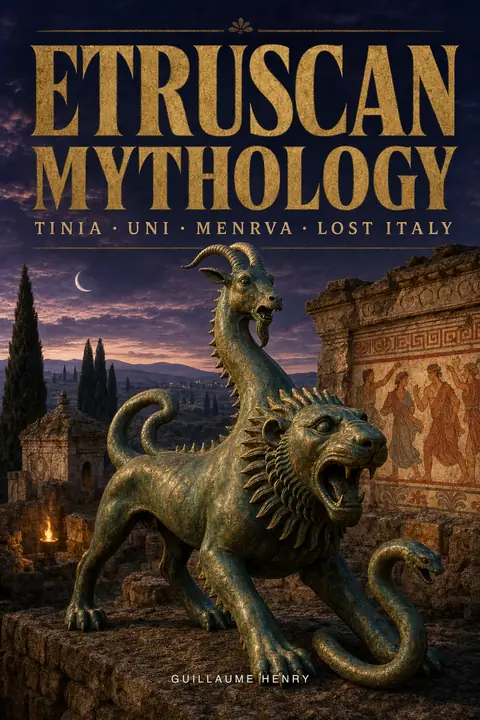
The Etruscan Mythology Book: Tinia, Uni, Menrva, and the Lost Religion of Italy
Tinia, Uni, Menrva, and Lost Italy
Before Rome, Italy belonged to the Etruscans: a people who read the future in lightning and livers, buried their dead in painted cities, and whose gods Rome quietly adopted. A mythology recovered from tombs, bronze mirrors, and the discipline of the haruspex.
More from Etruscan
All articles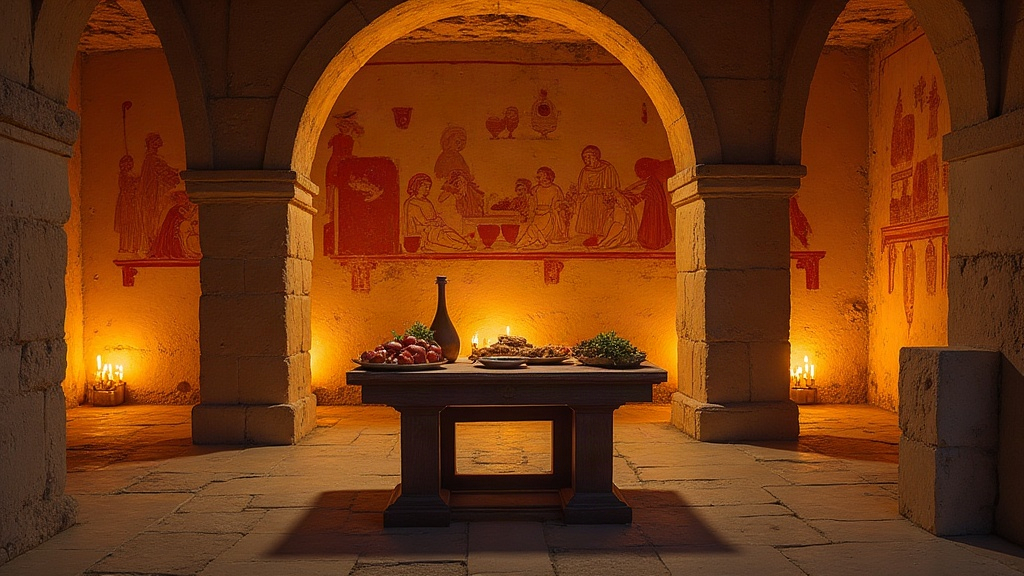
Etruscan
Etruscan Tomb Banquets: Feasting with the Dead
In Etruscan tombs, the dead reclined at eternal banquets. Through painted walls and grave goods, archaeologists recover a ritual that bound living and dead in a single meal. Discover how the Etruscans fed their ancestors and what it reveals about their afterlife beliefs.
Etruscan
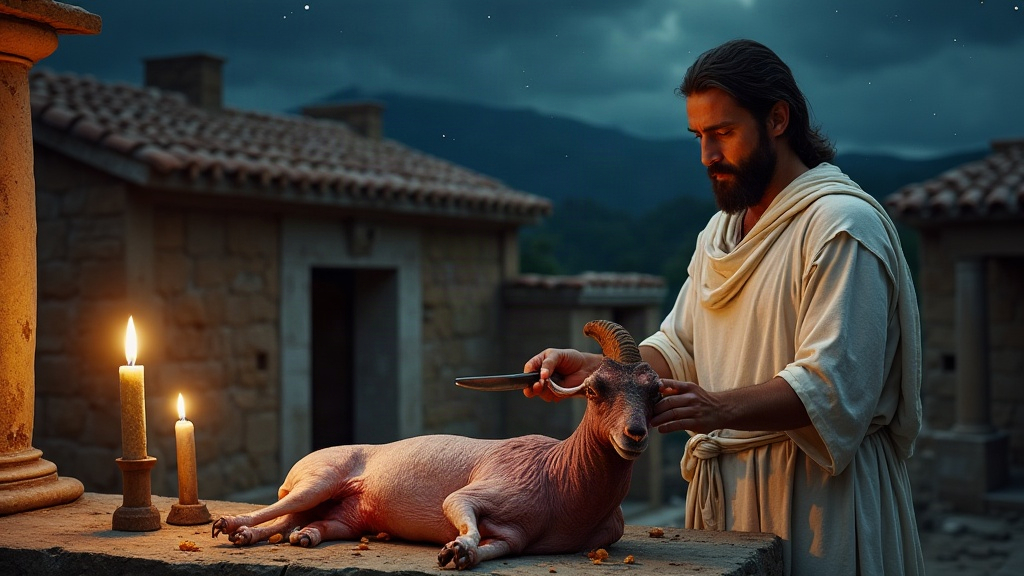
The Etruscan Disciplina: Sacred Books and Ritual Knowledge
The Etruscan Disciplina preserved the cosmos in ritual codes and sacred texts. Explore how haruspicy, augury, and divine protocol shaped an entire civilization and influenced Rome itself.
Etruscan
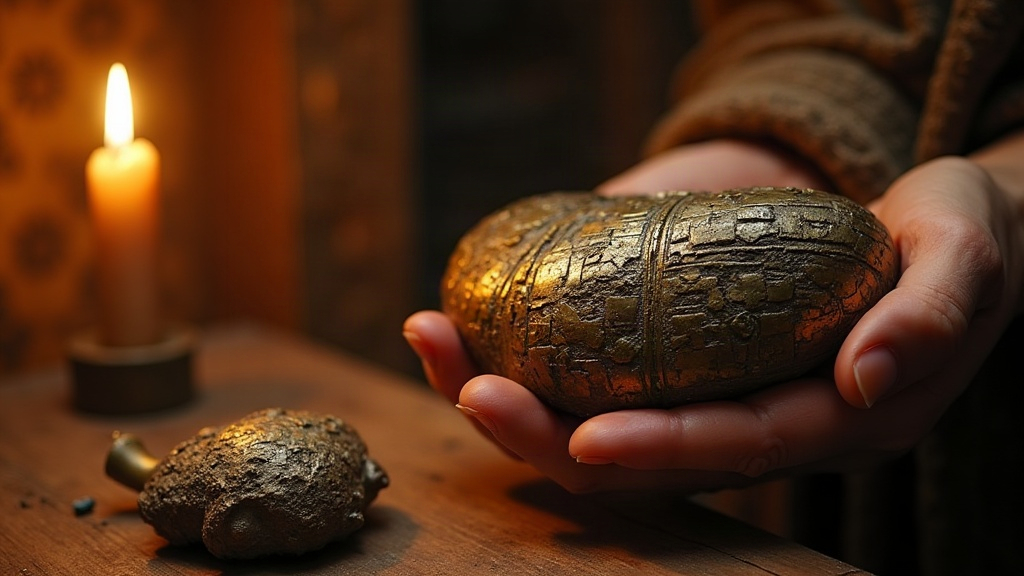
The Liver of Piacenza: Bronze Divination Model of the Etruscans
Discover how the Etruscan priests read fate itself: the Liver of Piacenza is a bronze model showing exactly where to look on a real liver for messages from the gods. It reveals the ancient art of haruspicy in bronze.
Etruscan
Tages: The Divine Child Prophet of Etruscan Divination
A child emerged from the earth to teach an Etruscan farmer the art of reading divine will. Tages, the Divine Child Prophet, became the source of all Etruscan divination knowledge, a figure so powerful that Roman priests carried his teachings for centuries.