
The Eleusinian Mysteries: Sacred Rites of Demeter
For nearly two thousand years, thousands of Greeks walked a sacred road to Eleusis and returned changed. The Eleusinian Mysteries promised something no other ritual could: a glimpse of what waited after death.
Contents
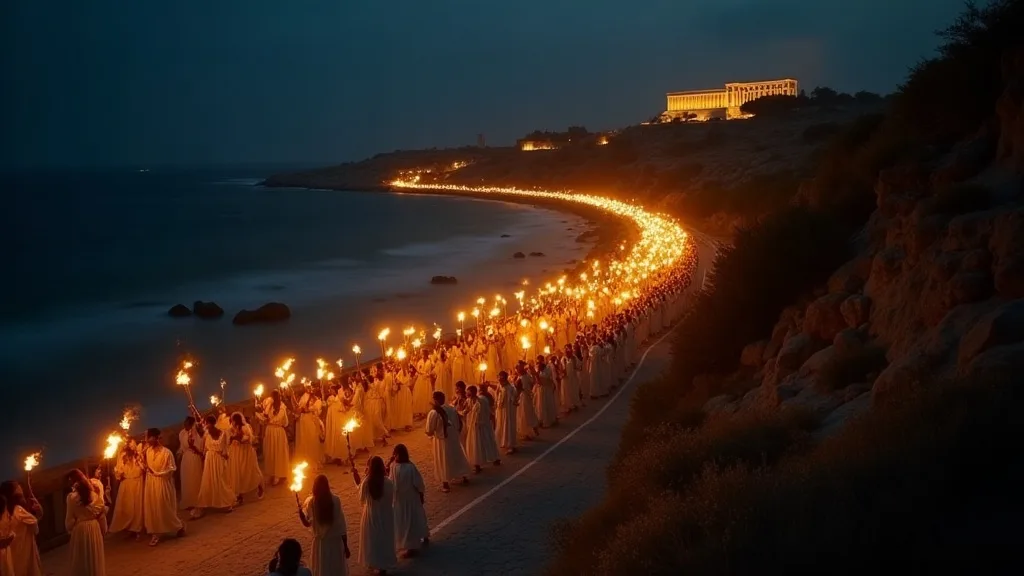
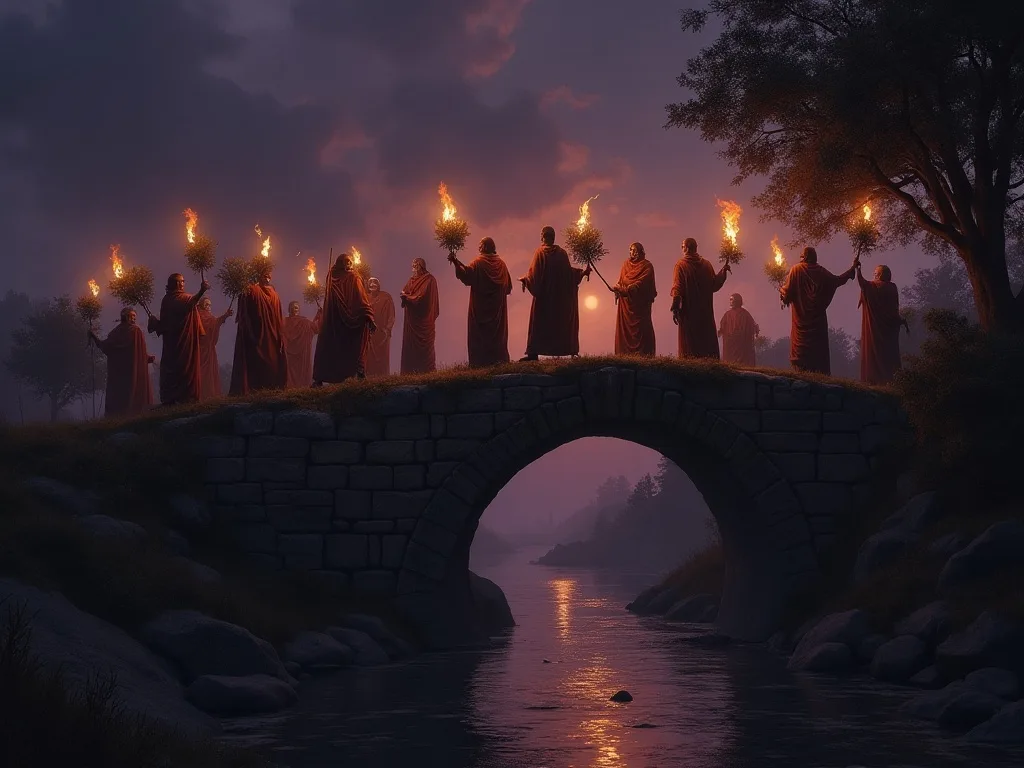
The road from Athens to Eleusis was eighteen miles long, and on certain autumn nights it blazed with torchlight. Thousands of initiates walked it barefoot, singing hymns, carrying sacred objects wrapped in myrtle branches. Priests chanted. Priests fell silent. The procession crossed a bridge over the Kephisos river, where masked figures leaped out from the shadows to hurl ritual insults at the crowd. Laughter and terror, side by side. That tension was the point.
At the end of the road stood a sanctuary. Inside it, behind walls no outsider could cross, something happened that changed people permanently. Greek writers who had undergone it struggled to explain the effect without betraying the secret they had sworn to keep. The Eleusinian Mysteries, held at the town of Eleusis near Athens, were the most revered religious rites in all of ancient Greece. They ran, with very few interruptions, for roughly two thousand years, from at least 1500 BC until the Roman emperor Theodosius banned all pagan festivals in 392 AD.
What the initiates saw or heard inside that hall, nobody wrote down. What we know is what it did to people. The Athenian general Alcibiades and the philosopher Plato both walked that road. So did the Roman emperor Marcus Aurelius. Cicero, who was himself initiated, wrote that Athens had given humanity nothing greater than the Mysteries. That is the scale of what happened at Eleusis.
The Myth That Made the Rites Necessary
Every ritual needs a story to explain why it exists. The story behind the Eleusinian Mysteries is one of the oldest and most emotionally powerful in Greek mythology: the abduction of Persephone and the grief of her mother Demeter.
The fullest version appears in the Homeric Hymn to Demeter, a Greek poem composed around the 7th century BC, though the myth itself is far older. Persephone, young and radiant, was gathering flowers in a meadow when the earth split open. Hades, king of the dead, rose through the gap, seized her, and dragged her down into the underworld. The meadow closed over them both.
Demeter heard her daughter scream. She searched for nine days and nine nights, carrying torches, refusing to eat, refusing to bathe. The earth felt her grief. Crops stopped growing. Animals stopped breeding. Famine crept across the land.

Eventually the sun god Helios told Demeter what had happened. Zeus had consented to the abduction. He had given Persephone to Hades without telling her mother. Demeter's sorrow curdled into rage. She abandoned Olympus and walked among mortals in disguise, an old woman with nowhere to go. She came at last to Eleusis, where the king's daughters found her sitting by a well and brought her into their household as a nurse.
While Demeter hid among humans, she refused to let anything grow. The Hymn says that all of humanity would have starved, and the gods would have lost their sacrifices, if Zeus had not intervened. He sent Hermes down to retrieve Persephone. But before Hermes arrived, Hades had given Persephone a pomegranate seed to eat, a single seed, enough to bind her to the underworld for part of every year.
The compromise that followed shaped the seasons. Persephone spends part of the year below, and while she is gone, Demeter mourns and the earth grows cold. When Persephone returns, the fields bloom again. This is why grain grows and why it dies. This is why winter exists. And this is why Demeter, before she returned to Olympus, left her gift at Eleusis: she taught the local people the secret rites that would allow humans to face their own death without terror.
The Town at the Heart of the Ancient World
Eleusis today is an industrial port city west of Athens, surrounded by refineries. In antiquity it was a modest agricultural town, famous for its grain and for one thing above all else: its sanctuary of Demeter.
The sanctuary, called the Telesterion complex, sits on a rocky hillside overlooking the Saronic Gulf. Excavations carried out since the 19th century, particularly by the Greek Archaeological Service, have revealed layers of building going back to Mycenaean times, around 1500 BC. The earliest cult structures were small. By the classical period (5th century BC), Athenian statesmen had rebuilt the main hall into something vast: a square building roughly 54 meters on each side, capable of holding several thousand initiates at once.
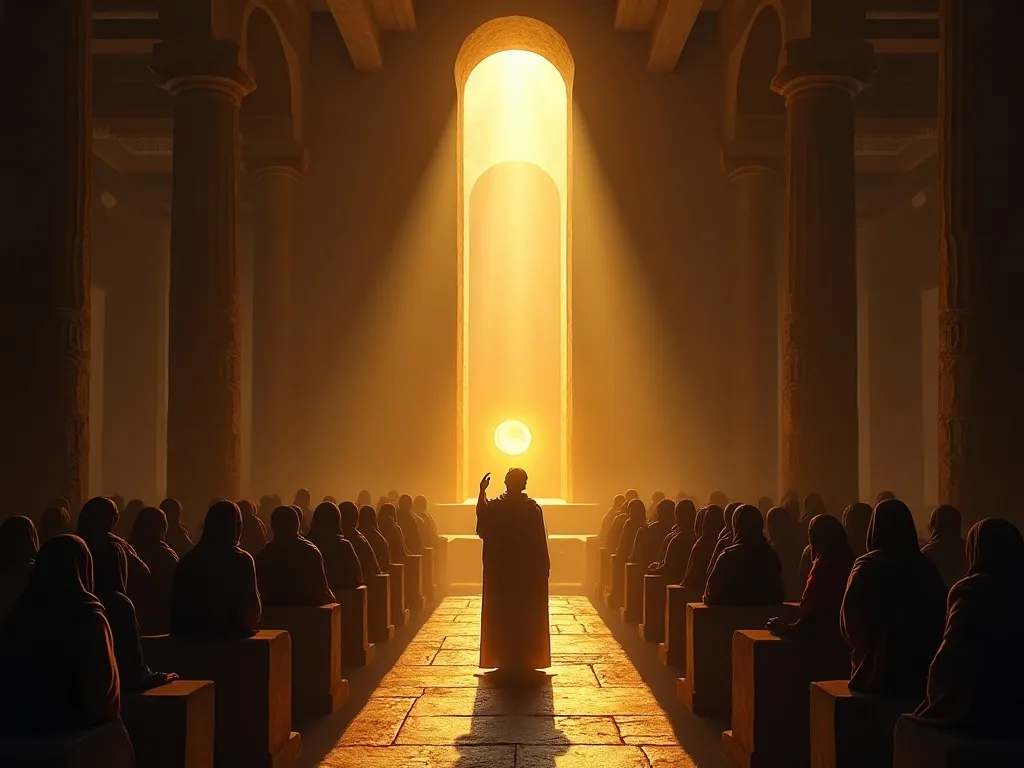
The hall had no windows. Tiers of stone seats lined its interior walls. At its center stood the anaktoron, a small inner chamber that only the chief priest, called the hierophant (from the Greek hierophantes, "the one who shows the sacred things"), could enter. Whatever was kept inside that chamber, it was never described in writing.
Eleusis was nominally independent but fell under Athenian influence from the 7th century BC onward. Athens ran the administration of the Mysteries, appointed the priestly families (the Eumolpidai and the Kerykes clans held the major roles for centuries), and drew enormous prestige from hosting what amounted to the spiritual center of the Greek-speaking world.
Two Cycles, One Initiation
The Eleusinian Mysteries were not a single event. They unfolded in two separate stages, months apart, each with its own preparation and its own sacred logic.
The Lesser Mysteries took place in early spring, in the month the Athenians called Anthesterion (roughly February-March). They were held at Agrai, a suburb of Athens along the Ilissos river. Ancient sources suggest these rites functioned as a prerequisite, a first purification that made candidates eligible for the full initiation. The philosopher Plato implies in his Phaedrus that Heracles had to undergo the Lesser Mysteries before he could be admitted to the Greater ones, because he was not Athenian by birth.
The Greater Mysteries were the heart of the cult. They took place in the month of Boedromion (roughly September-October), during the harvest, when the connection between grain, death, and rebirth was most viscerally felt. The festival lasted nine days, mirroring the nine days Demeter searched for Persephone.
The nine days followed a fixed sequence that ancient writers partially recorded:
- Day 1 (Agyrmos): Assembly of initiates in Athens. The hierophant formally convened the gathering.
- Day 2 (Halade Mystai): Initiates walked to the sea at Phaleron to purify themselves by bathing with a piglet, which they then sacrificed. The cry "Halade mystai!" ("To the sea, initiates!") rang across the city.
- Days 3-4: Sacrifices, processions, and secret rites in Athens, including a day of fasting.
- Day 5 (Iakchos procession): The great walk to Eleusis began at dusk. Initiates carried torches. A sacred image of the young god Iakchos, associated with Dionysus in some traditions, led the procession. Singing, dancing, the ritual bridge-crossing with its costumed insulters ("gephyrismoi", the bridge-mockers).
- Days 6-7: The secret rites inside the Telesterion. Here the sources go quiet.
- Day 8: Libations poured from special vessels called plemochoai, tipped east and west, honoring both the dead and the sky.
- Day 9: Return to Athens.
The progression was not random. Fasting, sea-bathing, walking through darkness, arriving at a great hall in the middle of the night: each step stripped away comfort, loosened ordinary consciousness, and prepared the initiate for whatever came next.
What Happened Inside the Telesterion
This is where certainty ends and careful reconstruction begins.
Ancient sources were bound by their oath. But several writers dropped enough hints that modern scholars have built a working model of the inner rites. The most important clue comes from a 2nd-century AD writer named Clement of Alexandria, a Christian critic of paganism who had no oath to keep. He describes the sacred formula that initiates used to identify themselves, the synthema, or password: "I fasted, I drank the kykeon, I took from the chest, I worked with it, I placed it back in the basket, and from the basket into the chest."
That formula tells us three things were involved: a ritual drink, a sacred chest (kiste), and a sacred basket (kalathos). What they contained, Clement does not say, though he suggests it was a sexual object of some kind, possibly related to fertility symbolism.
The kykeon deserves particular attention. The Homeric Hymn to Demeter describes it as a mixture of water, barley, and the herb pennyroyal. It was the drink Demeter herself accepted when she broke her fast at Eleusis. In 1978, the scholars R. Gordon Wasson, Albert Hofmann (the chemist who first synthesized LSD), and Carl Ruck published a book called The Road to Eleusis, arguing that the barley used in the kykeon was infected with ergot, a fungus that contains compounds chemically similar to LSD. If correct, this would mean the visionary experience at the heart of the Mysteries was at least partly chemically induced. The argument remains contested but has never been definitively refuted.
Beyond the drink, ancient sources agree that the inner rites were divided into three phases, using Greek terms that describe what happened:
- Dromena (things performed): ritual actions, likely a dramatic reenactment of Demeter's search and Persephone's return.
- Deiknymena (things shown): sacred objects displayed by the hierophant, perhaps the contents of the kiste.
- Legomena (things said): sacred words spoken in the darkness.
The culmination, called the epopteia (the "beholding"), was available only to initiates who returned for a second year. What they beheld was described by the 5th-century philosopher Aristotle as something that produced not knowledge but an experience, a pathos, a feeling that changed the soul.
Demeter, Grain, and the Power Behind the Rites
To understand why the Mysteries mattered so profoundly, it helps to understand who Demeter actually was in Greek religious life.
She was not a minor deity. Demeter was one of the twelve Olympians, sister of Zeus, daughter of the Titans Kronos and Rhea. Her domain was grain, agriculture, and the fertility of the earth, which in an ancient society meant she governed the difference between survival and starvation. Her name may derive from da (an archaic form of ge, "earth") and meter (mother): Earth Mother. That etymology is debated, but the concept is accurate. She was the ground that fed everyone.
Her connection to death was equally deep. Grain dies in winter and rises in spring. The farmer buries the seed in dark soil, just as the dead are buried, and waits for resurrection. The parallel between the agricultural cycle and the human cycle of birth, death, and possible rebirth was not a metaphor for the Greeks; it was a real structural connection, and the Mysteries made it visible.
The priesthood that served Demeter at Eleusis, the Eumolpidai family, traced their ancestry back to Eumolpos, a son of Poseidon, who was supposed to have founded the Mysteries at Demeter's direct instruction. For centuries the hierophant who led the rites always came from this family. He was required to be celibate for the duration of his office and was forbidden to eat pomegranate seeds, the fruit that had bound Persephone to the underworld.
Who Could Be Initiated
The Eleusinian Mysteries were unusually inclusive by ancient standards.
Any Greek speaker could be initiated, regardless of social class, gender, or origin. Men and women participated equally. Slaves were admitted, provided their master consented. The one firm exclusion was killers: anyone who had committed murder was barred until ritually purified, which is why Heracles, who had killed his own children in a fit of divine madness, needed special preparation before he could approach the sanctuary.
After the Roman conquest of Greece in the 2nd century BC, the Mysteries opened even further. Roman citizens, then emperors, sought initiation. Hadrian was initiated. So was Marcus Aurelius. By the 2nd century AD, the site at Eleusis was being rebuilt with Roman money, and the sanctuary had become one of the most visited religious destinations in the Mediterranean world.
The egalitarianism of the Mysteries was not purely spiritual generosity. It reflected a core belief: death comes for everyone equally, and the comfort of knowing what waits beyond the grave belonged to everyone willing to walk the road and keep the silence.
The Promise at the End of the Road
What did initiates actually receive, beyond the experience itself?
The ancient sources are consistent on one point: initiation changed how people felt about dying. The Homeric Hymn to Demeter closes with a direct statement: "Blessed is he among humans on earth who has witnessed these things. But he who is uninitiated and has no part in the holy rites never has the same lot once dead, down in the darkness and gloom."
Pindar, the 5th-century BC poet, wrote that the initiate "knows the end of life" and "knows its Zeus-given beginning." Sophocles, who was himself likely initiated, called the initiates "thrice blessed" because they would go to Hades not as strangers but as people who knew the territory.
This was not a vague comfort. The Greeks believed in an underworld that was, for most souls, a grey and joyless place. The Odyssey shows Achilles there, miserable, wishing he were a living beggar rather than a dead king. The Mysteries offered an alternative: the initiated soul would know where to go, what to say, perhaps even how to drink from the right spring. Some scholars connect the Mysteries with the Orphic gold tablets, small sheets of gold foil found in graves across the Greek world, inscribed with instructions for the soul of the dead, telling it which path to take, which spring to drink from, how to address the guardians of the underworld.
The promise, stripped to its core: you will not be lost when you die.
The Mysteries Under Rome and Their Eventual End
The Eleusinian Mysteries did not collapse; they were ended by law.
Under Roman rule, the site flourished. Cicero was initiated around 79 BC and wrote in his Laws that among all the excellent and divine institutions Athens had created, none was greater than the Mysteries, "by which we have been brought from a condition of savagery to humanity." The emperor Augustus rebuilt sections of the sanctuary. Hadrian was so moved by his initiation that he personally funded major construction projects at Eleusis. The sanctuary received the finest marble, the most skilled craftsmen.
But the relationship between Rome and the Mysteries was not always peaceful. In 170 AD, the Kostoboci, a tribal group from the Danube region, raided Eleusis and looted the sanctuary. They were eventually driven back, and the sanctuary was rebuilt. In 396 AD, the Visigothic king Alaric marched through Greece and sacked Eleusis a second time. The sanctuary did not recover from this second blow. Two years earlier, in 392 AD, the Christian emperor Theodosius I had issued his edict banning all pagan religious practices, specifically including the Mysteries.
By 400 AD, the Telesterion was empty. The hierophant family that had served for a thousand years dispersed. The last known hierophant, a man whose name was not recorded but who had been an initiate of Mithras as well, died sometime around 390 AD, reportedly weeping that he had lived to see the end of something ancient and irreplaceable.
The road from Athens to Eleusis fell quiet. The torches went out.
Echoes in Orphism, Platonism, and Early Christianity
The ideas that ran through the Mysteries did not vanish with the rites themselves. They flowed into several of the most influential philosophical and religious traditions of late antiquity.
Orphism, the Greek religious movement centered on the figure of Orpheus, shared deep structural similarities with the Eleusinian tradition: a god who descended and returned, a promise of blessed afterlife for the initiated, ritual purification as a prerequisite for divine favor. The Orphic texts, some of which survive on papyrus fragments, speak of Persephone's realm in terms that echo the Eleusinian promise directly.
Plato was shaped by the Mysteries more than he admits in plain language. His description of the philosopher's soul ascending toward the Form of the Good in the Republic, his vision of the soul's journey in the Phaedrus, his picture of the afterlife in the Phaedo, all use imagery of initiation, of seeing, of the sudden revelation of something beautiful and true that transforms the one who witnesses it. The Greek word he uses for this moment is epopteia, the same word used for the culminating vision inside the Telesterion.
Early Christian writers noticed the overlap and were troubled by it. Clement of Alexandria, who recorded the mystery formula, argued that the Mysteries were a demonic imitation of true revelation. But other early Christians, particularly those drawn to Gnostic traditions, borrowed the imagery of descent, initiation, and secret knowledge almost directly.
The structure of the Mysteries, the preparation, the journey, the darkness, the sudden light, the transformed return, reappears in Christian baptismal theology, in Neoplatonic mysticism, and in the Western esoteric traditions that run from the Renaissance through the 19th-century occult revival. Carl Jung wrote extensively about the Kore (Persephone's other name) as an archetype of the transforming feminine. The Mysteries became, in the modern imagination, a template for any experience that changes a person at the deepest level.
Frequently Asked Questions About the Eleusinian Mysteries
Frequently asked questions
Who was allowed to participate in the Eleusinian Mysteries?
Almost anyone who spoke Greek could be initiated, regardless of gender, social class, or origin. Women, slaves, and foreigners all participated, provided they had not committed murder and had completed the Lesser Mysteries as preparation. After the Roman conquest of Greece, Roman citizens and emperors were admitted as well. This openness was unusual in the ancient world, where most major rituals were restricted to specific families or civic roles.
What was the kykeon, and why does it matter?
The kykeon was the ritual drink consumed at Eleusis, described in the Homeric Hymn to Demeter as a mixture of water, barley, and pennyroyal herb. It was the drink Demeter herself first accepted when she broke her fast at Eleusis, giving it deep mythological significance. In 1978, R. Gordon Wasson, Albert Hofmann, and Carl Ruck proposed that the barley used in the kykeon was contaminated with ergot fungus, which contains psychedelic compounds. This would explain the visionary intensity that initiates described. The theory remains debated but has attracted serious scholarly attention.
What happened to initiates after death, according to Eleusinian belief?
The core promise of the Mysteries was that initiates would not face the underworld as helpless, bewildered souls. The Homeric Hymn to Demeter states directly that the uninitiated has "a different lot" in death, implying the initiated enjoy a better fate. Pindar wrote that initiates "know the end of life." Several scholars connect this belief to the Orphic gold tablets, small inscribed sheets found in Greek graves that give the soul instructions for navigating the underworld, suggesting a concrete geography of the blessed afterlife.
Why did the Eleusinian Mysteries survive for nearly two thousand years?
Several factors combined to sustain the cult across centuries. First, the rites were tied to grain agriculture, which was the foundation of survival for everyone, giving them relevance that purely theological cults lacked. Second, the oath of silence protected the core experience from over-explanation, keeping it potent and mysterious. Third, the emotional content, grief, loss, reunion, the possibility of life after death, is universal enough to speak across cultures and centuries. Rome adopted and funded the Mysteries rather than suppressing them, which gave the cult the institutional stability to last until 392 AD.
What primary sources tell us about the Eleusinian Mysteries?
The most important primary source is the Homeric Hymn to Demeter, probably composed in the 7th century BC, which tells the foundational myth and describes Demeter's time at Eleusis. Partial descriptions of the outer rituals appear in Plutarch, Pausanias (who describes the sanctuary in his 2nd-century AD Description of Greece), and the Athenian orator Androtion. Clement of Alexandria preserved the initiate's password (synthema). Pindar, Sophocles, and Cicero all described the emotional effect of initiation without revealing the secrets. The archaeological record at Eleusis itself, including the ruins of the Telesterion, adds physical context.
Is there a connection between the Eleusinian Mysteries and modern spirituality?
The structural influence is substantial. Neoplatonic philosophers, particularly Plotinus and Iamblichus, drew directly on Eleusinian concepts of the soul's ascent toward divine light. Renaissance Hermeticism and 19th-century theosophy both referenced the Mysteries as prototypes of spiritual initiation. Carl Jung analyzed the Kore-Persephone archetype as a fundamental pattern of psychological transformation. More recently, the psychedelic research tradition has revisited the kykeon hypothesis, with scholars like Brian Muraresku arguing in The Immortality Key (2020) that chemically assisted religious experience runs through the roots of Western spirituality.
The Question the Mysteries Left Open
The Eleusinian Mysteries ended, but the question they posed did not.
What happens after death? The Mysteries did not answer it with a text or a dogma. They answered it with an experience. That choice, to give people a felt encounter rather than an argued proposition, was a deliberate and sophisticated religious decision. The Greek word for the kind of knowledge gained at Eleusis was not gnosis (intellectual knowledge) but epopteia (beholding, witnessing). You did not learn that the soul survives death. You saw it, or you felt it, or something made it feel undeniably real.
Modern scholarship is still working out what that something was. The ergot-kykeon hypothesis put forward in The Road to Eleusis was developed further by Brian Muraresku in his 2020 book The Immortality Key, which added archaeological evidence of psychoactive substances found in ritual vessels at other Greek cult sites. The debate has moved from the margins of classical studies into mainstream conferences on religion and the history of consciousness.
Meanwhile, archaeologists continue to excavate around Eleusis. The sanctuary complex has never been fully explored; parts of the site lie beneath the modern town. Every few years a new finding, a carved relief, a fragment of inscription, a terracotta figurine with a torch, opens another small window onto what happened on those nine nights in September.
Two thousand years of silence is a remarkable achievement. It suggests that what initiates experienced at Eleusis was worth protecting, not because the priests commanded it, but because the initiates themselves, hundreds of thousands of them across two millennia, chose not to speak. That voluntary silence is perhaps the most eloquent testimony to the power of Demeter's rites that we have.
The road to Eleusis is still there. The torches are gone. The questions are not.
Free 25-page sample
Want the whole story?
Take the first 25 pages free. If it pulls you in, the full edition is yours as an instant PDF download, with a paperback on Amazon for selected titles.
Greek
The Greek Mythology Book: Zeus, the Olympians, the Heroes, and the Sacred Stories of Ancient Greece
Zeus, the Olympians, the Heroes, and the Sacred Stories of Ancient Greece
The complete guide to Greek mythology from Hesiod's Theogony to Homer's epics. Every Olympian, every hero, every descent to the underworld.
More from Greek
All articles
Greek
The Labyrinth and the Minotaur: Crete's Most Dangerous Secret
Beneath the palace of Knossos, a king hid his shame in stone. The story of the Labyrinth and the Minotaur is a myth about power, sacrifice, and the monsters we create.
Greek
Odysseus: Hero of the Odyssey
Cunning, restless, and indestructible in will, Odysseus spent ten years trying to reach home. His story is not just about survival. It is about what it costs a man to remain himself.
Greek
Hades: Lord of the Underworld
Hades rules the Greek underworld with quiet, absolute authority. Neither villain nor demon, he is the god who keeps the cosmic balance that Zeus and Poseidon could never maintain alone.
Greek
Heracles: The Greatest Greek Hero
Born of a god and a mortal woman, punished by a jealous goddess, and forced to perform twelve impossible labors, Heracles became the defining hero of ancient Greece and a symbol of human endurance that still resonates today.