
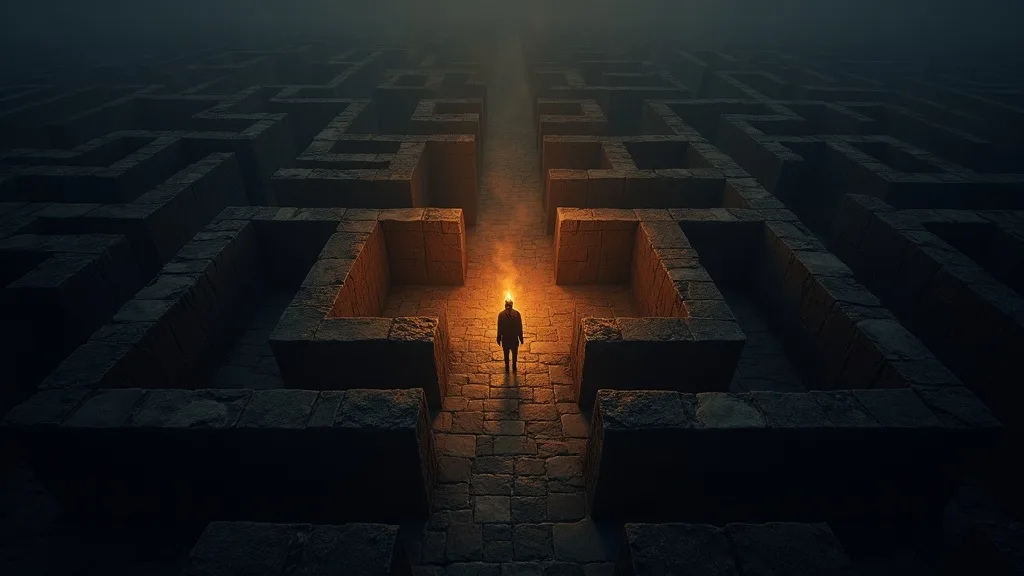
The Labyrinth and the Minotaur: Crete's Most Dangerous Secret
Beneath the palace of Knossos, a king hid his shame in stone. The story of the Labyrinth and the Minotaur is a myth about power, sacrifice, and the monsters we create.
Contents
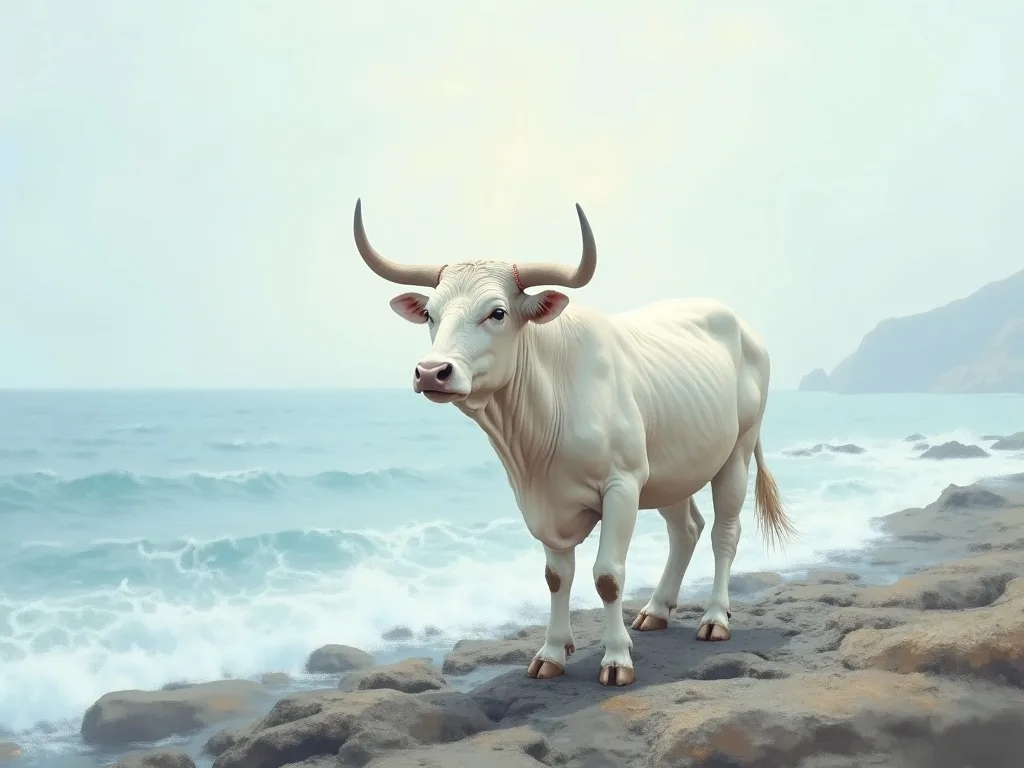
The bull arrived from the sea. Poseidon sent it as a gift to King Minos of Crete, white as seafoam and perfect in every way. The gift carried a condition: Minos should sacrifice the animal to honour the god. Instead, Minos kept it. He admired its beauty too much to let blood spill. That single act of pride set in motion everything that followed: a queen's unnatural desire, a half-human child, a prison of impossible corridors, and a hero who would kill in the dark.
The Labyrinth and the Minotaur is one of the oldest, strangest stories in Greek mythology. It comes from a world before mainland Greece dominated the Aegean, a world where Crete was the supreme naval power and its kings commanded tribute from across the sea. But the myth is not really about politics. It is about what happens when rulers believe their own greatness exempts them from the rules that govern everyone else.
The story stretches across generations and touches Theseus, Ariadne, and the master craftsman Daedalus before it is done. Each of them pays a price. None of them escapes Crete without losing something.
How Minos Lost Control of His Own Court
Poseidon's revenge was slow and surgical. The god did not strike Minos down. He turned Minos's own household against him. He made Pasiphae, the queen of Crete, fall into a consuming passion for the white bull. Pasiphae was not an ordinary woman. She was the daughter of Helios, the sun god, and carried divine blood. The curse twisted something that was already powerful.
Unable to act alone, Pasiphae went to Daedalus. The Bibliotheca, a mythological compendium attributed to Apollodorus and compiled around the 1st-2nd century AD, gives the fullest surviving account of what followed. Daedalus, an Athenian craftsman exiled to Crete for murder, was the most gifted builder in the known world. Pasiphae asked him to construct a hollow wooden cow, covered in real hide, in which she could conceal herself. Daedalus built it. The white bull was deceived.
The creature born from that union was Asterion, though history knows him almost exclusively as the Minotaur: Minotauros in Greek, meaning "Bull of Minos." He had a man's body and a bull's head. He ate flesh. He was strong enough to kill without effort. And he was, by every social measure, the most embarrassing possible consequence of a king's arrogance made visible in blood and bone.
Minos could not kill him. Whether this was guilt, fear, or some residual sense that the Minotaur was his own son by proxy is never entirely clear in the sources. Instead, he commissioned Daedalus to build a prison from which no creature could escape.
Daedalus and the Architecture of Impossibility
Daedalus built the Labyrinthos, and ancient writers struggled to describe it accurately because nothing comparable existed. The Roman poet Ovid, writing his Metamorphoses around 8 AD, says Daedalus "confused the usual marks of direction, and led the eye of the beholder astray by a tortuous path of divers winding passages." Pliny the Elder, writing in the 1st century AD, compared it to the Egyptian labyrinth at Lake Moeris, which he considered one of the architectural wonders of the ancient world.
The structure was not simply a long corridor that doubled back on itself. Ancient sources describe it as a place with thousands of paths, each one leading into another, with no reliable way to distinguish progress from retreat. Even Daedalus, who designed it, had to proceed carefully when he moved through it, according to the mythographer Hyginus writing in the 1st century BC. The labyrinth was less a building than a cognitive trap. Its cruelty was not physical confinement alone but the psychological destruction of anyone who entered.
The Minotaur lived at its centre. He ate, the myth tells us, on human flesh. This is where the tribute system becomes central to the story.
Minos had a son named Androgeos, a champion athlete who was killed in Athens, possibly during the Panathenaic games, possibly through treachery by the Athenian king Aegeus. The sources disagree on the details, but they agree on Minos's response. He launched his navy, crushed Athens, and imposed a tribute: every nine years, Athens would send seven young men and seven young women to Crete. They would be placed inside the Labyrinth. They would not return.
This is the human cost of the myth given its sharpest shape. Fourteen Athenian children, every nine years, fed to a monster in a prison no one could navigate. The Greeks who told and retold this story knew that Crete had, in historical memory, actually dominated the Aegean. The tribute felt like something that could have been real.
Theseus Volunteers for Crete
Theseus did not have to go. He was the prince of Athens, son of King Aegeus, and he could have remained safely in the city. He insisted on joining the third tribute ship. The reasons the ancient sources give vary slightly. In the version told by Plutarch in his Life of Theseus, written in the early 2nd century AD and one of the most detailed accounts we have, Theseus volunteered partly out of genuine pity for the condemned youth, and partly out of ambition. He wanted to kill the Minotaur. He wanted to end the tribute.
His father Aegeus extracted one promise from him. The tribute ships always sailed with black sails, the colour of mourning. If Theseus survived and was sailing home victorious, he should raise white sails. Aegeus would watch the horizon every day.
Theseus arrived in Crete and was brought before Minos. It was there that he met Ariadne, the daughter of Minos and Pasiphae. She fell in love with him immediately. Ancient sources, including Apollodorus, say that Aphrodite or Eros intervened to make this happen. But the myth works just as well without divine interference. Ariadne was a young woman in a court defined by shame and secrecy, and Theseus offered something her world had not seen in years: a person willing to face the thing at the centre of all that shame.
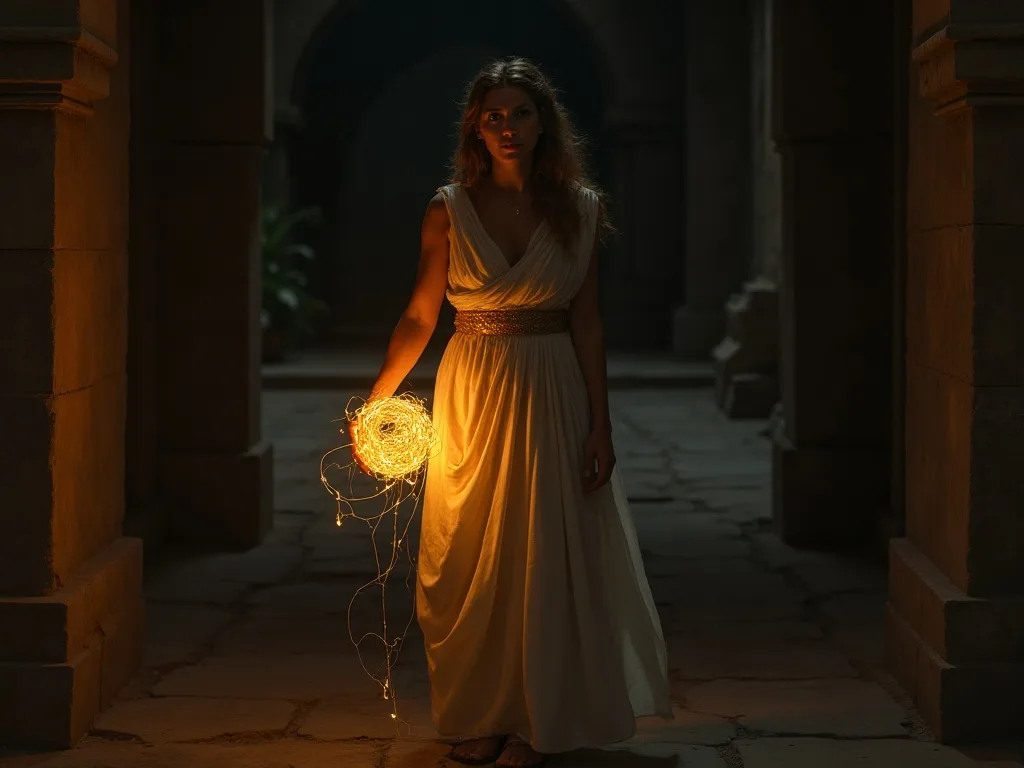
Ariadne went to Daedalus. She asked him how someone could navigate the Labyrinth. Daedalus gave her a ball of thread. The plan was simple enough to be brilliant: tie one end to the entrance, carry the ball inward, unwind it as you go, and follow it back out. The clew of thread is where the English word "clue" comes from. Every mystery novel, every detective story, owes a small debt to Ariadne's thread.
The Kill in the Dark
The night before the Athenians were to enter the Labyrinth, Ariadne brought Theseus the thread. She made him promise to take her with him when he sailed back to Athens.
What happened inside the Labyrinth is one of the silences of the myth. No ancient source describes the interior in detail. No one was there to witness it except Theseus and the Minotaur. What the sources agree on is the outcome: Theseus killed Asterion. Some accounts say he used a sword. Others say he killed the Minotaur with his bare hands. The Bibliotheca of Apollodorus simply states that Theseus "slew" him. The brevity feels deliberate. The labyrinth swallows the details.
Following Ariadne's thread, Theseus found his way back to the entrance. He led the surviving Athenians out. Together with Ariadne and her sister Phaedra, they sailed for the ships and pushed off from Crete before Minos could mobilize his fleet.
Ariadne Left on Naxos
Here the story turns cold. Theseus stopped at the island of Naxos. While Ariadne slept on the beach, the Athenians sailed away without her. This abandonment is one of the most disputed moments in all of Greek myth.
Plutarch lists several competing explanations. Some ancient authors claimed that Theseus loved another woman and left Ariadne deliberately. Others said a divine message or a storm forced him away. The god Dionysus is central to one version: he claimed Ariadne for himself, either telling Theseus in a dream to leave her, or simply arriving after Theseus departed. In the Theseid, an early epic poem now lost but quoted by later writers, Dionysus appeared to Theseus and ordered him to go.
The Dionysus tradition is the most mythologically satisfying version. Ariadne, left on a strange island, does not die in grief. She becomes the wife of a god, the queen of a divine household. Some ancient writers described her as achieving a form of immortality. Catullus, the Roman lyric poet writing in the 1st century BC, devotes a long passage of his poem 64 to Ariadne's anguish on the shore, focusing entirely on the human moment before the divine rescue arrives. Both truths exist at once: she was betrayed, and she was saved.
Theseus, meanwhile, forgot to change the sails.
Whether he forgot from grief, distraction, or something darker in his character, the black sails went up on the horizon instead of white. Aegeus, watching from the cliffs of Cape Sounion south of Athens, saw the black sails and believed his son was dead. He threw himself into the sea. The waters below that cape have been called the Aegean ever since.
Theseus arrived home to find he had killed his father by winning.
What the Minotaur Actually Represents
Greek myths rarely carry a single meaning, but the Minotaur is unusually rich in what it seems to be about. At the most immediate level it is a story about the consequences of dishonesty toward the gods. Minos keeps the bull; his whole dynasty pays. Pasiphae's desire is Poseidon's punishment wearing a different mask.
But the figure of the Minotaur himself is more complex than a punishment. He is called Asterion, "Starry One," the same name as a Cretan king who appears in other myths. He lives at the centre of the labyrinth as something both imprisoned and, in a strange way, central. He did not choose to exist. He did not design the labyrinth. He eats humans because that is what he was given. The ancient sources do not call him evil. They call him monstrous, which is different.
Several modern classical scholars, notably Gregory Nagy of Harvard in his work on hero traditions, have pointed out that the Minotaur occupies a liminal space in Greek thought: he is neither fully animal nor fully human, neither guilty nor innocent, neither inside society nor fully outside it. The labyrinth is the architecture of that ambiguity made physical. It is a place that mirrors the Minotaur's own nature: a space that cannot be read, that defeats the tools humans use to navigate the world.
The Minotaur
Half human, half bull. Born through divine punishment. Imprisoned without trial. Eats the tribute sent by Minos's enemies. Never leaves Crete. Dies without speaking. His name, Asterion, is almost never used.
Theseus
Fully human, fully heroic. Acts by choice. Enters and exits freely. Kills the creature at the center. Returns to become king. His name defines a dynasty. Yet he fails every person who loves him: Ariadne, Aegeus, and later Phaedra.
Daedalus Punished for Helping
Minos did not forgive Daedalus for giving Ariadne the secret of the thread. He imprisoned the craftsman and his son Icarus inside the Labyrinth itself. The detail is pointed: Daedalus was trapped inside his own masterwork. The prison he designed to defeat all navigation now defeated him.
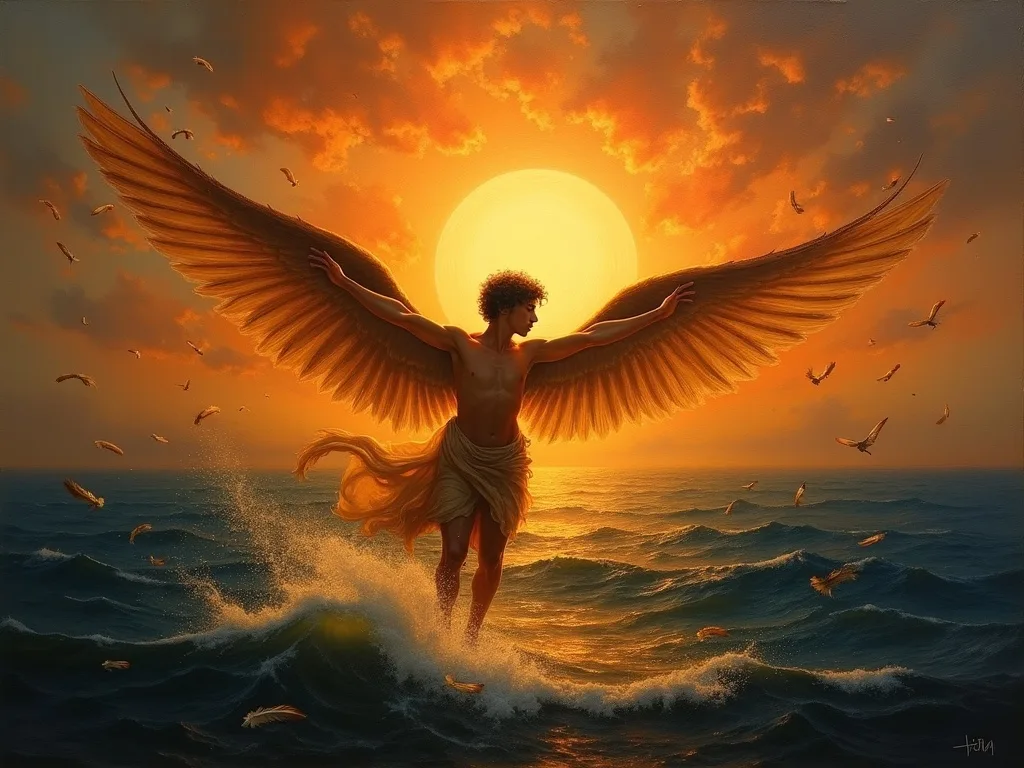
Daedalus solved the problem the only way he could. He could not escape by land or sea; Minos controlled both. He built wings from feathers and beeswax, one pair for himself and one for Icarus. Before they flew, he gave Icarus one warning: not too high, because the sun would melt the wax; not too low, because the sea spray would dampen the feathers. The middle path was safety.
Icarus flew too high. This part of the myth, told most fully by Ovid in the Metamorphoses, is one of the defining images in Western art. Icarus, exhilarated by flight, pushed upward until the wax softened and the feathers scattered. He fell into the sea. The island near where he drowned was named Icaria. Daedalus landed alone in Sicily, where he was eventually sheltered by a king named Cocalus. Minos tracked him there, demanding his extradition. Cocalus's daughters killed Minos in a bath. The god who started everything by punishing a king's pride watched another king die for the same reason.
The Archaeology Beneath the Myth
The site of Knossos on Crete is real. British archaeologist Arthur Evans excavated it beginning in 1900, finding a Bronze Age palace of extraordinary complexity. The palace had hundreds of rooms, multiple levels, a sophisticated drainage system, storage magazines running the length of the building, and fresco walls painted with bulls and bull-leaping athletes. Evans named the civilization he found Minoan, directly after the mythological king.
The palace ground plan, with its warren of interconnecting rooms and corridors, could genuinely disorient a visitor unfamiliar with it. Some scholars, including the archaeologist Nanno Marinatos, have proposed that the myth of the labyrinth was a memory of Knossos itself, distorted over centuries of oral transmission. The word labyrinthos may derive from labrys, the double-headed axe that appears repeatedly in Minoan iconography. The palace of the double axe: the labyrinth.
The bull cult was not mythological. Bull-leaping frescoes at Knossos show young men and women vaulting over charging bulls in what appears to have been a ritual practice. Whether this involved actual danger or death is debated, but the image of Cretan youth in mortal proximity to a bull had cultural roots going back to before the myth's written form existed.
The myths of Crete do not exist in isolation. They connect to traditions about Poseidon's power over the sea, about the ambitions of Aegean kingdoms, and about the moment mainland Greek culture absorbed and reinterpreted the older Minoan world.
The Labyrinth's Long Life in Art and Literature
The image proved almost indestructible. Roman mosaics from Britain to North Africa depicted labyrinth patterns, often with a small figure of the Minotaur at the centre. Medieval Christian builders embedded labyrinth patterns into the floors of cathedrals, most famously at Chartres in France, where the path was walked as a form of pilgrimage meditation. The symbol migrated from a prison to a spiritual journey without losing its essential structure.
Dante placed the Minotaur in the Inferno, in the seventh circle of Hell, as a guardian of the violent. Jorge Luis Borges returned to the myth repeatedly in his fiction, most directly in his 1949 story "The House of Asterion," told from the Minotaur's own point of view. Borges gave Asterion a voice and an interior life. The monster waited not with rage but with patience for the one who would come to kill him, imagining his killer as a kind of liberator.
The myth has not stopped generating new interpretations because its central images are genuinely ambiguous. A labyrinth can be a trap, a sanctuary, or a pilgrimage. The Minotaur can be a monster, a victim, or an aspect of the self that society refuses to acknowledge. Ariadne's thread can be love, intelligence, or the kind of practical help that never gets its full credit. The story absorbs new readings without breaking.
Frequently Asked Questions About the Labyrinth and the Minotaur
Frequently asked questions
Who built the Labyrinth, and where was it located?
Daedalus, an Athenian craftsman working under King Minos, built the Labyrinth at Knossos on the island of Crete. The palace of Knossos is a real Bronze Age site, excavated by Arthur Evans from 1900 onward. Many scholars believe the myth grew from the memory of the palace's genuinely complex architecture, and from the Minoan word labrys, meaning the double-headed axe found throughout Knossos.
What was the Minotaur's actual name, and who were his parents?
His name was Asterion, meaning "Starry One." His mother was Pasiphae, queen of Crete and daughter of the sun god Helios. His father, technically, was the sacred white bull that Poseidon sent to King Minos. Minos refused to sacrifice the bull as promised, and Poseidon cursed Pasiphae with an unnatural desire as punishment. The Minotaur was the result.
Why did Athens send tribute to Crete, and how many people were sacrificed?
Athens owed tribute because Minos blamed the Athenian king Aegeus for the death of his son Androgeos. Minos attacked Athens with his fleet and imposed terms: every nine years, seven young men and seven young women from Athens were sent to Crete and placed inside the Labyrinth. Plutarch's Life of Theseus records this as the standard version of the tribute system.
What happened to Ariadne after Theseus abandoned her?
Ariadne was left sleeping on the island of Naxos while Theseus sailed away. The most widely cited ancient tradition has the god Dionysus finding her there and taking her as his wife. In some versions she achieved a form of immortality through this union. The Roman poet Catullus described her despair on the shore before Dionysus arrived, making her one of mythology's most vividly rendered abandoned figures.
Is there archaeological evidence for the Minotaur myth?
No skeleton of a half-human creature has been found, but the cultural roots of the myth are archaeologically visible. Bull-leaping frescoes at Knossos show ritual interactions between young athletes and charging bulls. The palace layout is genuinely labyrinthine. The word labyrinthos appears in Linear B tablets found at Knossos, predating Homer. Scholars like Nanno Marinatos argue the myth preserves a distorted memory of Minoan bull ritual and palace life.
Why did Theseus forget to change the sails?
Ancient sources offer no single explanation. Plutarch mentions that some authors blamed divine intervention, others simple human carelessness, and others a grief-stricken mind preoccupied with losing Ariadne. The mythological function of the forgotten sails is to ensure that Theseus, despite his heroism, pays a price. He kills the monster and loses his father. Greek myth consistently resists uncomplicated victory.
The Monster at the Centre of Every Map
Every culture draws a map of the known world and places a monster somewhere near the edge. Greece did something stranger with the Minotaur: it placed the monster at the centre, underground, beneath a palace, inside a structure that was itself a kind of thought made physical.
The labyrinth is not at the edge of civilization. It is under the seat of power. Minos rules above; Asterion waits below. The tribute flows from Athens to Knossos and then down into the earth. The hero who wants to dismantle the system has to go all the way in, to the dark centre, and face what the system was built to contain.
That image proved more durable than any specific reading of the myth because it maps onto something people recognise without being able to fully name. Every institution that hides its worst consequences at the core of its operations, every authority that demands sacrifice to maintain its dignity, every maze of bureaucracy or grief or trauma that people must thread their way through in the dark: the story holds all of these without collapsing under the weight.
Ariadne's thread still works. The exit is still there. But you have to be willing to go all the way in before you can find your way out.
Free 25-page sample
Want the whole story?
Take the first 25 pages free. If it pulls you in, the full edition is yours as an instant PDF download, with a paperback on Amazon for selected titles.
Greek
The Greek Mythology Book: Zeus, the Olympians, the Heroes, and the Sacred Stories of Ancient Greece
Zeus, the Olympians, the Heroes, and the Sacred Stories of Ancient Greece
The complete guide to Greek mythology from Hesiod's Theogony to Homer's epics. Every Olympian, every hero, every descent to the underworld.
More from Greek
All articles
Greek
The Eleusinian Mysteries: Sacred Rites of Demeter
For nearly two thousand years, thousands of Greeks walked a sacred road to Eleusis and returned changed. The Eleusinian Mysteries promised something no other ritual could: a glimpse of what waited after death.
Greek
Odysseus: Hero of the Odyssey
Cunning, restless, and indestructible in will, Odysseus spent ten years trying to reach home. His story is not just about survival. It is about what it costs a man to remain himself.
Greek
Hades: Lord of the Underworld
Hades rules the Greek underworld with quiet, absolute authority. Neither villain nor demon, he is the god who keeps the cosmic balance that Zeus and Poseidon could never maintain alone.
Greek
Heracles: The Greatest Greek Hero
Born of a god and a mortal woman, punished by a jealous goddess, and forced to perform twelve impossible labors, Heracles became the defining hero of ancient Greece and a symbol of human endurance that still resonates today.