
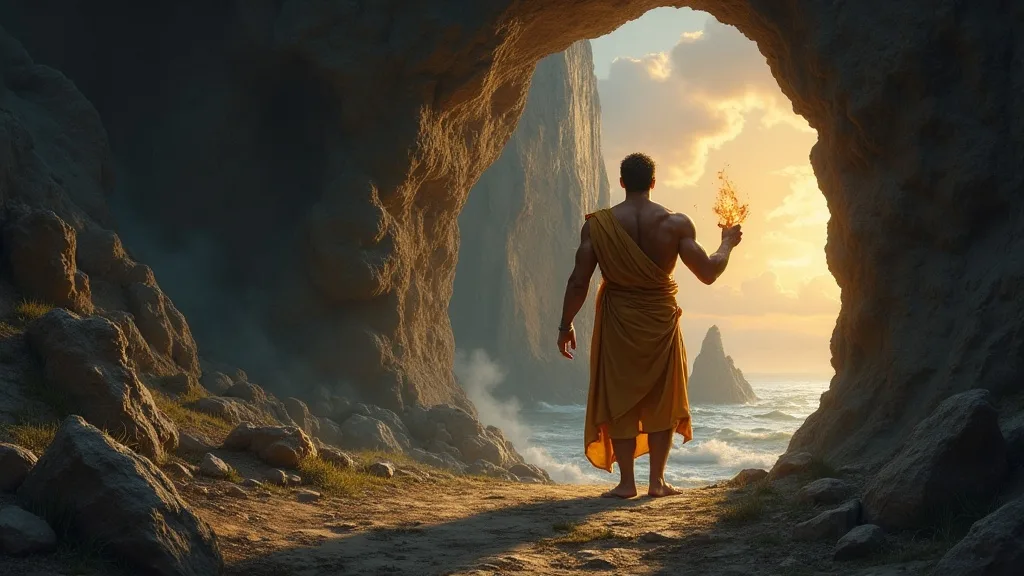
Heracles: The Greatest Greek Hero
Born of a god and a mortal woman, punished by a jealous goddess, and forced to perform twelve impossible labors, Heracles became the defining hero of ancient Greece and a symbol of human endurance that still resonates today.
Contents
The lion was still breathing when Heracles wrapped his hands around its throat. No weapon had worked. Arrows bounced off the Nemean lion's hide as if the skin were iron. So he dropped his bow and finished the fight with his bare arms, strangling the beast on the rocky slopes above Nemea. When it was dead, he skinned it using the lion's own claws, the only things sharp enough to cut through. He wore that pelt for the rest of his life.
That moment tells you almost everything about Heracles: the greatest Greek hero. He was not a trickster, not a navigator, not a singer. He was the man who stepped toward the thing that could not be beaten and found a way to beat it anyway. His myths are not subtle. They are enormous, like the man himself, packed with monsters and gods and impossible tasks and a grief so heavy it crushed ordinary mortals but only made Heracles push harder.
The ancient Greeks saw in him something they wanted to believe was possible: that a mortal body, trained hard enough and willed hard enough, could do the work of a god. That idea passed through Rome, through the Renaissance, through modern cinema. It has never gone quiet.
Born Between Two Worlds: The Origins of Heracles
Heracles was the son of Zeus, king of the Olympian gods, and Alcmene, a mortal woman from Thebes. Zeus came to Alcmene disguised as her husband Amphitryon, and on that night he stretched the hours so the union lasted three normal nights in one. The result was a child of extraordinary potential.
Hera, Zeus's wife, hated this child before he was born. She was not angry at Zeus for the first time, but something about Heracles drew her fury more than any other of Zeus's mortal children. She delayed his birth so that a lesser child, Eurystheus, would be born first and inherit the kingship of Mycenae that Zeus had promised to "the next descendant of Perseus." That manipulation worked. Heracles was born into a world where another man already held the power that should have been his.
The name itself has puzzled scholars. Heracles, in Greek Herakles, may mean "glory of Hera," which seems deeply ironic given that Hera spent most of his life trying to destroy him. Some ancient writers, including Diodorus Siculus writing in the first century BC, explained it as an attempt to appease the goddess. Others read it as deliberate tension built into the myth from the start: his greatness would always be entangled with her hatred.
As an infant he proved the point. Hera sent two serpents into his cradle. Heracles, not yet a year old, grabbed one in each hand and strangled them both. His nurse found him in the morning playing with the dead snakes like toys.
The Education of a Hero
Heracles grew up with tutors drawn from the best the ancient world offered. The centaur Chiron (the wise half-man, half-horse who also taught Achilles) trained him in some traditions. The archer Eurytus taught him to shoot. Autolycus, master wrestler, taught him to grapple. Linus, a musician, tried to teach him the lyre, but when Linus struck him for playing badly, Heracles killed him with the instrument. The boy had enormous strength and almost no patience for being corrected.
He married Megara, the daughter of King Creon of Thebes, and they had children together. For a time, life was as stable as a hero's life could be.
Then Hera drove him mad.
In a fit of divinely-induced insanity, he killed Megara and their children. The sources differ on the details: the playwright Euripides, in his tragedy Heracles written around 416 BC, places the killing after the labors as the cruelest blow Hera could land once he returned victorious. The mythographer Apollodorus, writing in the first or second century AD in his Library of Mythology, places it before, making the labors an act of penance. Both readings are haunting for different reasons. In Euripides, the madness strips the hero of every reward he earned. In Apollodorus, the labors are born from guilt so unbearable that only impossible tasks could contain it.
Either way, when the madness lifted and Heracles understood what he had done, he went to the Oracle at Delphi and asked how to atone. The oracle told him to go to Tiryns and serve King Eurystheus for twelve years. Whatever Eurystheus commanded, he had to do.
The Twelve Labors: A Map of the Ancient World
Eurystheus was frightened of Heracles from the start. The ancient sources tell us he received reports of each completed labor from inside a large bronze storage jar that he had buried in the ground for protection. He assigned the tasks hoping Heracles would die. He kept adding conditions and disqualifying completed labors when Heracles found help.
The twelve labors of Heracles form a kind of map, moving outward from the Greek mainland to the edges of the known world.
The First Six Labors: The Heart of Greece
- The Nemean Lion. The lion whose hide no weapon could pierce. Heracles killed it bare-handed, as described above, and wore its skin as armor.
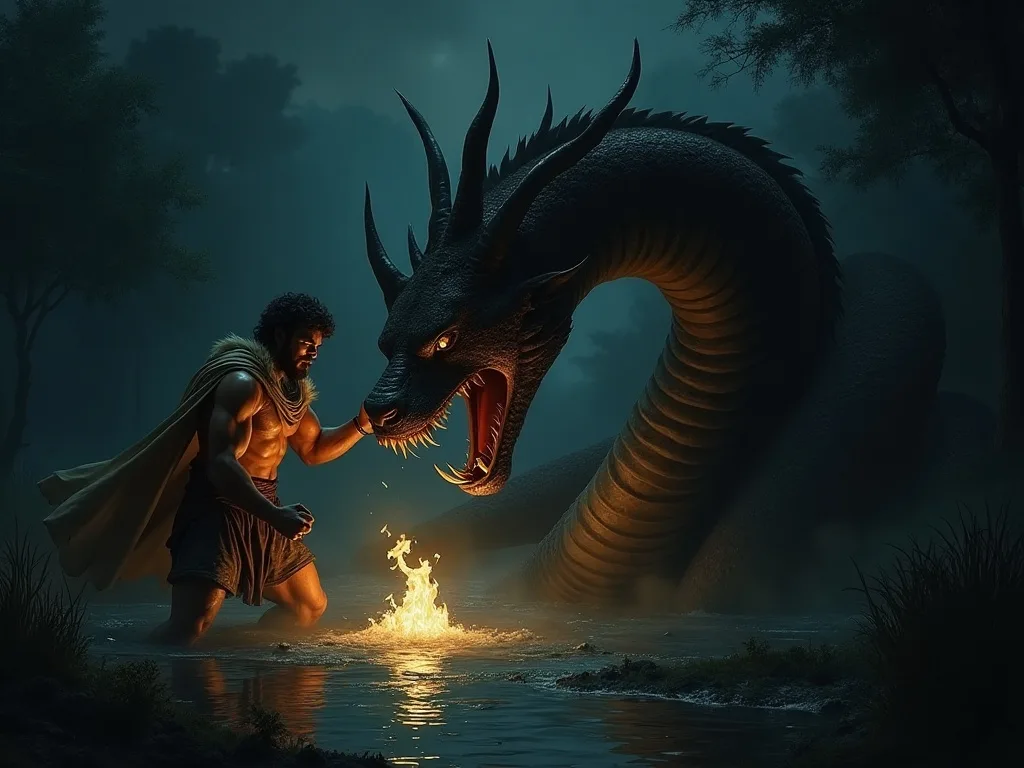
- The Lernaean Hydra. A serpent with multiple heads living in the swamps near Lerna. Cut one head off and two grew back. Heracles solved the problem with fire, cauterizing each neck stump immediately, stopping regrowth. His nephew Iolaus held the torch. Eurystheus disqualified this labor because Heracles had help.
- The Cerynitian Hind. A golden-horned deer sacred to Artemis. He could not kill it. He spent a full year tracking it before catching it alive, borrowing it briefly from the goddess and returning it unharmed.
- The Erymanthian Boar. He drove it into deep snow until it was too cold and exhausted to fight, then carried it back on his shoulders.
- The Augean Stables. Augeas, king of Elis, had not cleaned his enormous cattle stables in thirty years. Heracles redirected two rivers, the Alpheus and the Peneus, through the stables in a single day and washed them clean. Eurystheus disqualified this one too because Augeas had offered Heracles a payment.
- The Stymphalian Birds. Bronze-feathered birds nesting at Lake Stymphalia that ate human flesh and shot their feathers as weapons. Athena gave Heracles bronze castanets made by the smith-god Hephaestus. He shook them to startle the birds into the air, then shot them down with his arrows.
The Final Six Labors: The Edges of the World
- The Cretan Bull. Poseidon had sent a magnificent bull to King Minos of Crete to be sacrificed. Minos kept it. Poseidon made the bull mad. Heracles wrestled it into submission and brought it back to Greece.
- The Mares of Diomedes. Diomedes, king of the Bistones in Thrace, fed his horses on human flesh. Heracles killed Diomedes and fed him to his own mares, which calmed them down.
- The Belt of Hippolyta. Hippolyta, queen of the Amazons, agreed to give Heracles her war belt as a gift. Hera disguised herself among the Amazons and spread the rumor that Heracles planned to kidnap their queen. A battle broke out, and Hippolyta died. Heracles brought the belt back under grief and confusion.
- The Cattle of Geryon. Geryon was a giant with three bodies fused at the waist, living on the island of Erytheia far to the west. To reach it, Heracles sailed past the edge of the known world, setting up two pillars at the strait we now call Gibraltar. He stole Geryon's red cattle and drove them all the way back through Europe to Greece.
- The Apples of the Hesperides. These golden apples grew in a garden at the far end of the world, guarded by a serpent that never slept and by the nymphs called the Hesperides. Heracles held up the sky so that the Titan Atlas could go and pick the apples. When Atlas returned, he offered to carry them to Eurystheus himself, hoping to escape the burden of the heavens forever. Heracles agreed, then asked Atlas to take the sky back for one moment while he adjusted his lion-skin as a shoulder pad. Atlas obliged. Heracles picked up the apples and walked away.
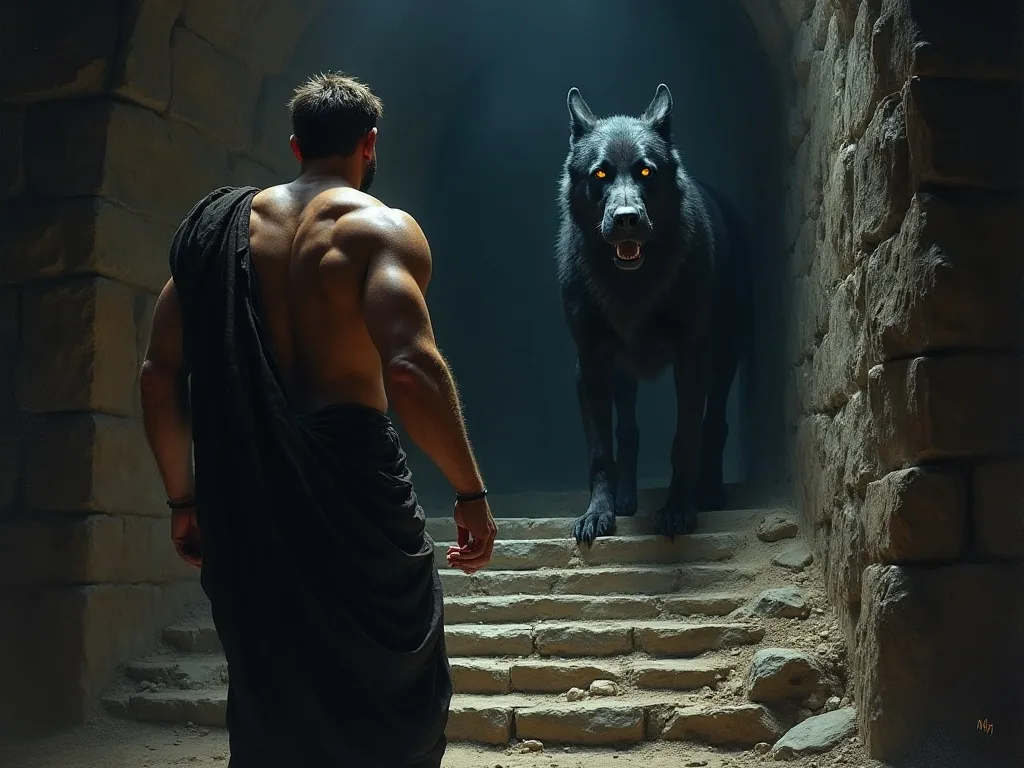
- Cerberus. The final labor sent him to the underworld itself. He had to bring back Cerberus, the three-headed dog that guarded the entrance to the realm of the dead, without using weapons. He wrestled Cerberus into submission, dragged the beast into daylight, showed it to Eurystheus (who hid in his jar), and then returned Cerberus to the underworld unharmed.
Beyond the Labors: The Other Battles of Heracles
The labors make up only part of his story. In between, around, and after them, Heracles fought and wandered with the same intensity.
He sailed with Jason on the Argo in search of the Golden Fleece, though he left the voyage early at Mysia when his companion Hylas was pulled into a spring by water-nymphs and Heracles refused to leave without him.
He rescued Prometheus, the Titan who had been chained to a mountain and tormented daily by an eagle eating his liver, as punishment for giving fire to humanity. Zeus eventually permitted the rescue, and Heracles shot the eagle with an arrow.
He sacked the city of Troy once before the famous war, after King Laomedon cheated him of promised horses following the rescue of Laomedon's daughter from a sea monster.
He accidentally killed his friend Iphitus and was punished with a period of slavery to Queen Omphale of Lydia. The ancient sources, including Ovid in the Heroides, take some delight in describing him spinning wool while wearing women's robes, his massive frame bent over a spindle. It was a labor of humiliation rather than danger.
He freed Alcestis, wife of his friend Admetus, by wrestling with the god of death, Thanatos, at the entrance to her tomb.
Every episode adds the same layer: the world threw something at him, and he kept going.
The Death of Heracles: Poison, Fire, and Transformation
His death came not from a monster but from a mistake made long before.
Years earlier, Heracles had been crossing a river with his new wife Deianira when the centaur Nessus offered to carry her across. Midway through, Nessus tried to assault her. Heracles shot him from the bank with an arrow dipped in the blood of the Lernaean Hydra, which was lethal even in tiny amounts.
As Nessus died, he whispered to Deianira that his blood would work as a love potion. If she ever feared losing Heracles's affection, she should anoint his clothing with it. Deianira kept the blood in a jar.
Years later, Heracles fell in love with Iole, a princess he had captured in battle. Deianira heard the news and quietly anointed a fine ceremonial robe with the centaur's blood before sending it as a gift. She believed she was saving her marriage.
When Heracles put on the robe at a sacrificial ceremony, the hydra-poisoned blood clung to his skin and would not come off. It burned him from the outside in. He tore at the robe, but it pulled his flesh with it. Heracles, who had strangled a lion and dragged Cerberus from the underworld, fell to his knees on the altar in agony.
He ordered his companions to build a funeral pyre on Mount Oeta. No one would light it until a young man named Philoctetes agreed. As a reward, Heracles gave Philoctetes his great bow, the one tipped with hydra venom. Then he climbed onto the pyre himself.
The fire took him. But the myths do not end there.
Zeus sent lightning to consume the mortal portion of Heracles entirely. The divine part, the side that came from Zeus, was lifted to Mount Olympus. Hera, who had spent an entire lifetime trying to destroy him, finally accepted him. He married Hebe, the goddess of youth. He became a god.
The philosopher and historian Diodorus Siculus noted in the first century BC that Heracles was worshipped both as a hero (with chthonic rites for the dead) and as a god (with Olympian rites for the living). The Greeks could not agree whether he was one or the other, so they offered both.

Heracles Across Cultures: The Hero Who Would Not Stay Greek
The Romans called him Hercules and made him the patron of merchants and travelers. His altar in Rome, the Ara Maxima in the Circus Maximus, was one of the oldest sacred sites in the city. Roman generals invoked him before battle. Senators swore oaths by him.
The Phoenicians identified him with their god Melqart, a figure associated with the cycles of death and rebirth, and with the sea. Greek colonists setting up trading posts in Spain and North Africa brought the Heracles cult with them, merging it with local traditions wherever it landed.
In ancient Egypt, he was equated with a local divinity during the Hellenistic period. Alexander the Great, who pushed his armies to the edge of India, claimed descent from Heracles on his father's side and consciously modeled himself on the hero, wearing lion skins in portraits and associating his own campaigns with the labors.
The Stoic philosophers of Greece and Rome saw in Heracles an ideal image of virtue under pressure. They read the labors as allegories: the Nemean lion was pride, the Hydra was vice that multiplied when you cut at it head-on, the descent into the underworld was the philosopher's willingness to confront death without flinching. Epictetus and Seneca both referenced him this way.
This is a hero who moved across linguistic and cultural boundaries with unusual ease. The reason is probably structural: his story is built around a simple, universal grammar. He was powerful. He suffered. He kept going. You do not need to know Greek to understand that.
Heracles in Art, Drama, and Modern Memory
Ancient Greek pottery from as early as the seventh century BC shows Heracles fighting the Hydra. He appears on the metopes, the carved stone panels, of the Temple of Zeus at Olympia, completed around 457 BC, where each labor gets its own relief. These carvings are among the finest examples of classical sculpture in existence.
The Athenian playwrights found him irresistible. Sophocles wrote Women of Trachis, focusing on Deianira and the poisoned robe. Euripides's Heracles pushed into the darkest corner of the myth: the killing of his own family, the madness, and the agonizing question of whether a hero can survive what the gods do to him.
Renaissance painters returned to him repeatedly. Annibale Carracci's ceiling frescoes in Rome's Palazzo Farnese, painted around 1600, show Hercules at the crossroads choosing between Virtue and Pleasure, a scene invented by the Greek philosopher Prodicus in the fifth century BC and retold endlessly since.
The Hollywood tradition of muscled heroes fighting monsters owes an enormous debt, even when the names change. Steve Reeves's Italian peplum films of the 1950s and 1960s built a genre. Disney's animated Hercules in 1997 bent the myth into a coming-of-age story but kept the labors. Marvel's Thor, DC's Superman, even the quiet version in the film The Truman Show's final image of a man walking through a door into something unknown, all carry traces of this particular shape: strength pressed into service, suffering used as proof.
Frequently Asked Questions About Heracles
Frequently asked questions
What is the difference between Heracles and Hercules?
Heracles is the original Greek name, while Hercules is the Roman version. The two figures share the same myths for the most part, but the Roman tradition gave Hercules additional roles, particularly as the patron of merchants, travelers, and soldiers. Roman writers like Ovid and Seneca added their own interpretations to the character. When scholars discuss the Greek mythological figure and his original context, they use Heracles. The Roman name Hercules is more common in popular culture today.
Why did Heracles have to perform the twelve labors?
According to the mythographer Apollodorus, Heracles killed his wife Megara and their children during a fit of madness sent by the goddess Hera. When the madness lifted and he understood what he had done, he went to the Oracle at Delphi to ask how to atone. The oracle directed him to serve King Eurystheus of Tiryns for twelve years and complete whatever tasks Eurystheus assigned. The labors were the form that penance took.
Was Heracles actually a god or a mortal hero?
He was both, which is precisely why the ancient Greeks found him so compelling. His mother Alcmene was mortal, making him a demigod by birth. After his death on Mount Oeta, Zeus elevated the divine portion of him to Olympus, where Heracles became fully immortal and married the goddess Hebe. Diodorus Siculus, writing in the first century BC, noted that he received two sets of religious rites in ancient worship: heroic rites for his mortal aspect and divine rites for his immortal one.
How many labors were there originally, and why are two sometimes disqualified?
Eurystheus originally assigned ten labors. He disqualified two of them: the slaying of the Lernaean Hydra, because Heracles's nephew Iolaus helped him cauterize the necks, and the cleaning of the Augean Stables, because Heracles had negotiated a payment from Augeas. To replace them, Eurystheus assigned two additional tasks, bringing the total to twelve. The canonical list of twelve labors is the version preserved by Apollodorus in his Library of Mythology.
Who killed Heracles, and how did he die?
No enemy killed him directly. His death came from a robe soaked in the blood of the centaur Nessus, which his wife Deianira sent him believing it was a love charm. Nessus's blood had been contaminated by the poison of the Lernaean Hydra, since Heracles had killed Nessus with a hydra-poisoned arrow years earlier. When Heracles put the robe on, the poison burned him from the inside out. Unable to bear the agony, he built his own funeral pyre on Mount Oeta and climbed onto it.
Did Heracles appear in other myths beyond his own labors?
Extensively. He sailed with the Argonauts on the quest for the Golden Fleece, freed the Titan Prometheus from his eagle torment, sacked Troy before the Trojan War, freed Alcestis from death by wrestling Thanatos, and fought the river god Achelous for the right to marry Deianira. He also founded cities, established the Olympic Games in some traditions, and set up the famous Pillars of Heracles at the Strait of Gibraltar. His myth intersects with nearly every major cycle in Greek tradition.
The Unresolved Question: What Kind of Hero Was He?
The Stoics answered it one way. They saw Heracles as ponos made flesh, a Greek word meaning toil, labor, hard effort without complaint. He suffered so that the world could be safer. Every monster he killed was a threat removed, every labor a piece of order imposed on chaos. This was the philosophical Heracles: the man who chose the hard road at the crossroads when Pleasure offered him an easier one.
But Euripides refused that clean reading. His Heracles kills his own children while wearing the victory laurels of his labors. The greatest hero in Greece stands in the ruins of his own home and is saved not by strength but by the love of his friend Theseus, who talks him down from suicide and offers him a place to live. That Heracles is not an allegory. He is a man crushed by forces he did not choose, surviving not because he is strong but because someone stayed.
The tension between those two versions has never been resolved, and that is probably why the myth keeps returning. People read the labors and find a model for discipline and endurance. They read Euripides and find something rawer: the idea that greatness does not protect you from catastrophe, and that what keeps you alive after the worst thing has happened might not be strength at all.
Both of those ideas still matter. The myth of Sisyphus offers a parallel torment, endless repetition with no resolution, but Heracles is different: his suffering ends in transformation. The gods who tortured him ultimately elevated him. Whether that is comfort or provocation depends entirely on who is reading.
What remains constant is the image: a man in a lion's skin, standing between the world and something that wants to destroy it, still moving forward.
Free 25-page sample
Want the whole story?
Take the first 25 pages free. If it pulls you in, the full edition is yours as an instant PDF download, with a paperback on Amazon for selected titles.
Greek
The Greek Mythology Book: Zeus, the Olympians, the Heroes, and the Sacred Stories of Ancient Greece
Zeus, the Olympians, the Heroes, and the Sacred Stories of Ancient Greece
The complete guide to Greek mythology from Hesiod's Theogony to Homer's epics. Every Olympian, every hero, every descent to the underworld.
More from Greek
All articles
Greek
The Labyrinth and the Minotaur: Crete's Most Dangerous Secret
Beneath the palace of Knossos, a king hid his shame in stone. The story of the Labyrinth and the Minotaur is a myth about power, sacrifice, and the monsters we create.

Greek
The Eleusinian Mysteries: Sacred Rites of Demeter
For nearly two thousand years, thousands of Greeks walked a sacred road to Eleusis and returned changed. The Eleusinian Mysteries promised something no other ritual could: a glimpse of what waited after death.

Greek
Odysseus: Hero of the Odyssey
Cunning, restless, and indestructible in will, Odysseus spent ten years trying to reach home. His story is not just about survival. It is about what it costs a man to remain himself.
Greek
Hades: Lord of the Underworld
Hades rules the Greek underworld with quiet, absolute authority. Neither villain nor demon, he is the god who keeps the cosmic balance that Zeus and Poseidon could never maintain alone.