
Saturnalia: Rome's Festival of Reversal and Renewal
Saturnalia turned Roman society upside down for seven days each December: slaves dined with masters, laws bent, and Saturn's golden age returned. Here is why it mattered.
Contents
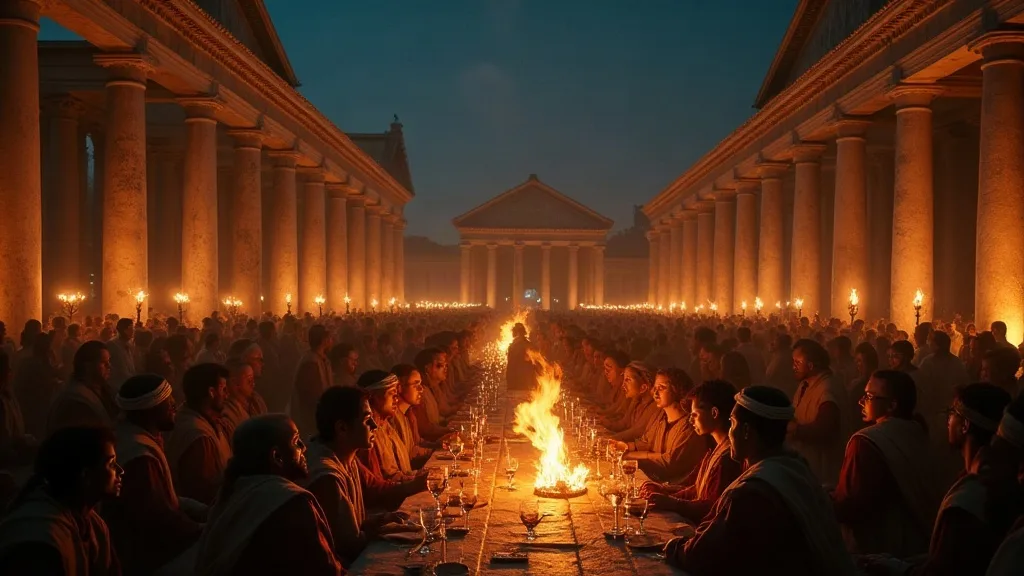
The torches went up before dawn. Across Rome, from the Capitoline Hill down to the Tiber docks, you could smell woodsmoke and roasting meat at an hour when the city was usually silent. Somewhere a flute played. Somewhere else a man who had spent eleven months in chains sat at a table while his master refilled his cup. It was the Saturnalia, and for a few days in December, the rules of the world were suspended.
This was not a small holiday. The Roman writer Pliny the Younger once retreated to his country villa specifically to escape the noise, plugging his ears against the shouts rising from his own household. The poet Catullus called December the best of months precisely because of it. And the moralist Seneca grumbled that even a philosopher could not entirely ignore the festival's pull. Saturnalia: Rome's Festival of Reversal and Renewal was the most beloved celebration in the Roman calendar, running from December 17th and eventually stretching across seven days by the imperial period. Understanding it means understanding something deep about how Rome thought about power, time, and the possibility of a better world.
Saturn, the God at the Heart of the Festival
Saturn is one of Rome's most ancient deities, and his origins are genuinely disputed among scholars. The Roman writer Varro, writing in the first century BC, connected Saturn to the Latin verb serere, "to sow," making him a god of seed-time and agricultural foundation. The later mythographer Macrobius, whose Saturnalia dialogues written around 400 AD remain the fullest ancient source on the festival, saw Saturn as a cosmic figure tied to time itself, echoing the Greek Kronos, father of Zeus.
The Greek-Roman equation of Saturn with Kronos is old and complicated. Both were displaced father-kings: Kronos swallowed his children to prevent a prophecy; Saturn was expelled from heaven by his own son Jupiter. Both ruled a lost golden age before the current order of things. But Roman Saturn had a distinct local character. According to Roman tradition recorded by Virgil in the Aeneid and Dionysius of Halicarnassus in his Roman Antiquities, Saturn arrived in Latium as a refugee king, welcomed by the god-king Janus. He taught the rough indigenous peoples to cultivate the land, build towns, and live under law. That reign - peaceful, fertile, without want - became the Roman memory of the golden age.
Saturn's temple at the western end of the Roman Forum was one of the oldest sanctuaries in the city. It also served as the state treasury (aerarium Saturni), a detail that speaks to how deeply this deity was woven into Roman civic life. The cult statue inside was unusual: its legs were bound in wool bandages throughout the year. Only during Saturnalia were those bandages removed, a ritual gesture that physically freed the god for the duration of his own festival.
The Structure of the Festival: Seven Days of Sanctioned Chaos
Saturnalia began officially on December 17th, the date of Saturn's temple dedication recorded in the Roman calendar (fasti). By the time of Augustus, it had grown to three days; under Caligula it was officially extended to five; by the late empire it commonly ran seven days, ending around December 23rd.
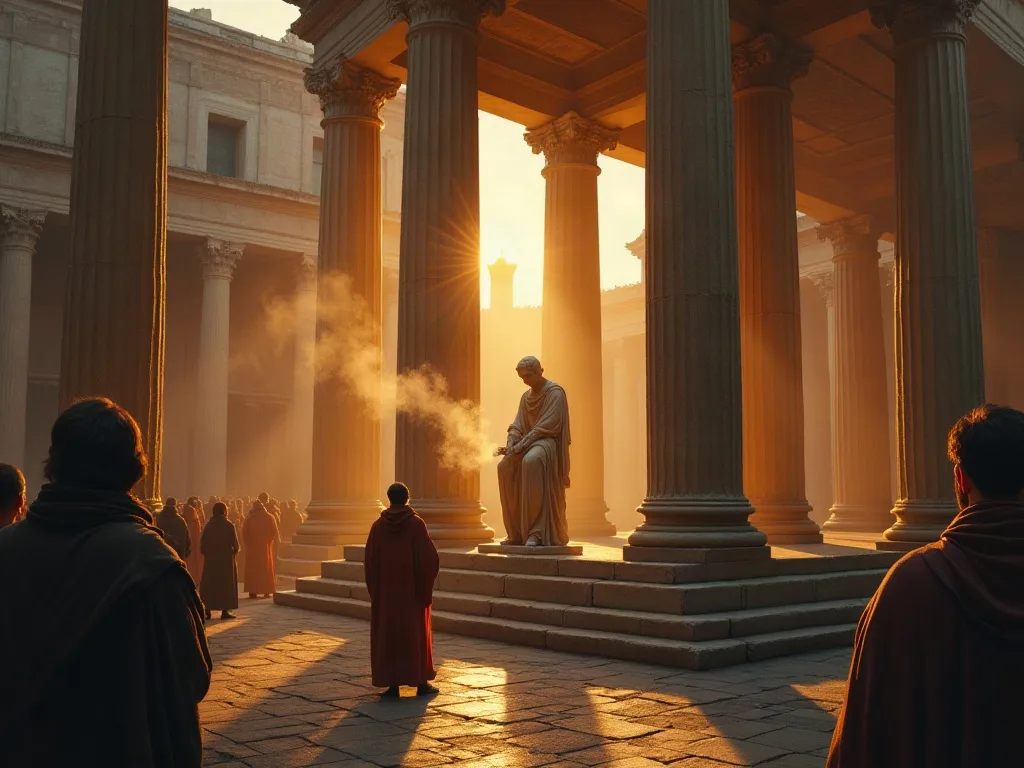
The opening day featured a public sacrifice at Saturn's temple, followed by a public banquet (convivium publicum) in the Forum. Any Roman citizen could attend. After the sacrifice, the god's statue was unbound, and the cry that rang through the streets was simple and joyful: "Io, Saturnalia!" The exclamation was a shout of release, the ancient equivalent of a starting gun.
What followed operated according to a set of understood inversions:
- Schools closed. Children were free.
- The law courts shut. No criminal could be prosecuted during the festival.
- War declarations were forbidden. Even Rome's generals paused.
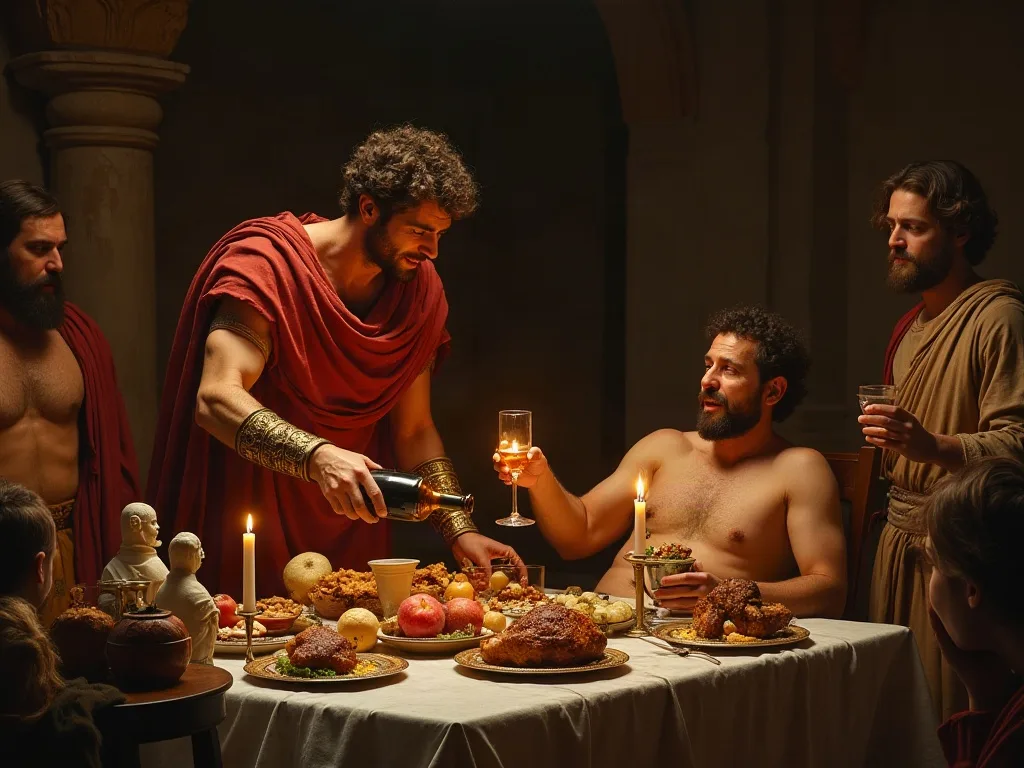
- Slaves ate before their masters at the formal dinner, or were waited upon by them. The satirist Lucian describes slaves speaking freely, eating the same food, and even giving orders to their owners.
- Gambling, normally illegal in public, was openly permitted across the city.
- Gifts were exchanged (strenae): wax candles (cerei), small clay figurines (sigillaria), nuts, and honeyed sweets.
The philosopher Seneca, writing from his house during the festival around 60 AD, described the sound of the city: dice cups rattling, crowds singing in the streets, the smell of perfume from every doorway. He tried to maintain his philosophical discipline but admitted the atmosphere was almost impossible to resist.
Each household also elected a rex Saturnalicius, a "king of Saturnalia," chosen by lot, often a slave or the lowest-ranking person present. This mock king had the authority to give absurd orders for the duration of the feast: make that man sing, make this one dance, pour wine for everyone. It was comedy with a serious undertow. The king wore a pointed felt cap called the pilleus, the same cap worn by freed slaves upon manumission. Even the costume was a statement about what the world could look like.
The Golden Age as Political Idea
Why would Rome, one of history's most rigidly stratified societies, build an annual festival around pretending hierarchy did not exist? The answer lies in the Roman concept of the aurea aetas, the golden age, which Hesiod had described in Greek poetry around 700 BC as an era when humans lived without toil, fear, or injustice, and which Ovid retold vividly in his Metamorphoses around 8 AD. In Rome, this was not merely a poet's fantasy. It was tied to a specific god, a specific time, and a specific place.
Saturn's reign in Latium was the golden age. His festival was therefore a yearly re-enactment of that time: by suspending the social rules of the present, Rome ritually collapsed the distance between the fallen now and the perfect then. Slaves and masters sharing a meal was not an act of mercy. It was a cosmological statement. For seven days, time ran backward toward Saturn's reign, and the social order of Jupiter's age was temporarily set aside.
This made Saturnalia politically useful, not merely festive. A society that allows its most oppressed members one week of symbolic equality per year is not necessarily more just, but it is more stable. Modern scholars, including the sociologist Henri Hubert and the anthropologist Victor Turner (who developed the concept of liminality, the threshold state between social structures), have analysed festivals like Saturnalia as "safety valves" that release social pressure without permanently rearranging the hierarchy. Rome's ruling class understood this intuitively, even if they never articulated it in those terms.
The poet Horace, writing under Augustus, captured the ambivalence well. He enjoyed the festival's looseness but was never entirely comfortable with it. His Epistles describe the Saturnalia as a time when a man could not be quite certain of his own dignity, and that uncertainty was, perhaps, the point.
Explore how Greek festivals like the Kronia paralleled Rome's Saturnalia
Food, Gifts, and the Economy of the Festival
Roman sources are specific about what people ate and gave during Saturnalia, and the detail matters because it tells us who the festival was actually for.
The gifts exchanged were deliberately modest. Martial, the poet who wrote twelve books of Epigrammata between 86 and 103 AD, devoted dozens of short poems to Saturnalia gifts: wax candles ("so that the darkness never catches you"), small clay dolls (sigillaria), little flasks of olive oil, ivory toothpicks, a sponge, a napkin, a writing tablet. The wealthy gave silver cups or fine cloth. But the cultural pressure ran toward simplicity. Giving something too expensive was considered bad form, a violation of the festival's spirit of rough equality.
Food at the slaves' table was the same as at the masters'. This parity was precisely the point. Macrobius records that in older practice, slaves ate first while masters waited standing, an inversion so complete it must have felt surreal to everyone in the room. By the imperial period the custom had softened: more often master and slave ate together, or the master simply served. But the symbolism remained intact.
The cerei, small wax candles given as gifts, carried their own meaning. Light in the darkest days of the year: a candle is a small, practical piece of hope. The winter solstice fell inside the Saturnalia window, and the gift of light at the year's darkest point was not accidental. Several ancient sources link Saturnalia's timing directly to the solstice, treating the festival as a ritual response to the sun's apparent retreat.
How Saturnalia Shaped the Christian Calendar
One of the most debated questions in religious history is how much Saturnalia influenced the placement and customs of Christmas. The short answer: more than most people realise, less than some enthusiasts claim.
The historical record is clear on several points. December 25th was not fixed as the date of Christ's birth until the fourth century AD, well into the period when Saturnalia was still being actively celebrated. The Roman festival of Sol Invictus (the "Unconquered Sun"), established by the Emperor Aurelian in 274 AD, also fell on December 25th. Early Christian writers were themselves aware of the overlap. The theologian John Chrysostom, writing in 386 AD, explicitly argued that celebrating Christ's birth in late December was strategically wise because pagans were already celebrating at that time.
The gift-giving, the candles, the feasting, the suspension of normal work, the emphasis on social generosity: these Saturnalia customs did not simply vanish when Rome became Christian. They were absorbed, reframed, and continued under a new theological roof. The historian of religion Bruce Forbes, in his 2003 work Christmas: A Candid History, documents this transition carefully and without sensationalism.
This does not mean Christmas "is" Saturnalia, a claim that oversimplifies a complex historical process involving dozens of cultural streams. What it means is that when Rome's population converted, it did not abandon its emotional calendar. The need for a midwinter festival of light, generosity, and social warmth outlasted the theology that had housed it.

Saturnalia in Roman Literature: The Writers Who Lived It
The richest accounts of Saturnalia come from writers who actually celebrated it, and their testimony gives the festival a human texture that no archaeological record can replicate.
Macrobius is the most systematic. His Saturnalia, written around 400 AD as a series of dinner-party dialogues set during the festival itself, is an encyclopaedic work covering the theology of Saturn, the history of the Roman calendar, the literary genius of Virgil, and the proper way to host a feast. It is the ancient world's most detailed portrait of how educated Romans understood their own traditions.
Martial is the most vivid. His Saturnalia epigrams are short, funny, and precise. He catalogues gifts, mocks cheap hosts, celebrates good wine, and describes the city's noise with a journalist's eye. Reading Martial on Saturnalia is the closest thing we have to a diary entry from ancient Rome.
Seneca is the most ambivalent. His Letters (especially Epistulae Morales 18) describe a philosopher trying to maintain his principles while the world around him gives way to appetite. He does not condemn the festival outright; he respects its historical weight. But he refuses to be swept away, and his refusal is itself a portrait of the tension the festival generated in thoughtful Romans.
Lucian of Samosata, the Greek satirist writing in the second century AD, composed a pair of playful texts called Kronos and Saturnalia Letters, in which the god Saturn himself speaks, defending the festival against critics who want it cancelled. Saturn argues, with comic earnestness, that his seven days of equality are the only honest week in the whole Roman year.
These four writers together give Saturnalia a literary life that spans five centuries. The festival was not just a street party. It was a sustained cultural argument about what Rome owed its poorest members, what the past meant to the present, and whether a just world was even imaginable.
Read about Jupiter, the god whose rule Saturnalia temporarily suspended
The King of Saturnalia and the Shadow of Sacrifice
One detail about the rex Saturnalicius has disturbed scholars for generations. A passage in the early Christian writer Lactantius, writing around 310 AD, describes a Saturnalia custom at the Roman military camp of Durostorum (modern Dobruja in Romania) in which a soldier was elected king of Saturnalia, given thirty days of festive license, and then at the festival's end killed himself or was killed as a sacrifice. The passage is specific enough to quote: the soldier chosen was named Dasius, who refused the role because he was Christian and was martyred for it.
The anthropologist James George Frazer famously built much of The Golden Bough (first published 1890) around this passage, arguing that Saturnalia derived from an ancient custom of sacrificing a mock king as a substitute for the real one, following a prehistoric pattern of divine kingship and ritual death. His argument was influential for decades.
Modern classical scholars treat the Lactantius passage with caution. It describes a provincial military custom, not a Roman civic practice, and it may reflect local Thracian traditions more than Roman religion. The evidence for a widespread sacrificial component to Saturnalia is thin. Still, the figure of the mock king, the rex who rules for a week and then returns to his ordinary station (or, in the darkest reading, does not return at all), carries a genuine mythological resonance. Power that is borrowed always has a price. The golden age always ends. Saturn was expelled. The carnival always closes.
Frequently Asked Questions About Saturnalia
Frequently asked questions
When exactly was Saturnalia celebrated in ancient Rome?
Saturnalia began on December 17th, the date of Saturn's temple dedication recorded in the Roman fasti (official calendar). In the early Republic it lasted one day. By Augustus it had grown to three days. Under Caligula it was officially five. By the late imperial period it commonly ran seven days, ending around December 23rd, just before the winter solstice window closed.
Did Roman masters really serve their slaves during Saturnalia?
Yes, according to multiple primary sources. Macrobius in his Saturnalia dialogues (around 400 AD) records that in earlier practice masters waited on slaves at table; by the imperial period the custom often meant eating together or masters refilling cups. The satirist Lucian describes slaves speaking freely and giving orders. The inversion was real, though its depth varied by household and era.
Is Saturnalia the origin of Christmas?
The relationship is real but not a simple one-to-one origin. December 25th was fixed as Christ's birth date in the fourth century AD, when Saturnalia was still being celebrated. Christmas absorbed several Saturnalia customs: gift-giving, candles, feasting, and a mid-winter atmosphere of generosity. But Christmas also drew on the Roman Sol Invictus feast, on Jewish Hanukkah traditions, and on the theology of Advent. Historian Bruce Forbes traces this layered transmission carefully in Christmas: A Candid History (2003).
What gifts did Romans exchange during Saturnalia?
Saturnalia gifts (strenae) were deliberately modest. Wax candles (cerei) symbolising light in winter darkness were standard. Clay figurines (sigillaria) gave the festival's final days their name. Martial's Epigrammata lists nuts, honeyed sweets, olive oil, writing tablets, ivory toothpicks, napkins, and sponges. The wealthy gave silver cups or fine cloth, but cultural pressure ran toward simplicity. An extravagant gift was bad manners.
What is the connection between Saturn and the Greek god Kronos?
Roman writers from the second century BC onward identified Saturn with Kronos, the Greek Titan-king displaced by Zeus. Both ruled a golden age before the current divine order; both were overthrown by a son. But Roman Saturn had a distinct local tradition: he arrived in Latium as a refugee, civilised the indigenous people, and was specifically a god of agriculture and sowing (possibly from Latin serere, to sow). The Greek-Roman equation simplified two figures who were genuinely different in origin.
What is the significance of freeing Saturn's statue during Saturnalia?
Saturn's cult statue in his Forum temple had its legs bound in woollen bandages for the entire year. Unbinding the statue on December 17th was a ritual act of liberation that mirrored the festival's social theme: the god himself was freed from restraint at the same moment his worshippers suspended ordinary rules. The gesture equated cosmic and social order, suggesting that hierarchy was something imposed on the world rather than natural to it.
What Saturnalia Still Tells Us About Time and Justice
The festival ended. The candles burned out. The mock king took off his felt cap. Slaves went back to their stations. The courts reopened. And yet something did not entirely vanish.
Saturnalia survived as a living tradition for at least seven centuries of Roman history, from the early Republic through the Christian empire. It outlasted the Republic, outlasted Augustus, outlasted the persecutions of Christians, outlasted the sack of Rome. Macrobius was still writing detailed theological defences of it around 400 AD, by which point Christianity had been the state religion for decades. That persistence is worth thinking about.
The festival encoded two ideas that proved extraordinarily durable. The first: that the present social order is not the only possible order, and that remembering this once a year matters. The second: that the darkest moment of the year (the winter solstice) is precisely the right moment to practice generosity, because generosity is a form of light.
Saturnalia's legacy is not simply that it shaped Christmas customs, though it did. Its deeper legacy is a mode of thinking about time: the idea that a society can, and perhaps must, step outside its own rules in order to remember what those rules are supposed to serve. Turner's concept of liminality, Bakhtin's carnival theory, the modern secular New Year: all of them are distant descendants of Rome's December reversal.
Saturn and the golden age of Latium connect to Roman ideas about cosmic cycles
The Romans knew, every year when they lit those candles and freed that statue, that the golden age was gone. Saturn had been expelled. The world ran on Jupiter's harder laws now. But for seven days in December, they pretended otherwise, and in that pretending they kept something alive that pure nostalgia never could: the belief that a better arrangement of the world is not only imaginable but worth remembering, worth rehearsing, worth celebrating with food and fire and the sound of dice rattling in a cup.
Free 25-page sample
Want the whole story?
Take the first 25 pages free. If it pulls you in, the full edition is yours as an instant PDF download, with a paperback on Amazon for selected titles.
Roman
The Roman Mythology Book: Jupiter, Mars, Venus, the Aeneid, and the Sacred Stories That Built an Empire
Jupiter, Mars, Venus, the Aeneid, and the Sacred Stories That Built an Empire
The complete guide to Roman mythology from Virgil's Aeneid to Ovid's Fasti. Every god, every founding myth, every Vestal rite.
More from Roman
All articles
Roman
Romulus and Remus: The Myth of Rome's Foundation
The twin sons of Mars raised by a she-wolf; a fratricide, a city, and an empire. How Rome's founding myth shaped the identity of Western civilization's greatest power.
Roman
Aeneas and the Founding of Rome: The Aeneid's Sacred Narrative
Virgil's Aeneas carries Troy's fate to Italy, writing Rome's origin in blood and duty. Discover how the Aeneid transformed a hero's journey into a nation's sacred story.
Roman
Venus: Goddess of Love and Ancestor of the Roman People
Venus was Rome's goddess of love, fertility, and military victory. But she was also the divine ancestor of the Roman people through her son Aeneas. Discover how this single goddess embodied Rome's most powerful myths about its own origins.
Roman
Mars: Roman God of War, Agriculture, and the Father of Rome
Mars was no mere god of bloodlust. The Roman war god fathered Romulus, blessed the harvest, and embodied the discipline that built an empire. Discover how Rome's greatest god shaped both sword and soil.