

Romulus and Remus: The Myth of Rome's Foundation
The twin sons of Mars raised by a she-wolf; a fratricide, a city, and an empire. How Rome's founding myth shaped the identity of Western civilization's greatest power.
Contents
A wolf prowls through the Tiber valley. Her teats are swollen with milk meant for a lost litter. She finds two infants abandoned in a wicker basket, left at the river's edge as a death sentence. This moment, real or not, became the most famous rescue in Western history. The twin brothers Romulus and Remus did not merely survive; they became Rome itself, their names inscribed into the very calendar that would order the ancient world. Their story is not history in the modern sense. It is myth, told and retold by Roman writers who shaped it to explain who Rome was and why it had the right to rule.
The legend appears nowhere in writing before the 3rd century BC. When Roman authors finally set it down in marble and ink, they already knew Rome's destiny: it had conquered the Mediterranean. So they reached backward into half-memory and folktale to craft an origin story worthy of such power. What they created was not truth, but something deeper: a compressed account of how Rome saw itself, what values it claimed, and what bloodlines and gods had marked it for greatness.
The Birth of the Twins: Divine Ancestry and Royal Betrayal
The story begins not at the river, but in the royal house of Alba Longa, a settlement on the Alban Hills southeast of Rome. This kingdom, according to Roman historians like Livy and Plutarch, was the seat of power before Rome existed. It was ruled by descendants of Aeneas, the Trojan prince whose escape from burning Troy had become the subject of Virgil's Aeneid.
Aeneas had fled Troy with his son Ascanius (also called Iulus) and eventually reached Latium, in central Italy. There he founded a dynasty. For generations this house prospered. Then came a usurper: Amulius, a younger son who seized the throne from his older brother Numitor. To secure his power, Amulius committed a crime that would reverberate through the founding myth. He forced Numitor's daughter, Rhea Silvia (sometimes called Ilia), into priesthood as a Vestal Virgin. Vestal Virgins had taken vows of chastity. A priestess who bore a child would be buried alive.
But Mars, the god of war, had other plans. Accounts differ on what happened next. Some versions say Rhea Silvia went to a sacred grove to fetch water and there encountered the god. Others claim he appeared to her as a phantom or took human form. The result was certain: Rhea Silvia became pregnant with twins. When the pregnancy became visible, Amulius acted. He imprisoned Rhea Silvia and ordered the newborn infants drowned in the Tiber River. The servant charged with the killing, however, lacked the cruelty required. He placed the twins in a basket and left them at the river's edge, hoping water or animals might do what his conscience could not.
The She-Wolf and the Shepherd: Divine Protection and Humble Adoption
Fate intervened through the body of an animal. A she-wolf (lupa in Latin) came to the riverbank. Some versions say she was drawn by the infants' cries. Others claim she had recently lost her own pups. What matters is what happened next: the wolf did not attack. Instead, she nursed the boys at her teats, as if they were her own offspring. A woodpecker brought them food, pecking seeds into their tiny mouths. These two creatures, the wolf and the bird, became sacred to Rome and to Mars, their supposed father. The woodpecker was Mars' bird. The wolf became the emblem of Rome itself.
A shepherd named Faustulus, tending his flocks nearby, discovered the infants being suckled by the wolf. He and his wife Acca Larentia raised the boys as shepherds' sons. The twins grew up in the pastoral hills, unaware of their royal blood, taught the customs of labor and outdoor life. This detail mattered to Roman identity. Rome's founders were not mollycoddled princes. They were raised among shepherds, exposed to hardship, trained in the virtues of honest work and survival. When their time came, these humble origins would not diminish them; instead, they would sanctify their later deeds.
The Recognition and Revenge: Restoration of a Throne
As the twins grew, their unusual vigor became impossible to hide. Romulus and Remus were known throughout Alba Longa's countryside as remarkable men; strong, brave, and commanding respect from their peers. Eventually their true identity became known. Some accounts say they were recognized by their physical resemblance to the royal family. Others claim Faustulus, their foster father, had preserved tokens of their infancy and revealed the truth when the moment was right. Word reached them that Numitor, their grandfather, was still alive and still mourning the grandchildren he believed dead.
The twins acted with swift justice. They raised a force, marched on Alba Longa, and killed Amulius the usurper. Numitor was restored to his throne. The natural order, violated by treachery, was set right. But the twins had no wish to stay in Alba Longa's shadow. They resolved to found a city of their own, a settlement that would become greater than the city their grandfather ruled. This ambition, rooted in their mixed nature as both divine princes and humble shepherds, would define their myth.
They chose the site on the Tiber where they had been abandoned and found by the wolf. Here, on the banks of a river that could nourish a city, they would build walls. Here, where the gods had tested them and wolves had saved them, Rome would begin.
The Foundation: The Pomerium and the Final Fraternity
The founding of a city in ancient Rome required ritual. A sacred boundary line, called the pomerium, had to be drawn around the settlement. This line demarcated the city's sacred space from the profane world beyond. It was traced by a plow drawn by oxen, the boundary marked with salt and sacred meal. The pomerium was not merely symbolic; to cross it in arms was an act of war. The founding ritual was solemn, controlled, and required the will of the gods.

Romulus undertook the ritual. But Remus, whether from jealousy, disrespect, or a desire to test his brother's authority, jumped over the half-drawn boundary. Some versions say he leapt over the pomerium mockingly, others say he crossed it in a symbolic claim to equal authority over the emerging city. Romulus' response was immediate and brutal: he killed Remus.
Different sources give different details. In some accounts, Romulus struck the blow himself. In others, workers loyal to Romulus committed the act. Some versions claim Romulus said: "So perish whoever else shall leap over my walls." The message was clear: the city had one founder, one authority, one will. Fraternity had given way to sovereignty. The wolf's milk that had saved them had also divided them.
Remus died on what would become sacred ground. His burial place, the Sepulcrum Remi (Remus' Tomb), was remembered and shown to visitors throughout Roman history. Some chronicles claim that Romulus, in grief or piety, honored his brother's memory, permitting his burial and sacrifices at his tomb. Others suggest Romulus felt guilt for the act and sought expiation through ritual. What is certain is that Rome's foundation was marked not by joy but by bloodshed, and the bloodshed was between brothers.
The City Rises: Asylum and Early Community

With Remus dead and his authority unchallenged, Romulus began the work of building. A city needed citizens. Rome in its earliest days was small, vulnerable, and sparsely populated. Romulus solved this problem through a measure called the asylum (from Latin, meaning "refuge without violation of sanctity"). He opened the city to refugees, exiles, and fugitives from neighboring communities. Criminals fleeing justice, landless men seeking opportunity, and displaced families found shelter within Rome's walls. No questions were asked; asylum was inviolable.
This pragmatic opening to outsiders became a cornerstone of Rome's identity and strength. Where other cities were closed circles of aristocratic families, Rome was a crucible where diverse peoples could become citizens. This myth, whether it reflects historical truth or not, shaped how Romans understood their own nature: they were not a people bound by blood alone, but a people formed by law, shared purpose, and mutual protection.
From this asylum-gathered population, Romulus established the city's institutions. He created the Senate, an advisory body of the most prominent men (the word senator comes from senex, old or elder). He established priests and priestesses to tend the gods. He created a popular assembly where free male citizens could gather to decide matters of common concern. These institutions, born in myth, reflected the actual political structures of the Roman Republic that would develop centuries later. The myth was not prophecy; it was an explanation, written backward, of how Rome had come to govern itself.
The Date and Calendar: Putting Foundation into History
The Romans needed a date for their city's birth. Without modern chronology, they reached for tradition and divination. Various calculations placed the founding between 753 BC and 751 BC. The year 753 BC eventually became standard, fixed as the traditional founding date. This was not history in the modern sense; it was Rome taking control of its own narrative, assigning meaning and magnitude to a moment.
The founding date became the basis of the Roman calendar. Years were numbered not from an absolute epoch (like our AD/BC system, which came much later) but ab urbe condita, "from the founding of the city." The year we call 1 BC was for Romans the year 753 AUC. This calendrical decision was profound: Rome was not merely a city among cities; it was the reference point against which all time was measured.
The Rape of the Sabines: Populating Rome Through Violence
Romulus had filled Rome with exiles and refugees, but the city lacked women. A community could not sustain itself with only men. Romulus attempted negotiation with neighboring peoples, requesting marriage alliances and women for his men. These requests were refused. The neighboring Latins and Sabines were wary of this upstart settlement and saw no reason to intermarry with its motley population.
Romulus responded with cunning and violence. He announced a great festival, the Consualia, honoring Consus, an ancient god of grain storage. He invited the Sabines and neighboring peoples to attend, promising games, spectacles, and entertainment. They came in great numbers, bringing their families. At a prearranged signal, Roman men drew swords and seized the Sabine women, carrying them off by force. This event, remembered as the "Rape of the Sabines" (from Latin rapere, to seize or carry away), was an act of war and abduction, though later Roman writers sometimes romanticized it as a passionate beginning to marriages that would later be consented to.
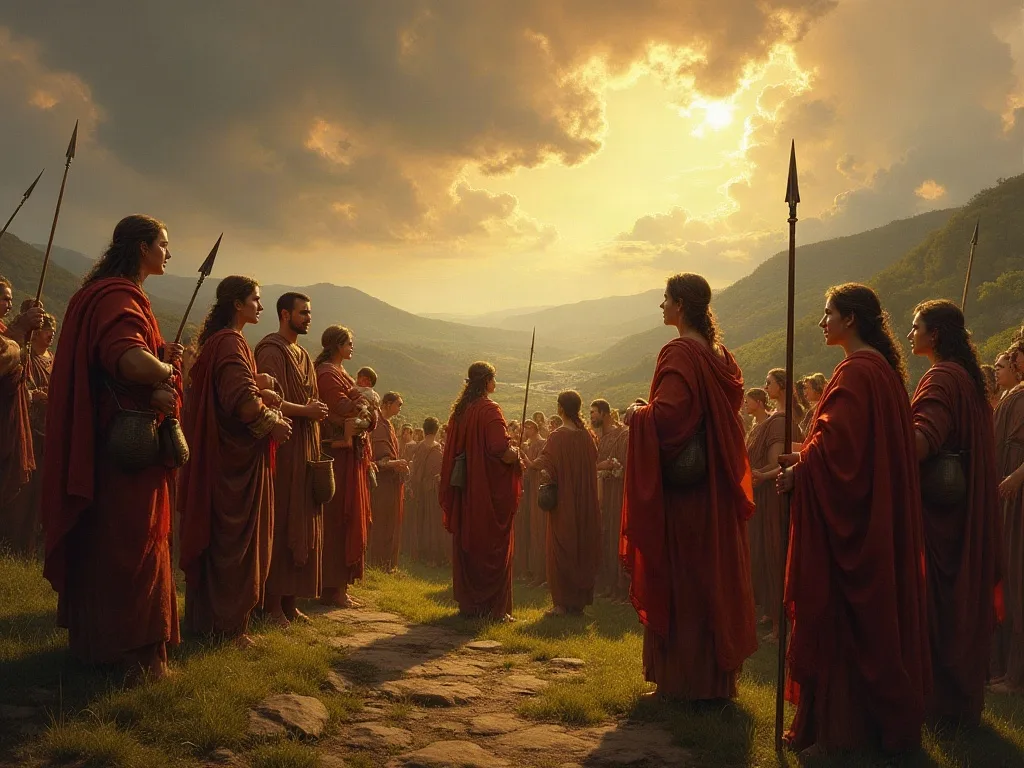
The Sabines, outraged, mobilized for war. They marched on Rome under their king Tatius. The city faced its first military threat. But the story took an unexpected turn. Many of the Sabine women, though taken by force, had begun to live with their Roman captors and had borne children. When the armies clashed within Rome's walls, the women rushed between the fighting men, holding up infants and small children, begging their fathers and brothers to stop killing their husbands and the fathers of their babies. The sight moved both armies. Bloodshed ceased. A peace was negotiated not through victory, but through the bonds of kinship and survival.
The peace was remarkable: Tatius and Romulus agreed to rule jointly, as co-kings. When Tatius died, Romulus continued alone. The Sabines, far from being destroyed or enslaved, were integrated into the Roman state as citizens with equal rights. This myth, whether rooted in historical events or not, explained why early Rome's population included both Latins and Sabines, why the Senate was eventually composed of Sabine as well as Latin families, and why intermarriage between groups became normal. The city was not pure; it was mixed, strong precisely because it had drawn people from many sources.
Disputed Endings: The Rapture of Romulus
The myths of Romulus' death differ sharply. The most famous version describes a miraculous ending. Romulus was addressing the people on the Campus Martius (Field of Mars) when a terrible storm arose. Lightning flashed, thunder rolled, and darkness covered the earth. When the sky cleared, Romulus was gone. No body was found. The people were bewildered until a senator named Proculus Julius came forward with a vision: Romulus, now divine, had appeared to him and declared that he had been taken to heaven by Mars, his father, and had become a god. His name, henceforth, was Quirinus, a god of the Roman state itself. Rome's founder had become immortal, a god watching over the city he had created.
Other versions were less miraculous. Some accounts say he was torn to pieces by senators angry at his tyranny. Others claim he simply died of old age. The divinization was perhaps a later invention, a way of explaining why a great hero could not be found and given proper funeral rites. But for Romans, the story of Romulus' ascent into divinity mattered more than the mundane details of his death. It elevated the founder to the realm of the sacred, binding the city's destiny to divine will and placing its first king beyond the reach of mortality or doubt.
The Myth Under Scrutiny: What Ancient Historians Actually Believed
The Roman historians who recorded the Romulus and Remus story were not fools; they were often skeptical of the tales they received. Livy, the great chronicler of Rome's history (writing in the 1st century BC), presents the founding myth but adds a note of caution. He acknowledges that the gods' hand in the events cannot be verified by reason, yet he records the traditions faithfully. It is as if he is saying: this is what Romans believe, what we have been taught, what binds us as a people; whether the wolves and the gods are literally true is beside the point.
Plutarch, a Greek historian writing in the 2nd century AD, offers multiple versions of the same events, noting contradictions without resolving them. He seems to treat the myth as a repository of meanings rather than a record of events. What matters is not whether Remus actually jumped over a pomerium, but what that detail tells us about Roman ideas of authority and law.
Modern scholars have long debated whether any historical kernel underlies the legend. Some have suggested that "Romulus" may derive from Roma, the name of the city, rather than Rome deriving its name from the king. Others note that the founding date of 753 BC has no clear historical support; Rome's actual earliest settlement seems to have been earlier and more gradual, without a single founding moment. The story of the she-wolf may have been borrowed or invented late, grafted onto an older, simpler tale. Yet none of this diminishes the myth's power or its historical importance. The story shaped how Romans saw themselves, and that self-perception shaped their actions for over a thousand years.
The Wolf and the Foundation: Symbol and Legacy
The image of the she-wolf nursing the twins became Rome's heraldic symbol. The statue of the Lupa Romana (the Roman She-Wolf), carved in bronze and displayed on the Capitol, became an object of civic reverence. When new Roman territories were conquered, the story of Romulus and Remus was taught to subject peoples as an explanation of Rome's right to rule. The city had been born not in conquest alone, but in rescue, in the gods' favor, and in the integration of diverse peoples into a common law.
Throughout the Middle Ages and into the Renaissance, the myth remained a touchstone of Roman identity. When Renaissance humanists sought to recover Rome's glory, they did not begin with battles or laws; they began with Romulus and Remus, the wolf, the shepherd, and the founding narrative. Artists painted the she-wolf across churches and palaces. Poets rewrote the twins' story in vernacular languages. Even in the modern era, the symbol of the she-wolf nursing two children is instantly recognized as Rome.
The myth also became a template for other foundation stories. Cities across Europe and the Mediterranean claimed their own mythic founders, their own she-wolves, their own moments of divine intervention. The story of Romulus and Remus, in other words, was not merely Roman; it became a model for how cities narrated themselves into existence.
Echoes Across Cultures: Foundation Myths in Comparative Perspective
The story of Romulus and Remus is not unique in its basic structure. The theme of twin brothers, one destined to rule and one to die, appears in myths across cultures. In Hindu tradition, Rama and his brothers faced trials and fraternal conflict; in Mesoamerican lore, the Hero Twins of the Popol Vuh were divided between life and death. The abandoned child raised by an animal appears in stories from Moses floating in a basket among bulrushes to Oedipus cast out as an infant. The pattern is universal: a hero marked for greatness must pass through trial, abandonment, and supernatural intervention before achieving his destiny.
What is distinctly Roman is how the myth handles authority and law. Unlike many foundation stories that emphasize the hero's conquest or the community's happiness, the Romulus story centers on a legal and political question: who has the right to rule? The death of Remus is not accidental; it is punishment for violating the sacred boundary. The integration of the Sabines is not conquest but negotiation, law, and intermarriage. Even the rapture of Romulus involves his transformation into a god of the state itself, not a warrior-king in an afterlife, but a civic presence. This emphasis on law, boundary, and institutional authority is profoundly Roman.
The myth also reflects Rome's experience of power. Rome did not think of itself as a natural or ethnic unity; it was self-consciously multiethnic, absorbing peoples from across the Mediterranean. The story of Romulus opening the city to asylum-seekers, then forging a peace with the Sabines, projected this identity backward onto the founding moment. Rome became Rome not because a pure people claimed a territory, but because diverse peoples agreed to live under a common law and shared institutions. That idea, whether reflected in historical events or not, became central to how Rome justified its expansion. We rule, Rome claimed, because we incorporate, not because we expel.
Frequently Asked Questions About Romulus and Remus
Frequently asked questions
Did Romulus and Remus actually exist as historical figures?
Modern scholars debate this. No contemporary evidence places Romulus in the 8th century BC. The story was composed centuries after Rome's founding, drawing on folklore, religious doctrine, and earlier traditions. Many elements (the she-wolf rescue, the divinization) are likely mythic elaborations rather than historical memory. What is clear is that the Romans believed the story and shaped their institutions and self-identity around it, which made it historically influential even if the events themselves did not occur as narrated.
Why is the she-wolf so important to the Roman symbol of Rome?
The she-wolf represents Rome's core values: care for the vulnerable (the abandoned infants), natural strength (the predator becoming protector), and the mixture of human civilization with raw nature. As a foster mother replacing the human one, she also represents how Rome absorbed diverse peoples into a common identity. The statue of the Lupa Romana on the Capitol became an emblem of the city itself, so powerful that the image has survived into modern times on Rome's coat of arms.
What does the death of Remus tell us about Roman law and authority?
The killing of Remus for violating the sacred pomerium established a principle: the city's boundaries and laws are sacred and must be obeyed absolutely. Remus' death was not presented as a tragedy but as a necessary enforcement of legal order. This reflects Rome's later emphasis on the supremacy of law over personal relationships, even familial ones. The state's institutions supersede individual will, even the will of a founder's brother.
How did the rape of the Sabines relate to actual Roman history?
The event is likely mythic rather than historical, but it may contain echoes of real intermarriage between early Latin and Sabine communities, which archaeology suggests did occur. The myth reimagines this integration as a dramatic story involving abduction, war, and eventual peace through kinship bonds. This narrative served to explain why early Rome included both Latins and Sabines in positions of power and to justify Rome's later practice of incorporating conquered peoples as citizens rather than slaves alone.
What is the connection between Romulus and the god Quirinus?
After his mysterious disappearance, Romulus was deified and given the name Quirinus, becoming a god of the Roman state. Quirinus was an older Italic deity of war and the people. By associating Romulus with Quirinus, Romans linked their founder not just to Mars (his divine father) but to the civic and collective identity of Rome itself. Romulus ceased to be merely a heroic ancestor; he became an eternal divine presence watching over the city's fate.
The Myth's Afterlife: From Livy to Modern Rome
The Romulus and Remus story did not end when Rome fell to barbarian invasions in the 5th century AD. During the Middle Ages, Christian Rome struggled with its pagan inheritance. The tale of a pagan king, a divine father, and a she-wolf nursing infants seemed incompatible with Christian doctrine. Yet the story was too deeply rooted in Roman identity to be abandoned. Medieval writers sometimes rationalized the she-wolf as a human woman or reinterpreted the divine conception through Christian lenses. Others simply kept the story alive as a secular history, stripped of its divine elements but treasured as Rome's past.
In the Renaissance, when classical learning was recovered and celebrated, Romulus and Remus became heroes again. Artists such as Luca Signorelli and Pintoricchio painted frescoes of the founding. Writers from Dante to Petrarch wove the myth into their works. The ideal of Rome, rebuilt through the lens of classical texts and newly excavated antiquities, made the twins symbols of a lost golden age that could potentially be recovered.
The modern city of Rome still lives in the shadow of this myth. The image of the she-wolf appears on the city's official seal. The Capitoline Museums preserve the ancient statue of the Lupa Romana. Visitors to Rome are told the story of Romulus and Remus, often without distinction between myth and history. The city's identity, even now, is inseparable from the narrative of its founding. Rome became Rome not through some inevitable historical process, but through a story it told itself, again and again, until the story became more real than any recoverable fact.
Free 25-page sample
Want the whole story?
Take the first 25 pages free. If it pulls you in, the full edition is yours as an instant PDF download, with a paperback on Amazon for selected titles.
Roman
The Roman Mythology Book: Jupiter, Mars, Venus, the Aeneid, and the Sacred Stories That Built an Empire
Jupiter, Mars, Venus, the Aeneid, and the Sacred Stories That Built an Empire
The complete guide to Roman mythology from Virgil's Aeneid to Ovid's Fasti. Every god, every founding myth, every Vestal rite.
More from Roman
All articles
Roman
Aeneas and the Founding of Rome: The Aeneid's Sacred Narrative
Virgil's Aeneas carries Troy's fate to Italy, writing Rome's origin in blood and duty. Discover how the Aeneid transformed a hero's journey into a nation's sacred story.

Roman
Venus: Goddess of Love and Ancestor of the Roman People
Venus was Rome's goddess of love, fertility, and military victory. But she was also the divine ancestor of the Roman people through her son Aeneas. Discover how this single goddess embodied Rome's most powerful myths about its own origins.

Roman
Mars: Roman God of War, Agriculture, and the Father of Rome
Mars was no mere god of bloodlust. The Roman war god fathered Romulus, blessed the harvest, and embodied the discipline that built an empire. Discover how Rome's greatest god shaped both sword and soil.

Roman
Juno: Queen of the Gods and Protector of Rome
Juno ruled the Roman pantheon as Jupiter's equal and Rome's divine guardian. Discover how this fierce goddess shaped the fate of an empire, from her role in the city's founding to her uncompromising protection of women and state.