
Venus: Goddess of Love and Ancestor of the Roman People
Venus was Rome's goddess of love, fertility, and military victory. But she was also the divine ancestor of the Roman people through her son Aeneas. Discover how this single goddess embodied Rome's most powerful myths about its own origins.
Contents
In the beginning, Rome did not spring from conquered land or the will of generals alone. It came from the womb of a goddess and the honor of exile. This is what the Romans believed: that their city was born from Venus, the mother of Aeneas, who fled the burning ruins of Troy to find a new homeland in Italy. No mortal founded Rome. The goddess herself had a hand in its destiny.
Venus was far more than the Greek Aphrodite given a Latin name. She was armor and eros, dynasty and desire, all woven into one divine figure. When a Roman general moved into battle, he moved with Venus at his back. When a Roman husband clasped his wife's hand, Venus watched over that union. The goddess shaped Rome from its mythic birth through every citizen's private life, and no statue or temple in the city stood quite as central to Rome's understanding of itself.
Her story begins long before Rome existed, in the turbulent moment when Troy fell to the Greek armies and a single hero had to choose between death and flight.
The Birth of Venus: From Primal Waters to Olympian Grace
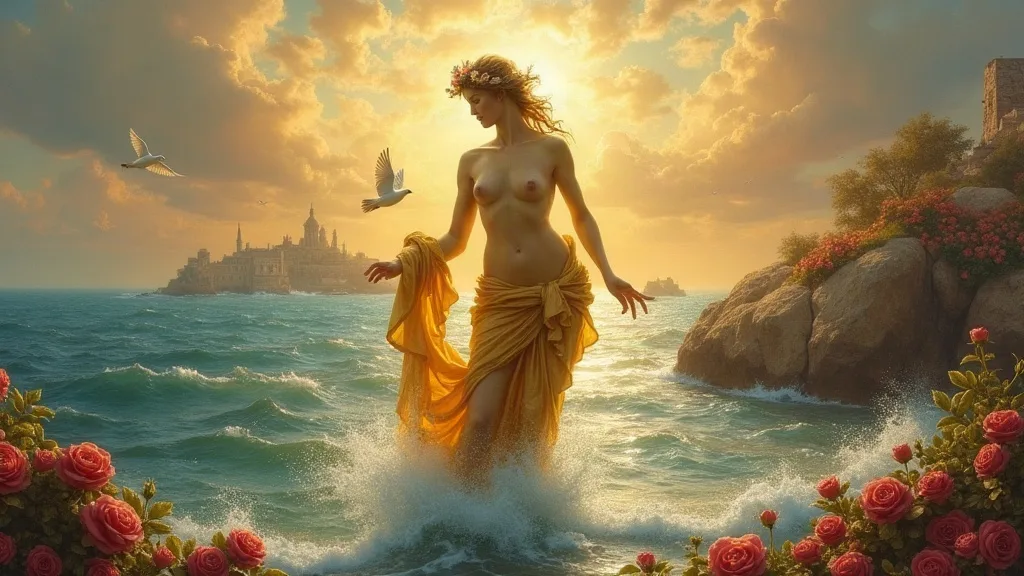
The Romans inherited the genealogy of Venus from Greek tradition but transformed its meaning. In Greek mythology, Aphrodite (the goddess's Greek name) was born from the foam of the sea when the Titan Kronos cut down Uranus, the sky god. But the Romans told her origins with a different weight.
Ovid, writing in his Metamorphoses around the year 8 AD, recounts that Venus emerged from the ocean as fully formed beauty itself, riding a shell, pulled by Zephyr the west wind. Where she stepped, flowers bloomed. The Graces dressed her. The Fates crowned her. She was not mere goddess of beauty; she was beauty's first cause, the standard against which all earthly loveliness was measured.
Yet the Romans loved a second story of her birth: that Venus was the daughter of Jupiter (the Roman king of gods) and Dione, an Oceanid (a water nymph). This lineage gave her a place within Rome's divine household not as an outsider goddess but as family. She belonged to the Olympian hierarchy, subject to no one but Jupiter himself.
Both versions coexist in Roman literature without contradiction. The Romans were comfortable with myth's fluidity. What mattered was that Venus held a unique rank among divine women: she was desire without shame, power without apology, and the mother of Rome's greatest hero.

Venus and Aeneas: The Goddess Becomes an Ancestor
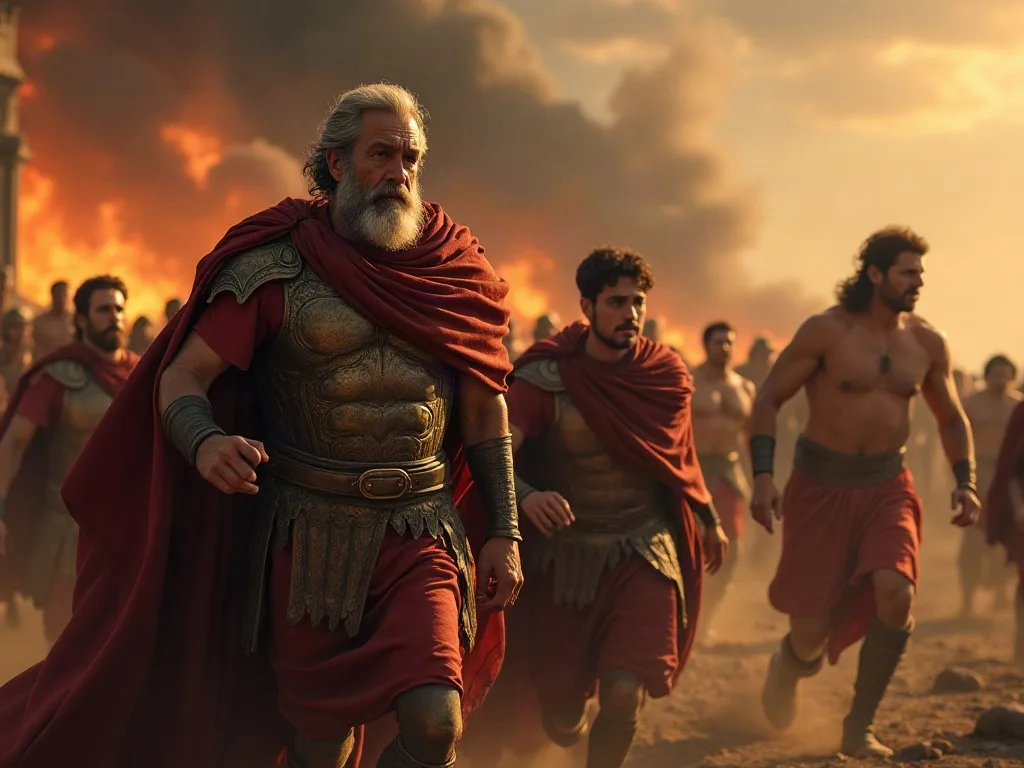
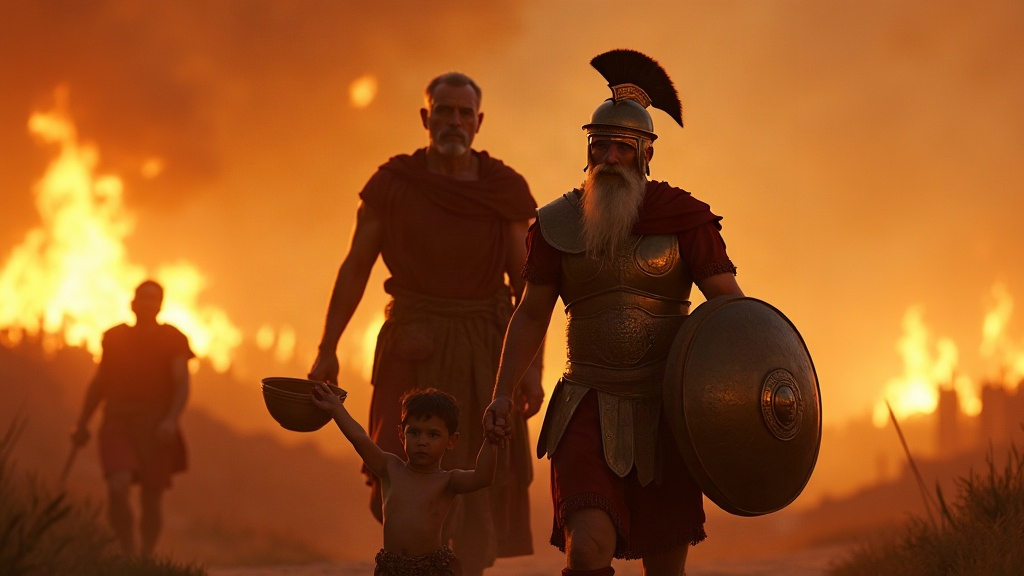
No story shaped Rome's self-image more than the tale of Aeneas, the Trojan prince and son of Venus. When the Greeks destroyed Troy, Aeneas did what honor demanded: he refused to abandon his city. But the goddess herself intervened, wrapping him in divine mist so he could slip past the flames with his elderly father on his back and his young son by his hand. She appeared to him in human form, warning him that his true destiny lay not in Troy but across the sea, in a land the gods had chosen for his descendants.
This was Venus acting as ancestor, not lover. She guided Aeneas through years of wandering, sheltering him, pushing him toward his fate. When he reached the coast of Libya and fell in love with Dido, the queen of Carthage, Venus did not oppose him; instead, she orchestrated the meeting, hoping he would find peace. But Jupiter himself sent a divine messenger to remind Aeneas of his mission. He was not meant for personal happiness. He was meant to found a dynasty that would create Rome.
Aeneas sailed onward. He reached Italy, married Lavinia (a local king's daughter), and established his line. His grandson Ascanius (also called Iulus) built the city of Alba Longa, which would eventually give birth to Rome itself through his descendants Romulus and Remus. Everything led back to Venus. Every Roman carried her blood.
This is why Romans understood Venus differently than the Greeks understood Aphrodite. She was not simply a goddess to be desired or placated. She was the mother of your nation, the reason you existed, the reason Rome ruled the world. When you honored Venus, you honored your own ancestry.
Venus as Warrior and Protector: The Military Face of Love
The paradox of Venus in Roman belief was this: she was the goddess of love, yes, but also of military victory and strategic power. Mars (the Roman god of war) was raw aggression; Venus was the force that unified a city and made its soldiers willing to die for each other. Love of country, love of comrades, desire for glory, the bonds that held an army together: these were all Venus's domain.
Generals invoked her before battle. When Julius Caesar claimed descent directly from Aeneas through Iulus, he was claiming kinship with Venus herself. Her favor meant victory. When Caesar built the Temple of Venus Genetrix (Venus the Mother) in Rome around 46 BC, he was not building a shrine to sensuality; he was building a monument to the divine source of his family's power, and by extension, Rome's power.
Roman soldiers wore protective amulets stamped with Venus's image. Soldiers addressed her in prayers. The month of April (Aprilis in Latin) was sacred to her because it marked the renewal of spring, the season of growth and war campaigns. No other goddess held such command over both the domestic hearth and the battlefield.
This fusion of love and war in a single goddess made sense to Roman philosophy. The Stoics and other philosophers argued that order, desire properly directed, and the bonds of affection between citizens were the foundations of empire. Venus represented not mere lust but the organizing principle of civilization itself.
Temples, Festivals, and the Daily Worship of Venus
Romans did not relegate Venus to poetry or private prayer. Her worship was woven into the official calendar and the city's physical landscape.
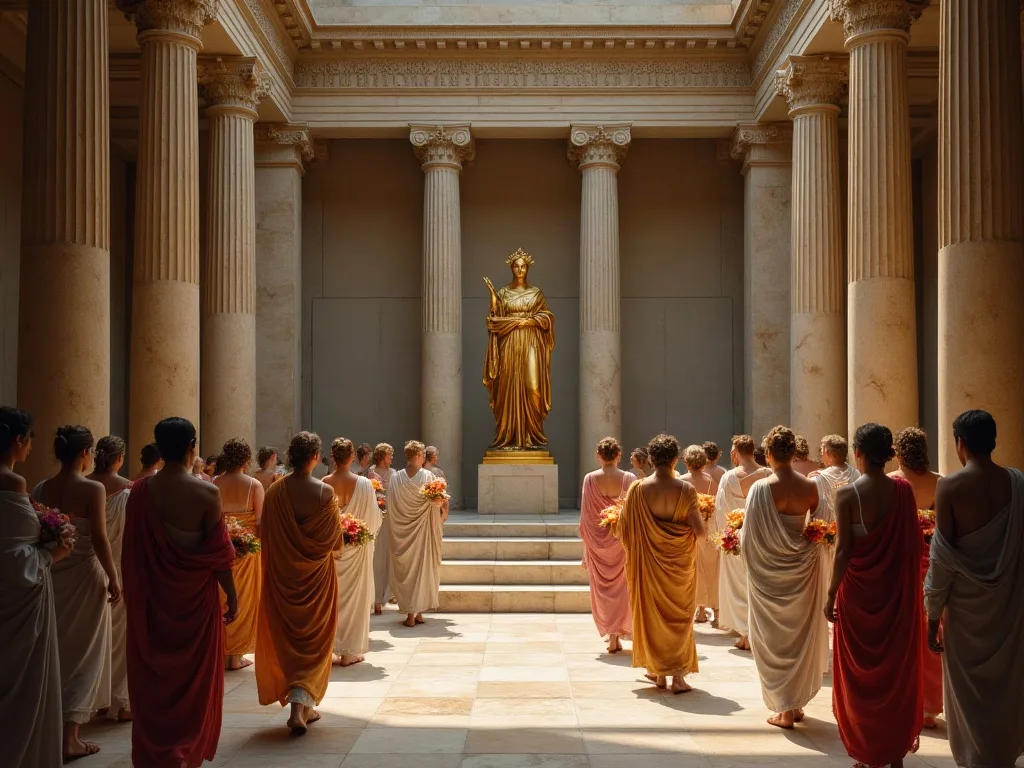
The Temple of Venus Genetrix stood in Caesar's Forum and housed a golden statue of the goddess. Every year, on August 18th, the feast of Venus Genetrix (Ludi Venerales) was celebrated with games and offerings. Citizens brought flowers, wine, and honey cakes to her altars. In April, during the Floralia festival, theatrical performances and wild celebrations honored Venus and the goddess Flora; the festival was notoriously rowdy, with stage actors often performing naked or semi-nude and crowds throwing nuts and beans onto the stage.
But the most intimate encounters with Venus happened at home. Roman families kept small household shrines where Venus (along with the Lares, household spirits, and Penates, gods of the storeroom) received daily offerings. A young bride entering her husband's home would make a formal prayer to Venus to bless the marriage and grant children. A merchant setting out on a voyage would leave wine and incense for her. A woman hoping for fertility would visit her temple and leave gifts.
The Romans also worshipped Venus under many titles, each emphasizing a different aspect of her power:
- Venus Genetrix (Venus the Mother): the ancestor of Rome and the source of fertility
- Venus Victrix (Venus the Victorious): the martial version, invoked before battle
- Venus Verticordia (Venus the Heart-Turner): invoked to restore morality and sexual virtue, especially after scandal
- Venus Murcia: an older, less well-understood form, perhaps connected to fertility or the mystic.
- Venus Libitina: the goddess of physical desire and sexual pleasure, though the Romans kept this aspect of her worship somewhat separate from her role as ancestor
Aeneid: The Literary Anchor of Venus's Story
If the Temple of Venus Genetrix was the goddess's physical center in Rome, the Aeneid was her literary immortality. Virgil, commissioned by the emperor Augustus to compose Rome's national epic, made Venus a central character in the poem. She appears constantly: warning Aeneas, protecting him from danger, arguing with other gods on his behalf, and ultimately seeing her descendants rule the world.
In the Aeneid, Venus is tender but also strategic. She loves her son fiercely, yet she accepts that his personal desires must yield to Rome's destiny. She bears witness to his suffering and validates his sacrifice. When Aeneas must abandon Dido, Venus does not stop him, though she understands the cruelty of the choice. She lets the hero do what he must do.
This portrayal gave Venus extraordinary psychological depth. She was not the scheming, petty deity of some Greek myths. She was a mother confronting the hard realities of fate, negotiating with Jupiter and other gods to protect her son's future. Roman readers recognized in her the dignity of sacrifice, the strength required to let go of personal happiness for the sake of something larger.
Virgil's Venus became the definitive version for centuries. She was quoted, illustrated, adapted, and prayed to because Virgil had shown her not as a distant mythological figure but as a being capable of genuine sorrow and unwavering commitment.
Comparison: Venus and Aphrodite in the Ancient World
Venus (Roman)
Ancestor of Rome through Aeneas; mother of a nation. Honored as a lineage goddess and divine progenitor. Protector of the state and its military ventures. Invoked before battles and as a guardian of empire. Associated with strategic power, organized civilization, and the founding of dynasties.
Aphrodite (Greek)
Goddess of beauty, desire, and pleasure. Often depicted as capricious, playing with mortals' hearts for amusement. Focus on sensuality and romantic entanglement. Less concerned with state power or family lineage. Worshipped primarily for her beauty and erotic influence, not as a national ancestor.
The Romans took the Greek Aphrodite and recast her as a figure of historical consequence. Where Aphrodite was often frivolous or vain in Greek stories, Venus was purposeful. Where Aphrodite represented chaos and desire, Venus represented order flowing from love and family. This was not a minor shift; it reflected how differently the two cultures understood divine power.
Venus in Love: The Affairs of the Gods
Despite her dignified role as Rome's ancestor, Venus was no stranger to passion herself. The Romans loved stories of her liaisons with gods and mortals, finding in them not scandal but inevitable consequence of her nature.
Her most famous affair was with Mars, the god of war. While Mars represented raw violence, Venus represented the energy that bound people together. The two deities embodied opposite forces, yet they were drawn to each other. The Roman poet Ovid describes how Mars came to Venus after battle, stripped of his armor, vulnerable and longing for her. Some versions of the myth say their union produced Harmonia or other divine children. Others suggest that their affair represented the balance between war and civilization, neither one sustainable without the other.
Venus also took a mortal lover in Anchises, the Trojan prince. Anchises was a shepherd living on Mount Ida when the goddess appeared to him in human form. She seduced him (or in some versions, tricked him), and from their union Aeneas was born. Some sources suggest Anchises was later punished with paralysis or blindness for glimpsing the goddess in her true divine form; others say he aged rapidly while Venus remained eternally young. The story emphasized an uncomfortable truth: an affair with a goddess, no matter how desired, came at a cost to any mortal involved.
These tales were not presented as moral lessons. Romans told them because they understood desire as a fundamental force of nature, something that moved even gods. Venus could be a loving mother to Aeneas and simultaneously a passionate lover to Mars. These were not contradictions in the Roman mind; they were facets of the same divine power.
Venus and the Power of Eros in Roman Philosophy
Roman philosophers and writers took Venus seriously as more than a mythological figure. The Stoic school, which dominated Roman intellectual life, saw in her symbolism a reflection of cosmic forces. The natural desire of things to bond, to unite, to create: this was Venus's domain.
The poet Lucretius, writing before Venus had fully become Rome's national ancestor (he lived in the first century BC), opened his great poem "De Rerum Natura" (On the Nature of Things) with a hymn to Venus. He called her the force of creation itself, the reason anything exists. He wrote that without Venus's power, the world would be barren, violent, and lifeless. This was not literal theology but poetic philosophy: Lucretius was arguing that the attractive force holding things together (what modern scientists might call gravity or molecular bonding) was best understood as a form of love, and Venus embodied it.
Later Roman thinkers expanded this. If Venus represented the organizing principle of love and attraction, then to honor her was to honor reason, civilization, and the bonds that made society possible. A proper Roman, in this view, was not someone who suppressed desire but someone who directed it correctly, toward family, country, and the gods.
This intellectual elevation of Venus gave her worship a philosophical depth. When you honored her, you were not merely indulging sensuality; you were aligning yourself with the fundamental forces that held the cosmos together.
The Cult Spreads: Venus Beyond Rome
As Rome's power expanded across the Mediterranean and beyond, the worship of Venus traveled with it. In Egypt, where the Romans ruled after Cleopatra's defeat, Venus was sometimes conflated with Hathor, the Egyptian goddess of love and motherhood. In Gaul, she was identified with local Celtic goddesses of fertility. In the Near East, she shared worship spaces and sometimes attributes with Syrian goddesses of love and war.
But the Romans never allowed these local assimilations to obscure Venus's Roman identity. She remained distinctly the goddess of Rome, the ancestor of the Roman people, the protector of Caesar and all subsequent emperors. Provincial temples to Venus were often sites of loyalty to Rome itself. To worship her was to acknowledge Rome's divinely ordained supremacy.
The emperor Augustus, who founded the Roman Empire after a century of civil war, was especially devoted to Venus. He claimed direct descent from her through Julius Caesar, who had in turn claimed descent from Aeneas. Augustus built temples, commissioned poets, and sponsored festivals in her honor. This was not piety alone; it was political strategy. By elevating Venus as Rome's founding ancestor, Augustus was arguing that his own rule was not a usurpation but the fulfillment of divine will stretching back to the fall of Troy.
Venus After Rome: From Pagan Goddess to Renaissance Muse
When Christianity triumphed across the Roman Empire in the fourth and fifth centuries AD, the pagan gods were officially abandoned. Temples were closed or converted into churches. The old prayers were silenced. Yet Venus did not disappear from European culture; instead, she transformed.
During the Middle Ages, Christian scholars tried to reconcile the pagan past with Christian truth. Some argued that Venus, properly understood, could represent divine grace or the Virgin Mary's aspect of nurturing love (though this was always a strained comparison). More often, Venus was retained as a symbol of earthly, worldly desire, the temptation that good Christians must resist.
But the Renaissance rekindled genuine love for the classical world. Artists and poets rediscovered Venus as a subject worthy of beauty and reverence. Sandro Botticelli painted "The Birth of Venus" around 1484, one of the most iconic paintings in Western art. Ovid's Metamorphoses, with its rich Venus stories, became required reading for educated Europeans. Neoplatonist philosophers (thinkers who combined Plato's philosophy with pagan theology) returned to the idea that Venus represented a divine principle of beauty and unity.
By the Renaissance, Venus had become not Rome's ancestor but something more universal: the embodiment of beauty itself, the ideal toward which all art and love aspire. She remained on the margins of Christian Europe, never officially sanctioned, but always present in art, literature, music, and the educated imagination.
The Lasting Echo: Venus in Modern Culture
Today, Venus survives in ways both obvious and hidden. The planet Venus is named after her, the brightest point in the night sky after the moon. The woman's symbol (♀) used in biology and medicine derives from her goddess symbol. Romance novels invoke her name. Artists still paint her birth, her affairs, her triumphs.
What is less often recognized is how profoundly she shaped the Roman idea of civilization itself. The concept that love, properly understood and properly directed, is the foundation of order and power; that beauty and strength are not opposed but complementary; that a nation can be built on more than conquest and legislation but on a shared story of divine ancestry: these ideas flow from Venus and the myths that surrounded her.
The Romans looked at their city built on seven hills and saw not the work of mortal hands alone but the fulfillment of a promise made by a goddess to her son. They understood themselves as citizens of Venus, descendants of an ancestor who had loved deeply, sacrificed entirely, and shaped the future. This mythology gave Rome a unique confidence, a sense that its empire was not merely political but cosmically ordained.
That confidence collapsed with Rome itself. But the myths endured, and so did Venus. She reminds us that the stories we tell about our origins shape who we believe we are allowed to become.
Frequently asked questions about Venus, goddess of love and ancestor of the Roman people
Frequently asked questions
Why did Romans believe Venus was their actual ancestor?
Romans traced their founding back to Aeneas, the Trojan hero who was Venus's biological son. When Aeneas escaped Troy and reached Italy, he founded a dynasty that led to Romulus and Remus, the legendary founders of Rome. This genealogy was not mere metaphor; Romans genuinely believed that every citizen carried Venus's blood. The emperor Augustus and Julius Caesar both claimed direct descent from her. This made Venus a real, biological ancestor in the Roman historical imagination, not simply a symbolic divine figure.
How was Venus different from the Greek goddess Aphrodite?
While Roman Venus was based on the Greek Aphrodite, the Romans emphasized different aspects. Venus was the ancestor of Rome and protector of the state; Aphrodite was primarily the goddess of beauty and desire. Venus was invoked before battles; Aphrodite played little role in Greek military affairs. Romans saw Venus as an embodiment of civilization-building power, while Greeks saw Aphrodite more as a force of erotic chaos. The two goddesses shared attributes but carried very different cultural weight.
Did Romans actually believe Venus was real, or was she purely symbolic?
Romans operated in a space where mythology and history were not separate. They genuinely honored Venus in temples, made offerings, and prayed to her for protection, fertility, and military success. Whether they believed in her as a literal person is a modern question that may not apply to Roman belief. What mattered was that Venus represented real forces in human life: love, attraction, the bonds that hold society together, and Rome's national identity. The power of the myth was real, regardless of whether the goddess was.
What was the most important temple dedicated to Venus in Rome?
The Temple of Venus Genetrix (Venus the Mother), built by Julius Caesar around 46 BC in his forum, was the most politically significant. It housed a golden statue and hosted the Ludi Venerales festival in August. Augustus also built the Temple of Venus and Mars in his forum. Beyond Rome itself, temples to Venus existed in every province of the empire, often serving as centers of loyalty to Rome's rule.
How did Venus figure into Roman marriage and family?
Venus presided over marriage, fertility, and the household. A new bride would pray to her for children and marital harmony. Families kept household shrines where Venus received daily offerings alongside the Lares (household spirits) and Penates (gods of the storeroom). She represented not just sexual desire but the bonds of family and the continuation of the lineage. To honor Venus was to honor the family structure that sustained Rome.
Venus Beyond Love: The Goddess Rome Built Itself Around
The story of Venus is ultimately the story of how Rome understood itself. By claiming her as an ancestor, Romans were not indulging in fantasy. They were articulating a fundamental truth about their own identity: that Rome was not merely a city of soldiers and engineers, but a civilization built on love, family, divine favor, and the persistent power of a mother goddess who refused to let her son's sacrifice be forgotten.
When you stand in the ruins of Rome today and read the names of her temples, when you see her image in a museum carved in marble or painted on pottery, you are encountering a force that shaped one of history's greatest empires. Venus made Rome believe in its own destiny. That belief, more than any legions or aqueducts, may have been Rome's true inheritance from the gods.
Free 25-page sample
Want the whole story?
Take the first 25 pages free. If it pulls you in, the full edition is yours as an instant PDF download, with a paperback on Amazon for selected titles.
Roman
The Roman Mythology Book: Jupiter, Mars, Venus, the Aeneid, and the Sacred Stories That Built an Empire
Jupiter, Mars, Venus, the Aeneid, and the Sacred Stories That Built an Empire
The complete guide to Roman mythology from Virgil's Aeneid to Ovid's Fasti. Every god, every founding myth, every Vestal rite.
More from Roman
All articles
Roman
Romulus and Remus: The Myth of Rome's Foundation
The twin sons of Mars raised by a she-wolf; a fratricide, a city, and an empire. How Rome's founding myth shaped the identity of Western civilization's greatest power.
Roman
Aeneas and the Founding of Rome: The Aeneid's Sacred Narrative
Virgil's Aeneas carries Troy's fate to Italy, writing Rome's origin in blood and duty. Discover how the Aeneid transformed a hero's journey into a nation's sacred story.

Roman
Mars: Roman God of War, Agriculture, and the Father of Rome
Mars was no mere god of bloodlust. The Roman war god fathered Romulus, blessed the harvest, and embodied the discipline that built an empire. Discover how Rome's greatest god shaped both sword and soil.

Roman
Juno: Queen of the Gods and Protector of Rome
Juno ruled the Roman pantheon as Jupiter's equal and Rome's divine guardian. Discover how this fierce goddess shaped the fate of an empire, from her role in the city's founding to her uncompromising protection of women and state.