
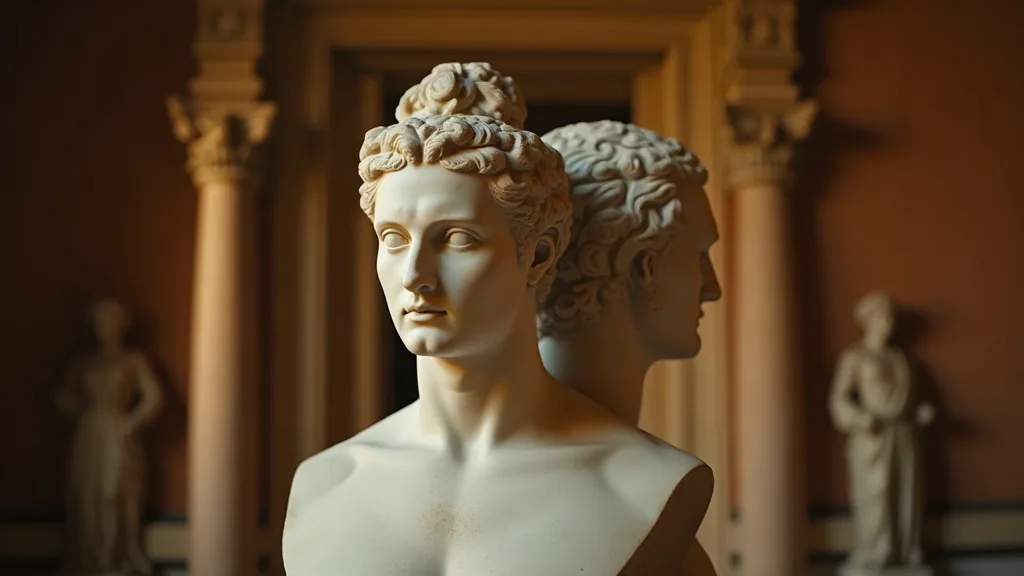
Janus: Two-Faced God of Beginnings and Transitions
Meet Janus, the uniquely Roman god who faces both past and future. Unlike his Greek counterparts, Janus has no mythology, he is pure function, guardian of doorways, transitions, and new beginnings across time itself.
Contents
The Roman god stands at the threshold. One face looks backward into what was; the other peers forward into what will be. He holds a key in one hand and a rod or staff in the other. His name is Janus, and he is the only major god in the Roman pantheon to emerge entirely from Italian soil, with no Greek counterpart to shadow or diminish him. While Jupiter had Zeus and Mars had Ares, Janus belonged only to Rome, born from Roman needs and Roman consciousness of time itself.
Unlike the gods you find celebrated in Greek temples and epics, Janus has almost no myth. He does not seduce mortals. He does not wage wars among the heavens. He does not suffer or transform. Instead, he embodies a pure principle: the power to open, to close, to stand between one state and another. To understand him is to understand how the Romans thought about time, thresholds, and the sacred boundary between the known and the unknown.
The Origins and Nature of Janus
The earliest traces of Janus appear not in grand narrative but in the oldest Roman religious practices. Varro, the Roman scholar writing in the first century BC, records that Janus was invoked first in every religious ceremony, before even Jupiter. This was not a matter of rank; it was a matter of sequence. You cannot enter sacred space, cannot address the gods, without first opening the door. Janus controlled that opening.
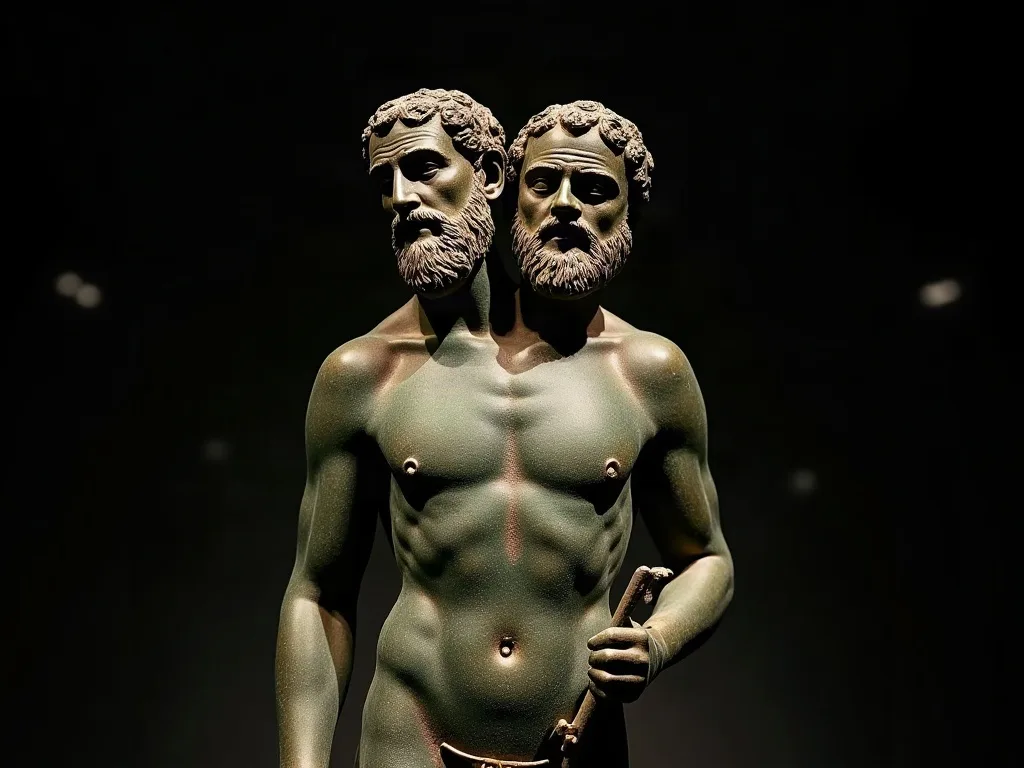
His name derives from the Latin word janua, meaning door. But this etymological fact barely scratches the surface. A door is not merely a portal through wood and stone. It is a boundary between the private and the public, the inner and the outer, the safe and the unknown. A door is where protection meets exposure. A door is where intention meets consequence. The Romans understood doors this way, and thus they understood Janus this way.
The god's two faces became his most recognizable feature, though ancient sources suggest this imagery developed gradually rather than appearing fully formed from the start. The earliest representations show him with a single face, sometimes bearded, sometimes youthful. The doubling was a refinement of his nature, a visual language that made his essential quality unmistakable: he occupies a threshold and looks both ways simultaneously. Neither face is more important than the other. Neither face is turned away.
He was considered a god of tremendous ancient standing, deus prisci (a god of old times). Some sources hint that Janus may have been worshiped even before the city of Rome itself was founded. King Numa Pompilius, the legendary second king of Rome, was said to have refined Janus worship and established particular rituals in his honor. Though Numa himself is a figure wrapped in legend rather than documented history, the claim underscores how foundational Janus seemed to Roman consciousness.
Janus as the Guardian of Thresholds and Doorways
A Roman home's entrance was no mere practical feature. It was sacred ground. The god Ianus, as he appears in household contexts, was thought to protect the household from harm and disorder. The doorway itself was called the janua, and above it, a small shrine might hold a small figure or image of the god. Every time a Roman citizen passed through that door, they moved under Janus's watch.
But Janus's domain extended far beyond the humble domestic threshold. He guarded the gate of the city itself. When the gates of Rome were closed, no army could enter; when they opened, Rome either went to war or received ambassadors. Janus held the power to seal or release the city. This was political power dressed in divine language, but it was no less real for it.
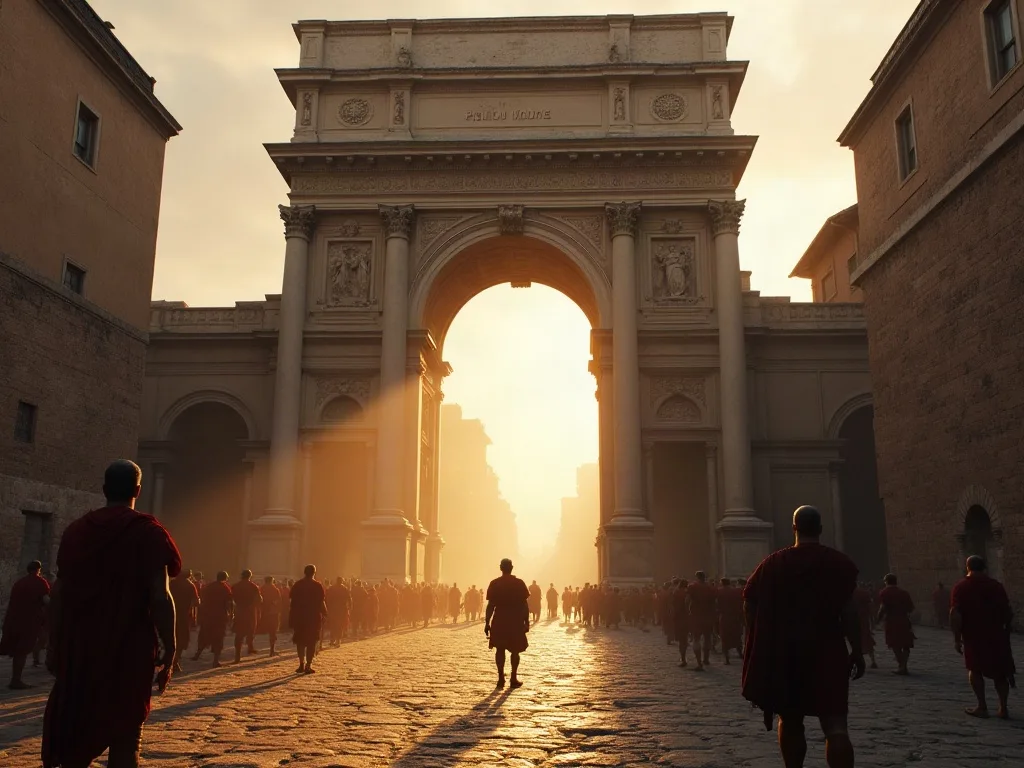
The Porta Iani (the Gate of Janus) stood in the Roman Forum, and its status communicated the state of the empire to every citizen. When Rome was at peace, the gate stood open. When Rome was at war, it was closed. Only in times of genuine peace, when no Roman legions were fighting anywhere in the known world, was this gate sealed shut. According to legend, this occurred only three times in Rome's entire history: during the reigns of Augustus and his successors, briefly under Claudius, and again under Vespasian. The closure was so rare that it was treated as a cosmic event, a sign of divine favor. The closing of the Gate of Janus meant the god had shuttered the boundary between Rome and chaos itself.
His role as threshold guardian extended to metaphorical doorways as well. He stood at the boundary between one year and the next. This is why the month of January carries his name to the present day. The month is his temple in the calendar. January 1st remains a threshold day, a moment of turning, a hinge on which the entire year pivots. The Romans celebrated the Kalends of January (the first day) as a sacred feast dedicated to Janus. Citizens exchanged gifts, offered prayers, and made resolutions. The modern tradition of New Year's resolutions is a direct descendant of this Roman practice.
The Sacred Rituals of Janus
The worship of Janus was intricate and demanding. He received libations (ritual pouring of wine or other liquids) before all other gods in official ceremony. He was offered wine, honey, cakes, and incense. The word for the opening prayer offered to him was carmentum, a formulaic utterance that preceded all sacred business.
The month bearing his name saw particular observance. On the Kalends of January, the god was worshiped with a festival of new beginnings. The previous year's ashes were swept away. Homes were cleaned. Slaves were sometimes granted temporary freedoms or granted gifts, a reversal of normal order that symbolized the reset quality of the threshold moment. The boundary between what was and what would be was so powerful that normal hierarchies dissolved in acknowledgment of it.
Interestingly, Janus had no flamen (a priest dedicated exclusively to him), as did Mars, Venus, and other major deities. Instead, he was served by the Pontifex Maximus, the chief priest, himself. This arrangement reflected Janus's unique position: he was too fundamental to be confined to a single priest. His worship touched all ritual, so all ritual leadership was entrusted with his service.
The god received offerings at crossroads and intersections. A compitum (a crossroads shrine) was a small altar where neighbors would gather and make offerings to Janus and the Lares (household spirits). These were threshold spaces within the city itself, places where roads met, where traffic flowed, where the known and unknown intersected. The Romans recognized that thresholds existed in the geography of the world, not only in architecture.
Janus and the Passage of Time
To the Roman mind, Janus represented more than just physical doorways. He embodied a deeper truth about time itself: that every moment is a threshold. The past lies behind, fixed and unchangeable. The future stretches ahead, full of possibility and danger. The present is the knife-edge between them, the hinge on which time turns. Janus stands at that hinge.
This is why his two faces look in opposite directions. One face sees backward with the wisdom of memory; the other looks forward with the caution of anticipation. A Roman understood that to move forward wisely, you must hold the past in view. You cannot abandon what has been without risking the repetition of old mistakes. Yet you cannot stare only backward without stumbling into what comes next.
The god was also associated with beginnings of all kinds. The start of a military campaign was placed under his protection. The first days of a child's life were marked by his blessings. The founding of a city required his sanction. Any venture that crossed from one state into another, from non-existence into being, was Janus's province. He was the god of commencement, the deity who stood between the "not yet" and the "now."
Janus in Roman Art and Literature
Roman coins frequently bore the image of Janus, his two bearded faces side by side, often wearing a diadem. The diadem was a symbol of kingship and divine authority, fitting for a god whose domain touched every moment of civic life. His image on currency reinforced his presence in daily commerce, another kind of threshold where value changed hands.
In literature, Janus receives less fanfare than Jupiter or Mars, yet he appears in Ovid's Fasti, a poem about the Roman calendar month by month. Ovid describes the god speaking in his own voice, explaining his nature and his role. In Ovid's account, Janus explains that he alone among the gods can see all things, past and present and future, in a single glance. His knowledge is complete and unparalleled. Where other gods are specialists, Janus is the overseer.
Roman writers consistently depicted him as wise and ancient. He is never foolish, never caught in embarrassing situations, never reduced to comedy. This reflects a fundamental respect for his function. The gods of desire and war could be mocked in literature because their domains contained conflict and irrationality. But Janus, the god of orderly transition and sacred boundaries, remained dignified in every account. To mock him would be to mock the very principle by which Roman society ordered itself.
Janus and Other Roman Deities
The relationship between Janus and Jupiter reveals much about Roman theology. Jupiter was the king of gods, the wielder of thunderbolt and fate. Yet even Jupiter required Janus to come first. This was not a matter of rank but of order. You must open a sacred space before you can fill it with the divine. Jupiter is the authority that enters; Janus is the guardian that opens the way.
The household Lares, spirits of the hearth and home, often appeared alongside Janus in domestic shrines. The Lares protected the interior space; Janus guarded its threshold. Together, they formed a complete system of household security and blessing. One god managed the inside; the other controlled the boundary.
Janus also had a distinct relationship with Mars, the god of war. Where Mars represented the chaos and violence of combat, Janus represented its boundaries. Mars drove men to battle; Janus through the closed gate determined whether Rome as a whole would go to war. Mars fought within the conflict; Janus decided whether Rome would cross the threshold into warfare at all.
In a theological sense, Janus stood apart from most other deities because he had no narrative history. He did not seduce anyone. He was not born in the usual sense. He had no quarrels with other gods. This absence of mythology made him, paradoxically, one of the most philosophically important gods in the Roman pantheon. He represented pure function, pure principle, divested of the personal drama that surrounded other deities.
The Modern Legacy of Janus
The influence of Janus extends directly into contemporary language and thought. The month of January preserves his name exactly. The word "janitor" comes from janitor, the Roman word for doorkeeper, the person who served Janus by managing thresholds. Every janitor in the modern world unknowingly carries the god's ancient title.
The symbol of Janus appears on the coat of arms of various institutions and has inspired modern artistic and literary exploration. The phrase "Janus-faced," while often used pejoratively to suggest duplicity, actually carries within it the original meaning: the ability to see multiple perspectives simultaneously, to hold contradictions without collapsing them into a false unity. A true Janus perspective is not deceptive; it is honest about complexity.
In contemporary psychological thought, the archetype of the threshold guardian persists. The image of standing at a crossroads, of the capacity to look backward and forward simultaneously, resonates with modern ideas about decision-making and self-awareness. The need to understand where you have been in order to move wisely toward where you are going remains as relevant now as it was in the Roman Forum two thousand years ago.
Writers and artists have returned repeatedly to Janus as a symbol of transition and liminality. In modern speculative fiction, Janus figures appear as guardians of boundaries between worlds. The god's two-faced nature provides a metaphor for navigating dualities: past and future, known and unknown, closure and opening, death and birth.
Frequently asked questions about Janus: Two-Faced God of Beginnings and Transitions
Frequently asked questions
Did Janus have a mythology or a story, like other Roman gods?
No. Unlike Jupiter or Mars, Janus has no myth. He is unique among major Roman deities in having no narrative of birth, transformation, or adventure. He is pure principle, the embodiment of thresholds and transitions themselves. This absence of story actually made him more important to daily Roman religious practice, because his function was so fundamental it needed no justification.
Why did the Romans invade Janus before Jupiter in every ceremony?
Order mattered. You cannot address the gods in sacred space until you have opened that sacred space itself. Janus controlled the opening. This reflected practical wisdom: before you invite someone into your home, you must open the door. The principle applies equally to the divine realm. Janus came first because thresholds come first.
What did it mean when the Gate of Janus was closed?
The closing of the Gate of Janus in the Roman Forum signaled total peace: no Roman legions were at war anywhere in the known world. This was so rare that it occurred only three times in Roman history. The closure was understood as a sign that Janus had shut the boundary between Rome and chaos, that the god was satisfied with the empire's state, and that divine favor rested upon the city.
How is Janus connected to January and New Year's resolutions?
The month of January is named directly after Janus. The Romans celebrated the Kalends of January, the first day of the year, as his festival, a threshold day when the old year ended and the new began. The custom of making resolutions and exchanging gifts on New Year's Day derives directly from this ancient Roman practice of marking the god's sacred moment.
Is the term 'Janus-faced' an insult because of the god's two faces?
In modern English, yes, but this misunderstands the original meaning. The god's two faces were not symbols of deception but of simultaneous vision: the ability to see past and future at once, to hold multiple perspectives in mind. True wisdom, in the Roman understanding, required this kind of doubled sight.
Did Janus have any equivalent in Greek mythology?
No. Janus is one of the few major deities in the Roman pantheon without a Greek counterpart. He emerged entirely from Italian religious practice and represents a distinctly Roman way of thinking about time, thresholds, and sacred boundaries. This makes him one of Rome's unique contributions to Western religious thought.
The Enduring Power of the Threshold
What makes Janus remarkable is not the drama of his stories but the simplicity and universality of his principle. Every human being knows the experience of crossing a threshold, of standing between one state and another, of needing to look back before stepping forward. Every person marks the passage of time by thresholds: birth and death, beginning and ending, childhood and adulthood, one year and the next.
The Romans understood that these moments required protection and blessing. They created a god who stood eternally alert at every boundary, holding the past in one hand and the future in the other, ready to open or close the way. In doing so, they articulated something fundamental about the human condition: we live in time, and time is made of thresholds.
The god has no temples in ruins waiting for archaeologists. His worship has left fewer grand monuments than those dedicated to Jupiter or Mars. Yet his presence is everywhere in how we think about time, about doorways, about new beginnings, about the sacred act of crossing from one moment into the next. Janus remains the most quietly essential god the Romans ever conceived.
Free 25-page sample
Want the whole story?
Take the first 25 pages free. If it pulls you in, the full edition is yours as an instant PDF download, with a paperback on Amazon for selected titles.
Roman
The Roman Mythology Book: Jupiter, Mars, Venus, the Aeneid, and the Sacred Stories That Built an Empire
Jupiter, Mars, Venus, the Aeneid, and the Sacred Stories That Built an Empire
The complete guide to Roman mythology from Virgil's Aeneid to Ovid's Fasti. Every god, every founding myth, every Vestal rite.
More from Roman
All articles
Roman
Romulus and Remus: The Myth of Rome's Foundation
The twin sons of Mars raised by a she-wolf; a fratricide, a city, and an empire. How Rome's founding myth shaped the identity of Western civilization's greatest power.
Roman
Aeneas and the Founding of Rome: The Aeneid's Sacred Narrative
Virgil's Aeneas carries Troy's fate to Italy, writing Rome's origin in blood and duty. Discover how the Aeneid transformed a hero's journey into a nation's sacred story.

Roman
Venus: Goddess of Love and Ancestor of the Roman People
Venus was Rome's goddess of love, fertility, and military victory. But she was also the divine ancestor of the Roman people through her son Aeneas. Discover how this single goddess embodied Rome's most powerful myths about its own origins.

Roman
Mars: Roman God of War, Agriculture, and the Father of Rome
Mars was no mere god of bloodlust. The Roman war god fathered Romulus, blessed the harvest, and embodied the discipline that built an empire. Discover how Rome's greatest god shaped both sword and soil.