

Juno: Queen of the Gods and Protector of Rome
Juno ruled the Roman pantheon as Jupiter's equal and Rome's divine guardian. Discover how this fierce goddess shaped the fate of an empire, from her role in the city's founding to her uncompromising protection of women and state.
Contents
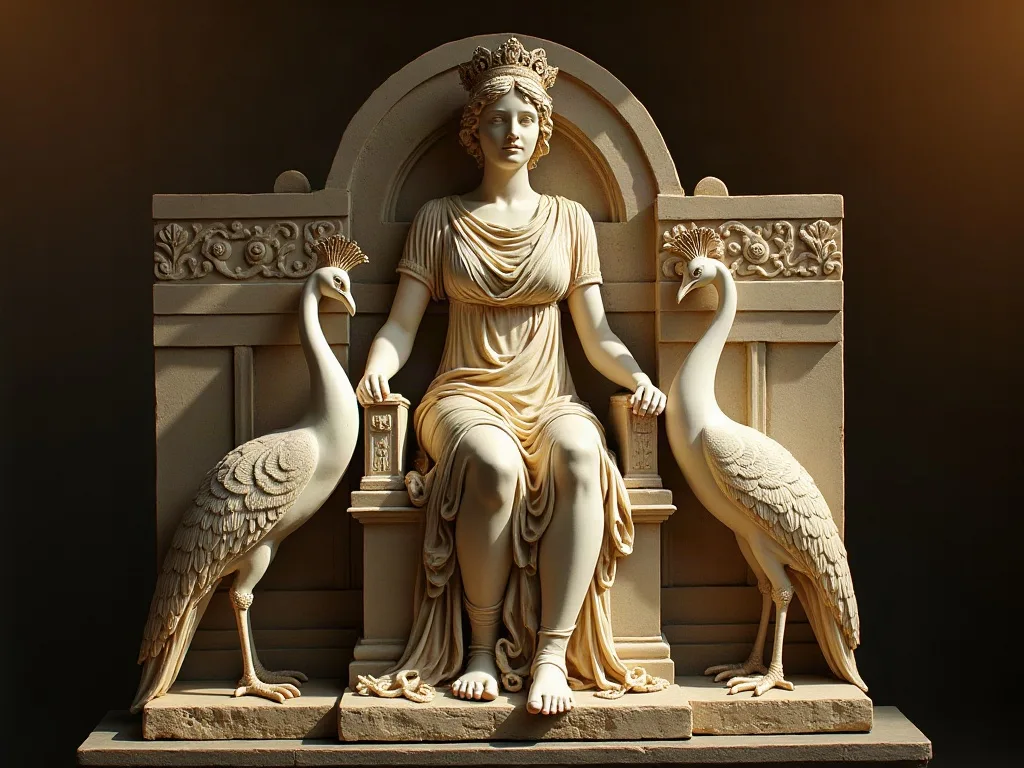
The great gates of Rome swung open, and a white peacock spread its tail across the marble floor of the Capitoline Hill. This was Juno's domain. Not as the jealous shadow of her Greek counterpart Hera, but as the Queen of the Gods and Protector of Rome in her own right, a deity whose voice mattered as much as Jupiter's thunderbolt. The Romans understood her differently than the Greeks understood their queen of heaven. Juno was not merely a divine wife. She was the guardian of the state itself, the one who decided whether Rome would prosper or crumble.
When a Roman general went to war, he would pray to Juno before he prayed to Jupiter. When Rome's women gathered at her festivals, they came not as supplicants to a temperamental deity, but as citizens honoring the goddess who protected their rights, their families, and their independence. The peacock, the pomegranate, and the crown were hers. And the eternal city built its fortune on her favor.
The Origins of Juno: From Etruscan Roots to Roman Sovereignty
Long before Rome became an empire, the Etruscans worshiped a goddess called Uni. When Roman culture absorbed the religious practices of their northern neighbors around the 5th century BCE, Uni transformed into Juno. Something remarkable happened in this change. The Romans did not simply copy the Greek goddess Hera and give her a Latin name. Instead, they created something entirely new, a deity shaped by their own values and their own vision of what divine power should look like.
Juno emerged as a separate being, not defined by her relationship to Jupiter. The Romans called her Regina, meaning "the Queen." This title meant she held autonomous power within the state. In the earliest Roman records, Juno appears as one of the Capitoline Triad, the three gods who shared the most sacred temple on Rome's holiest hill. That temple, the Temple of Jupiter Optimus Maximus, stood at the summit of the Capitoline and was completed around 509 BCE. Inside it, three deities received equal honor: Jupiter, Juno, and Minerva. Each had their own chamber, their own altar, their own share of the sacrifices.
This arrangement tells you everything about how Rome saw Juno. She was not a subordinate. She was not waiting in the wings. She was a full partner in Rome's divine government, the protector of the state's welfare just as Jupiter was its ultimate authority.
The Transformation: How Juno Became Rome's Protector
The moment of Juno's greatest power came during the sack of Rome by the Gauls in 390 BCE. As the Celtic warriors breached the walls and rampaged through the city, Roman soldiers huddled on the Capitoline Hill, their last stronghold. They were outnumbered, hungry, and losing hope. Then the geese of Juno's sacred temple began to honk and flap their wings in a frenzy. The noise woke the sleeping soldiers. The Gauls, thinking the Romans had fresh reinforcements, attacked with less conviction. In that moment, the geese saved Rome.
The historian Livy recorded this event in his History of Rome, written in the 1st century BCE. Whether the geese actually caused a crucial tactical shift or whether the story itself became the crucial thing for Rome, the result was the same. Juno became known as Juno Moneta, the Warner Goddess, the one who gives counsel and protection. The temple where her sacred geese lived became the mint where Rome struck its coins. Her warning had turned into Rome's fortune.
The connection between Juno and money, prosperity, and the state's welfare became permanent. When you held a Roman coin in your hand, you were holding Juno's protection. The word "money" itself comes from "Moneta," her epithet. Romans who handled commerce, currency, and financial matters would offer prayers to Juno Moneta, asking for her blessing on their transactions and her protection against fraud.

Juno's Many Faces: The Epithets That Defined Her Power
To understand Juno as the Protector of Rome, you must understand that she was never a single deity. The Romans gave her dozens of titles, each revealing a different aspect of her authority. These were not mere poetic flourishes. Each epithet represented a specific responsibility and a specific relationship with the people who invoked her.
Juno Regina was the Queen in her most formal aspect, the ruler of the gods and the guarantor of Rome's political stability. Generals approaching a crisis would make vows to Juno Regina, promising her gifts and honors if she steered the state to victory. When important decisions had to be made about war or peace, about the election of magistrates or the fate of provinces, the Senate would consult the auspices, the signs sent by the gods. Juno's signs carried weight equal to Jupiter's.
Juno Lucina protected women in childbirth. The epithet comes from lux, meaning light, and symbolized Juno's role in bringing new citizens into the light of the world. Roman women in labor would call her name, knowing that this aspect of Juno understood their struggle and their danger. The date of her festival, March 1st (the Matronalia), was sacred to all married women in Rome, a day when husbands gave gifts to their wives and Juno was honored as the protector of marriage and family.
Juno Sospita meant the Savior Goddess. She was invoked in times of plague, invasion, or natural disaster. Wearing her symbols, her sacred armor and spear, she appeared in statues throughout Rome as the ultimate warrior protector of the state. Unlike Minerva, who represented strategic wisdom in war, Juno Sospita represented sheer protective power, the force that saved Rome when all seemed lost.
Juno Pronuba blessed marriages and ensured their stability. She was the witness to the vows that bound couples together. No Roman marriage was complete without her blessing. Weddings involved specific rituals honoring this aspect of Juno, and married couples kept shrines to her in their homes.
Each of these was Juno, yet each was also distinct. She was not fragmented across these titles the way a modern mind might imagine. Rather, Romans understood her as possessing multiple natures simultaneously, like a gem that shows different colors depending on the angle of the light.
Juno and Jupiter: Partners in Divinity, Not Subordinates
The relationship between Juno and Jupiter in Roman religion was fundamentally different from the relationship between Hera and Zeus in Greek mythology. The Greeks told elaborate myths about Hera's jealousy, her rage at Zeus's infidelities, her persecution of his lovers and bastard children. These stories revealed something important about Greek culture: the idea that even in the divine realm, men held ultimate authority and women existed in relationship to that authority.
The Romans told different stories. When they adopted mythological material from Greece, they changed it. The myths of Juno and Jupiter that survived in Roman sources show a partnership, not a hierarchy. Yes, Jupiter was the king of the gods, the wielder of thunderbolts, the ultimate authority. But Juno was the queen, and a Roman queen was not a decorative figure. She was a power broker, a decision maker, a force to be reckoned with.
Ovid, the great Roman poet who lived during the reign of Augustus and recorded myths in his Metamorphoses, included many tales of Jupiter's transformations and affairs. But the tone is different from the Greek versions. There is less emphasis on Juno's rage and more on the actual consequences of Jupiter's actions. The stories explore the human and divine cost of his infidelities, not as a punishment Juno inflicts, but as a natural result of his choices.
This reflects something deep in Roman thinking. They were builders of institutions, creators of law codes, believers in structures that worked. They saw the divine pantheon as a government, and in their government, the roles were defined and the authority was balanced. Juno and Jupiter ruled together. When they disagreed, their disagreement shaped events, but it was not a matter of one overriding the other. It was a matter of negotiation, of different interests pulling in different directions, of the kind of tension that actually makes institutions function.
Women, Fertility, and the Continuity of Rome
To the Romans, Juno was not an abstract symbol. She was the living force that made Rome's future possible. This meant she was intimately connected with fertility, motherhood, and the continuation of the state. This was not because Romans were sentimental about motherhood, but because they understood, with stark clarity, that a state survives by producing the next generation of citizens.
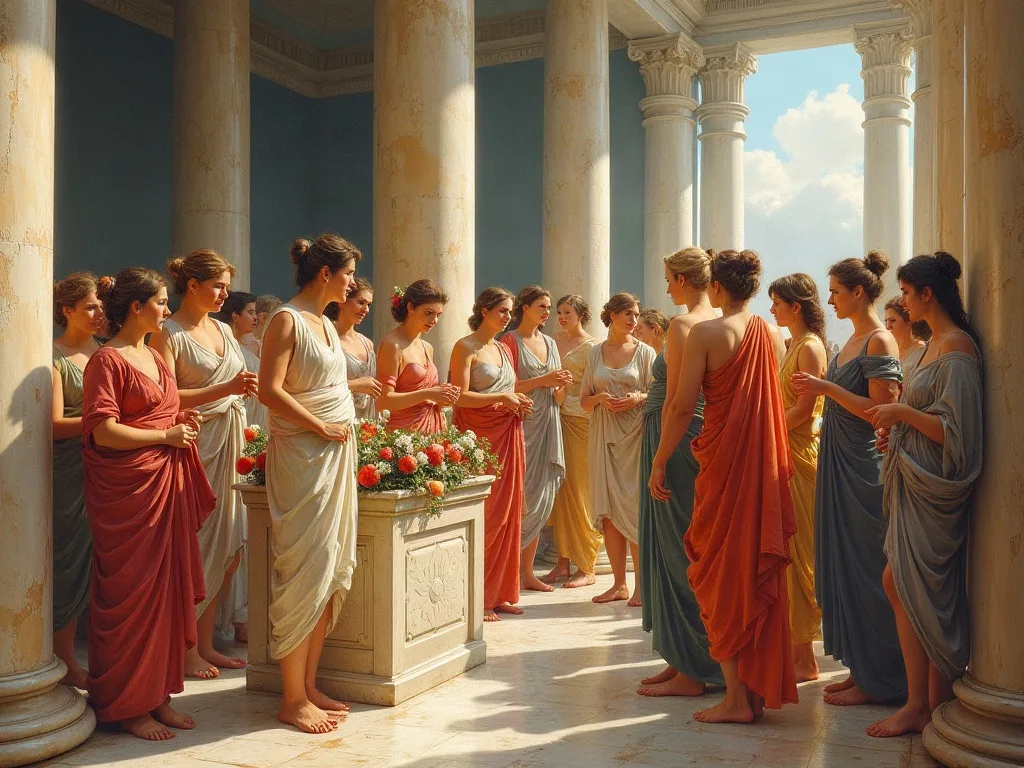
The festival called the Matronalia, held on March 1st each year, was one of Rome's most important religious observances. Every married woman in Rome was expected to participate. Husbands gave their wives gifts, servants received gifts from their mistresses, and the entire city honored Juno Lucina and Juno Pronuba. The purpose was explicit: to ensure the goddess's blessing on the marriages and families of Rome, to ask for her protection for the women who would bear the next generation of Romans.
There is something hard and practical about this. The Romans did not romanticize motherhood or imagine women as delicate flowers. They understood that childbirth was dangerous. Maternal mortality was high. Women needed divine protection to survive the process. Juno Lucina represented that protection in its most concrete form. She was the force that brought light into the world in the form of new children.
This protection extended beyond fertility. Juno was the guarantor of women's legal status. In Roman law, women had many fewer rights than men, but they had more rights than women in many other ancient societies. A woman could own property, manage an estate, initiate divorce, and conduct business. These rights existed partly because of social evolution, but they also existed because Juno, as the Queen of the Gods and protector of Rome, represented a sphere of female authority that even Rome's patriarchal legal system could not entirely override.
The Jealous Juno: Explaining the Hera Connection
The Greek myths of Hera's jealousy did influence how some Romans understood Juno, particularly during the later imperial period when Greek and Roman cultures blended more thoroughly. But the Romans often reinterpreted these stories. When they encountered the myth of Io, the maiden transformed into a white heifer by Zeus to hide her from Hera's vengeance, Roman versions sometimes emphasized not Hera's cruelty but the injustice of the situation itself. Hera was protecting her marriage rights against Zeus's violation of them. From this perspective, her rage becomes understandable, even justified.
This reframing tells you something important about Roman ethics. They were concerned with justice, with right action, with the rules that held society together. When they looked at the Greek story of a goddess punishing her husband's lover, they did not automatically side with the husband. They asked a harder question: what right had the husband to betray his partner? What obligation did he have to honor his marriage?
Some of this thinking was practical: Rome was a slave society, and the appearance of household harmony and order mattered enormously for the stability of society. But some of it was also genuinely moral. The Romans had their own code of behavior, and it included obligations between husband and wife, between ruler and subject, between the powerful and the vulnerable. Juno represented the enforcement of that code.
Juno in War and Statecraft
The presence of Juno as Queen of the Gods and Protector of Rome was felt most intensely during moments of crisis. When Rome faced existential threats, when the outcome hung in balance, commanders and leaders made direct appeals to Juno.
Livy records that during the desperate defense of the Capitoline Hill against the Gauls, the Senate made formal vows to Juno. If she would protect the state, they promised her a temple and annual sacrifices. Throughout Roman history, generals about to engage in critical battles would make similar vows. The language of these vows reveals something essential: Juno was not being begged for favor as an act of charity. She was being entered into a contract. The Romans promised her something of value, and in exchange, she agreed to use her power to protect Rome.
This concept, known as do ut des, literally "I give so that you might give," was fundamental to Roman religion. It was not piety in the Christian sense. It was more like a business transaction with the divine. You honored the gods with sacrifices, festivals, and temples, and they repaid you with protection and success. The gods were bound by this arrangement; they could not simply abandon you if you had honored your side of the bargain.
In statecraft and politics, Juno's influence was constant. The Senate consulted the auspices before every important vote. If the signs were unfavorable (if birds flew in the wrong direction, or if lightning struck in an inauspicious location), the Senate would postpone the vote. These were not mere superstitions or theater. They were a way of encoding caution into political process, of making sure that decisions were not made in haste or under pressure. Juno's signs, like Jupiter's and the other gods', carried the weight of divine will. To ignore them was to risk the gods' anger and the state's downfall.
Juno's Legacy in the Later Empire and Beyond
By the time Rome became a Christian empire under Constantine in the 4th century CE, Juno's worship faded. The new religion had no room for a queen of the gods. But her influence did not disappear entirely. The symbols she represented, the values she embodied, and the stories told about her lived on in subtle ways.
The concept of a divine protector of the state migrated into Christian theology. The Virgin Mary, in Christian art and devotion, took on some of the qualities that Juno had held. She became the protector of children, the guardian of marriage, the symbolic mother of a spiritual city. This was not conscious borrowing, but it shows how deep Juno's influence ran in the cultures of the Mediterranean.
The word "moneta" became the root of the word for money in multiple languages. Every time someone uses the word "money" or "mint," they are using Juno's epithet. The practical wisdom about the connection between stable currency and stable government, which Juno Moneta represented, never left Western civilization.
In Renaissance and Enlightenment art, Juno reappeared constantly. She was painted with her peacocks, crowned and commanding. Artists drew on Roman sources to imagine her as a figure of state authority and divine queenship. Scholars studied her texts, and the values she represented became part of the vocabulary of political philosophy. When thinkers discussed the nature of sovereign power and the relationship between ruler and people, they could not help but encounter Juno, because she was embedded in the literary and artistic heritage of the Western world.
Frequently asked questions about Juno
Frequently asked questions
How was Juno different from the Greek goddess Hera?
Juno was not simply a Latin name for Hera. The Romans transformed her into a deity of state power and protection. While Hera in Greek myth is often portrayed as jealous and vengeful, Juno was primarily the Queen of the Gods, the guarantor of Rome's welfare, and the protector of women's rights. She had her own complex mythology and was understood as a partner to Jupiter rather than a subordinate. The Romans actively reinterpreted Greek myths when they adopted them, changing emphases and meanings to match their own values.
Why did the geese of Juno's temple matter so much to Rome?
The geese of Juno's sacred temple on the Capitoline Hill gave their warning cry during the Gallic assault on Rome in 390 BCE, alerting sleeping Roman soldiers to danger. This event made Juno famous as the Warner, or Juno Moneta (the one who warns or advises). The goddess became forever associated with protection, prosperity, and financial counsel. Her temple later became the site of Rome's mint, cementing the connection between Juno and money itself. The geese became sacred animals, protected and honored throughout Roman history.
What were the most important festivals dedicated to Juno?
The Matronalia, celebrated on March 1st, was the most important festival. Every married woman in Rome participated, receiving gifts from husbands and other male family members. The festival honored Juno Lucina and Juno Pronuba, asking for their protection of marriages and safe childbirth. The Nonae Caprotinae, celebrated on July 7th, honored Juno Caprotina and involved unusual role-reversals where women and slaves played prominent roles. These festivals were not marginal celebrations but central to Rome's religious calendar and state identity.
Did Roman women actually have special rights under Juno's protection?
Roman women had fewer rights than men, but more than women in many neighboring societies. They could own property, manage estates, initiate divorce, and conduct business. While these rights came from legal development and social practice rather than directly from Juno's worship, the connection between Juno as a powerful female divine figure and women's protected legal status was real in Roman consciousness. Juno represented a sphere of female authority and autonomy that countered the patriarchal structure of Roman society, even if she could not fully overturn it. Her presence in the highest levels of Roman religious life affirmed that female power and authority were necessary parts of the cosmic and political order.
Juno's Unfinished Revolution
The story of Juno extends beyond Rome's collapse. Her representation in Western art, literature, and political philosophy reveals something about how ancient societies understood divine power and human authority. She was never a minor goddess, never a mere reflection of another tradition's deity. She was a full architect of civilization, standing at Rome's side as equal partner to Jupiter.
What makes Juno's story compelling is that she represents something rare in ancient religions: a female figure of state power who could not be fully domesticated or subordinated. Yes, Rome was patriarchal. But Rome's highest gods included a Queen who held real authority, made real decisions, and demanded real respect. For a society that did not believe in gender equality, this was a radical statement. It suggested that no human order, no matter how male-dominated, could entirely exclude female power from its structure. The universe itself would not permit it.
The peacock, Juno's sacred bird, remained a symbol of regal beauty and authority long after Rome fell. When medieval and Renaissance artists depicted monarchy, they reached for the peacock. When they painted the Virgin Mary in her queenly aspect, they remembered Juno. The currents of influence run deeper than explicit memory. They run through symbol, through story, through the half-conscious echoes that shape what comes after. Juno, the Queen of the Gods, lives on in every queen who demands to be recognized as more than just a wife, in every mother who claims her own authority, in every woman who insists that her voice matters in the ordering of the world.
Free 25-page sample
Want the whole story?
Take the first 25 pages free. If it pulls you in, the full edition is yours as an instant PDF download, with a paperback on Amazon for selected titles.
Roman
The Roman Mythology Book: Jupiter, Mars, Venus, the Aeneid, and the Sacred Stories That Built an Empire
Jupiter, Mars, Venus, the Aeneid, and the Sacred Stories That Built an Empire
The complete guide to Roman mythology from Virgil's Aeneid to Ovid's Fasti. Every god, every founding myth, every Vestal rite.
More from Roman
All articles
Roman
Romulus and Remus: The Myth of Rome's Foundation
The twin sons of Mars raised by a she-wolf; a fratricide, a city, and an empire. How Rome's founding myth shaped the identity of Western civilization's greatest power.

Roman
Aeneas and the Founding of Rome: The Aeneid's Sacred Narrative
Virgil's Aeneas carries Troy's fate to Italy, writing Rome's origin in blood and duty. Discover how the Aeneid transformed a hero's journey into a nation's sacred story.

Roman
Venus: Goddess of Love and Ancestor of the Roman People
Venus was Rome's goddess of love, fertility, and military victory. But she was also the divine ancestor of the Roman people through her son Aeneas. Discover how this single goddess embodied Rome's most powerful myths about its own origins.

Roman
Mars: Roman God of War, Agriculture, and the Father of Rome
Mars was no mere god of bloodlust. The Roman war god fathered Romulus, blessed the harvest, and embodied the discipline that built an empire. Discover how Rome's greatest god shaped both sword and soil.