
The Lares and Penates: Household Gods of Roman Religion
The Lares and Penates guarded every Roman home, hearth, and crossroads. Learn who they were, how families worshipped them daily, and why they mattered more than the Olympians to ordinary Romans.
Contents
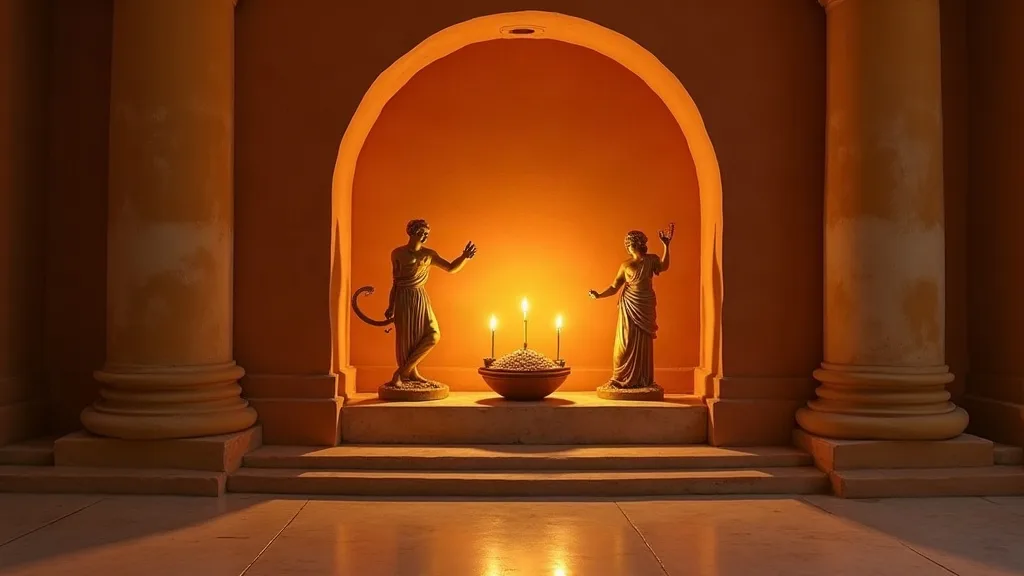
Every morning, before the first meal of the day, a Roman family paused at the lararium, the small shrine set into the wall or painted directly onto the plaster of their home. They offered a pinch of salt, a few grains of spelt, a garland of flowers, sometimes a drop of wine poured onto the floor. The figures watching from the shrine were not Jupiter or Mars. They were smaller gods. Closer gods. Gods who belonged to this particular house, this particular hearth, this particular family.
The Lares and Penates: Household Gods of Roman Religion were not remote powers seated on a marble throne. They were woven into the grain in the pantry, the fire crackling under the cooking pot, the crossroads at the end of the street. To ignore them was not impiety in some theological sense. It was closer to forgetting to feed your own children. Romans felt the presence of these gods as something immediate, practical, and deeply personal.
Roman literature from Plautus in the third century BC to Virgil and Ovid under Augustus treats these figures as constants of everyday life. Their cult was older than Rome itself, rooted in Italic soil before the city had walls or a Senate. Understanding them means understanding what religion actually felt like from the inside for most Romans, not the public spectacle of the Capitoline temples but the quiet flame on the household hearth.
Who Were the Lares? Guardians of Place and Family
The word Lares (singular: Lar) is one of the oldest words in Latin, and scholars have debated its origin for centuries. The most widely accepted view links it to an Etruscan root, reflecting the deep pre-Roman layer of Italian religion. Whatever its etymology, the word carried one clear meaning in practice: a protective spirit bound to a specific location.
The Lares came in several distinct categories, and Romans were precise about which kind they were invoking.
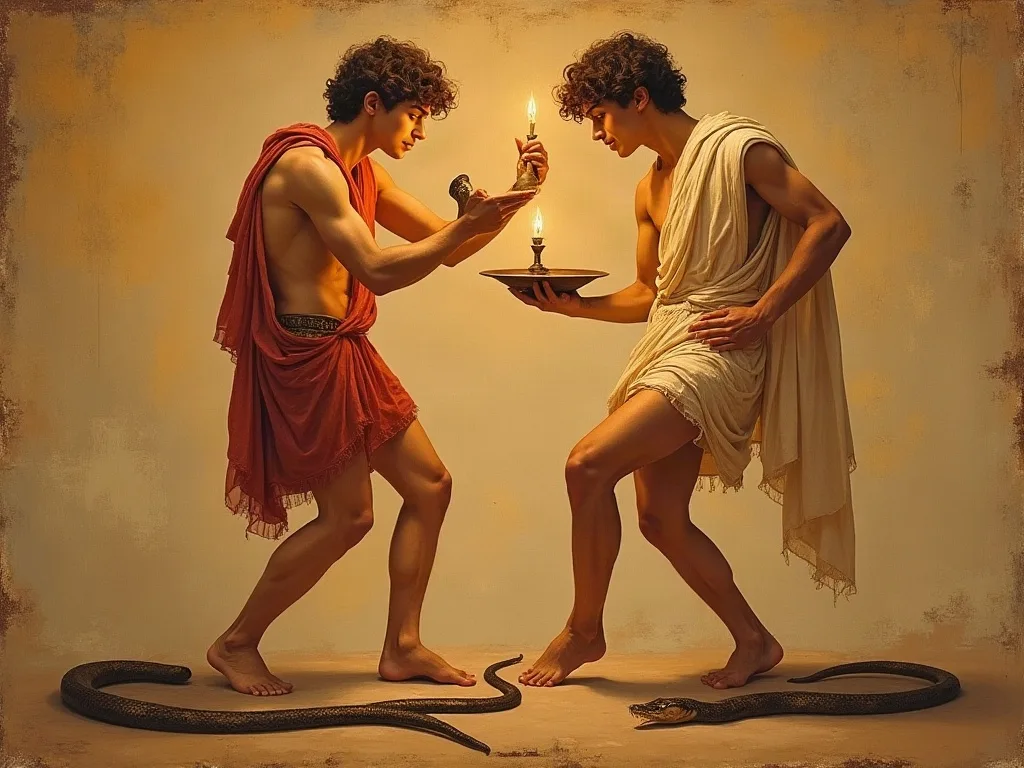
The Lares Familiares, the family Lares, presided over a single household. They are the ones depicted in Pompeian shrine paintings as two dancing young men in short tunics, holding a drinking horn and a patera (a shallow libation dish), with a snake often coiling below them. That snake was not a threatening symbol. In Roman domestic religion, the snake represented the fertile, protective life-force of the soil beneath the house.
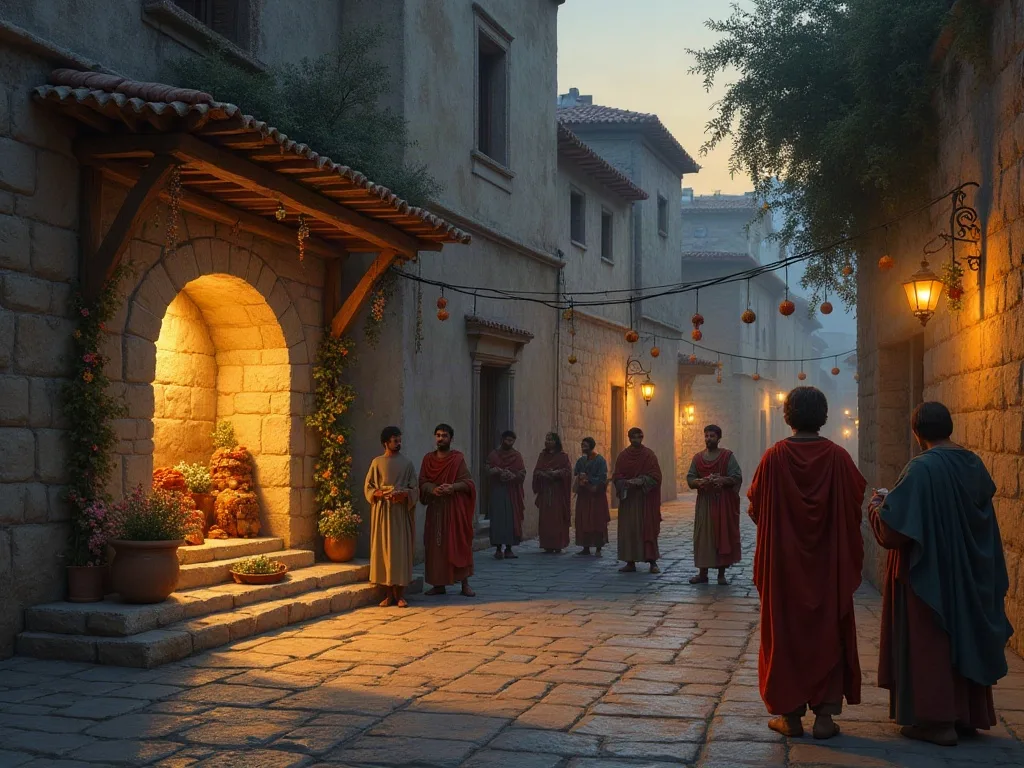
The Lares Compitales guarded the compita, the crossroads where the boundaries of several properties met. These Lares were neighborhood gods, shared by all the families whose land corners touched at a given point. Every year, at the festival called the Compitalia, neighbors gathered at the local crossroads shrine to offer sacrifices together. Plautus describes this festival with affectionate familiarity in his comedies. It was a community event, noisy and social, more like a street fair than a solemn ceremony.
Then there were the Lares Praestites, guardians of the entire city of Rome, and the Lares Augusti, a category Augustus himself created when he reformed the compital cults in 7 BC, linking neighborhood worship directly to the imperial household. That political move was brilliant: it plugged existing, beloved local religion into the machinery of imperial loyalty.
The Origin Stories: Ancestors, Spirits, or Something Older?
Ancient sources disagreed on where the Lares came from, and that disagreement is itself revealing. Ovid, in his Fasti (a poetic calendar of Roman religious festivals written around 8 AD), offers one of the most detailed accounts. He tells a story of Lara, a nymph who could not keep a secret. Mercury seduced her, and from that union came twin sons: the Lares. This myth is literary and relatively late, probably Ovid's own embroidery on older material. It makes the Lares simultaneously divine and earthy, born of a violation and a silenced woman, forever linked to thresholds and hidden spaces.
Older scholarly opinion, reflected in the antiquarian Varro (first century BC), suggested the Lares were originally the spirits of ancestors, specifically the spirits of the Roman dead who had been properly buried and who now protected the family line. This would connect them to the broader Roman category of the Manes, the shades of the dead, who were treated collectively as divine.
The truth is probably that both ideas are present in the cult, layered on top of each other over centuries. Romans were not systematic theologians. They accumulated meanings around religious forms rather than sorting them into clean categories.
Who Were the Penates? Gods of the Storeroom and the State
The name Penates comes directly from penus, the Latin word for the inner storeroom of a house, the place where the family kept its food supplies: grain, oil, dried figs, amphorae of wine. The Penates were the gods who kept that storeroom full. They guaranteed that the family would not starve.
The Penates were almost always depicted as a pair, two young male figures, often holding spears or cornucopias. Unlike the Lares, whose images were frequently painted or carved in place on the lararium, the Penates were portable. Families carried their Penates images with them when they moved. When a Roman soldier went on campaign, he took his Penates along. The gods traveled with the household because they were, in a precise sense, the household.
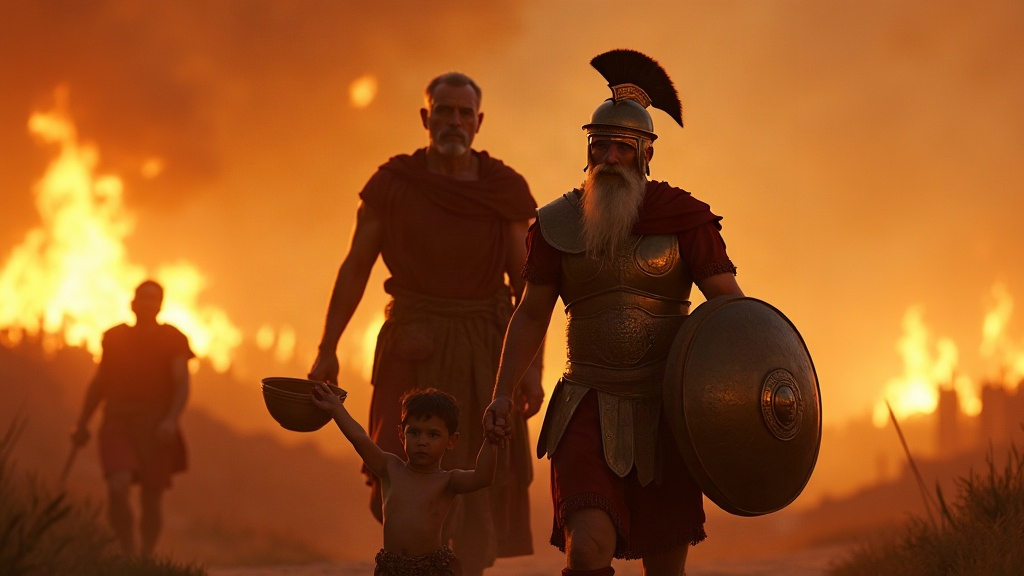
Virgil makes extraordinary use of this in the Aeneid. When Troy burns, Aeneas does not first grab weapons or gold. He grabs his father Anchises, his son Ascanius, and the sacred Penates of Troy. These three things, the elder generation, the next generation, and the divine protectors of the household, are what must survive if the family is to survive. Virgil is not being metaphorical. He is describing exactly what a Roman reader would have understood as the irreducible minimum of a household in flight.

The Penates of the Roman State
Here the cult takes on a dimension that modern readers might find surprising. Rome itself had state Penates, the Penates Publici Populi Romani, the Public Penates of the Roman People. These were kept in a sacred precinct on the Velian Hill in Rome, and tradition held that they had been brought from Troy by Aeneas himself.
This was not merely mythology. Roman priests, the pontifices, maintained the cult of the state Penates with the same seriousness they gave to the great Capitoline temples. The emperor was the paterfamilias, the head of the household, of the entire Roman state. His Penates were Rome's Penates. The domestic and the imperial were not separate registers of religion. They were the same register, scaled up.
Dionysius of Halicarnassus, a Greek historian writing in Rome around 7 BC, records that he actually visited the shrine of the Penates on the Velian Hill and saw the cult statues inside, described as two seated youths with spears. Whether these statues genuinely dated to the earliest period of Rome is impossible to verify. What matters is that Romans believed they did, and that belief structured how they understood the relationship between family, city, and divine protection.
The Lararium: Sacred Space Inside the Roman Home
The physical shrine is where domestic religion became tangible. Walk through the excavated houses of Pompeii today and you will find the lararia in kitchens, in atria, in entryways, painted on garden walls. Some are elaborate niches framed in carved stone. Others are simply a painted panel, a snake curling upward, two dancing Lares, and between them a central figure in a toga performing a sacrifice: the Genius of the paterfamilias, the generative spirit of the household head.
This triple image was standard. The Lares and Penates shared the shrine with the Genius, and together they formed a complete picture of what the household needed to function: protection from outside forces (the Lares), a full pantry (the Penates), and the continuing vitality of the family line (the Genius).
Offerings at the lararium followed a daily rhythm. The household made small offerings every morning. On the Kalends (the first of the month), the Nones (the fifth or seventh), and the Ides (the thirteenth or fifteenth), larger offerings were made, including garlands, incense, and honeycakes. On birthdays and wedding anniversaries, the family gathered formally at the shrine. When a slave was freed, the ceremony took place at the lararium. When a young man came of age and traded his bulla (a protective amulet worn from infancy) for the toga virilis of adult citizenship, the bulla was hung at the lararium as an offering.
The shrine was not decoration. It was a functional anchor for every significant moment in family life.
Vesta and the Hearth: The Fire That Connected Everything
The Lares and Penates cannot be fully understood without Vesta, the goddess of the hearth fire. She was not one of the domestic gods in the same sense, but she presided over the fire that physically connected them all.
Every Roman household maintained a hearth fire. If it went out, it was a bad omen requiring ritual action to restart it correctly. The hearth fire was the material presence of Vesta in the home, just as the great flame tended by the Vestal Virgins in the Forum Romanum was her presence in the city. The Lares stood at the edges of the space the hearth fire defined. The Penates kept the stores that feeding the household required. Vesta was the center point around which both cults orbited.
Cicero, in his speech Pro Domo Sua (57 BC), argues passionately that his house, which his enemies had consecrated to a deity to prevent his return, still belongs to him because the Lares and Penates of his household are still attached to it. His argument only works because his audience understood domestic religion as something legally and morally real, not just sentimental. The gods of the household were property, in a Roman legal sense. Destroying someone's lararium was an act of profound violation.
How the Compitalia Turned Neighbors into a Community
The Compitalia festival deserves its own moment here, because it shows something important: Roman household religion was not purely private. It spilled into the street.
The crossroads shrines, the compita, were maintained collectively. Each household that shared a boundary at a given crossroads contributed to the shrine's upkeep and participated in the annual festival. According to Dionysius of Halicarnassus, the celebration involved hanging a woolen doll for each free person in the household and a woolen ball for each slave, so the Lares could count their charges. This was both a census mechanism and an act of communal devotion.
The Compitalia was a festival in which slaves participated alongside free people, which was unusual in Roman religious life. The Lares Compitales, as protectors of the whole neighborhood rather than just the free family members, extended their care to everyone living under the roofs that touched their crossroads.
Augustus's reform of 7 BC reorganized these neighborhood shrines into 265 vici (districts) across Rome, each with its own magistrates, the vicomagistri, who were often freedmen. He added his own image to the crossroads shrines, alongside the Lares Compitales, and renamed them the Lares Augusti. It was a masterclass in using living, beloved religious practice as a vehicle for political integration.
The Penates in Virgil and the Myth of Trojan Origins
Virgil's Aeneid, composed between roughly 29 and 19 BC, is the fullest literary treatment of the Penates in Latin literature, and it is worth pausing on what Virgil does with them.
In Book Three, the Penates of Troy actually speak to Aeneas in a dream. They appear as two figures clothed in light and tell him that Italy, not Crete, is the land where he must found his city. They call themselves dii patrii, the gods of his fathers. They remind him that they were present at the fall of Troy, that they crossed the sea in the same ships, and that they will raise the city he builds to the stars. Virgil is making the Penates into agents of Roman destiny, not mere kitchen gods but the divine force that drives the whole Roman project from Troy to Augustus.
This move was not purely Virgil's invention. The connection between Aeneas, the Penates, and the founding of Rome was a staple of Roman historical memory going back at least to the third century BC. What Virgil did was give it its definitive poetic form, one that shaped how educated Romans understood their domestic cults in relation to their imperial mission for the next several centuries.
Aeneas carrying the Penates out of burning Troy is one of the most recognizable images in Roman art. It appears on coins, on relief sculpture, in paintings. The gesture of holding sacred objects while escaping disaster became a shorthand for Roman pietas, the combination of loyalty to gods, family, and state that Romans considered their defining virtue.
Decline, Survival, and Christian Transformation
The official end of the Lares and Penates as active cults came in stages. The Emperor Constantine's conversion in 312 AD shifted imperial patronage dramatically toward Christianity. His successors, particularly Theodosius I, banned pagan sacrifice in 391 AD. The public cult of the Lares Compitales and the state Penates lost their institutional support.
But domestic religion is harder to kill than official religion. The household shrine, the daily offering of food to protective figures, the idea that spiritual presences inhabit domestic space, these things persisted long after the official temples closed. Christian writers of the fourth and fifth centuries, including Augustine of Hippo in his City of God, devoted considerable energy to arguing against the Lares and Penates precisely because people were still taking them seriously.
What replaced the lararium, in many Italian households, was a niche with a statue of the Virgin Mary or a patron saint, candles lit daily, flowers offered on feast days. The structural logic is identical. A protective sacred presence, anchored to the home, honored through regular small acts of devotion, consulted at life's turning points. The names changed. The practice endured.
Archaeologists working in rural parts of central Italy have documented continuity of shrine placement across centuries, the same corner of the same room used first for a lararium, then for a Christian devotional niche, sometimes spanning fifteen hundred years of use.
Frequently Asked Questions About the Lares and Penates
Frequently asked questions
What is the difference between the Lares and the Penates?
The Lares were protective spirits tied to a specific place: the household, the crossroads, or the city. The Penates were tied to the household's food supply and followed the family wherever it moved. In practice, Romans often honored both together at the same shrine, and the terms were sometimes used interchangeably in casual speech, though technically they referred to distinct categories of divine protection.
Did every Roman family have a lararium?
Archaeological evidence from Pompeii strongly suggests yes. Shrines have been found in the smallest workshops, the back rooms of taverns, and modest apartments, not just in wealthy homes. The form varied enormously, from an elaborate painted niche to a simple shelf with a terracotta figurine, but the practice of maintaining some kind of domestic shrine appears to have been nearly universal across social classes.
Who were the Lares originally? Were they ancestors or nature spirits?
Ancient sources disagreed, and modern scholars still debate the question. Varro and other antiquarians linked them to the spirits of properly buried ancestors, connecting them to the broader Roman cult of the Manes (the honored dead). Others, following Ovid's Fasti, gave them a more mythological origin as the sons of the nymph Lara. The archaeological and linguistic evidence suggests they were originally spirits of the cultivated land, predating even the city of Rome, and that the ancestral interpretation was layered on later.
What was the Compitalia and how was it celebrated?
The Compitalia was an annual festival honoring the Lares Compitales, the guardian spirits of crossroads shared between neighboring properties. Celebrated in early January, it involved offerings at neighborhood crossroads shrines, the hanging of woolen figures to represent each member of the surrounding households, and communal feasting. It was unusual among Roman festivals for including slaves as active participants. Augustus reformed and expanded the festival in 7 BC, linking it to the imperial cult by adding the Lares Augusti to crossroads shrines across Rome.
How did Christianity affect the cult of the Lares and Penates?
Official bans on pagan sacrifice in the late fourth century AD ended the public, institutional forms of the cult. But domestic devotion proved far more resilient. Christian writers like Augustine criticized household cults because people continued practicing them. The structural pattern of the lararium, a protective sacred image in a domestic niche, honored daily with small offerings, appears to have survived into Christian practice in the form of household shrines to saints and the Virgin Mary, particularly in Italy.
Are there any surviving ancient lararia that visitors can see today?
Yes. The best preserved examples are in Pompeii, which was sealed by the eruption of Vesuvius in 79 AD. The House of the Vettii, the House of the Tragic Poet, and dozens of other excavated homes preserve painted lararia in situ, some with remarkable detail showing the two dancing Lares, the Genius, and the serpent. The Museo Nazionale Archeologico in Naples holds a large collection of bronze and terracotta Lar figurines recovered from Pompeii and Herculaneum.
Why the Smallest Gods Reveal the Most About Roman Religion
Scholars have long noted a paradox at the heart of Roman religious studies. We know far more about the grand public cults, Jupiter Optimus Maximus on the Capitoline Hill, the Vestal Virgins keeping the sacred flame, the elaborate rituals of the pontifex maximus, than we do about the religion most Romans practiced most of the time. Public religion was documented because it was politically significant. Domestic religion was documented only incidentally, in comedy, in poetry, in the occasional legal argument.
The Lares and Penates tip that balance. Because Pompeii preserved the physical evidence that texts alone cannot provide, we can see how ordinary Romans actually arranged their sacred spaces, what images they chose, where in the house they placed the shrine, how they integrated daily worship into cooking, eating, and sleeping. No other ancient city gives us this.
What emerges is a picture of Roman religion as something fundamentally relational. The gods of house and crossroads were not distant powers to be propitiated with elaborate rituals performed by specialists. They were presences to be maintained through consistent, affectionate attention. A daily pinch of salt. A garland of wildflowers. A cup of wine at a festival. The relationship required showing up, every day, in the ordinary run of life.
That is, in the end, what made these the most Roman of all Roman gods. Roman mythology was built outward from this center: the hearth, the stored grain, the threshold, the crossroads where neighbors met. The Olympians borrowed their grandeur from Greece. The Lares and Penates grew from Italian soil, and they never left it.
Free 25-page sample
Want the whole story?
Take the first 25 pages free. If it pulls you in, the full edition is yours as an instant PDF download, with a paperback on Amazon for selected titles.
Roman
The Roman Mythology Book: Jupiter, Mars, Venus, the Aeneid, and the Sacred Stories That Built an Empire
Jupiter, Mars, Venus, the Aeneid, and the Sacred Stories That Built an Empire
The complete guide to Roman mythology from Virgil's Aeneid to Ovid's Fasti. Every god, every founding myth, every Vestal rite.
More from Roman
All articles
Roman
Romulus and Remus: The Myth of Rome's Foundation
The twin sons of Mars raised by a she-wolf; a fratricide, a city, and an empire. How Rome's founding myth shaped the identity of Western civilization's greatest power.
Roman
Aeneas and the Founding of Rome: The Aeneid's Sacred Narrative
Virgil's Aeneas carries Troy's fate to Italy, writing Rome's origin in blood and duty. Discover how the Aeneid transformed a hero's journey into a nation's sacred story.

Roman
Venus: Goddess of Love and Ancestor of the Roman People
Venus was Rome's goddess of love, fertility, and military victory. But she was also the divine ancestor of the Roman people through her son Aeneas. Discover how this single goddess embodied Rome's most powerful myths about its own origins.

Roman
Mars: Roman God of War, Agriculture, and the Father of Rome
Mars was no mere god of bloodlust. The Roman war god fathered Romulus, blessed the harvest, and embodied the discipline that built an empire. Discover how Rome's greatest god shaped both sword and soil.