

The Sibylline Books: Rome's Prophetic Texts
The Sibylline Books were Rome's most sacred and secretive oracles, consulted only by officials in times of crisis. Discover how these cryptic prophecies shaped the fate of empires and survived burning only to vanish forever.
Contents
On a morning in the sixth century BCE, a strange old woman appeared at the gates of Rome carrying nine scrolls. The king turned her away. She burned three in a fire and returned with six, demanding the same price. He refused again. She burned three more and offered the final three at the original sum. Terrified by her cryptic power, the king bought them. Those three books, legend says, became the Sibylline Books: Rome's most sacred and secretive texts, consulted only when the city faced annihilation.
No Roman citizen ever read them freely. Only the quindecimviri sacris faciundis, a college of priests, held the keys to these prophecies. When plague ravaged the streets, when the gods seemed silent, when armies marched toward Rome's walls, the Senate sent these keepers into a locked sanctuary. There, by candlelight, they would consult the scrolls and return with instructions: appease this deity, perform that ritual, build this temple. The books shaped religious decisions that altered the empire's course. Yet by the time of late antiquity, no one remembered what they contained. Fire and time had erased Rome's most powerful oracle.
The Legend of the Sibyl and the Nine Books
The woman at Rome's gate was no ordinary prophet. She was the Sibyl of Cumae, or so the story goes. In Greek mythology, sibyllai (sibyls) were females seized by divine frenzy, their minds flooded with prophecy. The Sibyl of Cumae lived in a cave near Naples, where visitors descended seeking knowledge of the future. Aeneas himself consulted her in Virgil's Aeneid, the epic that bound Troy's founding to Rome's destiny. She did not speak in clear words but in fragments and riddles, utterances that priests had to interpret like puzzle pieces.
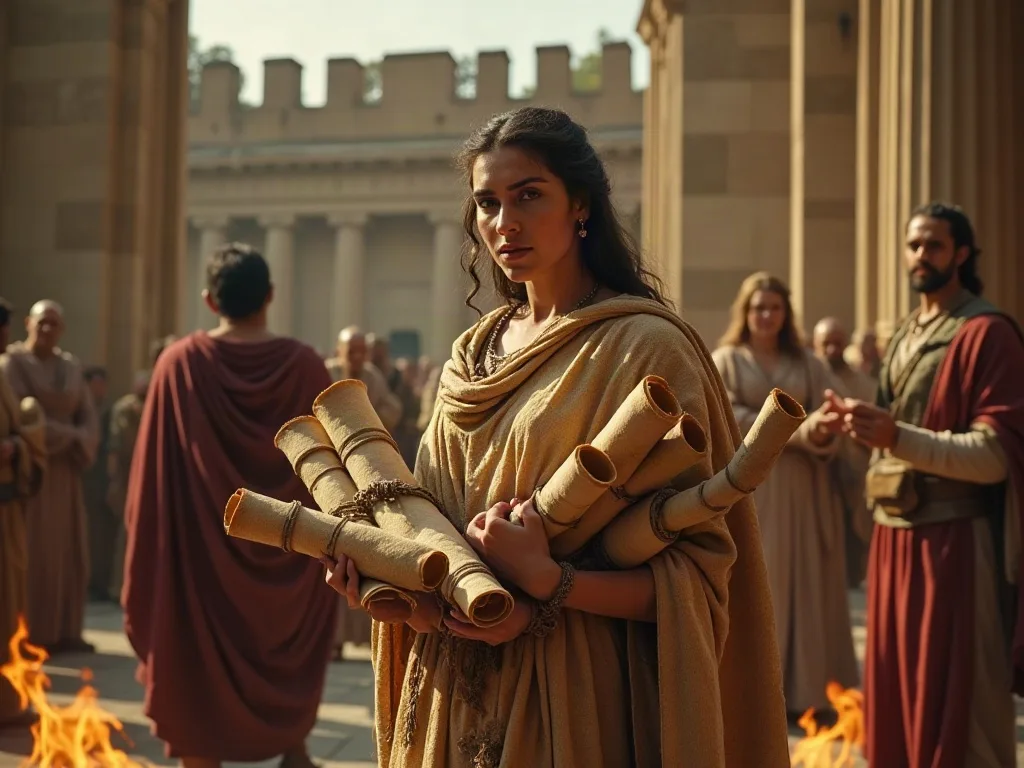
The offering of the books follows a pattern both Roman and ritualistic. The Sibyl comes bearing nine scrolls. The king refuses three times, each refusal met with fire. On the third approach, the king relents. The number three appears throughout Roman religious practice: the three major flamens (chief priests), the three centuries of knights, the three Fates who spin human destiny. The Sibyl's refusal to negotiate and her steady reduction of the price suggest not commerce but ordination; by purchasing the books at last, the king accepts his burden as Rome's protector.
Livy, the great Roman historian writing centuries later, recorded this legend with measured tone. He knew it sounded impossible. Coins were minted by Augustus commemorating the Sibyl, stamped with her image and the sacred scrolls. The story itself mattered more than its historical truth. It explained why these books commanded such fear and reverence. They were not compiled by priests or written by scholars. They fell into Rome from divine will, bought at terrible cost, preserved by a woman who vanished after delivering them.
The Collection and Curation of Prophecies
What did the Sibylline Books actually contain? Few Romans knew for certain. The scrolls held prophecies written in Greek, not Latin, a reminder that Rome's religious inheritance came from the east and south, from the Greeks and Etruscans whose wisdom preceded the wolf-nursed city by centuries. The texts were fragmentary, obscure, full of symbolic language: a king with a lion's heart would fall; a plague of black wings would cover the sky; when the fields bleed no wine, sacrifice to the chthonic deities.
The quindecimviri functioned as translators and interpreters. When the Senate brought a crisis to them, these priests did not prophecy anew. They consulted the old books, searching for passages that addressed the present calamity. If the Tiber flooded and people died in the waters, priests would search the scrolls for any mention of rivers and drowning. If a comet appeared in the sky, they would hunt for astronomical omens. The books were Rome's library of divine warning, and each consultation was an act of archaeological divination: reading the past to understand the present.
The collection grew over time. Not all of the books dated to the Sibyl's original offering. Priests added later prophecies, texts they believed came from sibylline sources or matched the ancient style. By the late Republic, the collection had expanded to fifteen volumes, though the total number of actual prophecies numbered in the thousands. Some scrolls dealt with specific crises: what to do if a temple burned, how to appease Juno if she grew wrathful, which god required a new cult. Others addressed fate itself: Rome's duration, the end of an empire, the trials of her greatest generals.
When Rome Consulted the Oracle
The Romans did not consult the Sibylline Books lightly. It was an act of desperation, a public admission that the ordinary gods were not answering. The Senate authorized the consultation only in extremity.
In 249 BCE, during the First Punic War with Carthage, the Roman fleet suffered a catastrophic defeat at the Battle of Drepana. Two hundred ships sank. Thousands of sailors drowned. The general fled in shame. Rome's naval power seemed broken. The Senate turned to the quindecimviri. The priests consulted the books and returned with a stark instruction: the gods demanded new temples. Build them immediately, conduct elaborate sacrifices, and only then would victory return. The Romans obeyed. They constructed sanctuaries, slaughtered animals, poured wine across altars. Within years, they defeated Carthage. The prophecy had come true, or so it seemed.
In 191 BCE, an outbreak of plague gripped the city. People fell ill with sudden fever. Children died. Physicians offered no cure. The Senate again approached the priests. The books spoke of an ancient god, one whom Rome had neglected. The goddess Plebs required a temple; the god Apollo demanded games. The Romans built the temple, established the Ludi Apollinares (games of Apollo), and the plague receded. Whether divine intervention or natural course, the prophecy seemed confirmed.
Most famous was the consultation during the Second Punic War, when Hannibal marched toward Rome itself. After the Roman defeat at Cannae, the worst military catastrophe in Roman history, the city teetered on the edge of collapse. The general Hannibal camped within sight of Rome's walls. The Senate authorized the most elaborate consultation on record. The priests emerged with a directive so shocking that it violated Roman custom: Rome must perform a human sacrifice. Two Gauls and two Greeks must be buried alive in the Forum Boarium, the cattle market. It was a horrifying break from tradition; Rome did not kill humans for the gods, that was the practice of barbarians. Yet the Senate ordered it done. Weeks later, Hannibal withdrew. Once again, the prophecy had worked.
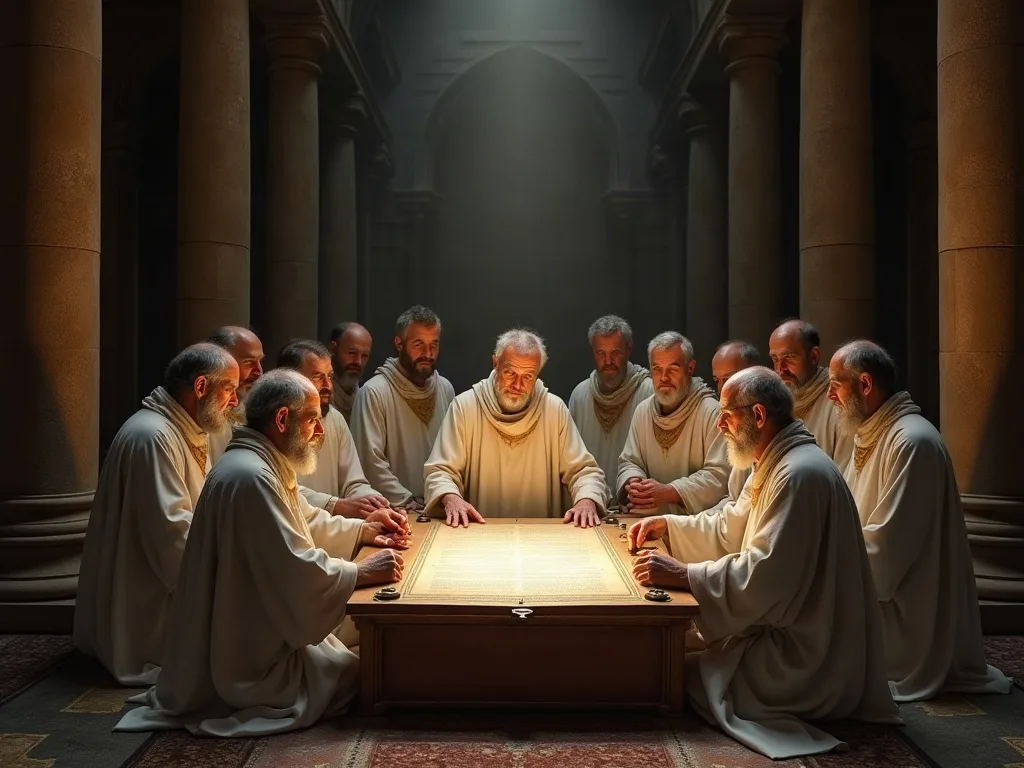
These consultations reveal the psychological function of the Sibylline Books. They did not predict the future with certainty. Rather, they gave Rome's leadership a framework for action in chaos. When catastrophe struck and ordinary priests could offer no guidance, the Sibylline Books provided divine authorization for extreme measures. They allowed the Senate to act decisively and claim divine backing. They transformed crisis into ritual, terror into orderly ceremony.
The Burning and the Loss
The Sibylline Books survived for over eight centuries, consulted in war and plague, preserved in a locked sanctuary on the Palatine Hill. Then, in 83 BCE, civil war convulsed Rome. The general Sulla marched on the city to seize power from his rival Marius. Buildings burned. Temples fell. In the chaos, the sanctuary of the quindecimviri caught fire. The scrolls were destroyed.
The loss was irreplaceable. The Romans felt the wound immediately. How could they continue without the ancient prophecies? Priests searched through rubble and salvaged a few charred fragments, but most was ash. The Senate authorized an expedition to Greece and Asia Minor to collect new prophecies, texts supposedly descended from the same sibylline tradition. They returned with scrolls gathered from various temples and oracles. These new books were installed in a new sanctuary, yet everyone knew they were not the originals. The authority had been broken.
Over the following centuries, later emperors consulted the replacement books, but their power had dimmed. By the time of the late empire, as Christianity spread and the old religion faded, the books lost all function. They were not destroyed; Rome's pagan temples were not immediately demolished under Christian rule. But no one consulted them. The quindecimviri ceased their interpretations. The prophecies went unread.
In the 400s CE, as Rome itself fell to barbarian invasion and Christianity became the state religion, the books vanished entirely. A few scholars believe they were deliberately burned by Christian authorities to erase the last symbol of pagan prophecy. Others suggest they simply rotted in neglect, scrolls crumbling to dust as the world they had guided turned to ashes. By the time the medieval period began, no one knew where they had gone. Their content was lost. Only fragments quoted by Livy, Dionysius of Halicarnassus, and other ancient writers remained.
The Priesthood of Keepers
The men who guarded the Sibylline Books held extraordinary power without official rank. They were not magistrates or generals. Yet when they spoke, the Senate listened. The college of the quindecimviri (literally "the fifteen men for sacred matters") was one of Rome's most exclusive priesthoods, and membership was a career pinnacle for aristocrats.
These were not full-time priests in the way of temple attendants. A quindecimvir was typically a senator or knight, a man of political influence who accepted the responsibility alongside other offices. He might serve for decades. He wore special robes when consulting the books. He was required to maintain ritual purity, which meant avoiding certain foods, certain ceremonies, even certain types of contact with the dead.
Membership was so coveted that emperors used it as a reward for loyalty. Augustus enrolled himself as a quindecimvir and, later, as the college's prefect, consolidating spiritual authority with temporal power. If a man wanted to reach the highest echelons of Roman society, holding this priesthood was invaluable. It proved his connection to the divine will. It marked him as a steward of Rome's sacred destiny.
The priesthood also attracted ambitious men willing to manipulate interpretation. A clever quindecimvir could read the books in ways that served his political interests. If a certain general was the Senate's favorite, that general's campaigns might be supported by favorable readings of the prophecies. If the current regime needed religious legitimacy, the books could be consulted to provide it. This ambiguity was part of their power. The prophecies were cryptic enough that multiple interpretations existed, and the priests' authority lay partly in choosing which reading served Rome best.
The Sibyl's Prophecies and Roman Destiny
One prophecy repeated in ancient sources concerned Rome's founding and duration. The Sibyl supposedly said that Rome would last one thousand years. This number haunted Romans throughout the imperial period. When would that millennium end? Would Rome fall to invasion? Would the gods abandon the city? Would a new power rise? The prophecy gave Rome a kind of temporal boundary, an expiration date stamped by fate itself.
Another cluster of prophecies dealt with specific generals and emperors. Some sources claim the books predicted Pompey's civil war with Caesar, though no original text survives to confirm this. Others suggest they foretold Augustus's rise to power, or that later emperors consulted them hoping to find their own names written in the ancient pages. Each era seemed to find prophecies that reflected its anxieties and ambitions.
The most obscure prophecies concerned foreign lands and distant peoples. The books apparently contained references to Parthia, that eastern empire that Rome's armies could never fully conquer. They spoke of kings with unpronounceable names, of wealth flowing from the ends of the earth, of a time when Roman power would be tested by rivals Rome had never encountered. To modern readers, these passages might sound like vague generalizations that could apply to almost any foreign threat. To Romans living centuries after the prophecies were written, they seemed like proof that the ancient Sibyl had foreseen all of history.
The Fate of the Texts: Historical versus Legendary
Scholars debate the Sibylline Books' true origin. The legend of the old woman at Rome's gates is almost certainly fictional, a story created centuries later to explain how Rome acquired these powerful oracles. Rome did possess a collection of prophetic texts; that much seems historical. But did they come from a single Sibyl in Cumae? Did they number exactly three after the third burning? Did the original nine later expand to fifteen?
Most historians believe the collection was assembled piecemeal. Rome may have acquired some genuine Greek prophetic texts, fragments from various sibyls or oracular sources, and these formed a nucleus. Priests then added later material, prophecies they believed fit the sibylline tradition or that addressed current needs. Over generations, the collection grew into an archive of religious law and prophecy both, a sacred text that combined the force of oracular utterance with the authority of written law.
The Sibylline Books existed in a strange space between Scripture and statute. They were not holy text like the Vedas or the Torah, composed by divine revelation and handed down unchanged. They were not civic law like the Twelve Tables, created by legal deliberation and open to public scrutiny. They were something hybrid: prophecies written in code, interpreted by a closed priesthood, consulted only in extremity, binding on the Senate's will yet fully transparent only to the quindecimviri themselves.
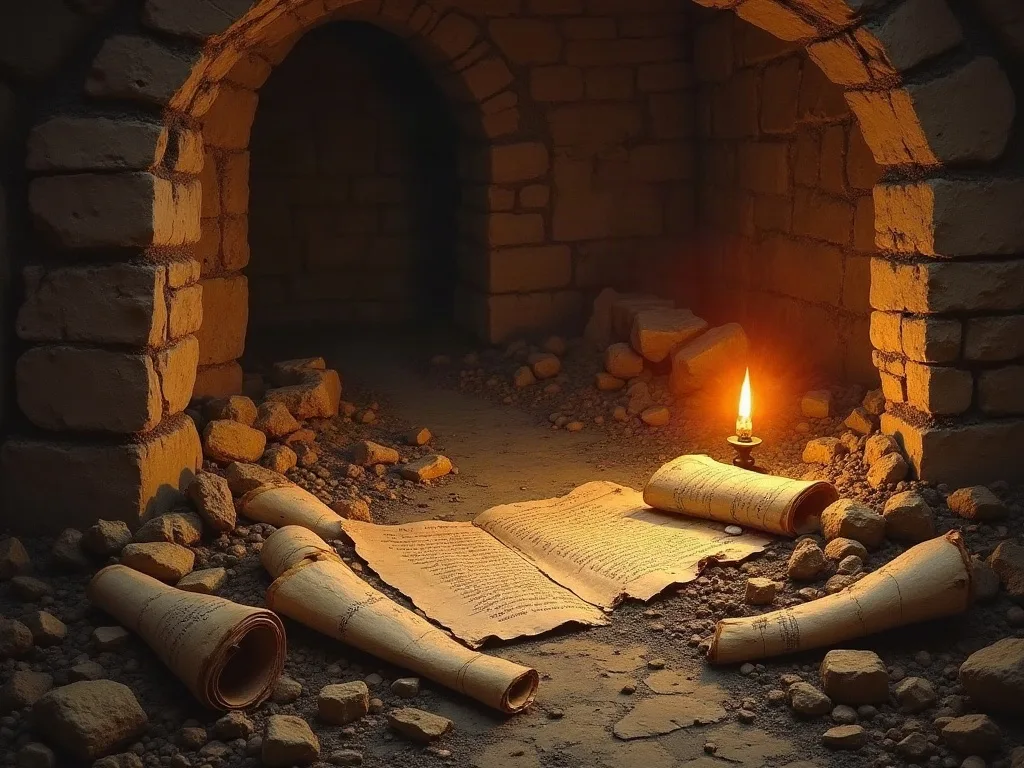
This hybrid nature gave them immense power. Because no one could read them freely, they remained perpetually mysterious. A prophecy's meaning could shift based on interpretation. The books seemed to confirm whatever policy the priesthood endorsed. They functioned as a tool of religious authority, a way for Rome's spiritual elite to guide the state while claiming to speak only for the gods.
The Sibylline Books and Later Prophecy Literature
After the original Sibylline Books were lost, fragments of their content survived in later texts. The Sibylline Oracles, a collection of Jewish and Christian prophecies written between 150 BCE and 180 CE, were falsely attributed to the ancient Sibyl. These later works borrowed the name and the style, creating a kind of literary echo of the lost authority. They were prophecies framed as if they came from the same source as Rome's sacred books, though they actually contained very different content shaped by Jewish and Christian concerns.
This shows how powerful the Sibylline Books' reputation remained. Even after the original scrolls vanished, later writers and religions tried to claim the Sibyl's authority for their own prophecies. If something was attributed to the Sibyl, it carried weight that an anonymous prophecy never could.
Medieval and Renaissance scholars, when they encountered references to the Sibylline Books in classical texts, felt a deep sense of loss. Here was an oracle as influential as Delphi, as mysterious as the Oracle of Amun, yet completely inaccessible. The originals were gone. Only quotations remained. The scholarly imagination filled the gap, speculating endlessly about what wisdom they might have contained, what secrets they might have revealed about Rome's future.
Consultation, Interpretation, and Political Will
The process of consulting the Sibylline Books was more ritual than research. When the Senate authorized a consultation, the quindecimviri did not simply open the scrolls and read prophecies aloud. The process was formal, choreographed, laden with ceremony.
The priests would enter the sanctuary dressed in special robes. They would make offerings to the gods. They would articulate the crisis before the books: "The city suffers plague. What must we do?" Then they would search through the scrolls, looking for passages that addressed disease, divine anger, or purification. What they found would be interpreted, discussed among the priesthood, and finally rendered as a recommendation to the Senate.
This process left room for judgment and interpretation. If multiple passages seemed relevant, which one took precedence? How was an obscure prophecy best understood? Could one passage override another if they seemed contradictory? The quindecimviri possessed the authority to answer these questions, and their answers shaped Rome's response.
In some cases, the books may have genuinely offered wisdom grounded in centuries of accumulated religious knowledge. A passage about purification rituals for plague might contain practical advice: isolation of the sick, proper burial of the dead, restoration of public morale through ceremony. The "prophecy" would work not through magic but through sound policy cloaked in divine language.
In other cases, the interpretation seems transparently political. When a general needed the Senate's support for a dangerous campaign, a favorable reading of the books could mobilize religious backing. When an unpopular policy needed legitimacy, a convenient prophecy could be consulted. The system allowed for both genuine religious guidance and deliberate manipulation, and historians cannot always distinguish between the two in individual cases.
Frequently asked questions about the Sibylline Books
Frequently asked questions
Did the Romans believe the Sibylline Books were genuinely prophetic?
Most Romans seem to have held them in awe without knowing their content, which made belief easier. The books' power rested partly on mystery. Officials credited them with accurate predictions when events aligned with their readings and forgot the failures. Like all prophecy systems relying on interpretation, they were unfalsifiable; any outcome could be read as confirming them.
What exactly did the Sibylline Books say about Rome's future?
We don't know with certainty because the originals were destroyed. Ancient writers quoted fragments referring to Rome's duration (one thousand years), foreign threats (especially Parthia), and divine trials. Most of these fragments are too vague to tell us what the actual full texts contained. They may have been much more specific, or much more generic, than later quotations suggest.
Were the Sibylline Books destroyed intentionally by Christians?
Possibly, but we lack definitive evidence. Christian authorities did suppress pagan religious practices in the late empire, so deliberate burning cannot be ruled out. However, they may have simply been neglected and lost to time. By the time Christianity became dominant, the books were already centuries old and no longer consulted, making deliberate destruction seem unnecessary.
How did the priesthood decide what the books meant?
The quindecimviri used a kind of interpretive method: when the Senate posed a problem, priests searched the scrolls for relevant passages, discussed their meaning, and rendered an opinion. Because the prophecies were written in cryptic language, multiple interpretations were possible. The priesthood's authority lay in choosing the interpretation they deemed most sound, which sometimes aligned conveniently with powerful interests.
Were there other oracles like the Sibylline Books in Rome?
Rome consulted many oracular sources: the Oracle of Apollo, haruspicy (reading animal entrails), augury (reading bird flight), and the counsel of individual seers. But the Sibylline Books held unique status as a permanent written archive of prophecy, officially sanctioned and consulted only by the highest authorities. Other oracles were consulted more freely and by more people.
The Legacy of Lost Prophecy
The destruction of the Sibylline Books marked the end of an era. Rome lost not just a collection of texts but an entire system of religious authority grounded in mystery and interpretation. Later attempts to replace them never carried the same weight. The Christian empire had no need for pagan prophecy. The medieval world looked to Scripture and saints for divine guidance, not to burned scrolls and forgotten priesthoods.
Yet the idea of the Sibylline Books lived on in Western imagination. Renaissance scholars, fascinated by classical antiquity, lamented the loss of these volumes. Poets and philosophers speculated about what secrets they had held. The Sibyl herself became a figure of literary fascination; Dante placed her in his Divine Comedy speaking prophecy from beyond death. The image of an ancient woman guarding divine secrets seemed to capture something eternal about human longing for certainty about the future.
In the end, the power of the Sibylline Books rested on what Rome did not know. The books guided imperial policy, shaped religious practice, and influenced the fate of millions not because their prophecies were clear but because they were obscure. The priesthood's interpretation carried authority precisely because the underlying text remained hidden. When the books burned and the priesthood's monopoly on their meaning ended, their power shattered. Rome had learned, perhaps too late, that prophecy derives as much from mystery as from truth.
Free 25-page sample
Want the whole story?
Take the first 25 pages free. If it pulls you in, the full edition is yours as an instant PDF download, with a paperback on Amazon for selected titles.
Roman
The Roman Mythology Book: Jupiter, Mars, Venus, the Aeneid, and the Sacred Stories That Built an Empire
Jupiter, Mars, Venus, the Aeneid, and the Sacred Stories That Built an Empire
The complete guide to Roman mythology from Virgil's Aeneid to Ovid's Fasti. Every god, every founding myth, every Vestal rite.
More from Roman
All articles
Roman
Romulus and Remus: The Myth of Rome's Foundation
The twin sons of Mars raised by a she-wolf; a fratricide, a city, and an empire. How Rome's founding myth shaped the identity of Western civilization's greatest power.
Roman
Aeneas and the Founding of Rome: The Aeneid's Sacred Narrative
Virgil's Aeneas carries Troy's fate to Italy, writing Rome's origin in blood and duty. Discover how the Aeneid transformed a hero's journey into a nation's sacred story.

Roman
Venus: Goddess of Love and Ancestor of the Roman People
Venus was Rome's goddess of love, fertility, and military victory. But she was also the divine ancestor of the Roman people through her son Aeneas. Discover how this single goddess embodied Rome's most powerful myths about its own origins.

Roman
Mars: Roman God of War, Agriculture, and the Father of Rome
Mars was no mere god of bloodlust. The Roman war god fathered Romulus, blessed the harvest, and embodied the discipline that built an empire. Discover how Rome's greatest god shaped both sword and soil.