
Vladimir the Great and the Christianization of Rus: When a Pagan Empire Chose Christ
In 988 CE, Vladimir the Great made a choice that reshaped Eastern Europe forever. Discover how a warrior prince abandoned the old Slavic gods and baptized an entire empire, triggering a spiritual and political earthquake that echoes through history.
Contents
A Pagan Warrior Turned Christian Emperor
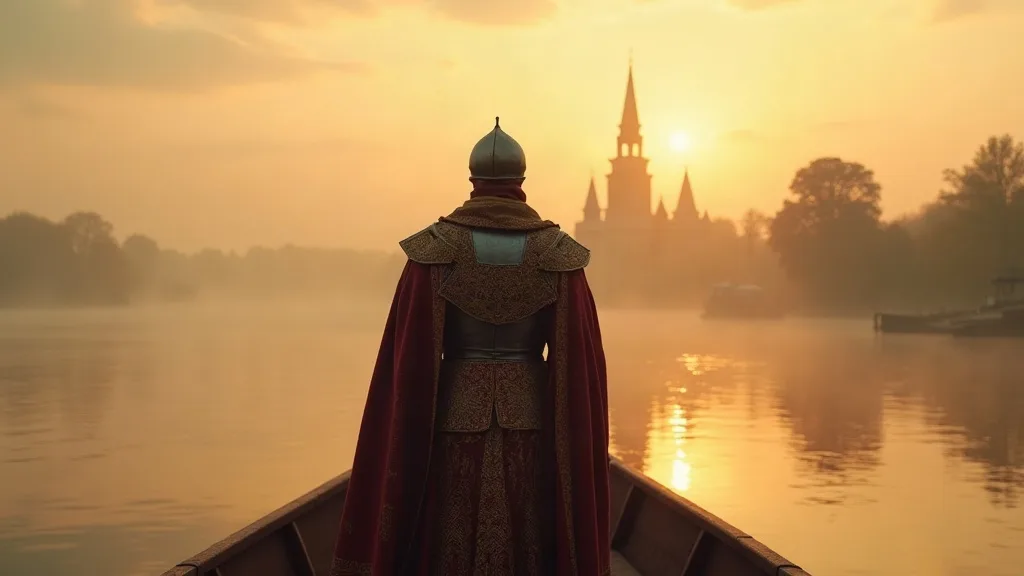
Vladimir the Great was not born a Christian. He was born into blood and thunder, heir to a confederation of Slavic princes who worshipped forces older than Rome itself. By the time he stood at the bow of a boat crossing the Dnieper River in 988 CE, ready to baptize himself and transform his kingdom, he had already won battles, murdered brothers, and ruled over a pagan Rus that stretched across the forests and steppes of Eastern Europe. What changed in the mind of this warrior prince was not weakness, but a calculation of power.
The choice he made that day in the river water was not a sudden conversion sparked by mystic vision. It was a political gambit of extraordinary audacity. Vladimir had conquered the Byzantine city of Cherson in the Crimea (then called Kherson). In exchange for returning it, the Byzantine Emperor Basil II offered him the hand of his sister, Anna. But there was a condition: the Rus prince must be baptized first. For a man like Vladimir, religion and statecraft were not separate things. He saw in Christianity the language of imperial power, the pathway to legitimacy on the world stage. And so he took it.
The Slavic Gods Before the Cross
To understand Vladimir's choice, we must first meet the gods he abandoned. The religion of pre-Christian Rus was rooted in the Slavic pantheon, a rich cosmos of divine forces tied to the rhythm of agriculture, warfare, and the natural world. Perun, the thunder god armed with an axe, sat at the apex of this hierarchy, much as Zeus ruled Mount Olympus or Indra commanded the Vedic sky. He was the patron of warriors and princes, the one who made oaths binding and protected the sovereignty of rulers.
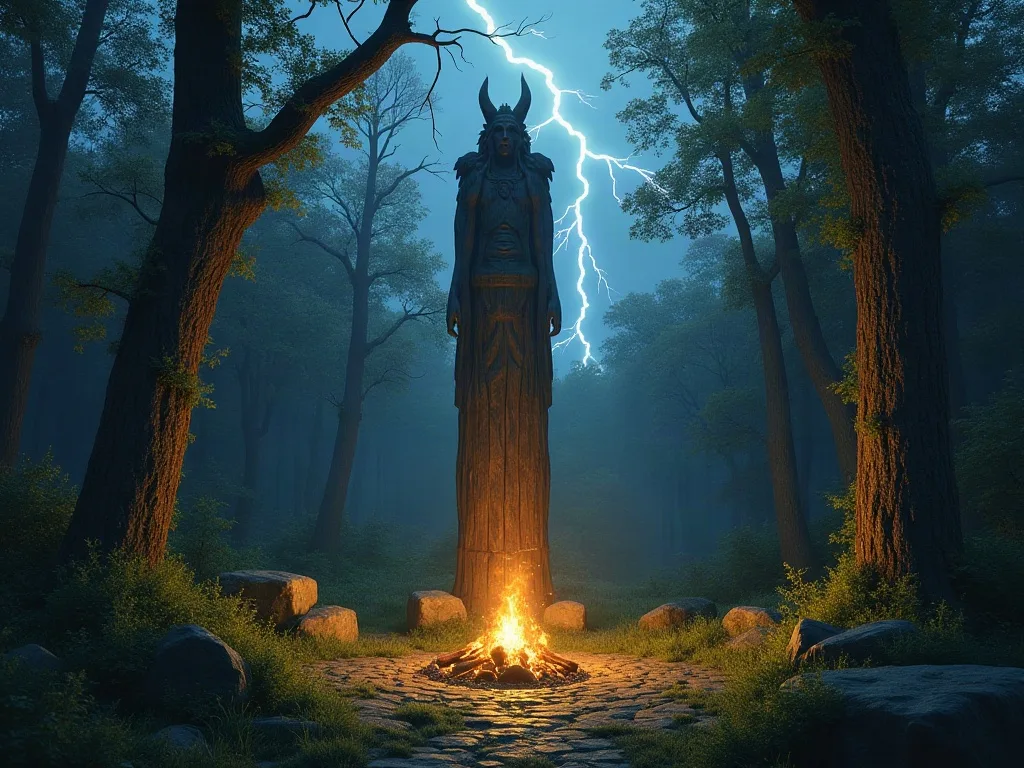
Beside Perun stood Veles, a shape-shifting god of death, the underworld, cattle, and magic. While Perun represented order and the upper realms, Veles embodied the wild, chthonic forces beneath the earth. Many scholars see in their relationship an eternal duality: the struggle between upper and lower worlds, between order and chaos. In the Slavic worldview, both were necessary.
Other deities inhabited this cosmos. Dazhbog brought the warmth of the sun and connected mortals to their ancestors. Stribog moved through the winds. Morana, a figure of winter and death, embodied the cycle of decay that made renewal possible. These were not abstract symbols; they were woven into daily ritual, into oaths sworn, into the timing of harvests and the preparation for war.
The worship of these gods was not confined to temples in the classical sense. The Slavs maintained sacred groves, spaces of old forest where priests called volkhvy performed rites and divination. When Perun was honored, a sacred fire was kindled; when oaths were sworn, they were sworn before his image. These gods were alive in the landscape itself, in rivers and stones and the wood of ancient trees.
The Crisis of the 980s
By the time Vladimir came to full power in the 980s, Rus was already feeling pressure from two great faiths. Islam had spread north through the Khazars and along the Volga. Christianity pressed westward from Rome and south from Constantinople. The princes of Rus, pragmatic men, watched these expansions with the keen eye of traders observing market currents.
Vladimir himself had initially made a gesture toward the old gods that revealed how deeply politics and religion were entwined. According to the chronicles, he reorganized the pantheon and elevated Perun above all others, even constructing a new idol of the god overlooking Kiev. This was not piety; it was statecraft. By centralizing worship around Perun, Vladimir was attempting to unify his fractious nobility under a single symbol of authority.
But the old gods had a problem that neither Islam nor Christianity faced: they were local, rooted in particular places and tribes. A Polane farmer and a Varangian warrior might both invoke Perun, but their understanding of him, the language of his worship, the rituals that pleased him, differed subtly. The old Slavic religion had no universal priesthood, no scripture transcribed in a single language that could bind an empire together. It had no emperor-cult apparatus, no established diplomatic precedent linking it to the great civilizations of the Mediterranean and the Silk Road.
The Conversion Decision
Sometime around 986 CE, Vladimir called together his boyars (nobles) and posed a question: which faith should Rus embrace? The chronicles record the conversations that followed. Muslim envoys spoke of Islam but mentioned that the faith forbade wine and pork. Vladimir, the story goes, dismissed them outright. A religion without wine, he said, was no religion for a warrior people. Jewish envoys from the Khazar sphere presented their case, but Vladimir noted that they were homeless, their temple destroyed, their people scattered. Why follow a god who could not protect his own land?
Christian envoys arrived from both Rome and Constantinople. The Byzantine missionaries, representing Orthodox Christianity, spoke of the majesty of Constantinople and the glory of its churches. They told of a faith linked to the greatest power in the Christian world. The detail mattered. Vladimir was not asking which God was truest in some abstract sense. He was asking which faith would make Rus powerful, which would bind it to the wider world, which would give him legitimate authority both at home and abroad.
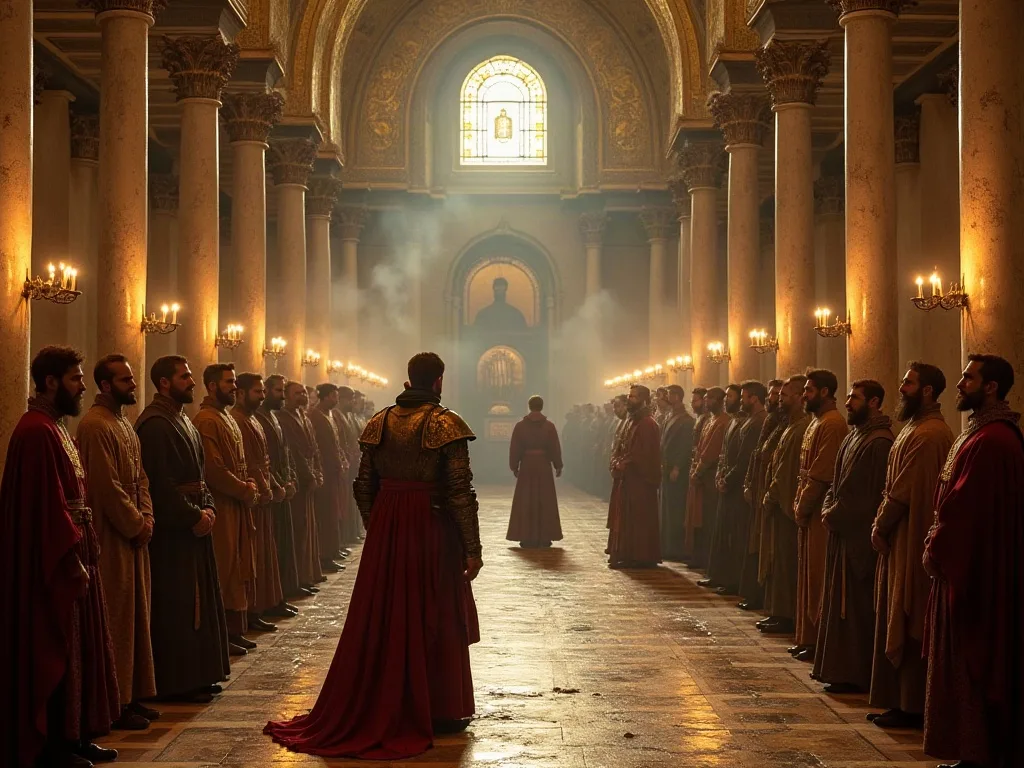
The chronicles describe a deputation of boyars being sent to Constantinople itself to witness the liturgy of the Hagia Sophia. They returned overcome. According to the Primary Chronicle, a key text written down after the conversion, they reported that they did not know whether they stood in heaven or on earth, so beautiful was the experience. Whether this meeting truly happened as described or is a later literary embellishment, the point is clear: Constantinople offered not just theology but spectacle, art, and the intoxicating sense of participating in something vast and enduring.
The River Baptism and Its Aftermath
In the summer of 988, Vladimir crossed the Dnieper and was baptized. The ceremony was not quiet or private. It was a public act, a dramatic reversal made visible to the entire population of Kiev. Priests performed the rite with Byzantine formality. Icons were introduced. The baptistry, once a place of pagan sacrifice, was consecrated as a Christian church. Perun's statue was brought down, dragged through the streets, and hurled into the river, a symbolic violence that showed the old order was finished.
The conversion was not instantaneous or total. Pagan practices persisted in the villages and forests for centuries. Slavic mothers still left offerings to household spirits. Farmers still made gestures to the sun at planting. The wise women, the znakharki, continued their work with old incantations and herbal knowledge. But at the level of state authority, at the court, in the great churches that began to rise in Kiev and Novgorod, Christianity had won.
Vladimir himself took the Christian name Basil. He married Anna, the Byzantine princess. He began to build churches with the fervor of a convert, commissioning the Desyatinnaya Church (the Church of the Tithes) in Kiev as a monument to his new faith. He distributed wealth to the poor, ordered the destruction of pagan idols throughout his realm, and invited Byzantine priests to establish a church hierarchy in Rus. These were not the hesitant gestures of a man uncertain in his faith. They were the aggressive moves of a ruler consolidating power through a new religious apparatus.
The Political Architecture of Conversion
Vladimir the Great and the Christianization of Rus was not simply a religious event. It was a political architecture of extraordinary sophistication. By adopting Christianity, Vladimir accomplished several things at once.
First, he legitimized his rule through connection to Byzantium, the great power of the medieval world. A prince who converted at Byzantine command was a prince who accepted a place in the Christian international order. This mattered for diplomacy, for trade, for the prestige of his court. Merchants now saw Kiev not as a pagan outpost but as part of a Christian commonwealth. Treaties could be negotiated with Western Christian princes. Dynastic marriages became possible with Catholic and Orthodox houses.
Second, he unified his scattered realm under a single spiritual authority. The church provided what the old gods could not: a universal priesthood, a hierarchy of authority that mirrored and reinforced his own political power, a set of moral doctrines that could be taught to all his subjects regardless of their tribe or origin. A bishop in Kiev could communicate with bishops in Novgorod and Pskov. All answered ultimately to the Patriarch of Constantinople. This vertical structure of obedience created bonds of loyalty that transcended blood kinship and regional identity.
Third, he weakened the power of the volkhvy and the old priestly class. These men had maintained authority through their intimate knowledge of ritual, their connection to the sacred groves, their role as diviners and healers. Christianity swept them aside. Christian priests, trained in a universal tradition and backed by the authority of the state, replaced them. This was not accidental. By destroying the old priesthood, Vladimir eliminated a potential check on his power.
Fourth, he positioned Rus as part of Christendom rather than part of the steppe world. The steppe, to his west and south, was the domain of nomadic peoples, tribal confederations, and religions Vladimir deemed less organized, less civilized. By converting to Christianity, he placed himself on the side of settled, hierarchical civilization. He was no longer a barbarian prince of the forests; he was a Christian ruler, a member of a civilized club.
The Transformation of Rus After 988
The decades following Vladimir's baptism saw a rapid and sometimes violent transformation of Rus society. Churches rose in the major cities. The church received a tenth of the state's revenue, hence the name of the Desyatinnaya, the Church of the Tithes. Monasteries were founded, and monks began the slow work of translating Christian texts into Old Church Slavonic, the liturgical language that had been established in the 9th century by Cyril and Methodius, those great missionaries to the Slavs.
The spread of Christianity was not uniform or peaceful. In Novgorod to the north, pagan resistance was fierce. One of Vladimir's missionary priests, Luka, was killed by a mob defending their old sanctuary. In the countryside, the conversion often took the form of replacing pagan idols with Christian icons without fundamentally changing the texture of ritual practice. A family might venerate an icon of the Virgin Mary with the same protective prayers they had once offered to a household spirit. The Church, pragmatic, allowed much of this syncretism to continue, gradually Christianizing folk practice from within rather than attempting impossible violence against it.
Vladimir's sons continued his work. His grandson, Yaroslav the Wise, built the Hagia Sophia of Kiev, modeled explicitly on its Constantinople ancestor. He established the first law code written in Old Church Slavonic, blending Christian moral principles with inherited Slavic legal traditions. He founded monasteries and scriptoriums where monks copied texts, creating a written culture where none had existed before.
The Unresolved Legacy of the Old Gods
Yet the disappearance of Perun, Veles, and the other deities from official worship does not mean they disappeared from Rus culture entirely. Buried beneath centuries of Christian practice, elements of the old religion persisted. Village customs that survived into the 20th century included rituals that clearly echoed pre-Christian Slavic practice: the Maslenitsa carnival that marked the end of winter, the midsummer festivals that honored the sun, the winter customs that negotiated with the spirits of the dead.
Modern scholars have also recognized that the old Slavic pantheon was not wholly erased but rather absorbed and transformed within Christian practice. Perun's role as a god of thunder and protection became encoded in the veneration of Saint George, a warrior saint. Dazhbog's association with the sun and healing echoes faintly in the cult of Svyatogor, a mysterious figure of ambiguous Christian and pre-Christian origins. Veles' relationship to the underworld and cattle found a shadow-echo in the role of lesser saints and protective spirits within folk Christianity.
The question haunts historians: did the old gods die, or did they transform? Did Christianity obliterate the Slavic pantheon, or did it absorb and disguise it? The answer is almost certainly both. At the level of official ideology and institutional practice, Christianity wholly triumphed. The priests of the old gods vanished. The public ceremonies and sacrifices ceased. But in the realm of folk belief, custom, and the half-conscious rituals that governed daily life, the old gods did not simply disappear. They became ghosts in the Christian machine, living on in transformed and often unrecognizable ways.
Vladimir's Transformation and the Question of Sincerity
One of the enduring debates among historians concerns Vladimir's sincerity. Was he a genuine convert, touched by the beauty of Christian doctrine and the majesty of Byzantine liturgy? Or was he a shrewd operator for whom faith was merely a tool?
The sources suggest something more complex than a simple dichotomy. The Primary Chronicle, written by monks loyal to the Christian order Vladimir established, portrays him as a man capable of moral growth. The wild prince who murdered his brothers, who ruled through force and cunning, supposedly became a patron of the poor in his later years. He is said to have distributed wealth generously to monasteries and the destitute. He freed slaves on Christian holy days.
Were these genuine conversions of the soul, or performances of piety calculated to secure his position among the Christian princes of Europe? The answer may be that the question itself is too modern. For Vladimir, a man of the 10th century, the distinction between political necessity and religious conviction was not as sharp as we imagine. A faith that gave him power was a true faith. A conversion that served his interests was a sincere conversion. He lived in a world where God and practical advantage moved in the same current.
What is certain is that Vladimir did not abandon the ruthlessness that had brought him to power. He continued to rule through force. He conquered and subjugated neighboring territories. He maintained a succession of concubines even after his Christian marriage. The conversion did not make him a saint in the modern sense, though later legend did so. It made him a Christian prince, which in medieval terms was something different: a ruler whose authority flowed from both God and the sword, from both ecclesiastical legitimacy and military might.
The Broader Echoes: Christianization as a Slavic Pattern
Vladimir's decision rippled outward. When neighboring Slavic peoples observed the success of his conversion, they took notice. The princes of Poland, Bohemia, and Hungary followed similar paths, adopting Christianity from Rome rather than Constantinople but following the same strategic logic: align yourself with Christendom, gain access to its networks, strengthen your authority through ecclesiastical hierarchy.
The split between what became Roman Catholicism in the West and Orthodox Christianity in the East crystallized along lines partly defined by these conversions. Rus and Bulgaria looked east to Constantinople. Poland and Hungary looked west to Rome. The Great Schism of 1054, which formalized the split between Catholic and Orthodox Christianity, found its geopolitical expression in exactly these regional choices made generations earlier by rulers like Vladimir.
For Eastern Europe, Vladimir's conversion was the moment that determined which Christian world it would belong to. It set Rus (later Russia) on an Orthodox path that would define its religious, cultural, and political identity for a thousand years. It meant that when the papacy and the patriarch quarreled, Rus stood with Constantinople. It meant that when Crusades were called, Russian princes had no part in them. It meant that theological disputes played out differently in Kiev than in Rome. One baptism, one choice, one moment in 988 CE, and the entire trajectory of a civilization shifted.
Frequently Asked Questions About Vladimir the Great and the Christianization of Rus
Frequently asked questions
Was Vladimir forced to convert, or did he choose Christianity of his own will?
Vladimir was not forced in the sense of military defeat. The Byzantine Emperor Basil II offered his sister's hand in marriage as a political incentive, contingent on baptism. But the choice itself was Vladimir's, made for calculated reasons of power and legitimacy rather than sudden spiritual awakening. Historical sources suggest he weighed the options between Islam, Judaism, and Christianity before deciding that Orthodox Christianity best served his imperial ambitions. The conversion was voluntary in form but strategically motivated.
What happened to the worship of Perun and the other Slavic gods after 988?
Official worship ceased quickly in the cities and courts. Perun's statue was pulled down and thrown into the Dnieper River as a symbolic end to the old order. However, pagan practices lingered in rural areas and folk customs for centuries, often disguised within Christian observance. Some scholars argue that Slavic deities were not entirely erased but rather absorbed into the veneration of Christian saints; Perun's warrior role echoed in Saint George, for example. The old gods did not simply vanish but transformed into folk memory, village custom, and the half-conscious rituals that survived beneath the Christian superstructure.
How did the Byzantine Emperor benefit from Vladimir's conversion?
Basil II achieved several strategic goals. First, he neutralized a powerful barbarian ruler by integrating him into the Christian world order. Second, he secured his sister a politically advantageous marriage that bound the Russian prince to Byzantium through dynastic ties. Third, Vladimir returned the conquered city of Cherson to Byzantine control. Fourth, by making Orthodox Christianity the official faith of Rus, Basil II extended Byzantine cultural and religious influence northward, creating a sphere of Orthodox Christian peoples loyal to Constantinople's patriarch. The conversion was not charity; it was realpolitik framed in religious language.
Did Vladimir's conversion unite the Rus principalities?
To a significant degree, yes. Christianity provided a single spiritual authority and a universal moral framework that transcended tribal and regional divisions. The church hierarchy created vertical chains of obedience that reinforced the political authority of the prince. However, Rus remained a loose confederation of principalities, and Vladimir's conversion did not create lasting political unity. After his death, his lands were divided among his sons, and the principalities soon splintered into competing kingdoms. The religious unity outlasted the political unity; Christianity became the shared faith that defined Rus identity even as political fragmentation continued.
What role did the Primary Chronicle play in telling Vladimir's story?
The Primary Chronicle, a key historical text written by monks in the 12th century, is our main source for Vladimir's conversion. It was composed generations after the events and carries the biases of Christian monks writing to justify and glorify the Christian order. The account is not factually false, but it is selective and shaped by religious ideology. Modern historians use it alongside archaeological evidence and later chronicles to reconstruct what likely happened, recognizing that the monks emphasized spiritual transformation and divine approval while perhaps downplaying the political calculation that almost certainly motivated Vladimir's choice.
How did Vladimir's conversion affect trade and diplomacy?
The conversion dramatically expanded Rus's diplomatic and commercial reach. By becoming Christian, Vladimir joined a vast network of Christian kingdoms with shared religious authority, shared rules of diplomacy, and established trade routes. Byzantine merchants had greater confidence dealing with a Christian Rus. Marriage alliances with Western Christian houses became possible. Treaties with other Christian powers could now be negotiated through ecclesiastical intermediaries as well as military channels. The conversion, in practical terms, opened Rus to the Mediterranean and European world in ways that pagan status had constrained. Religion and commerce moved together.
Christianity and the Transformation of Slavic Civilization
The conversion of Rus under Vladimir the Great was one of the great hinges of history. Not because it was unique; many pagan peoples adopted Christianity in the medieval period, often for similar reasons of political advantage and access to the wider world. But because it happened at a moment when Rus was still forming, still finding its identity. The choice between Slavic paganism and Orthodox Christianity was not simply a choice between two faiths. It was a choice about what civilization Rus would become.
The old gods of the Slavs did not vanish without a trace into mythology. They persisted, transformed and often unrecognizable, in the texture of folk practice, in the names of saints, in the holidays that marked the year. A Russian farmer in the 18th century might invoke "Saint Perun" or make offerings to household spirits without recognizing them as echoes of pre-Christian deities. The boundary between pagan and Christian Rus was not a sharp line but a long twilight in which the old and new interpenetrated for centuries.
Yet at the moment Vladimir emerged from the waters of the Dnieper in 988, a fundamental transformation became inevitable. The intellectual life of Rus would henceforth be mediated through Christian texts and theological categories. The hierarchy of authority would flow downward from the Patriarch of Constantinople through the Metropolitan of Kiev. The moral and legal codes by which society was organized would rest on Christian principles. The festivals and rituals that marked the year would carry Christian meaning, even where they preserved pre-Christian timing and practice.
This was not the triumph of truth over falsehood, though Christian monks writing afterward often framed it that way. It was the victory of one civilization's organizing principle over another. The old Slavic gods had served a world of scattered tribes, autonomous villages, and local sacred spaces. Christianity served an empire, a world of cities and hierarchies, of written law and centralized authority. Vladimir, the warrior prince who understood power, chose the faith of empire.
His choice still echoes. Through Vladimir's descendants, through the long succession of Orthodox rulers, through the institutions he helped establish, Christianity became inseparable from Russian identity. When Russians later resisted Mongol conquest, when they built their own Christian empire under Ivan the Terrible, when they created a Moscow that considered itself the "Third Rome," they were building on foundations laid in that river baptism in 988. And the old gods, Perun and Veles and the rest, lived on only in memory, in folklore, in the half-understood customs that survived beneath the dome of Christian faith.
Read the full book
Want the whole story?
The complete edition is an instant PDF download here, with a paperback on Amazon for selected titles.
Slavic
The Slavic Mythology Book: Perun, Veles, Mokosh, and the Sacred Stories of Pre-Christian Russia and the Balkans
Thunder Gods, Serpent Lords, and the Witch in the Chicken-Leg Hut
The mythology of the Slavs before Cyril and Methodius: Perun's thunder against Veles' serpent coils, Mokosh's weaving, Baba Yaga's mortar flight, and the four-faced idols that stood in sacred groves.
More from Slavic
All articles
Slavic
Veles: Slavic God of the Underworld and Cattle
Veles rules wealth, the underworld, and herds in Slavic tradition. A shapeshifter and keeper of secrets, he stands at the boundary between the living world and the realm below. Discover the god who defied easy categories.

Slavic
Rod and the Rozhanitsy: Slavic Deities of Fate and Fertility
Rod weaves the threads of destiny while the Rozhanitsy nurture life itself. Discover how these ancient Slavic deities embodied the hidden forces that shaped families, harvests, and the very fabric of fate.

Slavic
The Cosmic Battle of Perun and Veles: Thunder, Chaos, and the Slavic Cosmos
In the Slavic cosmos, thunder god Perun and serpent deity Veles clash eternally: a primal battle between order and chaos, sky and underworld, that sustains the world itself. Discover the myths, the gods, and what scholars have found in the ruins of this ancient tradition.

Slavic
Domovoi: The Slavic Household Spirit
Meet the Domovoi, the ancient Slavic guardian spirit who dwells behind the stove and watches over a family's fortune. Learn how peasants and nobles alike honored this invisible master of the home, and why his blessing or curse could mean survival or ruin.