
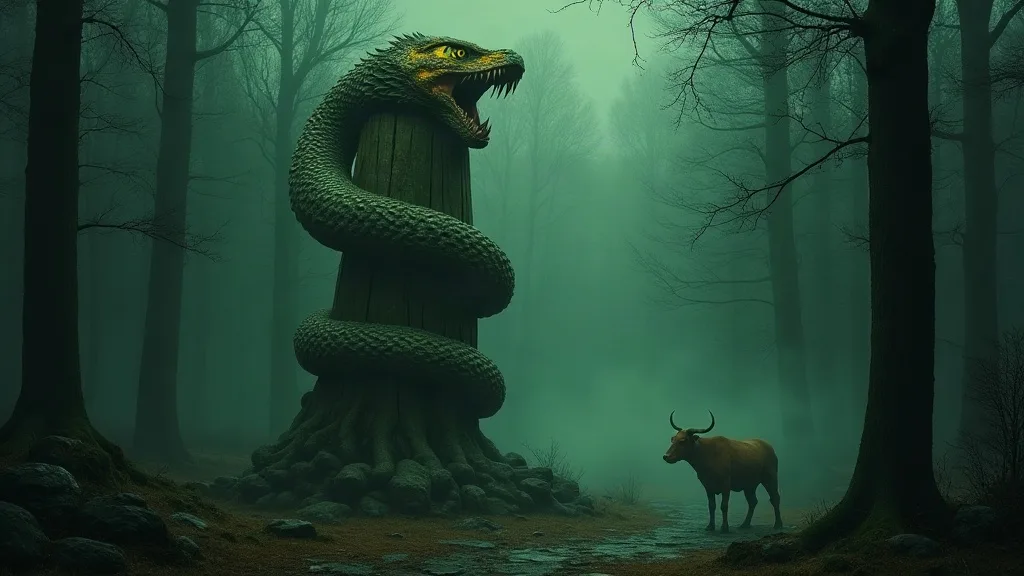
Veles: Slavic God of the Underworld and Cattle
Veles rules wealth, the underworld, and herds in Slavic tradition. A shapeshifter and keeper of secrets, he stands at the boundary between the living world and the realm below. Discover the god who defied easy categories.
Contents
The god who herded cattle beneath the earth. The keeper of riches. The serpent who guarded the roots of Yggdrasil's Slavic cousin. Veles does not fit neatly into the pantheons of his worshippers. He is neither purely good nor evil, neither wholly of the sky nor entirely of the soil. What we know of him comes in fragments: a few lines in medieval chronicles, place names still visible on maps, the memory of rituals half-remembered by Christian scribes who wanted him forgotten.
Yet Veles persists. In Slavic tradition, he is the god of boundaries and thresholds. He moves between worlds: the living and the dead, the visible and the hidden, the domestic herd and the wild forest. To understand Veles is to understand a mythology that embraced paradox long before modern philosophy gave it a name.
Who Veles Was: A God of Many Domains
The name Veles (also spelled Volos in some regions) likely derives from an Indo-European root meaning "to turn" or "to encompass." This etymology matters. It suggests a god who swirled around things, who wrapped himself around multiple domains. The medieval Byzantine chronicler Constantine VII wrote in the 10th century that the Rus' people swore their most sacred oaths by Perun and Veles together. Perun ruled the sky, thunder, justice, and war. Veles ruled everything Perun did not.
Veles was god of cattle and herds. This was no minor portfolio. Livestock meant survival in the medieval Slavic world. A wealthy Slavic family measured their worth in cattle, pigs, and sheep. Herds were status, sustenance, insurance against famine. Veles watched over them. Shepherds and herdsmen called on him. When an ox sickened, when wolves circled the fold, when thieves eyed your stock, Veles was the god who heard.
But cattle-herding was only the visible part of his work. Veles also ruled the wealth beneath the earth: ore, gems, precious metals. He was god of commerce, trade, and profit. Merchants invoked him. So did craftspeople who worked metal or worked the soil. His domain extended downward, into the hidden reserves of the world.
Most crucially, Veles was god of the underworld itself. This was his most profound identity. The realm of the dead, the place where souls went after the body ceased, fell under his watch. He was not Hades exactly (the Greek parallel), nor was he a psychopomp like Hermes. Rather, Veles was the owner of that realm, the master of death's domain. He held the wealth of the dead: not gold, but memory, shadow, and the ancestors themselves.
The Underworld Below: Veles' Kingdom
In Slavic cosmology, the world had three layers. The upper world was the realm of Perun and the sky gods, the place of air, light, and divine order. The middle world was where humans lived. The lower world was Veles' province.
This lower realm was not conceived as a punishment. It was not hell in the Christian sense. It was simply the other side. The place where things return. Seeds planted in the earth descended to Veles' kingdom before they rose again as plants. The sun itself was thought to pass through Veles' realm each night, moving from west to east beneath the earth, before returning to the sky at dawn. Veles held the sun during its nocturnal journey.
Archaeological and textual evidence suggests Veles was sometimes depicted as a serpent. Medieval texts refer to him in serpentine terms. The serpent, in Slavic belief, was a creature of the earth and the underworld. It coiled through the soil. It shed its skin and was reborn. These qualities made the serpent a fitting form for a god of transformation, wealth, and the boundary between death and life.
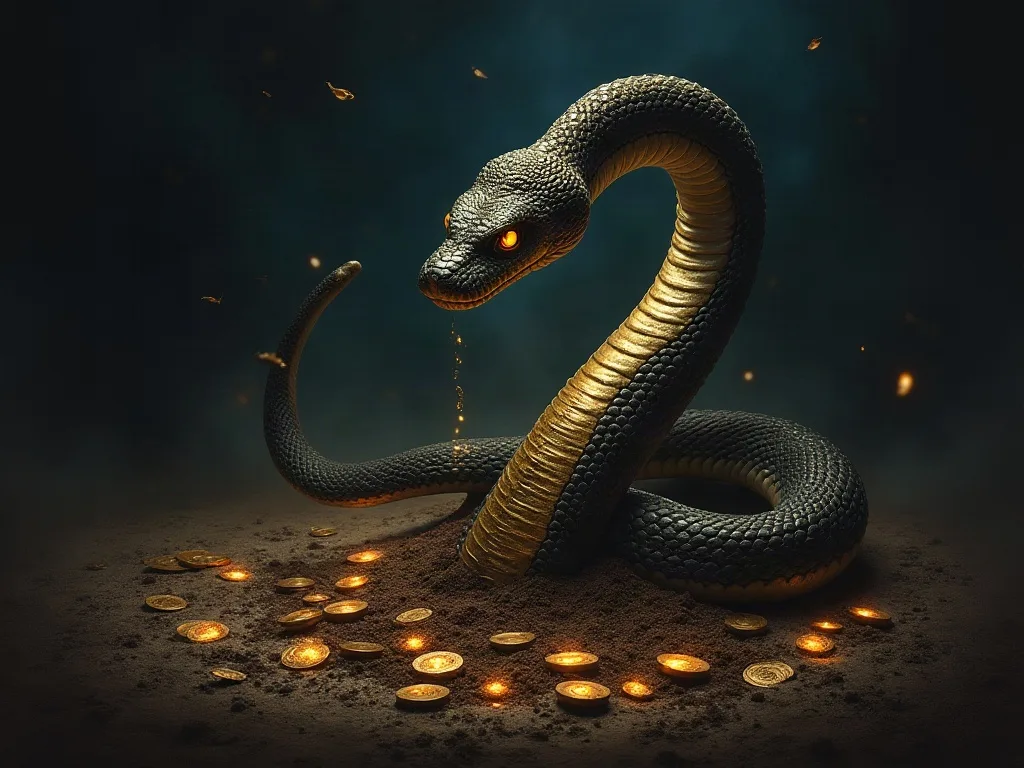
The underworld ruled by Veles was not a prison. It was a storehouse. The wealth of the soil, the memory of ancestors, the vital force that would generate new life in spring. These riches belonged to Veles. Those who died entered his realm, but they were not destroyed. They became part of his household, his wealth, his extended family of dependents. This is why Veles is sometimes called "god of the dead," though the term undersells his actual function. He was more precisely the god of the transition from life to death, and of the resources held in that transition.
Veles and Perun: A Divine Opposition
The most dramatic fact about Veles in surviving sources is his relationship with Perun. The two gods were not allies. They were cosmic opponents.
Constantine VII recorded that Rus' princes swore oaths by both gods, but the arrangement suggests a forced balance, not friendship. Perun occupied the sky. Veles occupied the earth and below. Perun represented order, law, justice, and the patriarchal rule of the warrior elite. Veles represented the hidden, the mercantile, the feminine principle (his worship was often led by women), and the resources of nature.
Some scholars argue that this opposition reflects Indo-European mythology generally. The sky father opposes the earth lord. Order opposes the chaos of nature and death. The rigid law opposes the fluid, transformative power of wealth and trade.
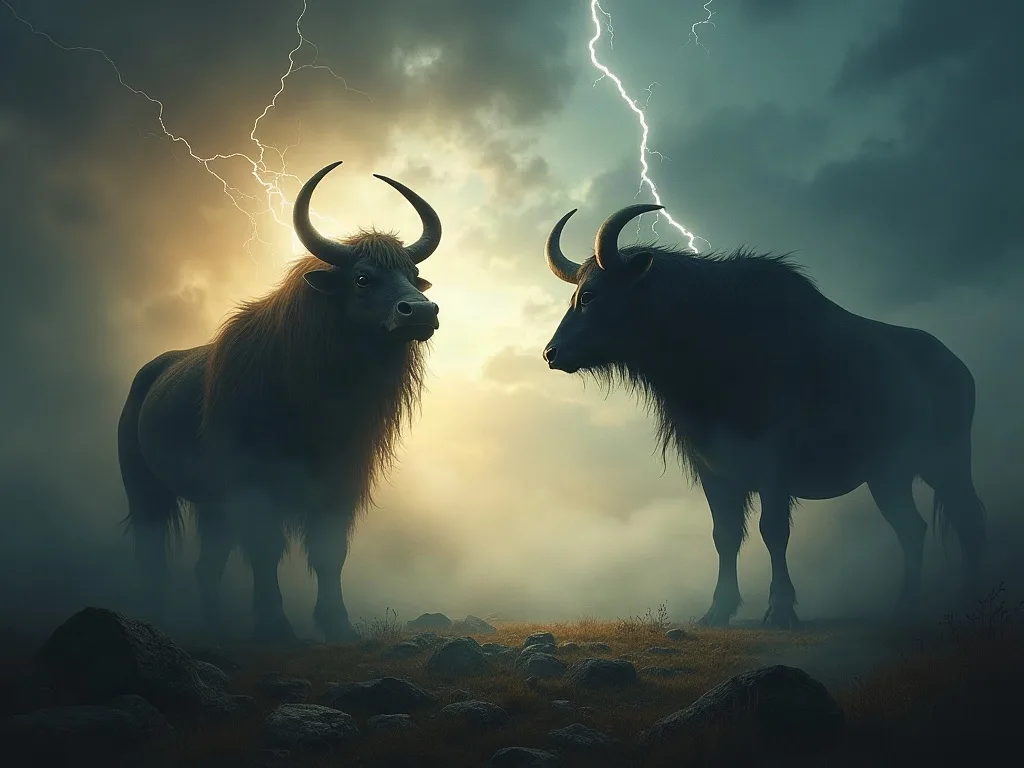
But the opposition was not simple moral struggle. Perun and Veles were locked in a cycle. When Perun threw lightning, it struck the earth (Veles' realm). When Veles' resources were unleashed, they nourished the sky-realm. Each needed the other. Neither could exist without opposition from the other. This is why both received oaths. A Slavic prince who swore only by Perun would court disaster in commerce and agriculture. A prince who swore only by Veles would invite chaos and disorder.
Medieval sources hint at a myth in which Perun and Veles fought, though the narrative was lost before it could be fully recorded. The 12th-century Chronicle of Novgorod mentions Veles and Perun in opposition during storm descriptions. Lightning was Perun's weapon; floods and darkness were Veles' response. These may be echoes of an older creation-myth or seasonal cycle, now fragmentary.
Veles as Shapeshifter and Trickster
One of the most compelling aspects of Veles in surviving folklore is his refusal to stay in one form. He was a shapeshifter. He could appear as a serpent, as a bull, as a bearded man, or as an old woman. This was not mere magic. It reflected his essential nature as a god of boundaries and transition. The shapeshifter moves between categories. So did Veles.
Folklorist Vladimir Propp noted in his studies of Russian folktales that the figure of the serpent-king or serpent-guardian who hoards wealth appears repeatedly. These later characters may preserve memories of Veles. The serpent tests the hero, demands a price, and reveals hidden knowledge. It is both dangerous and necessary.
Veles' trickster aspect appears in accounts of his dealings with humans. He was not the kind of god who rewarded the pure or punished the wicked in a straightforward way. He was more interested in contracts, in the exchange of value. If a farmer wanted Veles to protect his cattle, the farmer owed Veles something. Usually bread, ritual, an animal sacrifice. If payment was not made, Veles would not steal the cattle outright. Instead, he would arrange for them to stray. A deal broken would be answered not with direct punishment but with an ironic outcome: the farmer's wealth would flow to Veles, through loss and confusion.
This merchant's aspect of Veles surfaces in medieval complaints by Christian bishops. They condemned pagan Slavs for making oaths by Veles before commercial transactions. A buyer and seller would call on Veles as the witness, the guarantor of fair exchange. Only a god who understood value, who was himself a hoarder and reckoner of worth, could serve this function.
Rituals and Worship
Veles worship was woven into the rhythms of Slavic agricultural and pastoral life. Archaeology and medieval texts together suggest a complex ritual cycle.
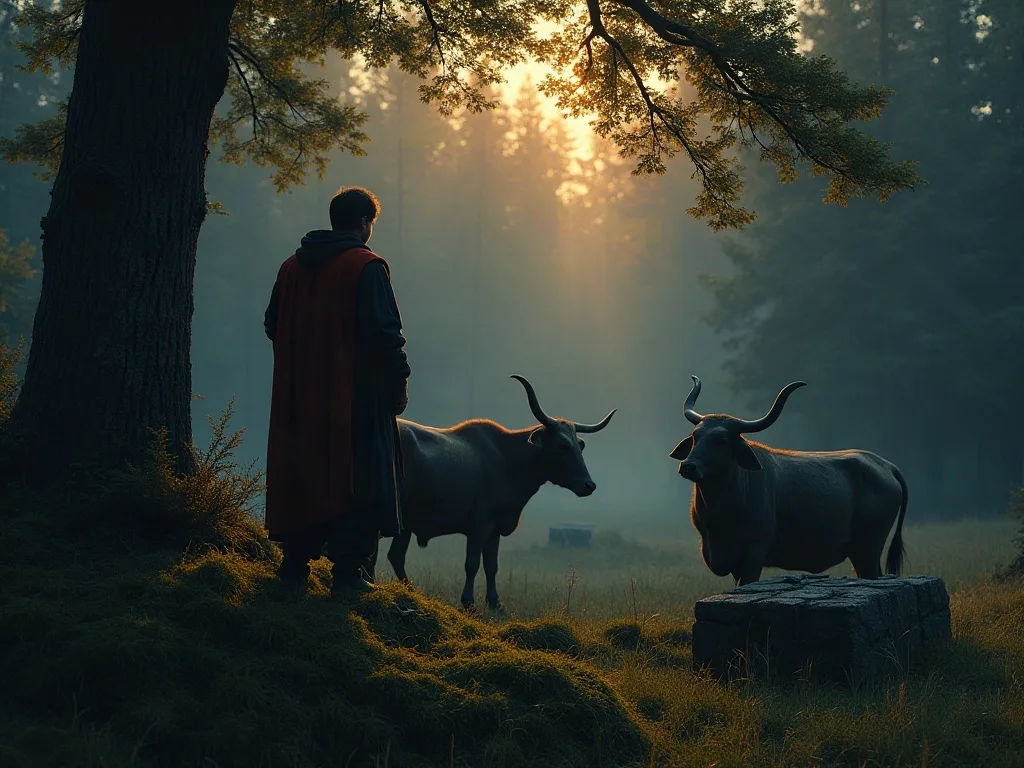
Before spring planting, farmers made offerings to Veles. They asked him to release the seeds held in his underworld, to send them upward to germinate. The offering might be bread baked for the purpose, or a small carved figure, or the first cream from the dairy. These were placed at the edge of fields or at the roots of old trees. The idea was to make a payment to the god below before asking him to deliver the goods.
Shepherds had their own Veles rituals. The last handful of grain harvested would be set aside and braided into a figure called a snopu (a bound sheaf). This was the "Veles' beard" or the "Veles' harvest." It was kept through the winter and fed to the cattle in spring, returning Veles' own gift back to him through the animals he protected. This practice survived in some Slavic regions into the 20th century.
There is evidence from place names and old chronicles that Veles had temples or sacred groves dedicated to him. The medieval chronicler Adam of Bremen, writing in the 11th century, describes pagan temples among the Slavs. While he does not name Veles explicitly in his surviving text, some scholars infer his presence from site names. A place called Veleszagrad in Serbia (now lost to history) may have been a sanctuary of Veles. The name literally means "Veles' fortified settlement."
The worship of Veles was not confined to the wealthy or the warrior class. Unlike Perun, who was the god of princes and war-leaders, Veles was the god of common people: farmers, herders, merchants, craftspeople. This made him dangerous to the Christian church. When missionaries converted Slavic regions, they could relatively easily absorb the warrior-god Perun into the figure of Saint George or another warrior saint. But Veles, with his underworld dominion and his association with death, wealth, and the common person's survival, was harder to contain. He became associated with the Devil, with underground power, with pagan stubbornness.
From Pagan God to Medieval Memory
When Christianity arrived in Slavic lands in the 9th and 10th centuries, Veles did not simply vanish. Instead, he underwent a transformation. He fractured into multiple figures.
Some of his underworld and death-domain functions were absorbed by Orthodox theology. The Devil, in Eastern Slavic Christianity, acquired some of Veles' characteristics. Not because Christians consciously converted Veles into the Devil, but because they needed a figure to embody the hidden, the dangerous, the wealth and power that did not belong to the church. The Devil served that role.
Other aspects of Veles survived in folklore. The serpent-guardian of treasure. The bull-god who watches over herds. The wise old man who appears at crossroads and tests travelers. These folktale figures retained something of Veles' nature long after the temples were demolished and the oaths ceased to be sworn.
Place names preserved Veles' memory. Across Slavic Europe, streams, groves, and hills still bore the name Veles or Velezja or similar variants. Medieval documents record them. Many have survived into the modern era. In Poland, the Vistula River valley contains numerous Veles-related names. In Serbia and Bulgaria, villages and geographic features still recall the god. These names are not random. They mark sacred sites, old pilgrimage routes, or places where Veles' cult was particularly strong.
The most explicit survival of Veles worship in Christianized form appears in the cult of Saint Vlass (or Blaise), particularly in Serbian and Bulgarian Orthodox tradition. Saint Vlass is the protector of cattle and livestock. He performs many of the functions that Veles once did. The connection is not certainly proven, but the parallels are striking. Saint Vlass appears in December and February, the seasons of animal husbandry and spring preparation. His iconography sometimes includes cattle or serpents. The scholarly consensus is not universal, but many historians of Slavic religion see Saint Vlass as a Christianized memory of Veles.
Scholarly Debates: Who Was Veles Really?
The surviving evidence for Veles is sparse compared to Norse or Greek mythology. We have a few sentences from medieval chroniclers. We have place names. We have fragmentary folklore. We have suggestive elements in later saint cults. From this thin record, scholars have attempted to reconstruct an ancient god. The result is productive debate.
Some scholars argue that Veles was originally a god of cattle alone, and that his underworld and wealth functions were secondary or developed later. Others contend that the underworld domain was always primary, and the cattle-herding was a surface manifestation of his deeper power over fertility and hidden resources.
There is disagreement about whether Veles and Perun were always in opposition. Some historians propose that the two gods were once allied, and that the opposition was a Christian-era invention designed to map the binary of God and Devil onto pagan pantheon. Others suggest that the opposition is authentically ancient and reflects the two fundamental forces in Indo-European cosmology: sky-order and earth-chaos.
The question of Veles' gender is also unresolved. Some sources hint that Veles was associated with the feminine principle, or that he was sometimes depicted as female. Other evidence suggests he was male. Some scholars propose that Veles was gender-fluid, or that the boundary between male and female did not apply to him in the way it applied to other gods.
What is certain is that Veles was a central figure in Slavic religious life. The anxiety with which Christian authorities attempted to erase him, and the persistence with which he lingered in folklore and place names, testifies to his importance. He was not a minor deity. He was not easily dismissed.
Veles in Modern Reconstruction
Contemporary pagan reconstructionists and Neo-Slavic religious communities have attempted to revive Veles worship. Using the fragmentary evidence, they have created rituals, iconography, and theology meant to honor the ancient god according to what can be inferred from the sources.
These modern practices vary widely. Some groups emphasize Veles as protector of animals and wild nature. Others focus on him as a god of commerce and fair dealing. Still others stress his underworld and ancestral functions, making offerings to honor the dead and invoke the protection of the ancestors.
The accuracy of these reconstructions is debated. Without living continuity of practice, without access to what the ancient Slavs actually did and believed beyond fragmentary hints, reconstruction is necessarily speculative. Yet it serves a function. It keeps Veles alive. It asserts that the history of Slavic peoples includes a sophisticated polytheistic religion that was not inferior to Greek or Norse traditions simply because less of it survived.
The Persistence of Boundaries
What unites all the fragments we have of Veles is his nature as a boundary-dweller. He stands at the threshold between earth and underworld. Between the visible and the hidden. Between commerce and death. Between the domestic herd and the wild forest. Between the past (ancestors) and the future (seeds not yet sprouted).
This is why Veles could encompass so many domains. The herdsman and the merchant, the undertaker and the farmer, the serpent and the man. All of these are faces of the same god. All are aspects of his function as the keeper of thresholds and the master of what lies on the other side.
A god without clear sides or stable form is uncomfortable for a religion built on hierarchy and order. Perhaps this is why Perun became the god of princes, and Veles the god of the common people. Perun fits into a system. Veles ruptures it.
Frequently asked questions about Veles: Slavic God of the Underworld and Cattle
Frequently asked questions
Was Veles evil, or did medieval Christian sources make him sound that way?
Veles was not evil in the original Slavic belief system. He was powerful, hidden, and ruled domains (death, the underworld, wealth) that Christian theology wanted to associate with evil. Medieval chroniclers, writing as Christians, may have emphasized the more sinister aspects of his character to justify the suppression of his worship. What we read about Veles as dangerous or demonic must be filtered through the bias of hostile sources.
Why did Veles and Perun oppose each other?
The opposition reflects a cosmic principle common in Indo-European mythology: the tension between order (Perun, sky, law) and the hidden or wild (Veles, earth, mystery). Neither god could exist without opposition from the other. This is not a struggle between good and evil, but a necessary balance that sustains creation.
Did Veles worship continue after Christianization?
Explicit Veles worship ended when Christianity became dominant in Slavic lands. However, his functions and character survived in folklore, in place names, and possibly in the cult of Saint Vlass, who took over Veles' protective role over livestock. The god did not disappear; he transformed into new shapes.
What is the connection between Veles and the World Tree?
While Veles is not explicitly linked to a Slavic equivalent of Yggdrasil in surviving texts, scholars infer that he may have guarded the roots of such a cosmic tree. As god of the underworld, he would logically have inhabited the underground portions of the axis that holds the three worlds together. This is reconstruction based on structural parallels with Norse and other Indo-European mythologies.
Why is Veles less well-known than Norse gods?
Most of what we know about Norse mythology comes from the Eddas, written down by medieval Icelandic authors. Slavic mythology was not recorded in similar detail before it was disrupted by Christian conversion. What survives comes from scattered medieval chronicles, folk memory, and archaeology. The lesser fame of Veles reflects the uneven survival of sources, not the unimportance of the deity in antiquity.
Did Veles control the afterlife the way Hades or Yama did?
Not exactly. Unlike Hades, Veles was not primarily a judge of the dead. Unlike Yama, he did not oversee elaborate heavens and hells. Rather, Veles' realm was the natural underworld, the place where things return. The dead entered his household, but they were not punished or rewarded according to ethical judgment. Death was transition, not evaluation.
Veles Across the Boundaries
The persistence of Veles in Slavic culture, even after his temples fell, suggests something important about how religions survive. Gods of order, justice, and hierarchy can be replaced by new gods of the same kind. But gods who embody the hidden, the mercantile, the connection between life and death, the resources of the earth itself, are harder to suppress.
Veles never had the temples or the priesthoods that Perun commanded. Yet he was closer to the daily life of the Slavic farmer, herder, and merchant. He was the god invoked in secret, in times of need. This intimacy made him enduring. Even now, over a thousand years after Christianization, his name persists in the landscape. His presence lingers in folktales. Modern practitioners reconstruct his rituals.
To understand Veles: Slavic god of the underworld and cattle is to understand a mythology that refused simple categories. It is to see a people who could hold contradictions in balance: a god who was both merchant and death-keeper, both domestic protector and wild danger, both sky-ordered and earth-mysterious. This complexity was not a weakness. It was the strength of a tradition that understood the world as multivalent, layered, and full of hidden connections.
Read the full book
Want the whole story?
The complete edition is an instant PDF download here, with a paperback on Amazon for selected titles.
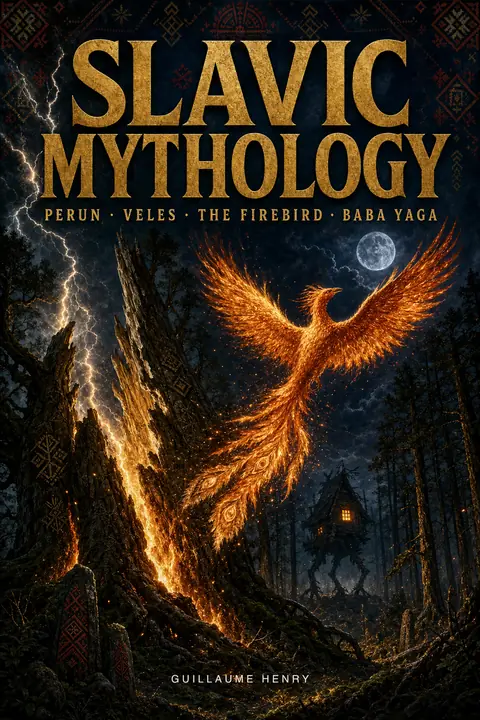
Slavic
The Slavic Mythology Book: Perun, Veles, Mokosh, and the Sacred Stories of Pre-Christian Russia and the Balkans
Thunder Gods, Serpent Lords, and the Witch in the Chicken-Leg Hut
The mythology of the Slavs before Cyril and Methodius: Perun's thunder against Veles' serpent coils, Mokosh's weaving, Baba Yaga's mortar flight, and the four-faced idols that stood in sacred groves.
More from Slavic
All articles
Slavic
Rod and the Rozhanitsy: Slavic Deities of Fate and Fertility
Rod weaves the threads of destiny while the Rozhanitsy nurture life itself. Discover how these ancient Slavic deities embodied the hidden forces that shaped families, harvests, and the very fabric of fate.

Slavic
The Cosmic Battle of Perun and Veles: Thunder, Chaos, and the Slavic Cosmos
In the Slavic cosmos, thunder god Perun and serpent deity Veles clash eternally: a primal battle between order and chaos, sky and underworld, that sustains the world itself. Discover the myths, the gods, and what scholars have found in the ruins of this ancient tradition.

Slavic
Domovoi: The Slavic Household Spirit
Meet the Domovoi, the ancient Slavic guardian spirit who dwells behind the stove and watches over a family's fortune. Learn how peasants and nobles alike honored this invisible master of the home, and why his blessing or curse could mean survival or ruin.

Slavic
The World Tree in Slavic Cosmology: Structure, Symbols, and Sacred Ritual
The World Tree anchors Slavic belief from the pre-Christian era through living folk practice, connecting sky, earth, and underworld. Discover how this sacred axis shaped Slavic ritual, settlement, and the seasons.