
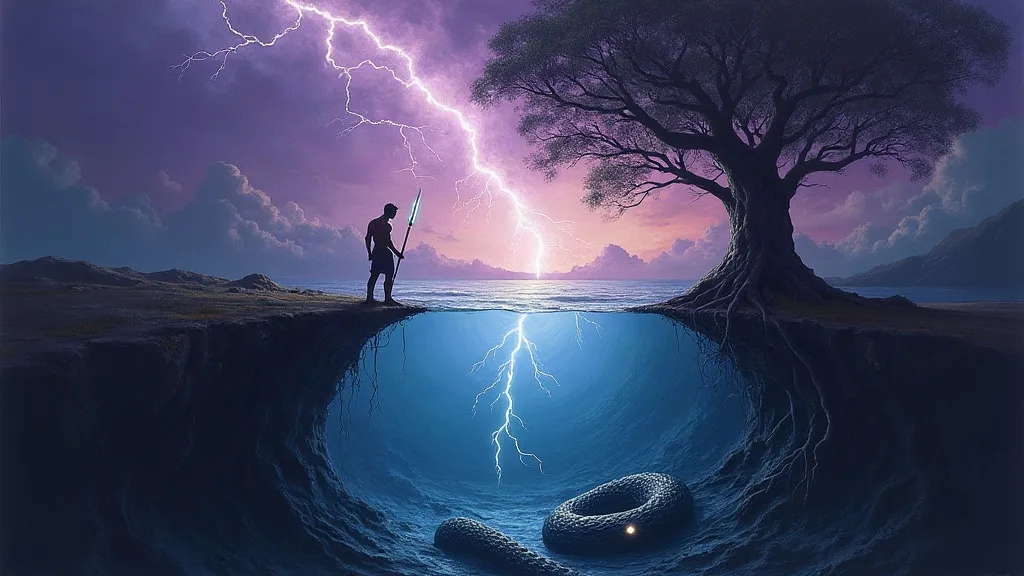
The Cosmic Battle of Perun and Veles: Thunder, Chaos, and the Slavic Cosmos
In the Slavic cosmos, thunder god Perun and serpent deity Veles clash eternally: a primal battle between order and chaos, sky and underworld, that sustains the world itself. Discover the myths, the gods, and what scholars have found in the ruins of this ancient tradition.
Contents
Thunder splits the sky. A serpent coils beneath the earth. For the Slavic peoples, this was not mere weather, it was the cosmic order playing out, the eternal war between Perun, god of the storm and sky, and Veles, the shape-shifting lord of the underworld and chaos. This battle was not a myth to watch from the sidelines. It happened every year, every storm, every season. The Slavs lived inside this conflict, and their survival depended on knowing which god to honor and when.
The cosmic battle of Perun and Veles stands at the heart of one of Europe's oldest religious traditions. It shaped how Slavic peoples understood weather, fertility, death, wealth, and the very structure of existence. Yet because Slavic paganism was largely destroyed or hidden by Christianity after the 10th century, these myths come to us in fragments, scattered across medieval chronicles, place names, folk customs, and the stories that village grandmothers still told centuries after the gods supposedly fell silent. Piecing the battle together is like reassembling a shattered vessel from scattered sherds.
Who is Perun: The Thunder God of Order
Perun appears first in the records because his worship was the most visible and feared. He was the supreme god of the sky, the thunder, and the oak tree. His weapon was the thunderbolt. His enemy was water, serpents, and all things that dwelled beneath the earth.
Medieval chroniclers describe Perun's idol in the pagan sanctuary at Kiev (before it was torn down in 988 CE during Christianization). The statue had a human face but a silver mustache. The priests kept an eternal fire burning near his shrine. When the Christian prince Vladimir destroyed the idol, witnesses reported that the locals wept as though they had lost a living king.
Perun's role was order, justice, and the protection of warriors. He was called upon in oaths. Breaking an oath sworn by Perun brought thunder and death. Warriors made offerings before battle, and after victory, they left part of the spoils at his shrine. The oak was his tree; the eagle was his bird. Wednesday in some Slavic languages derives from his name.
What made Perun especially important was that he held back chaos. Veles, in contrast, embodied everything that threatened the structured world above.
Veles: The Serpent, the Cattle Lord, and the Chthonic Threat
Veles is far harder to pin down than Perun, and that is precisely the point. He was a god of boundaries, transitions, and hidden knowledge. He dwelt in the underworld, in bodies of water, in the roots of the World Tree. He controlled wealth, cattle, magic, and the spirits of the dead. He was associated with snakes, dragons, and all manner of creatures that inhabited the deep places.
Unlike Perun, Veles was not straightforwardly good or evil. He was necessary. Cattle herders offered to Veles because he controlled the animals. Merchants and thieves both prayed to him. He was a god of cunning, transformation, and the liminal spaces between life and death, land and water, civilization and wilderness.
The relationship between Perun and Veles mirrors patterns found across Indo-European traditions: the sky god versus the earth/underworld god, storm-bringing versus fertility-bringing, order versus flux. But in the Slavic version, there is no simple hierarchy. They are locked in permanent opposition, and the cosmos requires both.
The Battle Itself: Storm and Serpent
The myths of the cosmic battle of Perun and Veles are reconstructed from scattered clues rather than preserved in a single epic narrative (unlike the Norse Eddas or the Greek Theogony). But the outline is clear: Perun chases Veles with thunder and lightning. Veles flees, transforming into various creatures, a serpent, a fish, a bird. The battle causes storms, disrupts the balance of the cosmos, and must be renewed regularly.
One key detail: Veles often steals something at the beginning of each cycle. In some accounts, he steals the rains. In others, he steals cattle or treasures. This theft mirrors the annual cycle. When Veles steals the rains, Perun must pursue him, and the chase brings the first rains of spring and the summer storms. The battle is thus tied to the agricultural and pastoral calendar. No rain without the conflict. No fertility without pursuit.
Archaeological and linguistic evidence suggests that the battle myth had a seasonal rhythm. Spring rains came when Perun defeated Veles. Summer heat and drought corresponded to Veles lying low, recovering. Autumn and winter were times of truce or Veles' ascendance, when the earth belonged more to him.
The scholar Marija Gimbutas, who studied Indo-European mythology extensively, proposed that this battle pattern reflects the actual climate cycle of Eastern Europe: dry winters, explosive spring storms, and the life-giving rains of summer. The Slavs encoded their survival needs into divine narrative.
Why the Conflict Mattered: Order, Chaos, and the Price of Living
For the Slavs, the cosmic battle of Perun and Veles was not abstract theology. It had consequences.
If Perun won too completely, there would be endless drought. Lightning and thunder are terrifying but also needed; the electrical charge in storm clouds triggers nitrogen fixation that enriches soil. Too much Perun without Veles meant a world of hard rules, unyielding sky, punishment without mercy.
If Veles won, chaos would flood in. The underworld would rise. The dead would walk. Water would drown the land. Snakes and demons would have dominion. Fertility would become disease. Wealth would become theft.
The Slavs lived in a world where both threats were real. Famine could come from drought or from plague. Social order could collapse into anarchy or tyranny. The myth taught that survival meant honoring both powers, knowing when to appeal to each, understanding that neither could be allowed to fully vanquish the other.
Rituals and the Cult of Perun
Perun worship had visible, organized structure. The pagan sanctuaries kept eternal flames. Warriors formed priesthoods. Oaths sworn by Perun were the highest contracts in Slavic law.
The cult of Perun was masculine, hierarchical, and martial. His priesthood was organized. His shrine was at the top of the sacred city, elevated, reaching toward the sky. This matches the pattern across Indo-European societies: sky gods got the most elaborate cults.
But Veles' worship was harder to track, partly because it was performed in private spaces: at crossroads, by water, in forests and caves. Cattle herders made offerings in barns, away from public view. Shamans and sorcerers invoked him. Thieves and merchants whispered his name. His priesthood, if it existed, left few traces.
Echoes in Slavic Folklore and Place Names
When Christianity arrived in the 10th and 11th centuries, the great temples fell. The idols were burned or pulled into rivers. But the myths did not die. They transformed.
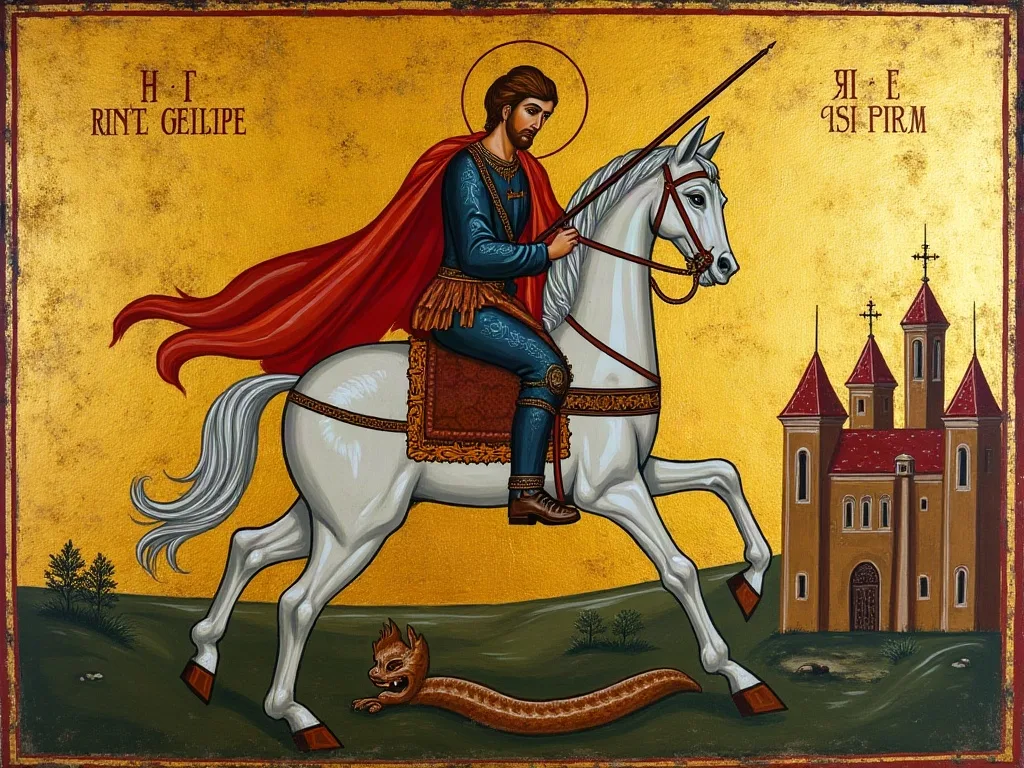
Perun became Saint George, the warrior saint who kills the serpent (Zmey). Saint George on horseback slaying a dragon is not Christian invention, it is a Christianized version of Perun striking down Veles. The serpent-dragon is Veles, now recast as evil because the new religion needed order over chaos, not balance between them.
Place names preserve the old gods. The Dnieper River, one of the great rivers of Slavic lands, has a name possibly derived from Perun. Veles' name appears in town names and river names, particularly near caves and underground springs, places associated with the underworld.
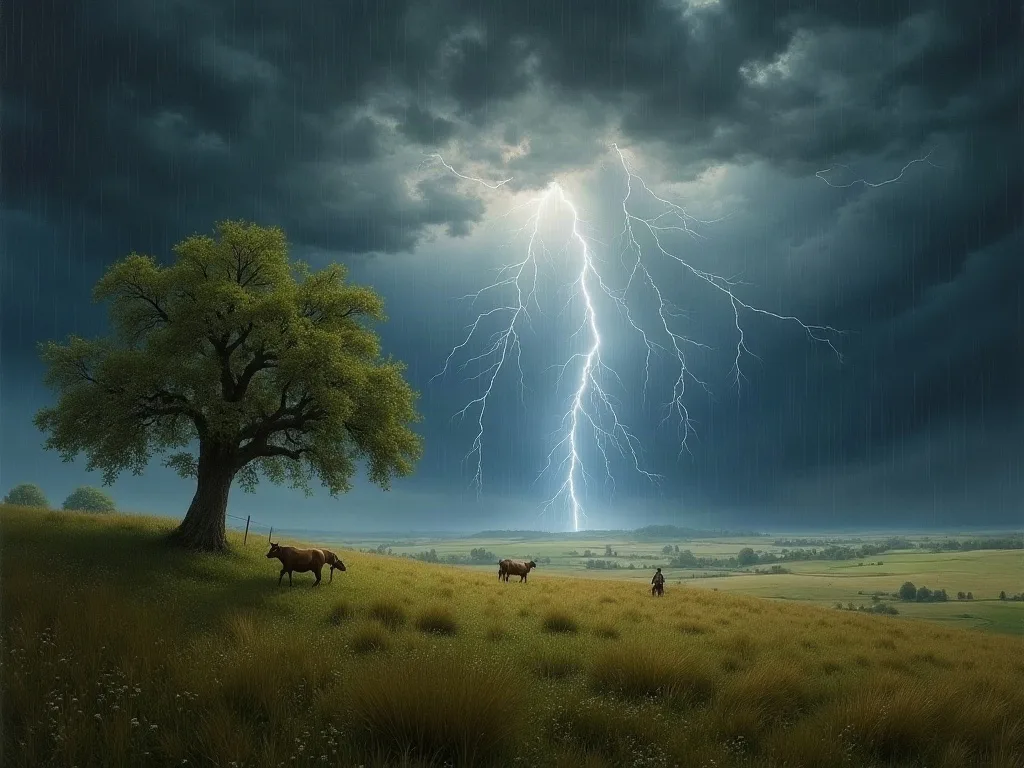
Folklore customs carried memory forward. In some regions, storms were still understood as Perun's hunt. When thunder rolled, people knew the god was at war with the serpent below. Midsummer fires lit in June corresponded to Perun's summer victory. The winter solstice, when the sun was weakest and death seemed closest, was Veles' season.
Village customs around cattle herding preserved Veles worship disguised as folk practice. Shepherds made offerings at the edges of pastures. Rituals were performed at water crossings to appease the underwater lord and keep him from stealing livestock. These practices persisted for centuries after the gods officially ceased to exist.
Scholarly Reconstruction: What We Know and What We Guess
The study of Perun and Veles is an exercise in scholarly patience and honesty about sources. We have no continuous mythological text written by ancient Slavs about their gods. What we have are:
-
Medieval Christian chronicles written by clergy who despised paganism and recorded myths only as examples of error. The 11th-century chronicler Ibrahim al-Tartushi described the pagan Rus and their gods but with the bias of an outsider.
-
Linguistic analysis: The names themselves carry information. Perun likely derives from a root meaning "to strike" or "to hit." Veles may relate to words for cattle, wealth, or serpents depending on the dialect.
-
Comparative mythology: By looking at related Indo-European peoples (Balts, Hittites, Hindus, Greeks), scholars reconstruct the likely structure and symbols of the Slavic system.
-
Folklore and oral tradition: Nineteenth and twentieth-century scholars collected folk customs, songs, and stories from rural Slavic communities where Christian overlay was thin and old memories persisted.
-
Archaeology: Temple sites, ritual objects, and artifact analysis provide indirect evidence of cult practice.
The most influential reconstruction comes from scholars like Viacheslav Ivanov, Wladimir Toporov, and Marija Gimbutas, who approached Slavic mythology as a coherent system rather than scattered superstitions. They proposed that the entire Slavic pantheon (Perun, Veles, Stribog the wind god, Dazhbog the sun god, Mokosha the earth mother) operated as a balanced whole, with Perun-Veles as the central binary opposition.
The Battle and the World Tree
Some scholars connect the Perun-Veles myth to the concept of a World Tree (similar to Yggdrasil in Norse mythology, though Slavic accounts are fragmentary). The tree stands at the center of the cosmos. Perun occupies the sky-realm above it. Veles dwells in the roots below. The battle shakes the tree, disrupts its equilibrium, and must be repeatedly resolved.
This model explains why the battle is not a single event but recurring. Each spring, Veles steals something (rains, cattle, the sun's warmth) from the upper world. Perun pursues. The chase creates storms, which bring rain and fertility. By summer, Perun dominates. By winter, the cycle begins again. The World Tree endures because it is rooted in this eternal struggle.
The image is profound: the cosmos is not a machine that runs smoothly once wound up. It is an organism sustained by conflict. Remove either god, and the tree dies.
The Christianization: Veles as the Demon, Perun as the Saint
When Christianity spread through Slavic lands, it faced a theological problem. The pagan cosmology had two equal divine principles in opposition. Christian theology had a Supreme God and subordinate devils. The transition was violent and incomplete.
Perun, as the sky god, the warrior god, the keeper of order and justice, fit more easily into the Christian framework. He became Saint George in some regions, Saint Elias (the thunder prophet of the Bible) in others. The thunderbolt became the sword that kills the demon serpent.
Veles, the lord of the underworld, the serpent-dweller, the keeper of hidden knowledge and the spirits of the dead, was recast as a demon. He became Zmey, the dragon. Or worse, he became associated with the Devil himself, a figure dwelling beneath the earth, associated with snakes and chaos and the rebellion against the God of order.
This was not misunderstanding. Medieval Christian authors deliberately remapped the old dualism onto the new theology. What had been cosmic balance became a war between absolute good and absolute evil. The Slavs had to choose. Many retained folk memories and customs in private, but the official story changed.
Why the Conflict Faded from Memory
Slavic mythology is less known than Greek, Norse, or Hindu mythology for several reasons. First, the Christianization was thorough and early. By the 12th century, the pagan religion was largely destroyed or driven underground. Norse mythology survived in Iceland because the islands were isolated; Hindu and Greek traditions survived because they were written down in protected texts.
The Slavs had no Eddas, no Vedas, no Iliad to preserve the myths against time. They relied on oral transmission, ritual practice, and the priesthood. When the priesthood was eliminated, the oral tradition fragmented. What survived was dispersed: a place name here, a folk custom there, a corrupted story in a Christian saint's life.
Second, Slavic lands were repeatedly conquered, divided, and ruled by outsiders: Mongols, Ottomans, Austro-Hungarians, Russians, Nazis, Soviets. The question of Slavic identity was always entangled with politics and survival. Recovery of the pagan past happened in bursts, often mixed with nationalism.
Third, there is no unified "Slavic mythology" in the way there is Norse or Hindu mythology. The Slavic peoples spread across vast territories and developed regional variations. What Perun meant to the Rus of Kiev may have differed from what he meant to the Poles or the Serbs. We see fragments of a larger whole but cannot reconstruct it completely.
Perun and Veles in Modern Slavic Culture
In recent decades, there has been renewed interest in Slavic paganism, both scholarly and spiritual. Some contemporary Slavs have revived worship of Perun and Veles as part of a broader reconstruction of pre-Christian identity called Slavic Neopaganism or Rodnoverie.
This revival is genuine but complicated. Without continuous tradition, every reconstruction involves creative choices. Modern Slavic pagans must work from the same fragmentary sources that scholars use, fill gaps with logic and intuition, and navigate questions about what is authentic recovery versus what is modern invention.
What is clear is that the cosmic battle of Perun and Veles continues to resonate. The image of thunder and serpent, sky and underworld, order and chaos speaks to something enduring in the human imagination. It maps onto real experiences: the terror and necessity of storms, the ambivalence of nature as both provider and threat, the need to balance opposing forces rather than choose one absolutely.
The Unresolved Question: Was There Really a "Perun Myth"?
One final scholarly caveat: some historians debate whether Perun and Veles actually had a coherent myth-cycle in pre-Christian times, or whether the "battle" is a reconstruction built from fragments and comparative logic. We have no ancient text that explicitly says, "And Perun chased Veles who stole the rains." We infer this from place names, folklore, the structure of other Indo-European mythologies, and hints in medieval chronicles.
This uncertainty is honest. It reflects the limits of what we can know. But it does not diminish the importance of these figures. Whether the battle was explicitly narrated in a lost epic or woven through ritual and seasonal practice, Perun and Veles shaped how Slavic peoples understood their world. The myths worked. The rituals sustained communities. The gods were real in the only way that matters: they shaped thought, behavior, and meaning.
Frequently asked questions about the cosmic battle of Perun and Veles
Frequently asked questions
Is the Perun-Veles battle cycle documented in any primary sources?
No single continuous narrative survives. The battle is reconstructed from medieval chronicles (like those of Nestor and al-Tartushi), linguistics, comparative Indo-European mythology, and Slavic folklore collected in the 19th and 20th centuries. This fragmentation is why Slavic mythology is harder to study than Norse or Greek traditions, which have preserved texts. But the cumulative evidence is strong enough that scholars treat the conflict as a core Slavic belief.
How did Perun and Veles map onto Christian saints and demons?
Perun became Saint George (the dragon-slayer) or Saint Elias (the thunder prophet) in different Slavic regions. Veles was recast as the demon Zmey (the dragon) or associated with the Devil himself. This was not accidental; Christian missionaries deliberately remapped the old cosmic dualism onto the new theology of absolute good versus evil. The ritual spaces and even some prayers were reused but reinterpreted.
Why is Slavic mythology less known than Norse or Greek mythology?
Norse mythology survived largely intact in Iceland and was written down in the Eddas. Greek mythology was preserved in Homer and Hesiod and remained central to Western education. Slavic mythology was destroyed by Christianization in the 10th-11th centuries and left few written records. What survived was dispersed in folklore, place names, and corrupted saint-stories rather than preserved texts. Modern recovery depends on scholarly reconstruction from fragments.
What did Veles represent that was not simply evil?
Veles was ambiguous. He controlled cattle, wealth, magic, and the underworld. Shepherds and merchants prayed to him. He embodied the powers necessary for survival (fertility, hidden knowledge, the resources of the deep earth) but also posed constant danger if not respected. This matches a view of nature common in pre-industrial societies: neither good nor evil, but powerful and demanding respect. Christianity's reduction of Veles to pure evil was a theological choice, not a Slavic one.
Is modern Slavic Neopaganism a recovery of the ancient religion or a new invention?
Both, in complex measure. Modern Slavic pagans work from the same fragmentary sources that scholars use and attempt honest reconstruction. But without a continuous tradition (like Hindu or Jewish communities maintain), there are gaps that must be filled creatively. Modern practitioners are aware of this and often approach their practice as interpretive rather than claiming to replicate ancient ritual exactly. It is a genuine spiritual choice informed by history, not mere reenactment.
The Eternal Storm: Perun and Veles in the Slavic Soul
The cosmic battle of Perun and Veles never ended, not truly. It transformed. It survived in the name of a saint, in the shape of a dragon, in the thunder that still makes villagers pause and listen. It lives in the structure of Slavic languages, in the customs of shepherds, in the place names on maps, in the dreams of modern people seeking to reconnect with their ancestors' gods.
What the Slavs understood, encoded in this myth, was that the universe is not a fixed design but a dynamic struggle. Order and chaos, sky and earth, the god who strikes and the god who steals, both are necessary. Remove one, and the whole collapses. This is not a cheerful message, but it is a true one. Any culture that survives for centuries learns this. The Slavs learned it and made it sacred.
Read the full book
Want the whole story?
The complete edition is an instant PDF download here, with a paperback on Amazon for selected titles.
Slavic
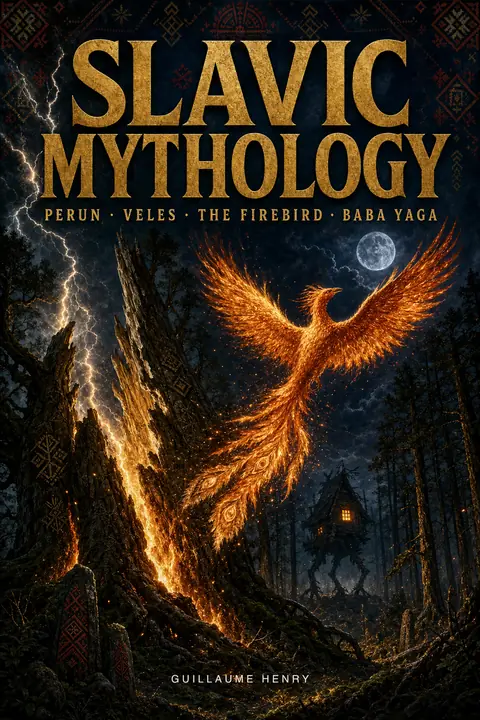
The Slavic Mythology Book: Perun, Veles, Mokosh, and the Sacred Stories of Pre-Christian Russia and the Balkans
Thunder Gods, Serpent Lords, and the Witch in the Chicken-Leg Hut
The mythology of the Slavs before Cyril and Methodius: Perun's thunder against Veles' serpent coils, Mokosh's weaving, Baba Yaga's mortar flight, and the four-faced idols that stood in sacred groves.
More from Slavic
All articles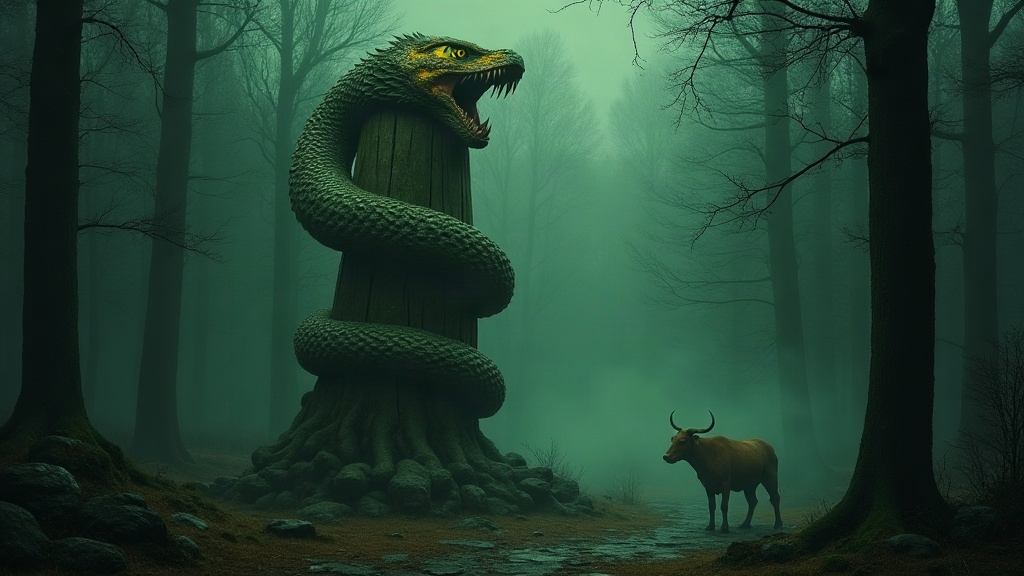
Slavic
Veles: Slavic God of the Underworld and Cattle
Veles rules wealth, the underworld, and herds in Slavic tradition. A shapeshifter and keeper of secrets, he stands at the boundary between the living world and the realm below. Discover the god who defied easy categories.
Slavic
Rod and the Rozhanitsy: Slavic Deities of Fate and Fertility
Rod weaves the threads of destiny while the Rozhanitsy nurture life itself. Discover how these ancient Slavic deities embodied the hidden forces that shaped families, harvests, and the very fabric of fate.

Slavic
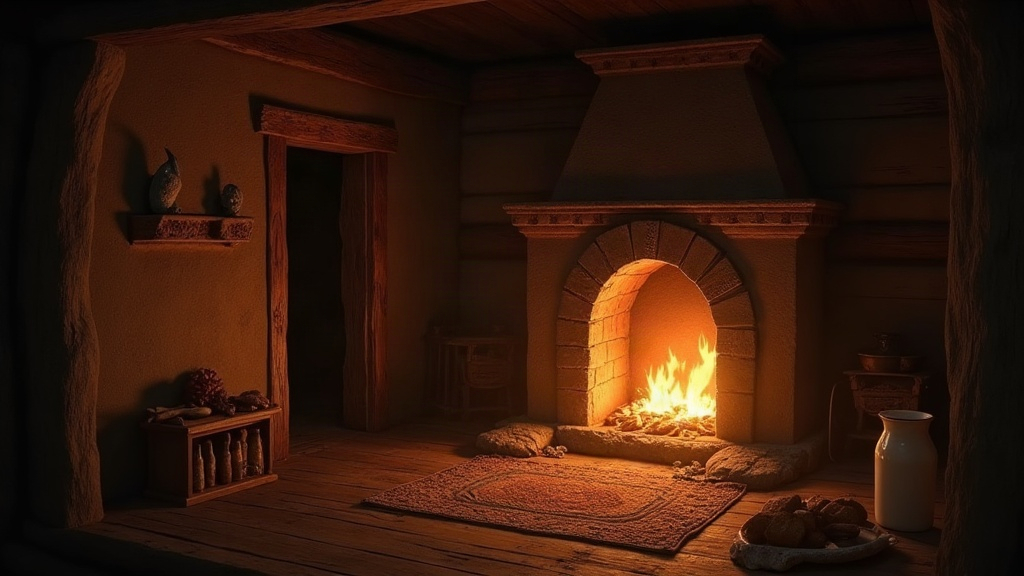
Domovoi: The Slavic Household Spirit
Meet the Domovoi, the ancient Slavic guardian spirit who dwells behind the stove and watches over a family's fortune. Learn how peasants and nobles alike honored this invisible master of the home, and why his blessing or curse could mean survival or ruin.
Slavic
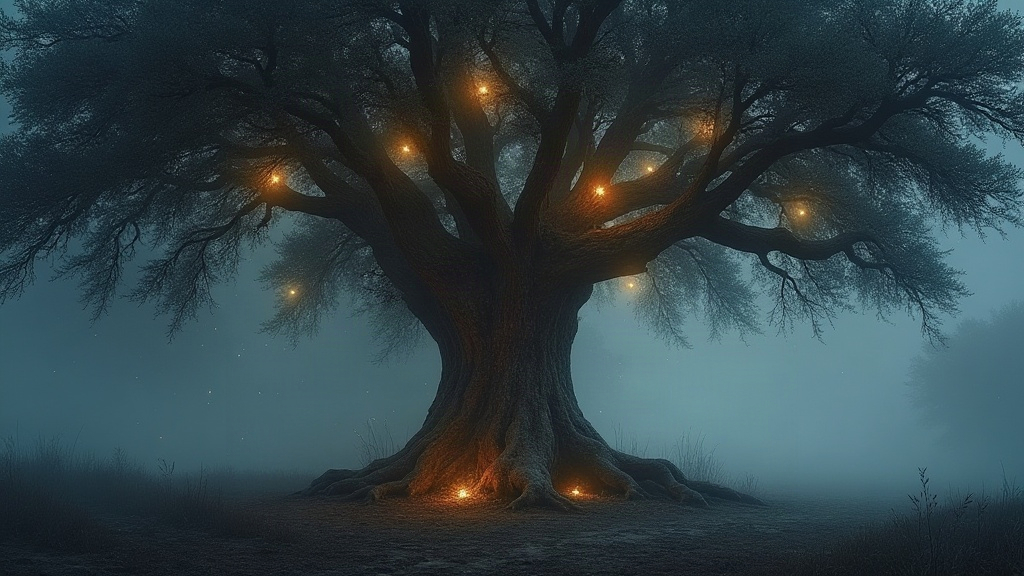
The World Tree in Slavic Cosmology: Structure, Symbols, and Sacred Ritual
The World Tree anchors Slavic belief from the pre-Christian era through living folk practice, connecting sky, earth, and underworld. Discover how this sacred axis shaped Slavic ritual, settlement, and the seasons.