
The World Tree in Slavic Cosmology: Structure, Symbols, and Sacred Ritual
The World Tree anchors Slavic belief from the pre-Christian era through living folk practice, connecting sky, earth, and underworld. Discover how this sacred axis shaped Slavic ritual, settlement, and the seasons.
Contents
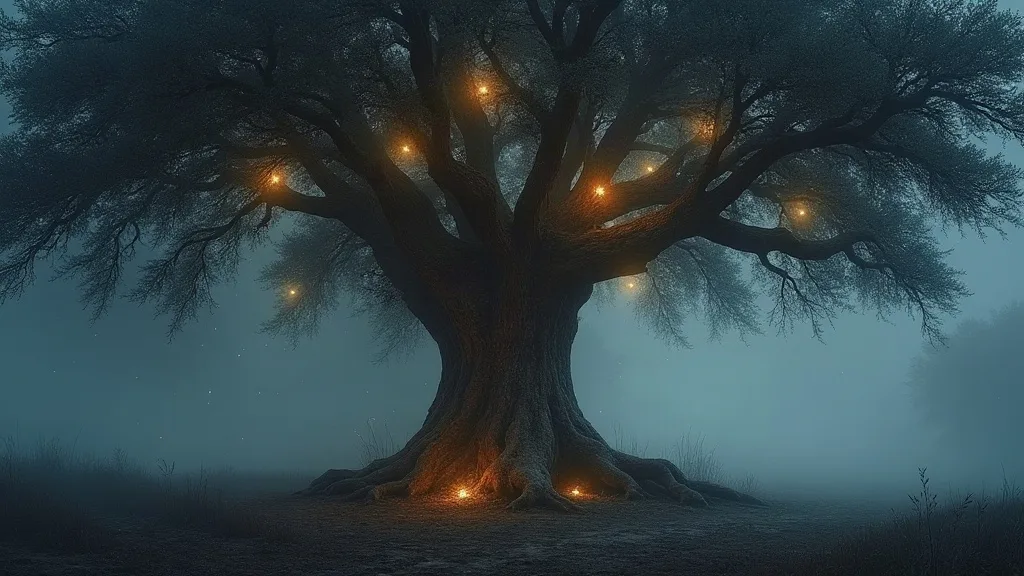
Deep in Slavic tradition, a single tree connects all the worlds. Not a metaphor, but a lived reality in ritual, settlement, and story. The World Tree in Slavic cosmology stands at the center of creation, its roots holding the underworld, its trunk anchoring earth, its branches cradling the sky. Every Slavic community recognized this axis. They built their homes around it. They invoked it in prayer. They measured time and sanctity by its rhythm.
Scholars know the World Tree in Slavic cosmology through fragments: folk charms, place names, archaeological traces of sacred groves, and the stubborn survival of tree veneration in Christian lands where priests forbade it for a thousand years. The tree never quite died. It persisted in wedding rituals, in children's songs, in the oldest Slavic villages where a single oak still stands at the center, ringed by houses. This is not romantic reconstruction. This is archaeology and oral tradition converging.
The Cosmic Structure: How the World Tree Holds Creation
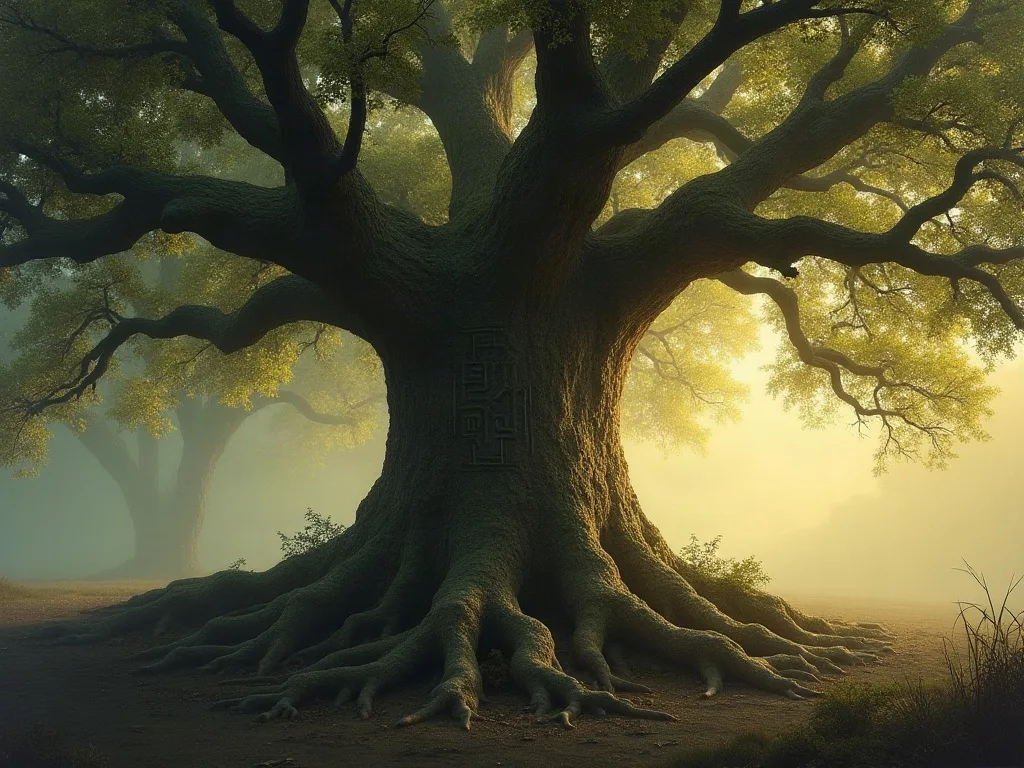
The Slavs imagined the cosmos as a unified organism, organized vertically like a great tree. At the very top lived the sky gods. In the branches dwelt birds of fate and light. Along the trunk, the visible world of humans unfolded, marked by seasons and harvests. Below, in the roots and soil, lay the realm of the dead, of chthonic (underground) powers, of potential and transformation.
The World Tree was not a distant symbol. It was a functional architecture. Every real oak or birch in a Slavic settlement could be understood as a microcosm of that cosmic structure. A family that gathered under a household tree was positioning itself at the axis mundi (the center of the cosmos). A sacred grove was not merely a place of worship; it was a tangible point where the boundary between worlds grew thin.
The tree's roots fed on the underworld; its crown drew light from the heavens. The tree served as a conduit, a ladder, a bridge. Shamans climbed it in trance. The souls of the dead descended through it. The seasonal cycle turned around its trunk. This was not metaphor in the Slavic mind. It was structural geology of the universe itself.
Ancient Slavic communities planted or preserved specific trees as the living embodiment of this cosmic axis. Oak was most sacred; birch was the tree of the living, the threshold; lime (linden) belonged to fate and women's mysteries. Regional variations existed, but the principle held: one tree per settlement, tended with ritual care, its health bound to the community's prosperity.
The Sacred Groves: Where the Worlds Touched
Slavic sacred groves, called svjatilishche or rodilishche (place of birth, place of lineage), were not wild forests but carefully tended spiritual centers. Medieval chroniclers, both Christian and foreign, described them with mingled awe and horror. The most famous was at Arkona, on the island of Rügen, where a great temple held a four-headed wooden idol of the god Svantevit, and a sacred white horse grazed in a grove that no mortal could enter without ritual purification.
The groves typically surrounded one or more ancient trees, often marked by a wooden fence or stone boundary. Inside, the Slavs conducted oracular divination: they consulted the flight of birds, the patterns of animal entrails, the rustling of leaves. A priestess or elder would interpret these signs, understanding them as the voice of the tree itself, the voice of the lineage ancestors who lived in its wood.
Ritual sacrifice took place in these groves. Archaeological evidence and medieval accounts agree: animals were offered to sanctify the space, to feed the invisible powers below and above. The blood was poured at the tree's roots. The meat was shared in communal feasts that bound the living to the dead, the mortal to the immortal, through a single shared meal at the axis of the world.
The World Tree in Slavic Myth and Cosmography
Unlike Norse tradition, which preserved the Eddas in written form, Slavic mythology was largely oral. The Christianization of the Slavs (beginning in the 9th century, accelerating in the 10th and 11th) interrupted the transmission of myth before scribes could record it. What we know comes from fragments: place names, folk etymology, the comparative method (comparing Slavic data with nearby Indo-European traditions), and crucially, folklore that survived under Christian cover.
One thread that runs through recovered Slavic traditions is the presence of three vertical realms organized around a central tree. The upper realm belonged to celestial deities: Perun (the thunder god), Dazhbog (the sun), Stribog (the wind). The middle realm was the domain of humans and the domesticated world. The lower realm held Veles (or Volos), the chthonic god of cattle, wealth, the underworld, and the liminality between life and death. He was neither good nor evil, but powerful: the keeper of thresholds.
The World Tree in this cosmology was not owned by any single god but existed as a neutral fact of creation, acknowledged by all. Its roots extended into Veles's domain. Its crown reached toward Perun's sky. The god Morana, goddess of winter and death, was sometimes said to rest in the tree's depths during the warm months, emerging each autumn to freeze the land.
The cycle of the seasons could be understood as the tree's breathing: the sap rising in spring (the tree awakening, life returning), the full green of summer (the tree in its power), the harvest and descent into autumn, the dormancy of winter when the tree seemed dead but was not. This was not poetic fancy. This was how Slavic communities understood their own survival and renewal, mapped onto the physiology of their central tree.
The World Tree and the Household: Ritual and Daily Life
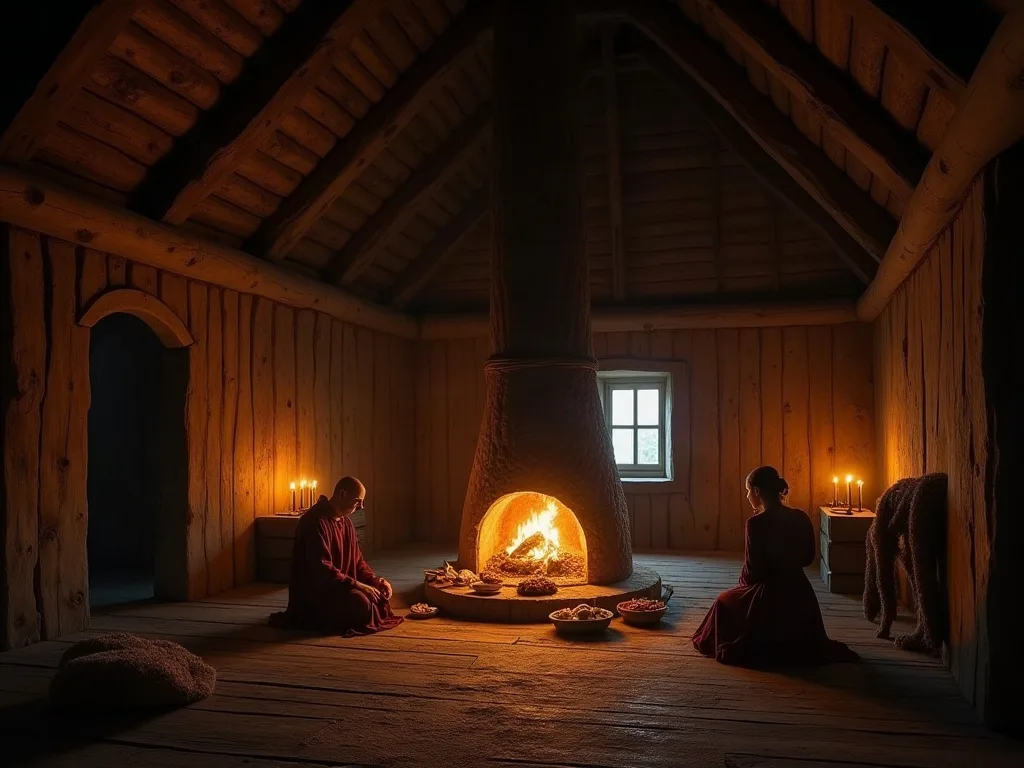
The World Tree in Slavic cosmology extended into the smallest domestic space. Nearly every Slavic dwelling, especially in the earliest period, was oriented around a central post or tree-like structure: the stup or stoba. This pillar held up the roof and also served as the axis of the household's relationship to the cosmos.
Food offerings were left at the base of the household tree or post. Prayers were spoken toward it. Young girls would circle it at betrothal ceremonies. The newborn would be shown to it to be acknowledged by the ancestors. The sick would be laid in its shadow seeking healing. When a family member died, the tree became a conduit for their journey to the ancestral realm.
Birch branches were woven into wreaths at spring fertility festivals (the Rusalka festivals, honoring the female water spirits who emerged when the ice broke). Oak was invoked in oaths and legal agreements, its presence ensuring that the words spoken could not be denied without incurring cosmic punishment. Ash and alder had their own associations: ash with the spear of fate, alder with the liminality of water and land.
The household tree was not interchangeable. A family's relationship to a specific tree could last for generations. If the tree died, the family's fortunes were said to decline. If it flourished unexpectedly, it was read as a sign of blessing or of danger (a luxuriant growth sometimes presaged plague or war, a surfeit of life-force pressing against its boundaries).
Living Traces: The Folk Tradition That Never Died
Medieval Christian sources record with frustration the persistence of tree worship among Slavic peoples, even after baptism. Priests would cut down sacred trees, only to find them replanted. Pagan groves would be sanctified as the burial grounds of Christian saints, reabsorbing the old magic into new names. The rodilishche (birthplace sacred grove) survived as the rodilishche-toloka (birth-labor gathering place), a secular-seeming tradition where women still went to labor and birth under or near an ancient tree.
In modern times, scattered across Eastern Europe, evidence of the old reverence persists. In Russian villages, an old oak or birch stands at the center, called the staraya dub (the old oak), and local people will not cut it, though none can articulate why. In Poland, Lithuania, and Ukraine, certain trees are still regarded as holy or inhabited; to harm them invites misfortune. Weddings in some regions still involve a binding of bride and groom with birch branch, invoking the tree's power to join and hold.
These are not invented traditions. They are living memory, attested in ethnographic fieldwork from the 19th century onward. They show that the World Tree in Slavic cosmology never truly vanished. It was buried, it was obscured, but the deep structure of cosmological understanding persisted at the level of practice and custom.
The World Tree and Fate: Rods, Norns, and the Binding of Time
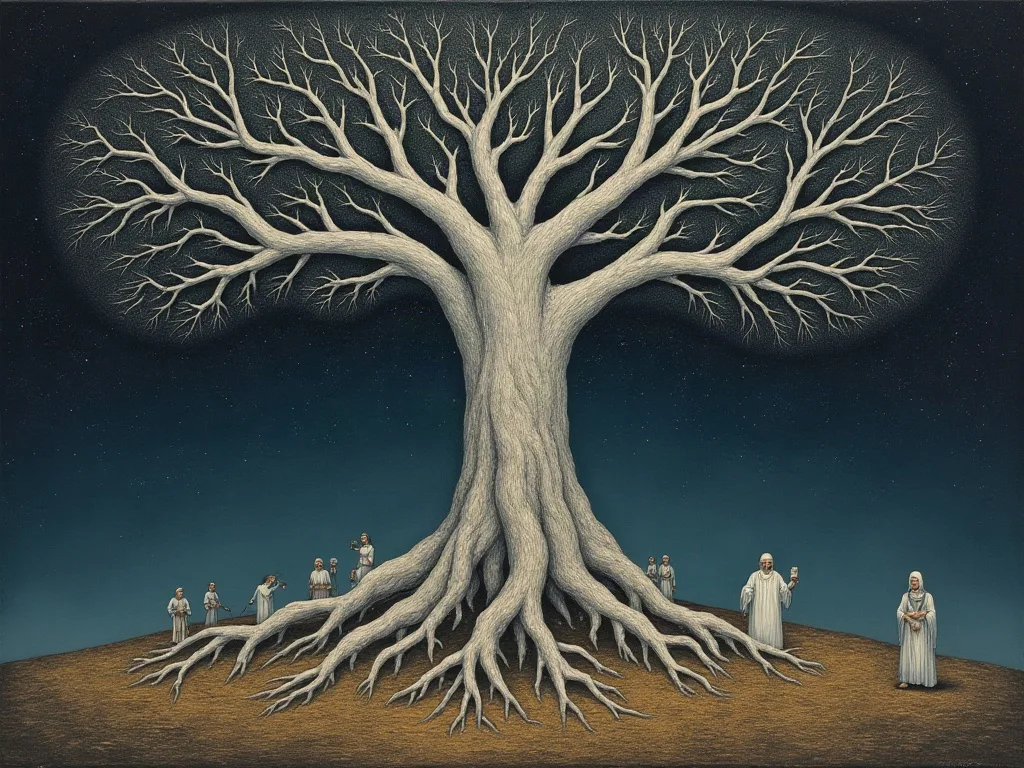
One of the most intriguing parallels between Slavic and Norse traditions is the association of the cosmic tree with fate. The Norse Yggdrasil sustains the Norns, the three weavers of fate, who water it each day with the waters of destiny. The Slavic tradition did not record a direct equivalent, but the logic was similar.
Certain Slavic deities were understood as weavers or binders. Mokosh (or Mokyosh), the goddess of women's work, spinning, and fertility, was sometimes depicted with her feet rooted in the earth like a tree, her hands spinning the threads of life. She was not the tree, but she worked through it and with it, in the same way a weaver uses a loom. The tree provided the structure upon which fate could be woven.
The rod (plural rody), a concept central to Slavic kinship and spirit, literally means "birth" or "lineage." But it also refers to a protective spirit, often envisioned as dwelling in the household tree or in the roots of the communal sacred grove. Your rod was your lineage, your ancestors, your spiritual guardians all at once. To honor the rod was to lay food at the base of the tree, to invoke protection for one's family, to affirm one's place in the ongoing chain of birth and death.
This understanding bound individual fate to cosmic fate. Your life was not separate from the tree's life. You were a leaf or a branch. Your death was a falling leaf, which fed the root system, which would produce new growth. The separation between ancestor, living human, and future generation was permeable, enacted around the central tree.
Comparative Echoes: The World Tree Across Indo-European Traditions
The concept of a cosmic tree is ancient and widespread, found across the Indo-European language family. The Norse Yggdrasil, the Hindu Ashvattha (the bodhi-like cosmic tree of the Vedas), the Iranian Haoma, and the ancient Mesopotamian traditions all share the basic architecture: a tree standing at the center of the cosmos, connecting upper and lower realms, sustaining the gods and the structures of law and order.
The Slavic World Tree in Slavic cosmology fits into this larger pattern but with distinctive features. Unlike the Norse or Hindu versions, which appear in written mythological texts, the Slavic version is almost entirely reconstructed from lived practice, folklore, and linguistic evidence. This gives it a different texture: less literary, more embedded in daily ritual and domestic space.
Some scholars argue that the Slavic World Tree was borrowed or reinforced through contact with Norse traditions, especially during the Viking Age when Norse traders penetrated deep into the Dnieper and Volga river valleys. Others contend that it represents an independent development of a common Indo-European religious layer, surviving in Slavic lands because the Slavs maintained a more conservative polytheism longer than their Western neighbors did.
What is clear is that the Slavic version emphasizes fertility, lineage, and the porousness of the boundary between the living and the dead in a way that parallels but differs from Norse or Hindu versions. The Slavic tree is less a site of cosmic conflict (as in the Norse Ragnarok, the apocalyptic end-times) and more a site of cyclical renewal, death feeding life, the seasonal round turning eternally around the same axis.
The World Tree in Modern Scholarship and Spiritual Practice
Contemporary scholars of Slavic religion, particularly Marija Gimbutas (though her earlier work was sometimes over-speculative), and more recent figures like Vyacheslav Ivanov and Vladimir Toporov, have spent decades reconstructing Slavic cosmology from this fragmentary evidence. Their work shows that the World Tree in Slavic cosmology was not marginal but central: a unifying concept that organized religious practice, kinship, law, settlement patterns, and the experience of time itself.
Modern Slavic neopagan and folk-religion practitioners have taken up the World Tree as a symbol of cultural continuity and spiritual rootedness. Some groups, like those practicing rodnover (the return to the ancestral faith), explicitly revere the World Tree and tend sacred groves, seeing this as a restoration of what was obscured by Christianity. Scholars debate the historical authenticity of these modern reconstructions, but the impulse itself is not new: people have always returned to these old images when seeking to reconnect with deep heritage.
The image of the World Tree also appears in modern Slavic literature and visual art as a symbol of national identity and spiritual depth. It grounds contemporary Slavic cultures in a tradition that predates the nation-states, the religions imposed by conquest, and the modern transformations of the landscape. In this sense, the tree continues to do what it has always done: hold together the vertical dimension of existence, connecting past and future through an eternal present rooted in earth and reaching toward sky.
Frequently asked questions about the World Tree in Slavic cosmology?
Frequently asked questions
What trees were most sacred in Slavic tradition?
Oak was the supreme tree, associated with the sky god Perun and oath-swearing. Birch belonged to the threshold between worlds and to feminine powers of fertility. Lime (linden) was connected to women's councils and fate. Ash and alder held their own ritual significance, often linked to magic and liminality. The choice of tree varied by region and need.
How do we know about Slavic World Tree beliefs if most mythology was oral?
Scholars reconstruct Slavic cosmology from three main sources: medieval Christian chronicles that describe (and condemn) pagan practices; archaeological evidence of sacred groves, ritual sites, and tree-shaped idols; and folklore recorded in the 19th and 20th centuries that preserves far older patterns. Comparative mythology also helps, by showing how nearby Indo-European traditions (Norse, Iranian, Hindu) organized similar concepts around a cosmic tree.
Did the World Tree survive Christianity, or is the modern veneration entirely reconstructed?
Elements survived. Ethnographers from the 19th century onward documented living practices: sacred trees at village centers that people refuse to cut, tree-binding in marriage rites, the sanctity of specific groves. These are attested habits, not invented. Modern neopagan reconstruction is partly based on genuine continuity and partly on scholarly inference. The line between living tradition and conscious revival is blurred by a thousand years of Christian overlay.
How did the World Tree relate to the concept of the rod?
The rod was both lineage and a protective ancestral spirit dwelling in the household tree or communal sacred grove. Honoring the rod meant making offerings at the tree's base and invoking protection for one's family. The tree was the physical anchor where abstract kinship became concrete and where the living could communicate with ancestors and future generations.
Was the Slavic World Tree similar to Yggdrasil in Norse mythology?
Both serve as cosmic axes connecting multiple realms, but with differences. Yggdrasil is more explicitly depicted in written sources and features apocalyptic destruction (Ragnarok). The Slavic World Tree emphasizes cyclical renewal, the porousness between living and dead, and integration into daily household ritual. The two traditions likely share an ancient Indo-European source, but developed distinctly.
The Tree Uncut: Ancient Roots in a Modern World
The World Tree in Slavic cosmology stands differently than many other elements of pagan religion. While the gods faded into folklore and Christian saints, while temples were built over sacred sites, the tree itself persisted as a physical fact. An ancient oak is an ancient oak. It lives. It continues to grow. Every ring in its trunk is another year of witnessing.
This is perhaps why Slavic peoples, even after centuries of Christianity, have never wholly abandoned the reverence. The tree does not require belief in a specific doctrine. It simply requires attention. And in attention, the old cosmology returns: the sense of standing at an axis, of roots below and sky above, of being part of a continuity that extends backward to ancestors and forward to the unborn, all held together by a single, living connection that no human law could entirely sever.
The World Tree in Slavic cosmology is not a relic. It is an ongoing presence, waiting for those with eyes to see it.
Read the full book
Want the whole story?
The complete edition is an instant PDF download here, with a paperback on Amazon for selected titles.
Slavic
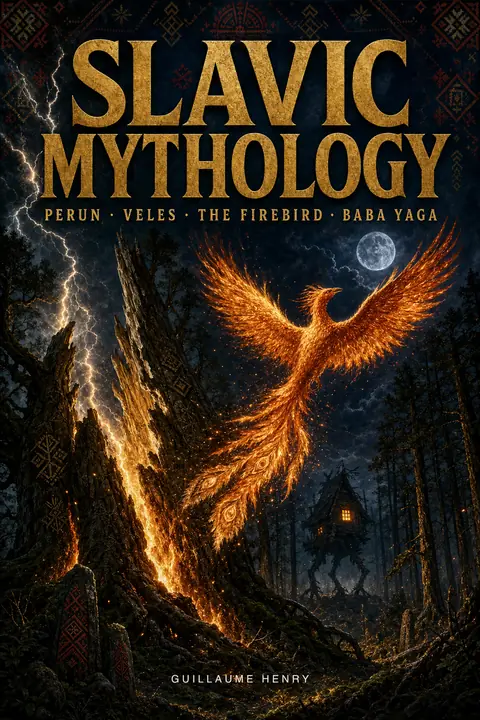
The Slavic Mythology Book: Perun, Veles, Mokosh, and the Sacred Stories of Pre-Christian Russia and the Balkans
Thunder Gods, Serpent Lords, and the Witch in the Chicken-Leg Hut
The mythology of the Slavs before Cyril and Methodius: Perun's thunder against Veles' serpent coils, Mokosh's weaving, Baba Yaga's mortar flight, and the four-faced idols that stood in sacred groves.
More from Slavic
All articles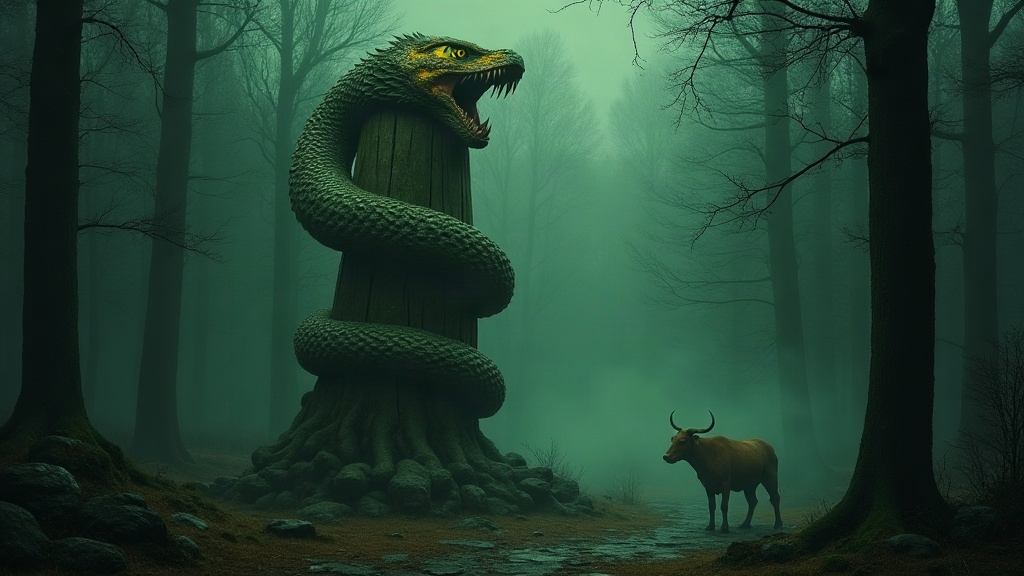
Slavic
Veles: Slavic God of the Underworld and Cattle
Veles rules wealth, the underworld, and herds in Slavic tradition. A shapeshifter and keeper of secrets, he stands at the boundary between the living world and the realm below. Discover the god who defied easy categories.
Slavic
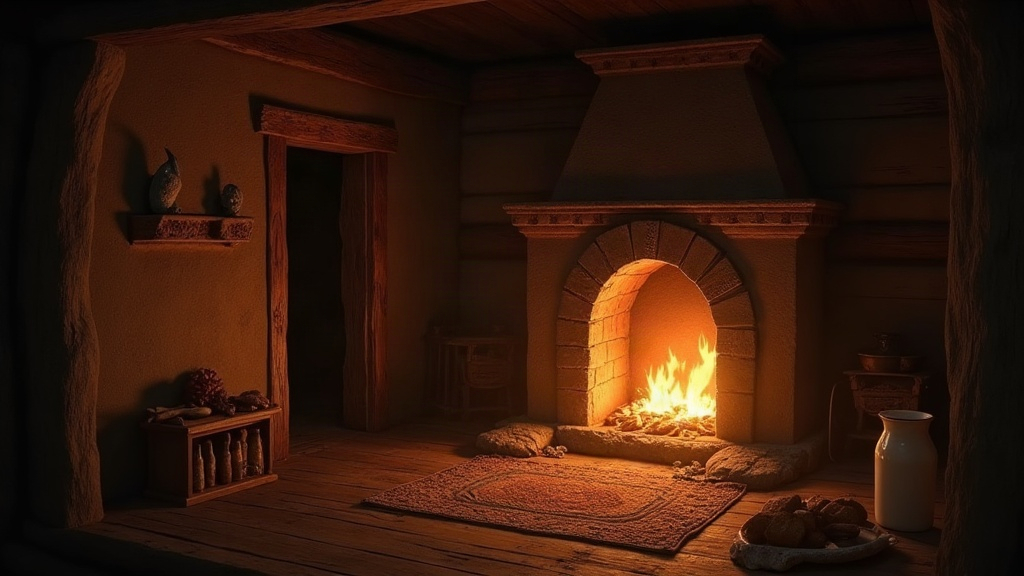
Rod and the Rozhanitsy: Slavic Deities of Fate and Fertility
Rod weaves the threads of destiny while the Rozhanitsy nurture life itself. Discover how these ancient Slavic deities embodied the hidden forces that shaped families, harvests, and the very fabric of fate.

Slavic
The Cosmic Battle of Perun and Veles: Thunder, Chaos, and the Slavic Cosmos
In the Slavic cosmos, thunder god Perun and serpent deity Veles clash eternally: a primal battle between order and chaos, sky and underworld, that sustains the world itself. Discover the myths, the gods, and what scholars have found in the ruins of this ancient tradition.

Slavic
Domovoi: The Slavic Household Spirit
Meet the Domovoi, the ancient Slavic guardian spirit who dwells behind the stove and watches over a family's fortune. Learn how peasants and nobles alike honored this invisible master of the home, and why his blessing or curse could mean survival or ruin.