

Songlines: Sacred Pathways Across the Land
Songlines are the invisible tracks sung into existence by Ancestor beings during the Dreaming, mapping every rock, river, and dune across Australia. Follow the paths that turned raw earth into a living scripture.
Contents
The old man begins to sing, and the desert moves with him.
His voice traces a line across red sand and spinifex, naming a waterhole two days' walk to the east, then a granite outcrop beyond it, then the place where a wedge-tailed eagle first split the sky. He is not describing the landscape. He is performing it back into being, note by note, word by word, step by step. The country exists in full because the song holds it.
This is how Songlines: Sacred Pathways Across the Land work in Australian Aboriginal tradition. They are not metaphors. They are not poetry in the Western decorative sense. They are navigational charts, sacred contracts, and cosmological maps braided into a single living thread of melody and word, stretching from one end of a continent to the other.
The Dreaming: Where Songlines Begin
To understand Songlines, you need to start where they start, in the Tjukurpa (pronounced "Chook-orr-pa"), the Anangu word often translated as "the Dreaming" or "the Law." The Dreaming is not a historical past, not a dream state, and not a religion in the Western institutional sense. It is a continuous present. The Ancestor beings who shaped the world during the Dreaming did not finish and leave; they folded themselves into the land. They became the rock, the river, the hill, the rain.
Anthropologist W.E.H. Stanner, who devoted decades to studying Aboriginal thought, coined the phrase "the Dreaming" in the 1950s, noting that it carries none of the sleeping connotations its English label suggests. He wrote that it describes "a sacred, heroic time long ago when man and nature came to be as they are." The critical insight Stanner pressed on his readers: the Dreaming is not over. It continues alongside the everyday world, accessible through ceremony, song, and story.
It was during this Dreaming time that the great Ancestor beings crossed an unformed, silent continent and sang the world into shape. Each feature they created, a sand dune, a creek bend, a grove of casuarinas, became encoded into the song they were singing as they walked. The song was the act of creation. Creation left a trail. That trail is the Songline.

How a Songline Actually Works
Picture a long, thin corridor of song cutting across country. An elder from the Western Desert knows the verses that correspond to each landmark from her community's sacred site outward, perhaps for 200 kilometres. Where her knowledge ends, the song continues in a different language, held by people of a neighbouring group. They sing the same Ancestor being's journey, but in their own tongue. The melody stays recognisable. The landmarks match. The track is continuous.
This is one of the most remarked-upon features of Songlines: they cross language boundaries. Australia had more than 250 distinct language groups at the time of European contact, and the Songline network connected them across vast distances. Bruce Chatwin, the British travel writer who brought Songlines to a global audience with his 1987 book The Songlines, described them as "a labyrinth of invisible pathways which meander all over Australia." His work has its critics among scholars and Aboriginal communities who felt he simplified a complex living tradition into a literary vehicle, but his core description of the tracks as cross-linguistic navigational corridors holds up against ethnographic evidence.
Linguist Patrick McConvell and anthropologist Myfany Turpin have documented how the same melodic contour survives translation across language groups, the tune acting as a mnemonic anchor even when the words change. You do not need to speak every language along the track; the music guides you. This is navigation without maps, but it is not primitive. It is a sophisticated, distributed memory system encoded in performance.
The sacred pathways across the land carry different types of information inside the same song:
- The sequence of landmarks in the correct order of travel
- The identity of the Ancestor being who made each feature
- The ceremonial obligations owed at particular sites
- The kinship relationships between neighbouring groups who share custody of the track
- The seasonal knowledge of when water, food, or shelter is available at each location
Stripping out any single layer does not leave the song intact. The geographical, spiritual, and social information is fused. That is why separating "the navigation" from "the religion" misreads Songlines completely.
The Ancestor Beings Who Walked the Tracks
Each Songline belongs to one or more Ancestor beings, and the character of that Ancestor shapes everything the Songline means. The most widely known is the Rainbow Serpent, a vast being present in countless Aboriginal traditions under different names: Yurlunggur among the Yolngu of Arnhem Land, Ngalyod in some Gunwinggu traditions, Wanambi at Uluru in Anangu country. The Rainbow Serpent does not travel one single Songline; it carved watercourses, created rain, and defined the boundaries between life and death across the continent. Where the Serpent rested, permanent waterholes formed. Where it turned, rivers bent.
Other Ancestor beings are more local in reach but equally precise in their mapping. The Seven Sisters (the Pleiades) are tracked across the desert in a Songline that runs through Anangu, Pitjantjatjara, and Yankunytjatjara country, telling of the sisters fleeing a relentless pursuer named Wati Nyiru. Every camp the sisters made, every hill they climbed, every rockhole where they stopped to drink, the song records all of it. The landscape is the story, and the story is the landscape.
Baiame, the sky Ancestor of the Kamilaroi and Wiradjuri peoples of New South Wales, walked tracks across the eastern slopes of the Great Dividing Range, leaving imprints at sites that remain ceremonial centres today. His tracks are known in the ethnographic record through the work of linguist R.H. Mathews, who documented Baiame ceremonies in the late nineteenth century, and through the ongoing knowledge held by Kamilaroi communities.
Custodianship, Not Ownership: The Law of the Tracks
A critical point that Western listeners often miss: you do not own a Songline. You hold it in trust.
Each person born into an Aboriginal community is connected to particular Dreaming tracks through their parents, birthplace, and ceremonial initiations. This connection is called being "the owner" or "the custodian" of a song, but the language of ownership is misleading in a Western property sense. The song does not belong to you the way a piece of land can be titled. You belong to the song. Your obligation is to carry it correctly, perform it in the right context, and pass it on unaltered to the next generation.
The custodianship system creates a web of accountability across country. If you travel through someone else's Songline territory, you must have permission, signalled through ceremony, kinship ties, or negotiation with the custodians of that track. Entering sacred country without this protocol is a serious transgression, not merely a social one, but a cosmic one: you risk disturbing the Dreaming that underlies the physical world at that location.
This is why the destruction or desecration of specific sites carries consequences far beyond what non-Aboriginal Australians might call "cultural damage." When a sacred site is bulldozed for a mine or road, the Ancestor being encoded at that location is harmed. The Songline is broken. The community responsible for that section of track bears a loss that is simultaneously spiritual, ecological, and navigational.
Anthropologist Deborah Bird Rose, whose fieldwork in the Northern Territory produced the landmark 1992 study Dingo Makes Us Human, documented how Aboriginal communities in the Victoria River District described the land as "alive with Law." Every feature carried an obligation. The Songlines were the visible pattern of that Law written into geography.
Singing the Land: Performance as Sacred Act
A Songline is not a text you read. It is a performance you embody.
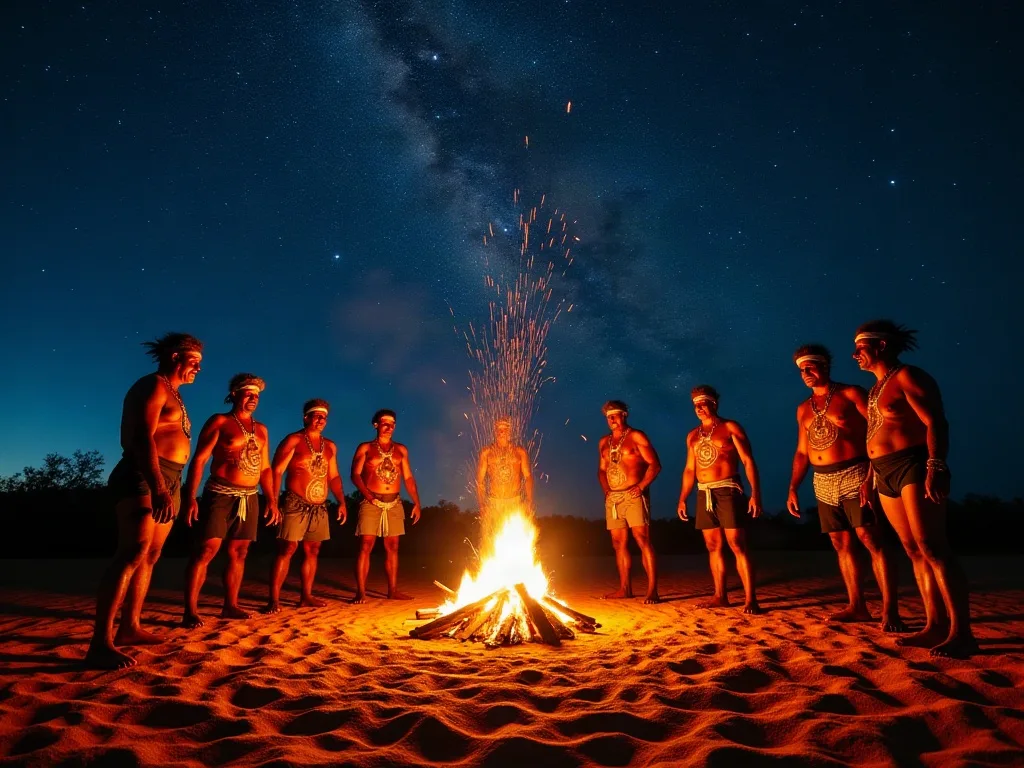
The singing typically accompanies walking. In ceremonial contexts, the performance includes body paint, the use of sacred objects called tjurunga (flat oval stones or boards engraved with the track of an Ancestor being), and dance sequences that re-enact the Ancestor's journey. The voice, the movement, and the landscape all participate together. Remove any one element and the ceremony is incomplete.
Musicologist Stephen Wild documented in his research at the Australian Institute of Aboriginal and Torres Strait Islander Studies (AIATSIS) how the melodic contours of Songlines can encode directional information: a rising phrase might correspond to ascending terrain, a falling phrase to a descent toward water. The song is topographic in a literal sense. Singing it correctly is inseparable from navigating it correctly.
Children begin learning fragments of Songlines early, often through publicly shareable portions of the song that carry geographic but not yet ceremonial content. As they age and are initiated, deeper layers of the song are entrusted to them. Some knowledge remains restricted: sacred versus secret-sacred distinctions mean that certain verses are never performed outside of ceremony, and some portions of the track are the domain of men, others of women, with separate but parallel song sequences covering the same country.
The sacred pathways across the land are therefore also a curriculum, a lifelong education system encoded in sung geography.
Songlines and the Stars: A Sky Map Mirroring the Earth
One of the most striking dimensions of Songlines that receives too little attention outside specialist anthropology: many tracks have counterparts in the sky.
The Yolngu of Arnhem Land have documented astronomical knowledge that maps celestial bodies onto Dreaming figures with striking precision. Duane Hamacher, a researcher in Indigenous astronomy at the University of Melbourne, has collaborated with Aboriginal knowledge holders to show that features like the Emu in the Sky (a dark constellation formed by dust lanes of the Milky Way, not by stars) correspond to Dreaming tracks on the ground. The emu on earth, the emu in the sky, and the ceremonial emu dance are three expressions of a single Songline existing simultaneously across three planes: land, sky, and human performance.
The Pleiades track described above is not only a story of the Seven Sisters moving across the desert. It is also a calendar. When the Pleiades rise at a particular angle on the horizon, certain foods are ready, certain ceremonies are due, certain journeys should begin. The sky Songline and the earth Songline are read together, in parallel.
This coordination of land, sky, and ceremony suggests a knowledge system of considerable sophistication, one that has operated continuously across tens of thousands of years. The oldest firm dates for ceremonial ochre use in Australia go back at least 60,000 years. The Songlines may be among the longest-running information-transmission systems in human history.
What Colonisation Did to the Tracks
The British settlement of Australia beginning in 1788 did not encounter an empty continent. It encountered a continent covered in living Songlines, carrying tens of thousands of years of encoded knowledge. The violence of colonisation was not only physical; it was epistemic. Killing knowledge holders, forcibly relocating communities off their country, banning language use, and severing children from elders in the Stolen Generations policy all broke sections of the Songline network.
Some tracks have been irrevocably lost. The knowledge holders died without being able to pass on the restricted portions of their songs, and no written record exists because the deeper levels of Songlines were never meant to be written. They were oral, ceremonial, and alive in performance.
Other tracks have survived through extraordinary resilience. Communities forcibly moved hundreds of kilometres from their country have maintained the songs in exile, and in some cases have used the songs to navigate their way back, literally identifying features in country they had never physically visited because the song told them it would be there.
The ongoing Native Title legal process in Australia has forced courts to grapple with Songlines as property law. In the 1992 Mabo v Queensland decision, the High Court of Australia overturned the legal fiction of terra nullius ("empty land") and recognised that Aboriginal and Torres Strait Islander peoples had sovereign connections to country that survived colonisation in law. Songlines, as the evidence of that continuous connection, became legally significant documents in their own right.
Songlines in Contemporary Aboriginal Art and Culture
The visual language of Songlines: Sacred Pathways Across the Land has entered the global art market in a form that is both celebrated and contested.
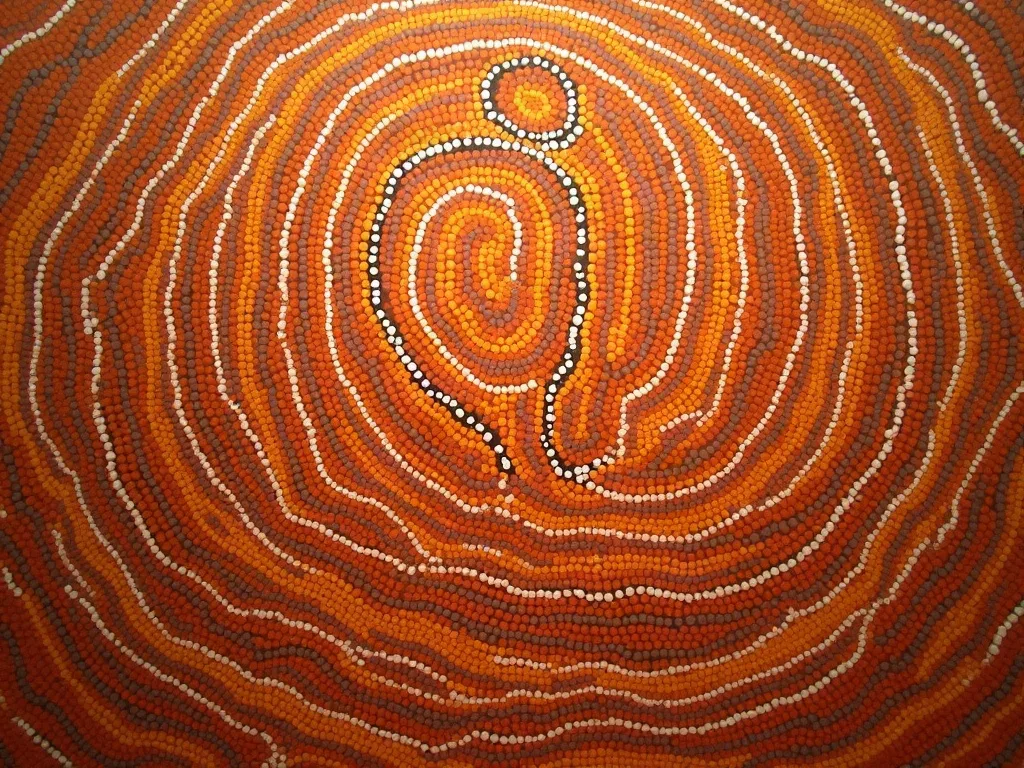
Western Desert acrylic painting, the movement that began at Papunya in the Northern Territory in 1971, grew directly from the tradition of painting Songline maps on bodies and ceremonial objects. The concentric circles, dotted paths, and directional lines that characterise "dot painting" are not purely decorative patterns. They are often diagrammatic renderings of Dreaming tracks: the circles mark sacred sites, the lines between them trace the Ancestor's path.
Papunya Tula artists, guided by Geoffrey Bardon (a schoolteacher who encouraged the transfer of ceremonial designs to canvas), produced work that was simultaneously a preservation effort, an economic lifeline, and an act of cultural assertion. Artists like Clifford Possum Tjapaltjarri and Johnny Warangkula Tjupurrula became internationally recognised while encoding knowledge that, to the uninitiated eye, read as abstraction. To those who held the corresponding Songline, the paintings were precise maps.
The tension between accessibility and restriction remains active. Some communities have made deliberate choices about which versions of Songline imagery may be shared publicly and which must remain within ceremonial contexts. This is not censorship but custodianship: the same principle that governs who may sing which verses of the track.
For readers seeking to understand the living Songlines tradition, the work of Aboriginal Australian mythology connects the visual, ceremonial, and cosmological dimensions that no single art market can capture alone.
Frequently Asked Questions About Songlines: Sacred Pathways Across the Land
Frequently asked questions
Are Songlines the same across all Aboriginal groups in Australia?
No. Australia had over 250 distinct language groups, each with their own Dreaming tracks, Ancestor beings, and ceremonial protocols. Some Songlines cross multiple language territories and are shared (with different verse-sets) across groups. Others are local to a single community. The network is diverse and interconnected, not uniform.
What is the difference between a Songline and the Dreaming?
The Dreaming (or Tjukurpa) is the foundational cosmological framework, the ongoing creative time-plane in which Ancestor beings exist and act. A Songline is one specific thread within the Dreaming: the route and the song associated with a particular Ancestor being's journey across a particular stretch of country. The Dreaming is the whole; a Songline is one expression of it.
Can non-Aboriginal people learn or access Songlines?
Some portions of Songlines are publicly shareable and have been taught in cross-cultural contexts, including school programmes and cultural tourism. Restricted or secret-sacred portions are not available to outsiders, and seeking access to them without proper protocol is considered a serious breach of Aboriginal Law. Anthropologist Deborah Bird Rose and others have written extensively about respecting these boundaries in research contexts.
How old are the Songlines?
A definitive date is impossible to establish, but the oral tradition is continuous and living rather than fossilised. The ceremonial use of ochre in Australia dates back at least 60,000 years. Some researchers, including those working with Aboriginal knowledge holders and geologists, argue that certain Songlines encode memories of specific geological events, such as volcanic eruptions and sea-level rises, from thousands of years ago. Duane Hamacher's research suggests some astronomical knowledge embedded in Dreaming tracks may be at least 10,000 years old.
What happened to Songlines during the Stolen Generations period?
The Stolen Generations refers to the Australian government policy, active roughly from the 1910s to the 1970s, of forcibly removing Aboriginal children from their families and communities. This severed the transmission of Songline knowledge between generations. Many restricted portions of tracks were held by elders who died before they could initiate and teach the children who had been taken. Some Songlines were lost entirely. Others survived in fragments, and contemporary communities are engaged in ongoing recovery and revitalisation work, often in collaboration with AIATSIS (the Australian Institute of Aboriginal and Torres Strait Islander Studies).
Do Songlines appear in Australian law?
Yes. Since the 1992 Mabo v Queensland High Court decision overturned the doctrine of terra nullius, Aboriginal connection to country, evidenced partly through Songlines and Dreaming track knowledge, has been recognised as a basis for Native Title claims. Songlines function as legal testimony of continuous, unbroken relationship to specific land, waterways, and sites.
The Ongoing Life of the Tracks
Scholars and Aboriginal communities continue to wrestle with a central paradox: how do you protect living knowledge from erasure without freezing it into a museum exhibit?
The AIATSIS archive in Canberra holds thousands of recordings, photographs, and documents relating to Songlines and Dreaming tracks, collected over more than a century of anthropological fieldwork. Access is controlled by community protocols, and many items are restricted to the communities they came from. Researchers like Philip Clarke have documented the ethnobotanical knowledge embedded within specific Dreaming tracks, showing that the plants named in a Songline are ecologically accurate indicators of soil type, water proximity, and seasonal availability. The song is also an environmental management guide.
Meanwhile, GPS and satellite mapping have been turned into unexpected allies. Several Australian communities have layered their Songline knowledge onto geographic information systems, creating digital maps that show the country as it is known through song, not only as it is measured by survey. These hybrid tools are not replacements for the sung tradition; they are aids for the elders who must now also litigate, negotiate, and educate in a bureaucratic world.
The Songlines remain living. They are sung at funerals to guide the deceased's spirit back to the country of their Ancestors. They are sung at births to introduce a child to the land they belong to. They are walked during ceremonial gatherings that bring together custodians from across a track's length, sometimes travelling thousands of kilometres to perform in sequence.
Every verse still names the same waterhole the same Ancestor touched in the Dreaming. The country recognises the song. The song recognises the country. That contract, struck before the first human memory, has not expired.
Read the full book
Want the whole story?
The complete edition is an instant PDF download here, with a paperback on Amazon for selected titles.
Australian Aboriginal
The Aboriginal Mythology Book: The Rainbow Serpent, Wandjina, Baiame, and the Dreamtime Stories of the World's Oldest Tradition
60,000 Years of Unbroken Ancestral Memory
The world's oldest continuous mythology. From the Rainbow Serpent to the Wandjina cloud spirits, explore the Dreamtime stories that have mapped Australia for 60,000 years.
More from Australian Aboriginal
All articles
Australian Aboriginal
Namarrgon: The Lightning Man of Arnhem Land
Namarrgon is the terrifying sky god of the Yolngu people who creates lightning and controls the monsoon storms that shape life across Arnhem Land. His thunderous presence reveals how Aboriginal cultures read the sky as a living, ancestral force.

Australian Aboriginal
The Dreamtime: Creation and Eternal Present in Aboriginal Belief
The Dreamtime is the Aboriginal foundation of existence: the era when ancestral beings shaped the land, set down the laws of kinship and ritual, and wove themselves into every rock, waterhole, and song. It is neither ancient history nor myth alone, but an ongoing reality that Aboriginal peoples access through ceremony, song, and country.

Australian Aboriginal
The Seven Sisters: Celestial Pursuit and Pleiades Myth in Aboriginal Australia
Seven sisters flee across the sky in Australian Aboriginal mythology, hunted by a man who will never catch them. This eternal chase, traced in the Pleiades star cluster, reveals how Aboriginal peoples read the cosmos as a living story of desire, escape, and sacred boundaries.
Australian Aboriginal
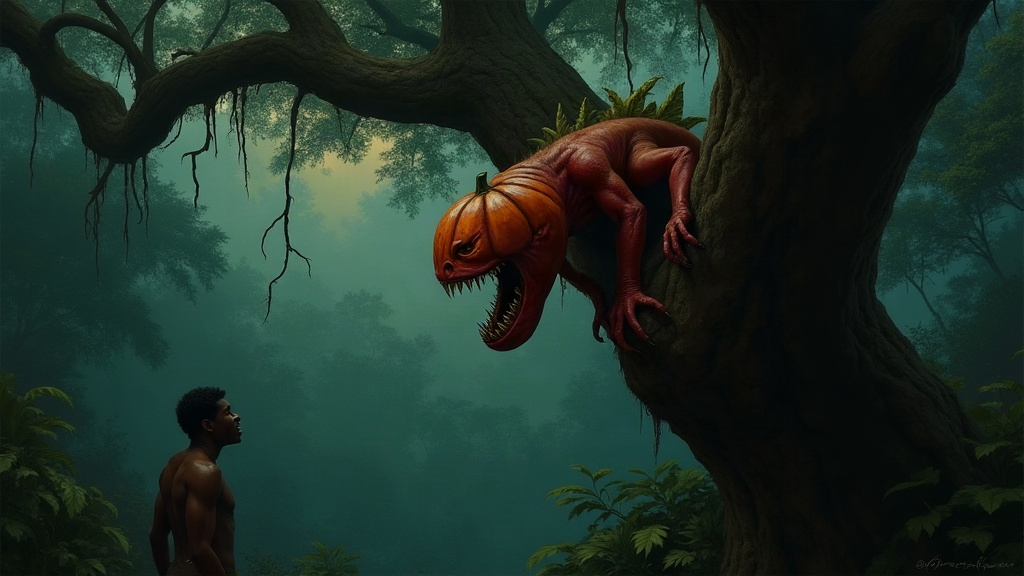
Yara-ma-yha-who: The Bloodsucking Tree Dweller of Australian Aboriginal Myth
Meet the Yara-ma-yha-who, a small but lethal tree-dwelling creature from Rainrainforest Aboriginal lore that hunts humans by bloodsucking and regurgitation. Discover what this creature reveals about danger, transformation, and survival in the deep Australian bush.