
The Seven Sisters: Celestial Pursuit and Pleiades Myth in Aboriginal Australia
Seven sisters flee across the sky in Australian Aboriginal mythology, hunted by a man who will never catch them. This eternal chase, traced in the Pleiades star cluster, reveals how Aboriginal peoples read the cosmos as a living story of desire, escape, and sacred boundaries.
Contents
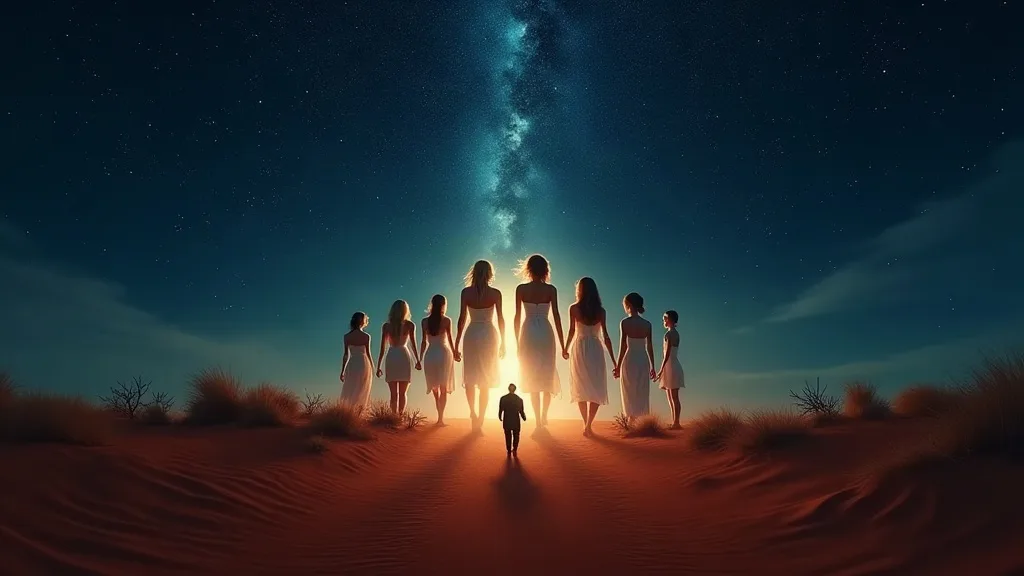
Six sisters lean into the night sky, their hair flying, feet barely touching earth as they run. A man chases, always behind, always burning with hunger he cannot name. This is how Aboriginal Australians read the Pleiades: not as distant lights to be named and catalogued, but as kin on an eternal journey, their movement holding meaning that has echoed through the continent for tens of thousands of years.
The Seven Sisters and their celestial flight sit at the heart of Aboriginal Australian astronomy. The story changes in its details from nation to nation across the vast continent, but the core remains constant: women ascending to heaven, pursued by desire, transformed into stars that never rest. For the Kimberley peoples of northwestern Australia, they are the Malaiyka. For the Wardaman people further east, they are the Kambugiarri. In the Dreaming narratives of the Western Martu, they are the Djerait, the Seven Sisters who rose from the earth in a single moment of crisis and transformation.
The Pleiades itself appears as a tight cluster of six or seven luminous points in the night sky, visible across both hemispheres. But what Western astronomy identifies as a stellar nursery, young stars bound by gravity, Aboriginal skygazers understood as a sacred text. Observing the sisters was not passive observation. It was reading law, history, and warning all at once.
The Sisters Flee: Origin and Pursuit
In the Kimberley region, the oldest recorded versions of the myth come from the Ngarinyin people, who tell of seven sisters living on earth. A man named Djamar (in some versions Yaghan or Dyinyinga) becomes obsessed with them. His desire grows unchecked, consuming him. The sisters sense his hunger and understand it threatens not just them but the order of things: attraction without consent, need without boundary, a force that will bend the world if they remain earthbound.
They run. The earth trembles beneath their feet. They call to the sky spirit, and in answer, they begin to lift. Their bodies grow lighter. The man below chases, leaping higher, his arms stretched toward them, but his feet remain tied to the ground. The sisters rise faster, becoming mist, becoming light, becoming fixed in the eternal night above.
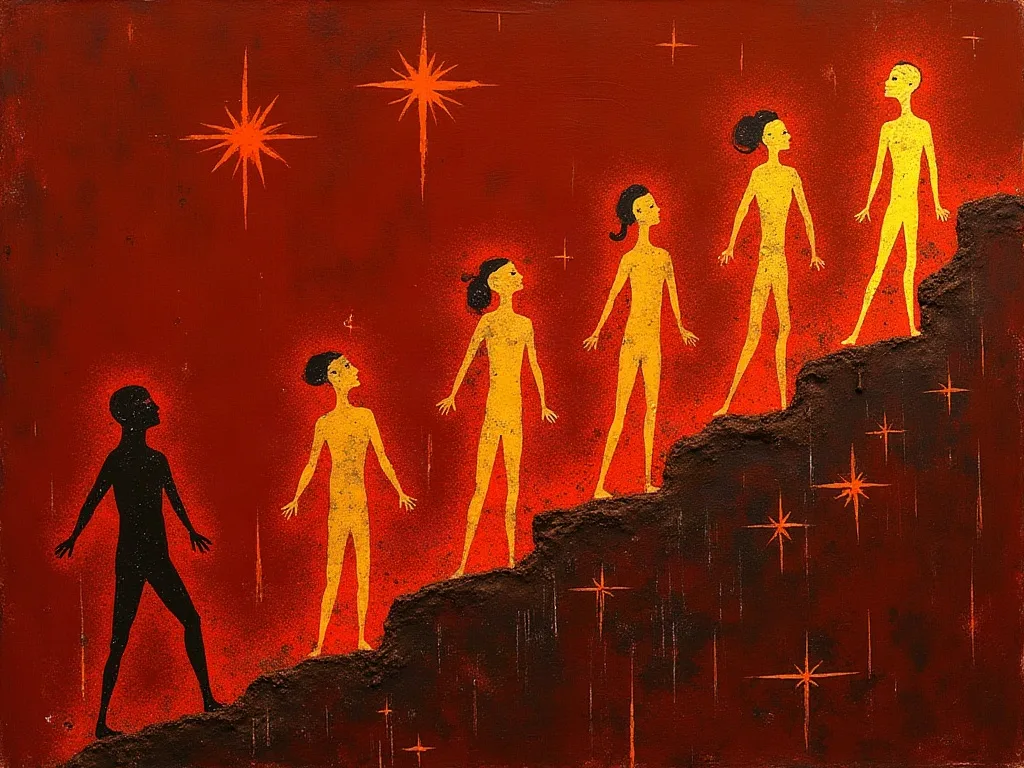
In versions from the Martu and Ngarrinyin traditions, the sisters leave before reaching the sky. A man follows them up into the heavens, and there the chase continues without end. He becomes Orion, the eternal hunter in the night sky, always visible when they are visible, always pursuing, never catching. Some accounts describe him as so desperate that he becomes the star Rigel or the constellation hunter himself, locked in pursuit across the seasons.
Other traditions add layers to the pursuit. A woman figure sometimes appears as well, a mother, a rival, or a guardian. In some Pilbara versions, an older woman chases after the sisters too, concerned with their safety, creating a more complex aerial narrative where protection and danger blur together.
Reading the Stars: Seasonal Astronomy and Navigation
For Aboriginal peoples across Australia, the Pleiades served purposes far beyond mythological storytelling. The cluster was practical and sacred at once.
The Pleiades rises at different times depending on latitude and season. In many parts of Australia, the cluster rises heliacally (just after the sun) in early winter or late spring, marking crucial seasonal transitions. The Pleiades signaled time to gather certain foods, when plants ripened, when animals moved, when water sources changed. The Yolngu people of Arnhem Land tracked the star cluster's rising and setting as part of a wider calendar system woven into ceremony, movement across country, and trade. The Pleiades told you when to move, when to gather, when to prepare.
In navigation, the sisters served as waypoints across vast distances. Aboriginal travelers moving through desert country could locate themselves by reading where the Pleiades sat in the sky, just as mariners in other traditions used Polaris. The cluster's rising and setting against particular landmarks on the land created a map legible only to those who had learned the country and its stories together.
The pursuit narrative itself encoded knowledge: the man chasing the sisters below the horizon reflected the fact that Orion and the Pleiades have a specific angular relationship. When one rises, the other follows. When one sets, the other descends. The "chase" is not metaphor but observation of actual celestial mechanics expressed as kinship and law.
Sacred Law and Sexual Boundary
The Seven Sisters myth speaks to something deeper than navigation or seasonal markers. In Aboriginal Australian law systems, which are often called Dreaming Law or Country Law, the story encodes rules about sexual propriety, kinship, and the consequences of transgression.
In many Australian Aboriginal societies, kinship systems determine who may marry whom, who belongs to which group, and how relationships unfold through generations. These systems are not casual rules but sacred orders, written into song cycles, dances, and stories. A man who pursues women who are not lawfully his to pursue violates not just personal boundaries but the cosmic architecture itself.
The sisters ascending represents the escape from disorder. Their transformation into stars shows that when human law is respected, the cosmos remains balanced. When it is violated, transformation becomes necessary, not as punishment, but as restoration. The woman must flee. The boundary must be restored. And the eternal pursuit in the sky serves as permanent warning: this hunger exists. It must always be resisted.

In the Kimberley traditions, the Seven Sisters are often described as belonging to a particular skin group or totem line. The man who chases them is sometimes from a forbidden category entirely, a brother, a wrong-skin relative, or an outsider. The mythological pursuit is therefore not a story of romantic desire but of violation, incest, or theft. His endless chase becomes his punishment and his penance: to pursue forever what he can never legitimately possess.
The Sisters Across the Continent
The Pleiades myth does not appear identically everywhere in Aboriginal Australia. The continent is vast, over seven million square kilometers, and home to several hundred distinct Aboriginal nations, each with their own languages, Dreaming stories, and astronomical knowledge.
In northern Australia, the story centers on the Malaiyka or similar figures. The Yolngu people of northeastern Arnhem Land know the sisters as part of a broader narrative involving the Djanggawul sisters, who in some tellings are connected to the celestial sisters through transformation and dreaming sequences. The Wardaman and Jawoyn peoples of the Katherine region describe the Kambugiarri, a name that carries meanings related to gathering and movement.
In central and southern traditions, particularly among the Martu and western desert peoples, the story shifts emphasis. Here, the pursuit becomes less about law violation and more about protective escape. Some versions describe the sisters as fleeing a harmful spirit or a man driven mad by loneliness. The narrative takes on a different emotional weight: not judgment but compassion.
In Tasmania, where Aboriginal nations maintained complex astronomical knowledge before colonial disruption, similar narratives appear in oral traditions, though recorded versions are fewer because colonial suppression was particularly severe.
The differences reflect not confusion but diversity of understanding. Each nation's telling is specific to their country, their kinship systems, their own particular relationship with the stars above that country.
Connections to Other Cultures
The Pleiades appear in mythologies across the world. The Tupi peoples of Brazil tell of the Pleiades as seven women transformed to stars. The Māori of Aotearoa New Zealand call the cluster Matariki and mark it as the start of their new year. In Greek mythology, the Pleiades are daughters of Atlas and Pleione, fleeing the giant Orion and transformed into stars by Zeus. The Kiowa of North America tell of seven sisters ascending to become the stars.
These similarities raise questions that scholars continue to debate. Did these stories arise independently because humans everywhere see seven sisters in that cluster of stars? Or do they reflect deeper cultural exchanges, shared migrations, or universal patterns in how humans construct meaning from the night sky?
For Australian Aboriginal traditions, the evidence suggests deep antiquity and independent development. The stories are woven into language structures, place names, and Dreaming Law systems in ways that suggest tens of thousands of years of continuity. The Kimberley traditions are among the oldest recorded mythology in the world. Aboriginal astronomy was sophisticated, practical, and connected to sacred law in ways that feel uniquely Aboriginal.
The Sisters in Modern Aboriginal Culture
The Pleiades and the Seven Sisters myth remain vital in contemporary Aboriginal Australian culture, particularly in the Kimberley region and across the north.
Elders continue to teach the story to younger generations, not as museum artifact but as living law. Songlines and ceremonies associated with the sisters persist, particularly in communities where Dreaming Law continues to be the framework for understanding country and kinship. In some places, the rising of the Pleiades still marks ceremonies, gatherings, and transitions in the ritual year.
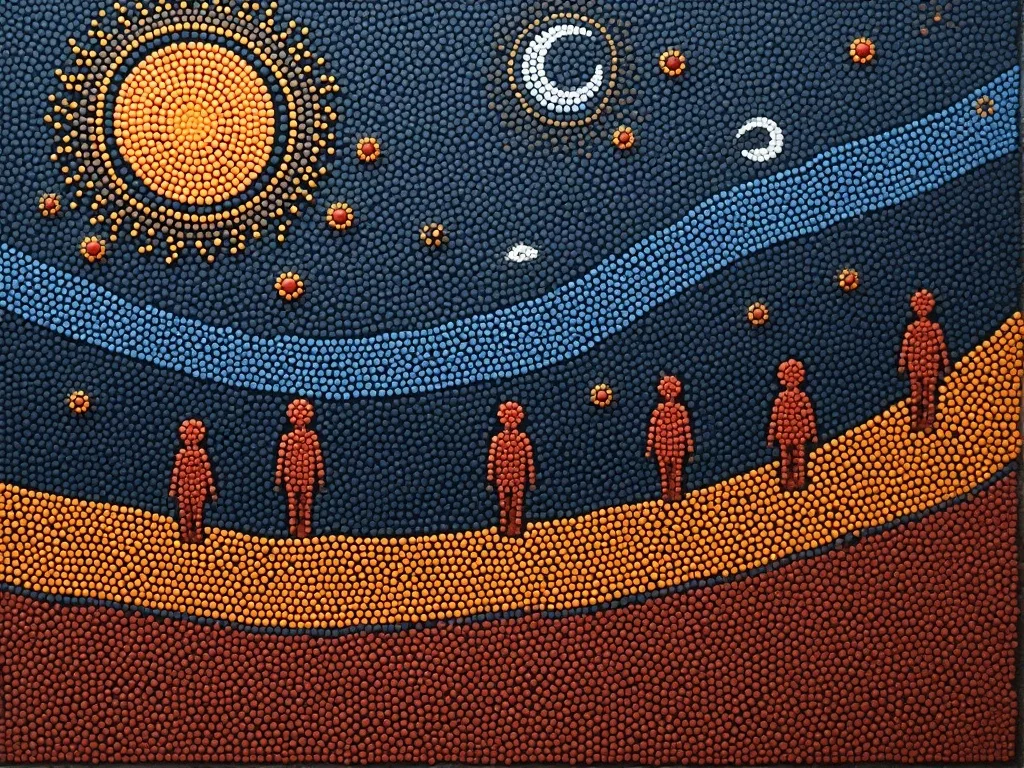
In the visual arts, contemporary Aboriginal artists have drawn on the Seven Sisters narrative, creating new works that honor the old stories while engaging with contemporary contexts. The story appears in dot painting traditions, in prints, and increasingly in digital media. These retellings are not reductions of the myth but extensions of it, adding to a tradition that has always been adaptive and responsive to its moment.
In literature and film, Aboriginal writers and directors have used the Seven Sisters story to explore themes of autonomy, safety, and the persistence of Aboriginal knowledge despite centuries of colonization. The sisters' eternal escape becomes a metaphor for Aboriginal survival and continuation.
The myth also appears in discussions of women's safety and feminist Aboriginal perspectives. Some contemporary Aboriginal women writers have reclaimed the sisters as figures of agency and resistance, reading the pursuit not only through male predation but through women's power to flee, to transcend, to refuse. The transformation into stars becomes not only escape but apotheosis.
Seasonal Visibility and the Pleiades Today
The Pleiades cluster remains one of the most readily visible star clusters in the night sky. It rises in the east in late September and early October in the Northern Hemisphere, and in late March and early April in the Southern Hemisphere. The cluster is brightest during the winter months in each hemisphere.
To the naked eye, most people can distinguish six or seven stars in the cluster, though photographic observation reveals many more, over 3,000 stars are now known to be members of the Pleiades association. The brightest stars bear names in many cultures: Alcyone, Merope, Electra, Maia, Taygeta, Pleiope, and Atlas in the Greek tradition, each a member of a single family constellation.
The cluster lies approximately 440 light-years from Earth, making it one of the nearest star clusters to our solar system. It is young in astronomical terms, only about 100 million years old, which is why its stars are still hot and bright, giving the cluster its distinctive bluish hue visible to observers with good eyesight.
For Aboriginal observers, the specific rising and setting of the Pleiades against known landmarks in the landscape created a permanent calendar. A person who knew their country well could mark time and place simply by looking up. The stars were not external decorations but threads woven into the fabric of country itself.
Frequently asked questions about the Seven Sisters and Pleiades myth
Frequently asked questions
Why do the Seven Sisters appear in so many different Aboriginal Australian traditions?
The Pleiades is visible from every part of the Australian continent and rises at different times depending on where you are. Each Aboriginal nation would have observed the cluster and integrated it into their own Dreaming stories, seasonal calendars, and systems of law. The myth is not a single story but a shared observation generating different tellings across diverse cultures, much as a single river takes different courses through different landscapes but remains recognizable as itself.
Is the man who chases the sisters always the same figure?
No. In Kimberley traditions, he is often Djamar or a similar name. In other traditions, he becomes Orion, the constellation hunter visible in the winter sky pursuing the sisters forever. Some versions describe him as a brother, some as an outsider, some as a spirit or being driven mad. The variations reflect different nations' understanding of what transgression looks like and what restoration requires. The pursuit is consistent; the pursuer's identity shifts.
Do Aboriginal peoples still use the Pleiades for navigation and seasonal marking?
In many communities, particularly in the north and Kimberley regions, the Pleiades remains part of active astronomical and seasonal knowledge systems. Elders teach the rising and setting of the cluster as part of reading country and understanding Dreaming Law. While colonial disruption affected many knowledge systems, the stars themselves have never been conquered, and the knowledge continues to be transmitted and practiced in communities where it has never been abandoned.
Why is the story about an eternal pursuit rather than about rescue or resolution?
In Aboriginal Australian law and philosophy, some violations cannot be "fixed." The boundary violated requires permanent defense. The eternal pursuit demonstrates that some hungers are part of the world and must always be resisted. This reflects a different cosmological understanding than Western narrative traditions, which often resolve conflicts through final victory or redemption. Here, the eternal tension itself is the resolution.
Are the Pleiades and Seven Sisters myth the same story worldwide?
Different cultures across the world, from Greece to Japan to the Americas, tell stories of seven sisters and the Pleiades. Whether these represent independent observations (the cluster does have roughly seven visible stars) or reflect deeper connections remains debated. For Aboriginal Australia, the evidence suggests a tradition developed over tens of thousands of years, specific to Australian languages, law systems, and astronomy, though the shared human impulse to find meaning in this particular star cluster appears nearly universal.
What the Stars Teach: Boundaries and Belonging
The Seven Sisters myth persists because it teaches something that facts alone cannot convey. A star cluster is an object in space. The Pleiades is a fact that can be measured and catalogued. But the sisters fleeing, the man chasing, the law being broken and restored, these are truths about how the world holds together.
For tens of thousands of years, Aboriginal Australians looked at the same stars visible to us now and saw kin, saw law, saw warning, saw seasonal pattern, saw the boundaries that keep desire and violation in balance. That knowledge did not end with colonization. It continues in communities where it has been protected, in songs still sung, in ceremonies still performed, in knowledge still passed from elder to child under the same stars.
The seven sisters still run. The man still pursues. The boundaries hold. And for anyone who learns to read the night sky as the old peoples did, the story never stops teaching.
Read the full book
Want the whole story?
The complete edition is an instant PDF download here, with a paperback on Amazon for selected titles.
Australian Aboriginal
The Aboriginal Mythology Book: The Rainbow Serpent, Wandjina, Baiame, and the Dreamtime Stories of the World's Oldest Tradition
60,000 Years of Unbroken Ancestral Memory
The world's oldest continuous mythology. From the Rainbow Serpent to the Wandjina cloud spirits, explore the Dreamtime stories that have mapped Australia for 60,000 years.
More from Australian Aboriginal
All articles
Australian Aboriginal
Namarrgon: The Lightning Man of Arnhem Land
Namarrgon is the terrifying sky god of the Yolngu people who creates lightning and controls the monsoon storms that shape life across Arnhem Land. His thunderous presence reveals how Aboriginal cultures read the sky as a living, ancestral force.

Australian Aboriginal
The Dreamtime: Creation and Eternal Present in Aboriginal Belief
The Dreamtime is the Aboriginal foundation of existence: the era when ancestral beings shaped the land, set down the laws of kinship and ritual, and wove themselves into every rock, waterhole, and song. It is neither ancient history nor myth alone, but an ongoing reality that Aboriginal peoples access through ceremony, song, and country.
Australian Aboriginal
Yara-ma-yha-who: The Bloodsucking Tree Dweller of Australian Aboriginal Myth
Meet the Yara-ma-yha-who, a small but lethal tree-dwelling creature from Rainrainforest Aboriginal lore that hunts humans by bloodsucking and regurgitation. Discover what this creature reveals about danger, transformation, and survival in the deep Australian bush.

Australian Aboriginal
Wandjina: Cloud and Rain Spirits of the Kimberley
The Wandjina are powerful cloud and rain spirits central to Kimberley Aboriginal culture, shaped in rock art and songlines for thousands of years. Discover their role in creation, their visual grammar, and why their caves remain sacred today.