
Yara-ma-yha-who: The Bloodsucking Tree Dweller of Australian Aboriginal Myth
Meet the Yara-ma-yha-who, a small but lethal tree-dwelling creature from Rainrainforest Aboriginal lore that hunts humans by bloodsucking and regurgitation. Discover what this creature reveals about danger, transformation, and survival in the deep Australian bush.
Contents
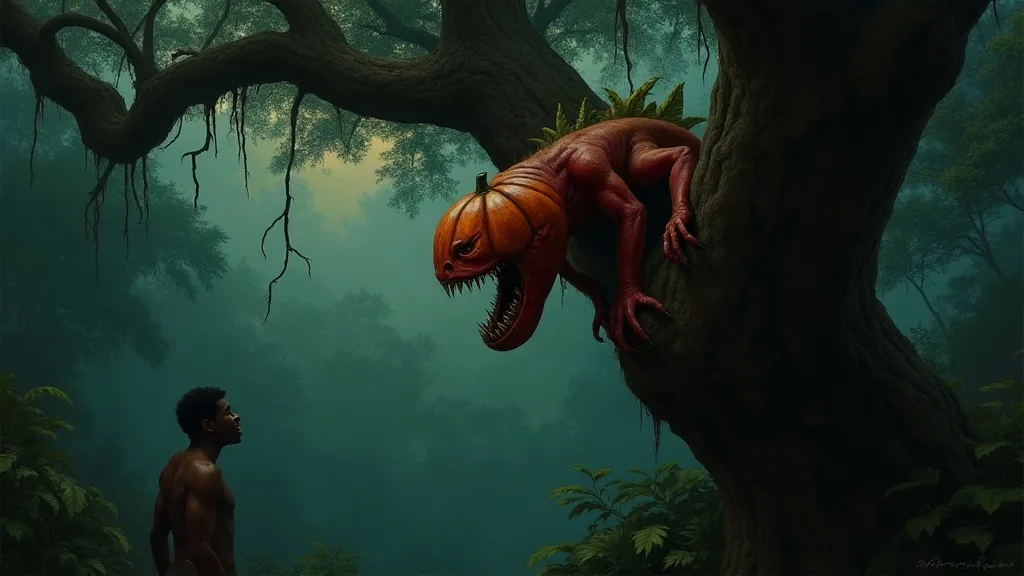
In the dense rainforests of northern Queensland, where the tropical canopy grows so thick that sunlight barely touches the ground, there lives a creature that waits in the trees. It is barely three feet tall, with smooth red skin, a round body, and a head shaped like a pumpkin. Its claws are sharp. Its mouth is large enough to swallow a man. The Yara-ma-yha-who is one of the most feared beings in Australian Aboriginal mythology, not because it is an all-consuming monster, but because of what it does once it captures you alive.
The creature does not kill quickly. It does something far worse: it draws your blood through the suction of its mouth, then swallows you whole, stores you inside its small body, and later vomits you back out, diminished and transformed. Survive the ordeal enough times, and you stop being entirely human. This is the genius of the Yara-ma-yha-who myth. It is not a story about death. It is a story about the boundary between being eaten and being transformed, between victim and something else.
Origins in Rainforest Country
The Yara-ma-yha-who belongs to the Rainrainforest Aboriginal peoples of northeastern Australia, specifically the Mamu, the Dja Dja Wurrung, and other groups whose Country lies in the wet tropics around Cairns and the Atherton Tableland. This is not desert mythology. It is the mythology of a landscape soaked in water, where vines strangle trees, where waterholes hide predators, and where a person alone in the bush is truly alone.
The creature's origins fade into the Dreaming, the ancient time when the land itself was being created and when the beings that inhabit it took their forms. Some versions say the Yara-ma-yha-who has always lived in certain trees, waiting. Others suggest it was once something else, a human or a different kind of creature, that was transformed into this small hunter through transgression or curse. The specifics depend on which Country the story comes from and which elder holds it.
What is consistent across the traditions is the creature's habitat: it lives high in the canopy of fig trees and rain trees, where few people venture and where a climber can easily be surprised. It is known to the Rainforests Aboriginal peoples by reputation and by direct encounter tales, stories passed down through families and shared at gatherings as warnings for the young.
The Hunt and The Bloodsucking
The Yara-ma-yha-who hunts at night or in the late afternoon, when the light grows dim under the forest cover. It waits on a branch or in the fork of a tree, motionless. When a person passes below, it drops down with surprising speed for something so small and lands on the person's shoulders or back.
What happens next is the creature's signature act: it fastens its large mouth to the skin of its prey and begins to suck. It draws blood steadily, methodically, without apparent hurry. The victim feels the pressure, the sensation of being drained. But the Yara-ma-yha-who does not drain all at once. It sucks enough to weaken the person severely, to make them dizzy and unable to run, but not enough to kill them outright.
Once the prey is weakened, the creature uses its claws to hold them in place. Then, with a motion that takes on the quality of a horrible swallow, it opens its large mouth wider than anything so small should be able to open, and ingests the entire person. This is not digestion. The person does not dissolve inside the creature's small body. Instead, they are stored, still alive, in a condition between life and death, held in stasis.
After some time, the creature regurgitates the person back out onto the ground. But the person who emerges is not unchanged. They are smaller. Some versions say they lose skin, or are covered in slime. Some say they wake in a different place, disoriented. Some say they have lost memories, or that certain parts of their body no longer obey their will in the same way.
Transformation Through Consumption
The true horror of the Yara-ma-yha-who myth lies not in the bloodsucking itself, but in what happens if the creature captures the same person repeatedly. Each time a person is swallowed and regurgitated, they shrink further. Each time, they lose more of what made them human. Eventually, after being caught and vomited out several times, a person becomes small enough to be mistaken for a Yara-ma-yha-who itself. They begin to lose the ability to speak, to think as they once did. They transform into the very creature that hunted them.
This is a unique kind of mythological horror. It is not about being eaten and gone. It is about being eaten repeatedly and slowly becoming your predator. It is a reversal tale, an inversion story. The victim and the victimizer blur. The boundary dissolves.
In some tellings, the transformation is complete: a person who has been caught three or four times by the Yara-ma-yha-who can no longer fully return to human society. They have been changed in some fundamental way. In other versions, the transformation is partial, ambiguous. The person retains some memory, some human awareness, even as their body shrinks and their instincts turn predatory.
This element of the myth speaks to something deep in Aboriginal oral tradition: the understanding that encounters with dangerous beings can alter a person in ways that cannot be undone. You do not meet the Yara-ma-yha-who and walk away the same. Even survival comes with a cost.
Encounters and Survival Strategies
Stories of people who have encountered the Yara-ma-yha-who and lived vary in detail, but share common elements. Some tell of hunters or travelers who saw the creature descending from a tree and managed to light a fire before it landed on them. The Yara-ma-yha-who reportedly fears fire and will not attack a person surrounded by flames.
Other accounts speak of people who climbed higher than the creature, or who managed to reach open ground where the creature's advantage in the trees was lost. There are stories of hunters who traveled in groups and were thus harder to isolate. The implicit lesson is always the same: isolation in the rainforest, especially at twilight, invites danger.
Some versions of the myth include rituals or substances that ward the creature off. Certain plants or the smell of particular fires supposedly repel it. These elements are tied to specific Country and specific elder knowledge, and are not widely known outside the communities that hold them.
The Yara-ma-yha-who is not typically portrayed as invincible. People do survive encounters with it. But the price of survival is often invisibility, a decision to stay out of the bush at dusk, to avoid certain places, to acknowledge the creature's sovereignty over its territory.
The Creature's Physical Form
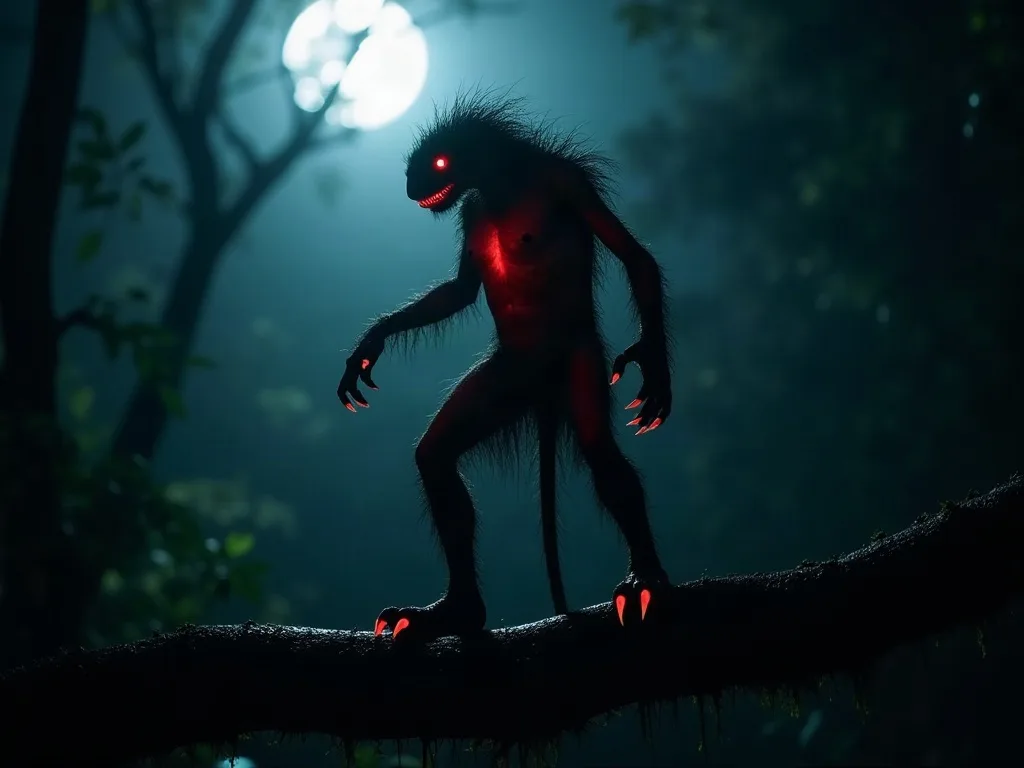
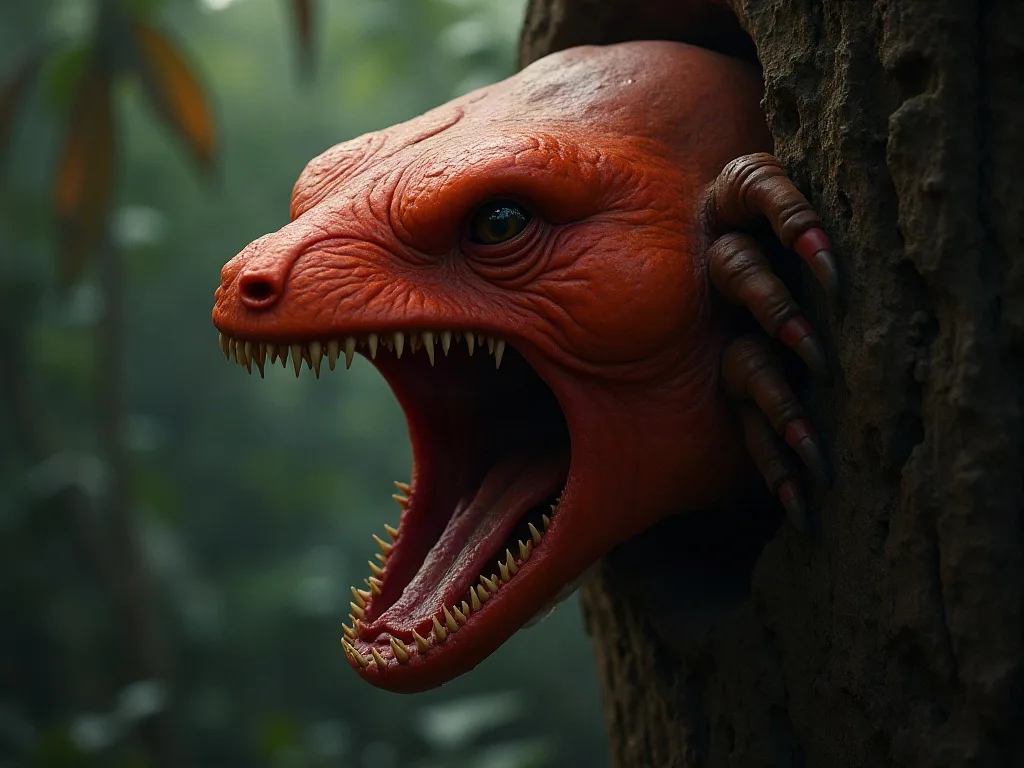
The Yara-ma-yha-who is consistently described as small, yet built with malevolent purpose. Its body is roughly humanoid but compact, no taller than three feet (some accounts say four or five, but never large). Its skin is described as smooth and red, though some tellings say it is reddish-brown or even covered in scales. It has a large head, sometimes described as melon-shaped or pumpkin-shaped. Its mouth is unusually wide, capable of distending to accommodate a human body whole.
Its claws are disproportionately large for its size, strong and sharp enough to grip and hold prey. Its eyes are sometimes described as lidless, unblinking, giving it an expression that combines the predatory with the utterly alien. It moves with surprising speed and agility, far more nimble in the trees than a human could ever be. On the ground, it is slower, which is why most encounters happen in the trees or at the margin where forest and clearing meet.
The creature has no obvious hair, or at least none that stands out in descriptions. It is often portrayed as sexless, though some versions refer to it with masculine pronouns and others remain neutral. The Red Skin of the Yara-ma-yha-who may mark it as something created in the Dreaming, as something that belongs to the land itself rather than to the world of humans and animals.
Ecological Significance and Sacred Landscape
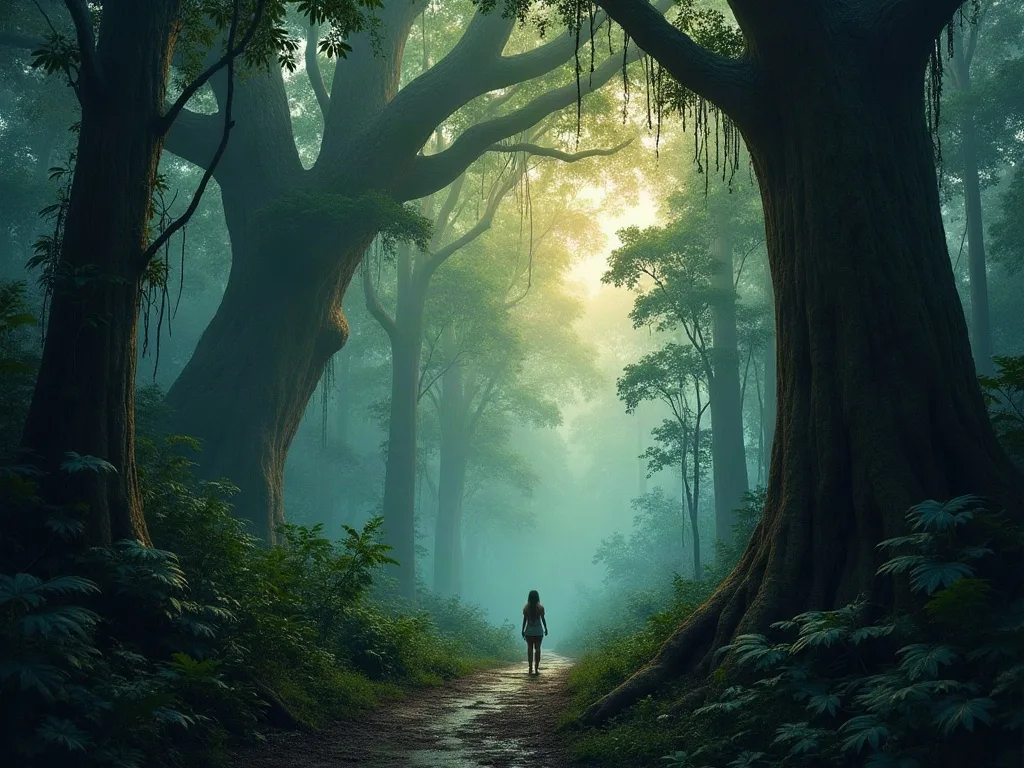
The Yara-ma-yha-who is not simply a monster imposed on the landscape. It is woven into the landscape itself, particularly into certain fig trees and rain trees of the northern Queensland rainforest. These specific places, specific trees, may be marked as the creature's dwelling and are passed over or avoided in actual travel and hunting.
This reflects a fundamental aspect of Aboriginal land knowledge: the understanding that certain places are inhabited by dangerous beings and that the landscape itself has agency. To travel through Country is to navigate not just geography but spiritual and biological reality. The Yara-ma-yha-who myth encodes practical information about forest safety alongside spiritual and philosophical meaning.
Some scholars and Aboriginal knowledge-keepers have noted that the creature's behavior and habitat suggest a metaphorical dimension as well. The rainforest itself can be seen as consuming, transforming people who venture into it unprepared. The wet, enclosed environment, the humidity, the difficulty of navigation, the easy getting lost, the slow adaptation required to survive there, all these might be embodied in the figure of the Yara-ma-yha-who.
The creature's act of bloodsucking might also reference actual bloodsucking animals found in the rainforest: certain bats, leeches, and insects that feed on mammals including humans. The Yara-ma-yha-who amplifies and literalizes this predatory relationship, making it central to the creature's identity in a way that transforms a naturalistic threat into a supernatural one.
Mythological Parallels and Cross-Cultural Echoes
The Yara-ma-yha-who shares structural features with other predatory beings in world mythology, though its particular form remains distinct. Like certain Caribbean and Pacific creatures in local folklore, it combines bloodsucking with a form of regurgitative transformation. Like some figures in Southeast Asian mythology, it inhabits a liminal space between human and animal form.
The concept of transformation through predation appears in many traditions. In Mesoamerican myth, certain jaguars and supernatural felines consume and alter their victims. In Native American traditions, shape-shifters and tricksters sometimes consume people and transform through that act. In Slavic folklore, certain vampiric beings blur the line between predator and transformed victim.
What makes the Yara-ma-yha-who unique is its specificity to the Australian rainforest ecology and its philosophical focus on the ambiguity of the consumed person's state. The creature does not create undead servants or corrupted slaves in the way some vampire figures do. Instead, it creates something harder to categorize: a being who was once human but is becoming something else.
The myth also reflects a particular Aboriginal philosophical stance: the understanding that boundaries between categories (human, animal, spirit, predator, victim) are more permeable than Western taxonomy suggests. In the Dreaming, transformation is possible. Being consumed and surviving can change what you are fundamentally.
Modern Context and Continued Resonance
The Yara-ma-yha-who remains a living part of Rainforests Aboriginal culture and is increasingly known to wider Australian audiences through storytelling, cultural education programs, and recent media adaptations. The creature has appeared in Australian horror and speculative fiction, where it is often portrayed much as it is in traditional tellings: as a genuinely dangerous being that deserves respect rather than sensationalism.
Contemporary Aboriginal artists and storytellers continue to represent the Yara-ma-yha-who, sometimes in traditional visual forms and sometimes in new contexts. This ongoing transmission is significant not as novelty or tourism, but as active cultural continuity. The creature is not a relic. It is a living presence in the mythology of its people.
Scholars of Aboriginal studies and mythology have increasingly emphasized the importance of learning these creatures and narratives from Aboriginal sources directly rather than from secondhand European documentation. The Yara-ma-yha-who myth, like all Aboriginal mythology, has been filtered through colonial records, academic texts, and non-Aboriginal retellings that sometimes distort or trivialize its meaning.
Authentic understanding of the Yara-ma-yha-who requires listening to the voices of the Rainforests Aboriginal peoples themselves, reading works by Aboriginal authors and storytellers, and acknowledging that the full spiritual and practical significance of the creature may be known only to those whose Country it inhabits and whose ancestors carried the stories.
Frequently asked questions about the Yara-ma-yha-who?
Frequently asked questions
Is the Yara-ma-yha-who based on a real animal?
The Yara-ma-yha-who is not a real animal, but the myth incorporates features of real rainforest creatures. Bloodsucking bats, leeches, and certain insects do exist in northern Queensland, and the creature may metaphorically amplify these threats into a supernatural form that carries spiritual and cultural meaning beyond biological accuracy.
Can the Yara-ma-yha-who actually transform a person permanently?
In the mythological sense, repeated encounters with the Yara-ma-yha-who can alter a person so fundamentally that they become something other than fully human. Whether this is understood as spiritual, literal, or metaphorical depends on the specific version of the story and the cultural context in which it is told. Traditional tellings suggest the transformation is real and irreversible.
Is the Yara-ma-yha-who still feared in Australia today?
Among Rainforests Aboriginal communities, the Yara-ma-yha-who remains a significant part of cultural knowledge and is treated with the respect due to a dangerous being. In the wider Australian population, knowledge of the creature has grown in recent decades, though not all non-Aboriginal Australians are familiar with it. The creature is presented in contemporary Aboriginal cultural education and storytelling programs.
What Country does the Yara-ma-yha-who come from?
The Yara-ma-yha-who belongs to the rainforests of northeastern Australia, particularly the Country of the Mamu and other Rainforests Aboriginal peoples around the Atherton Tableland and Cairns region in Queensland. The creature is tied to specific trees and places within this landscape and is not part of the mythology of Aboriginal peoples from other regions like the Western Desert or the central grasslands.
How does the Yara-ma-yha-who compare to vampires in European folklore?
Like European vampires, the Yara-ma-yha-who feeds on blood, but it does not create undead servants or spread its condition through a bite. Instead, it stores its prey alive inside its small body and later regurgitates them, transformed and diminished. The key difference is that the Yara-ma-yha-who transforms its victims gradually into something like itself, rather than corrupting them into a different kind of undead being.
The Creature's Place in Aboriginal Philosophy and Land Knowledge
The Yara-ma-yha-who is ultimately a teaching story, one that encodes practical, spiritual, and philosophical knowledge about survival, respect, and the dangerous intelligence of the rainforest. To know about the Yara-ma-yha-who is to understand that certain places require caution, that isolation can be lethal, and that the landscape itself is alive with beings that have their own agency and authority.
The myth also teaches something subtler: that encounter with the dangerous or the other can fundamentally change who you are. You do not pass through a meeting with the Yara-ma-yha-who unmarked. The creature is a boundary-keeper, a teacher through terror, a reminder that the world contains forces far older and stranger than human civilization, and that respecting those forces is necessary for survival. The Yara-ma-yha-who waits in the Queensland rainforest still, in the stories that sustain the knowledge and culture of the people whose Country it inhabits, and in the dark spaces where the trees grow so thick that sunlight becomes a rumor.
Read the full book
Want the whole story?
The complete edition is an instant PDF download here, with a paperback on Amazon for selected titles.
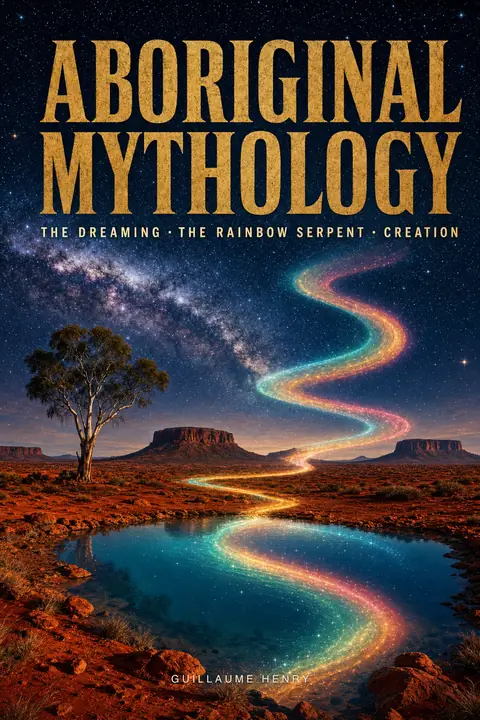
Australian Aboriginal
The Aboriginal Mythology Book: The Rainbow Serpent, Wandjina, Baiame, and the Dreamtime Stories of the World's Oldest Tradition
60,000 Years of Unbroken Ancestral Memory
The world's oldest continuous mythology. From the Rainbow Serpent to the Wandjina cloud spirits, explore the Dreamtime stories that have mapped Australia for 60,000 years.
More from Australian Aboriginal
All articles
Australian Aboriginal
Namarrgon: The Lightning Man of Arnhem Land
Namarrgon is the terrifying sky god of the Yolngu people who creates lightning and controls the monsoon storms that shape life across Arnhem Land. His thunderous presence reveals how Aboriginal cultures read the sky as a living, ancestral force.
Australian Aboriginal
The Dreamtime: Creation and Eternal Present in Aboriginal Belief
The Dreamtime is the Aboriginal foundation of existence: the era when ancestral beings shaped the land, set down the laws of kinship and ritual, and wove themselves into every rock, waterhole, and song. It is neither ancient history nor myth alone, but an ongoing reality that Aboriginal peoples access through ceremony, song, and country.
Australian Aboriginal
The Seven Sisters: Celestial Pursuit and Pleiades Myth in Aboriginal Australia
Seven sisters flee across the sky in Australian Aboriginal mythology, hunted by a man who will never catch them. This eternal chase, traced in the Pleiades star cluster, reveals how Aboriginal peoples read the cosmos as a living story of desire, escape, and sacred boundaries.
Australian Aboriginal
Wandjina: Cloud and Rain Spirits of the Kimberley
The Wandjina are powerful cloud and rain spirits central to Kimberley Aboriginal culture, shaped in rock art and songlines for thousands of years. Discover their role in creation, their visual grammar, and why their caves remain sacred today.