

Wandjina: Cloud and Rain Spirits of the Kimberley
The Wandjina are powerful cloud and rain spirits central to Kimberley Aboriginal culture, shaped in rock art and songlines for thousands of years. Discover their role in creation, their visual grammar, and why their caves remain sacred today.
Contents
When the Kimberley sky darkens and the first rains fall on the red earth, the Wandjina watch from the stone. These cloud and rain spirits inhabit the rock shelters and gorges of north-western Australia, their images painted on stone for at least the last three thousand years. Tall, spare figures with enormous oval eyes, dark halos radiating from their heads like electromagnetic fields, they embody the force that brings water to one of the world's harshest and most beautiful deserts. The Wandjina are not distant gods; they are tangible, present, alive in the cycles of monsoon and drought. To the Kimberley's Aboriginal peoples, the Ngarinyin, Worrora, and Unggumi among them, the Wandjina remain the bridge between earth and sky, the makers of rain, the keepers of place.
The Wandjina represent something profound in world mythology: the direct, visual connection between a people and the forces that sustain life. Unlike the gods of literate traditions, bound to written tablets and priestly interpretation, the Wandjina live in the landscape itself. A person standing in a Kimberley gorge might touch the exact spot where a Wandjina was painted by an ancestor thousands of years before, and that act of touch is prayer, remembrance, and renewal all at once.
The Origins of the Wandjina in Creation Time
In the Dreamtime, the deep mythological past that Aboriginal peoples call the Dreaming, the Wandjina emerged from the clouds and the sea. They did not create themselves; rather, they came into being as the law itself, the organizing principle that shaped the Kimberley landscape. The oldest accounts, transmitted orally for countless generations and recorded by anthropologists in the mid-twentieth century, describe the Wandjina as ancient beings who travelled across the land during the creation period, painting the world into existence with every step.
The Ngarinyin people, whose territory covers much of the central Kimberley, hold that the Wandjina descended from the Dreamtime sky. Some versions name specific Wandjina: Walngari, Jabaru, Jagamarra. Each had its own path, its own song, its own raison d'etre. They moved across the land with purpose, establishing the routes of water (the creeks and rivers), the locations of sacred sites, and the proper relationships between humans and country. Unlike many creation myths where a god shapes the world from nothing, the Wandjina awakened the land that was already there. They revealed the names of places, the songlines that explain how to find water in dry season, the protocols for hunting and ceremony.
What makes the Wandjina unique in global mythology is that their creation act continues. They are not relegated to a mythological past. Rain still falls from the sky; the monsoons still arrive; the country still speaks through these spirits. The Wandjina did not retire from the world after creation; they moved into the caves and rock galleries of the Kimberley, and there they remain, their painted forms a permanent imprint of their presence.
The Visual Language: How to Read a Wandjina
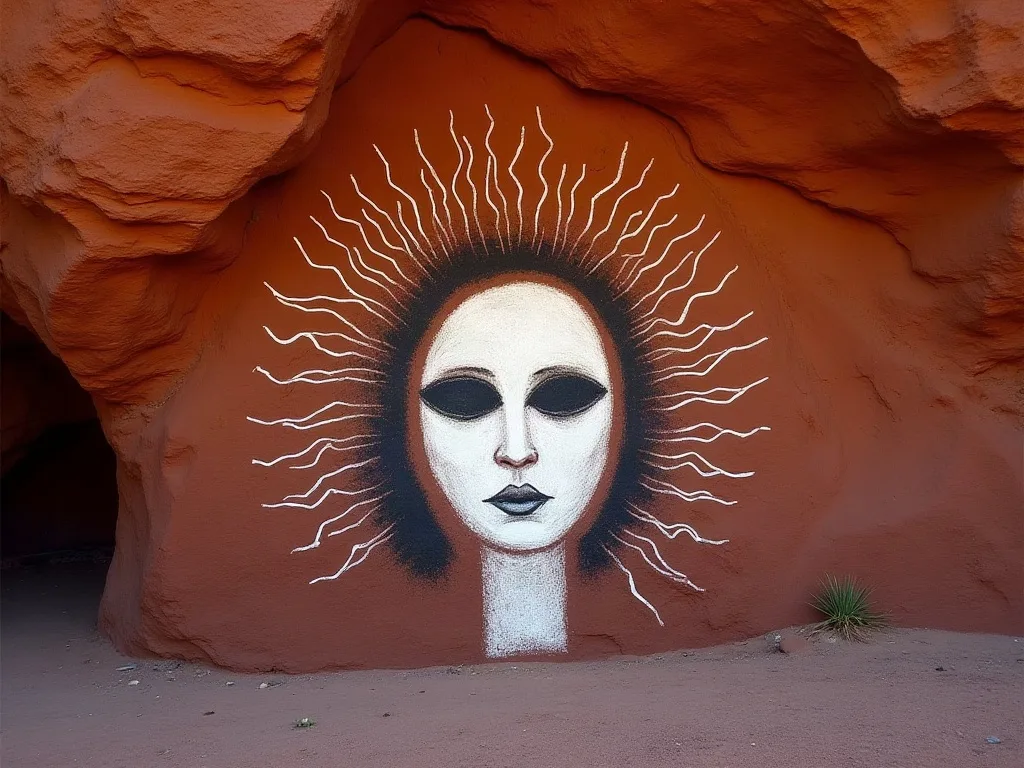
If you visit a Wandjina gallery deep in a Kimberley gorge, you will recognize the figures instantly: they are unlike any other sacred art tradition on Earth. A typical Wandjina stands nearly human in height, sometimes taller. The body is spare, almost economical in line. But the face dominates: an enormous oval, perfectly formed, often white or pale, filled with two enormous dark eyes that seem to look directly at you. There is no nose. There is no mouth. The absence of a mouth is deliberate and crucial; a Wandjina's power is so great that if it could speak, it would overwhelm the land and the people.
Around the head radiates a distinctive dark halo or corona, lines extending outward like rays or like lightning frozen in stone. This is not merely ornamental. The halo represents the Wandjina's power, the electrical charge that summons rain. Some older rock art shows the Wandjina with a tail or with extensions downward, what researchers call a "tail" that may represent the descent of water itself.
The Wandjina's physical depiction follows strict protocols that have survived for millennia. Variations exist between different Wandjina and different regions, but the core grammar remains: oval face, staring eyes, radiating halo, often an antenna or horn-like projection at the crown. This consistency is not accident or laziness. It is theological precision. The visual form encodes the spiritual truth: here is a being of pure presence and power, a consciousness without need for speech, entirely focused outward, radiating influence into the world.
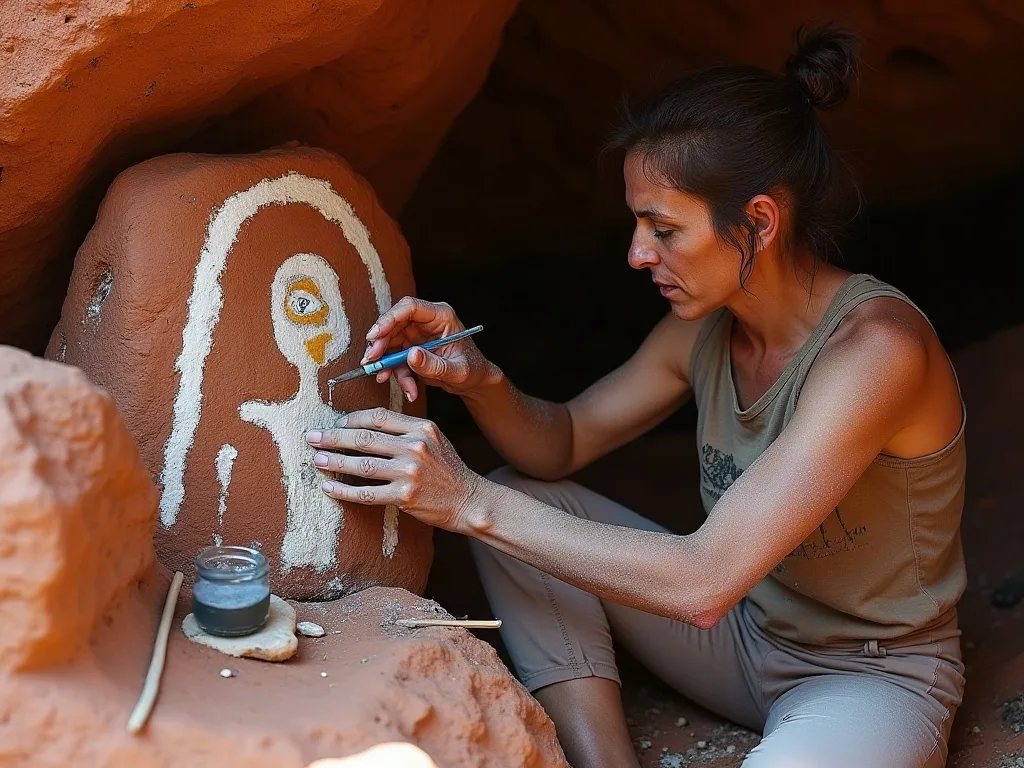
Paint was applied using manganese oxide (a black mineral) for the halo and often the eyes, and kaolin (white clay) or red ochre for the body and face. The paint was applied with fingers and simple brushes made from plant fibers or animal fur. Remarkably, Kimberley Aboriginal peoples never abandoned Wandjina painting, even as the colonial period transformed the continent. In shelters deep enough to resist weather, Wandjina figures painted hundreds of years ago remain visible. Some have been retouched by living artists, keeping the line fresh, the presence renewed.
The Wandjina as Rain-Bringers and Life-Givers
The primary function of the Wandjina is to bring rain. This is not poetic metaphor; it is biological necessity. The Kimberley receives most of its rainfall during the monsoon season, roughly November to March. Outside this window, the land becomes parched. Waterholes shrink. Life concentrates around permanent springs and deep gorges where water persists underground. Understanding the Wandjina as rain-bringers means understanding them as the force that determines whether people, animals, and plants live or die.
Ceremonies involving the Wandjina were and are weather-making events. When rain was late, when the monsoon delayed, when drought threatened the land, Aboriginal people would visit a Wandjina gallery and perform songs and rituals in the presence of the painted figures. The act was not supplication in the Western sense; it was not begging an external god for favor. Rather, it was reminder and activation. By singing the proper songlines, by touching the rock at the correct place, by enacting the ceremonial patterns associated with a particular Wandjina, people believed they were "calling the rain home," activating the Wandjina's inherent power. The rains would come.
Anthropologists in the twentieth century recorded Kimberley Aboriginal peoples describing this process with great specificity. A particular Wandjina, say Walngari, would be associated with rain from a specific direction, or rain that fell at a specific time. The songline attached to Walngari contained the knowledge of how water moved across the country, where it collected, how to find it. To sing the Walngari songline was to align yourself with that movement, to put yourself in harmony with the water's path.
Wandjina Country: Sacred Landscape and Songlines
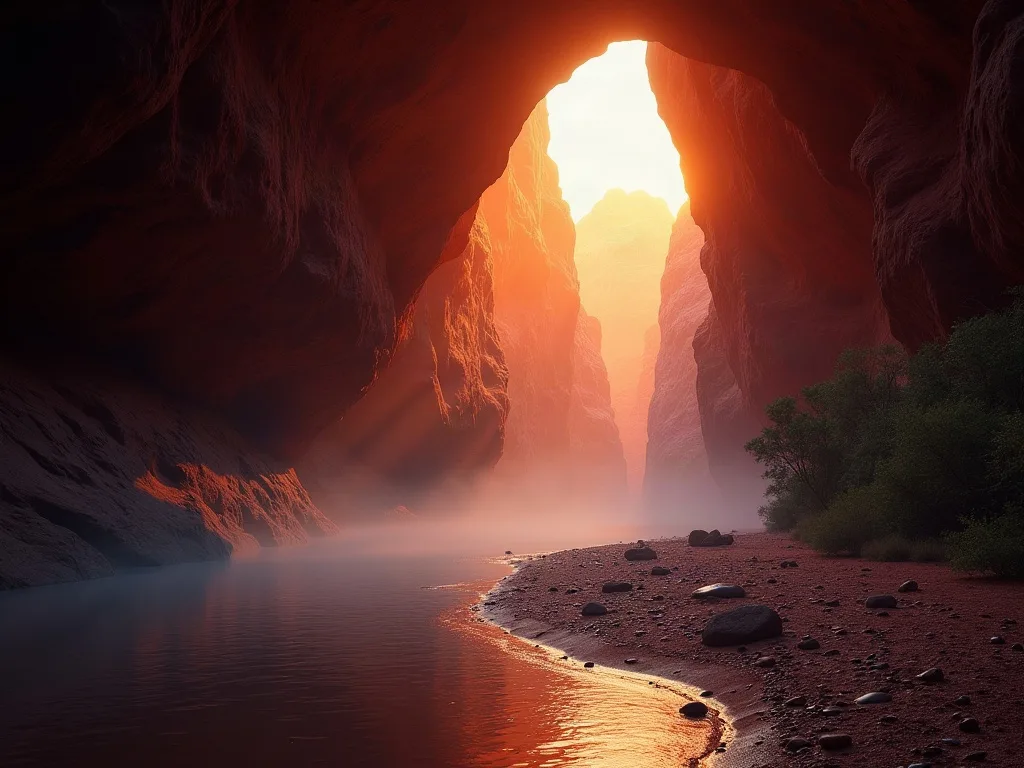
The Wandjina do not exist in isolation; they are woven into the Wandjina songlines and sacred sites that map the entire Kimberley landscape. A songline is a pathway of story and song that connects places across the country. It was encoded in the land itself: a particular rock formation, a waterhole, a tree, a bend in a river, each one marked a verse or a turning point in the song. To know the songline was to know the country; to walk the songline was to experience the sacred narrative in your body.
The Ngarinyin, Worrora, and Unggumi territories in the Kimberley contain dozens of Wandjina sites. Some are small rock shelters with a single figure; others are large galleries with multiple Wandjina and associated creatures. Karunjie, in the Mitchell Plateau region, is one of the most significant Wandjina galleries, holding dozens of figures painted on the rock over many centuries. Each Wandjina at Karunjie is named, associated with particular clans, particular songlines, particular responsibilities for the land.
The relationship between a Wandjina and a place is not arbitrary. A Wandjina inhabits a gorge because that gorge is part of its country, because water rises there, because the rock itself holds the spiritual signature of that being. To be responsible for a Wandjina site means to know its songs, to understand its cycles, to perform the necessary ceremonies at the right times. This responsibility is inherited, passed from parent to child, woven into kinship systems and clan obligations that have structured Kimberley societies for thousands of years.
The colonial period and the forced removal of Aboriginal peoples from their country disrupted these systems, sometimes catastrophically. Yet in communities where land access has been restored, or where knowledge keepers have maintained the traditions despite displacement, Wandjina ceremonies continue. Living artists still paint Wandjina figures on rock. Songlines are still sung. The Wandjina remain active forces in the world.
Wandjina in the Wider Aboriginal Cosmology
The Wandjina are not isolated figures; they exist within a larger Aboriginal Australian spiritual framework. Some scholars and knowledge keepers have drawn connections between the Wandjina and other supernatural beings across Australia: the Rainbow Serpent, for instance, a creator and water spirit found across much of the continent, or the Sky Heroes of other regions. The Wandjina, however, have a specificity and a visual intensity that marks them as distinct.
The Wandjina also sit within systems of increase ceremonies, rituals designed to ensure the abundance of a particular species or the arrival of a particular season. Different Wandjina were called upon for different increases: one for rain and water, one for particular animals, one for plant growth. The ceremonies were not entertainment or mere superstition; they were sophisticated environmental knowledge embedded in spiritual practice. By performing the right ceremony at the right time of the year, in the right place, a community maintained its alignment with the seasonal cycles and the resources that sustained it.
Comparison with other rain-bringing spirits from world mythology reveals something striking about the Wandjina. The Hindu god Indra, for instance, brings rain through destructive conflict with drought demons. The Mesoamerican Tlaloc demands human sacrifice to feed the rain. The Wandjina bring rain not through violence or cosmic conflict, but through their inherent presence. They are not warriors or demanders; they are forces aligned with natural law. Their power is generative, not destructive. This difference reflects a fundamentally different worldview: where many global religions see nature as something to be conquered or appeased through violence, the Wandjina embody an understanding of humans as one part of an integrated whole, needing only to remember and activate what is already present.
Wandjina Art Through Time: Continuity and Change
One of the most remarkable aspects of Wandjina tradition is its continuity. Pigment analysis and archaeological work suggest that Wandjina rock art has been created in the Kimberley for at least three thousand years, possibly much longer. The style has remained remarkably consistent: the oval face, the staring eyes, the radiating halo appear in figures painted in the distant past and in figures painted in the last few decades. This is not conservatism born from lack of innovation; it is conscious adherence to protocol. The form works. The form encodes spiritual truth. Why change it?
Yet change does occur, and in subtle, significant ways. Older Wandjina figures sometimes display more elaborate detail: additional lines or extensions, more complex body shapes. Over time, some become more simplified, more iconic. Some sites show evidence of deliberate retouching, old figures repainted over previous versions. This practice of renewal is itself spiritual; it keeps the Wandjina fresh, active, alive. A painted Wandjina is not a finished artwork consigned to a museum; it is a living entity requiring maintenance and care.
The arrival of Europeans and the colonial period created new pressures. Many Wandjina sites became inaccessible to their traditional custodians due to land dispossession. Some sites were damaged by development, mining, or pastoral activities. Others were "rescued" by anthropologists who photographed and documented them, often without permission or proper consultation with knowledge keepers. The 1970s and 1980s saw a revival of interest in Aboriginal art, including Wandjina traditions, as Indigenous artists began exhibiting their work in galleries and as Aboriginal rights movements gained momentum.
Today, Wandjina art is exhibited internationally. The National Museum of Australia, the Kimberley Foundation Australia, and galleries around the world hold reproductions and documentation. Yet the primary location of Wandjina power remains the rock itself, in the Kimberley gorges, where the connection between the painted figure and the living landscape, the songline, and the ceremony, remains unbroken.
Wandjina Iconography in Modern Aboriginal Culture
Since the 1980s, Wandjina imagery has become iconic in Aboriginal and non-Aboriginal Australian culture. The distinctive oval face and halo appear on didgeridoos, paintings, textiles, and public artworks. Some of this represents genuine transmission of cultural knowledge; living Wandjina custodians have created works for gallery exhibition and public education. Some represents cultural appropriation, where the Wandjina image is used decoratively without understanding or permission.
The distinction matters. When a Ngarinyin or Worrora artist creates a Wandjina painting for exhibition, they carry forward a living tradition, adapt it to new media, and assert Indigenous authority over representation. When a non-Indigenous artist adopts the Wandjina face as a generic symbol of Aboriginal Australia or of "nature spirituality," something is lost: the specificity, the connection to country, the embedded knowledge. The Wandjina are not universal symbols; they are the particular spirits of particular people and particular places.
Aboriginal communities in the Kimberley today navigate these questions consciously. Some knowledge keepers welcome controlled sharing of Wandjina imagery as a way to educate the broader public about Aboriginal culture and land rights. Others prefer to restrict access, believing that certain ceremonies and images carry power that should remain within the community. Both positions are valid and reflect the complexity of cultural transmission in the modern world.
Wandjina and the Question of Contact: Archaeological and Scholarly Debate
One enduring scholarly question concerns whether the Wandjina represent purely Aboriginal spiritual invention or whether they incorporate elements from outside contact. Some scholars, particularly in the mid-twentieth century, speculated that Wandjina imagery might reflect contact with Asian seafarers, particularly peoples from modern-day Indonesia or Malaysia, who had long-standing trading networks with Aboriginal peoples in northern Australia. The theory pointed to the apparent "foreignness" of the Wandjina style compared to other Aboriginal rock art, and the sophisticated artistic technique.
Modern scholarship has largely moved away from this "Asian contact" theory, though it remains debated in some circles. The consensus among Aboriginal knowledge keepers and most contemporary archaeologists is that the Wandjina tradition is authentically Aboriginal, developed within Aboriginal Australia and reflecting Aboriginal theological and artistic innovation. The apparent difference in style reflects the different ecological and spiritual context of the Kimberley; every region of Australia developed its own artistic traditions suited to its landscape and spiritual needs.
What this debate reflects is a broader scholarly bias: the assumption that sophisticated art, complex spiritual systems, and continuous cultural practice over millennia must be borrowed or influenced by outside contact. Aboriginal Australia challenges this assumption. The Wandjina tradition demonstrates that complex, refined, persistent spiritual systems developed independently, embedded in specific places, sustained through oral transmission and artistic practice for thousands of years. No outside contact required.
Wandjina in the Present Day: Living Tradition and Land Rights
Today, the Wandjina remain active in Kimberley Aboriginal life. Government recognition of land rights, particularly through the Native Title Act of 1993 and subsequent claims, has allowed some communities to regain access to traditional country and to revive Wandjina ceremonies that had been disrupted or suppressed. Organizations like the Kimberley Foundation Australia work to support Aboriginal cultural practitioners, document Wandjina sites, and facilitate connections between Aboriginal communities and broader Australian society.
The Wandjina also serve as focal points for land rights advocacy and environmental protection. The Kimberley landscape faces pressures from mining, industrial agriculture, and climate change. Aboriginal communities argue that the preservation of Wandjina sites and the protection of Wandjina country are inseparable from the preservation of the land itself. To protect a Wandjina site is to protect the country it inhabits; to destroy the country is to diminish the Wandjina's power. This argument carries spiritual, legal, and environmental force.
Young Aboriginal people in the Kimberley are learning Wandjina stories and songlines from elders, sometimes for the first time, sometimes reconnecting after their families lost access to country during the colonial period. The process of recovery is often difficult, marked by trauma and disruption. Yet it is also powerful: young people seeing themselves reflected in ancient tradition, learning that their ancestors maintained a sophisticated, beautiful, and intelligent spiritual relationship with the land for tens of thousands of years.
Frequently asked questions about Wandjina, cloud and rain spirits of the Kimberley
Frequently asked questions
Are the Wandjina still painted today, or only in historical times?
Wandjina figures are actively painted and retouched today by Aboriginal custodians in the Kimberley. Rock galleries are maintained, and some living artists continue the tradition on canvas and other media. The practice has never ceased; communities with unbroken connection to country continue the ceremonies and artistic renewal that keep the Wandjina alive.
What is the connection between Wandjina and the Aboriginal concept of Dreamtime?
The Wandjina emerged during the Dreamtime (the Aboriginal "creation time" or Dreaming), when the spiritual forces that shape the world were active and present. Unlike other creator beings who withdrew after their work, the Wandjina remain permanently embedded in the Kimberley landscape, accessed through rock art, songlines, and ceremony. They embody an Aboriginal understanding where creation was not a one-time event but an ongoing process.
Why do Wandjina figures have no mouth?
The absence of a mouth represents the Wandjina's immense power. If a Wandjina could speak, the force would be too great; it would overwhelm the land and the people. The closed mouth suggests that the Wandjina's communication happens through other means: through the rain that falls, through the songlines that channel their energy, through the ceremonies that activate their presence. This is a theological principle: true power does not need to announce itself through words.
Are Wandjina beliefs found in other parts of Aboriginal Australia?
Wandjina tradition is specific to the Kimberley region and the peoples associated with it (Ngarinyin, Worrora, Unggumi). Other parts of Australia have their own sacred figures and traditions: the Rainbow Serpent in the north and east, different ancestor beings in other regions. Each tradition is locally rooted and adapted to its specific landscape and people. The Wandjina are particular to the Kimberley's environment, ecology, and the spiritual innovations of its peoples.
Can non-Aboriginal people visit Wandjina rock galleries?
Some Wandjina sites are open to visitors with proper permissions and guides; others remain restricted to Aboriginal people and require careful respect for protocol. Many sites are culturally sensitive and access must be negotiated with local Aboriginal communities. If you visit the Kimberley, consult with local Aboriginal tourism operators or cultural organizations to learn about appropriate ways to encounter Wandjina country.
The Wandjina's Unfinished Story: Land, Climate, and Future
The Wandjina's story does not end in the past or even in the present moment. The Kimberley landscape faces unprecedented pressures from climate change, which is altering rainfall patterns and monsoon timing. Some scientists predict the monsoon may become more erratic, bringing greater extremes of flood and drought. For communities whose spiritual and practical life depends on understanding and aligning with seasonal cycles maintained by the Wandjina, this change carries weight beyond mere weather.
In this context, the Wandjina become more relevant, not less. Their traditional knowledge systems, encoded in songlines and ceremony, represent thousands of years of observation about how to live sustainably with the land's rhythms. As the broader world grapples with climate adaptation, the Wandjina remind us that humans are not separate from natural systems; we are part of them. The rain does not fall for us to exploit; we live only insofar as the Wandjina choose to bring it. This is not primitive superstition; it is ecological humility encoded in spiritual language.
The Wandjina's future depends on whether Aboriginal people maintain access to their country and the freedom to practice their traditions without interference or appropriation. It depends on whether governments recognize land rights and protect sacred sites from development. It depends on whether young people continue to learn the songlines and touch the painted rock. The Wandjina are not ancient relics. They are living beings, and their fate is tied to the fate of the land and the people who know them.
Read the full book
Want the whole story?
The complete edition is an instant PDF download here, with a paperback on Amazon for selected titles.
Australian Aboriginal
The Aboriginal Mythology Book: The Rainbow Serpent, Wandjina, Baiame, and the Dreamtime Stories of the World's Oldest Tradition
60,000 Years of Unbroken Ancestral Memory
The world's oldest continuous mythology. From the Rainbow Serpent to the Wandjina cloud spirits, explore the Dreamtime stories that have mapped Australia for 60,000 years.
More from Australian Aboriginal
All articles
Australian Aboriginal
Namarrgon: The Lightning Man of Arnhem Land
Namarrgon is the terrifying sky god of the Yolngu people who creates lightning and controls the monsoon storms that shape life across Arnhem Land. His thunderous presence reveals how Aboriginal cultures read the sky as a living, ancestral force.
Australian Aboriginal
The Dreamtime: Creation and Eternal Present in Aboriginal Belief
The Dreamtime is the Aboriginal foundation of existence: the era when ancestral beings shaped the land, set down the laws of kinship and ritual, and wove themselves into every rock, waterhole, and song. It is neither ancient history nor myth alone, but an ongoing reality that Aboriginal peoples access through ceremony, song, and country.

Australian Aboriginal
The Seven Sisters: Celestial Pursuit and Pleiades Myth in Aboriginal Australia
Seven sisters flee across the sky in Australian Aboriginal mythology, hunted by a man who will never catch them. This eternal chase, traced in the Pleiades star cluster, reveals how Aboriginal peoples read the cosmos as a living story of desire, escape, and sacred boundaries.

Australian Aboriginal
Yara-ma-yha-who: The Bloodsucking Tree Dweller of Australian Aboriginal Myth
Meet the Yara-ma-yha-who, a small but lethal tree-dwelling creature from Rainrainforest Aboriginal lore that hunts humans by bloodsucking and regurgitation. Discover what this creature reveals about danger, transformation, and survival in the deep Australian bush.