
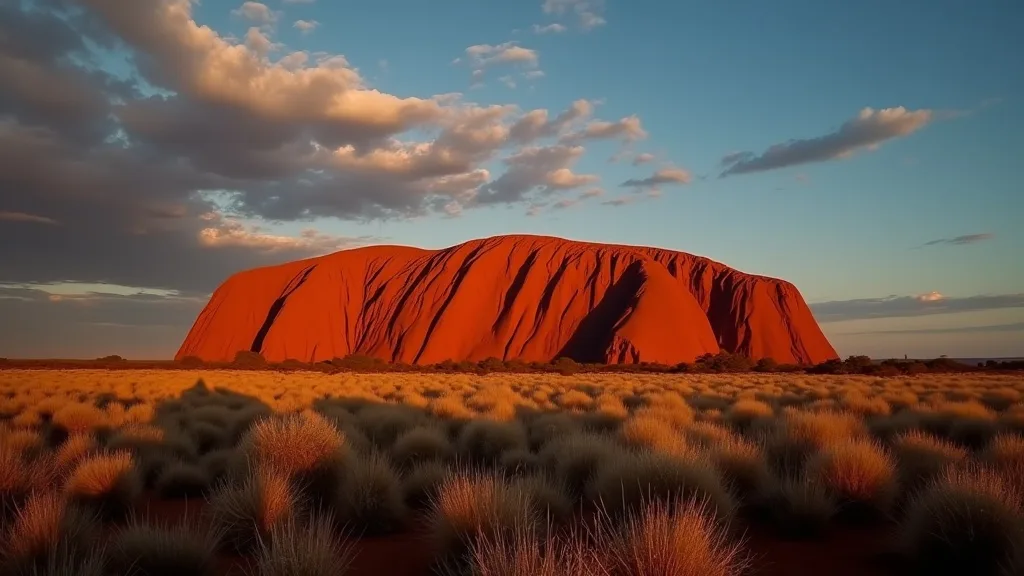
Uluru: The Sacred Heart of Australia
Rising from the red desert plain, Uluru is not a landmark but a living archive of Anangu law, creation stories, and ancestral memory stretching back at least 60,000 years.
Contents
The stone arrives before anything else. Long before the horizon resolves into shapes, a single rust-red mass pushes above the spinifex and the shimmering heat-haze of Australia's Western Desert. It does not look placed there. It looks as though it has always been the centre around which everything else organises itself. Travellers who see Uluru: The Sacred Heart of Australia for the first time often fall quiet without knowing exactly why.
That silence has a name among the Anangu people, the traditional custodians of this country. They call the deep authority of the land Tjukurpa - the Law, the Dreaming, the living fabric of creation that connects past, present, and future into a single, continuous reality. Uluru is not a symbol of that Law. It is the Law made stone.
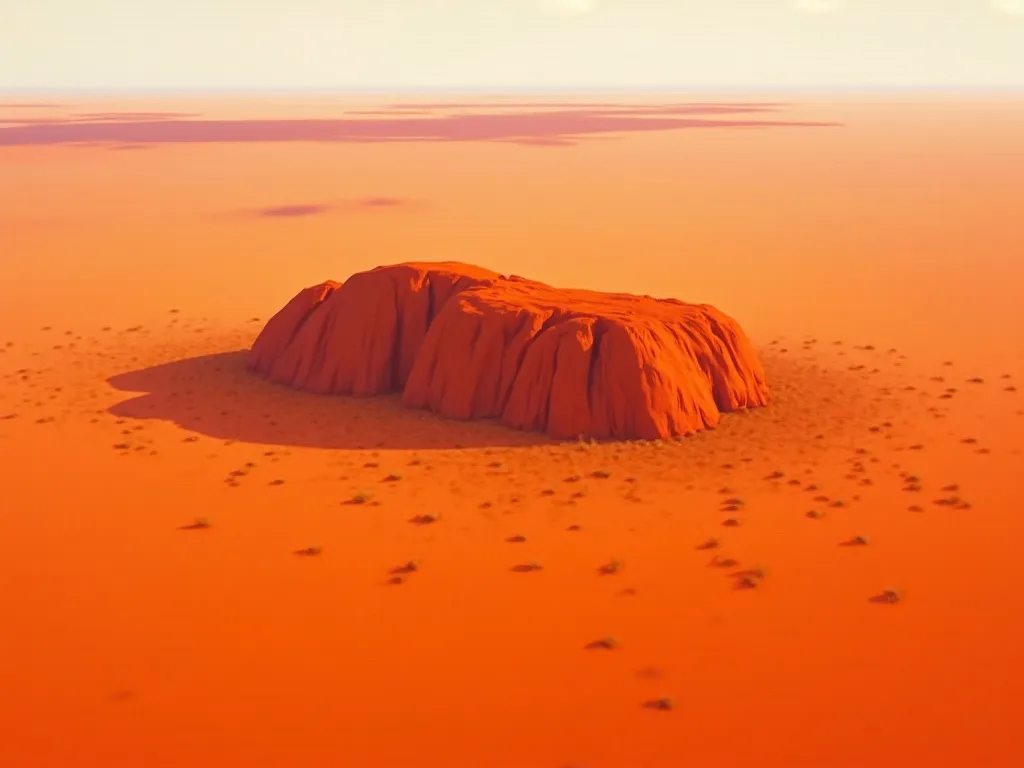
Standing 348 metres above the surrounding plain and measuring roughly 9.4 kilometres in circumference, the monolith is the exposed tip of a vast arkosic sandstone formation that plunges several kilometres into the earth. Geologists date its rock to approximately 550 million years ago. The Anangu trace it further still, to the moment creation beings first moved across an unformed world and shaped everything that exists.
Tjukurpa: The Law That Shaped the Rock
Tjukurpa (pronounced roughly "chook-orpa") is often translated as "the Dreaming," but that translation strips it of its operational force. For the Anangu, Tjukurpa is simultaneously cosmogony, legal code, ecological guide, and moral philosophy. It describes how the ancestral beings (tjukuritja) moved across a formless earth during the creation period, singing, fighting, grieving, and loving their way through the landscape, and how the physical contours of the land record every one of those acts.
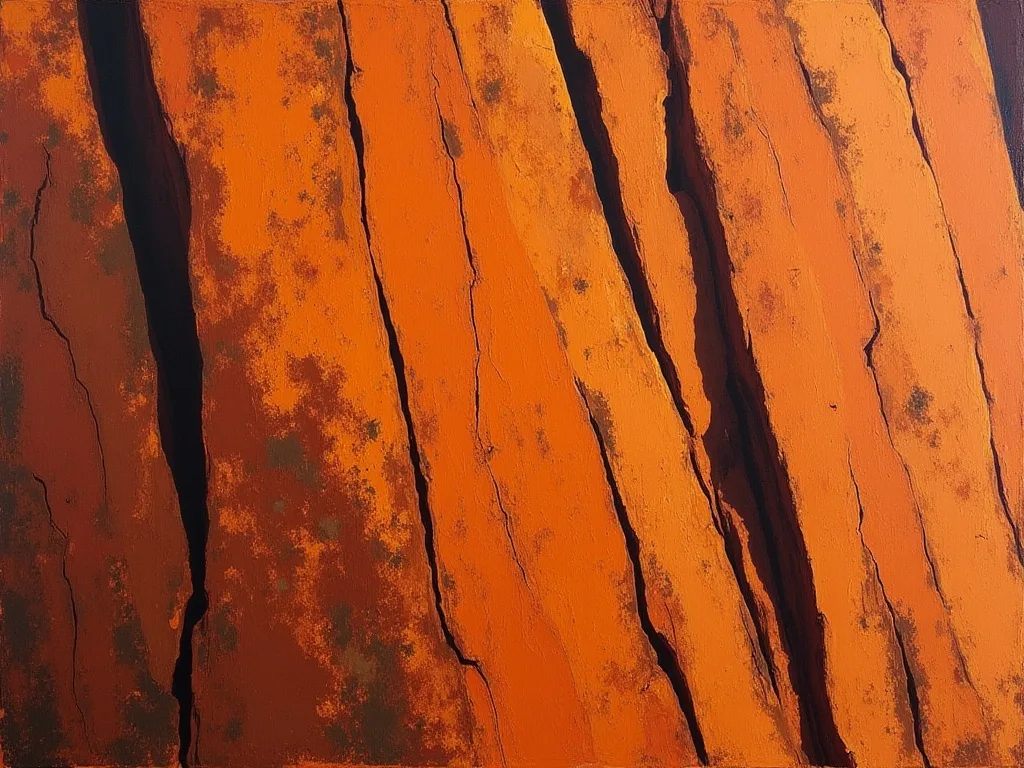
Every scar, cave, waterhole, and ridge at Uluru corresponds to a specific episode in a specific story cycle. The deep grooves running down the rock's western face mark where the python ancestor Kuniya travelled. The dark staining near Mutitjulu waterhole shows where ancestral blood was shed in a battle between Kuniya and the venomous-snake being Liru. The shallow caves on the northern side preserve the memories of the Mala (rufous hare-wallaby) beings who camped here during a ceremonial gathering before disaster scattered them across the desert.
The anthropologist W.E.H. Stanner, writing in his landmark 1953 essay series The Dreaming, was among the first non-Indigenous scholars to insist that translating Tjukurpa as a past-tense myth cycle fundamentally misreads its logic. For the Anangu, as Stanner argued, the ancestral events are not historical but everywhen, a word he coined to describe their permanent presentness. Deborah Bird Rose, working with Aboriginal communities in the Northern Territory decades later, extended that insight in her 1992 study Dingo Makes Us Human, showing how the same Law-encoded landscape principle governs relations between people, animals, and country across a vast swath of Aboriginal Australia. Both scholars underscore what any Anangu elder will tell a careful visitor: Uluru: The Sacred Heart of Australia cannot be understood as monument. It must be understood as living text.
These are not allegories. Within the framework of Tjukurpa, these events are the substrate of physical reality. The rock does not represent the story; the rock is the story in a form that outlasts any spoken word.
The Kuniya and Liru: A Story Written in Stone
Of all the narrative cycles attached to Uluru, the encounter between Kuniya and Liru is the most publicly shared by the Anangu, and even in its shared form it carries a structural complexity that rewards slow reading.
Kuniya, a woma python ancestor, travelled to Uluru from the east carrying a clutch of eggs. She made camp on the rock's eastern face, at a place now called Taputji. While she rested, her nephew was attacked and killed by a group of Liru, the poisonous-snake warriors who had come from the southwest. Kuniya heard of her nephew's death and the grief transformed into something more dangerous than sadness. She performed a death-song, a chant of inma ceremony, and moved toward the Liru warrior who had struck the fatal blow.
The confrontation at Mutitjulu waterhole is recorded in the rock itself. A large, dark stain on the canyon wall is Kuniya's spilled venom. A curved scar lower down is the shape left where she struck with her wana (digging stick). The warrior she faced showed no remorse, and that refusal of remorse made Kuniya's anger into something the Anangu call kuru ala - an irrational, consuming fury that breaks the codes of proper conduct. The story is, among other things, a sustained meditation on how grief handled wrongly becomes destruction.
This moral weight - the idea that place encodes consequence - runs through every story cycle at Uluru. Certain areas of the rock are restricted from public view because their stories contain ritual knowledge (Inma) that belongs exclusively to initiated men or women. The Anangu do not hide these sections because they are ashamed of them. They protect them because sacred knowledge, like a medicine, has a correct context for transmission. Readers drawn to similar story-in-landscape traditions will find close parallels in Rainbow Serpent myths, where ancestral serpent beings also carve rivers, waterholes, and ranges into existence as they travel.
The Mala: Ceremony, Failure, and Dispersal
The Mala story cycle opens with a gathering. The Mala people had come to Uluru to perform an important inma ceremony. Camp was made on the northern side of the rock, in the area now signposted as the Mala Walk. Everything was prepared: the ground cleared, the performers assembled, the protocols observed.
Then an invitation arrived from the Wintalka men in the west. The Mala refused it. The reasons are layered in the tradition and only partly told in public accounts. As Deborah Bird Rose notes in Dingo Makes Us Human, the refusal of a ceremonial obligation in Aboriginal Law is never a private act; it reverberates through the relational network that holds country together. The refusal, whatever its precise cause, carried a consequence. The Wintalka men sent a supernatural being called Kurpany, a devil-dog, a creature of raw destructive force, to attack the Mala camp.
The Mala scattered. Some fled into the rock itself, their forms preserved in the cave markings and the small, rounded shapes still visible along the northern base. Others ran out across the desert and became the physical rufous hare-wallaby that still exists as a species in the wild. The story is not a tragedy in the Greek sense, where a fatal flaw in an individual destroys them. It is a story about the consequences that travel through community when obligation is broken. Mythologis readers familiar with Dreamtime creation stories will recognise this structural emphasis on relational duty over individual heroism as a consistent feature of the tradition.
Sacred Geography: Reading Uluru's Surface
Walking the base circuit of Uluru (9.4 kilometres, approximately three to four hours at a measured pace) is an exercise in reading a text written at geological scale. The rock does not look the same from every angle, and that variability is intentional within Tjukurpa: different faces encode different story cycles, and the appropriate approach to each is governed by protocol.
Key sites along the circuit include:
- Kuniya Piti: the cave where Kuniya made her camp on the eastern side. The ceiling still shows dark markings interpreted as traces of her presence.
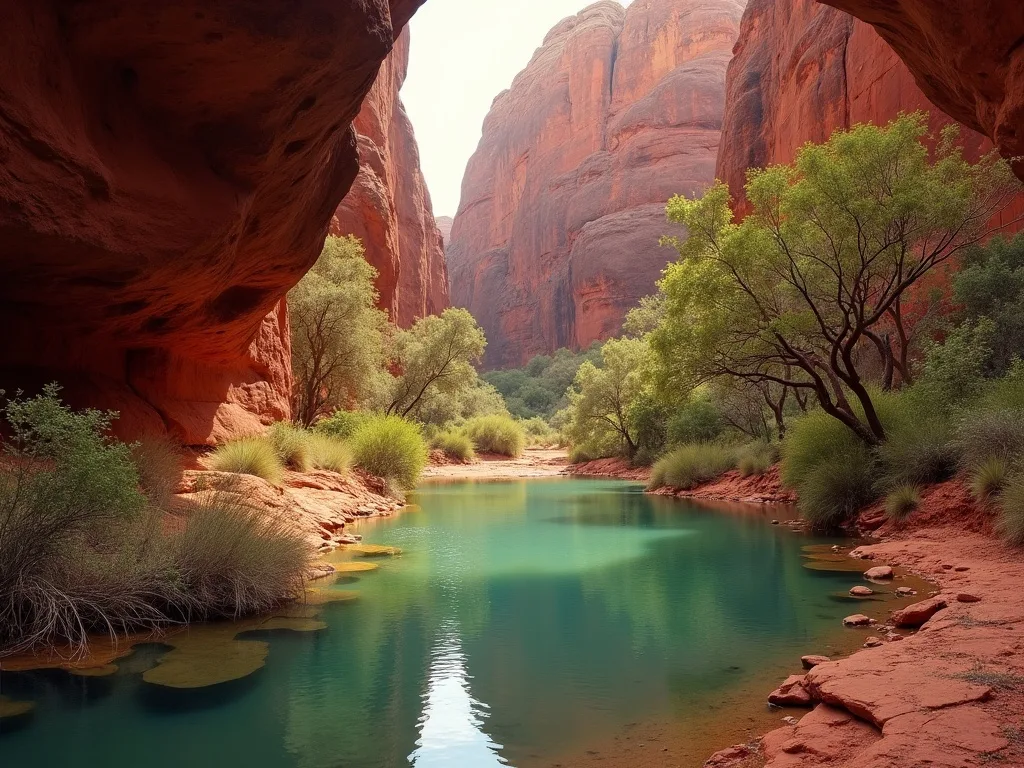
- Mutitjulu waterhole: a permanent waterhole on the southeastern face. Its reliable water is itself a creation-act, a gift from the ancestral beings whose story made the spring possible. Park rangers note that the Anangu have managed this waterhole's ecology continuously for generations.
- Mala Puta: a large cave on the northern face, associated with the female Mala elders. The red ochre marks inside are among the most visible examples of ceremonial marking at the site.
- Kantju Gorge: on the western face, this narrow canyon catches the first runoff after rain and fills a pool at its base. The falling water during the rare desert rains is described in Tjukurpa as the breath of the ancestor who made the gorge.
- Taputji: the eastern area where Kuniya first arrived. Access here requires following the pathway in the direction the ancestral beings travelled, a directional protocol that encodes respect into physical movement.
The rock's colour shifts are themselves meaningful. The deep ochre of the stone - caused by iron oxide oxidising over millennia - connects Uluru: The Sacred Heart of Australia to the ochre pigments used in ceremony throughout Central Australia. The rock bleeds a colour that initiated people carry on their bodies during sacred performance.
The Geology Beneath the Ceremony
No account of Uluru is complete without the deep time that the geology reveals, and the Anangu do not regard science as an adversary to Tjukurpa. The sandstone of Uluru belongs to the Amadeus Basin sedimentary sequence, laid down during the Neoproterozoic era roughly 550-600 million years ago. The rock was buried, compressed, tilted approximately 90 degrees from its original horizontal bedding (which explains why the strata lines visible on the surface run nearly vertical), and then slowly exposed by hundreds of millions of years of erosion.
The neighbouring formation, Kata Tjuta (the Olgas), is geographically and geologically related: a conglomerate rock formation 34 kilometres to the west, similarly sacred to the Anangu and similarly managed under joint-title arrangements. Kata Tjuta is the home of the Wanampi, great serpent beings associated with waterholes, and of ceremonies so restricted that most of them are never publicly described. Where Uluru is relatively open - the base walk is accessible to all - Kata Tjuta holds its secrets more tightly. Kata Tjuta and its Wanampi serpent beings occupy a parallel sacred geography that intersects with Uluru's story cycles at specific ceremonial points.
The tiltedness of the rock is not incidental to the Anangu reading. The near-vertical layering, visible as long parallel ridges and grooves running down the face, is itself described as the record of ancestral movement, the direction of travel encoded in the stone's orientation.
Colonial History and the Long Road to Anangu Authority
Uluru entered European written records in 1873, when explorer William Gosse became the first non-Indigenous person to climb it and named it after Sir Henry Ayers, then-Chief Secretary of South Australia. For almost a century after that, the Anangu relationship to the site was systematically disrupted. Missions displaced families. Government policies forcibly removed children. The rock was opened to tourism in 1950, and a road and lodge were built inside what would later become a national park.
The return of Uluru to Anangu hands came in 1985, when the Australian federal government handed title back to the Pitjantjatjara and Yankunytjatjara people under the Aboriginal Land Rights Act. The handback ceremony on October 26, 1985, is remembered by those who attended it as one of the most emotionally charged public events in modern Australian history. An Anangu elder named Nipper Winmati received the title deed on behalf of his people and immediately leased the land back to the federal government for a period of 99 years for joint management - a pragmatic recognition that the site's infrastructure required continued federal involvement.
The climb. That is the issue that defined Uluru's public life for four decades after the handback. The Anangu asked visitors not to climb Uluru almost immediately after receiving title. The path to the summit runs directly across a sacred Mala men's ceremonial route, and the act of climbing, for the Anangu, carries the same register of disrespect as walking across an altar. After decades of requests that went largely ignored by hundreds of thousands of tourists, the Australian government permanently closed the climb on October 26, 2019, exactly 34 years after the original handback. Reactions ranged from relief to controversy, but the Anangu response was straightforward: Palyaringkunytja nyangangka, "It is good to see this happen."
Uluru in Modern Australian Identity
The monolith carries a weight in the national imaginary that no purely aesthetic object could hold. It appears on banknotes, in airline liveries, in the naming of political summits. The 2023 Voice to Parliament referendum used Uluru's name explicitly because the Uluru Statement from the Heart was signed at the base of the rock in May 2017 by over 250 Aboriginal and Torres Strait Islander leaders, making the site a focal point for a generation of constitutional debate.
That document, drafted after a series of regional dialogues, called for a constitutionally enshrined Indigenous Voice to Parliament, a Makarrata (treaty) commission, and a truth-telling process. The choice of Uluru as its location was not metaphorical. It was a deliberate act of grounding a political demand in the oldest form of law the country possesses. Tjukurpa, not Westminster statute, provided the founding moral authority the statement invoked.
Writers, painters, and filmmakers have grappled with Uluru since the early twentieth century. The painter Albert Namatjira, a Western Arrernte man who became the most commercially celebrated Indigenous Australian artist of the mid-century, painted the Western Desert landscape in a tradition that included Uluru's broader country. The contemporary Anangu art movement, rooted in the dot-painting tradition that began at Papunya in 1971, carries visual knowledge of Tjukurpa in a form that is simultaneously commercially accessible and ceremonially guarded: the publicly sold designs encode story, but they do not expose restricted knowledge.
The site also draws significant scholarly attention from archaeologists and anthropologists. Rock art at Uluru and the surrounding region has been dated by various methods, with some researchers placing the earliest human presence in the region at 40,000-60,000 years ago, making this one of the longest continuously inhabited sacred landscapes on earth. For comparative depth, the Anangu traditions of Central Australia offer a broader survey of how the same Tjukurpa principles operate across the entire Western Desert cultural bloc.
How Anangu Law Governs the Landscape Today
The joint management arrangement between the Anangu and Parks Australia under the Uluru-Kata Tjuta National Park framework is one of the more carefully designed co-governance models in the world. The Uluru-Kata Tjuta Board of Management has an Anangu majority. All rangers receive training in Tjukurpa. Signage throughout the park is bilingual in Pitjantjatjara and English.
Practical management decisions follow Anangu ecological knowledge. Fire management, for example, uses a patchwork-burning technique (Anangu-style fire management) that creates a mosaic of vegetation at different stages of regrowth, supporting the biodiversity the desert animals need. This technique, documented at length by ethnobotanists and brought to wider scientific attention through the work of researchers including David Trigger and others working in the Northern Territory land management tradition, is now recognised by conservation biologists as superior to the broad-area burning that European land managers initially applied.
Water management at Mutitjulu waterhole similarly follows protocols established in Tjukurpa: specific species are not hunted near the waterhole, certain plants are protected, and the approach corridors are managed to prevent erosion. These are not nostalgic conservation practices. They are the applied knowledge of 60,000 years of continuous observation.
Visitors today encounter a landscape managed on these terms. The cultural centre at Uluru (the Mutitjulu Community and Tjukurpa Cultural Centre) provides interpretation that the Anangu have deliberately shaped. Photography is restricted at several sites. Guides, many of them Anangu, explain what they are permitted to share under Tjukurpa, which itself teaches exactly what is and what is not for public transmission.
Readers who want to understand how this tradition relates to other Indigenous sacred landscapes across the Pacific might also look at the broader context of Oceanian sacred places, where similar principles of Law-encoded landscape appear across very different geological and cultural terrains.
Frequently Asked Questions about Uluru and Its Sacred Traditions
Frequently asked questions
Why is Uluru sacred to the Anangu people?
Uluru is sacred because it is a physical record of Tjukurpa, the Anangu system of Law and cosmology. Every feature of the rock corresponds to an action taken by ancestral creation beings during the formation of the world. The rock is not a monument to those events; within Anangu understanding, it is those events in material form. The site is also home to restricted ceremonial knowledge belonging to initiated Anangu men and women, transmitted across generations through story, song, dance, and marking.
What is Tjukurpa and how does it differ from 'the Dreaming'?
Tjukurpa is the Pitjantjatjara word for the body of Law, story, and cosmological knowledge that governs Anangu life. The English phrase "the Dreaming" or "the Dreamtime" was introduced by early anthropologists and, while widely used, misleads many readers into thinking this is a past-tense myth cycle. W.E.H. Stanner, who coined the term everywhen to describe the permanent presentness of ancestral events, argued in The Dreaming (1953) that this mistranslation is one of the most consequential errors in the study of Aboriginal Australia. Tjukurpa is present-tense and operational: it governs land use, social relationships, ceremony, ecological practice, and moral conduct right now. It did not end when the creation beings finished their work. It continues through every act of correct observance.
Why was climbing Uluru banned, and when did the ban take effect?
The Anangu requested that visitors not climb Uluru from at least the time of the 1985 land handback, on the grounds that the climbing route crosses a sacred Mala men's ceremonial path. This request went widely unobserved for decades. The Australian government formally closed the climb on October 26, 2019, citing both the Anangu's sustained request and safety concerns (over 35 people died attempting the climb over the years it was open). The closure date was chosen to coincide with the 34th anniversary of the 1985 handback.
What is the Uluru Statement from the Heart?
The Uluru Statement from the Heart is a document signed at Uluru on May 26, 2017, by over 250 Aboriginal and Torres Strait Islander leaders following a series of regional dialogues called the First Nations National Constitutional Convention. It calls for three structural reforms: a constitutionally enshrined First Nations Voice to Parliament, a Makarrata (treaty) commission, and a national truth-telling process. The site was chosen deliberately to anchor the statement's moral authority in Tjukurpa rather than in colonial legal frameworks.
Can visitors still access Uluru, and what protocols should they follow?
Yes. The 9.4-kilometre base walk remains open, as does the Mala Walk on the northern side and the Kuniya Walk on the southeastern face near Mutitjulu waterhole. Photography is restricted at several sacred sites, marked clearly on signage. Visitors are asked not to photograph or film in restricted areas. The Tjukurpa Cultural Centre near the car park provides Anangu-directed interpretation. Entry requires a valid park pass, and all visitors are expected to follow the protocols displayed at the park entrance and throughout the site.
How old is Uluru, and how does its geology relate to its sacred significance?
The arkosic sandstone that forms Uluru was deposited roughly 550-600 million years ago during the Neoproterozoic era. The rock was later compressed, tilted approximately 90 degrees from its original horizontal bedding, and gradually exposed by erosion over hundreds of millions of years. The Anangu do not regard geological deep time as separate from or contradictory to Tjukurpa. The near-vertical strata visible on the surface are read within Tjukurpa as records of ancestral movement, the two accounts describe the same reality at different registers of knowledge.
The Unresolved Question of Sacred Knowledge and Public Access
The tension at Uluru between openness and restriction has no clean resolution, and the Anangu do not ask for one. Tjukurpa itself contains a sophisticated theory of knowledge tiering: some stories are for children, some for initiated adults, some for senior knowledge-holders, and some are held by specific custodians alone. The public face of Uluru, what the Anangu choose to share through the cultural centre, the base walk interpretations, and their guides, is not a diluted version of the sacred. It is the portion of the sacred that Tjukurpa designates as appropriate for transmission to outsiders.
This model challenges a dominant Western assumption that full transparency is the highest form of respect. For the Anangu, respect is demonstrated precisely by honouring the boundaries that knowledge sets around itself. A visitor who photographs a restricted site is not expanding their understanding; they are taking something that was never offered. Deborah Bird Rose framed this principle memorably in Dingo Makes Us Human: country is not a resource to be extracted but a subject with its own authority over what it gives and withholds.
The broader scholarly question is whether the Uluru model, where indigenous law and state law co-govern a landscape through negotiated frameworks rather than one simply replacing the other, can be reproduced at other contested sacred sites globally. Researchers in legal anthropology and heritage law have looked at Uluru's joint-management structure as a potential template for sites from the Black Hills of South Dakota (sacred to the Lakota) to the high Andean apus (mountain deities) of Peru. A future article in this series will examine how comparable co-governance frameworks are being tested at Machu Picchu and at the He Sapa (Black Hills) negotiations, tracing the legal architecture that Uluru pioneered into its global iterations. The idea that a place can simultaneously hold two systems of authority without either being subordinate is perhaps the most radical thing about Uluru: The Sacred Heart of Australia.
The rock does not resolve these questions. It simply continues to stand, 348 metres above the plain, red in the morning light, darker in the afternoon, and at dusk, briefly, the colour of a coal just before it goes cold.
Read the full book
Want the whole story?
The complete edition is an instant PDF download here, with a paperback on Amazon for selected titles.
Australian Aboriginal
The Aboriginal Mythology Book: The Rainbow Serpent, Wandjina, Baiame, and the Dreamtime Stories of the World's Oldest Tradition
60,000 Years of Unbroken Ancestral Memory
The world's oldest continuous mythology. From the Rainbow Serpent to the Wandjina cloud spirits, explore the Dreamtime stories that have mapped Australia for 60,000 years.
More from Australian Aboriginal
All articles
Australian Aboriginal
Namarrgon: The Lightning Man of Arnhem Land
Namarrgon is the terrifying sky god of the Yolngu people who creates lightning and controls the monsoon storms that shape life across Arnhem Land. His thunderous presence reveals how Aboriginal cultures read the sky as a living, ancestral force.
Australian Aboriginal
The Dreamtime: Creation and Eternal Present in Aboriginal Belief
The Dreamtime is the Aboriginal foundation of existence: the era when ancestral beings shaped the land, set down the laws of kinship and ritual, and wove themselves into every rock, waterhole, and song. It is neither ancient history nor myth alone, but an ongoing reality that Aboriginal peoples access through ceremony, song, and country.

Australian Aboriginal
The Seven Sisters: Celestial Pursuit and Pleiades Myth in Aboriginal Australia
Seven sisters flee across the sky in Australian Aboriginal mythology, hunted by a man who will never catch them. This eternal chase, traced in the Pleiades star cluster, reveals how Aboriginal peoples read the cosmos as a living story of desire, escape, and sacred boundaries.

Australian Aboriginal
Yara-ma-yha-who: The Bloodsucking Tree Dweller of Australian Aboriginal Myth
Meet the Yara-ma-yha-who, a small but lethal tree-dwelling creature from Rainrainforest Aboriginal lore that hunts humans by bloodsucking and regurgitation. Discover what this creature reveals about danger, transformation, and survival in the deep Australian bush.