
Tjurunga: Sacred Objects of the Ancestors
Tjurunga are the most sacred objects in Australian Aboriginal religion, physical links to the Dreaming that carry ancestral power, identity, and law across generations.
Contents
An old man lifts a flat oval of stone from its wrappings of possum fur. His hands move with the deliberate care of someone holding something alive. Around him, younger men sit in silence. No one speaks. The stone is not a tool or an ornament. It is a person, or something closer to a person than any word in English quite captures. It is a tjurunga, and it has been waiting in the earth since the Dreaming first shaped the world.
Few sacred objects anywhere on Earth carry the weight that tjurunga carry. They are not symbols pointing toward something sacred. They are, in the understanding of the people who keep them, the sacred thing itself. Each one contains ancestral power, records a lineage, and binds the living to a cosmos that was sung into existence before human memory began.
To approach Tjurunga: Sacred Objects of the Ancestors with real seriousness is to confront some of the oldest continuous religious practice on the planet, stretching back tens of thousands of years. It also means sitting with limits: some of what tjurunga mean belongs exclusively to initiated men, and this article respects those boundaries while opening the publicly available record as fully as possible.
What the Word "Tjurunga" Actually Means
The word comes from the Arrernte (also spelled Aranda or Arunta) language of Central Australia. The two earliest systematic accounts in Western literature come from anthropologists Baldwin Spencer and Francis Gillen, who published The Native Tribes of Central Australia in 1899, and from the German-born ethnologist Carl Strehlow, whose multi-volume work Die Aranda- und Loritja-Stämme in Zentral-Australien (1907-1920) offered a rival and often corrective view.
Spencer and Gillen glossed the term as "sacred" or "of the Alcheringa," their rendering of the Arrernte word for the Dreaming. Strehlow argued the root meaning was closer to "one's own body" or "one's own flesh," a translation that carries far more theological weight. If Strehlow's reading is right, then calling a tjurunga "one's own body" means the object is not a stand-in for the ancestor but a genuine extension of the ancestor's physical being.
Later linguists and anthropologists, including W.E.H. Stanner in his influential 1956 essays collected as White Man Got No Dreaming, largely sided with a sense closer to Strehlow: the term denotes deep personal identity and ancestral substance, not simply "holy." The difference matters. A relic in a cathedral represents a saint. A tjurunga, by contrast, participates in the saint's ongoing existence. That is a conceptually distinct kind of sacred object.
The term has also been spelled churinga (the Spencer-Gillen orthography) and cyringe in older colonial-era texts. Linguists today prefer tjurunga as the more accurate rendering of the Arrernte phonology. It is worth noting that across neighbouring language groups, cognate terms exist: among Arrernte speakers of the Eastern and Western dialects, the object and its sacred status are recognized under slightly different phonological forms, yet the theological weight remains consistent. The word carries the land inside it.
The Dreaming and Why Tjurunga Exist at All
To understand why tjurunga are what they are, the Dreaming needs a brief unpacking, because it is one of the most commonly misunderstood concepts in Aboriginal thought.
The Dreaming, Altjira or Altyerre in Arrernte, is not the past. Or more precisely, it is not only the past. It is the period, the condition, and the ongoing reality in which ancestral beings (Altjiranga) traveled across a featureless earth, singing, naming, shaping. A river, a hill, a rock formation: each is where an ancestor stopped, fought, danced, died, or transformed. The land itself is the record of those events. That record does not fade. The Dreaming is still happening, at a level of reality beneath ordinary time.
Ancestral beings did not simply walk away at the end of creation. Many of them entered the earth, becoming the landforms and the sacred sites. Others left portions of their power, their substance, inside objects or in the ground. Those objects are tjurunga. The Arrernte scholar and linguist Veronica Dobson has described tjurunga as "the bodies of the Dreamtime beings left behind when they went into the earth." They are, quite literally, the physical residue of creation.
This is why tjurunga are not manufactured in a workshop and consecrated afterward. They are found, retrieved, excavated, or inherited. An elder might know, from inherited knowledge, that a particular ancestral being's tjurunga lies beneath a certain rock shelf. The act of recovering it is an act of reunion rather than production. The object was always there, waiting.
It helps to hold this cosmology alongside what Stanner called the "living law" embedded in Aboriginal Dreaming traditions: the Dreaming is not mythology in the sense of old stories. It is ongoing legislation, a moral order written into the landscape. A tjurunga is simultaneously a deed of title, a biography, and a covenant. Every scratch on its surface is a clause in an agreement between the living and the ancestral world.
Stone, Wood, and the Forms Tjurunga Take
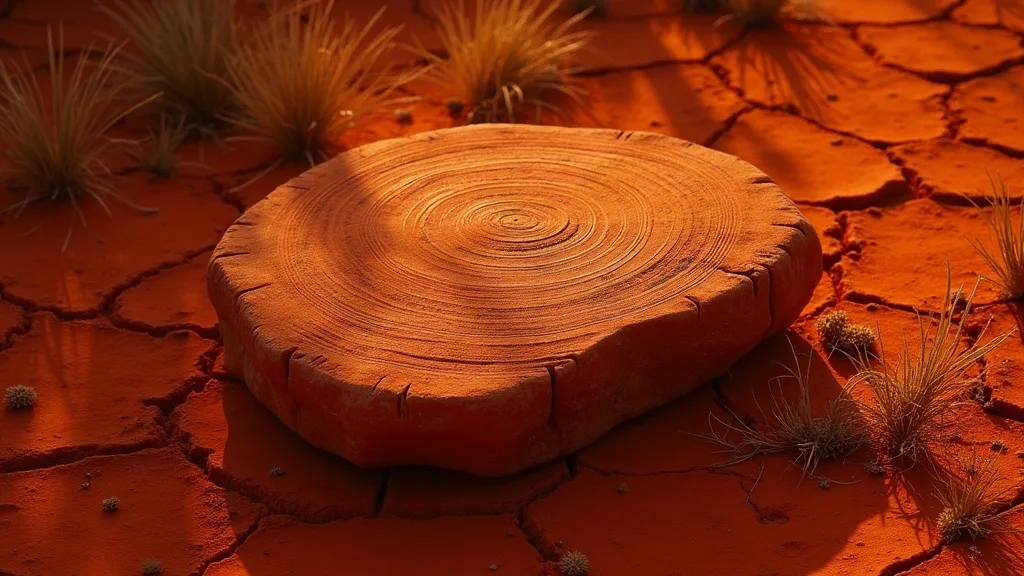
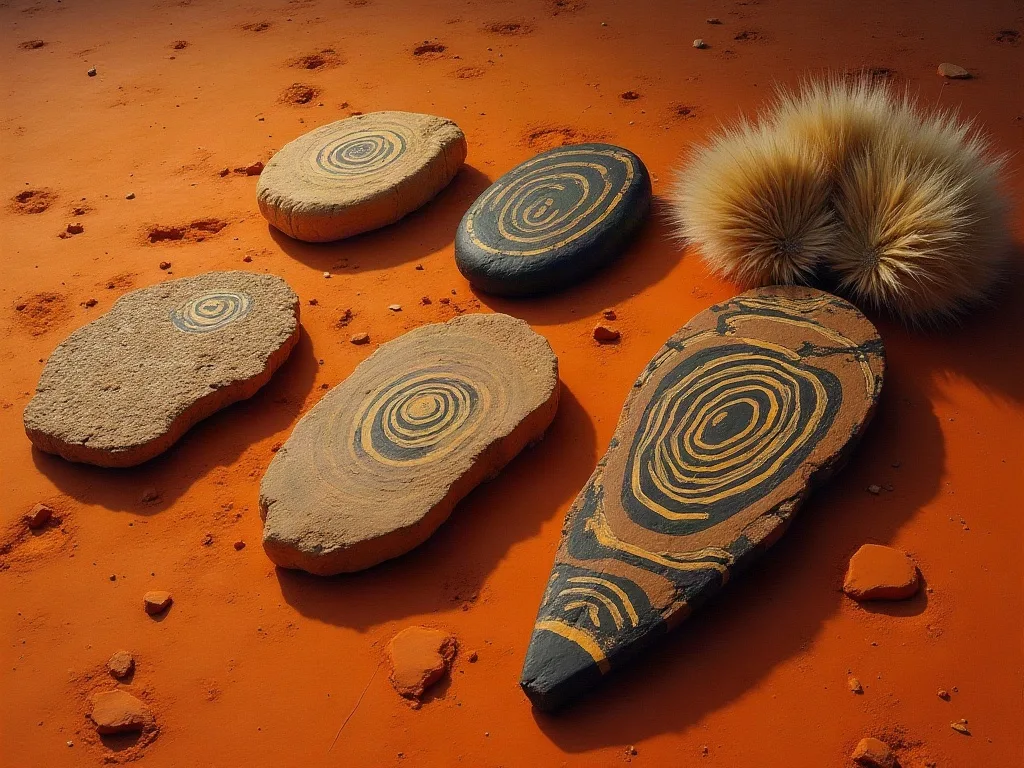
Most tjurunga associated with male initiation rites are made of flat stone (typically red or grey sandstone from Central Australia) or mulga wood (Acacia aneura). Shapes vary: oval, elongated, leaf-like, or rounded at both ends. Sizes range from a few centimeters to well over a meter in length. The largest known examples, sometimes called "great tjurunga," run to 120-130 centimeters and require two people to carry.
Their surfaces are engraved with patterns: concentric circles, curved lines, arcs, and dots. These are not decorative. Each design encodes the path an ancestor took across the landscape during the Dreaming. A concentric circle may mark a waterhole, a resting place, or a ceremony site. A curved line traces a songline, the invisible musical path an ancestor sang into existence as they moved. Reading a tjurunga's design requires knowing which ancestor it belongs to and which country that ancestor traveled through. The design is a map, a genealogy, and a liturgical text all at once.
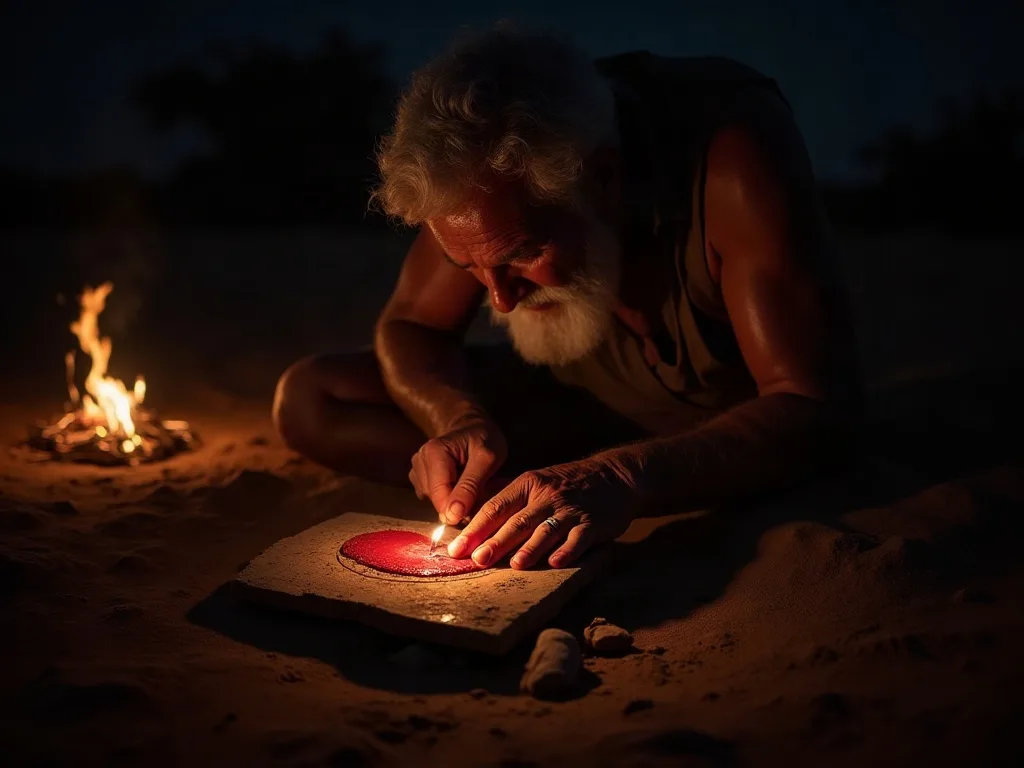
The ochre pigments used to dress a tjurunga before ceremony are themselves meaningful. Red ochre, quarried from specific sacred sites such as the Parachilna deposits in the Flinders Ranges, is associated with blood, life force, and ancestral warmth. Yellow ochre and white kaolin may also appear, marking different stages of ceremony or different ancestral qualities. The object's surface is never static: it is repainted, re-sung, and re-handled across generations, accumulating layer upon layer of ceremony without losing the engravings beneath.
A separate and widely known form of sacred object associated with tjurunga traditions is the bullroarer, a flat wooden blade attached to a cord and swung in the air to produce a deep, pulsing roar. Bullroarers are often considered a form of tjurunga or closely linked to them. Their sound is described in many traditions as the voice of the ancestor, and women and uninitiated men are forbidden from seeing them in many communities, though the rules vary by group and country.
Guardianship, Ownership, and the Concept of Keeping
No tjurunga is simply owned the way a tool or garment is owned. The correct framing is closer to guardianship, or to the idea that a person is "held by" a tjurunga as much as they hold it. Each object belongs to a specific person, a specific totemic ancestor, and a specific stretch of country. The three cannot be separated.
A man's relationship to his tjurunga begins before his birth. When a woman becomes pregnant, the location of conception is often understood as the place where an ancestral spirit entered the child. That location, and the ancestor associated with it, determines the child's totem. The tjurunga connected to that ancestor will eventually become the child's own, passed down through the male line with ceremony and instruction.
Spencer and Gillen recorded that in Arrernte communities they observed, each local group maintained a knanikilla, a sacred storehouse, often a hollow log or a carefully chosen rock shelter, where communal and individual tjurunga were kept wrapped in bark or animal skin. Access to the storehouse was strictly controlled. Women and uninitiated boys were forbidden from approaching. Even among men, only those of the appropriate degree of initiation could handle specific objects.
An important nuance here, emphasized by anthropologist Deborah Bird Rose in Nourishing Terrains (1996): the restrictions around tjurunga do not mean secrecy in the sense of hidden knowledge for the sake of power. They reflect a view that certain kinds of power are genuinely dangerous to those not prepared for them. Uninitiated contact is not simply forbidden. It is understood to cause real harm to both the person and the object.
The custodial relationship also has an economic and ecological dimension that is easy to miss. A man who holds a tjurunga associated with a particular waterhole ancestor bears responsibility for the ceremonies that keep that waterhole spiritually maintained. Neglect of the object, failing to sing it, anoint it, or bring it to the appropriate ceremony, is understood to affect the health of the land itself. Sacred guardianship is inseparable from land stewardship. The tjurunga is, among many other things, an environmental compact.
Tjurunga in Initiation: The Moment of Revelation
The most pivotal encounter with a tjurunga in a man's life comes during initiation. In many Arrernte and related traditions, the ceremony of revealing a young man's own tjurunga is one of the most emotionally charged moments of the entire initiatory sequence, which can unfold over years.
Up to this point, the initiate has heard the bullroarer's sound, undergone physical trials, and received fragments of ancestral knowledge. Then, at the appropriate stage, senior men bring out the tjurunga that belongs to him by ancestral right. They anoint it with red ochre (okra) and emu fat, substances that carry warmth and life. They sing over it. Then they place it against his chest.
T.G.H. Strehlow, who had unique access to Arrernte religious life through his upbringing among Arrernte people as the son of a Lutheran missionary, recorded in Aranda Traditions (1947) that initiates often wept on first contact with their tjurunga. This was not grief. It was recognition. The ancestral being whose power lived in the stone was, in a deep sense, the initiate's own self. The encounter was a reunion of a person with the oldest part of what they were.
After initiation, a man begins learning to read the engravings on his tjurunga and those of his group. Each ceremony adds another layer of meaning. The design that looked like abstract lines at first gradually reveals the complete itinerary of his ancestral being across the country. His knowledge of sacred geography grows in direct proportion to his knowledge of the object.
The initiatory sequence is itself a kind of slow reading. Years may pass between the moment a young man first hears the bullroarer's roar at the edge of camp and the moment he is trusted with the full interpretation of his tjurunga's engravings. Elders do not rush this. The knowledge is calibrated to the person's readiness, and readiness is judged not by age but by demonstrated capacity for responsibility, silence, and care. In this way, the tjurunga functions as a pedagogical instrument of extraordinary refinement: it withholds and reveals in exact proportion to a person's growth.
Songlines, Country, and the Sacred Geography Encoded in Each Object
Tjurunga do not exist in isolation from the land. They are inseparable from specific places, and those places are connected by songlines, the ancestral paths that crisscross the continent. The concept of songlines was made widely accessible by Bruce Chatwin's 1987 book The Songlines, though Aboriginal scholars have noted that Chatwin's account, while evocative, missed much of the religious depth.
A songline is not merely a route. It is the memory of an ancestor's journey, preserved in song, ceremony, and sacred objects. Each group along a songline holds a portion of the ancestral song cycle, and ceremonial exchange between groups keeps the entire path alive. Tjurunga associated with different segments of the same songline are related to one another. Their designs, when read in sequence, form a continuous narrative of the ancestor's journey from one end of the country to the other.
The Dreaming tracks of Central Australia run for hundreds, sometimes thousands of kilometers, connecting communities who speak different languages but share the same ancestral inheritance. A tjurunga from an Arrernte community might connect, through the logic of the songline, to ceremonial objects among the Luritja or the Pintubi people to the west. The sacred geography is not tribal. It belongs to the ancestor, and the ancestor belongs to the land.
Anthropologist Fred Myers, whose Pintupi Country, Pintupi Self (1986) remains the most sustained study of sacred object traditions among a specific Western Desert group, described how Pintupi men spoke of their tjurunga with the language of kinship rather than ownership. An object was not "mine" in a possessive sense. It was "my father," "my grandfather," the material body of the relational chain stretching back to creation. To hold it was to hold the whole lineage at once.
This relational geography also means that the destruction or displacement of a single sacred site in Aboriginal Australia can sever connections between multiple communities along the same songline. A quarry blasted for a road, a waterhole fenced off for cattle: these are not merely environmental losses. They are amputations in the body of an ancestral being whose presence is held together by interconnected tjurunga, songs, and ceremonies distributed across hundreds of kilometers.
This is one of the reasons why the removal of tjurunga from country is understood as so catastrophic, not just culturally, but cosmologically. When an object is taken from its place, the land itself is diminished. The ancestral being is cut off from the body of the world.

The Colonial Theft and the Long Road to Repatriation
From the 1880s onward, tjurunga were systematically removed from Aboriginal communities by collectors, museums, and missionaries. Spencer and Gillen themselves facilitated the transfer of hundreds of objects to the Museum Victoria and the British Museum. Carl Strehlow's son T.G.H. Strehlow, who grew up speaking Arrernte fluently and became the most linguistically sophisticated outside scholar of Arrernte culture, spent decades collecting tjurunga, some acquired with consent, others in circumstances that remain disputed. On his death in 1978, his collection (the Strehlow Research Centre collection, now in Alice Springs) became the subject of one of the longest and most contentious repatriation disputes in Australian history.
The scale of removal was enormous. By the mid-20th century, major museums in Berlin, London, Paris, Vienna, and across Australia held hundreds of tjurunga, most acquired without meaningful consent, many taken by outright theft or under conditions of coercion. For the communities from which they came, this was not a loss of artifacts. It was the amputation of living ancestral presence from the land.
Repatriation began slowly in the 1970s and accelerated after Australia's Aboriginal and Torres Strait Islander Heritage Protection Act of 1984 and the passage of the Native Title Act in 1993. The South Australian Museum, the Museum of Victoria, and the National Museum of Australia have all conducted major repatriation processes. Internationally, German museums have been among the more proactive: the Linden-Museum Stuttgart and the Museum am Rothenbaum in Hamburg have returned significant collections to Arrernte custodians.
The returns are not without complexity. Some communities no longer have elders who remember which objects belonged to which ancestral being and which country. Some tjurunga have been removed from their original context so completely that their proper custodians cannot be determined. In several documented cases, Arrernte elders working with museum photographs have been able to identify engravings by their design sequences, effectively reading the object's map from a reproduction. The knowledge, even when strained, persists.
The work is ongoing, careful, and in many cases deeply painful. Each repatriation is also a ceremony of its own kind: a restoration of the ancestral body to the land that holds it.
Tjurunga and Women: A Corrective Note
Western accounts, including most of the Spencer-Gillen-Strehlow tradition, focused almost exclusively on male tjurunga because male researchers had access only to male initiation contexts. For decades, the scholarly consensus was that tjurunga were exclusively male sacred objects.
Later fieldwork, particularly by anthropologist Diane Bell, whose Daughters of the Dreaming (1983) was a landmark correction, established that women held their own distinct sacred objects with comparable functions. These women's sacred objects, sometimes called atnunghara in Arrernte, have their own designs, their own ancestral associations, and their own ceremonial protocols.
Bell's fieldwork among Kaytej and Warlpiri women in the 1970s revealed that women's ceremonies, particularly those centered on sites associated with female ancestral beings such as Nakamarra figures in Warlpiri cosmology, were not peripheral to religious life. They were its co-equal half. Women's atnunghara are passed down through the female line in a ceremonial sequence that mirrors male initiation in its graduated revelation of ancestral knowledge. Senior women guard these objects with the same protocols of restricted access, careful storage, and ceremonial re-anointing that govern male tjurunga.
Bell's work showed that women's religious life was not an absence but a parallel system, equally complex, equally grounded in ancestral law, but simply invisible to male researchers who were not permitted into women's ceremonies. The women's ceremonies of Central Australia constitute an entire sacred geography that colonial-era scholarship effectively erased from the record for nearly a century.
This correction matters for understanding tjurunga broadly. The sacred object traditions of Aboriginal Australia are not a single male institution. They are a pair of interlocking systems, each with its own geography of objects, ancestors, and country.
How Tjurunga Survive in the 21st Century
For many communities, particularly in the Central and Western Desert, tjurunga traditions remain alive. Initiation still happens. Objects are still passed from elders to initiated men in ceremony. The knowledge encoded in the designs is still taught, still sung, still walked across the land in ceremony.
The landscape of transmission has changed. Some knowledge has been lost through the deaths of elders, the disruptions of mission life, and the removal of children through the Stolen Generations policy that forcibly separated Aboriginal children from their families between roughly 1910 and 1970. Recovery work, combining oral tradition, repatriated objects, and archival records, is underway in many communities.
Digital recording projects, undertaken with strict community control over access and use, have allowed some groups to preserve songs, design knowledge, and ceremonial protocols that would otherwise be lost. The Arrernte-controlled body Strehlow Research Centre in Alice Springs holds records under a carefully negotiated access protocol: some materials are open to researchers, others are accessible only to initiated men of the right lineage, and others are sealed entirely.
Community-led language revitalisation programs have also played a role. As Arrernte and related languages are taught to younger generations, the vocabulary for reading tjurunga engravings, including the precise ceremonial terms for each design element and their ancestral referents, becomes available again. Language and sacred object are, in this tradition, inseparable. To recover one is to begin recovering the other.
The sacred objects themselves continue to be the center of gravity. As long as a tjurunga exists and someone knows which ancestor it holds, the thread back to the Dreaming is intact.
Frequently Asked Questions About Tjurunga and Aboriginal Sacred Objects
Frequently asked questions
Are tjurunga still used in ceremonies today?
Yes. In many communities across Central Australia, including among Arrernte, Luritja, and Western Desert peoples, tjurunga remain central to initiation and other ceremonies. The traditions have survived enormous disruption but have not disappeared. Community-controlled recording and repatriation projects are actively supporting their continuation.
Why are tjurunga so dangerous to see or touch without initiation?
In Aboriginal religious understanding, tjurunga contain concentrated ancestral power. That power is not neutral. Contact by someone unprepared for it, whether through lack of initiation or wrong lineage, is understood to cause physical and spiritual harm to both the person and the object. The restrictions are protective rather than simply exclusionary.
What is the relationship between tjurunga and the Dreaming?
Tjurunga are physical manifestations of the Dreaming, the ongoing ancestral reality beneath ordinary time. Each object is the body or the power-residue of a specific ancestral being who shaped a specific stretch of country during the Dreaming. The object's design maps that ancestor's journey, and its custodian's identity is rooted in that same ancestral being. Tjurunga are, in effect, where the Dreaming touches the material world most directly.
How were so many tjurunga taken by museums?
From the late 19th century onward, anthropologists, missionaries, and collectors removed tjurunga through a combination of purchase (often for token goods), deception, and outright theft, operating in a colonial context where Aboriginal religious rights were not recognized. Spencer and Gillen facilitated major transfers to Melbourne and London institutions. T.G.H. Strehlow's decades of collection resulted in the most contentious single archive. Repatriation has been ongoing since the 1970s, though many objects remain in overseas institutions.
Are tjurunga unique to the Arrernte people?
The word tjurunga is Arrernte in origin, but comparable sacred object traditions exist across many Aboriginal Australian peoples. The Luritja, Pintubi, Warlpiri, and many Western Desert groups have their own terms and their own object-traditions that function in analogous ways, each tied to specific ancestral beings, specific country, and specific ceremonial protocols. The tjurunga concept has sometimes been used loosely in anthropological literature to refer to all such objects, though many communities prefer their own terms.
Can non-Aboriginal people ever see a tjurunga?
Some tjurunga that have been repatriated are held in community-controlled storage and are not publicly displayed. Others, particularly those in museum collections, may be visible in display cases, though many institutions now restrict access per community requests. The question of public display is decided by the custodian communities, and the trend since the 1990s has been toward restricting or removing museum display of sacred objects out of respect for their living religious status.
Tjurunga, Ontology, and What Sacred Objects Mean Across Cultures
The debate that tjurunga sparked in 20th-century anthropology was not really about Aboriginal Australia alone. It was about what a sacred object is, and whether Western categories like "symbol," "relic," or "icon" were adequate containers for non-Western religious experience.
W.E.H. Stanner, writing in the 1950s and 1960s, argued that the Dreaming represented an entirely different philosophical stance toward time, identity, and matter than anything in the Western tradition. A tjurunga does not represent an ancestor the way a portrait represents a person. It participates in the ancestor's being. The object and the being are not two things connected by resemblance. They are one thing distributed across time and matter.
Anthropologist Fred Myers, whose Pintupi Country, Pintupi Self (1986) remains the best sustained account of sacred object traditions among a specific group, made a related argument. For the Pintupi people of the Western Desert, the sacred object is the proof of relationship, the material evidence that a person belongs to a specific ancestor and a specific stretch of country. Identity is not internal and psychological. It is external, material, and geographic. The tjurunga is where self meets land.
This stands in sharp contrast to, say, the Christian relic tradition, where a bone of a saint is venerated because the saint's holiness is believed to have saturated the body. In the Christian case, the saint is elsewhere (in heaven), and the relic is a remainder. In the tjurunga case, the ancestor is present, here, in the object, in the land, in the person. There is no "elsewhere." The sacred is not above or beyond the world. It is the ground beneath the sand.
Comparative mythologists have noted echoes of this logic elsewhere: in the churel stones of certain South Asian traditions, in the Polynesian concept of mana as a transferable sacred force that saturates objects and persons, in the Lakota understanding of the sacred pipe as a living presence rather than a symbol. The Yoruba ashe, that animating force believed to reside in particular objects, priests, and places, operates on a similar ontological register: power is not merely attributed but genuinely present, active, responsive. But the tjurunga tradition, grounded in what may be the oldest continuous religious culture on Earth, gives this idea its most elaborately worked-out form. No other sacred object tradition so precisely maps the relationship between object, person, ancestor, and land into a single material thing.
The most important lesson tjurunga offer to anyone who studies world religion is this: not all sacred objects are symbols. Some of them are something else entirely. And recognising that difference is not an act of romantic primitivism. It is the beginning of genuine comparative theology, one that takes seriously the possibility that different cultures have not just different stories about the sacred, but different accounts of what the sacred is made of, where it lives, and what it demands of the people who carry it forward through time.
Read the full book
Want the whole story?
The complete edition is an instant PDF download here, with a paperback on Amazon for selected titles.
Australian Aboriginal
The Aboriginal Mythology Book: The Rainbow Serpent, Wandjina, Baiame, and the Dreamtime Stories of the World's Oldest Tradition
60,000 Years of Unbroken Ancestral Memory
The world's oldest continuous mythology. From the Rainbow Serpent to the Wandjina cloud spirits, explore the Dreamtime stories that have mapped Australia for 60,000 years.
More from Australian Aboriginal
All articles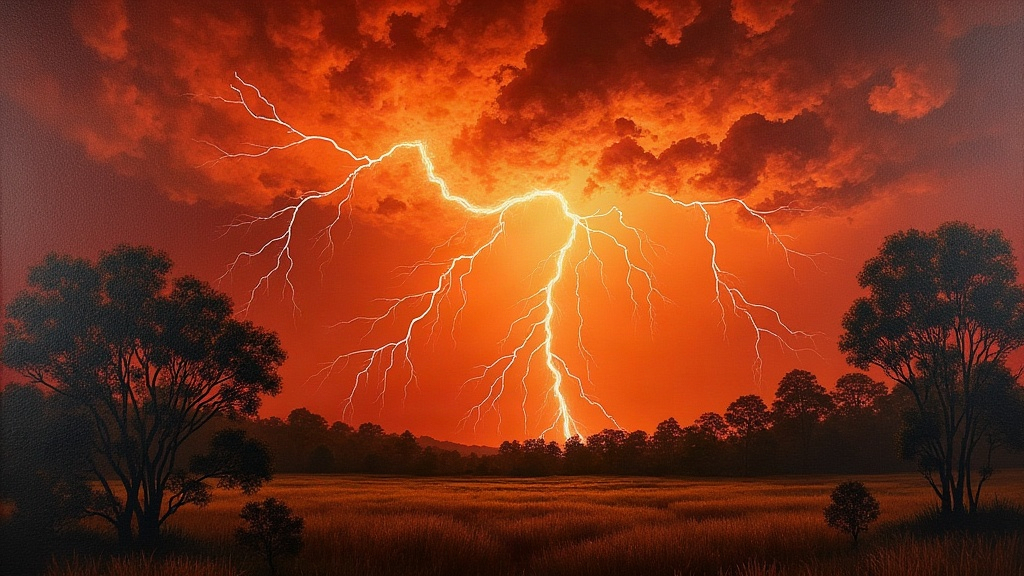
Australian Aboriginal
Namarrgon: The Lightning Man of Arnhem Land
Namarrgon is the terrifying sky god of the Yolngu people who creates lightning and controls the monsoon storms that shape life across Arnhem Land. His thunderous presence reveals how Aboriginal cultures read the sky as a living, ancestral force.

Australian Aboriginal
The Dreamtime: Creation and Eternal Present in Aboriginal Belief
The Dreamtime is the Aboriginal foundation of existence: the era when ancestral beings shaped the land, set down the laws of kinship and ritual, and wove themselves into every rock, waterhole, and song. It is neither ancient history nor myth alone, but an ongoing reality that Aboriginal peoples access through ceremony, song, and country.

Australian Aboriginal
The Seven Sisters: Celestial Pursuit and Pleiades Myth in Aboriginal Australia
Seven sisters flee across the sky in Australian Aboriginal mythology, hunted by a man who will never catch them. This eternal chase, traced in the Pleiades star cluster, reveals how Aboriginal peoples read the cosmos as a living story of desire, escape, and sacred boundaries.
Australian Aboriginal
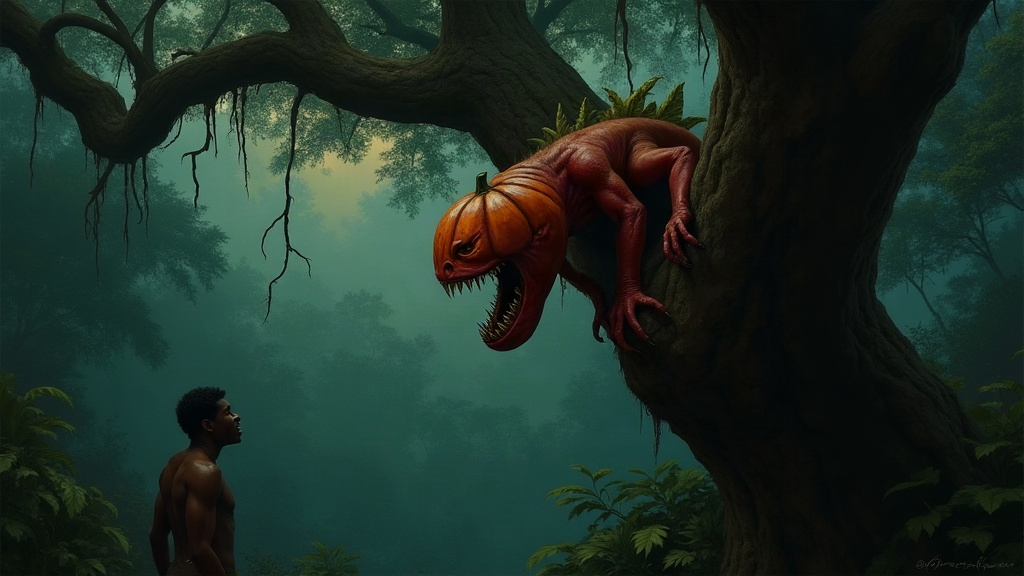
Yara-ma-yha-who: The Bloodsucking Tree Dweller of Australian Aboriginal Myth
Meet the Yara-ma-yha-who, a small but lethal tree-dwelling creature from Rainrainforest Aboriginal lore that hunts humans by bloodsucking and regurgitation. Discover what this creature reveals about danger, transformation, and survival in the deep Australian bush.