

Hine-nui-te-po: Goddess of Death and the Underworld
Hine-nui-te-po rules the Maori underworld with obsidian eyes and hair like the horizon at dusk. Learn who she is, how she became death, and why Maui could not outrun her.
Contents
The sky was still dark when Maui crept toward the giant sleeping figure at the edge of the world. Her body stretched across the horizon. Her hair spread like the last light before night wins. Her mouth, ringed with obsidian and greenstone, opened and closed with each slow breath. This was Hine-nui-te-po, the Great Woman of the Night, the one who swallows the dead. Maui had already lassoed the sun and fished up the North Island of Aotearoa. He believed he could slip through her body while she slept and steal immortality back for humankind.
He did not succeed. That failure is one of the most resonant moments in all of Maori tradition: the moment death became permanent, the moment human life found its limit, the moment a goddess who had once been a daughter chose to become the boundary at the end of all things.
From Daughter to Darkness: The Origin of Hine-nui-te-po
The story begins with Tane, one of the great sons of Ranginui the Sky Father and Papatuanuku the Earth Mother. Tane separated his parents, pushing sky from earth to let light into the world. He shaped forests, clothed trees in birds and leaves, and gave the world its green breath. Then he wanted a human wife.
He went to his mother Papatuanuku and she told him: go to the red earth of Kurawaka, a sacred place, and shape a woman from the soil. Tane did this, shaping the first woman and breathing life into her through her nostrils. He named her Hine-ahuone, "the woman formed from earth." She and Tane had a daughter, Hine-titama, "the Dawn Maiden."
Hine-titama grew up radiant. Tane, without revealing who he was, became her husband too. They had children together. One day, wanting to know her father's name, she asked the carved house post. The post, a keeper of lineage, told her the truth: her husband and her father were the same being. The Maori term for this violation is weighty and untranslatable in a single word, but it describes a breach of tapu (sacred restriction) so severe it tears the fabric of right relationship.
Hine-titama did not stay. She ran toward Te Po, the realm of night and death below the roots of the earth. As she fled, Tane chased her and called out for her to come back, to raise their children. She turned at the threshold. "Go back," she told him, according to versions recorded by the scholar Elsdon Best in the early twentieth century. "Go back and nurture our children in the light. I will draw them down to me here in the darkness."
At that threshold, she shed her dawn name. She became Hine-nui-te-po: the Great Woman of the Night. Goddess of death and the underworld.
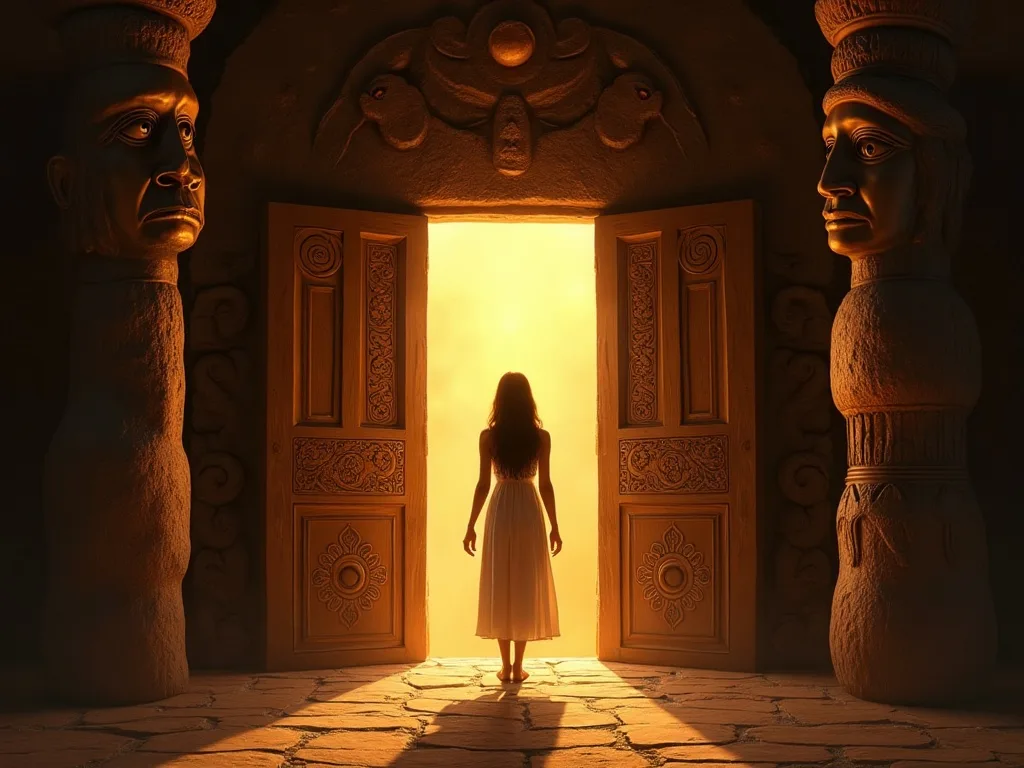
The Realm She Rules: Te Po and the Maori Underworld
Te Po is not identical to the Christian hell, nor is it the Greco-Roman Hades in any simple sense. It is better understood as the great darkness that preceded creation and that waits beyond it. The Maori cosmos, as recorded in oral traditions and later written down by scholars like John White in his 1887 collection "The Ancient History of the Maori," describes creation as a progression from darkness toward light. Te Po was first, before sky and earth separated, before Tane grew the forests, before humans were shaped from red earth.
When people die, they travel north along the body of Aotearoa to the cliffs at Te Reinga (Cape Reinga), where an ancient pohutukawa tree clings to the rock face. The spirit slides down its roots into the sea and from there descends into Te Po. Hine-nui-te-po waits below.
In some accounts she receives the dead gently. She is not a torturer. The underworld she governs is described less as a place of punishment and more as a place of permanence. What goes to Te Po does not return. That finality is her function. She holds, she keeps, she receives. Grief in Maori tradition is tied to the image of her arms opening to receive a person. Some laments (tangi) address her directly, acknowledging her as the one who has taken the beloved.
Her appearance in tradition is both terrible and queenly. Her eyes are described as pounamu (greenstone jade), glinting. Her hair is like the reddish horizon at dusk, echoing her former name, Hine-titama the Dawn Maiden. Her mouth, in the Maui myths, is lined with sharp obsidian, matā, the volcanic glass used for cutting. She is enormous, as large as the horizon, because she IS the horizon between the living world and what lies beyond.

Hine-nui-te-po and Maui: The Myth of the Last Quest
The most widely known episode involving Hine-nui-te-po is Maui's attempt to win immortality. Maui, the trickster demigod, had already performed impossible feats. He slowed the sun with a jawbone rope so that days would be long enough for people to work. He pulled land up from the sea floor with a fishhook carved from the same jawbone (the ancestor's jawbone, Te Manaia o te Rangi). He brought fire from Mahuika, the guardian of flame, though that story nearly killed him too.
But people still died. Maui hated that. He had watched his brother-in-law die, watched his mother grieve. He believed that death was a problem with a solution, the way the short day had been a problem with a solution.
He gathered a group of companions, small birds in most versions (the fantail, the piwakawaka, appears in several tellings), and set out to find Hine-nui-te-po where she slept at the edge of the world. His plan was to enter her body feet-first while she slept, pass through her completely, and emerge from her mouth. Doing so would reverse the act of death, establish the pattern of rebirth, and make humans immortal.
His companions were terrified. He silenced them: do not laugh, do not make a sound, not until I am through.
He crept inside. The piwakawaka watched. The little bird, in the version recorded by Sir George Grey in "Polynesian Mythology" (1855), could not hold back. The sight was too strange, too absurd, too enormous. The fantail laughed. Hine-nui-te-po woke. She clenched the obsidian edges of her body, and Maui was crushed.
He died. And because Maui died before completing the passage, humans remained mortal. The fantail's laugh, in many Maori communities, is heard to this day as a reminder of that moment. When a piwakawaka enters a house, some families still consider it a sign that death is near.
Maui (the Trickster)
- Demigod, son of Taranga and a divine father
- Defined by cunning, irreverence, and the refusal to accept limits
- Slowed the sun, fished up land, stole fire
- Believed death was a solvable problem
- Entered the underworld on his own terms, and failed
- His death sealed human mortality
Hine-nui-te-po (the Keeper)
- Once Hine-titama, the Dawn Maiden, daughter and wife of Tane
- Defined by grief, transformed into sovereignty over death
- Governs Te Po, the primordial darkness beneath creation
- Holds all who die; releases none
- Woke at the critical moment, ending Maui's quest
- Her waking made death irreversible for humankind
The Theology of Transformation: Why She Matters
What makes Hine-nui-te-po unusual among death deities is the path she took to become one. She was not born to darkness. She chose it, in response to a wound. That distinction matters enormously for how Maori tradition understands death itself.
Death, in this framework, is not arbitrary punishment from a hostile cosmos. It is the consequence of a broken relationship at the origin of humanity. Tane, the god who breathed life into the first woman, also violated the sacred order of kinship. Hine-titama's flight was a response to that violation. She became the boundary between the living and the dead not as a curse, but as a kind of mercy: she told Tane to raise the children in the light while she waited below to receive them at the end.
The scholar Te Ahukaramū Charles Royal has written extensively about the depth of meaning encoded in these narratives. He points out that Hine-nui-te-po functions not as an enemy of humanity, but as a parent waiting. Her role as death-goddess and her origin as a wronged daughter are inseparable. Death is not a monster. Death is a mother who remembers.
This has direct consequences for how tangi, the Maori funeral tradition, is conducted. The dead are addressed, wept over, sung to. The wailing of a tangi is not just grief; it is communication across the threshold, acknowledgment of her power, and a kind of farewell that accepts the finality of Te Po.
Cross-Tradition Parallels: Other Great Women of the Night
Hine-nui-te-po occupies a role that resonates across the Pacific and beyond, though each tradition shapes it differently.
In Hawaiian tradition, Milu (sometimes male, sometimes female across regional variations) rules Pulotu, the underworld, receiving the dead and holding them. Like Te Po, Pulotu is permanent. There is no return. The structural parallel is strong, though the Hawaiian accounts attach less narrative weight to a single origin story of transformation.
In Norse tradition, Hel rules the realm of the dead who do not die in battle. She is half-living, half-corpse, and she too receives without releasing. Both Hel and Hine-nui-te-po are female sovereigns over a cold, permanent underworld who were placed or chose to be there rather than seizing power through violence. The comparison reveals a cross-cultural pattern: death as a feminine keeping, not a masculine conquest.
Izanami, the Japanese goddess who became queen of Yomi (the underworld) after dying in childbirth, offers another parallel. Her husband Izanagi went to retrieve her, failed, and the two became permanently separated. The pattern of a goddess transformed by grief or death into the ruler of the land of the dead, then encountering a male figure who tries to undo that transformation and fails, appears in Maori, Japanese, and other traditions independently.
What differs in the Maori version is the moral weight given to the origin. Hine-titama's transformation was caused by a specific act of betrayal within the family, not by a random death. That gives Hine-nui-te-po a particular kind of gravity: she is not just death; she is the consequence of broken tapu.
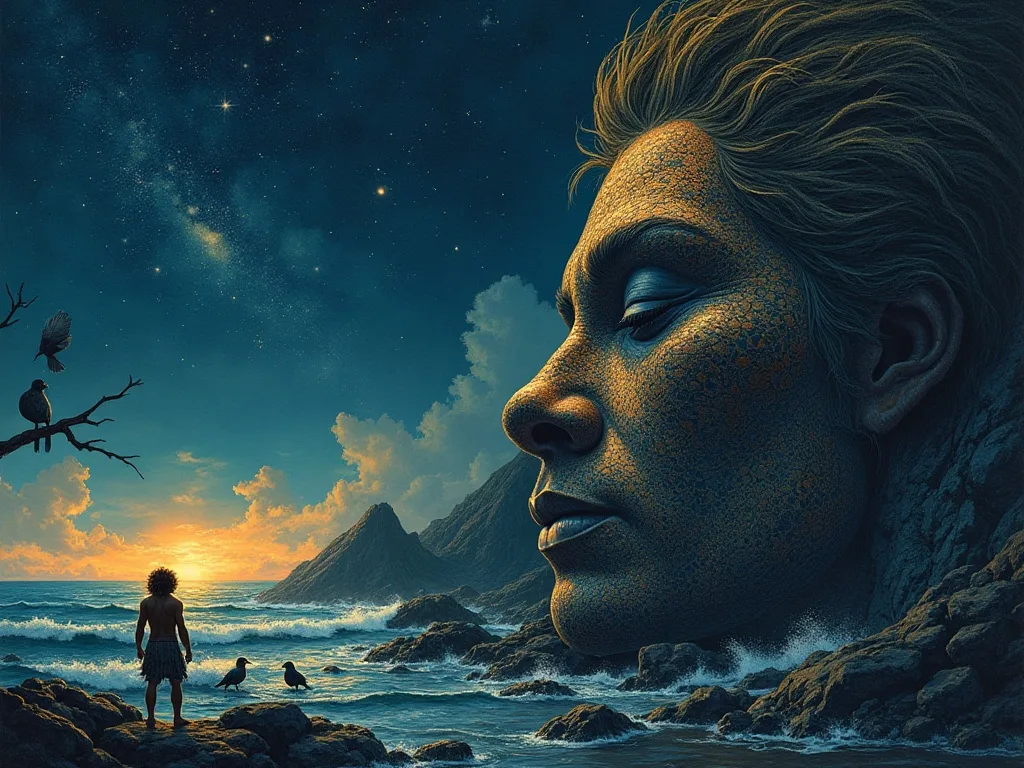
Her Name in Language and Tradition
The name itself repays attention. Hine means "woman" or "daughter" in te reo Maori. Nui means "great" or "vast." Te Po means "the Night," and by extension the primordial darkness, the deep formlessness before creation. So Hine-nui-te-po is literally "the Great Woman of the Night," a name that carries both personal identity and cosmic description simultaneously.
Her earlier name, Hine-titama, pairs hine with titama, which relates to dawn, the first light. The contrast is deliberate and poetic: she moved from the first light to the final night. Maori oral literature holds that kind of naming as deeply intentional. Names in te reo Maori encode history, genealogy, and meaning in a way that translation always slightly flattens.
Her other names or titles in different regional traditions include Hine-i-tapeka and Hine-nui-o-te-po. The core meaning stays stable: she is the great female presence at the boundary between life and what comes after.
The Maori creation myth gives Tane's role equal weight, since understanding Hine-nui-te-po requires understanding what Tane did and built. The full cosmological sequence, from Te Kore (the void) through Te Po to the separation of Ranginui and Papatuanuku and the creation of the living world, is essential context for the weight her role carries.
Hine-nui-te-po in Modern Maori Culture
She has not faded. In contemporary Aotearoa, Hine-nui-te-po remains a living presence in language, ceremony, and creative work.
Maori health frameworks sometimes invoke her when speaking about death and dying, treating the transition to Te Po as something that can be approached with preparation, ceremony, and dignity rather than with fear. Hospice workers and tohunga (spiritual experts) within Maori communities draw on her mythology to help frame the end of life for patients and families.
Contemporary Maori artists, carvers, and weavers represent her in wharenui (meeting house) carvings, in textile art (tukutuku panels), and in poetry. The poet Hone Tuwhare (1922-2008), one of the most important voices in New Zealand literature, wove death and the land together in ways that echo her mythology without ever needing to name her directly. The land receives the dead. That is Hine-nui-te-po's logic, running underneath the verse.
In film and literature, she appears in works like Witi Ihimaera's fiction and in animated retellings for younger audiences, often stripped of the more confronting elements of the Tane-Hine-titama origin but retaining the power and size and finality that make her recognisable. The Maori pantheon as a whole has seen renewed popular attention since the 2010s, partly through the global reach of the waka hourua (voyaging canoe) revival movement and the pride in Pacific heritage it carries.
She also appears in the Disney-Pixar film "Moana 2" (2024) as a character drawn loosely from Pacific death-deity traditions, though the filmmakers condensed and shifted the mythology for narrative purposes. That appearance sparked renewed discussion in Aotearoa about the accuracy of representation and the importance of hearing her story in full, from Maori voices.
Frequently Asked Questions about Hine-nui-te-po
Frequently asked questions
What is the relationship between Hine-titama and Hine-nui-te-po?
They are the same being at different stages of her existence. Hine-titama, the Dawn Maiden, was the daughter of Tane and Hine-ahuone (the first woman shaped from earth). When she discovered that Tane was both her father and her husband, she fled to the underworld and transformed herself into Hine-nui-te-po, the Great Woman of the Night. Her transformation is a central event in Maori cosmology, explaining both the origin of death and the moral consequences of violating tapu.
Why did Maui fail to defeat death when he had succeeded at so many other impossible tasks?
The Maori oral tradition, as recorded in sources like George Grey's "Polynesian Mythology" (1855), suggests the failure was not simply bad luck. Maui's companions, particularly the piwakawaka (fantail), could not stay silent. Their laughter woke Hine-nui-te-po at the critical moment. Some scholars, including Te Ahukaramū Charles Royal, interpret this as a narrative statement: death cannot be tricked, because it is not an external obstacle but a structural element of the cosmos, woven in by the actions of Tane himself. Cleverness reaches its limit at the boundary of Te Po.
Is Hine-nui-te-po worshipped or invoked in traditional Maori religious practice?
She is acknowledged rather than worshipped in the Western sense. In tangi (funeral ceremonies), the dead are understood to pass to her keeping, and laments sometimes address her directly. Tohunga (spiritual experts) might invoke her presence when accompanying the dying. She is not propitiated with offerings in the way some traditions approach death deities, but she is treated with profound respect as a sovereign force whose domain every human will eventually enter.
How does the Maori underworld Te Po compare to underworlds in other mythologies?
Te Po is the primordial darkness that preceded creation, not a place constructed after the fact. The dead travel to it at the end of life, but it existed before life began. This makes it unlike Hades or Sheol, which are generally understood as realms created to hold the dead. It is closer in concept to the Hindu Naraka (understood cosmologically) or to aspects of the Mesopotamian Kur, a dark deep below the living world. What distinguishes Te Po is its connection to the specific narrative of Hine-titama's transformation: it is a place of grief become sovereignty, not simply a geographic afterlife realm.
What are the primary sources for the myth of Hine-nui-te-po?
The main written sources are Sir George Grey's "Polynesian Mythology" (1855), Elsdon Best's extensive ethnographic writings from the late nineteenth and early twentieth centuries (including "Maori Religion and Mythology," 1924), and John White's "The Ancient History of the Maori" (1887-1890). These drew from oral traditions shared by Maori elders across Aotearoa, though they vary by iwi (tribal group) and region. Scholars like Te Ahukaramū Charles Royal have since worked to recover and present these narratives from within a Maori intellectual framework.
Does Hine-nui-te-po have a role in Maori creation stories, or only in death myths?
She appears at the intersection of creation and death, which in Maori cosmology are deeply linked. Her origin connects directly to Tane's act of creating the first human woman, which is a foundational creation event. Her departure to Te Po establishes the boundary between the living world and the realm of darkness. Without her transformation, the sequence of creation would be incomplete: the Maori cosmos requires both light (Te Ao) and night (Te Po) as complementary forces. She is as much a cosmological figure as a funerary one.
The Living Boundary: What Her Myth Still Asks
The story of Hine-nui-te-po is unresolved in the best possible sense. It does not close neatly. Maui is dead. Death remains. But Hine-nui-te-po, standing at the edge of Te Po with her greenstone eyes and her hair like the last red light before night, is not simply an antagonist. She is a figure who suffered an injustice at the beginning of human time and responded by becoming the most permanent force in the cosmos.
That is not a comfortable story. It is an honest one.
Scholars continue to debate the exact relationship between regional variants of her myth. In some northern iwi traditions, the emphasis falls more heavily on her role as a mother receiving her children. In some southern traditions, her fearsome physical description is more prominent. The tension between her tenderness and her terrible size is never fully resolved, and perhaps that is the point. Death itself holds both of those things.
What contemporary Maori scholars like Rangi Matamua and others working in the revitalisation of matauranga Maori (Maori knowledge systems) emphasise is that Hine-nui-te-po is not a symbol to be decoded. She is a figure in a living tradition, still addressed in ceremony, still invoked in grief, still present in the names people give children, in the carvings on wharenui walls, in the sound of a piwakawaka inside a house.
The Polynesian mythological tradition that holds her also holds Maui, Tane, Tangaroa (god of the sea), and Tu (god of war): a whole cosmos of relationships, responsibilities, and powers. She sits at its necessary limit. Every tradition that has human beings in it eventually needs to say what happens at the end. Maori tradition answered that question with a woman who chose to be there, who turned grief into sovereignty, and who holds the door of Te Po open for everyone, without exception.
That is her power. That is why she endures.
Read the full book
Want the whole story?
The complete edition is an instant PDF download here, with a paperback on Amazon for selected titles.
Maori
The Maori Mythology Book: Māui, Tāne, and the Gods of Aotearoa
Māui, Tāne, and Rangi and Papa
The mythology of New Zealand’s first people: the sky-father and earth-mother locked in an embrace, the children who forced them apart to let in the light, and Māui the trickster who fished up islands, snared the sun, and died trying to defeat death itself.
More from Maori
All articles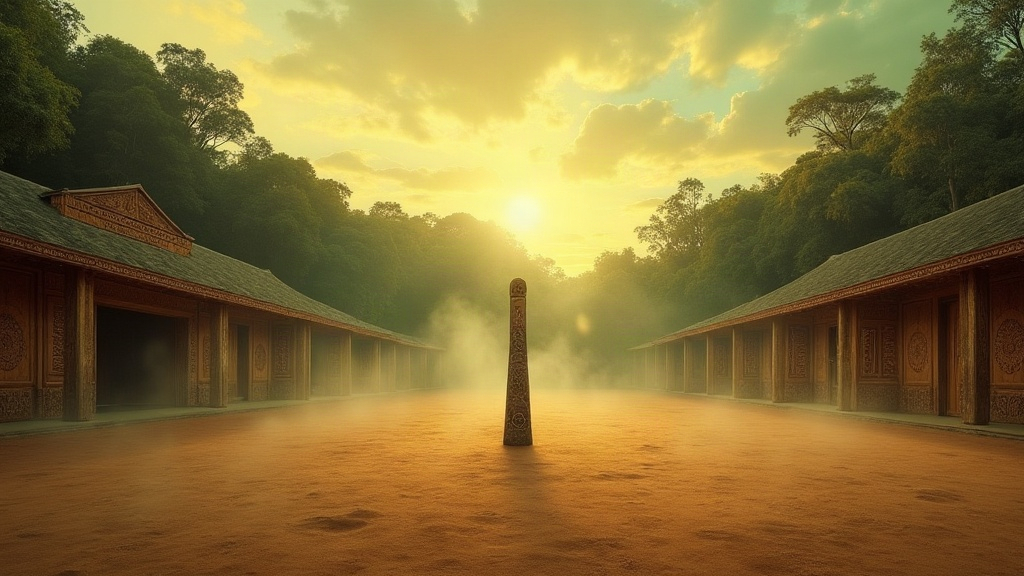
Maori
The Marae: Sacred Meeting Ground in Maori Culture
The marae stands at the heart of Maori identity: a sacred communal space where land, genealogy, and spiritual power converge. Discover how this open courtyard became the foundation of Maori society, ceremony, and connection to place.
Maori
Tiki: The First Man and Ancestral Symbol in Maori Mythology
In Maori creation myth, Tiki was the first human, carved from earth by Tane Mahuta, the god of forests. This symbol represents the bridge between the divine and human worlds, still vital in Maori art and culture today.

Maori
The Taniwha: Supernatural Guardians of Waterways in Maori Mythology
The taniwha are powerful supernatural beings in Maori mythology that guard rivers, lakes, and caves. These shape-shifting creatures demand respect and have shaped Maori settlement patterns for centuries.
Maori
Tapu and Noa: Sacred Restriction and Freedom in Māori Worldview
Tapu and Noa are the twin forces that shaped Māori life: one sacred, restricted, potent; the other free, ordinary, unrestricted. Learn how these concepts governed everything from food and ritual to social order and spiritual safety.