
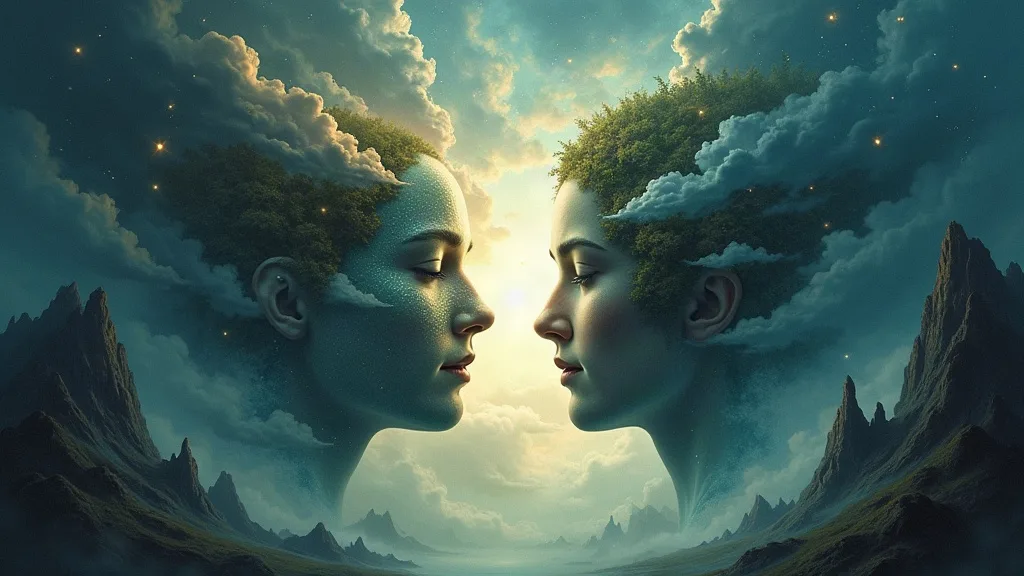
Ranginui and Papatuanuku: The Sky Father and Earth Mother
Before light, before separation, sky and earth lay locked in an embrace so tight nothing could exist between them. Ranginui and Papatuanuku, the primordial parents of Maori tradition, held the cosmos in darkness until their children forced them apart to birth the world.
Contents
In the beginning, there was no light. No sky arching overhead, no earth beneath your feet. There was only Ranginui and Papatuanuku locked so closely together that not even a thought could pass between them. The Sky Father and Earth Mother lay pressed against each other in an eternal embrace that was beautiful and suffocating at once, and from this crushing intimacy, all life would eventually be born.
This separation, the tearing apart of Ranginui and Papatuanuku, is the foundational act of Maori creation. It does not happen gently. It happens because the children born in darkness between them grow tired of the blackness and decide their parents must be forced apart. This myth shapes everything that follows in the Maori understanding of the universe: the relationship between sky and earth, light and dark, separation and connection, order and chaos.
The Primordial Pair in the Darkness
When Maori cosmology speaks of the very first moment, it names two beings whose union creates everything. Ranginui, whose name means "vast sky," is the father who stretches across the heavens. Papatuanuku, whose name means "earth stretched wide," is the mother who lies below. They are not separate entities existing in some abstract void. They are the physical substance of the cosmos itself before creation truly begins.
In the Maori telling, preserved in oral tradition and recorded in sources like the Maori Elder's Collection, these two are already fertile. Their union produces offspring, but these children remain trapped in the narrow darkness between their parents' bodies. The space is suffocating. There is no room to move, no possibility of growth or distinction. The children exist in a state of potential, not yet fully alive.
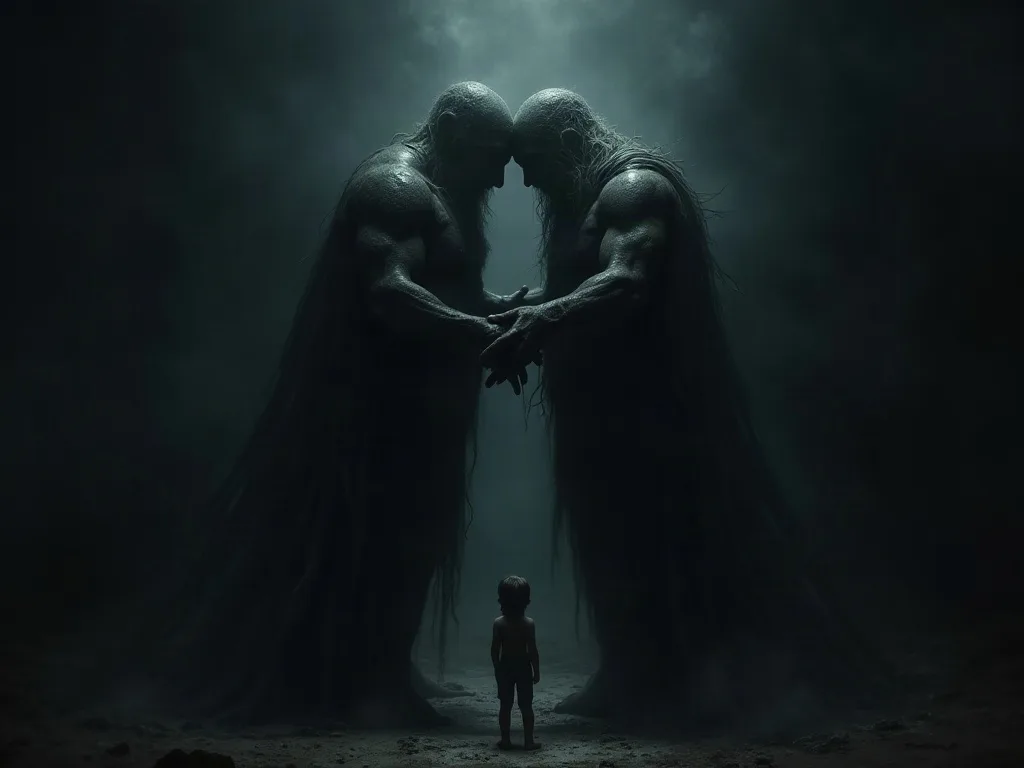
Who are these children? The traditions name several: Tane, who will become the god of forests and light; Tangaroa, who will rule the seas; Tawhirimatea, god of weather; Tu, god of war; and others depending on the region and the version. Each of these figures will play crucial roles in the cosmos that comes after separation, but in the darkness, they are only possibilities, only potential deities crushed together with no room to become themselves.
The Great Separation: Breaking the Sacred Bond
The children cannot bear their imprisonment any longer. They gather together in the darkness and debate what must be done. Some suggest that their parents must be slain. Others propose something different: the Sky Father and Earth Mother must be pushed apart, separated, forced to release each other so that light and space can exist between them.
Tane, the god of light and forests, volunteers to attempt this monumental task. He plants himself between his parents and begins to push. His brothers join him. They strain against the weight of the sky pressing down, against the weight of the earth beneath. The effort is immense. Ranginui and Papatuanuku, even as they are being separated, struggle to remain together. Their love for each other is strong, and the separation causes them both agony.
But Tane and his brothers push, push until finally the sky tears away from the earth with a sound that echoes through all the newly created dimensions. Sky and earth are thrust so far apart that the distance between them becomes the very atmosphere where light can move. The children of the primordial pair tumble out into this new space, falling like rain, settling into their roles as the great forces of the cosmos.
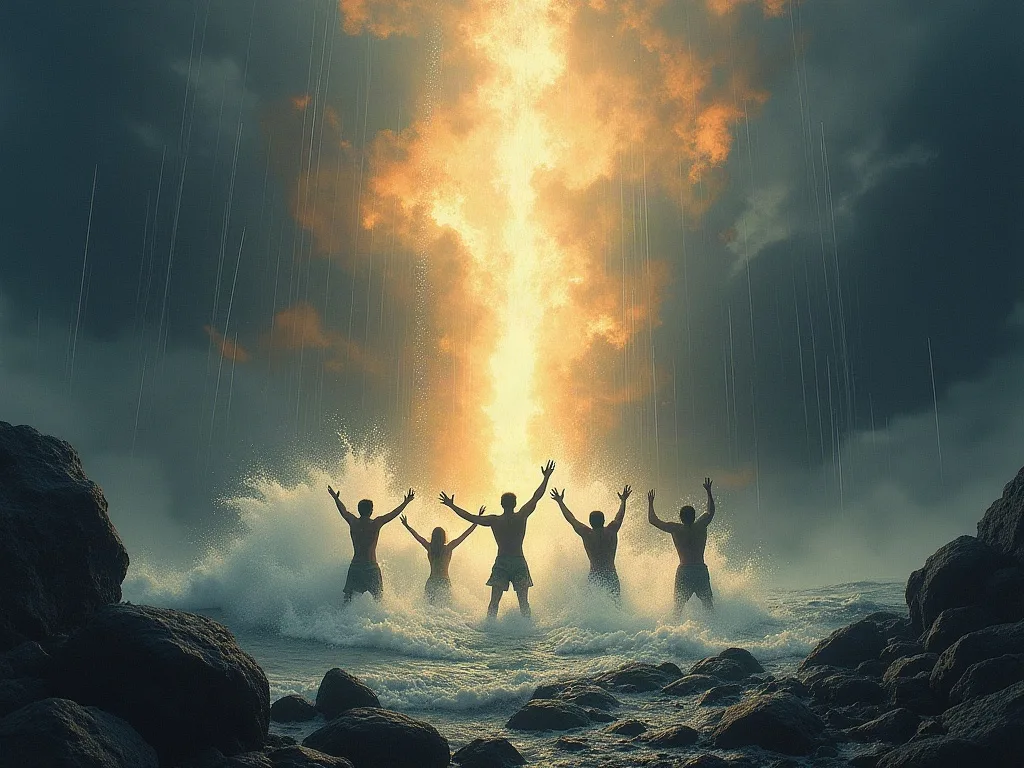
The separation is not clean. When Papatuanuku is torn from Ranginui's embrace, the Earth Mother weeps. Her tears become the rain that waters her soil. Ranginui, too, grieves at being separated from his beloved. His tears become the dew that falls each morning from the sky. Even in their parting, their love remains visible in the natural world. The mist and the rain are the physical evidence of the pain and tenderness between the Sky Father and Earth Mother.
The Separated Realm: What Comes After
Once the great separation is complete, the cosmos takes on the shape that Maori understanding recognizes. The sky is not an empty void but a realm inhabited by Ranginui himself, who becomes a father figure presiding over that upper realm. Stars are his eyes, clouds are his movements, weather is his moods. The sky is not distant abstraction. It is a conscious, animated being still present in the world.
The earth, too, remains a presence. Papatuanuku does not disappear into passivity. She is the source of all growth, all abundance, all sustenance. Every plant that grows, every creature born from soil or stone, is her offspring. The Maori understanding treats the earth not as resource but as a living mother who must be respected and maintained. The act of planting, of harvesting, of walking upon the land involves acknowledgment of Papatuanuku's presence and her generosity.
Between these two fundamental beings, now separated, the real work of creation and maintenance happens. Tane, after the separation, must create the sky above with its stars. He also creates light itself and the forests that clothe the earth. Tangaroa, the ocean god, fills the space between sky and earth with water. Tu becomes the god of warfare and human strength, necessary for balance. Each of these figures, now able to move in the light and space created by their parents' separation, takes their rightful place in the functioning cosmos.
The Grief of Separation and Ongoing Connection
What makes the Ranginui and Papatuanuku myth distinctive among world creation stories is its emotional depth. This is not a separation that heals or is forgotten. It is an ongoing condition that carries weight. The Sky Father and Earth Mother remain aware of each other across the void their children opened between them. They cannot rejoin, and the cosmos depends on this permanent separation, yet their love persists in visible, tangible ways.
The rain is not mere water. It is Ranginui's tears, his constant weeping for the partner from whom he is forever separated. The dew in the morning is Papatuanuku's response to her husband's tears, her own expression of longing and sorrow. The mist that clings to valleys and mountains is the visible presence of their mutual grieving. This is not presented as tragedy in an abstract sense. It is presented as the natural and necessary cost of creation, a sacrifice that enables everything else.
This emotional dimension shapes how the Maori people understand their relationship to the land and sky. To walk upon Papatuanuku's body is to walk on your mother. To look up at the stars, the sun, the moon is to see your father's eyes and movements. Every breath of air is the space created by your ancestors' separation. This is not poetic metaphor detached from practical life. It is a lived understanding that connects kinship, ecology, and spirituality into a single coherent system.
The Genealogy of Divinity: Children and Descendants
The children of Ranginui and Papatuanuku do not exhaust the genealogical depth of Maori mythology. Each of these primary deities has offspring and descendants who further populate the cosmos with power, character, and agency. These relationships are recorded in whakapapa, the genealogical recitations that were central to Maori oral culture and that survive in modern scholarship and cultural practice.
Tane, for instance, is credited with creating many things, and he also fathers numerous beings. His relationships and descendants are traced through different versions of the mythology depending on regional tradition. Rongo, god of agriculture and peace, is another key figure whose place in the cosmic order depends on understanding the initial separation and what it made possible. Even Maui, the famous culture-hero who appears in Polynesian mythology across multiple islands, is positioned within genealogies that trace back, ultimately, to the primordial pair.
The Maori did not view mythology as a fixed narrative that happened once and then concluded. Instead, the myths describe principles and relationships that continue to operate. The separation of Ranginui and Papatuanuku is not a past event that is simply remembered. It is an ongoing condition that structures reality. Every separation or joining of elements in nature reflects this first separation. Every act of creation involves both divine will and the cooperation of multiple beings, just as the tearing apart of the primordial parents required collective effort.
Symbolism and Spiritual Significance
In Maori spiritual life, the relationship between Ranginui and Papatuanuku carries multiple layers of meaning that extend far beyond the narrative of creation. The separation represents the necessity of distinction itself, the idea that creation requires differentiation. Before separation, there is only potential. After separation, there is actuality, difference, and the possibility of change and growth.
The grief that accompanies this separation speaks to a reality that Maori philosophy acknowledges explicitly: that some necessary things carry sorrow with them. The universe as a habitable, functional place exists only because of an action that caused pain to the beings most fundamental to existence. This is not presented as unjust or as a problem to be solved. It is presented as part of the fabric of reality, something to be honored and acknowledged rather than denied or overcome.
The feminine power of Papatuanuku is particularly significant. The Earth Mother is not subordinate to the Sky Father. She is his equal, his partner, and the source of all embodied life. In Maori culture, this translated into real power, authority, and spiritual significance given to women in ways that distinguished Maori society from many neighboring colonial powers. The earth is not conquered or dominated. It is the mother, and relationships with mothers carry respect, reciprocal obligation, and genuine affection.
Regional Variations and Scholarly Interpretations
Like many foundational myths, the story of Ranginui and Papatuanuku has regional variations across Aotearoa (New Zealand) and the broader Polynesian world. Some versions emphasize different aspects of the separation or name different beings as the primary actors. Some tribal traditions have their own elaborations and specific genealogies that connect their ancestors to the primordial pair in particular ways.
Modern Maori scholars and cultural practitioners have increasingly documented and explored these variations, bringing together the work of early European collectors (often missionary records) with contemporary Maori knowledge keepers and oral traditions that remained strong within communities. Figures like Te Ahukaramu Charles Royal and other indigenous scholars have worked to reclaim and reinterpret these myths not as anthropological curiosities but as living knowledge systems.
The separation myth has also attracted attention from comparative mythologists interested in creation narratives across cultures. The pattern of an initial unity being broken or separated to allow creation appears in various forms across the world, from the Egyptian separation of Shu and Tefnut to the Chinese primordial pair Pangu. However, the Maori version carries its own distinctive features, particularly in the emotional tenor and the ongoing consequences given to the separation.
The Myth in Contemporary Maori Culture and Knowledge
In modern Aotearoa, the story of Ranginui and Papatuanuku has become increasingly central to Maori cultural resurgence and environmental advocacy. The understanding that the earth is not a commodity but a living mother, and that humans have obligations to her similar to obligations to one's own parents, has taken on urgent relevance in conversations about land use, conservation, and climate change.
Maori environmental movements and legal efforts have invoked the personhood and kinship relationship implied by Papatuanuku's status as mother. There have been legal cases and legislative efforts in Aotearoa New Zealand to recognize rivers, forests, and mountains as living entities deserving of protection and respect, directly drawing on the philosophical framework that the Sky Father and Earth Mother myth establishes. This is not a romantic appeal to tradition but a practical assertion that the old metaphysical framework makes better ecological sense than more recent Western frameworks that treat nature as inert matter.
In educational contexts, schools in Aotearoa increasingly teach the Ranginui and Papatuanuku myth as part of the curriculum, recognizing it as foundational knowledge for all New Zealand children, Maori and non-Maori alike. The myth is taught not as historical fact in a literal sense but as profound wisdom about the nature of existence, relationship, and responsibility.
Frequently asked questions about Ranginui and Papatuanuku
Frequently asked questions
Are Ranginui and Papatuanuku mentioned in written sources, or only in oral tradition?
Both. The myth was preserved in oral tradition for centuries, recorded in whakapapa recitations and storytelling. Early European collectors, particularly missionaries and ethnographers, wrote down versions in the 1800s and early 1900s. Modern Maori scholars have documented the myth in both traditional and contemporary sources. The earliest European written records come from sources like John White's Ancient History of the Maori, though these early records were filtered through colonial perspectives.
How does the Maori creation myth compare to other Polynesian creation stories?
Many Polynesian cultures share a version of the primordial pair separated by a child, suggesting a common ancestral myth. Hawaiian tradition has Papa and Wakea; Samoan tradition has Tangora and Papatea. However, the Maori version emphasizes the emotional consequences and the ongoing grief of separation in distinctive ways. The role of Tane in pushing the parents apart is also specific to the Maori telling.
Why does the myth emphasize the tears and grief of the separated parents?
This reflects a philosophical understanding in Maori thought that necessary things sometimes come at a cost, and that grief and obligation are natural responses to that cost. The visible presence of rain and dew as the ongoing tears of the separated parents keeps the separation present in daily experience. It transforms a mythic event into something observable and emotionally real every day.
Is Papatuanuku still worshipped in contemporary Maori practice?
Papatuanuku is not worshipped in a formal religious sense as she might have been in pre-contact times, though Maori spiritual practice was disrupted by colonization. However, Papatuanuku remains a deeply important figure in contemporary Maori culture, invoked in environmental movements, legal frameworks, and cultural education. She represents kinship with the earth and ethical obligations to the land.
What role does the separation play in later Maori myths and genealogies?
The separation establishes the framework within which all subsequent cosmic action happens. Every god, hero, and human is positioned within genealogies that trace back to Ranginui and Papatuanuku. The separation determines that there is sky, earth, and space between them where change and history become possible. It is not just one myth among many but the structural foundation of the entire system.
Ranginui and Papatuanuku in the Modern World
The myth of the Sky Father and Earth Mother continues to reverberate in unexpected places in contemporary Aotearoa. Climate scientists working on environmental issues have found common language with Maori communities by recognizing that Papatuanuku is not merely symbolic but represents a real framework for thinking about ecological relationships. Universities in New Zealand now regularly include Maori philosophy and mythology in their curriculum, not as anthropology or history, but as living thought systems relevant to urgent contemporary problems.
The separation of Ranginui and Papatuanuku also appears in contemporary Maori literature, visual art, and film as a source of meaning and creative inspiration. Artists draw on the emotional power of the myth and its imagery to explore themes of love, loss, necessity, and connection. The myth provides a structure for thinking about relationships, change, and the costs of necessary transformations that resonates across generations and contexts far removed from the original oral telling.
The story reminds us that myths do not belong to museums. They are living frameworks for understanding the world, frameworks that may have been suppressed or colonized but that retain power and relevance when communities have the space and support to claim them again.
Read the full book
Want the whole story?
The complete edition is an instant PDF download here, with a paperback on Amazon for selected titles.
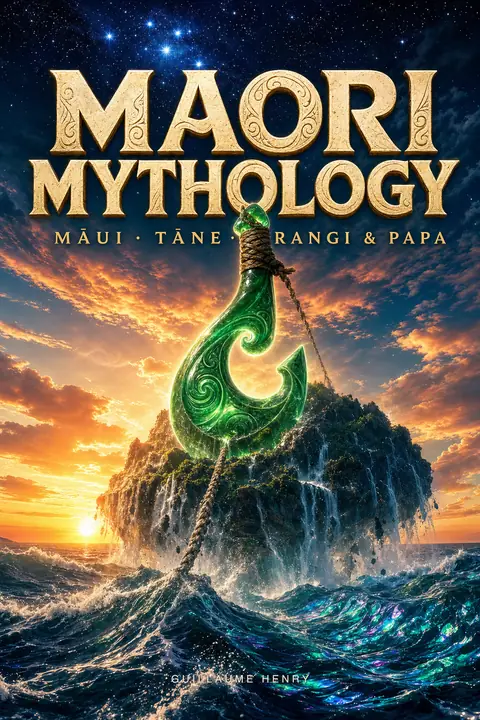
Maori
The Maori Mythology Book: Māui, Tāne, and the Gods of Aotearoa
Māui, Tāne, and Rangi and Papa
The mythology of New Zealand’s first people: the sky-father and earth-mother locked in an embrace, the children who forced them apart to let in the light, and Māui the trickster who fished up islands, snared the sun, and died trying to defeat death itself.
More from Maori
All articles
Maori
The Marae: Sacred Meeting Ground in Maori Culture
The marae stands at the heart of Maori identity: a sacred communal space where land, genealogy, and spiritual power converge. Discover how this open courtyard became the foundation of Maori society, ceremony, and connection to place.
Maori
Tiki: The First Man and Ancestral Symbol in Maori Mythology
In Maori creation myth, Tiki was the first human, carved from earth by Tane Mahuta, the god of forests. This symbol represents the bridge between the divine and human worlds, still vital in Maori art and culture today.

Maori
The Taniwha: Supernatural Guardians of Waterways in Maori Mythology
The taniwha are powerful supernatural beings in Maori mythology that guard rivers, lakes, and caves. These shape-shifting creatures demand respect and have shaped Maori settlement patterns for centuries.
Maori
Tapu and Noa: Sacred Restriction and Freedom in Māori Worldview
Tapu and Noa are the twin forces that shaped Māori life: one sacred, restricted, potent; the other free, ordinary, unrestricted. Learn how these concepts governed everything from food and ritual to social order and spiritual safety.