
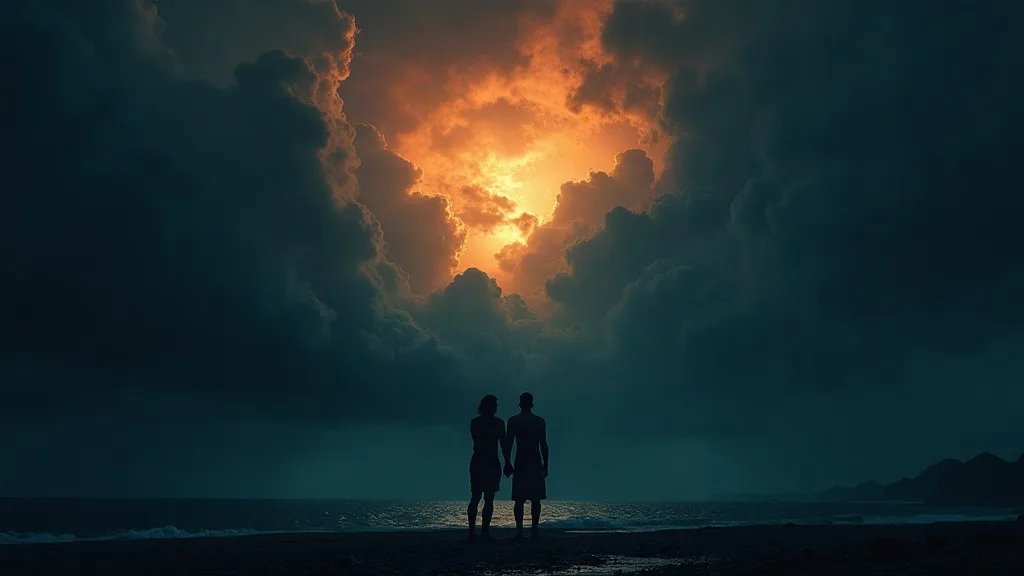
The Separation of Rangi and Papa: Creation Through Division
When sky and earth were wrenched apart, light and life flooded a world that had only known darkness. This is the Maori creation myth that still shapes how Polynesia understands existence.
Contents
Before light, there was only Te Kore, the Void, and then Te Po, the Long Night. Inside that darkness, two beings held each other so tightly that nothing could breathe, nothing could grow, nothing could be named. Rangi, the Sky Father, pressed himself against Papa, the Earth Mother, and their embrace was the entire universe. Their sons lay crushed in the narrow gap between them, squirming in the dark, waiting.
What happened next is one of the most vivid creation stories anywhere on earth. Not a god speaking light into being from a safe distance, not a cosmic egg cracking open by accident. This was a family argument that remade reality. It was sons debating, one refusing, one weeping, and one finally standing and pushing with everything he had until the sky split from the earth and the world opened its eyes for the first time.
Te Kore and Te Po: The Void Before Everything
Maori cosmology does not rush toward creation. It lingers in what came before, and that lingering is deliberate.
The universe began in Te Kore (the Void, often translated as "the Nothing"). But Maori oral tradition does not treat Te Kore as simple emptiness. Chant sequences recorded by Sir George Grey in his 1855 collection Nga Mahi a Nga Tupuna name multiple phases of Te Kore, each one a shade of potentiality: Te Kore-tua-tahi (the First Void), Te Kore-tua-rua (the Second Void), and further iterations spiraling toward something. This is closer to quantum potential than to a blank page.
From Te Kore came Te Po, the Night, which was equally layered. There was Te Po-nui (the Great Night), Te Po-roa (the Long Night), Te Po-uriuri (the Deep Night), and Te Po-kerekere (the Intense Night). Each name describes a quality of darkness, not just an absence of light. The tradition insists that darkness had texture, weight, and duration.
Out of this long and textured night, Rangi-nui (the Great Sky) and Papa-tu-a-nuku (the Earth who stands far below) came into being, and they clung to each other without pause. They were the first parents, and their embrace was total.
The Sons in Darkness: Gods Waiting to Be Born
Rangi and Papa had many sons. The exact number varies across tribal traditions, ranging from six to seventy, but the main protagonists of the separation narrative are broadly consistent across iwi (tribes) throughout Aotearoa New Zealand.
These sons lived in the lightless space between their parents' bodies. They had names, they had natures, but they had no room to act on either. The darkness was not merely inconvenient; it was existential. Without light, plants could not grow. Without space, wind could not move. The sons of sky and earth were gods of potential with nowhere to put that potential.
According to the version recorded by the scholar and ethnographer Elsdon Best in his 1924 work Maori Religion and Mythology, the sons eventually gathered to discuss their situation. The debate itself is significant. These were not passive beings waiting for rescue. They reasoned, they argued, they disagreed. Their conference is the first political act in Maori mythology.
The principal voices were these:
- Tu-matauenga, god of fierce human beings and war, whose name means "the face of Tumatauenga stands against the sky." He argued for killing the parents outright.
- Tane-mahuta, god of forests and birds, who disagreed with Tu. Tane proposed pushing them apart rather than destroying them, letting Rangi rise upward and Papa remain below.
- Rongomatane, god of cultivated food plants, who sided with Tane.
- Haumiatiketike, god of wild and uncultivated food, who also agreed.
- Tangaroa, god of the ocean and fish, who supported separation.
- Ruaumoko, the youngest, who had not yet even been born fully. He remained tucked against Papa's back, and his restless movement is still said to cause earthquakes.
One voice opposed everything: Tawhirimatea, god of winds and storms. He alone did not want his parents separated. His refusal was not weakness; it was grief. He loved the closeness of Rangi and Papa, and he knew, with prophetic certainty, that separation would wound his father forever.
The sons took a vote, and the vote did not go Tawhirimatea's way.
Tane Stands Up: The Act That Made the World
The moment of separation is described in vivid physical terms across multiple Maori oral traditions. Tu's suggestion, to kill the parents, was rejected because it showed no reverence. Tane's method required patience and tremendous force.
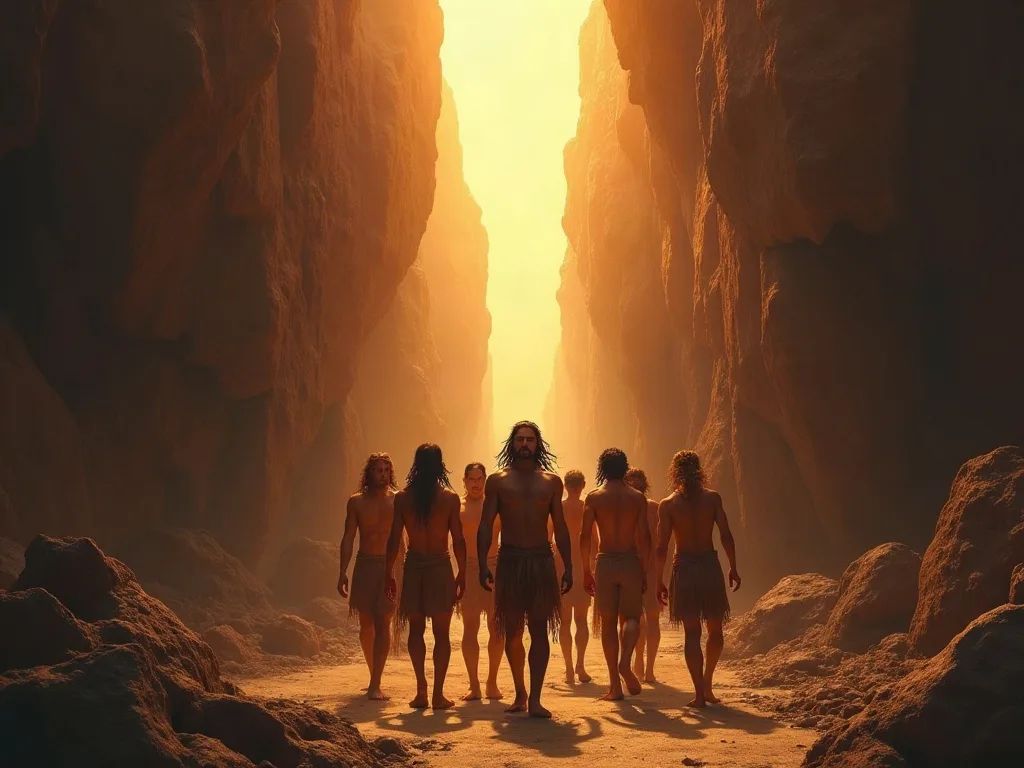
Tane positioned himself with his shoulders pressed against Papa, the earth beneath him, and his feet pushing upward against Rangi. Some accounts describe him lying on his back and straightening his legs. Others say he braced and thrust. All accounts agree on the effort and on the sound: a groan, a crack, and then a tearing apart that changed everything.
Tane-mahuta pushed until Rangi and Papa were wrenched free of each other. Light poured into the world. The sons, who had spent their entire existence in dim cramped darkness, suddenly had space, air, and sky. The forests that Tane would later plant had room to grow upward. The ocean that Tangaroa ruled had room to stretch. The wind that Tawhirimatea commanded now had an entire atmosphere to rage through.
But Rangi wept.
The rain, in Maori understanding, is the tears of Rangi falling toward Papa. The mist that rises from the earth in the morning is Papa's sighing breath reaching back toward Rangi. The two parents are still communicating. They are just separated now, and the space between them is what humans call the world.
The scholar Anne Salmond, in her 1978 work Te Ao Hou: The New World, notes that this dynamic between longing and distance is not merely poetic. It structures how Maori cosmology understands the relationship between the spiritual realm and the physical one: always in tension, always in conversation, never fully resolved.
Tawhirimatea's Rage: The War That Shaped Nature
Tawhirimatea did not accept the outcome quietly. After the separation, he rose to join his father Rangi in the sky and then unleashed his rage on every one of his brothers who had voted against him.
His attack on Tane was devastating. Tawhirimatea's wind children splintered trees, shredded branches, and toppled the great forest. Tane's domain, those first great forests of Aotearoa, was battered. The myth explains real weather: the cyclones and gale-force winds that tear through New Zealand's landscape are Tawhirimatea's unending grudge.
He turned next on Tangaroa. His waves churned the ocean, and Tangaroa's children scattered. Fish fled into the deep sea. The ancestor of reptiles, Tu-te-wehiwehi, fled to the land to escape the waves, and this is why lizards live on shore and not in water. Tangaroa never forgave the desertion, and the enmity between sea and forest, between Tangaroa and Tane, persists: the sea erodes the land, storms fell trees into rivers that feed the ocean.
Tu-matauenga, the war god, stood alone among the brothers and did not flee. He faced Tawhirimatea directly and was not broken. This is one reason Tu is associated with human resilience: he withstood the storm that leveled everyone else.
Tawhirimatea's war against his brothers is not a digression from the creation story. It is the creation story continuing. The conflict between wind, forest, sea, and human cultivation is the Maori explanation for every ecological tension visible in the natural world. The myth is also a natural history.
Tane-mahuta, the forest god, whose forests bore the brunt of Tawhirimatea's vengeance, later performed another act of profound creative courage: he journeyed to the highest heaven to retrieve the three baskets of knowledge for humanity.
Tane Shapes Humanity: The Making of Hineahuone
With the world opened and the first conflicts of nature underway, Tane turned to a problem none of his brothers had solved. The world had space and light and growing things, but it had no human beings.
Tane went to the sacred place of Kurawaka, where Papa's pubic mound lay, and he shaped a human form from red clay. He breathed life into the nostrils, and the figure moved, sneezed, and opened its eyes. This was Hineahuone, the Earth-formed Maiden, the first woman.
From Tane and Hineahuone came Hinetitama, the Dawn Maiden. But Hinetitama later discovered that Tane, who had raised her, was also her father. When she understood this, she fled in grief and shame to the underworld, Te Po, and became Hine-nui-te-po, the Great Woman of the Night, the goddess of death. She told Tane: "Let the day remain for you. I will draw our children into the darkness."
Every human being, in Maori thought, descends from Tane and Hineahuone and eventually returns to Hine-nui-te-po. Birth comes from earth and sky; death leads back to the night from which everything emerged. The cosmological cycle closes on itself.
The Symbolic Architecture of Division
What makes the Separation of Rangi and Papa: Creation Through Division so structurally rich is that it is not just a story about the past. It is a template that Maori culture used to understand every binary in the world.
Rangi is above; Papa is below. That vertical axis maps onto a series of other pairs:
- Sky and earth
- Light and dark
- Male and female
- Sacred (tapu) and ordinary (noa)
- The realm of the gods (Te Ao Marama, the World of Light) and the realm of night (Te Po)
The act of separation created what scholars call a "cosmological axis," a vertical spine around which the world is organized. The great meeting houses of Maori communities, the wharenui, are themselves built as embodiments of an ancestor's body, with the ridgepole as the spine reaching from earth to sky, a physical echo of the moment Tane pushed Rangi and Papa apart.
Even the word for "person" in Maori, tangata, contains layers that trace back to this story. The tanga root connects to the ground, to Papa, to clay, to the physical world. Every human body is a small re-enactment of the original separation: something formed from earth, reaching upward.
The scholar Bruce Biggs, writing in the Journal of the Polynesian Society, noted that the separation narrative functions as what he called a "master myth," meaning a story whose internal logic provides the structural grammar for almost every other story in the tradition. When Maui later tries to reverse the process of death by entering the body of Hine-nui-te-po feet-first (an attempt to be reborn rather than killed), he is acting within the same spatial logic that Tane established: up is life, down is return to darkness, and bodies moving between those poles carry the fate of everyone.
Rangi's Tears: How Grief Became Climate
One of the most emotionally direct elements of the myth is what happens to Rangi after the separation.
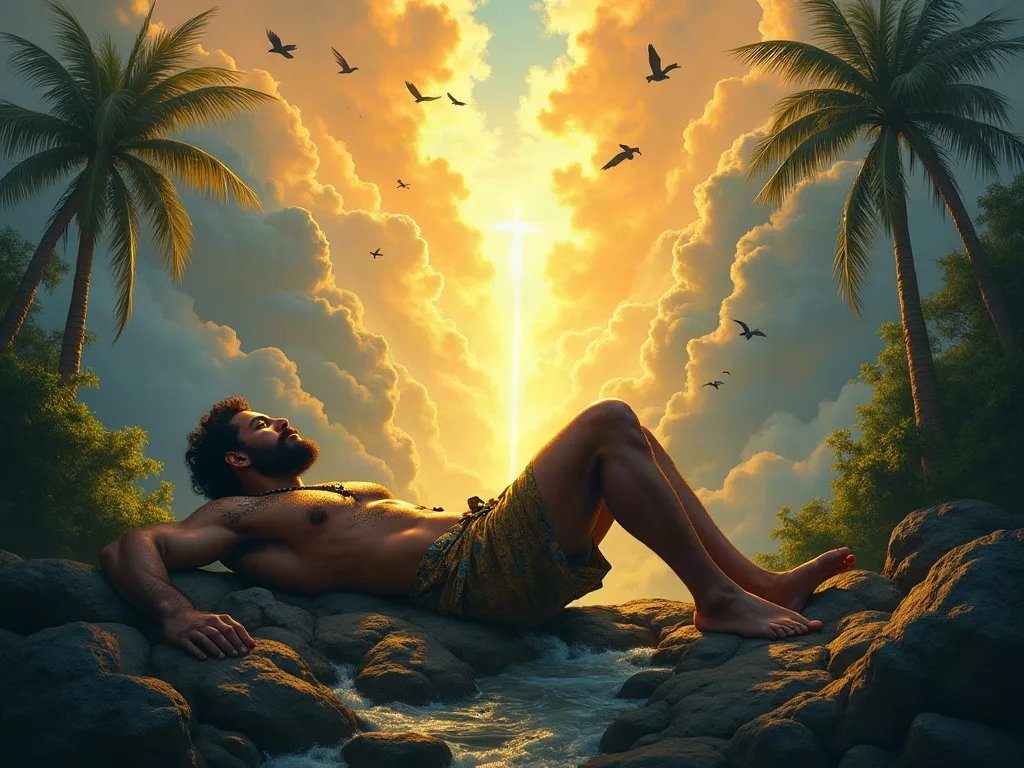
He does not rage like Tawhirimatea. He does not create or build like Tane. He grieves. His tears fall as rain, the ua that Maori farmers and fishermen read the sky for, the water that feeds the rivers and the crops. Papa answers from below. Her sighs and her warmth rise as mist. On cold mornings in New Zealand, when fog clings to the valleys and rivers, the old explanation is still available: these are two beings who were separated and have not stopped reaching for each other.
This is not sentimental decoration. In Maori agricultural and environmental practice, weather was understood as relational, as communication between sky and earth. A flood was not just a natural event. It was Rangi weeping hard. A long drought was a sign of distance or silence between the parents. The myth created a framework for environmental observation that carried real practical weight.
Ethnographer Elsdon Best documented prayers and chants specifically addressed to Rangi during times of heavy rainfall and to Papa during times when food was planted or harvested. The parents were not remote, archaic figures. They were addressed directly, regularly, as living presences whose emotional states had physical consequences.
Cross-Tradition Echoes: Division as the Grammar of Creation
The idea that creation requires separation rather than addition appears across Polynesia and beyond.
In Hawaiian tradition, the Kumulipo, a cosmological chant composed around the 18th century to honor the birth of a high chief, describes creation as a series of pairings and separations in the darkness, with life emerging from division rather than from a single act of will. The structural resemblance to the Maori account is not coincidental: both descend from an ancestral Proto-Polynesian worldview carried across the Pacific by navigating peoples over roughly 3000 years.
In Mesopotamian myth, the Babylonian Enuma Elish (composed in its current form around 1100 BC) describes the god Marduk splitting the slain body of the primordial goddess Tiamat to form sky and earth. The mechanics differ, an act of violence rather than an act of child-against-parent; but the structural logic is identical: separation is the prerequisite for an inhabitable cosmos.
In Egyptian cosmology, the sky goddess Nut and the earth god Geb were separated by the air god Shu, who pushed Nut upward and held her there. The visual is striking: in wall paintings from the New Kingdom period (1550-1070 BC), Shu stands with arms raised, Nut arching over him, Geb lying below. Any Maori viewer of those images would recognize the shape of their own creation story immediately.
The comparison does not collapse the Maori account into a generic template. What makes the Rangi-Papa separation distinctive is its emotional register: the emphasis on grief, on ongoing relationship, on the tears that become rain. Other separation myths end at the moment of creation. The Maori version insists that the relationship between sky and earth continues to happen in every storm, every morning mist, every downpour that fills the river.
For a deeper reading on how Polynesian cosmology compares to other Pacific Island traditions, the structural parallels across island groups reveal just how far the ancestral worldview traveled.
Rangi and Papa in Living Maori Culture
The Separation of Rangi and Papa is not a story that lives only in academic collections. It is woven into contemporary Maori identity, art, law, and politics.
In 1992, when Aotearoa New Zealand's Waitangi Tribunal began ruling on environmental claims, Maori advocates argued that the land, as the body of Papa-tu-a-nuku, carried an intrinsic dignity that European property law did not recognize. The cosmological status of the earth mother was not folklore introduced for rhetorical effect. It was doctrine. The Whanganui River was granted legal personhood in 2017, partly on the basis of this relational worldview: the river as a living ancestor rather than a resource.
Contemporary Maori artists return to Rangi and Papa constantly. The sculptor Paratene Matchitt and the painter Ralph Hotere both engaged the sky-earth tension in large-scale works during the late 20th century. In Matchitt's sculptures, the opposition of vertical and horizontal elements often echoes the cosmological axis without naming it directly.
Kapa haka (group performing arts, combining song, dance, and chant) still carries lines about Rangi and Papa in the words of many pieces. When a group performs a peruperu (a fierce haka performed in full body motion), they stand on Papa and reach toward Rangi, and the physical gesture contains the whole cosmological story: humans as the living consequence of the original separation, still living between sky and earth, still shaped by the push that Tane made in the Long Night.
The myth is not behind glass. It breathes.
Frequently Asked Questions About the Separation of Rangi and Papa
Frequently asked questions
Who separated Rangi and Papa in Maori mythology?
Tane-mahuta, the god of forests and birds, performed the separation. He pressed his shoulders against Papa (the earth) and pushed Rangi (the sky) upward with his feet until the two parents were wrenched apart. Other brothers debated and agreed to the plan, but it was Tane who carried out the act. Tu-matauenga had argued for killing the parents instead, but the brothers rejected that idea.
What does the rain represent in this myth?
Rain is the tears of Rangi falling toward Papa after their separation. The two parents continue to grieve and reach for each other across the space between sky and earth. The mist that rises in the morning is understood as Papa's own breath or sighing reaching upward. Maori oral tradition treats weather as an emotional language exchanged between sky and earth.
Why did Tawhirimatea oppose the separation of his parents?
Tawhirimatea, the god of winds and storms, loved the closeness between Rangi and Papa and did not want them torn apart. He alone voted against separation. After it happened, he rose to the sky to join his father Rangi and then attacked his brothers in revenge. His ongoing rage explains storms and gales in Maori understanding. His conflict with Tane (forests) and Tangaroa (ocean) is especially enduring, accounting for the ecological tension between wind, forest, and sea.
What primary sources record the Rangi-Papa creation myth?
The most important written records are Sir George Grey's Nga Mahi a Nga Tupuna (1855) and Elsdon Best's Maori Religion and Mythology (1924). Both drew on oral traditions collected from knowledgeable elders (tohunga) across different iwi (tribes). The accounts vary in detail by tribal region, which reflects the oral nature of the tradition: no single canonical text exists, and regional versions are all considered authentic.
How does the Rangi-Papa myth compare to creation myths from other Polynesian cultures?
Close parallels exist across Polynesia. Hawaiian cosmogony as recorded in the Kumulipo also describes creation as emerging from paired divisions in the primordial dark. Tahitian and Samoan traditions share the idea of a sky-earth pairing separated to create livable space. All these versions likely descend from a shared Proto-Polynesian ancestor worldview, carried across the Pacific over roughly three thousand years of oceanic migration. The distinctly Maori contribution is the emotional continuity: Rangi and Papa remain in ongoing relationship, not just backstory.
What does the Rangi-Papa story mean for Maori environmental philosophy?
The earth is not raw material or property in this worldview; she is a parent, Papa-tu-a-nuku, whose body carries mana (sacred authority) and relational obligations. Human beings are her grandchildren through Tane's creative work. This cosmological status of the land underpinned Maori arguments before the Waitangi Tribunal and contributed to legal innovations like the granting of legal personhood to the Whanganui River in 2017. The myth is not metaphor in Maori legal thinking; it is foundational charter.
The Myth That Keeps Separating: Rangi and Papa in the Present Tense
Old creation myths usually have an endpoint. A god speaks, the world appears, the story closes, and human history begins separately. The Rangi-Papa story refuses that clean break.
The parents are still active. Rangi weeps every time it rains, which in Aotearoa is often. Papa shudders when Ruaumoko, the unborn son still pressed against her back, moves in restless sleep, which is why the ground shakes. The separation happened in the mythic past, but its consequences are continuously present, visible, and felt.
This is what makes it theologically unusual and, for Maori communities, practically useful. The myth is a diagnostic tool. When the land suffers, it is because the relationship between sky, earth, and the forces between them is out of balance. The story provides not just an origin but an ongoing relational map.
Scholars like Te Ahukaramuu Charles Royal, a Maori ethnomusicologist and researcher who has written extensively on Maori cosmology, argue that the Rangi-Papa narrative belongs to a class of stories he calls "living myth." Not mythology in the Western museum sense, a story kept behind glass and explained with placards, but a story that continues to generate meaning in direct proportion to how seriously it is engaged. The more you bring to it, the more it gives back.
The sons of Rangi and Papa are still at work. Tane's forests grow wherever they are allowed to. Tangaroa's tides shape every coastline. Tawhirimatea's winds arrive unannounced and level what they will. The debate among the brothers never really ended. It simply moved from the dark space between two embracing bodies to the visible, breathing world where all of us, Maori or not, now live.
That is creation through division: not a loss, but the necessary opening of space where something new could finally happen.
Read the full book
Want the whole story?
The complete edition is an instant PDF download here, with a paperback on Amazon for selected titles.
Maori
The Maori Mythology Book: Māui, Tāne, and the Gods of Aotearoa
Māui, Tāne, and Rangi and Papa
The mythology of New Zealand’s first people: the sky-father and earth-mother locked in an embrace, the children who forced them apart to let in the light, and Māui the trickster who fished up islands, snared the sun, and died trying to defeat death itself.
More from Maori
All articles
Maori
The Marae: Sacred Meeting Ground in Maori Culture
The marae stands at the heart of Maori identity: a sacred communal space where land, genealogy, and spiritual power converge. Discover how this open courtyard became the foundation of Maori society, ceremony, and connection to place.
Maori
Tiki: The First Man and Ancestral Symbol in Maori Mythology
In Maori creation myth, Tiki was the first human, carved from earth by Tane Mahuta, the god of forests. This symbol represents the bridge between the divine and human worlds, still vital in Maori art and culture today.

Maori
The Taniwha: Supernatural Guardians of Waterways in Maori Mythology
The taniwha are powerful supernatural beings in Maori mythology that guard rivers, lakes, and caves. These shape-shifting creatures demand respect and have shaped Maori settlement patterns for centuries.
Maori
Tapu and Noa: Sacred Restriction and Freedom in Māori Worldview
Tapu and Noa are the twin forces that shaped Māori life: one sacred, restricted, potent; the other free, ordinary, unrestricted. Learn how these concepts governed everything from food and ritual to social order and spiritual safety.