
Tapu and Mana: Sacred Power in Polynesian Belief
Tapu and mana shaped every corner of Polynesian life, from royal bloodlines to ocean navigation. Learn how these two forces defined the sacred and the powerful across the Pacific.
Contents
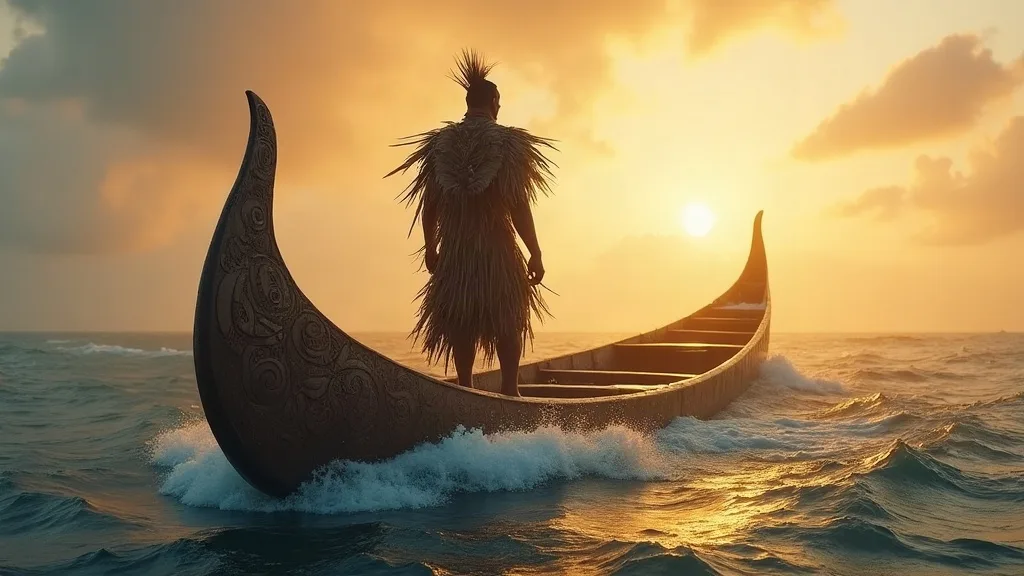
A chief stands at the prow of a great voyaging canoe. The wind pulls hard at the sails woven from pandanus leaves. He does not touch the food his men eat, nor do they touch his. The water he drinks comes in a vessel no one else may use. He is not cruel. He is not distant out of pride. He is, in the language of his people, so full of mana that ordinary contact would be dangerous to those around him. His body is a vessel for sacred power, and that power has a boundary: tapu.
These two words, tapu and mana, sit at the absolute center of Polynesian cosmology. Every political system, every ritual, every carved figure, every taboo on eating certain fish or entering a certain forest, flows from them. Scholars from E. S. Craighill Handy to Marshall Sahlins have wrestled with them for over a century, and the debate is still alive. Yet at their core, both concepts are surprisingly clear, almost physical in the way Polynesian thinkers understood them.
They are not metaphors. They are forces, as real to a Maori warrior or a Hawaiian ali'i (chief) as gravity is to us.
Mana: The Current Beneath Everything
Mana is the animating force that runs through all things. The sky has it. The sea has it. A shark has more of it than a small fish. A great navigator has more of it than a man who has never left shore. A carved ancestor post carries it. A sacred stone accumulates it over generations. In the Hawaiian tradition, mana is the divine energy that the gods, or akua, poured into the world at creation and that moves through bloodlines, objects, words, and deeds.
The key point that Western translators often miss is this: mana is not simply prestige or reputation, though those follow from it. It is a real, transmissible force. When a chief defeats an enemy in battle, he does not just gain honour, he literally gains mana, sometimes understood as being absorbed from the defeated warrior. The Maori tradition (the indigenous people of Aotearoa, New Zealand) makes this especially clear. A great rangatira (chief) accumulates mana through ancestry, through success in war, through skill in oratory, through generosity to his people. Lose a battle, lose face publicly, fail your community, and mana drains away. It is as concrete as water in a vessel.
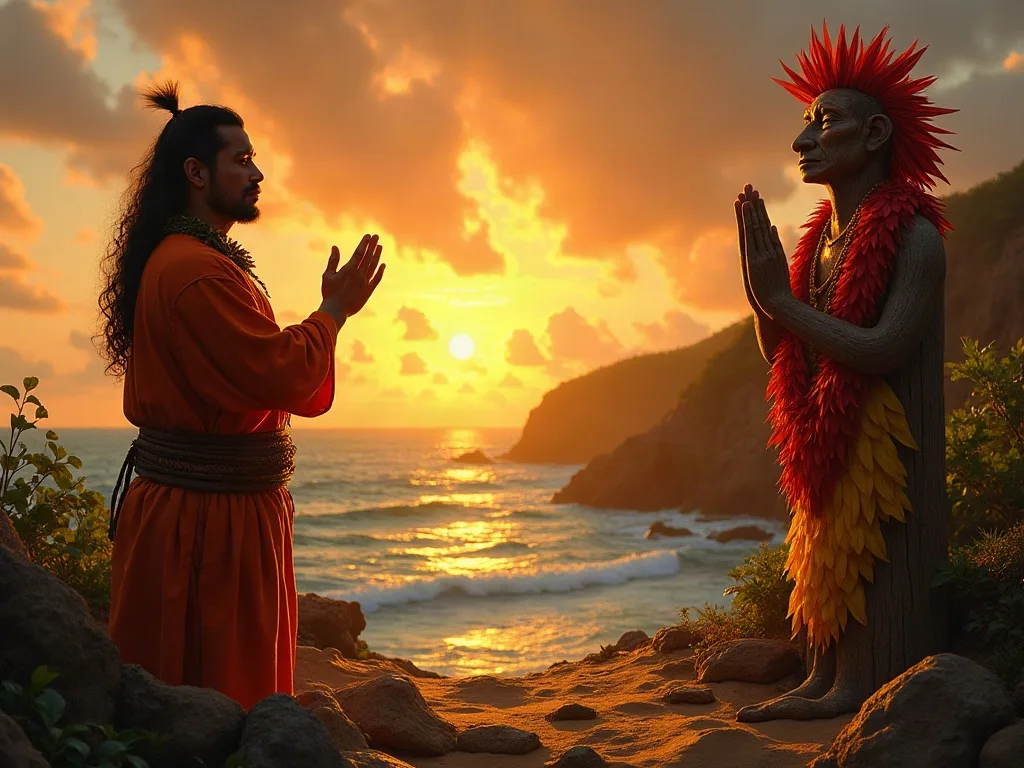
Mana also flows between the human and divine worlds. In the mythology of the Society Islands, the god Ta'aroa (the great creator deity of Tahitian tradition) was said to have breathed mana into the first men and women, making them capable of worship, craft, and reproduction. In Hawaiian mythology, the god Kane sent mana into the taro plant, making it the sacred food that sustained the people and linking every act of eating to a divine origin.
Crucially, mana is not democratic. Some bloodlines carry far more of it than others. Chiefs in Polynesia were not simply strong men who seized power; they were understood to be genealogically closer to the gods, which meant the divine current ran stronger in them. The longer and more illustrious the genealogy a chief could recite, the more credible his claim to supernatural potency. In Hawaii, the highest-ranking ali'i were sometimes said to be so saturated with mana that the ground they walked on became sacred. Commoners would prostrate themselves, not from mere fear, but from a genuine belief that proximity to such a body was physically overwhelming.
Tapu: The Sacred Boundary
Where mana is the current, tapu is the boundary that channels it.
The word itself means "marked off" or "set apart." Something that is tapu is removed from ordinary use, ordinary touch, ordinary speech. It is not simply forbidden in a punitive sense, as though a king had decided to make something illegal. It is forbidden because the force concentrated in it, or around it, is too intense for normal contact. Think of high-voltage electrical cable. The cable is not evil. The warning signs around it are not arbitrary rules. They exist because the energy inside is real and dangerous to the unprepared.
A chief's head was the most tapu part of his body across almost every Polynesian culture. The head was the seat of mana, the point closest to the ancestors and the gods. In Maori tradition, touching a chief's head without permission was one of the gravest violations imaginable. Food touched by a chief's hands, or passing over his body, became tapu and could not be eaten by those of lower rank without risk. The physical logic of this is consistent: mana flows through the body, concentrates in the head, and can transfer to anything the body contacts.
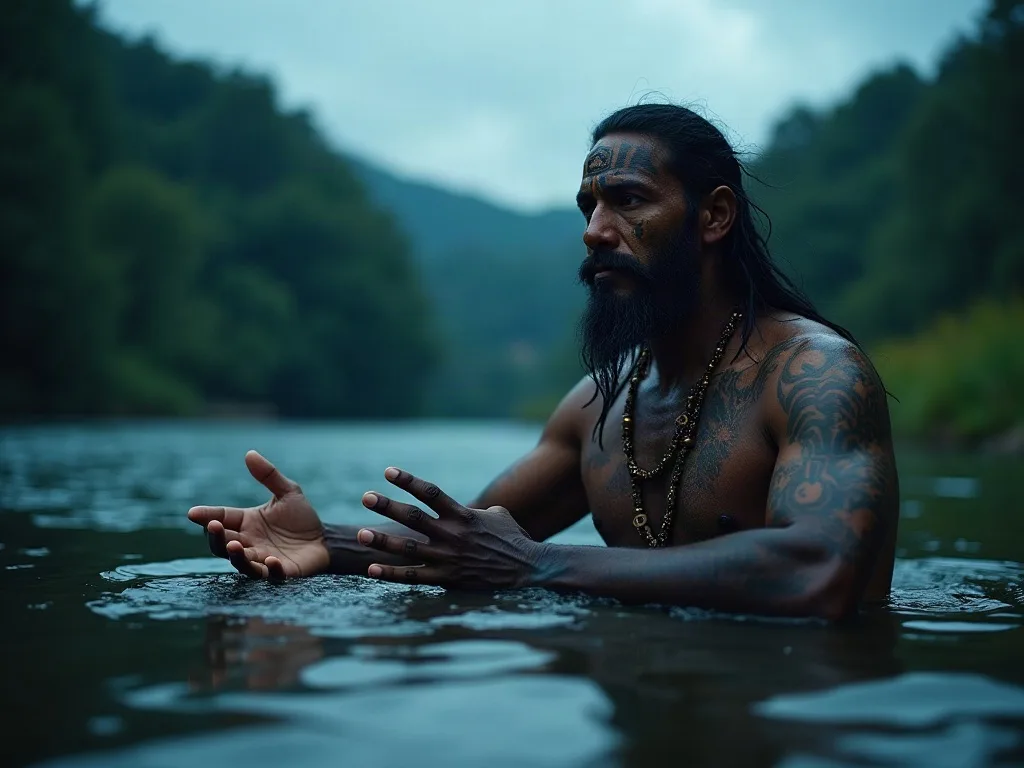
The Maori language preserves an important counterpart: noa. If tapu means sacred and set apart, noa means ordinary, free, unrestricted. Most of daily life is noa. The rituals of everyday cooking, sleeping, and casual work happen in noa space. The transition between tapu and noa was managed through ritual, often involving water (considered a purifying element), chiefly priests called tohunga in Maori tradition, and specific prayers or incantations called karakia. These were not vague spiritual gestures. Each ritual had a precise form, and a tohunga who made an error risked unleashing the very forces he was trying to manage.
Tapu applied to people, places, seasons, and objects:
- A new canoe being built for a chief was tapu until its first successful voyage.
- A burial ground was tapu permanently; to desecrate it was to invite direct reprisal from the ancestors.
- Certain fishing grounds became tapu during breeding seasons, functioning as a conservation mechanism with a sacred enforcement mechanism.
- A woman during menstruation was tapu in many Polynesian cultures, not from contempt but from the belief that she was at her most powerful, most filled with generative force.
- Warriors preparing for battle moved into a state of tapu, abstaining from women, from certain foods, from ordinary social contact, concentrating their mana for combat.
The practical effect of tapu, across Polynesian societies, was to create a structured, sacred regulation of daily life. Resources were protected. Chiefs were insulated from the erosive effects of too much ordinary contact. Sacred knowledge was kept with those trained to handle it.
The Rank System and the Flow of Sacred Power
Polynesian societies were stratified, but the stratification was not purely economic or military. It was cosmological. The highest chiefs in Hawaii, Tonga, and the Society Islands were described in sources like the Kumuhonua tradition and various chiefly genealogies as descendants of specific gods. This genealogical connection was the justification for both their rank and their surplus of mana.
The scholar Patrick Kirch, in his work on Polynesian chiefdoms, describes the system as a "mana economy": the chief's body was a sacred reservoir, his political authority was the social expression of his supernatural potency, and the tribute flowing toward him was the people's acknowledgment of that potency. When crops grew well, when voyages succeeded, when fish were plentiful, the chief's mana was confirmed. When catastrophe struck, questions arose about whether his mana had been compromised.
Polynesian navigation was itself wrapped in this logic. A master navigator, a wayfinder, was not simply a skilled technician. He held a body of knowledge so sacred that in some traditions it could only be transmitted verbally, in conditions of tapu, to selected apprentices. The stars, the swells, the birds, were not neutral information; they were the language of the ancestors, and reading them required mana of a particular kind. A navigator who lost his mana through ritual violation might, in the belief of his people, lose his ability to read the sea.
Mana and Tapu in Myth: Three Stories
Abstract concepts in Polynesian tradition rarely floated free of story. They were demonstrated through narrative. Here are three examples where tapu and mana do exactly that.
The Maui Cycle and the Limits of Tapu
Maui, the great trickster-demigod of Polynesia, is the embodiment of someone who pushes against tapu. He fishes up islands with his magic hook. He snares the sun and beats it with his grandmother's jawbone to slow it down. He steals fire. In each adventure, he crosses a boundary that ordinary people cannot. His surplus of mana lets him touch things that are tapu to others.
His death, in the most widely told version of the cycle, comes precisely when he exceeds even his own mana. He attempts to crawl through the body of the goddess of death, Hine-nui-te-po (the Maori name meaning "great woman of the night"), to conquer death itself. The birds who travel with him cannot suppress their laughter as the absurdity of the attempt unfolds, and she awakens, crushing him. The story is a precise mythological lesson: even the most mana-rich being cannot dissolve every tapu. Death is the boundary even the greatest hero cannot cross.
The Hawaiian Creation Chant and Mana at the Origin
The Kumulipo, a Hawaiian creation chant composed in the eighteenth century and translated by Queen Liliuokalani herself in 1897, opens in complete darkness. From that darkness, life emerges in paired forms: the coral polyp and the worm, the sea cucumber and the starfish, moving upward through ever more complex creatures toward the human being. Each stage is understood as mana gathering, concentrating, differentiating. The chant was composed to celebrate the birth of a high chief and to locate him within this cosmic sequence, identifying him as the current apex of mana flowing through the universe since the first moment of creation.
The Kumulipo is not simply genealogy. It is a statement about the physics of sacred power: mana accumulates through time, through lineage, through increasing complexity, until it reaches its sharpest concentration in the person of a divine chief.
Tongan Tapu and the Sacred Status of the Tu'i Tonga
In the Kingdom of Tonga, the paramount chief, the Tu'i Tonga, held a degree of tapu so extreme that, according to accounts preserved in oral tradition and later recorded by early European visitors, even other high chiefs could not stand in his presence without specific ritual permission. His food was prepared in conditions of strict separation. His possessions could not be touched. When he traveled through a village, people were required to be indoors, averting contact entirely.
The scholar E. W. Gifford, writing in the 1920s on Tongan society, documented these protocols in detail. What is striking is that the Tongan system was not unique; it was an extreme version of principles shared across the entire Pacific. The Tu'i Tonga simply represented the maximum concentration of the dynamic that ran through every Polynesian chiefdom.
Tapu Violations and Their Consequences
The question that always arises: what actually happened when tapu was broken?
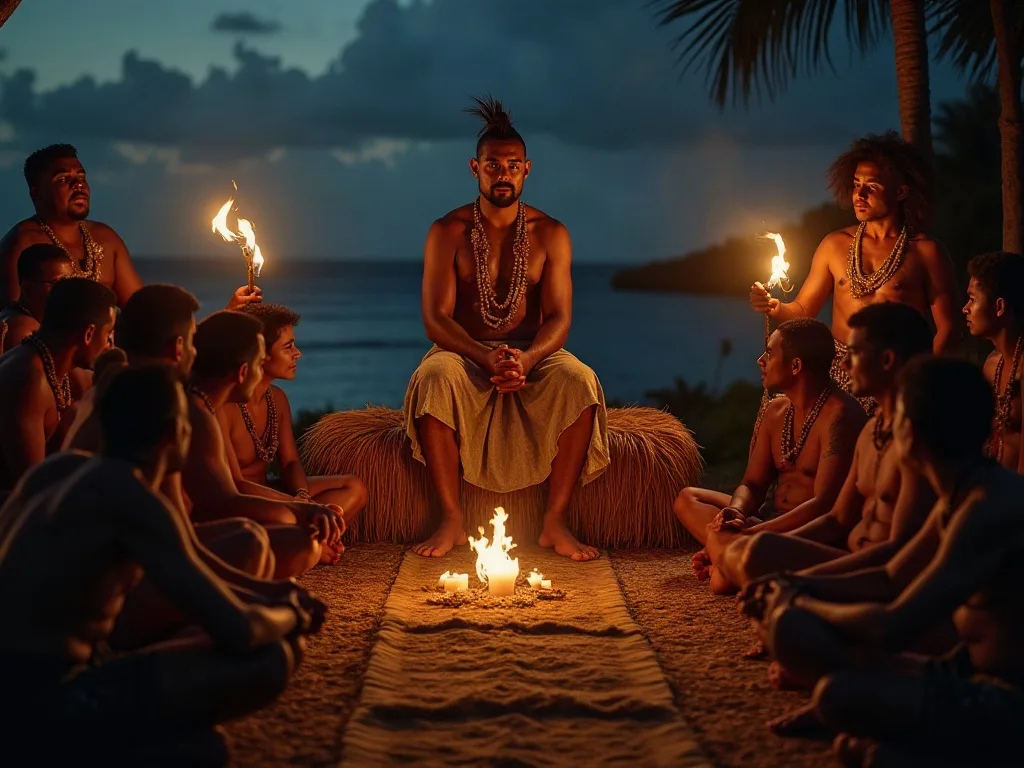
In the most severe cases, the answer was death. Not always at the hands of an executioner, though that happened. In many recorded traditions, a person who inadvertently broke a major tapu became so overwhelmed by the force they had disturbed that they sickened and died of what we might today call psychosomatic shock. The anthropologist James Frazer described similar dynamics across many cultures in his 1890 work "The Golden Bough," noting cases from New Zealand where individuals who discovered they had eaten food cooked over a chief's fire died within hours of learning what they had done.
This was not fraud or political manipulation, though powerful figures certainly used tapu for those purposes too. It reflected a genuine belief in the physical reality of sacred power. The violation was not symbolic. The transgressor had genuinely put themselves in contact with a force their body was not built to handle.
Lesser violations had lesser consequences: purification rituals, offerings, periods of social exclusion, fines in some traditions. The tohunga or kahuna (the Hawaiian term for a specialist priest) managed these cases, diagnosing the nature of the breach, prescribing the remedy, and performing the rites needed to restore the transgressor to noa status.
Tattoo, Carving, and the Visible Body of Mana
Mana and tapu were not invisible abstractions. They had a visual language.
Polynesian tattoo traditions, among the most elaborate in human history, were a direct inscription of mana and genealogical identity onto the body. The Marquesan tradition in particular, documented in detail by the artist and scholar Karl von den Steinen in the early twentieth century, covered the body almost entirely with interlocking patterns derived from ancestral imagery. Each design element had specific meaning, marking the wearer's lineage, rank, and spiritual status. The act of tattooing was itself a tapu process: the tattooist was a specialist whose tools, if used carelessly, could transfer unwanted force to the recipient.
Maori ta moko (facial tattoo) worked on the same principle. The face, as the most tapu part of the body, was the appropriate site for the most intense expression of identity and mana. A chief's moko was a map of his ancestry, his achieved status, and his spiritual potency. Forging or falsifying such marks would have been unthinkable, because the marks were not decorative; they were a record of real genealogical force.
Carved figures, from the great stone moai of Rapa Nui (Easter Island) to the intricate ancestor posts of Maori meeting houses, were also understood as repositories of mana. They did not represent gods or ancestors in a purely symbolic sense. They housed some portion of the force associated with those figures. To damage them was tapu violation. To commission them was to create a site where mana could be concentrated and accessed.
How Mana and Tapu Survived Colonial Contact
The nineteenth century brought Christian missionaries, colonial governments, and the systematic dismantling of tapu systems across Polynesia. In Hawaii in 1819, the year before the first American missionaries arrived, the ruling chiefs made a deliberate decision to break the kapu system (the Hawaiian cognate of tapu) by eating together across ranks and genders, an act that would have been unthinkable a generation before. The reasons were complex: political, economic, influenced by increasing contact with foreign traders who operated outside the system entirely.
Yet the concepts did not die. They went underground, they adapted, and they re-emerged in new forms. In Aotearoa New Zealand, the Maori revival of the twentieth century explicitly centred on mana and tapu as the philosophical foundations of indigenous sovereignty. Legal documents now recognise mana whenua (the mana of the land, and the people whose mana is tied to a particular territory) as a concept with genuine legal weight in New Zealand's framework for indigenous rights.
The word "mana" is in everyday use in New Zealand English, meaning prestige, authority, dignity. It is one of the most eloquent examples in the Pacific of a concept crossing cultural boundaries without losing its core meaning.
Frequently Asked Questions About Tapu and Mana in Polynesian Belief
Frequently asked questions
Where does the English word 'taboo' actually come from?
It comes directly from the Tongan word tapu, which Captain James Cook and his crew encountered during the Pacific voyages of the 1770s. Cook rendered it as "taboo" in his journals, and the word entered English to describe any strong social prohibition. The original Polynesian meaning was more specific: something set apart because of its concentration of sacred power, not simply something forbidden by social convention.
Is mana always a positive force in Polynesian belief?
Mana is potent rather than inherently good or evil. A great chief's mana brings rain, good harvests, and military success. But mana that is disturbed, violated, or concentrated in an unstable way can also harm. A warrior's battle-mana was dangerous to his own household if he returned without proper purification rituals. The concept is closer to electricity than to virtue: immensely useful when channeled correctly, dangerous when mishandled.
How did ordinary Polynesian people interact with tapu in daily life?
Most ordinary life was categorized as noa (unrestricted), meaning daily cooking, fishing, farming, and social interaction happened outside tapu conditions. Tapu became relevant at moments of transition: birth, death, war, planting and harvest, the construction of sacred buildings or vessels, and encounters with chiefly persons or sacred objects. Specialists called tohunga (Maori) or kahuna (Hawaiian) managed the movement between tapu and noa states through prescribed rituals, prayers called karakia, and purification with water.
Did women have mana in Polynesian cultures?
Yes, women held mana, sometimes of a very high order. In many Polynesian traditions, a chiefly woman's genealogical mana could exceed that of her husband if her lineage was more distinguished. In Hawaii, some ali'i wahine (female chiefs) held independent political and sacred authority. Women's mana during menstruation and childbirth was considered intensely concentrated, which explains tapu restrictions during those periods: they were protective boundaries around a state of heightened power, not expressions of pollution or contempt.
Are mana and tapu still active concepts in Pacific cultures today?
Very much so. In Aotearoa New Zealand, mana has legal recognition in frameworks relating to indigenous land rights, and the concept of mana whenua (the people whose mana is rooted in a given territory) shapes environmental and urban planning law. In Hawaii, indigenous rights movements explicitly invoke mana as a framework for sovereignty. Across Samoa, Tonga, and the Cook Islands, tapu and its cognates continue to regulate ceremonial contexts, chiefly protocol, and community governance.
What primary sources describe mana and tapu in detail?
The Hawaiian Kumulipo, a creation chant recorded in full in the eighteenth century and translated by Queen Liliuokalani in 1897, is the richest single document for understanding mana as a cosmological force. For Maori tradition, the writings of Sir George Grey, particularly his 1855 collection "Polynesian Mythology," and later the work of Maori scholar Sir Apirana Ngata provide essential primary and near-primary material. E. S. Craighill Handy's work from the 1920s-1940s remains a foundational comparative source across island groups.
The Living Argument: What Mana and Tapu Still Demand of Us
These two concepts did not become museum pieces when the missionary ships arrived. They continue to generate real political and philosophical arguments in the twenty-first century.
When Maori communities in New Zealand oppose the development of a mountain or river, they are not simply mounting a legal challenge in the Western sense. They are making a claim about whakapapa (genealogy), mana, and tapu: the mountain or river holds sacred force accumulated over centuries of relationship with a specific people, and that relationship constitutes a form of ownership and obligation more durable than any title deed. The 2017 recognition of the Whanganui River as a legal person in New Zealand law was, at one level, the legal system attempting to translate precisely this claim into a language it could process.
In academic anthropology, the debate over whether mana is best understood as a substance, a quality, a social construct, or something that resists all these categories is unresolved. Maurice Bloch challenged the substantive reading in the 1980s. Anthropologist Webb Keane brought fresh comparative analysis in the 2000s. Maori scholars like Linda Tuhiwai Smith have argued, compellingly, that the concepts can only be fully understood from within the traditions that generated them, not merely observed from outside.
That argument is itself an expression of mana: the authority to define, to name, to set the terms of understanding. The boundary around that authority is, fittingly, a kind of tapu.
Read the full book
Want the whole story?
The complete edition is an instant PDF download here, with a paperback on Amazon for selected titles.
Polynesian
The Polynesian Mythology Book: Maui, Pele, Tangaroa, and the Sacred Stories of the Navigator Cultures
From Hawaii to New Zealand: The Gods Who Shaped the Pacific
The trickster Maui who fished up islands, Pele's volcanic fury, Tangaroa's ocean realm, and the separation of sky and earth. The mythology that sailed 10 million square miles of Pacific.
More from Polynesian
All articles
Polynesian
Tangaroa: God of the Sea and Ocean Depths
Tangaroa rules the ocean across Polynesia, commanding fish, tides, and the boundary between human and divine realms. Discover how this primordial god shaped creation and why fishermen still honor him today.
Polynesian
Māui: The Trickster Hero Who Fished Up Islands
The demi-god Māui outwits gods and giants to reshape the Pacific. Discover how this Polynesian trickster hero slowed the sun, pulled islands from the sea, and became the ancestor of human achievement across the islands.
Polynesian
Pele: Hawaiian Goddess of Volcanoes and Fire
Pele is the fierce Hawaiian goddess who creates and destroys islands through volcanic fire. Learn how this shape-shifting deity shaped Hawaiian cosmology, sacred landscape, and cultural identity from ancient times to today.

Polynesian
Tāne: God of Forests, Birds, and Creation in Polynesian Mythology
Tāne stands among Polynesia's most vital deities, separating sky from earth and populating the world with forests, birds, and human life. Discover how this divine carpenter shaped creation itself in Māori, Hawaiian, and Tahitian traditions.