
Māui: The Trickster Hero Who Fished Up Islands
The demi-god Māui outwits gods and giants to reshape the Pacific. Discover how this Polynesian trickster hero slowed the sun, pulled islands from the sea, and became the ancestor of human achievement across the islands.
Contents
A boy born in secret, wrapped in the hair of his mother and thrown into the sea, should have drowned. Instead, the ocean cradled him. When Māui washed ashore on a Polynesian island, he emerged from the foam no longer a castaway but a demi-god with an appetite for the impossible. This is the opening scene of the Polynesian trickster hero whose antics, cunning, and sheer audacity would reshape the Pacific itself.
Across the islands from Hawaiki to Aotearoa (New Zealand) to Tahiti, the stories of Māui's exploits spread from canoe to canoe, embedded in oral tradition, chanted by tohunga (Māori experts and priests) in meeting houses, recited by kupuna (Hawaiian elders) under the stars. He is not a god of war or majesty. He is something stranger: a shape-shifter, a boundary-walker, a figure who proves that cunning and will can bend the laws of creation itself.
Origins: The Child of the Mist
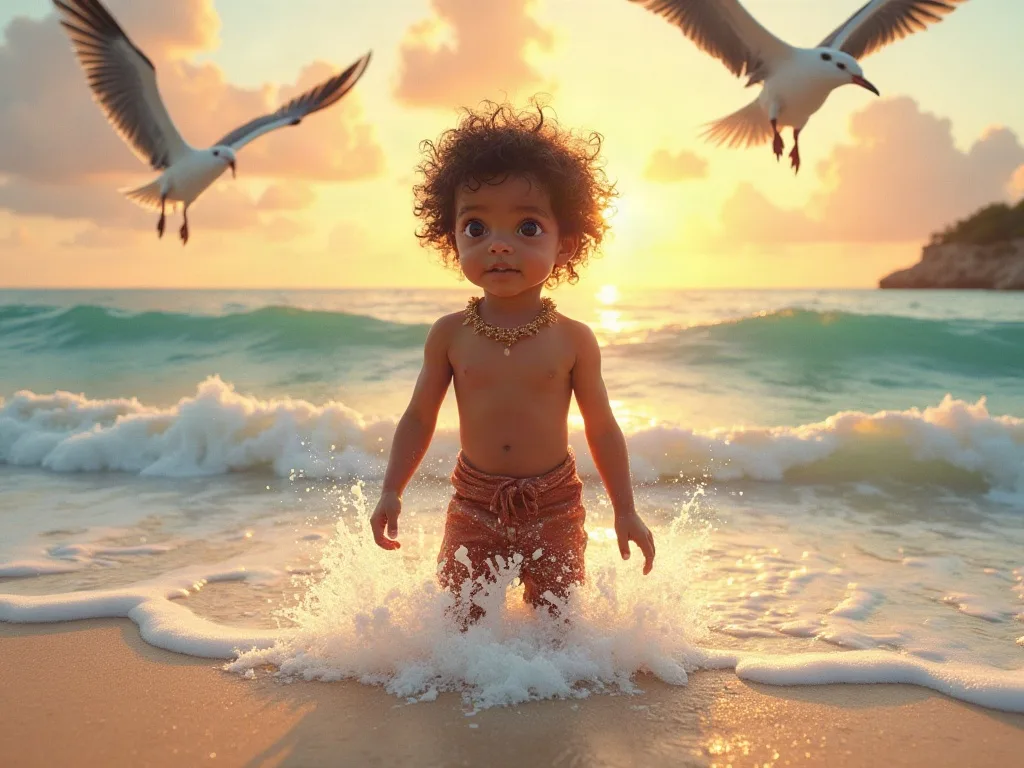
Māui was born under shadow. His mother, Taranga (or Hina in some traditions), conceived him in secret and, fearing the judgment of her people, wrapped her newborn son in the locks of her own hair and cast him into the sea. The child did not perish. Instead, the ocean spirits, the sea-foam, the tides, the creatures of the deep, cradled him. Some versions say he was guided ashore by the birds; others claim the sea god Tangaroa himself carried him to safety.
Washed onto the beach of Hawaiki, the ancestral Polynesian homeland, Māui crawled onto the sand as the sun climbed. There he encountered his brothers, who were already grown and fishing. They did not recognize him. When he asked to join their canoe, they jeered. A boy raised by the mist? A child with no father to give him mana (spiritual power, authority)? He was nothing.
This rejection becomes Māui's fuel. He will spend the rest of his life proving that origin means nothing against will, wit, and magic. His first trick is simple: he hides in the canoe, stowed beneath a pile of fishing gear. When his brothers' lines go slack and their nets fill with nothing, he reveals himself and casts his own hook. When his line tightens, it is not a fish that bites but the carved wooden image of his ancestor, a sign that his mana is real, rooted in the genealogy his mother tried to erase.
The Sun Slowed: Māui's Greatest Feat
The sun, in Polynesian cosmology, is Te Rā or Lā: a constant, relentless presence that hurries across the sky, stealing daylight and condemning the people to perpetual labor before darkness falls. The days are too short for fishing, for weaving, for cooking, for living with dignity. The sun runs wild.
Māui decides the sun must be caught and taught manners.
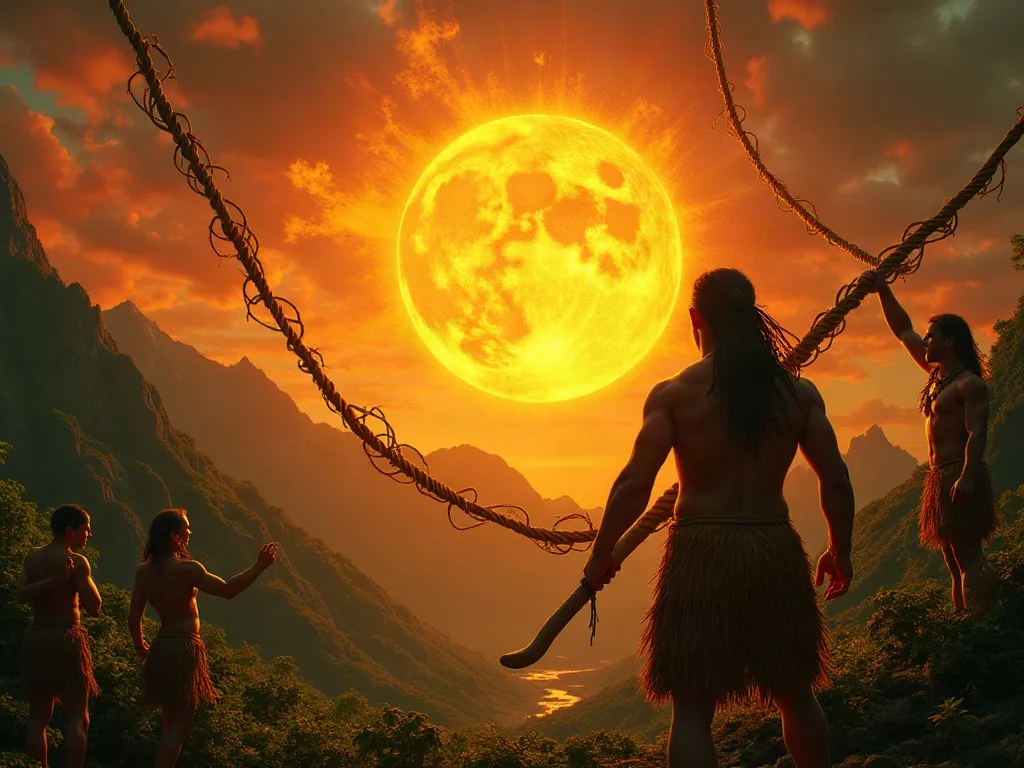
He travels to the east, to the place where the sun rises, gathering his brothers and ropes woven from the bark of the hibiscus tree and the flax plant. Some versions say he braided the ropes from his sister's hair; others claim he used vines. The brothers dig a pit on the mountain and wait through the night. When the sun appears, rising fat and red at the horizon, they loop their ropes around its neck.
The sun thrashes and roars. The sky trembles. The brothers hold fast, their feet braced, their hands bleeding, their hearts hammering. Māui steps forward with a magical jawbone, some say it belonged to his ancestor, others claim it was his grandmother's, and begins to beat the captive sun like a drum. With each blow, the sun weakens. It begs for mercy. Finally, it promises to travel more slowly across the sky, to give humanity more light and more time.
This is not a story of physical strength. It is Māui's signature: the marriage of preparation, audacity, and magical knowledge. He does not negotiate with the sun as an equal. He captures it like a fisher captures bait. He beats it like an artisan shapes bone. He teaches it, a force of nature itself, that it must yield to human need and human will.
The Fishing of Islands: Creation by Hook
If the sun-slowing proves Māui's magical knowledge, the fishing of islands proves his shamanic skill at transformation and his understanding that the ocean itself is a living thing to be negotiated with, not conquered.
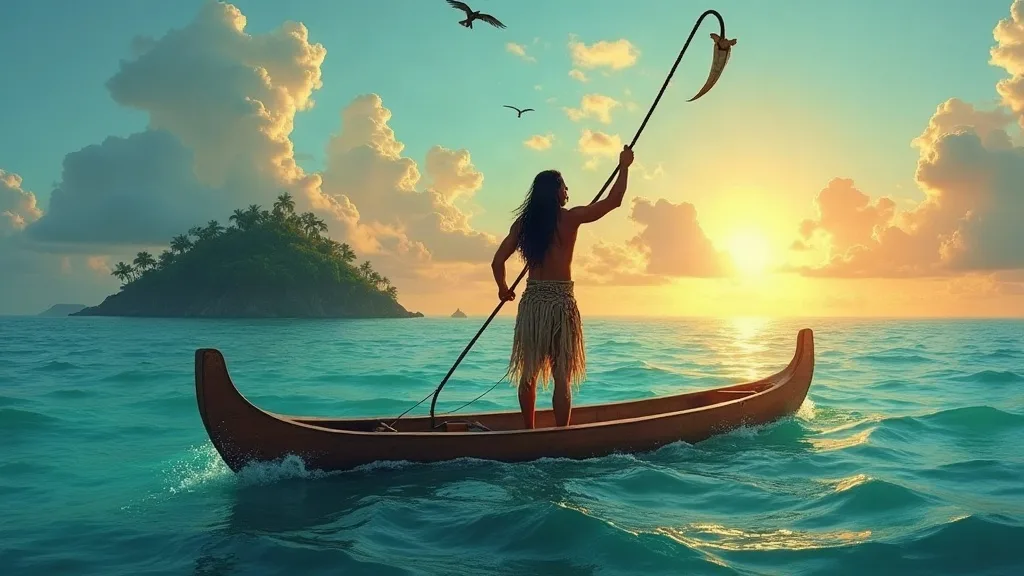
His brothers are fishing again, in their canoe, far from shore. The waters are bare. No fish bite. Māui appears with a hook he has fashioned from his own jawbone, the same jawbone used to beat the sun, or sometimes from the bone of his ancestor. He casts his line into the deep, speaking incantations, calling to the gods of the abyss.
His hook catches not a fish but something vast and immobile. His brothers pull at the oars in panic. The canoe strains. The line creaks. Then, slowly, the sea rises. Islands emerge from the depths, draped in seaweed, still dripping brine. Tonga, Samoa, Hawaiki itself: the inhabited world rises because Māui had the courage to fish where there is no water.
In some traditions, his brothers betray him in his moment of triumph. They cut the fishing line before he can land the islands completely, which is why some are fragmented, why some are separated by channels. In others, Māui uses the magic of the islands to teach them, binding them to the seafloor so they will not sink back.
The islands themselves become proof of his power. Walk the shores of Aotearoa or Hawaiki, and you are walking on a fishing-ground that Māui hauled from the deep. The landscape is his signature.
The Fire Thief and the Conquest of Death
Not all of Māui's exploits are triumphant. His hunger for power and his refusal to accept human limitation lead him into confrontations where even his cunning falters.
He steals fire from the underworld kingdom of Mahinarangi (the Māori version) or Mahuika (in other Pacific renderings), a goddess who guards the sacred flame. He approaches her as a suppliant, begging for a single ember. She grants it. He smothers it. He returns. Again and again, he begs; again and again, she gives. Each time he extinguishes the gift. When she understands his theft, she pursues him in a rage that sets the forest alight. Māui escapes only by transforming into an eagle and diving into a river, bringing fire to the world but nearly destroying it in his selfishness.
His greatest failure comes when he attempts the one thing even a demi-god should not attempt: the conquest of death itself.
He learns that the goddess Hine-nui-te-pō, the lady of the night and keeper of the underworld, is the source of all mortality. If he can pass through her body while she sleeps, he can slay her from within and free humanity from death. His friends and helpers become horrified at the plan, but Māui is undeterred.
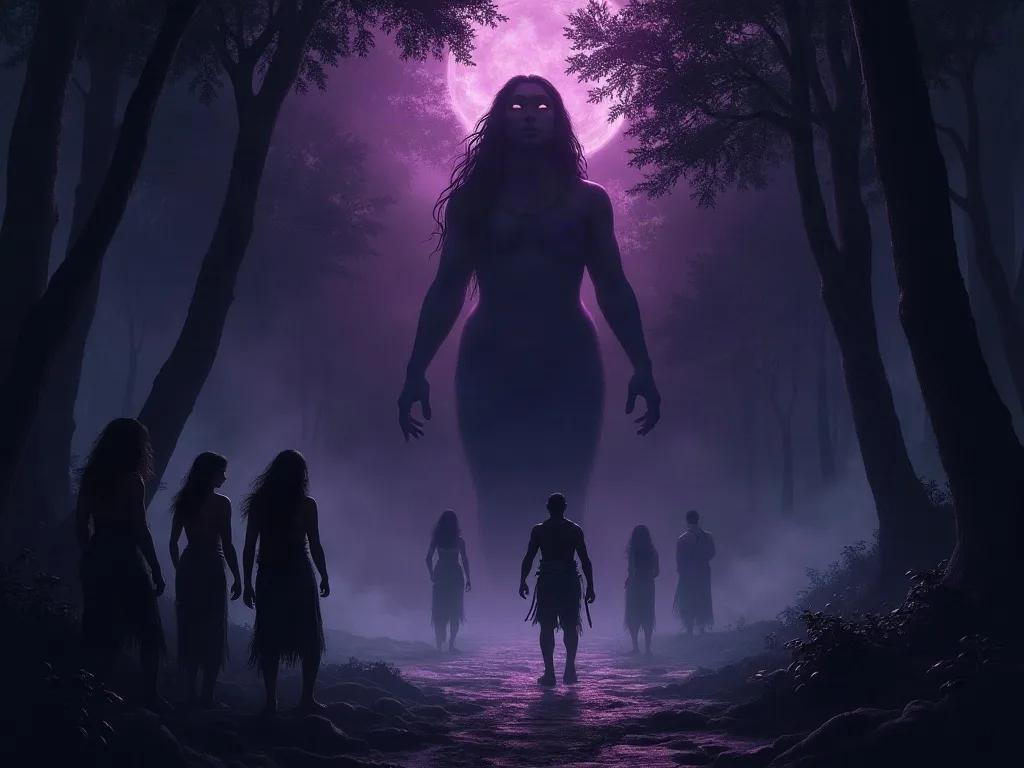
He strips naked and begins to enter Hine-nui-te-pō as she sleeps. His companions watch in silence from the trees. Inside her, in the place where flesh and darkness meet, he loses himself. He transforms into a weta (a large insect) but his companions, startled by a bird, cry out in alarm. The goddess wakes. She closes her thighs. Māui is crushed between her limbs, his power broken, his immortality forfeit.
He dies trapped inside the source of death itself. Some versions say his companions retrieved his body and buried him. Others claim he was consumed entirely, becoming one with the underworld.
Māui Across the Pacific: Regional Variations
The core story of Māui is remarkably consistent across Polynesian islands separated by centuries of ocean voyaging, yet regional traditions have woven their own colors into the tapestry. In Hawaii, he is Maui, and his exploits are recorded in the mo'olelo (Hawaiian stories) with particular emphasis on his role in raising the sky, in the Hawaiian version, Maui and his brothers literally pushed the sky upward from the land, which had been pressing down and suffocating creation.
In Māori tradition of Aotearoa, Māui (also spelled Maui) is the ancestor hero par excellence, the figure through whom human achievement enters the world. The Māori genealogies, the whakapapa, trace descent back to him, making him not merely a mythological figure but a genealogical ancestor. His exploits are recited in whare wānanga (Māori schools of learning) as proof that cunning and mana can overcome any obstacle.
In Tonga and Samoa, Māui appears in slightly different guises. The Samoan versions sometimes emphasize his role as a culture-hero who brings useful skills and knowledge to humanity. The Tongan mo'ui preserve the core narrative but sometimes integrate Māui into a broader cosmological framework involving the creator god Tangora (Tangaroa) and other divine figures.
Across all these traditions, Māui is never heroic in the Greek sense, he is not noble, not self-sacrificing, not driven by duty to community. He is heroic in a stranger way: by sheer force of will and magical knowledge, he makes the world larger and more livable for humans. He does this partly from pride, partly from hunger for recognition, partly from genuine mischief. He is entirely himself.
Māui and the Trickster Archetype
Scholars of mythology have long recognized that Māui belongs to a family of trickster figures that spans cultures: Anansi of West African folklore, Coyote in Native American traditions, Hermes and Prometheus in Greek mythology, Loki among the Norse, Susanoo in Japanese Shinto. Each operates by wit rather than strength, by rule-breaking rather than obedience, by a willingness to endure punishment or failure in pursuit of a goal.
What distinguishes Māui is his trickery in the service of concrete transformation. He does not trick merely to prove his cleverness or to escape consequence. He tricks to reshape the cosmos itself. When he catches the sun, he is not trying to humiliate it; he is solving a genuine problem that affects every person who must work by daylight. When he fishes up islands, he is not stealing from the gods out of malice; he is expanding the habitable world.
This makes him more than a trickster. He is a transformer, a liminal figure who stands between the divine and the human, the possible and the impossible, the natural and the shaped. In anthropological terms, he is a culture-hero: the mythological figure who brings to humanity the tools, knowledge, and territory that make civilization possible.
His failures and deaths are equally important. By dying in pursuit of immortality, Māui proves that there are limits, even to divine will. The boundary that separates gods from humans is not arbitrary; it is woven into the fabric of creation. His death is an acceptance of this boundary, and in that acceptance, he becomes fully real: not a distant god, but an ancestor whose blood flows in living veins.
Māui in Oral Tradition and Cultural Practice
Before these stories were written down (which happened only after European contact, through the work of Māori scholars, Hawaiian kupuna, and Polynesian historians), Māui lived in living memory. The stories were chanted as karakia (Māori incantations) and mele (Hawaiian chants), performed at hui (gatherings), taught to children as instruction in courage and wit, invoked when ancestors' names were recited in genealogy.
The structure of these oral tellings differed from written narrative. A skilled tohunga kōrero (Māori storyteller) would not recite a linear sequence but rather emphasize particular episodes, vary the details according to the audience and occasion, link Māui's adventures to local geography and local ancestry. A Māori from Ngāti Tūwharetoa might emphasize the fishing of Tongariro or other peaks; a Hawaiian from Hawaiki would center the story on specific islands and their relationship to Maui.
This flexibility is not a weakness of oral tradition; it is its strength. The same story serves multiple purposes: entertainment, instruction in values and survival, genealogical anchor, spiritual invocation. Māui is not frozen in a text; he lives in the voice and memory of the person telling his story.
In contemporary Polynesian communities, Māui continues to serve this role. The stories are taught in schools. They appear in literature, drama, and visual art. In 2016, the Disney film "Moana" brought Māui to a global audience, depicting him as a confident, humorous demi-god with a magical fishhook. That interpretation sparked both enthusiasm and critique within Polynesian communities: enthusiasm for the visibility and celebration, critique of the simplification and Western re-shaping of a figure who deserves more complexity.
The Fishhook of Māui: Symbol and Archaeology
The fishhook itself, known as the fishhook of Māui or Māui's fishhook, has become a symbol of Polynesian identity and pride. The shape, often rendered as a stylized hook with a curved bend, appears in tattoos (moko in Māori tradition, kakau in Hawaiian), jewelry, and contemporary Pacific art. It represents not just the mythological exploit but the values associated with it: resourcefulness, connection to the ocean and navigation, the ability to shape one's destiny.
Archaeologists studying Polynesian settlement and wayfinding have noted that the oral traditions preserved in Māui's stories contain genuine information. The migrations across the Pacific, the discovery and settlement of islands, the use of canoes, the relationship with the ocean, all of these appear embedded in mythological form. Some scholars suggest that Māui himself, as a mythological figure, may preserve a memory of real ancestral wayfinders, though this remains speculative.
The fishing expeditions, in particular, may encode historical knowledge about navigation and island discovery. Polynesian wayfinding involved reading stars, ocean swells, bird behavior, and other subtle signs to find islands across open water. The image of Māui fishing islands up from the deep, using supernatural knowledge to locate what others cannot see, may be a mythological rendering of this extraordinary skill.
Māui's Death and the Boundaries of Power
Māui's attempt to conquer death stands apart from his other exploits. It is not cunning that matters here; it is desire itself that proves his undoing. He wants what cannot be wanted: an end to mortality, the erasure of the boundary that separates the divine from the human, the temporary from the eternal.
This desire is not despicable. It arises from genuine compassion, he wishes to free his people from death, and from his own refusal to accept limitation. But it overreaches. The moment his companions cry out in alarm, the moment they betray his purpose (whether through fear or accident), he loses. The goddess wakes. The boundary reasserts itself with absolute finality.
In Polynesian theology, this boundary is not punishment but natural law. Death is part of the structure of creation, as necessary as the sun, as fundamental as the ocean. Māui can slow the sun and fish up islands because those acts work within creation's logic. He can steal fire because fire, though sacred, is not forbidden to those with enough mana to claim it. But he cannot step outside creation itself.
His death is thus not tragedy but wisdom: the recognition that some things should not be changed, that mortality is not a curse to be lifted but a reality to be honored. It is the moment when the trickster, the transformer, the boundary-walker finally respects the boundaries themselves.
Māui in Modern Literature and Film
Contemporary writers and filmmakers have been drawn to Māui because his story speaks to something deeper than adventure. It speaks to the human desire to reshape the world, to prove oneself against impossible odds, to leave a mark on creation itself.
The 2016 Disney film "Moana" integrated Māui into a romantic narrative focused on a young Polynesian wayfinder and her struggle to restore a lost island. The film's Maui is funny, boastful, and cowardly before his courage awakens. This interpretation, while departing from traditional tellings, captures something essential: Māui's humor, his confidence, his ability to transform himself.
Polynesian authors such as Wendy Pfeffer have written their own literary treatments of Māui, centering Polynesian perspectives and drawing on deep knowledge of the oral traditions. These works tend to emphasize the complexity of Māui, his failures alongside his triumphs, his role as ancestor and teacher rather than merely entertainer.
In visual art, Māui appears in paintings, sculptures, and digital media across the Pacific. Artists use the figure to explore themes of identity, decolonization, and the reclamation of indigenous knowledge. The fishhook becomes not just a symbol but a declaration: the ocean belongs to us, the islands were won by our ancestors, the stories are ours to tell.
Māui and Hero-Mythology: Comparative Echoes
Māui's story, while uniquely Polynesian in context and detail, echoes patterns found in hero myths across the world. Like Heracles in Greek mythology, he performs seemingly impossible tasks. Like Loki among the Norse, he operates by cunning and rule-breaking. Like the Mesoamerican Quetzalcoatl, he is a figure of transformation who brings cultural benefits to humanity.
Yet Māui differs in crucial ways. He has no tragic flaw that leads to downfall, in the Greek manner. His failure is not a character defect but a fundamental truth: there are limits to what any being can achieve. He also lacks the savior narrative that dominates many hero myths. He does not sacrifice himself for humanity (as Christ does) or die to atone for a curse (as many tragic heroes do). He simply overreaches, is crushed, and dies. The world continues. Humans live with the benefits of his exploits: longer days, more islands, fire stolen from the gods.
This acceptance of limitation within the context of transformation may be the deepest teaching of the Māui cycle. The hero is not an exception to the natural order but a force within it, subject to the same laws that bind all living things. His power lies not in transcendence but in courage, in the willingness to act despite knowing the risks.
Frequently Asked Questions About Māui
Frequently asked questions
Was Māui a real historical person?
Māui is a mythological figure, not a documented historical individual, but the stories may preserve genuine memories of Polynesian wayfinders and the skills that allowed them to settle the Pacific. The core narrative appears across the islands in remarkably similar form, suggesting it is ancient, pre-dating the written record by centuries. Some scholars argue that Māui represents the collective memory of ancestral navigators; others see him as purely mythological. The historical versus mythological question matters less than what the stories teach: they encode knowledge about courage, resourcefulness, navigation, and the relationship between humans and the ocean.
Why does Māui die trying to defeat death?
In Polynesian cosmology, death is a natural part of creation, not a curse to be lifted. Hine-nui-te-pō, the goddess of death, is not evil; she is necessary. Māui's attempt to slay her represents a boundary that even divine power cannot cross. His failure teaches that acceptance of natural law is wiser than the endless pursuit of transcendence. It is a mature mythological statement: the hero's true wisdom lies in knowing when not to act.
How did Māui spread across the entire Pacific?
The wide distribution of Māui stories, from Hawaiki in the north to Aotearoa (New Zealand) in the south, to Samoa, Tonga, and Tahiti, reflects the settlement patterns of Polynesian wayfinders over roughly 1000 years. As canoe cultures migrated across vast ocean distances, they carried stories with them, adapting them to new islands and environments. The fact that the core Māui narrative persists across these far-flung islands suggests the story's age and importance to Polynesian identity.
What does the fishhook of Māui symbolize in modern Polynesia?
The fishhook has become a symbol of Polynesian pride, identity, and connection to the ocean and ancestral knowledge. It appears in tattoos, jewelry, art, and contemporary design as a declaration that Polynesian culture, wayfinding, and storytelling traditions are living, valuable, and worthy of celebration. The symbol bridges the mythological past and the present, anchoring contemporary Polynesian communities to their ancestors' achievements.
How does the Disney film compare to traditional tellings of Māui?
Disney's "Moana" adapts Māui significantly for a global audience, simplifying the mythology and centering a romantic narrative about a female wayfinder. The film captures Māui's humor and confidence but omits the darker themes: his failures, his overreach, his death. Many Polynesian viewers appreciated the visibility and celebration of Polynesian culture but noted that the adaptation flattens the complexity and moral ambiguity of the original stories. The film is best understood as inspired by Māui traditions rather than a faithful rendering of them.
The Living Legacy of Māui
The stories of Māui did not end when European colonizers arrived in the Pacific. They did not disappear when missionaries preached against "pagan" beliefs or when colonial authorities worked to suppress indigenous languages and practices. Instead, they persisted in the memories of tohunga kōrero, kupuna, and families who kept them alive through oral recitation, sometimes in secret, sometimes openly.
In the 20th and 21st centuries, as Polynesian communities reclaimed cultural autonomy and indigenous knowledge systems gained recognition in academic and public spheres, Māui's stories returned to prominence. They are taught in schools, published in books and comics, performed in theater and dance, invoked in contemporary Pacific literature and art.
What makes Māui enduring is that he speaks to fundamental human questions: Can I reshape my world? Can I prove myself despite my origins? What limits should I accept? These are not ancient questions; they are eternally present. And Māui, with his wit, his courage, his failures, and his refusal to be diminished, offers a mythological answer that remains vital: transform what you can, accept what you cannot, and leave your mark on creation itself.
Read the full book
Want the whole story?
The complete edition is an instant PDF download here, with a paperback on Amazon for selected titles.
Polynesian
The Polynesian Mythology Book: Maui, Pele, Tangaroa, and the Sacred Stories of the Navigator Cultures
From Hawaii to New Zealand: The Gods Who Shaped the Pacific
The trickster Maui who fished up islands, Pele's volcanic fury, Tangaroa's ocean realm, and the separation of sky and earth. The mythology that sailed 10 million square miles of Pacific.
More from Polynesian
All articles
Polynesian
Tangaroa: God of the Sea and Ocean Depths
Tangaroa rules the ocean across Polynesia, commanding fish, tides, and the boundary between human and divine realms. Discover how this primordial god shaped creation and why fishermen still honor him today.
Polynesian
Pele: Hawaiian Goddess of Volcanoes and Fire
Pele is the fierce Hawaiian goddess who creates and destroys islands through volcanic fire. Learn how this shape-shifting deity shaped Hawaiian cosmology, sacred landscape, and cultural identity from ancient times to today.

Polynesian
Tāne: God of Forests, Birds, and Creation in Polynesian Mythology
Tāne stands among Polynesia's most vital deities, separating sky from earth and populating the world with forests, birds, and human life. Discover how this divine carpenter shaped creation itself in Māori, Hawaiian, and Tahitian traditions.
Polynesian
Hina: The Moon Goddess Across Polynesian Cultures
Hina appears across the Pacific as the moon's keeper and shaper of tides. From Hawaii to Tahiti to Samoa, she embodies cycles, creation, and the feminine sacred. Discover why this goddess matters to modern Polynesian identity.