
Hina: The Moon Goddess Across Polynesian Cultures
Hina appears across the Pacific as the moon's keeper and shaper of tides. From Hawaii to Tahiti to Samoa, she embodies cycles, creation, and the feminine sacred. Discover why this goddess matters to modern Polynesian identity.
Contents
The moon has a keeper in Polynesian cultures. Her name is Hina, and she appears everywhere across the Pacific: in Hawaiian chants, Tahitian rituals, Samoan genealogies, Maori legends. In some places she weaves the tides. In others she births the first people. She is often the mother of heroes, the guardian of the night, the one who shapes time itself.
Unlike the sun gods who blaze across many Pacific traditions with martial energy, Hina moves quietly through the mythologies. Yet her presence is constant. When Polynesians looked up at the moon's changing face, they saw her hand at work. When they read the tides that fed their survival, they understood Hina's cycles. She was less a distant deity demanding sacrifice than a companion in the rhythm of life.
What makes Hina remarkable is not one unified story but a family of stories. The same goddess appears across thousands of miles of ocean, yet each island culture shaped her tale to fit its own landscape, its own values. To understand Hina is to see how Polynesian peoples shared a spiritual language across the vast Pacific while keeping it alive in their own local speech.
The Name and the First Stories
The name Hina (or variants like Ina, Hine, He'e in different languages) appears in every major Polynesian culture. Linguists trace it back to a common Proto-Polynesian root, a word so old it predates the great voyages that scattered Polynesian peoples across the Pacific perhaps 3,500 years ago. This shared root tells us something important: the idea of Hina traveled with the canoes. She was already sacred to the ancestral Polynesians before they split into Hawaiian, Samoan, Tahitian, Maori, and dozens of other peoples.
In the earliest traditions recorded by scholars, Hina appears as a goddess tied to the moon's visible cycles. The moon waxes and wanes, grows full and shrinks to nothing. In Polynesian thought, this wasn't random. Hina was doing the work. Sometimes the stories say she shapes the moon itself. Sometimes they say she rides inside it. In a few places, she is the moon.
The Hawaiians called her Hina, keeper of the night. The Samoans knew her as Ina, often paired with the moon-god Marama in their creation tales. The Tahitians remembered Hina as the mother who birthed Polynesian civilization itself. In New Zealand, the Maori knew her as Hine, the first woman, the female principle of creation.
These are not identical goddesses. Yet the connections run deep. She is never purely one thing; she shifts and multiplies like the moon itself.
Hina in Hawaiian Tradition
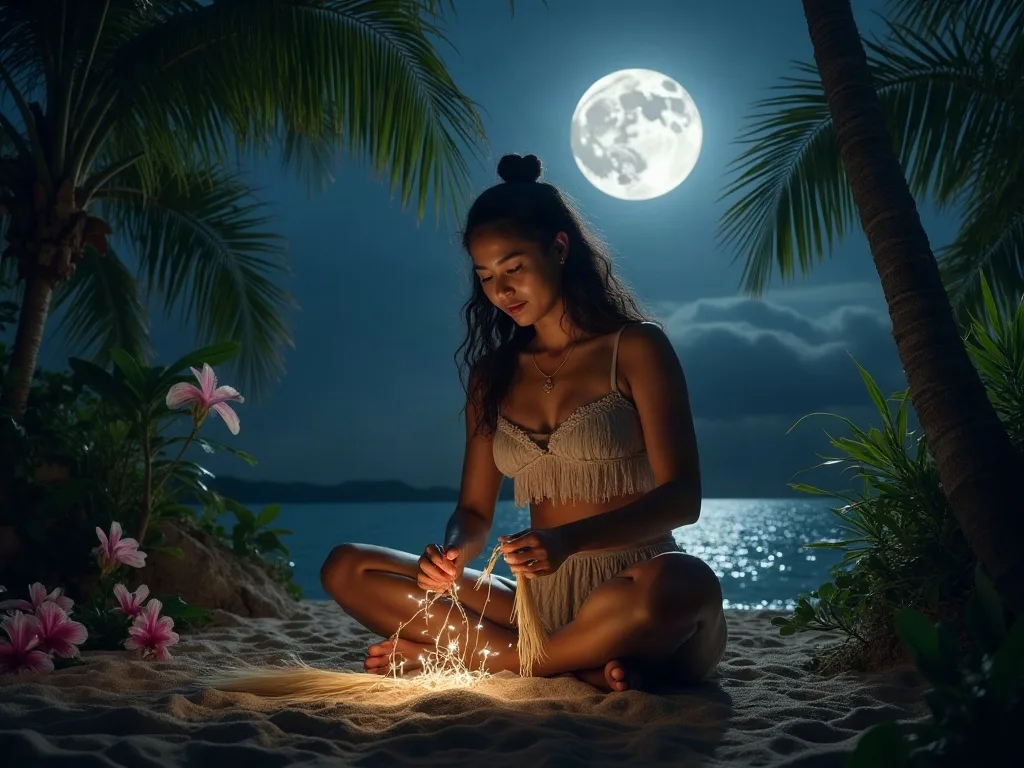
In Hawaii, Hina holds several roles at once. She appears as an ancestress, a goddess of the moon, a keeper of sacred time, and a mother of heroes. The most common image shows her as the woman who tends the moon and watches over the night ocean.
One Hawaiian chant describes Hina dwelling in the moon itself, weaving kapa cloth (the bark cloth used for clothing and ritual). In this version, the moon's surface markings are the pattern of her weaving. She sits there working eternally, creating the designs that make cloth sacred. Scholars who collected these chants in the 1800s found Hawaiians pointing at the full moon and naming it "Hina's cloth" or "Hina's work."
This image carries deep meaning. Kapa cloth in Hawaii was not mere material. The ritual of making it, beating the bark, bleaching it, marking it with dyes, was spiritual work. Women held the knowledge. Hina's eternal weaving suggested that women's labor, women's art, women's hands shaped something as essential and visible as the night sky itself.
In other Hawaiian accounts, Hina becomes a mother figure. She births or adopts important figures in the genealogies (whakapapa). Some versions name her as the mother of Maui, the trickster demigod who fished up islands and slowed the sun. In these stories, Hina is the calm parent of a chaotic son, the one who knows secrets and helps him survive his escapades.
There is also a darker Hawaiian version. In some traditions, Hina is a woman of the deep sea, dwelling in an underwater cave. She becomes a refuge for those fleeing danger. A man might dive down and find her; she would hide him, offer him safety, even take him as a lover. In these tales, Hina bridges the human world and the ocean world, acting as guardian of boundaries.
Hina in Tahitian and Cook Islands Lore
When Europeans first reached Tahiti and the Cook Islands, the chief explorers and missionaries wrote down local stories. In these records, Hina emerges as the supreme mother, the first woman, sometimes even the creator of all things.
The Tahitians told explorers that Hina was born from the union of the sky and the earth. She became the ancestress of all Polynesian peoples. In some versions, she shaped the islands themselves. Other stories say she married a chief and gave birth to the line of kings. Everywhere, her children were heroes and chiefs, carriers of divine blood.
One Tahitian myth tells how Hina came down from the heavens and fell in love with a mortal man. She bore him children, then returned to the sky, leaving her family behind. In this story, she represents the divine feminine that touches the mortal world and then withdraws, leaving mortals forever yearning upward.
The Cook Islands tradition calls her Ina and weaves her into the creation stories more tightly. She partners with male gods in bringing the world into being. Her role is often creative but also restraining, as if she represents the order and cycles that balance male divine energy.
What strikes scholars in these Pacific versions is how Hina is often more central than the male creator gods. She is not merely the goddess of the moon; she is the first woman, the mother of nations, the one whose children inherit kingdoms. In a way, to be Polynesian is to carry her blood.
The Trickster's Mother: Hina and Maui
One of the most widespread Polynesian myths links Hina to the demigod Maui, the trickster who performs impossible feats. In versions from Hawaii, Tahiti, New Zealand, and Samoa, Maui has a mother or grandmother named Hina (or a close variant).
The connection varies by place. In some stories, Hina is Maui's actual mother. In others, she is an older relative, a divine woman who knows magic. What remains constant is that Hina helps Maui or gives him tools or knowledge that allows him to achieve his tricks.
One famous tale: Maui wants to slow the sun so that days grow longer and people have more time to work. He goes to consult Hina. She tells him secrets, gives him advice, or even provides magical weapons. With her guidance, Maui catches the sun in a snare and forces it to move more slowly across the sky. It is Hina's wisdom that makes Maui's impossible act possible.
In another cycle, Maui wants to fish up islands from the sea. Again, he visits Hina or receives her help. She teaches him the right words, the right timing, or gives him a magical hook. When he casts his line into the ocean and hauls up land, it is because Hina has made him ready.
These stories suggest something important about the Polynesian view of male heroism. The trickster, the male hero, achieves great things. But he does not act alone. Behind him stands Hina, the woman who knows the sacred knowledge, who understands the deep cycles, who makes his audacity possible. In a way, it is Hina's power that Maui channels.
Hina as Moon, Tide, and Time
The most consistent thread running through Hina myths is her connection to the moon, the ocean's tides, and the cycles that govern time itself. These are not separate; in Polynesian thinking, they are linked.
The moon controls the tides. The tides control when fish migrate, when sailing is safe, when certain plants ripen. To live on islands in the Pacific is to live by these cycles. A Polynesian navigator or fisherman could not survive without intimate knowledge of when the moon waxes and wanes, when high tides come, when the sea grows calm or rough.
In this context, Hina is not a whimsical or distant goddess. She is intimate knowledge made divine. To honor Hina is to honor the cycles that keep you alive.
Some Hawaiian sources describe Hina as the one who compresses the moon, making it rise and set on its proper schedule. Others say she guards the moon's passage across the sky, ensuring it follows the right path. In Samoa, Ina dances with the moon in some versions, their movements together creating the tides.
There are also stories where Hina is imprisoned or trapped in the moon against her will. In a few Polynesian versions, a male figure (sometimes a god, sometimes a man) abducts her or traps her in the lunar sphere. She spends eternity there, weaving or waiting or mourning. In these darker tales, the moon's waning is Hina's sadness, her monthly fading a cycle of grief and then renewal.
The Maori variation is instructive. In Maori cosmology, Hine (the female principle) and Marama (the moon) are sometimes paired as lovers or complementary forces. Hine is the night, the dark, the inward journey. Marama is the light, the revelation, the outward gaze. Their dance creates the rhythm of time itself.
Hina and the Creation of Humans
One family of myths credits Hina with the actual creation of human beings. In these versions, she is not merely a secondary goddess but the fundamental creative force.
In some Tahitian and Tuamotuan accounts, Hina molded the first people from clay or brought them forth from the earth. She gave them form and breath. Sometimes a male god (Tangaroa, the sea god, or another creator figure) provides the broader cosmological framework, but it is Hina who actually shapes humans, who breathes them into being.
Other versions describe how Hina taught humans the crafts necessary for survival. She showed them how to make cloth from bark (kapa), how to fish, how to navigate, how to mark sacred time. In these stories, she is the giver of culture as much as nature.
There is also a line of stories in which Hina bears children who become the ancestors of specific Polynesian peoples. Her genealogy is the genealogy of islands and nations. To trace your own lineage back far enough is to find Hina at the root of your family tree.
This differs markedly from many Indo-European or Near Eastern traditions where male creator gods dominate. In much of Polynesian mythology, the female principle is generative in a way that demands respect and gratitude.
Regional Variations: Hawaii, Samoa, New Zealand, and Beyond
While the name and basic concept of Hina spread across Polynesia, each culture developed its own emphasis and interpretation.
Hawaii: Hina is primarily the moon keeper and the mother of heroes. She is associated with sacred crafts, particularly kapa cloth. Hawaiian genealogies sometimes begin with Hina, and she appears in chants as both ancestor and divine guardian.
Samoa: The Samoan Ina is often less prominent as a solo goddess but appears in creation stories and genealogies. She is sometimes paired with other deities and, in some accounts, becomes a human woman or acquires human form. The Samoan fa'a Samoa (the Samoan way) preserves stories of Ina as a figure of power and knowledge, though her cult and stories were less elaborated than in Hawaii or Tahiti.
Tahiti and the Tuamotus: Hina reaches her fullest expression as a creator goddess and supreme ancestress in Tahitian traditions. Early European accounts describe her as one of the most important deities in the Tahitian pantheon, with dedicated shrines and regular propitiation.
New Zealand (Aotearoa): The Maori Hine becomes more abstract, often representing the female or night principle in a dualistic cosmological system. She appears in many genealogies but is less narratively developed than in other Polynesian cultures. However, specific figures named Hine (such as Hine-nui-te-po, the goddess of the underworld) become central to Maori mythology.
Easter Island: The Rapa Nui people, isolated on their distant island, preserved stories of a goddess figure associated with the moon and fertility, though Rapa Nui's mythology was heavily disrupted by European contact and the slave trade of the 1860s.
Marquesas: In these islands, Hina appears in genealogies and is associated with childbirth and female power, though her stories are less elaborately recorded than in Hawaii or Tahiti.
This geographic variation shows something essential about how mythology works. A shared cultural root (the ancestral Polynesians) gives rise to the same goddess's name and basic character. But each culture, adapting to its own island, its own social structures, its own spiritual needs, developed Hina in its own direction. She is one goddess and many goddesses at once.
Hina in Myth and Ritual Practice
Hina was not merely a figure in stories told around fires. She had ritual significance. Polynesians performed ceremonies tied to her cycles, made offerings to her, and invoked her in contexts of need.
Women especially invoked Hina when they were engaged in craft work, particularly the making of kapa cloth. The ritual process of beating bark into cloth was sacred work that required spiritual attention. A woman working on kapa might chant to Hina, asking for her presence, her guidance, her blessing on the work. In this way, every finished piece of cloth carried not only the woman's labor but also Hina's spiritual presence.
Fishermen also honored Hina, especially at certain lunar phases. The full moon is a time when certain fish come close to shore or become more active. By honoring Hina as the keeper of the moon, a fisherman was honoring the cycles that governed his livelihood.
In some island cultures, women of high status (chiefesses, priestesses) were associated with Hina or claimed direct descent from her. Their mana (spiritual power) was understood as Hina's mana flowing through them. Their authority was, in a sense, Hina's authority made visible in the human world.
Birth and fertility rites also invoked Hina. When a woman was pregnant or giving birth, prayers or chants might call on Hina to ensure a safe delivery. The connection between Hina and the cycles of the moon linked her to menstruation, pregnancy, and the lunar phases that governed fertility in Polynesian understanding.
None of this ritual practice survived European contact intact. Colonial conversion to Christianity, the suppression of indigenous religions, and the disruption of traditional knowledge transmission meant that by the 20th century, most Polynesian islands had abandoned or deeply modified these practices. Yet in the last 50 years, there has been a renaissance of interest in pre-contact Polynesian spirituality, and some practitioners have attempted to reconstruct or re-imagine ritual honoring to Hina.
Scholarly Debates and Questions
Scholars have asked several important questions about Hina that remain unresolved or contested.
Is Hina one goddess or many? Some researchers argue that the spread of the name Hina across Polynesia represents a single shared myth tradition that fractured into regional variants. Others suggest that the name became a pan-Polynesian identifier for a role (the moon goddess, the ancestress) that existed in different forms in different places before the name unified them in retrospect. The truth likely involves both processes.
How much did European contact and Christian conversion reshape Hina's stories? The accounts we have of Hina come mostly from the 1800s and early 1900s, recorded by missionaries, explorers, and later anthropologists. These sources had biases. They sometimes simplified or Christianized what they heard. They spoke to individuals who may not have been the keepers of the deepest traditions. Scholars now work carefully to distinguish between what we can say with confidence about pre-contact Hina and what was recorded or altered after European arrival.
What was Hina's actual role in pre-contact Polynesian religious practice? We know she was important, but how central was she to ritual and worship compared to other gods? Were there Polynesian islands or regions where she was less prominent? The surviving records are incomplete, especially for areas where indigenous traditions were suppressed earliest.
How do modern Polynesians relate to Hina? Since the 1960s, there has been a cultural revival across the Pacific. Indigenous scholars and spiritual practitioners have worked to reclaim and reimagine Polynesian mythology. Some invoke Hina as a symbol of female power and indigenous identity. Others incorporate her into contemporary spiritual practice. This modern relationship to Hina is itself part of her mythology now, part of how she lives on.
Hina in the Modern Pacific
In the last 60 years, Hina has experienced a quiet but significant renaissance in Polynesian consciousness. She appears in contemporary Hawaiian and Maori literature, in indigenous women's writings, in spiritual practice, and in artistic work.
Contemporary Hawaiian writer Ku'u Kahakalau has written about Hina as a symbol of female sovereignty and knowledge-keeping. Maori author Patricia Grace has woven Hine into complex modern narratives that ask what it means to carry ancient power in a colonial world. Samoan poet Albert Wendt has referenced Ina in works exploring the layers of Pacific identity.
In Hawaii specifically, the kapa cloth tradition (once nearly extinct) has been revived by practitioners. Some who work with kapa today frame their work explicitly as honoring Hina, continuing the sacred craft she is said to work eternally. The cloth becomes, again, not just an object but a spiritual practice.
Dance companies across Polynesia have choreographed works inspired by Hina myths. Teuila Suit's hula and contemporary Pacific dance draw on traditional stories but reimagine them for modern audiences. The movement itself becomes a form of transmission, a way of keeping Hina alive.
In academia, scholars like Valeska Grisbach, Paul Lyons, and others working in Pacific Studies have elevated Hina and other Polynesian female figures as essential to understanding how Pacific cultures worked and how they continue to evolve. This scholarly attention feeds back into communities, offering validated frameworks for reclaiming and reinterpreting the goddess.
There is also a growing body of work by Polynesian feminists who claim Hina as a figure of female power and resistance. In a colonial context where Polynesian women have been marginalized and exoticized, Hina becomes a symbol of an indigenous female authority that predates colonialism and that can anchor contemporary struggles.
Frequently asked questions about Hina, the Polynesian moon goddess
Frequently asked questions
Is Hina the same goddess in all Polynesian cultures?
Yes and no. The name and basic concept of Hina are shared across most Polynesian cultures, suggesting she was known to ancestral Polynesians before the great voyages scattered them across the Pacific. However, each island culture developed her stories and roles to fit their own context. Hawaiian Hina emphasizes moon-keeping and heroic motherhood. Tahitian Hina becomes a supreme creator and ancestress. Maori Hine becomes more abstract, a principle of the feminine. They are variations on a shared theme, not identical figures.
Did Polynesians actually worship Hina in pre-contact times?
Yes, though the evidence is stronger for some regions than others. Hawaiian, Tahitian, and Samoan sources describe rituals, offerings, and invocations to Hina. Women particularly honored her during craft work and childbirth. However, because most of our records come from the 1800s and early 1900s (after European contact), scholars must work carefully to separate what we can confirm about pre-contact practice from what was reshaped or lost. The broad outline is clear: Hina was sacred. The precise details of how she was worshipped vary by place and remain partly lost.
Why is Hina associated with the moon?
The moon's cycles govern the ocean's tides, which governed fishing, sailing, and plant growth. For island peoples, the moon was not a distant object but a partner in survival. Polynesians understood the moon as a living force with agency and personality. Hina, as the keeper or embodiment of the moon, represents that agency. She is the intelligence behind the cycles that keep people alive. Some traditions say she literally shapes the moon; others say she dwells within it. Either way, she is the link between the sky and human life.
What is the connection between Hina and Maui?
In versions found across Hawaii, Tahiti, New Zealand, and Samoa, Hina is connected to the demigod Maui as his mother, grandmother, or magical mentor. She provides him with knowledge, tools, or guidance that enables his trickster feats, such as slowing the sun or fishing up islands. The relationship suggests that in Polynesian mythology, male heroes achieve greatness not through individual strength alone but through wisdom and support from the feminine divine.
How is Hina remembered in modern Polynesia?
Since the 1960s, Polynesian scholars, artists, and spiritual practitioners have reclaimed Hina as a symbol of indigenous female power, ancestral connection, and cultural survival. She appears in contemporary Hawaiian and Maori literature, in revival of traditional kapa cloth-making (explicitly linked to Hina's weaving), in dance and performance, and in indigenous women's writing. For many Polynesians, Hina represents a pre-colonial source of female authority that offers resources for understanding identity and resistance in a post-colonial world.
Why Hina Endures
Hina has survived across centuries of disruption, colonialism, forced conversion, and cultural suppression. She lives in written myths, in genealogies, in the night sky, and increasingly in the conscious reclamation of Pacific peoples who see in her a figure of continuity and power.
Part of her endurance is practical. The moon is still there. The tides still follow its pull. A Polynesian living today, looking at the full moon, can know that her ancestors saw the same face in the sky and heard the same stories about Hina's hand in its making. The goddess never left the sky; she only left human speech and ritual for a time.
Part of her endurance is also that she is mutable. She can be a creator and a helper, a weaver and a warrior's mother, a moon keeper and an ancestress, a human woman and a divine being. Across regional variants and across centuries, Hina has bent to fit what different peoples needed her to be. That flexibility, that refusal to be pinned down to one role or one story, keeps her alive in ways that more rigid mythologies sometimes struggle to remain.
Most importantly, Hina matters because she represents something that was true before colonialism: Polynesian cultures understood the feminine divine as central, active, creative, and worthy of honor. She is not a subordinate figure serving male gods. She is the mother, the teacher, the keeper of essential knowledge. To remember Hina is to remember that another way of thinking about the sacred has existed, exists, and can be carried forward.
Read the full book
Want the whole story?
The complete edition is an instant PDF download here, with a paperback on Amazon for selected titles.
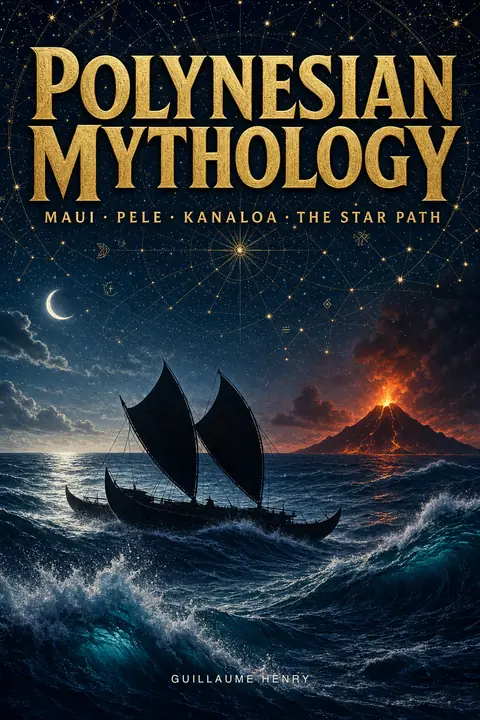
Polynesian
The Polynesian Mythology Book: Maui, Pele, Tangaroa, and the Sacred Stories of the Navigator Cultures
From Hawaii to New Zealand: The Gods Who Shaped the Pacific
The trickster Maui who fished up islands, Pele's volcanic fury, Tangaroa's ocean realm, and the separation of sky and earth. The mythology that sailed 10 million square miles of Pacific.
More from Polynesian
All articles
Polynesian
Tangaroa: God of the Sea and Ocean Depths
Tangaroa rules the ocean across Polynesia, commanding fish, tides, and the boundary between human and divine realms. Discover how this primordial god shaped creation and why fishermen still honor him today.

Polynesian
Māui: The Trickster Hero Who Fished Up Islands
The demi-god Māui outwits gods and giants to reshape the Pacific. Discover how this Polynesian trickster hero slowed the sun, pulled islands from the sea, and became the ancestor of human achievement across the islands.
Polynesian
Pele: Hawaiian Goddess of Volcanoes and Fire
Pele is the fierce Hawaiian goddess who creates and destroys islands through volcanic fire. Learn how this shape-shifting deity shaped Hawaiian cosmology, sacred landscape, and cultural identity from ancient times to today.

Polynesian
Tāne: God of Forests, Birds, and Creation in Polynesian Mythology
Tāne stands among Polynesia's most vital deities, separating sky from earth and populating the world with forests, birds, and human life. Discover how this divine carpenter shaped creation itself in Māori, Hawaiian, and Tahitian traditions.