
Makemake: Creator God of Rapa Nui (Easter Island)
Makemake shaped humanity from clay, ruled the sky above Easter Island, and inspired the island's strangest ritual. Learn how the creator god of Rapa Nui still speaks through stone and ceremony.
Contents
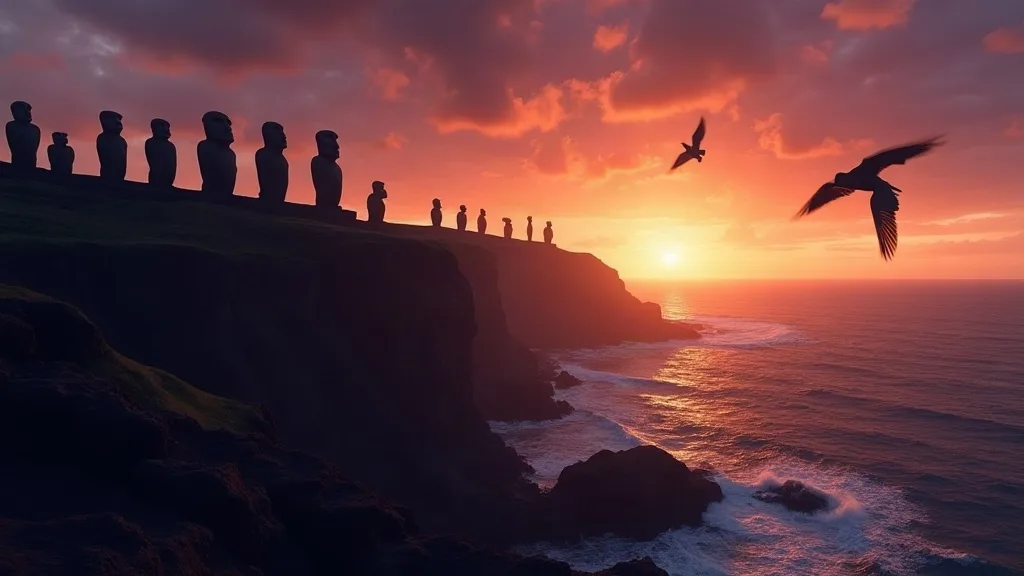
The island sits alone. Three thousand kilometres from the nearest inhabited land, Rapa Nui rises from the South Pacific as a triangle of volcanic rock. The people who settled there, perhaps around 800 CE, brought their gods with them across open water. One god, above all others, became the axis of their spiritual life. His name was Makemake: creator god of Rapa Nui (Easter Island), and his presence saturated everything, from the colossal stone figures on the hillsides to the eggshell races that determined who would rule for a year.
He made the first humans. He placed the birds on the island. He spoke through the sea and the wind and the volcanic crater. Makemake was not a distant, abstract deity but an immediate, demanding presence whose will played out in flesh and feather every spring on the cliffs of Orongo.
How Makemake Stands Apart in Polynesian Religion
Polynesian mythology stretches across a vast triangle from Hawaii in the north to Aotearoa (New Zealand) in the southwest and Rapa Nui in the southeast. Across that entire region, gods share family resemblances. Tane, the god of forests and birds in Maori and Hawaiian tradition, shaped the first human from clay. Tangaroa ruled the sea in many island traditions. Maui fished up islands with a magic hook.
Makemake belongs to this world, yet he stands apart from it. He is not named in the great mythological cycles of Hawaii or Tahiti. He appears to have developed in near-total isolation, on an island so remote that Rapa Nui culture evolved along its own lines for perhaps a thousand years before European contact in 1722. That isolation made his mythology distinctive: compressed, immediate, shaped by the specific geography of one small volcanic island.
Where Tane and Tangaroa have elaborate genealogies linking them to primordial sky and sea parents, Makemake's origin is simply not recorded in surviving sources. He appears in the oral tradition already fully formed, already supreme. Scholars including Alfred Métraux, who conducted fieldwork on Rapa Nui in 1934 and published his findings in Ethnology of Easter Island (1940), note that by the time systematic recording of Rapa Nui religion began in the late nineteenth century, much of the mythological detail had already been lost, partly because Christian missionaries arrived in force in the 1860s and actively suppressed the old religion.
What survived is fragmentary but striking. And what it shows is a creator god unlike any other in Polynesia.
The Creation of Humanity: Clay, Breath, and a Gourd
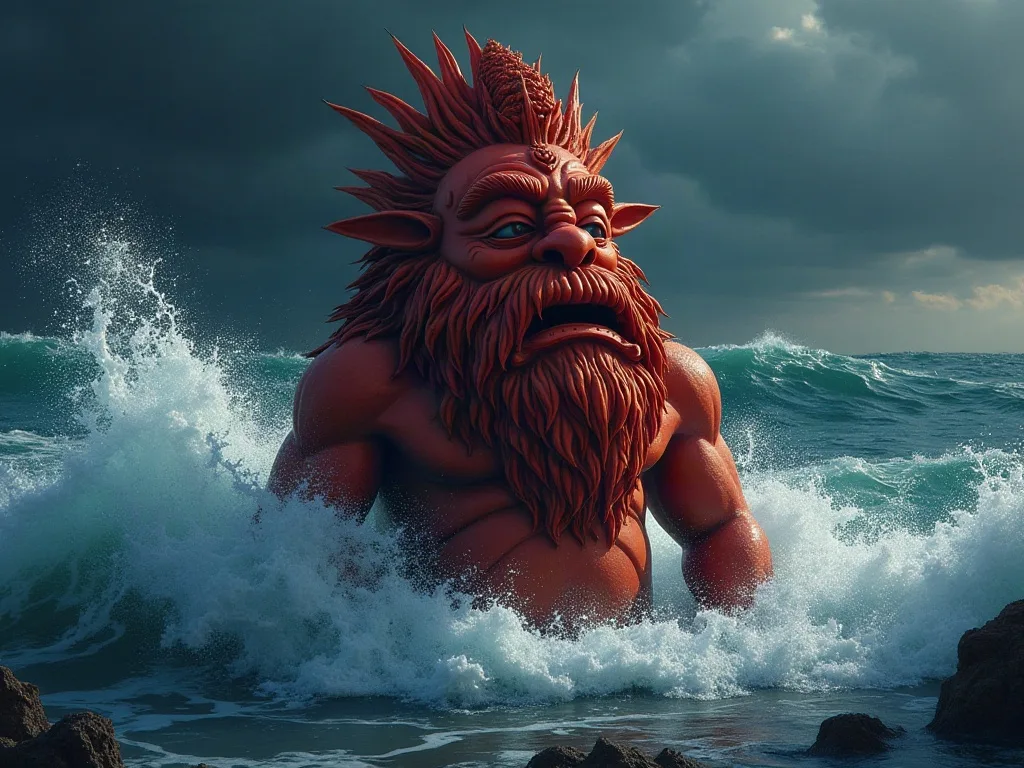
The Rapa Nui oral tradition, as recorded by missionaries and later by ethnographers, credits Makemake with creating the first human beings. He shaped them from red clay, the volcanic earth that colours parts of the island. This image, of a deity forming people by hand from soil, appears across world mythology, but on Rapa Nui it connects directly to the land itself: the red scoria stone used to carve the pukao, the topknots placed on the great moai statues, comes from the same geological family as that red clay. The creator and his creation were made of the same island.
In some accounts, Makemake first tried to create humans in a pool of water, then in a gourd, before succeeding with clay. This sequence of failed attempts before a final success is a recurring structure in Polynesian creation stories. The Maori tradition describes Tane carefully crafting the first woman, Hineahuone, from the soil of Kurawaka. The Rapa Nui version follows a similar logic: creation is an act of effort and refinement, not an effortless command.
After shaping the first people, Makemake breathed life into them. The breath of the creator entering the body of the first human is one of the most persistent images in world religion, appearing in the Hebrew ruach (the breath of God in Genesis), the Egyptian ka (the life-force breathed into creation), and here, in the wind-scoured isolation of the Pacific. Myths often converge on the same profound images across cultures that never contacted each other, because those images capture something true about the feeling of being alive.
Makemake and the Birds: The God Who Gave Rapa Nui Its Wings
If clay represents Makemake's terrestrial power, birds represent his celestial one. He is consistently described in tradition as the lord of seabirds, the deity who brought birds to the island and who continued to govern their movements and nesting cycles.
This matters enormously in context. Rapa Nui's land fauna was always sparse. The island had no native land mammals apart from the Polynesian rat (kiore), introduced by the first settlers. Seabirds, by contrast, were abundant: migratory species nested on the island and on the small islets just offshore, particularly on the three rocky islets called Motu Nui, Motu Iti, and Motu Kao Kao, which lie about a kilometre and a half from the main island's southwestern tip, below the ceremonial village of Orongo.
Makemake's special relationship with seabirds was not merely symbolic. Seabird eggs and flesh were a significant food source. The migratory arrival of the sooty tern (manutara in Rapa Nui) signalled a season of abundance. When the terns arrived each spring to nest on Motu Nui, it was understood as Makemake sending his gift. The timing of the birds' arrival became the heartbeat of the island's ceremonial calendar.
This is why, when Rapa Nui religion organised itself around a central annual ritual sometime after approximately 1400 CE (though the precise dating remains debated among archaeologists), that ritual was built around the first egg of the sooty tern, retrieved in Makemake's name.
The Birdman Cult: When a God's Will Became a Race
Of all the religious institutions of Rapa Nui, the tangata manu ritual, the Birdman competition, is the one that left the most vivid impression on the historical record. It is also the one that brings Makemake most dramatically into the human world.
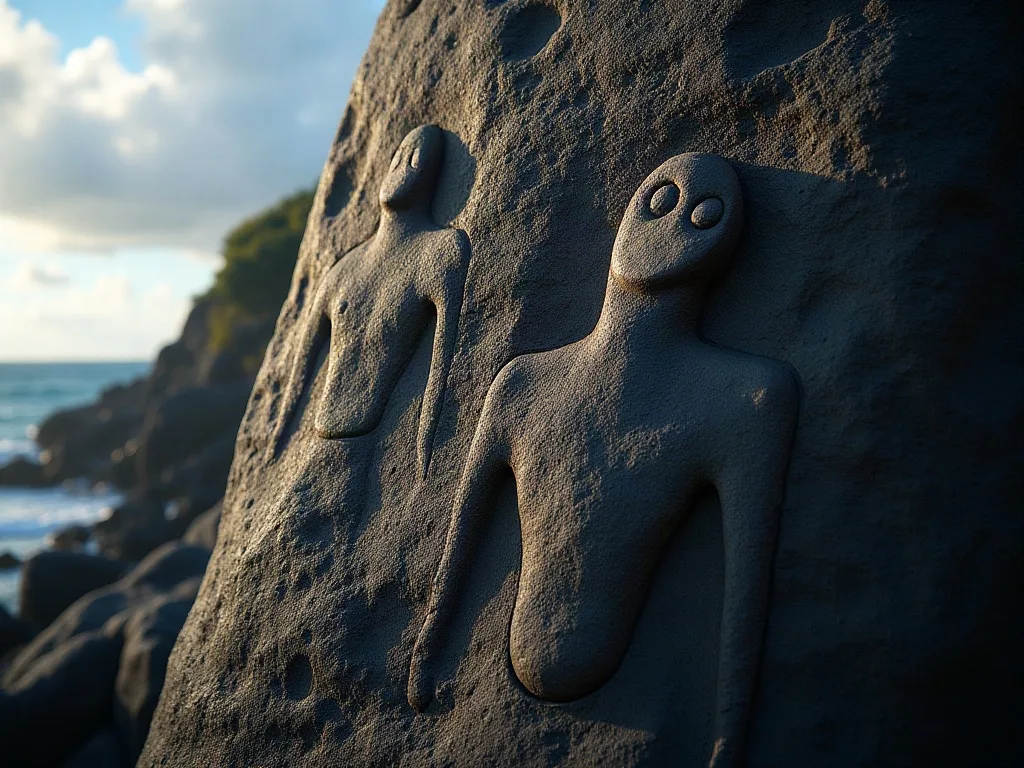
Each spring, representatives of the island's competing clans gathered at Orongo, a village of low stone houses perched on the rim of the Rano Kau volcanic crater, a dizzying drop above the sea. The stone houses, still standing today, face the three offshore islets. Inside those houses, and carved into almost every available rock surface at Orongo, are petroglyphs, images of a birdman: a crouching human figure with the head of a frigate bird or sooty tern, holding an egg. This figure represents the tangata manu, the chosen man who would carry the god's power for the coming year.
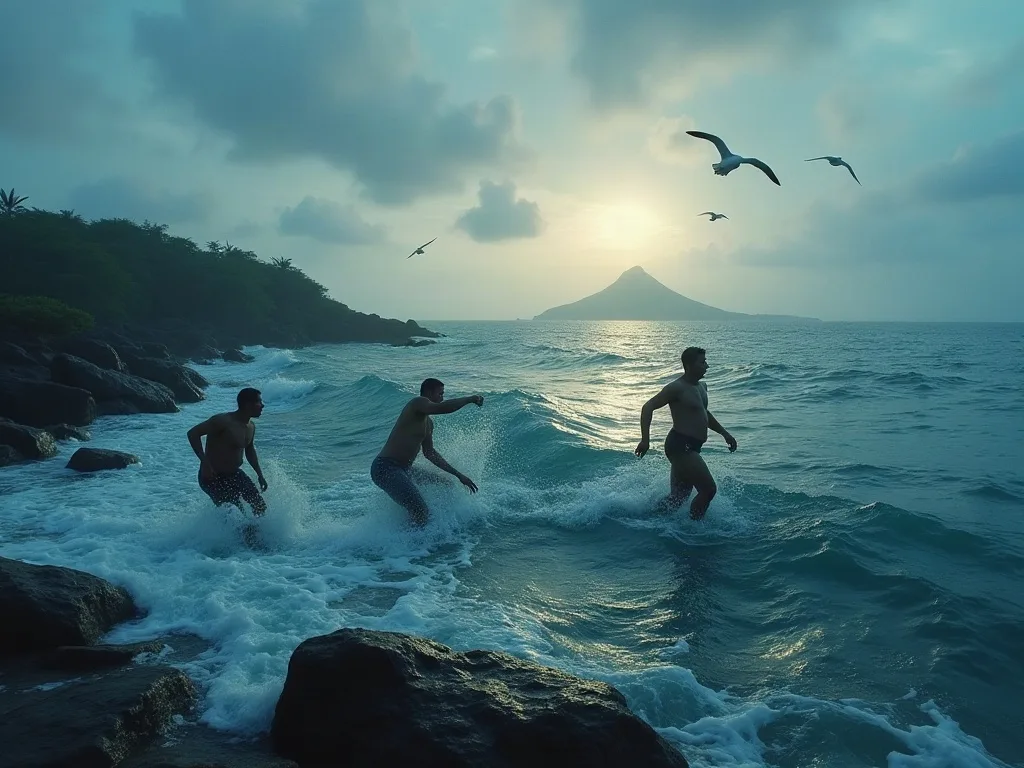
The ritual worked like this. Each chief or high-ranking man sponsored a swimmer-servant called a hopu. When word came that the sooty terns had arrived on Motu Nui, the hopu competitors climbed down the 300-metre cliff face at Orongo and swam out through shark-frequented waters to the islet. They waited, sometimes for weeks. The first hopu to find an intact tern egg, strap it to his forehead in a woven headband, and swim back to the mainland without breaking it, won the competition for his patron.
The winning patron was then declared tangata manu, the Birdman, the human representative of Makemake on earth for one year. He withdrew into a period of ritual seclusion, his nails and hair left to grow, his body painted and marked. He held the first egg of the god's own bird. He was, for that year, the earthly mouth through which Makemake spoke.
Orongo and the Sacred Landscape of Rapa Nui
The ceremonial village of Orongo was not simply a place. It was a geography built around Makemake's dual nature: the volcano below, the ocean ahead, the sky above, the birds crossing between sea and rock.
Rano Kau, the crater on whose rim Orongo sits, contains a freshwater lake choked with floating reed mats, a strange and beautiful inland sea. The crater itself was considered sacred. Makemake, as supreme god, was associated with this vertical axis: the water below, the human village on the rim, the sky and seabirds above. Standing at Orongo, you feel the convergence physically. The crater drops behind you. The Pacific stretches ahead. The three islets sit in the water like an arrow pointing west.
The petroglyphs at Orongo number in the hundreds. Beyond the birdman figures, researchers have identified images associated with Makemake himself: a wide-eyed, ring-shaped face, sometimes described as a goggle-eyed being, carved repeatedly into the basalt. This image, called komari in some analyses and associated with the creator god in others, remains partially debated among scholars. Georgia Lee, who catalogued the Orongo petroglyphs in the 1990s, identified over 480 carved figures at the site, with the birdman motif appearing more than 150 times.
The moai, the towering stone figures that line Rapa Nui's coastal platforms (ahu), are not directly associated with Makemake in most surviving traditions. They represent deified ancestors, ariki (chiefs) whose mana, their spiritual power, continued to protect the living. But the worldview that made the moai possible, the idea that sacred power could be materialised in stone and directed toward human welfare, belongs to the same religious logic that placed Makemake at the centre of Rapa Nui life.
Makemake in the Rongorongo Texts: A Written Mystery
Rapa Nui produced one of the rarest things in Polynesian culture: a writing system. Rongorongo is a set of glyphs carved onto wooden tablets, discovered by European missionaries in the nineteenth century. Only about two dozen tablets survive today, held in museums across Europe, the United States, and Chile.
The tablets have never been fully deciphered. Scholars agree that rongorongo is not a simple picture-writing system but something more complex, possibly a mixed logographic and phonetic script. The name rongorongo itself means something like "chant" or "recitation," and most researchers believe the tablets recorded ritual texts, hymns, genealogies, and cosmological narratives.
Makemake's name has been tentatively identified in some rongorongo sequences. The American linguist Steven Fischer proposed in 1997 that one tablet, the so-called "Santiago Staff," contains a cosmogonic chant describing Makemake's creative acts, beginning with "all the birds copulated" as a founding creative act. Fischer's reading remains disputed. Scholars Jacques Guy and Paul Horley have proposed competing structural interpretations of the tablets' grammar and glyph-grouping logic that diverge sharply from Fischer's phonetic reading. Adding further weight to the sceptical camp, the Russian linguist Yuri Knorozov, who helped crack the Maya script and turned his attention to rongorongo before his death in 1999, concluded that the tablets are a memory-aid system rather than a fully generative script, which would make precise name-identification inherently ambiguous. The honest position is that rongorongo remains one of the great unsolved puzzles of ancient writing, and until a consensus decipherment emerges, claims about what specific tablets say must be held lightly.
What is certain is this: the people of Rapa Nui felt their sacred knowledge was important enough to encode in a permanent, portable form. Whatever the tablets contain, they were treated as precious objects, carried by priests and stored carefully. Makemake, as the supreme deity of the island, almost certainly figures in them. Reading his words directly remains, for now, beyond reach.
Makemake After European Contact: Suppression and Survival
The first European to record contact with Easter Island was the Dutch navigator Jacob Roggeveen, who arrived on Easter Sunday 1722 and gave the island its Western name. He found a population he estimated at several thousand, with the great moai still standing on their platforms, and a rich ceremonial life. Within a century and a half, that world had been catastrophically disrupted.
The causes were multiple. Deforestation, which had begun long before European contact, degraded the island's agricultural base. Peruvian slave raids in the 1860s took an estimated 1,500 people, including most of the island's educated priestly class, the very people who could read rongorongo and transmit the Makemake myths in their full form. Disease followed. By 1877, the Rapa Nui population had fallen to around 111 people, from a pre-contact peak that some estimates place between 3,000 and 15,000.
Catholic missionaries, led by Eugène Eyraud and later Bishop Florentin-Étienne Jaussen, conducted extensive conversion work from 1864 onward. Within a few years, essentially the entire surviving population had converted. The old religion, including active worship of Makemake, ceased as a living practice. The last tangata manu ritual is generally placed around 1867, the year Rapa Nui's last recorded Birdman competition took place.
Yet something survived. The petroglyphs at Orongo could not be erased. The oral traditions, fragmentary as they were, passed through the memories of a few families. Ethnographers like Alfred Métraux arrived in time to record those fragments. Later researchers, including the work of Rapa Nui's own cultural revival movements in the late twentieth century, have worked to reconstruct and honour the tradition.
The Mythology's Modern Echo: A God Named for a Dwarf Planet
In 2005, astronomers at the California Institute of Technology discovered a large trans-Neptunian object in the outer solar system. It sits beyond Pluto, in the Kuiper Belt. They named it Makemake, after the creator god of Rapa Nui.
The choice was deliberate and fitting. The dwarf planet Makemake (officially designated 136472 Makemake) is one of the largest known objects in the outer solar system. It is reddish in colour, distant, and cold. It was discovered close to Easter, which connected it poetically to Easter Island and thus to the god whose island bears that name in European usage.
This naming followed the tradition of naming solar system bodies after mythological figures. The recognition extended the reach of a Pacific island's creator deity across modern science and culture. For Rapa Nui's living community, now numbering several thousand people and actively reclaiming their cultural heritage, the naming of a dwarf planet for their supreme deity carries a weight beyond astronomy.
Frequently Asked Questions About Makemake and Rapa Nui Religion
Frequently asked questions
What exactly did Makemake create, according to Rapa Nui tradition?
Makemake is credited with creating the first human beings, shaping them from red clay after earlier attempts using water and a gourd. He also brought birds to the island, which held deep practical and ceremonial significance for the Rapa Nui people. As supreme deity, he was understood as the ultimate source of life on the island, including the annual return of the sooty terns whose eggs triggered the Birdman ritual.
What was the Birdman ritual, and how does it connect to Makemake?
The Birdman (tangata manu) ritual was an annual competition held at the ceremonial village of Orongo. Sponsored competitors swam out to the islet of Motu Nui and raced to retrieve the first egg of the sooty tern, a bird considered sacred to Makemake. The man whose swimmer won became the Birdman: Makemake's earthly representative for one year. The last recorded competition occurred around 1867. Hundreds of petroglyphs at Orongo depict the birdman figure, making it the most documented ritual in Rapa Nui archaeology.
Is Makemake related to other Polynesian gods like Tane or Tangaroa?
Makemake shares broad thematic ground with other Polynesian creator figures: he creates humans from clay, he governs birds, he represents divine sovereignty. But he does not appear in the genealogical networks that connect Tane, Tangaroa, and other major Polynesian deities. Rapa Nui's thousand-year isolation allowed its mythology to develop independently. Makemake appears to have no surviving myth describing his own origins, which itself distinguishes him from the elaborately genealogised gods of Hawaii, Tahiti, or Aotearoa.
What are the rongorongo tablets, and do they mention Makemake?
Rongorongo is an undeciphered writing system unique to Rapa Nui, carved onto around two dozen surviving wooden tablets now held in museums worldwide. Linguist Steven Fischer proposed in 1997 that one tablet, the Santiago Staff, contains a creation chant mentioning Makemake, but his reading is disputed by scholars including Jacques Guy, Paul Horley, and the late Yuri Knorozov, who argued the tablets function as a memory-aid system rather than a generative script. Until a verified decipherment is achieved, no firm claim can be made about which specific texts describe Makemake. The tablets are the only indigenous writing system documented in Polynesia.
Why is Makemake also the name of a dwarf planet?
In 2005, astronomers at Caltech discovered a large reddish dwarf planet in the Kuiper Belt beyond Pluto. They named it Makemake partly because the discovery was made close to Easter, connecting it to Easter Island, and partly to follow the convention of naming outer solar system bodies after mythological creator figures. The International Astronomical Union officially recognised the name. Makemake the dwarf planet is now classified as a plutoid and is one of the five recognised dwarf planets in the solar system.
What happened to the living religion of Makemake after European contact?
A combination of factors destroyed the active practice of Rapa Nui's traditional religion. Peruvian slave raids in the 1860s killed or deported most of the island's priestly class and knowledgeable elders. Introduced diseases reduced the population to around 111 people by 1877. Catholic missionary work from 1864 onward converted the entire surviving population within a few years. The last Birdman competition was held around 1867. Today, Rapa Nui's cultural revival movement works to reconstruct and transmit the tradition, drawing on ethnographic records, archaeology, and community oral memory.
Makemake's Unanswered Questions: What Scholarship Still Seeks
The story of Makemake is, in part, a story of what was lost. The slave raids of 1862-1863 took an estimated 1,500 people in a matter of months. Among them were the maori rongorongo, the learned men and women who could read the sacred tablets aloud and transmit the full body of myth. When they died in Peruvian mines and sugar plantations, they took the keys to the written tradition with them.
This gap creates genuine scholarly puzzles. We do not know the full narrative of Makemake's creative acts. We do not know whether he had a consort (some researchers have proposed a female deity named Haua as a possible counterpart, but the surviving evidence is thin, and any fuller treatment awaits the surfacing of additional sources). We do not know the complete liturgy of the Birdman ritual or the precise cosmology that structured Rapa Nui religious thought before contact.
What archaeology keeps uncovering adds new angles. Underwater surveys around Rapa Nui's coast have identified submerged features that suggest the island's shoreline was once different, and that some ceremonial sites may now lie beneath the sea. The ongoing study of ancient DNA from Rapa Nui skeletons has refined our understanding of when the island was settled and whether there was pre-European contact with South America, a question that touches on how isolated Rapa Nui culture really was. A 2020 study published in Nature found genetic evidence of contact between Polynesian peoples and Native South Americans around 1200 CE, predating European arrival. Whether that contact influenced Rapa Nui's religious traditions, including the mythology of Makemake, is an open question that molecular anthropology and oral-tradition research are only beginning to address together.
The petroglyphs at Orongo continue to erode under wind, salt, and the pressure of visitor traffic. Chilean authorities and the Rapa Nui community have worked to restrict access and document the carvings digitally. Those wide-eyed faces carved into basalt, Makemake's image staring out from volcanic rock above the Pacific, hold details that scholars are still recording before the stone itself decides what to keep.
Some myths end with resolution. The myth of Makemake ends with a question mark, and with the stubborn survival of stone.
Read the full book
Want the whole story?
The complete edition is an instant PDF download here, with a paperback on Amazon for selected titles.
Polynesian
The Polynesian Mythology Book: Maui, Pele, Tangaroa, and the Sacred Stories of the Navigator Cultures
From Hawaii to New Zealand: The Gods Who Shaped the Pacific
The trickster Maui who fished up islands, Pele's volcanic fury, Tangaroa's ocean realm, and the separation of sky and earth. The mythology that sailed 10 million square miles of Pacific.
More from Polynesian
All articles
Polynesian
Tangaroa: God of the Sea and Ocean Depths
Tangaroa rules the ocean across Polynesia, commanding fish, tides, and the boundary between human and divine realms. Discover how this primordial god shaped creation and why fishermen still honor him today.
Polynesian
Māui: The Trickster Hero Who Fished Up Islands
The demi-god Māui outwits gods and giants to reshape the Pacific. Discover how this Polynesian trickster hero slowed the sun, pulled islands from the sea, and became the ancestor of human achievement across the islands.
Polynesian
Pele: Hawaiian Goddess of Volcanoes and Fire
Pele is the fierce Hawaiian goddess who creates and destroys islands through volcanic fire. Learn how this shape-shifting deity shaped Hawaiian cosmology, sacred landscape, and cultural identity from ancient times to today.

Polynesian
Tāne: God of Forests, Birds, and Creation in Polynesian Mythology
Tāne stands among Polynesia's most vital deities, separating sky from earth and populating the world with forests, birds, and human life. Discover how this divine carpenter shaped creation itself in Māori, Hawaiian, and Tahitian traditions.