

Rata: The Voyager Hero and Tree-Felling Legend
Rata is one of Polynesia's greatest mythic heroes: a canoe-builder, ocean voyager, and avenger whose story spans from New Zealand to Tahiti. Learn what drives him, and why the forest fights back.
Contents
The tree falls in the night. By morning, it stands again, every cut branch reattached, every axe scar healed, as though no blade had ever touched the wood. This happens a second time. A third. When Rata finally hides in the fern to watch, the forest itself rebuilds what he destroyed: birds, insects, and spirits working together in the dark, weaving bark back onto living wood with a chant that shakes the canopy.
That scene, repeated across dozens of Polynesian island traditions from the Maori of Aotearoa New Zealand to the Ra'ivavae of the Austral Islands and the storytellers of Tahiti and the Cook Islands, is not merely about a stubborn hero and a magical forest. It is about permission, debt, and the sacred compact between human ambition and the natural world. Rata wanted a canoe. He needed it to cross impossible seas and avenge his father's death. But he had cut without asking, taken without thanking, built without ceremony. The forest noticed.
Rata: the voyager hero and tree-felling legend sits at the crossroads of ecology, ancestry, and oceanic adventure. No other Polynesian hero knots those threads quite the same way.
Rata's Place in the Polynesian Hero Tradition
Polynesian mythology organises its heroes on a clear axis: the ancestor who achieves something impossible on behalf of his people, almost always through a combination of supernatural parentage, human stubborness, and hard-won spiritual knowledge. Maui fishes islands from the sea, lassoes the sun to slow it down, and tries to steal immortality from the sleeping goddess Hine-nui-te-po. Rata operates on the same scale but with a different emotional register. Where Maui is a trickster who bends the rules with a grin, Rata is a young man burning with grief and duty. His story is not about cleverness; it is about learning the weight of responsibility.
Rata belongs to a long genealogical chain. In the Maori tradition recorded by scholars like Sir George Grey in his 1855 collection Nga Mahi a nga Tupuna (Maori Legends), Rata is the son of Wahieroa and the grandson of Tawhaki, the sky-climbing hero who ascends to the heavens on a vine. Genealogy in Polynesia is never mere family record: each name in the chain carries mana, a kind of sacred authority that accumulates through heroic deeds and correct ritual. Rata inherits a rich store of mana from Tawhaki, but also an unfinished debt: his father Wahieroa was killed, and the killers never faced justice.
That debt is the engine of the whole story. Everything Rata does, every impossible task he attempts, flows from a single obligation: bring the remains of his father home and avenge his death. The canoe he must build is not a project; it is a sacred vessel.
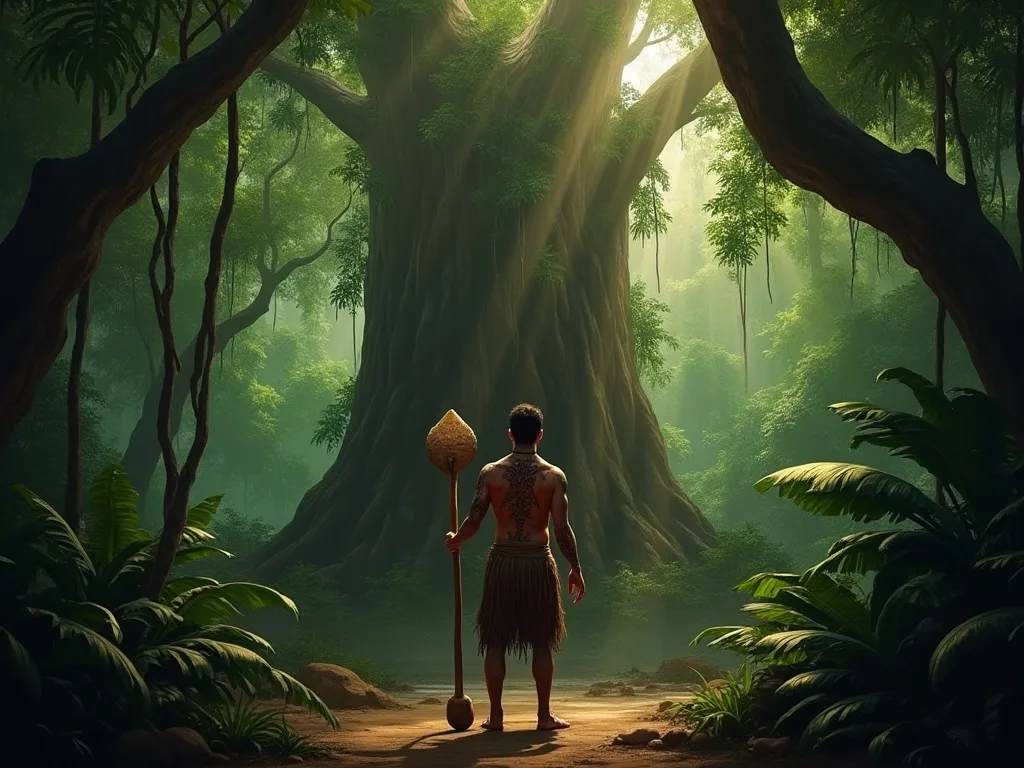
The Tree That Would Not Stay Felled
The sequence of events follows a pattern that scholars of comparative mythology call a "prohibition and transgression" cycle: a rule exists, the hero breaks it, the world corrects him, and only when he submits to the rule can he move forward.
In most versions of the myth, Rata enters the forest alone and finds an enormous totara tree (in the Maori telling) or a tamanu tree (in many Tahitian and Cook Island versions), ancient, towering, exactly the kind of heartwood a great ocean-going canoe demands. He raises his adze and cuts. He works all day, stripping branches, shaping the hull. Then he goes to sleep.
When he returns at dawn, the tree stands whole. Not a splinter on the ground.
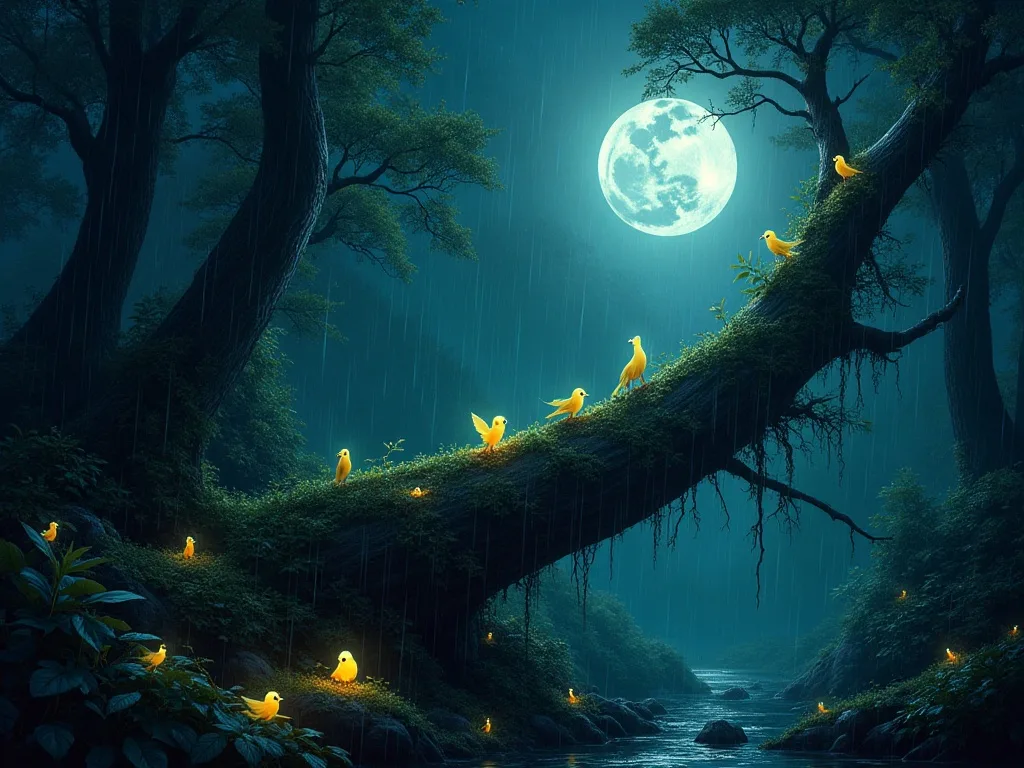
He cuts again. The same thing happens. On the third night, he waits and watches. The hakuturi, the forest spirits or wood-fairies depending on the tradition, emerge from the undergrowth. In the Maori version, they are tiny, bright, intensely organised: birds work alongside insects alongside supernatural beings, each assigned a part of the reconstruction. Their chant, preserved in Grey's collection, runs roughly as: "Fly together, chips and shavings, stick fast, stick fast! Let the deep wounds be healed." The tree rises.
Rata steps forward. He confronts the spirits. Their reply stops him cold. He did not ask the tree's permission. He performed no karakia, the ritual prayer that acknowledges the presiding spirit of the tree before cutting. He offered no recognition to Tane, the god of forests and birds who owns every great trunk in the bush. The wood was not his to take without negotiation.
Rata cuts without permission
- The tree regrows overnight
- The forest spirits rebuild it in silence
- Rata is trapped, progress impossible
- No canoe, no voyage, no justice for Wahieroa
Rata cuts with ceremony
- The forest cooperates openly
- The hakuturi finish the canoe in a single night
- Rata moves forward with mana intact
- The voyage becomes possible
What happens next is the mythological hinge. Rata listens. He acknowledges the transgression. In some Maori tellings, he performs the karakia then and there; in others, he simply accepts the spirits' rebuke. The response of the hakuturi is extraordinary: rather than punishing him further, they finish the canoe themselves. In a single night of collective labour, they shape a hull that would have taken a skilled craftsman months. The very forest that resisted his violation now pours its energy into helping him. The lesson is not just that ritual matters; it is that the natural world, when properly approached, is a collaborator rather than a resource.
The Ocean Voyage and the Monsters Below
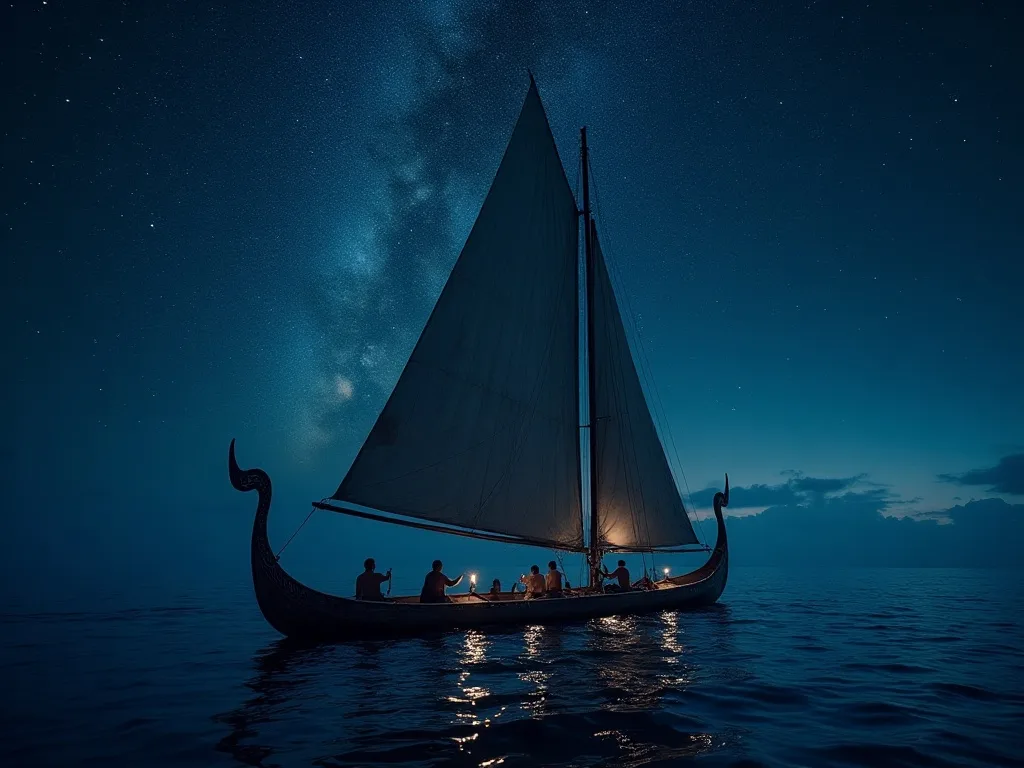
With the canoe complete and his crew assembled, Rata sets out on the voyage that is the second act of his myth. This is where the story shifts from forest legend to oceanic adventure, and where the Polynesian mastery of deep-water navigation becomes the backdrop.
The precise destination and the nature of the enemies varies by island tradition. In the fullest Maori versions, Rata must cross vast stretches of ocean to reach the land where his father's remains are held by the being called Matuku-tangotango, sometimes described as a giant heron-like demon who devours men. In some Cook Island and Tahitian versions, the enemies are sea monsters or powerful sorcerers on a distant island. The geography is always somewhere over the horizon, which in Polynesian terms means it is as real as any named island: the horizon is not the edge of the world, it is the beginning of the next one.
Rata's canoe, born from the forest compact, is supernaturally capable. In several versions, it cannot be wrecked by ordinary storms. The crew faces supernatural obstacles: whirlpools that drag ships down, a giant clam that swallows vessels whole, sea serpents coiling around the hull. Rata defeats each one through a combination of inherited mana, physical strength, and the guidance of ancestral spirits who speak through signs in the sea and sky.
The figure of Tangaroa, god of the ocean, looms over this section of the myth. The sea is Tangaroa's domain, and the voyage is possible only because the compact Rata struck with Tane (forest) has a mirror in the wider spiritual order: the hero who honours the natural world on land earns passage across the sea. Nothing in Polynesian mythology happens in isolation from the web of sacred relationships.
Avenging Wahieroa: The Myth's Violent Heart
The confrontation with Matuku-tangotango is the myth's sharpest moment. In the Maori version, the monster lives in a pit or cave and emerges only at intervals to feed. Rata discovers that Matuku-tangotango killed his father Wahieroa to eat him: not from war or ritual cause, but from appetite. That detail is significant. In Polynesian moral cosmology, being consumed without ceremony, without the proper acknowledgment of the dead, is a profound desecration. Wahieroa's remains must be retrieved so that proper funerary rites can restore his mana to the ancestral chain.
Rata does not trick the monster the way Maui might. He kills it directly, using a noose or trap set at the entrance to its cave, springing it the moment Matuku-tangotango emerges. The violence is swift, purposeful, almost ritual in its timing. Then Rata retrieves the bones of Wahieroa, wraps them with care, and begins the voyage home.
The return journey is rarely described in detail. Mythologically, that is correct: the story's energy lived in departure and confrontation. What matters is that Rata comes back, that the ancestral bones are restored, and that the debt is paid. The genealogical chain, broken by Wahieroa's death, is repaired.
How the Myth Changes Across Islands
One of the richest aspects of the Rata cycle is watching what each island group keeps, changes, or emphasises. These variants are not errors or degraded copies: they are deliberate local adaptations that reflect each community's relationship with its own forest, its own ocean, and its own ancestral history.
In the Maori version, the hakuturi are among the most vivid supernatural beings in the tradition. The emphasis on karakia and on Tane's authority reflects Maori cosmology's deep weaving of ecology and religion. The totara tree is specifically named because that species, slow-growing and hard-grained, provided the hull timber for the great waka hourua (double-hulled voyaging canoes).
In Ra'ivavae (Austral Islands), a version collected by ethnographer Donald Marshall in the mid-twentieth century features a character named Rata who must build his canoe to rescue his parents from a supernatural adversary, shifting the emotional core from father-revenge to parent-rescue. The forest magic remains, but the ocean voyage extends further and the supernatural opponents multiply.
In the Cook Islands version, sometimes called the Laka cycle (Laka being the Hawaiian cognate of Rata), the hero's identity sheds some Maori specificity but the structural bones are identical: transgression against the forest, correction by spirits, cooperative canoe-building, oceanic ordeal, and successful return. The Hawaiian Laka is also associated with hula, the sacred dance tradition, adding a dimension absent in the Maori telling, which suggests that Pacific communities layered their own cultural priorities onto a shared ancestor-narrative.
The comparative spread of these variants across thousands of kilometres of open ocean is itself a piece of evidence for the reality of Polynesian long-distance navigation. The same story does not travel that far without people carrying it deliberately, on voyaging canoes, between communities that stayed in contact across generations.
The Forest Compact: Ecology Encoded in Myth
Modern readers often notice something striking about the Rata myth that ancient Polynesians probably did not separate from the story's spiritual meaning: the tree-felling sequence is an extraordinarily precise account of sustainable forestry ethics.
The requirement to perform karakia before cutting a large tree was not symbolic in the decorative sense. It was a real obligation in pre-colonial Polynesian communities, enforced by the authority of priests and chiefs. Trees of a certain size and species were protected under the rahui, a system of temporary or permanent resource restriction that functioned like a conservation zone. Cutting a great totara or tamanu without the proper ritual was a breach of community law as much as a spiritual offence.
The myth encodes that law in the most memorable possible format: a story where breaking the rule causes visible, immediate, dramatic failure. The tree grows back. You cannot progress until you comply. No legal text, no chiefly decree, no priestly lecture is as sticky in the memory as a story where the forest literally defeats you.
Scholars like Anne Salmond, whose work on Maori thought and ecology appears in Tears of Rangi (2017), have argued that Maori relationships with the natural world were not merely "in tune with nature" in the romantic sense but were structured through specific, enforceable spiritual contracts. The Rata myth is one of the clearest expressions of that contractual logic. Tane Mahuta, the forest god, is not a passive presence: he has jurisdiction, and jurisdiction means enforcement.
Rata in Art, Carving, and Modern Pacific Identity
The image of Rata and his canoe appears throughout Maori visual culture. Whakairo, the art of Maori wood carving, often depicts ancestral heroes in panels on the walls of wharenui (meeting houses), and Rata features in genealogical carvings that connect communities to their voyaging past. The association with canoe-building makes him particularly resonant: the great voyaging canoe is one of the central symbols of Polynesian identity, representing not just transport but cosmological movement, the carrying of people and sacred knowledge across the moana (ocean).
In contemporary Pacific art and literature, the Rata cycle has proven particularly generative. New Zealand writers like Witi Ihimaera have drawn on the broader Maori hero tradition, and the canoe-as-vessel-of-identity motif runs through works like his novel The Whale Rider. Pacific visual artists working in the early twenty-first century have returned to the hakuturi sequence as a meditation on indigenous land rights, resource extraction, and the cost of taking without asking: themes that land with immediate political force in a region where colonial logging stripped many islands of their ancient forests.
The Polynesian Voyaging Society, which in 1976 sailed the traditional double-hulled canoe Hokule'a from Hawaii to Tahiti using only traditional navigation, explicitly connects its project to the mythic tradition of heroes like Rata and Maui. The voyage proved that the Pacific was not settled by accident but by skilled, intentional navigation, exactly the worldview the Rata myth presupposes.
Frequently asked questions about Rata the Polynesian hero
Frequently asked questions
Who are Rata's parents and why does his ancestry matter?
In the Maori tradition documented by Sir George Grey, Rata is the son of Wahieroa and the grandson of Tawhaki, the sky-climbing hero. In Polynesian mythology, genealogy is not background detail: each ancestor's deeds accumulate mana (sacred authority) that the descendant inherits and is obligated to honour. Rata's quest to avenge Wahieroa is an act of genealogical repair, restoring the chain of mana broken by his father's death.
What are the hakuturi and where do they come from?
The hakuturi are supernatural beings associated with the forest in Maori tradition, often described as tiny, intensely skilled wood-spirits or fairies. They act as agents of Tane, the god of forests and birds. Their role in the Rata myth is to enforce the law of karakia (ritual prayer before cutting) by rebuilding the tree Rata fells without permission. Once Rata acknowledges his transgression, they redirect their extraordinary skill toward completing his canoe overnight.
Is the Rata myth found only in Maori culture?
No. The Rata cycle appears across a wide arc of eastern Polynesia: the Society Islands, the Austral Islands (where Donald Marshall collected the Ra'ivavae version), the Cook Islands, and Mangareva. In Hawaii, the cognate figure is called Laka and carries some different associations, including links to hula. The shared structural core (the tree-felling prohibition, the canoe, the ocean voyage, the ancestral revenge) points to a common origin myth that dispersed with Polynesian migration across the Pacific.
What does the tree-rebuilding episode mean symbolically?
At the most immediate level, it encodes real Polynesian conservation practice: large trees required ritual permission before cutting, enforced through both spiritual belief and community law (the rahui system). At a deeper level, the episode maps a universal heroic lesson: ambition without reciprocity fails. The hero who takes from the natural world without acknowledgment cannot move forward. Only when Rata submits to the forest's terms does the forest become his ally.
What primary sources preserve the Rata myth?
The most accessible written source is Sir George Grey's 1855 collection Nga Mahi a nga Tupuna, which transcribed Maori oral traditions including the Rata cycle. John White's The Ancient History of the Maori (1887-1890) provides additional variants. For Tahitian and Cook Island versions, the work of Teuira Henry, particularly Ancient Tahiti (1928), is the key scholarly reference. Ra'ivavae versions appear in Donald Marshall's mid-twentieth century ethnographic fieldwork.
How does Rata compare to other Polynesian heroes like Maui?
Maui is a trickster: he achieves his goals through deception, shape-shifting, and rule-bending, and his failures (like his death while trying to steal immortality) are part of his character. Rata operates differently. He is a warrior and a builder, driven by grief and obligation rather than curiosity. Where Maui bends the cosmos for fun, Rata endures it with determination. The two figures represent complementary poles of the Polynesian heroic ideal: the inventive outsider and the dutiful heir.
Rata's Myth and the Ongoing Conversation About Ocean and Forest
The Rata cycle did not close when the last traditional voyaging canoe was hauled ashore. If anything, the twenty-first century has reopened it. The revival of traditional Polynesian navigation, the legal recognition of rivers and forests as persons with rights in Aotearoa New Zealand, the growing Pacific-led conversation about climate change and ocean sovereignty: all of these movements carry the structural logic of the Rata myth inside them.
The hakuturi enforced a principle: you do not take from the living world without entering into relationship with it. That principle was encoded in myth because myth is the most durable technology humans have invented for transmitting values across generations. Written laws change. Stories with the right bones outlast everything.
Rata cut the tree and the forest rebuilt it, not to punish him permanently, but to teach him. That is the detail that separates this myth from a simple cautionary tale. The forest was not his enemy. It was waiting for him to understand the terms. Once he did, it gave him everything he needed to cross the ocean, face the monster, and bring his father home.
The great canoe eventually sailed. The bones were retrieved. The genealogical chain held. And in the telling and retelling of that story, from island to island across thousands of years, the lesson sailed with it.
Read the full book
Want the whole story?
The complete edition is an instant PDF download here, with a paperback on Amazon for selected titles.
Polynesian
The Polynesian Mythology Book: Maui, Pele, Tangaroa, and the Sacred Stories of the Navigator Cultures
From Hawaii to New Zealand: The Gods Who Shaped the Pacific
The trickster Maui who fished up islands, Pele's volcanic fury, Tangaroa's ocean realm, and the separation of sky and earth. The mythology that sailed 10 million square miles of Pacific.
More from Polynesian
All articles
Polynesian
Tangaroa: God of the Sea and Ocean Depths
Tangaroa rules the ocean across Polynesia, commanding fish, tides, and the boundary between human and divine realms. Discover how this primordial god shaped creation and why fishermen still honor him today.

Polynesian
Māui: The Trickster Hero Who Fished Up Islands
The demi-god Māui outwits gods and giants to reshape the Pacific. Discover how this Polynesian trickster hero slowed the sun, pulled islands from the sea, and became the ancestor of human achievement across the islands.
Polynesian
Pele: Hawaiian Goddess of Volcanoes and Fire
Pele is the fierce Hawaiian goddess who creates and destroys islands through volcanic fire. Learn how this shape-shifting deity shaped Hawaiian cosmology, sacred landscape, and cultural identity from ancient times to today.

Polynesian
Tāne: God of Forests, Birds, and Creation in Polynesian Mythology
Tāne stands among Polynesia's most vital deities, separating sky from earth and populating the world with forests, birds, and human life. Discover how this divine carpenter shaped creation itself in Māori, Hawaiian, and Tahitian traditions.