
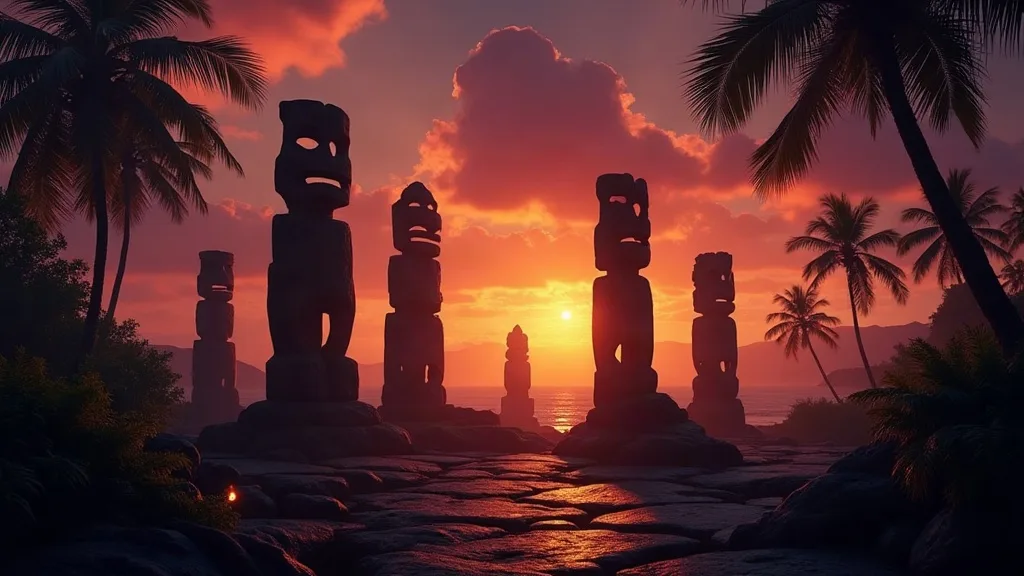
Tiki: The First Man and Carved Ancestor Figures
Tiki is both the first man of Polynesian myth and the carved wooden ancestors watching over the living. Learn who Tiki was, what the figures mean, and why they still matter.
Contents
The hands were enormous. That was always the first thing people noticed. Carved from hardwood or volcanic stone, the figure stared outward with wide, hollow eyes, arms pressed against a swollen belly, fingers spread wide as if holding something precious just out of sight. It stood at the entrance to a marae (a sacred ceremonial platform) in the warm Pacific air, and every person who passed it knew: this was not decoration. This was an ancestor.
Tiki: the first man and carved ancestor figures sits at the heart of Polynesian spiritual life, connecting the living to the dead, the human to the divine, and the present moment to the very beginning of the world. Few symbols in world mythology carry that much weight so quietly.
Across the vast Pacific, from Aotearoa (New Zealand) to the Marquesas Islands to Rapa Nui (Easter Island), the word tiki means something slightly different in each tradition, yet the core holds steady: a primal human figure, the first ancestor, the bridge between the gods and humanity. Understanding Tiki means understanding how Polynesian peoples thought about what it means to be human at all.
Who Tiki Was: The Myth of the First Human
The oldest recorded versions of the Tiki creation story come from Maori oral tradition, collected by scholars such as George Grey in the nineteenth century and by later ethnographers working directly with tohunga (priests and knowledge-keepers) in Aotearoa.
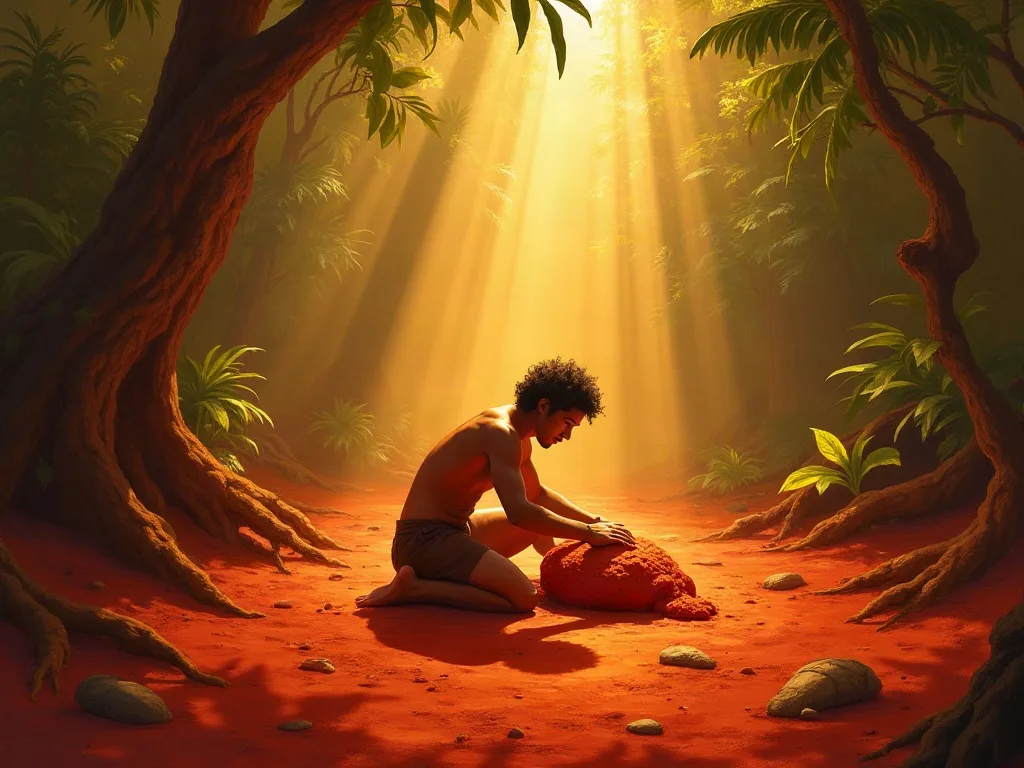
In the most widely told version, Tiki is not a god but the first product of divine craft. The great god Tane, who rules forests and birds and the breath of life, decides to create a companion for himself and for the world. He shapes a figure from red ochre earth, uku, kneeling on the ground to form it with his own hands. Then he breathes life into the nostrils. The figure sits up. It is human, and it is the first.
Some accounts name this first being Tiki-ahua, meaning "the image of Tiki" or "the likeness." Others simply call him Tiki. Either way, he is both the creature and the template: every human being who comes after carries his shape.
The Maori scholar Te Rangihiroa (Sir Peter Buck), in his monumental 1949 work "The Coming of the Maori," traces how this origin story ties directly to the physical carved figures. To carve a tiki is to re-enact the moment Tane pressed his hands into the earth. The figure is not a portrait of a specific ancestor so much as it is a re-embodiment of the primal act of creation.
In some eastern Polynesian traditions, including those of the Marquesas Islands, Tiki is more explicitly the first man rather than a divine creation. He simply appears at the beginning of time, emerging from the void, and takes a wife named Hina (the moon goddess, who appears in many forms across Polynesia). Their union produces human lineages. The Marquesan versions recorded by ethnographer E.S. Craighill Handy in the early twentieth century show Tiki as a culture hero: the one who taught humans to fish, to plant, to build shelter.
The Carved Figure: What a Tiki Actually Is
The word tiki in most Polynesian languages covers both the mythological first man and any anthropomorphic carved figure that channels ancestral power. These are not separate meanings. They are the same meaning held in two registers.
A carved tiki is, at its simplest, a human figure rendered in durable material, usually wood, stone, or bone, with an exaggerated head (often one-third to one-half of the total height), large eyes, a wide mouth with a protruding tongue, and hands placed prominently on the belly or thighs. The proportions are deliberate. The oversized head signals that this is a being of mana (sacred power), concentrated in the skull. The tongue, in Maori tradition, is a sign of defiance toward enemies and greeting toward allies. The hands on the belly can indicate fertility, protective power, or the gathering of vital energy.
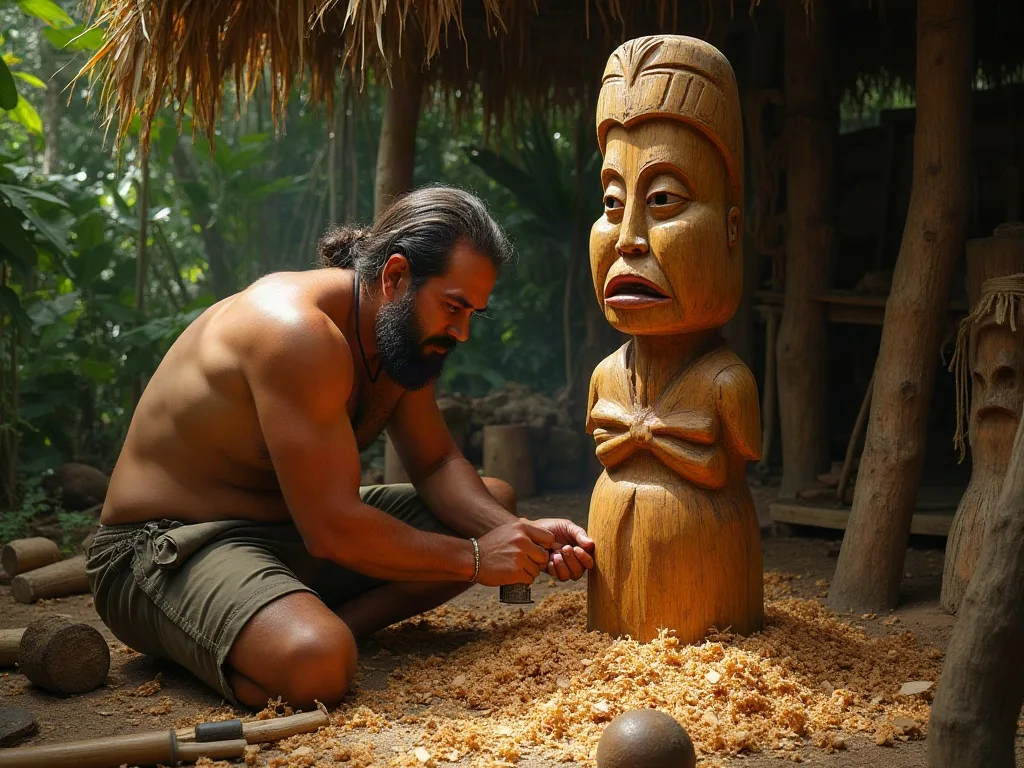
Carvers across Polynesia spent years, sometimes a lifetime, learning the sacred geometry of the tiki form. In the Marquesas, tiki statues carved from basalt or tuff could stand taller than three meters, guarding ritual platforms. In Aotearoa, the pou (carved posts) at the entrance to a wharenui (meeting house) depicted specific named ancestors, their genealogies encoded in the tattoo-like surface patterns called kowhaiwhai.
The carved ancestor figure is not a passive object. It is understood to hold wairua, the spirit or essence of the ancestor it represents. This makes it a living participant in the community, present at ceremonies, consulted before war or planting, and treated with protocols of respect: it is fed symbolically, addressed directly, and never casually stepped over.
Hei-Tiki: The Living Pendant
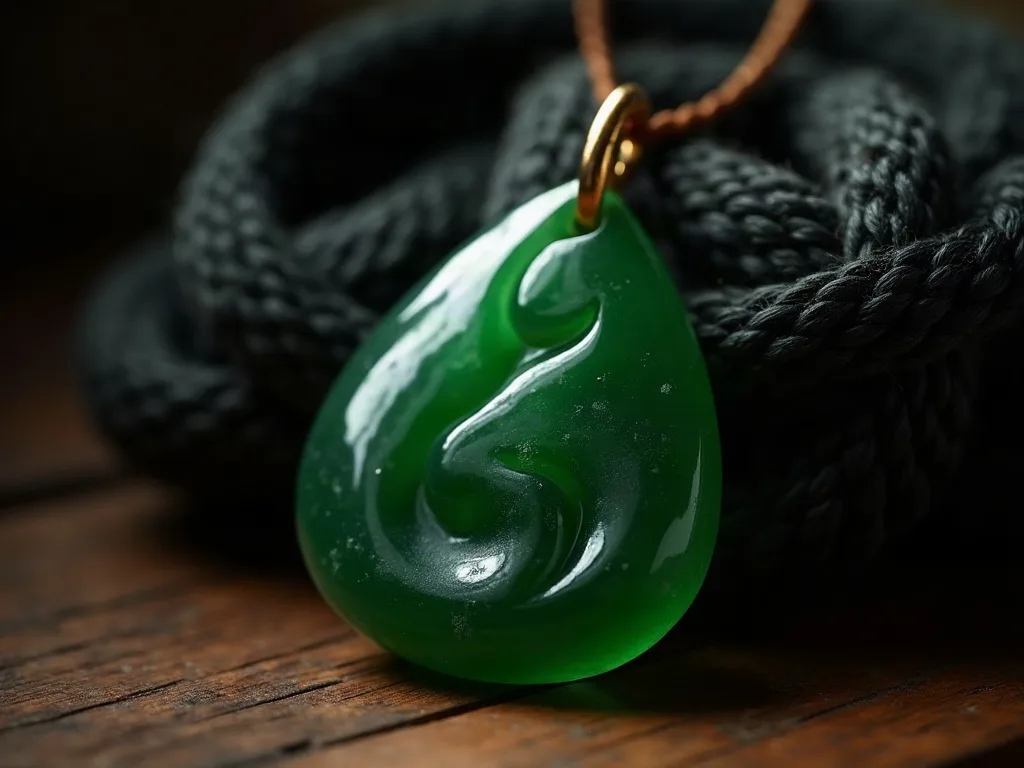
Of all the forms the tiki takes, the hei-tiki is the most intimate. A hei-tiki is a small pendant, typically carved from pounamu (greenstone or nephrite jade), worn around the neck directly against the skin. Its name means roughly "tiki worn as an ornament." It is the most recognizable Maori art form in the world outside Aotearoa, yet its meaning is frequently misread by outsiders.
A hei-tiki is not a good-luck charm in the tourist-shop sense. Each one is a repository of accumulated mana. As it passes from parent to child over generations, it absorbs the life force of each person who wore it. The oldest examples, some several centuries old, are treated as taonga (treasured heirlooms) of extraordinary power. Parting with one is a major act; receiving one is an honor.
The figure in a hei-tiki is typically shown tilting its head to one side, an posture that scholars including Adele Tutter have connected to representations of the unborn child in the womb. This links the pendant explicitly to fertility, safe birth, and the continuation of lineage. When a woman wore a hei-tiki through pregnancy, she was asking the accumulated ancestors inside the stone to protect the new life being formed.
Tiki Across the Pacific: Regional Variations
Polynesia covers an area larger than the continental landmass of North America, and the tiki concept shifted as Pacific voyagers settled new islands over roughly two thousand years of migration. Comparing the regional versions shows both how stable the core idea was and how each island group made it their own.
-
Aotearoa (New Zealand): Tiki is the first man created by Tane. Carved figures appear as pou inside meeting houses, as tekoteko (gable figures) on rooftops, and as hei-tiki pendants. The Maori carving tradition is among the most technically developed in Polynesia, with deep surface patterns encoding genealogical information.
-
Marquesas Islands: The term tiki refers directly to both the first man and to the large stone or wood figures placed on me'ae (sacred platforms). Marquesan tiki are among the most visually striking, with almond-shaped eyes, high brows, and a formal frontality. Some stand in groups, watching over the sacred precincts from different angles.
-
Hawaii: The word tiki is less central here; the Hawaiian equivalent of the carved ancestor figure is the ki'i (the same root word, shifted by linguistic drift). The massive ki'i pohaku (stone figures) of the Big Island's Pu'uhonua o Honaunau, a place of refuge, line the walls and communicate the presence of powerful royal ancestors.
-
Rapa Nui (Easter Island): The moai, those massive stone figures weighing up to 75 tons, represent a monumental extension of the same ancestral figure logic. The island's name for these statues connects to the concept of the living face of the ancestor, present and watching. The moai of Easter Island are perhaps the most extreme expression of the impulse that also produces the small hei-tiki pendant.
-
Samoa and Tonga: These western Polynesian traditions preserved a version of Tiki as a primordial ancestor, though the carved figure tradition is less pronounced here than in eastern Polynesia. The concept of sacred genealogy connecting humans to divine origins is equally strong.
The linguistic evidence supports the cultural connections. Linguist Andrew Pawley and others working in historical linguistics have traced tiki to the Proto-Polynesian root *tiki, meaning both "to make" and "human figure," suggesting the double meaning (creator and created, act and artifact) is very ancient.
Mana and the Sacred Power of Carving
You cannot understand the tiki figure without understanding mana. In Polynesian cosmology, mana is a kind of sacred potency or efficacy that flows from the gods through certain objects, places, and people. It is not abstract; it is as real as heat. High-ranking chiefs carry more of it. Certain stones hold it. A carved ancestor figure, properly made and properly consecrated, concentrates it.
This is why the carver's work is not simply craft. Across Polynesia, master carvers occupied a ritual role. In Maori tradition, the tohunga whakairo (expert carver) worked under tapu (ritual restriction), the same sacred prohibition system that governed priests and chiefs. Certain tools were set aside exclusively for carving figures. Chips of wood from an ancestor figure were never swept up carelessly; they were gathered and disposed of with ceremony, because they carried residual mana.
Maui, the trickster demigod who fished up islands and lassoed the sun, is associated in some traditions with the first acts of fashioning and shaping. His creative energy echoes in the work of carvers who follow after him. The tiki figure thus sits in a chain of making that runs from the gods through the first man through every carver who has ever picked up a chisel of obsidian or shark tooth.
The mana of a tiki figure does not reside solely in the image. It resides in the making process, in the genealogy of the wood or stone, in the prayers spoken over the work, and in the history of the people who have lived alongside it.
Tiki in Ritual Life: War, Fertility, and the Dead
Tiki figures performed specific ritual functions that varied by island group and by the occasion. Three contexts recur most persistently across the ethnographic record.
War and protection. Before a raid or a battle, a carved figure associated with a war god (like Tu, the Polynesian god of war) might be brought out, addressed, and asked for strength. Smaller personal tiki worn as pendants were believed to deflect spiritual harm. In the Marquesas, large tiki on the me'ae platform watched over the remains of sacrifices offered to secure divine favor before conflict.
Fertility and birth. The tiki's association with the first human being, with the original act of creation, made it a natural focus for prayers around conception, pregnancy, and birth. In Maori communities, a hei-tiki was sometimes placed near a woman in labor, and its accumulated ancestral power was understood as protective presence.
The dead and the ancestors. Funerary contexts across Polynesia often involved carved figures. Among the Maori, carved pou at burial sites marked the transition zone between the living and the dead. The figure did not mourn. It stood guard. It kept communication open between two worlds that Polynesian cosmology always understood as permeable and adjacent rather than sealed from each other.
Tiki and Western Misreading: A History of Symbols Stripped of Meaning
When American servicemen returned from the Pacific after World War Two, they brought back carved figures and a half-understood notion of "tiki culture." By the 1950s, tiki bars proliferated across California, complete with bamboo, rum drinks named after Polynesian gods, and mass-produced wooden figures that retained the visual vocabulary of the ancestor figure while stripping away everything the form actually meant.
This transformation was well-documented by scholars including Sven Kirpal in studies of mid-century American popular culture. The tiki became, in that context, a prop for fantasy Polynesia: warm, exotic, vaguely spiritual, fully domesticated. The irony is complete. A figure designed to concentrate sacred power and hold the presence of a named ancestor became a bar decoration with a cocktail in front of it.
Polynesian artists and scholars have been clear about the distinction. Maori carver and academic Rangi Matamua has written and spoken publicly about the difference between tiki as a living cultural category and tiki as commercial image. The figures sold in tourist shops in Hawaii or Fiji may look similar to a hei-tiki. They carry no mana, no genealogy, no wairua. They are, in the Polynesian framework, empty shells.
This does not mean every non-Polynesian encounter with the carved figure is disrespectful. It means context is everything. A museum display that names the ancestor, explains the community's history, and situates the object in its ritual function does something profoundly different from a tiki torch on a suburban patio.
Frequently Asked Questions About Tiki in Polynesian Mythology
Frequently asked questions
Is Tiki a god or a human in Polynesian myth?
Tiki sits in a category between the two. In most traditions, he is the first human being, shaped by a god (usually Tane in Maori myth) rather than born of divine parents. He is neither immortal nor a deity, but his origin from divine hands gives him a status above ordinary humans. Some Marquesan accounts treat him as a primordial being who simply appears at the start of time, making his status even more ambiguous. The ambiguity is deliberate: Tiki marks the threshold where the divine and the human meet.
What is the difference between a tiki figure and a moai?
Both are ancestral figure traditions rooted in the same Polynesian cosmological logic, but they developed independently on different islands. Tiki figures across most of Polynesia are smaller, made from wood or greenstone, and used in personal or community rituals. The moai of Rapa Nui (Easter Island) are monumental stone constructions, some standing over ten meters tall, commissioned by competing clans to represent deified royal ancestors. The moai concentrated mana on a massive civic scale; a hei-tiki concentrated it on an intimate personal scale. Same impulse, radically different expression.
What does the hei-tiki pendant actually mean when worn?
A hei-tiki is a Maori pendant carved from pounamu (greenstone) that carries the accumulated mana of every ancestor who wore it. It connects the wearer to their genealogical line and to Tiki, the first human. It is not a good-luck charm. It is a living heirloom, treated with protocols of respect. Wearing one means carrying responsibility to the lineage it represents. The oldest hei-tiki pieces are classified as taonga (treasured objects of deep cultural significance) and may not be sold without the community's consent.
Where does the word 'tiki' come from linguistically?
Historical linguists trace 'tiki' to the Proto-Polynesian root *tiki, which carried the double meaning of "to make or create" and "human figure." This ancient root appears across Polynesian languages with minor phonological shifts: tiki in Maori and Marquesan, ki'i in Hawaiian, ti'i in Tahitian. The fact that the word held both the act of creation and the created form from the very beginning suggests the connection between Tiki-as-first-man and tiki-as-carved-figure is not a later metaphor but an original unity.
Are tiki figures still made and used in living Polynesian communities?
Yes. Across Aotearoa, the Marquesas, Hawaii, and other Polynesian communities, carving traditions are actively maintained and in many places experiencing renewal. Maori carving schools (wananga) teach the sacred geometry and protocols of whakairo. Marquesan carvers produce both ritual objects and works for cultural institutions. The meaning of these contemporary pieces is continuous with tradition: they are not reproductions of dead artifacts but extensions of a living practice. Contemporary Maori artists like Rangi Kipa have also explored how pounamu carving connects to identity and sovereignty in the present moment.
Tiki in the Modern Pacific: Sovereignty, Revival, and the Return of the Ancestors
The late twentieth and early twenty-first centuries have brought a significant shift in how Polynesian communities engage with tiki figures and the traditions surrounding them. What outside observers sometimes call a "cultural revival" is more accurately described from inside those communities as a refusal to let something essential die.
In Aotearoa, the Maori renaissance of the 1970s and 1980s brought carving schools, language nests, and a reassertion of legal rights over taonga held in overseas museums. The 1990 Treaty of Waitangi settlements began (slowly, incompletely) to return some of those objects. Each hei-tiki repatriated from a British or American collection is understood not as an art object returning to storage but as an ancestor returning home. The spiritual logic is entirely consistent with traditional Maori cosmology: the object holds wairua, and wairua belongs with its people.
In the Marquesas, the biennial Matavaa festival (the Marquesas Arts Festival, held since 1987) has become one of the Pacific's most significant cultural gatherings, with carving competitions and demonstrations of tiki-making at their center. Carvers from across the archipelago gather to practice techniques that might otherwise be lost, passing them to younger generations under conditions of full cultural context rather than commercial extraction.
The question of what tiki means in 2026 is, in part, a question about who gets to say. Polynesian scholars, artists, and community leaders are increasingly insisting on that right, and the answer they give is consistent with what the carved figures have always communicated: the ancestors are present, their mana is intact, and the line between past and present has never been broken.
Polynesian mythology holds within it one of the most coherent systems of ancestor veneration ever developed by any human civilization. The tiki figure, in all its forms, is that system's most visible sign.
Read the full book
Want the whole story?
The complete edition is an instant PDF download here, with a paperback on Amazon for selected titles.
Polynesian
The Polynesian Mythology Book: Maui, Pele, Tangaroa, and the Sacred Stories of the Navigator Cultures
From Hawaii to New Zealand: The Gods Who Shaped the Pacific
The trickster Maui who fished up islands, Pele's volcanic fury, Tangaroa's ocean realm, and the separation of sky and earth. The mythology that sailed 10 million square miles of Pacific.
More from Polynesian
All articles
Polynesian
Tangaroa: God of the Sea and Ocean Depths
Tangaroa rules the ocean across Polynesia, commanding fish, tides, and the boundary between human and divine realms. Discover how this primordial god shaped creation and why fishermen still honor him today.
Polynesian
Māui: The Trickster Hero Who Fished Up Islands
The demi-god Māui outwits gods and giants to reshape the Pacific. Discover how this Polynesian trickster hero slowed the sun, pulled islands from the sea, and became the ancestor of human achievement across the islands.
Polynesian
Pele: Hawaiian Goddess of Volcanoes and Fire
Pele is the fierce Hawaiian goddess who creates and destroys islands through volcanic fire. Learn how this shape-shifting deity shaped Hawaiian cosmology, sacred landscape, and cultural identity from ancient times to today.

Polynesian
Tāne: God of Forests, Birds, and Creation in Polynesian Mythology
Tāne stands among Polynesia's most vital deities, separating sky from earth and populating the world with forests, birds, and human life. Discover how this divine carpenter shaped creation itself in Māori, Hawaiian, and Tahitian traditions.