Buddhism
Buddhist cosmology, realms of rebirth, deities, and the mythic life of the Buddha. Drawn from Pali Canon, Mahayana sutras, and Tibetan sources.
Most readers come to Buddhism expecting philosophy. They find the Four Noble Truths, the Eightfold Path, meditation techniques. What they miss is the mythology: a cosmology of six realms stacked across three planes, gods who bow to the Buddha, demons who assault him at the moment of enlightenment, and a biography so laden with miracles that it rivals any Greek hero's tale. Buddhist mythology is not incidental decoration. It is the narrative architecture that carries the teaching, preserved in the Pali Canon, elaborated in Mahayana sutras, and painted across temple walls from Sri Lanka to Tibet.
The Buddha himself appears in myth as a figure who has lived 547 lives, defeated Mara the tempter, walked on water, and descended from the heaven of the Thirty-Three Gods. To treat this material only as allegory is to ignore how it functions in practice and art.
What makes Buddhism a mythology
A mythology is a system of narratives that explains origins, structures the cosmos, and populates it with beings who act. Buddhism qualifies on all counts. It offers an origin story for suffering, a map of existence divided into realms, and a cast that includes gods, demons, serpent kings, and enlightened beings who traverse worlds.
The Pali Canon, compiled in the centuries after the Buddha's death, preserves cosmological details in texts like the Digha Nikaya and the Majjhima Nikaya. The Abhidharmakosa, composed by Vasubandhu in the fourth or fifth century, systematizes the structure of the universe. The Lalitavistara Sutra, a Mahayana text, expands the Buddha's biography into a cosmic drama. These are not dry doctrinal manuals. They are narrative engines.
What distinguishes Buddhist mythology from others is its refusal to anchor meaning in a creator god. The cosmos operates by impersonal law, karma and causation, but it is no less populated with divine beings for that. The gods are part of the system, not above it.
The mythic biography of Siddhartha Gautama
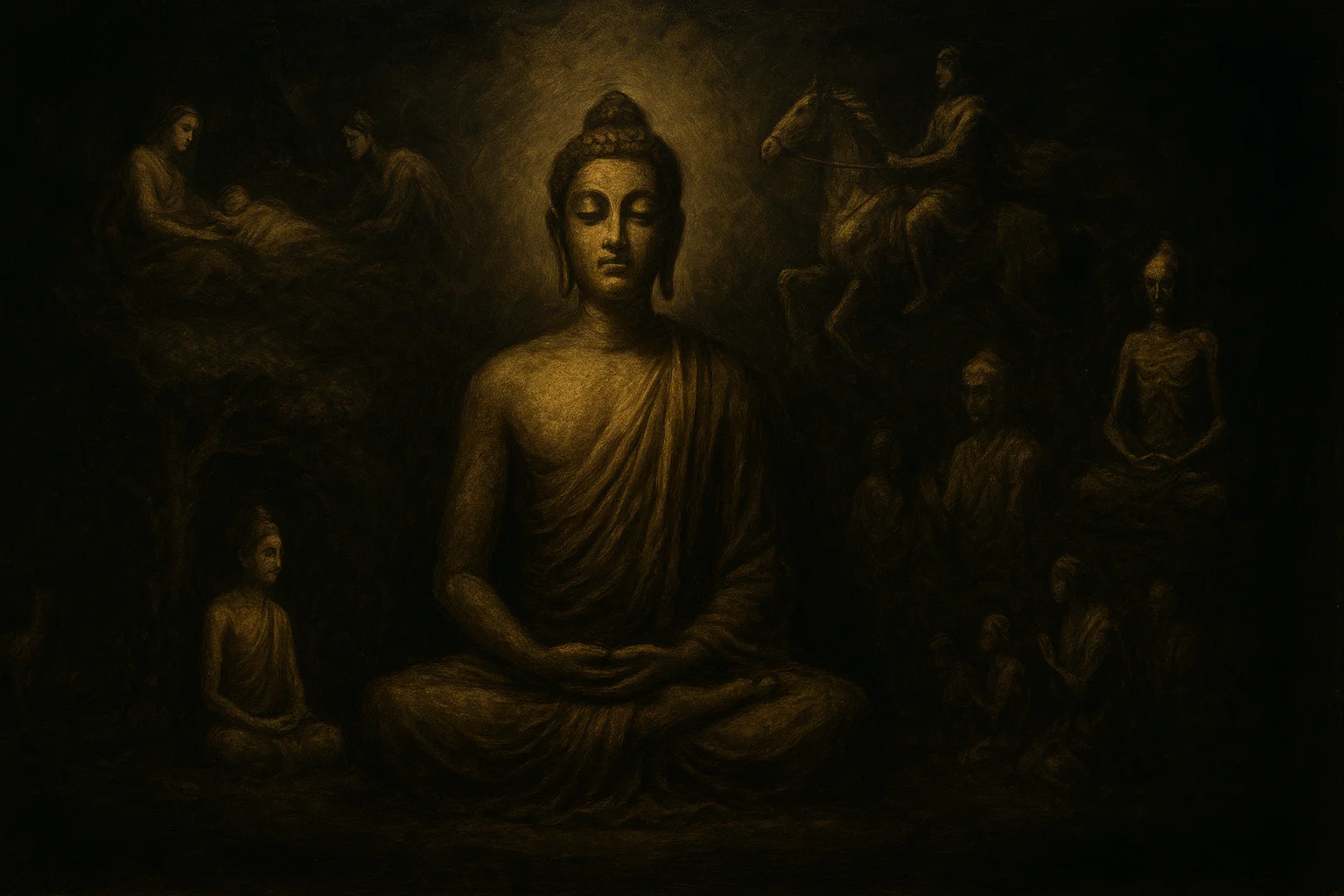
The Buddha's life story, as preserved in texts like Ashvaghosa's Buddhacarita and the Lalitavistara Sutra, follows the structure of the hero's journey: prophecy, departure, ordeal, transformation, return. It is a mythic biography in the same register as those of Krishna or Heracles.
Birth and the prophecy
Queen Maya dreams of a white elephant entering her womb. Ten months later, standing in the Lumbini grove, she gives birth to Siddhartha Gautama from her right side. The infant takes seven steps, and lotuses spring from his footprints. He announces, "I am the chief of the world." The sage Asita examines the child and weeps, not from sorrow but because he will not live to hear the Buddha teach.
The prophecy is twofold: Siddhartha will become either a universal monarch or a fully enlightened Buddha. His father, King Suddhodana, chooses the former and builds three palaces to insulate the boy from suffering.
The four sights and renunciation
At 29, Siddhartha ventures beyond the palace walls. On four successive trips, he encounters an old man, a sick man, a corpse, and a wandering ascetic. The first three sights reveal the inevitability of decay. The fourth offers a path. He abandons his wife, his infant son Rahula, and his inheritance. The Buddhacarita describes him cutting his hair with his sword and sending his charioteer back with his royal ornaments.
Enlightenment under the Bodhi tree
After six years of extreme asceticism, Siddhartha accepts a bowl of milk-rice from a village woman named Sujata. He sits beneath a pipal tree at Bodh Gaya and vows not to rise until he has understood the nature of suffering. Over the course of a single night, he recalls his past lives, perceives the cycle of death and rebirth, and comprehends the Four Noble Truths. At dawn, he becomes the Buddha, the Awakened One.
Mara's assault
Just before enlightenment, Mara, the deity of death and desire, attacks. He sends armies of demons, then his three daughters: Craving, Discontent, and Lust. The Buddha remains unmoved. Mara challenges his right to the seat of enlightenment. The Buddha touches the earth with his right hand, calling the goddess of the earth to witness his merit accumulated over countless lifetimes. She appears, wringing water from her hair to create a flood that washes Mara's army away. This moment, the earth-touching gesture, is one of the most depicted in Buddhist art.
Buddhist cosmology: the structure of existence
Buddhist cosmology is vertical, cyclical, and vast. It describes not one world but countless world-systems, each passing through cycles of formation, duration, destruction, and void. The Abhidharmakosa and the Visuddhimagga, Buddhaghosa's fifth-century compendium, provide the most detailed maps.
The three realms
Existence is divided into three realms, stacked by refinement:
- Kamadhatu, the Desire Realm, includes hells, hungry ghosts, animals, humans, and the lower heavens. Beings here are driven by sensory craving.
- Rupadhatu, the Form Realm, contains 16 heavens inhabited by gods absorbed in meditative states. They have form but no gross desire.
- Arupadhatu, the Formless Realm, holds four heavens where consciousness exists without physical substrate. These are the highest planes short of nirvana.
The six realms of rebirth
Within the Desire Realm, beings cycle through six possible states of rebirth, determined by karma. The six realms are depicted in the Wheel of Life, a diagram held in the jaws of Yama, the lord of death:
- Gods (devas) in heavens of pleasure, whose lives are long but not eternal
- Jealous gods (asuras) locked in perpetual warfare with the devas
- Humans, the only realm where enlightenment is readily attainable
- Animals, driven by instinct and ignorance
- Hungry ghosts (pretas), tormented by insatiable craving
- Hell beings, enduring torments that correspond to their karmic debts
None of these states is permanent. A god can be reborn as a hungry ghost. A hell being can ascend to human birth.
Mount Meru and the geography of the cosmos
Mount Meru stands at the center of the world-system, a golden mountain 84,000 yojanas high. The sun and moon orbit it. On its summit sits the heaven of the Thirty-Three Gods, ruled by Indra. Below the mountain lie the hells, arranged in eight hot and eight cold layers. The Jambudvipa, the southern continent where humans live, is one of four continents surrounding Meru. This cosmography appears in the Digha Nikaya and is elaborated in later Abhidharma literature.
Deities, bodhisattvas, and divine beings
Gods who are not creators
Buddhism inherits much of its divine cast from Hindu tradition but reassigns their roles. Indra, king of the gods, becomes Sakra, a protector of the Dharma who listens to the Buddha's teachings. Brahma, the creator in Hindu cosmology, is reduced to a long-lived but ultimately ignorant deity who mistakenly believes himself eternal. The gods are powerful, but they are trapped in samsara, the cycle of rebirth. They can be reborn as animals or humans. They are not objects of ultimate refuge.
Bodhisattvas as compassionate saviors
In Mahayana Buddhism, the bodhisattva emerges as a central figure. A bodhisattva is a being who has generated the aspiration for enlightenment but delays final nirvana to assist others. Avalokiteshvara, the bodhisattva of compassion, appears in countless forms, including the female Guanyin in China. Manjushri wields the sword of wisdom. Ksitigarbha vows to empty the hells. The Lotus Sutra describes bodhisattvas as more numerous than the sands of the Ganges, each with a specific vow and domain.
Protector deities and wrathful figures
Tibetan Buddhism, drawing on Vajrayana traditions, populates its pantheon with wrathful protectors. Mahakala, the Great Black One, tramples demons and wears a garland of skulls. Palden Lhamo rides a mule across a sea of blood. These figures are not evil. They are enlightened beings who take terrifying forms to subdue obstacles and protect practitioners. The Tibetan Book of the Dead describes encountering such figures in the bardo, the intermediate state between death and rebirth.
Theravada cosmology
Focuses on the 31 planes of existence as described in the Pali Canon. Gods are present but secondary. The emphasis is on individual liberation through the arhat path.
Mahayana cosmology
Expands the pantheon with bodhisattvas and Pure Lands, celestial realms created by enlightened beings. The goal shifts from personal nirvana to universal salvation.
Jataka tales: the Buddha's previous lives
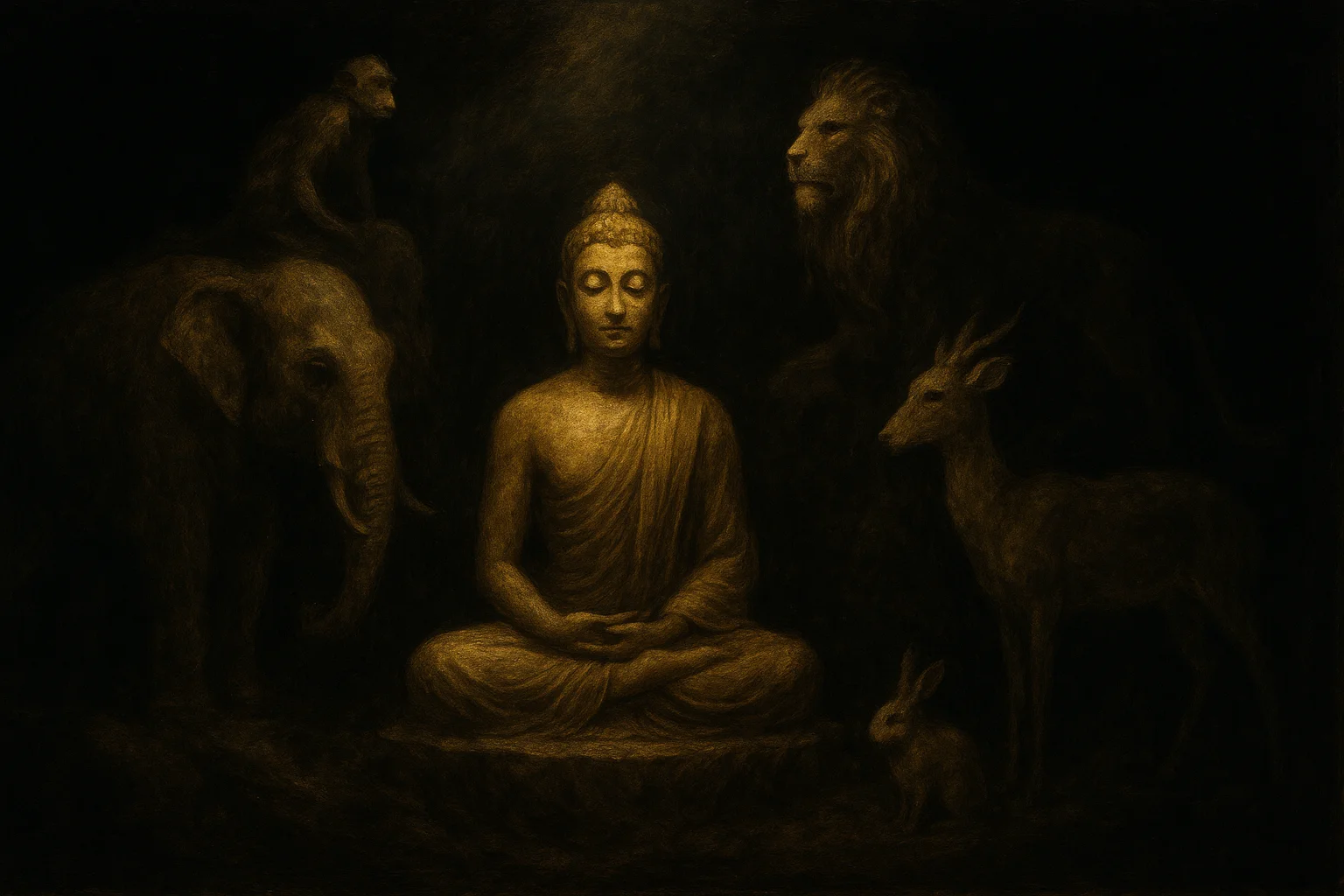
The Jataka tales are a collection of 547 stories recounting the Buddha's previous births. In these lives, he appears as a king, a merchant, a monkey, an elephant, even a tree spirit. Each tale illustrates a virtue: generosity, patience, wisdom, compassion. The stories are preserved in the Pali Canon and elaborated in vernacular traditions across Asia.
In the Vessantara Jataka, the Buddha's penultimate life, he is a prince who gives away everything, including his children, to demonstrate perfect generosity. In the Mahasattva Jataka, he is a prince who offers his body to a starving tigress and her cubs. These are not parables. Within the logic of Buddhist mythology, they are biographical facts, episodes in a career that spans eons.
"In the past, when Brahmadatta was king of Benares, the Bodhisattva was born as a monkey. He lived in the Himalayas with a troop of 80,000 monkeys." Jataka Tales, Pali Canon
The tales function as moral instruction, but they also establish the Buddha's authority. His wisdom is not the product of a single lifetime but the fruit of countless acts of merit.
Regional variations: Theravada, Mahayana, Vajrayana
Buddhist mythology is not monolithic. It adapts to the cultures it enters, absorbing local deities and reshaping narratives.
Theravada, dominant in Sri Lanka, Thailand, Myanmar, and Cambodia, adheres closely to the Pali Canon. Its mythology is restrained. The Buddha is a human teacher who achieved enlightenment. Gods exist but are marginal. The cosmology of the 31 planes is taught, but the focus is on the path to arhatship, individual liberation.
Mahayana, which spread to China, Korea, Japan, and Vietnam, expands the mythic landscape. It introduces the concept of multiple Buddhas across time and space. Amitabha presides over the Pure Land of Sukhavati, a paradise where beings are reborn to practice without distraction. The Lotus Sutra reveals that the historical Buddha is merely an emanation of an eternal, cosmic Buddha. Bodhisattvas become central, and the mythology grows more devotional.
Vajrayana, practiced in Tibet, Bhutan, and Mongolia, incorporates tantric elements. It adds layers of esoteric symbolism, wrathful deities, and elaborate rituals. The Tibetan Book of the Dead maps the journey through the bardo, describing encounters with peaceful and wrathful deities as projections of the mind. Deities are visualized in meditation, not merely worshiped. The mythology becomes a technology for transformation.
Buddhist mythology in practice and art
Buddhist mythology is not confined to texts. It is enacted in ritual, carved into temple walls, and painted in thangkas. The earth-touching gesture of the Buddha appears in thousands of statues. The Wheel of Life is painted at the entrance to monasteries, a reminder of the six realms. Jataka tales are depicted in bas-relief at Borobudur in Java and in murals at Ajanta in India.
In Thailand, monks chant the Vessantara Jataka during festivals. In Japan, the descent of Amitabha to welcome the dying is a common theme in Pure Land art. In Tibet, ritual dances reenact the subjugation of demons by Padmasambhava, the tantric master who brought Buddhism to the Himalayas. The mythology is not background. It is the medium through which the teaching is transmitted.
Even the architecture of stupas encodes cosmology. The square base represents the earth, the dome the water, the spire the fire, the crescent the air, and the jewel at the top the space element. To circumambulate a stupa is to traverse the cosmos in miniature.
Frequently asked questions
Does Buddhism have gods and mythological beings?
Yes. Buddhism includes gods, demons, serpent kings, and other beings inherited from Hindu cosmology and adapted to new roles. These gods are not creators or saviors but are themselves subject to karma and rebirth. They appear in the Pali Canon, Mahayana sutras, and Vajrayana texts, and they play active roles in the Buddha's biography and in cosmological narratives.
What are the six realms of rebirth in Buddhist cosmology?
The six realms are gods, jealous gods, humans, animals, hungry ghosts, and hell beings. They form the Desire Realm and represent different states of existence determined by karma. Rebirth in any realm is temporary; beings cycle through them until they achieve liberation. The human realm is considered most favorable for attaining enlightenment because it balances suffering and pleasure.
What is the mythic story of the Buddha's enlightenment?
Siddhartha Gautama sat beneath the Bodhi tree and vowed not to rise until he understood suffering. Mara, the deity of death and desire, attacked with armies and temptations. The Buddha remained unmoved, touched the earth to call the earth goddess as witness, and achieved enlightenment at dawn. This narrative is preserved in the Buddhacarita and the Lalitavistara Sutra.
What role do bodhisattvas play in Buddhist mythology?
Bodhisattvas are beings who have vowed to achieve enlightenment for the sake of all sentient beings and delay their own nirvana to assist others. In Mahayana Buddhism, figures like Avalokiteshvara and Manjushri function as compassionate saviors who respond to prayers and guide practitioners. They are central to devotional practice and appear throughout Mahayana sutras, including the Lotus Sutra.
How do Theravada and Mahayana mythologies differ?
Theravada adheres to the Pali Canon and emphasizes the historical Buddha as a human teacher. Its mythology is restrained, focusing on the 31 planes and the path to individual liberation. Mahayana expands the pantheon with multiple Buddhas, bodhisattvas, and Pure Lands, shifting the goal to universal salvation. Vajrayana, a branch of Mahayana, adds tantric deities and esoteric practices.
What are Jataka tales and why do they matter?
The Jataka tales are 547 stories of the Buddha's previous lives, preserved in the Pali Canon. They illustrate virtues like generosity and compassion and establish the Buddha's authority as the result of eons of merit. These tales are not allegories but biographical facts within Buddhist cosmology. They are widely depicted in art and recited in rituals across Buddhist cultures.