
Bragi, Norse God of Poetry: Skald, Sage, and Voice of Valhalla
Bragi guards the sacred craft of Norse skalds: the god of poetry who sat beside Odin, welcomed heroes to Valhalla, and carried runes on his tongue. Uncover his myths, his sources, and his enduring reach.
Contents
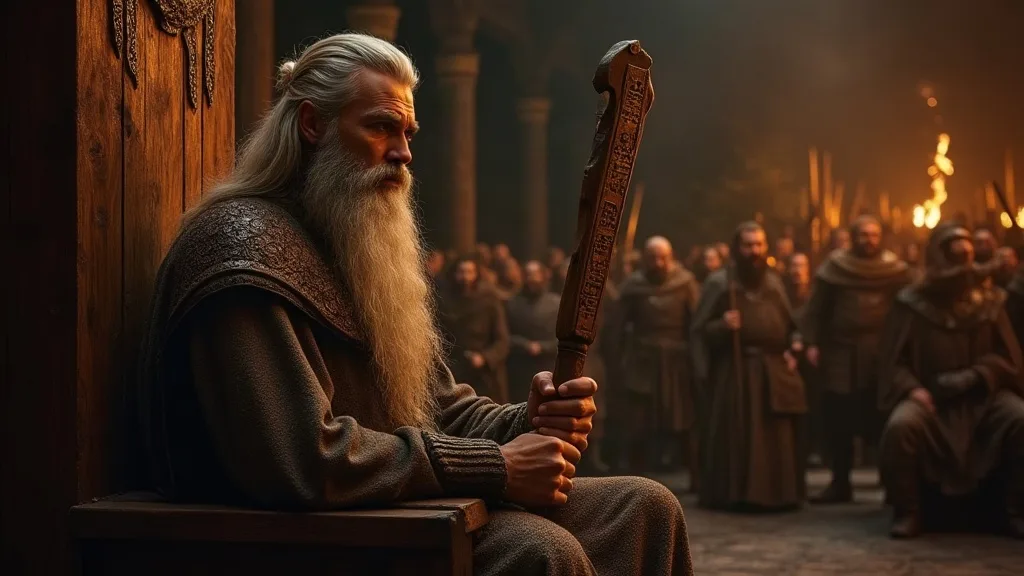
The hall goes quiet the moment he rises. Mead cups stop midair. Warriors who have split shields with their bare hands sit still, listening. Bragi, god of poetry, opens his mouth, and the words that come out are not decoration. They are power. They name the dead, anchor the living, and feed the world's memory.
In Old Norse belief, a story told badly was a story lost. A hero whose deeds went unsung was, for all purposes, a hero who had never existed. Bragi held the key to that permanence. He was the skáld of the Aesir, a word usually translated as "poet" but carrying the weight of historian, priest, and keeper of fate all at once. What he sang became true in a way that outlasted stone.
He is not the loudest figure in the Norse pantheon. Odin swallows the headlines; Thor swings the hammer that shakes mountains. But Bragi is the reason we know their stories at all. Without him, or without the human skalds who imitated his art, the Eddas would not exist, the myths would have dissolved into silence, and the whole edifice of Norse mythology would be rubble.
Who Is Bragi? His Origins in the Eddic Sources
The primary sources for Bragi are two: the Prose Edda, written by the Icelandic scholar Snorri Sturluson around 1220 AD, and the older Poetic Edda, a collection of mythological and heroic poems gathered in the Codex Regius manuscript around 1270 AD (though many of the poems are considerably older, some reaching back to the Viking Age itself).
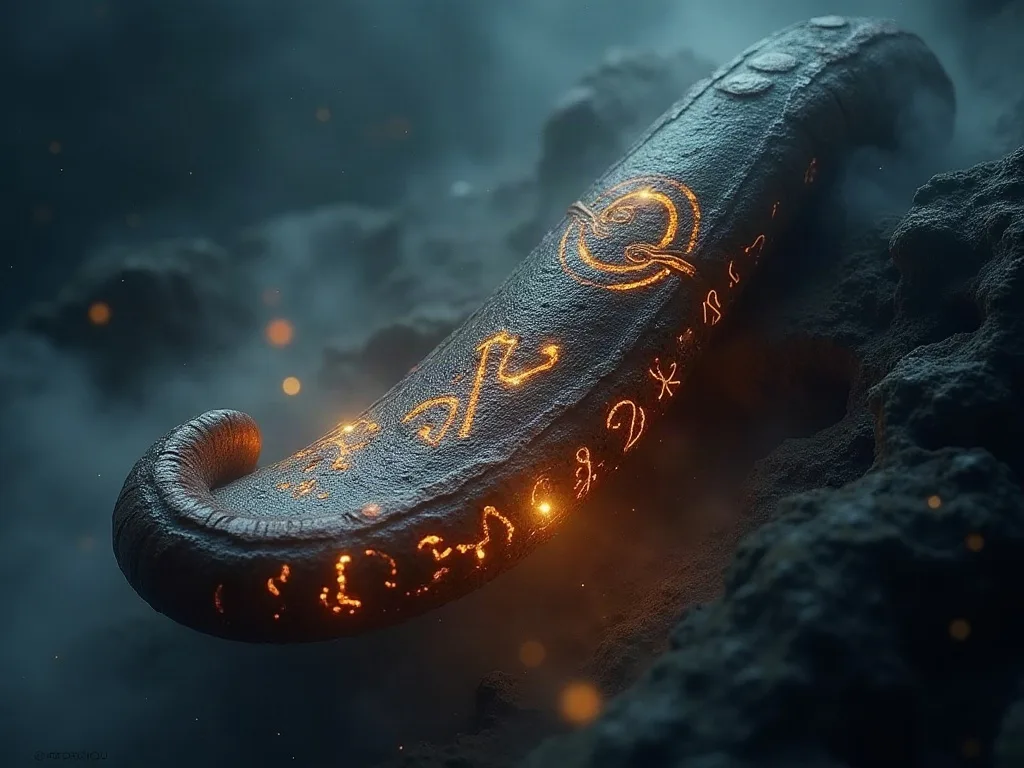
Snorri is our most detailed guide. In his Prose Edda, specifically in the section called Skáldskaparmál ("The Language of Poetry"), he names Bragi as the greatest skald among the gods, renowned for wisdom and eloquence of speech. Bragi's tongue, Snorri tells us, is carved with runes, the magical alphabet that in Norse thought was not merely a writing system but a technology of reality. Runes on a tongue mean that every word Bragi speaks carries the weight of a spell.
His parentage in Snorri's account connects him directly to Odin: Bragi is listed among Odin's sons, making him a half-brother to Thor and a full member of the Aesir, the ruling family of Norse gods. His mother is not named with certainty in the surviving sources. Some scholars, including John Lindow in his 2001 reference Norse Mythology: A Guide to the Gods, Heroes, Rituals, and Beliefs, note that this absence of a named mother is itself unusual among major Aesir figures, possibly reflecting the loss of older source material.
His wife is Idunn, the goddess who guards the golden apples of immortality. That marriage is not incidental. The god of creative speech is paired with the keeper of eternal youth: together they represent what a Norse audience would have understood as the two guarantors of the gods' survival. The apples keep the body young; the poetry keeps the name alive.
Runes on His Tongue: The Mechanics of Divine Poetry
To understand Bragi's power, you first need to understand what Norse poetry actually was. It was not the rhyming verse of later European traditions. Old Norse skaldic poetry was built on strict rules: complex meters called dróttkvætt (court meter), intricate systems of alliteration, and most distinctively, kennings, compressed metaphorical compounds that rewrote reality in miniature.
A sword was a "wound-snake". The sea was the "whale-road". A battle was a "storm of swords", or a "Thing of spears" (the Thing being the Norse assembly, so a battle was a parliament of blades). Blood was "the sweat of the sword". A poet was a "feeder of ravens", since ravens fed on the battlefield dead and the poet fed on the story of that battlefield.
These were not rhetorical flourishes. In the Norse worldview, a kenning was a compressed piece of understanding: it revealed the hidden nature of a thing by naming it through its relationship to other things. Bragi, as the god who commanded this system, was the god who saw the true nature of everything and could name it exactly.
The runes carved on his tongue made this literal. In the Prose Edda's Skáldskaparmál, Snorri describes Bragi as being the origin of the art of skáldskap itself, the craft of poetry. He appears as the divine prototype of every human skald who ever composed in the elaborate court tradition. When a 10th-century Icelandic poet stood before a Viking king and delivered a praise-poem, he was performing a ritual whose celestial version Bragi had already performed in Asgard.
Human skalds were sometimes called Bragar-menn, "Bragi-men", a title that placed them directly in his lineage. The best of them were said to have received the gift of skaldamjöðr, the "mead of poetry" (a concept bound up with Odin's own myth of stealing the sacred mead, but channeled through Bragi's voice into the world).
The Mead of Poetry and Bragi's Place in the Chain of Inspiration
The mead of poetry runs through Norse myth like an underground river. Its origin story is told in Snorri's Skáldskaparmál. After the Aesir and the Vanir (the two families of Norse gods) made peace following their great war, they sealed the treaty by spitting into a vat. From that mixed saliva the gods shaped a being named Kvasir, the wisest creature who had ever existed, who could answer any question.
Two dwarves named Fjalarr and Galarr killed Kvasir and mixed his blood with honey to create a mead that gave whoever drank it the power of poetry and wisdom. The mead passed through several hands, eventually reaching the giant Suttungr, who hid it inside a mountain called Hnitbjorg. Odin stole it back through trickery, seduced Suttungr's daughter Gunnlod, drank all three vats, and flew back to Asgard in eagle shape. He spat the mead out for the gods.
Bragi's connection here is structural. He is the god who distributes and embodies what the mead represents. While Odin is the one who acquired the mead through cunning and violence, Bragi is the god who uses it perfectly, the one in whom the gift of eloquence is not a stolen commodity but a native condition. He is poetry as a state of being, not just a power one can borrow.
This distinction matters for understanding Bragi's role. Odin is the god who pursues wisdom at any cost (he hanged himself from Yggdrasil for nine nights to win the runes; he sacrificed an eye at Mimir's well for foresight). For Odin, poetry is one more tool among many. For Bragi, it is his entire nature.
Bragi in the Lokasenna: The Skald Who Would Not Fight
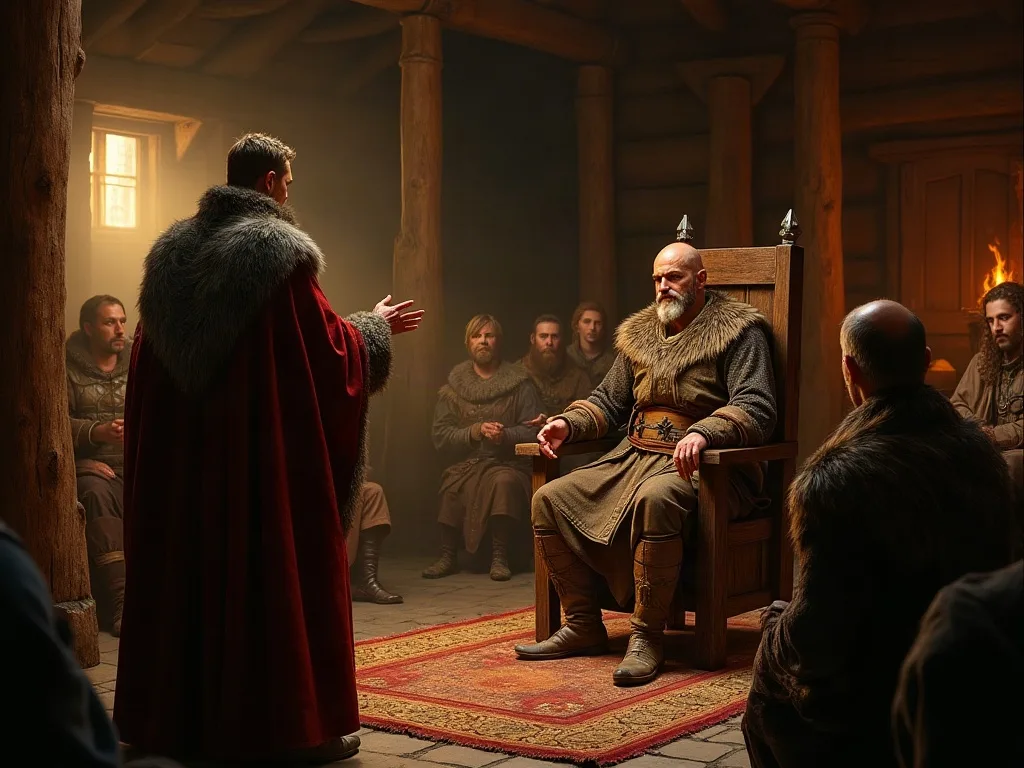
The Lokasenna ("Loki's Quarrel"), a poem in the Poetic Edda, is the closest thing Norse mythology has to a roast. Loki crashes a feast of the gods, insults every deity in the hall one by one, and they mostly fail to shut him up. His exchanges with individual gods reveal their characters through the specific taunts he levels at them.
His exchange with Bragi is short but pointed. When Bragi protests Loki's presence, Loki calls him a coward, saying he is the most battle-shy of all the Aesir, the one who flinches from fighting. Bragi responds not by denying this but by offering Loki his horse, his sword, and his ring (the traditional Norse gesture of compensation or gift-giving to defuse conflict). Loki calls him a liar and pushes harder.
It is a strange scene. A god being taunted for avoiding battle in a mythology that glorifies combat seems vulnerable, almost pitiable. But read against the full texture of Norse belief, something different emerges. The skald in human society was also not expected to fight. He fought with words. His weapons were memory and metaphor. Loki, the master of verbal attack, recognizes in Bragi a rival of his own kind and escalates accordingly. The taunt is less "you are a coward" and more "you are like me", and Bragi refuses to accept that equivalence.
Idunn, Bragi's wife, intervenes in this same passage to urge her husband not to respond to Loki's provocations. Her calm, diplomatic voice paired with Bragi's measured response creates a portrait of a couple whose power is patience rather than violence. In a hall full of thunder-gods and warrior-giants, that is its own kind of strength.
Welcoming the Einherjar: Bragi at the Gates of Valhalla
In Eiríksmál, a praise-poem composed around 954 AD celebrating the death of the Norwegian king Eirik Bloodaxe, a remarkable scene unfolds: Odin, hearing the thunder of an approaching warrior's footsteps, tells Bragi to go and greet the newcomer, for the sound is unmistakably the step of a great king.
Bragi stands at the entrance of Valhalla as a herald and greeter. This role is deeply significant. The einherjar, the honored dead who feasted in Valhalla preparing for Ragnarok, did not simply arrive; they were received, named, and acknowledged. To be named by the god of poetry at the doors of Valhalla was to have your story absorbed permanently into the divine record. Bragi, by greeting Eirik, confirms his worthiness and inserts him into the eternal narrative.
The Eiríksmál is one of our earliest dateable sources connecting Bragi directly to Valhalla's rituals, and it shows the god operating as something close to a divine archivist: the being who decides which human stories get added to the permanent collection.
Was Bragi a God or a Deified Skald?
One of the most interesting open debates in Norse scholarship concerns Bragi's origins. Several 19th-century scholars, and some more recent ones, have proposed that the mythological Bragi was not an original deity but a historical human skald named Bragi Boddason who was later elevated to divine status.
Bragi Boddason is a real figure: he lived in the 9th century and composed Ragnarsdrápa, one of the oldest surviving pieces of skaldic verse, a poem describing scenes painted on a shield. He is among the earliest named human skalds in the record. The argument goes that his genius was so extraordinary that later tradition mythologized him into a god, much as historical shamans or wise men sometimes become culture heroes in other traditions.
The counter-argument is equally compelling. The name Bragr, as noted above, predates any individual and carries the abstract meaning of "poetic excellence". The god Bragi's connection to Idunn and the Aesir pantheon, his rune-inscribed tongue, his structural role in the mythology of divine poetry: all of these suggest an older, properly mythological figure who inspired the naming of the historical poet rather than the other way around.
John Lindow and Andy Orchard (in his 1997 Dictionary of Norse Myth and Legend) both treat this ambiguity as probably irresolvable given the available evidence. The most honest reading is that the historical Bragi Boddason and the mythological Bragi god of poetry became so intertwined in the Norse imagination that the boundary dissolved deliberately. A tradition that believed poetry was a divine gift wanted to see its greatest poets as touched by the divine.
This is not unique to Norse culture. Apollo in Greek mythology similarly merged the abstract force of musical and prophetic inspiration with very specific human artists and traditions. Saraswati in Hindu thought is simultaneously a river goddess, a goddess of speech, and the patron of every individual act of learning. The deification of the inspired creator seems to be a near-universal human instinct.
Bragi Across Traditions: The Divine Poet in World Mythology
The Bragi god of poetry archetype is not unique to Norse culture. A brief comparison illuminates what is shared and what is distinctly Norse.
Bragi (Norse)
Bragi commands skaldic verse: dense, kenning-heavy, built for oral performance before kings. His power lies in memory and naming. He operates inside a warrior society and his poetry serves commemoration of the dead. His rune-tongue makes every word a permanent inscription.
Apollo (Greek)
Apollo governs music, lyric poetry, prophecy, and the healing arts. He commands the Muses, nine daughters of Memory who inspire all creative work. His poetry is associated with light, clarity, and the oracle at Delphi. He operates inside a civic, religious, and philosophical culture.
The difference is instructive. Apollo's domain is vast and solar: music, light, prophecy, medicine, civilization itself. Bragi's is narrower and more precise: the spoken word as historical record, the poem as memorial, the skald as the one person who can save a life from oblivion. Apollo is the god of all arts. Bragi is the god of this specific art, and the specificity is very Norse.
Saraswati in Hindu tradition offers a different parallel. She holds a veena (a stringed instrument), a book of knowledge, and prayer beads: music, learning, and devotion braided together. Her river-goddess origins connect speech to the flow of water, which is also a Norse association (the mead of poetry is a liquid; inspiration flows like water through the divine realm). But Saraswati's domain includes science and mathematics alongside poetry. Bragi stays closer to the hall, the feast, the warrior's story.
The closest structural parallel may be Ogma in Irish Celtic mythology: the inventor of Ogham script, a warrior-poet who combined physical strength with verbal power, and who was credited with the creation of the Irish sacred writing system. Like Bragi, Ogma sits at the intersection of word and war, though in the Irish version the poet also fights.
What Norse tradition does differently is separate the sword from the word. Bragi does not fight, and the Lokasenna makes clear this is known and noted. The skald is defined precisely by his refusal to substitute violence for eloquence. In a mythology otherwise saturated with combat, that refusal carries its own significance.
The Legacy of Bragi in Skaldic Poetry and Modern Culture
The skalds who followed Bragi's model left a record spanning roughly 400 years, from the 9th century through the 13th. We have named poets: Egill Skallagrímsson, whose defiant Hávamál-inspired verse in Egils saga reads like self-mythologization; Eyvindr skáldaspillir (Eyvindr the Plagiarist, which is itself a skaldic joke about borrowing too heavily from earlier poets); Þórbjörn hornklofi, who composed the Haraldskvæði celebrating Harald Fairhair's unification of Norway.
Each of these poets understood themselves as working in a tradition that Bragi had originated and sanctified. Composing a praise-poem (drápa) was not simply a professional service. It was a ritual act with theological dimensions, one that placed the commemorated king or warrior inside the same story-space as the gods themselves.
The Icelandic sagas, composed in the 12th and 13th centuries, are saturated with this attitude. In Egils saga, the poet Egill composes a poem (Höfuðlausn, "Head Ransom") to save his own life from King Eirik Bloodaxe. One night of verse bought him his freedom. The saga presents this not as clever rhetoric but as something closer to a transaction with fate: the poem was so well-made that refusing it would have been a violation of the cosmic order poetry upheld.
Today, Bragi gives his name to the Norse-derived word that lives inside the English language without most people noticing: "brag". Scholars debate whether the English verb derives directly from the god's name or from the Old Norse noun bragr, but the connection to confident, performative speech is clear. Every time someone boasts of an achievement, a ghost of the god's function is present.
In modern Norse revivalism and the Ásatrú movement, Bragi is honored as the patron of artists, writers, and musicians. His name appears as the title of the Bragi Awards, given for excellence in Icelandic literature. He gives his name to a character in Marvel's Thor comics and films, though that version strips away almost everything mythologically specific and turns him into a cowardly bureaucrat, which would have earned a scathing kenning from any self-respecting 10th-century skald.
Frequently Asked Questions About Bragi, Norse God of Poetry
Frequently asked questions
What is Bragi the god of, exactly?
Bragi is the Norse god of poetry, eloquence, and skaldic verse. Snorri Sturluson's Prose Edda (written around 1220 AD) identifies him as the greatest poet among the Aesir, with runes carved on his tongue that give his words magical weight. His domain covers oral poetry used for commemoration, praise, and the preservation of heroic memory, which in Norse society carried the force of historical record.
Who are Bragi's parents and who is his wife?
Most sources identify Bragi as a son of Odin, placing him firmly within the Aesir family. His mother is not named with certainty in any surviving text. His wife is Idunn, the goddess who keeps the golden apples that preserve the gods' youth. The pairing of the god of poetry with the keeper of immortality has a clear symbolic logic: poetry preserves names where the body eventually fails.
What is the difference between Bragi and Odin as gods of poetry?
Both Odin and Bragi are connected to poetry, but their relationships to it differ fundamentally. Odin acquired poetic power through sacrifice and theft (he stole the mead of poetry from the giant Suttungr, as told in Snorri's Skáldskaparmál). Bragi embodies it natively. Odin uses poetry as one instrument among many for gaining knowledge and power. Bragi exists for no other purpose: he is the art itself given divine form, which is why skalds invoked him as their specific patron.
Was Bragi a real person who became a god?
Some scholars, including 19th-century figures like Sophus Bugge, proposed that the mythological Bragi was a deification of Bragi Boddason, a real 9th-century skald and one of the earliest named Norse poets. His surviving work, Ragnarsdrápa, is among the oldest skaldic verse we have. The counter-view, supported by scholars like John Lindow, holds that the god Bragi predates the historical poet and that the name Bragr (meaning poetic excellence) was given to the skald because of the god, not vice versa. The evidence does not fully resolve the question.
What happens in Bragi's scene in the Lokasenna?
In the Lokasenna, a Poetic Edda poem in which Loki insults each god at a feast, Loki accuses Bragi of cowardice and of being the most battle-shy of the Aesir. Bragi responds by offering gifts (horse, sword, ring) to defuse the quarrel rather than fighting back verbally or physically. His wife Idunn urges restraint. Scholars read this passage as a deliberate portrait of the skald as a figure who operates by different codes than the warrior: his power lies in measured, purposeful speech, not in matching Loki's aggression blow for blow.
Does Bragi appear in the story of Valhalla?
Yes. In Eiríksmál, a praise-poem composed around 954 AD for the Norwegian king Eirik Bloodaxe, Odin instructs Bragi to go and greet the arriving hero at Valhalla's threshold. This positions Bragi as a greeter and herald of the honored dead, the god who receives fallen warriors, names them, and incorporates their stories into the divine record. It is a small scene but it makes explicit Bragi's function as the custodian of heroic memory inside the halls of the gods.
The Unfinished Argument: What Bragi Says About Norse Cosmology
There is a question that Bragi's existence forces into the open, one scholars of Norse religion have circled without fully resolving. In a mythology so committed to combat, physical strength, and the warrior's death as the highest form of honor, why does the tradition grant divine status to a figure who refuses to fight?
The answer may be that the Norse worldview was more internally contradictory, and more interesting, than the popular image of Viking berserkers allows. The skalds who composed in Bragi's tradition were not marginal figures. They sat in the seats of honor at royal courts. Their poems were political instruments that could make or break a king's reputation. Egill Skallagrímsson's Höfuðlausn saved his life; conversely, a níð (a poem of insult or defamation) could destroy a man's honor so completely it functioned, in legal and social terms, as a kind of death.
In that world, Bragi's refusal to fight is not weakness. It is a statement that he wields a different kind of force, one that outlasts any sword. The warrior's body decays. The poem that named him does not.
This is why Bragi god of poetry sits at the structural heart of Norse mythology even if he appears less often than Odin or Thor. The Eddas themselves, the texts we now read as the record of Norse belief, are the product of skaldic and eddic traditions that Bragi personifies. He is, in a very real sense, the reason the mythology survived at all. Every kenning, every verse-form, every drápa composed in a Viking-age hall was a small act of cosmological maintenance, keeping the names of gods and heroes alive long enough to reach us.
The irony is precise: the quietest god in the Norse pantheon built the loudest monument.
Free 25-page sample
Want the whole story?
Take the first 25 pages free. If it pulls you in, the full edition is yours as an instant PDF download, with a paperback on Amazon for selected titles.

Mythology
The World Mythology Book: The Gods, Heroes and Myths of Every Culture
The Gods, Heroes and Myths of Every Culture, in One Volume
The whole of world mythology in a single volume: Greek, Norse, Egyptian, Japanese, Hindu, Celtic, Slavic, Mesoamerican and African myths gathered side by side, each drawn from the primary sources.