
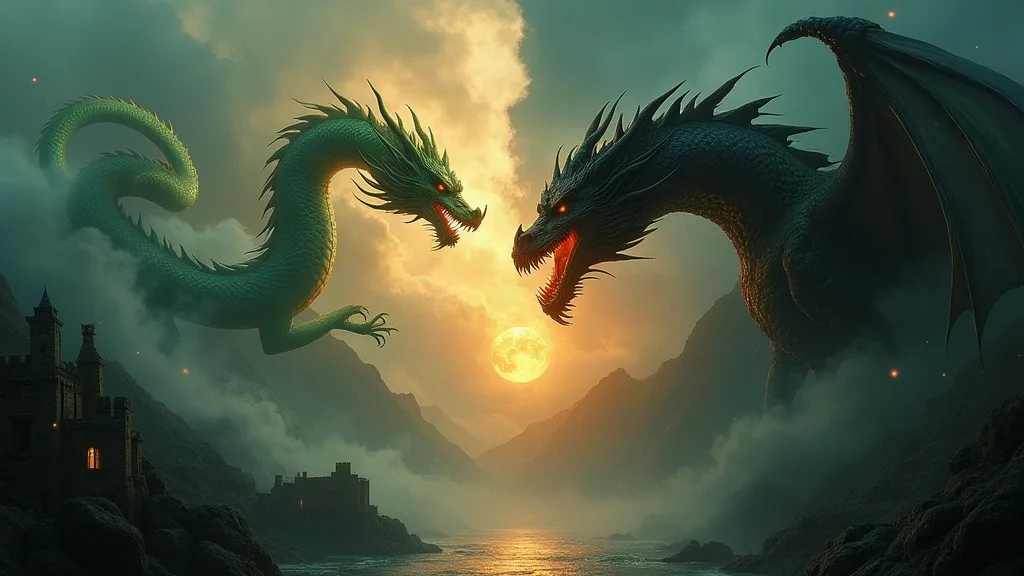
Dragons in World Mythology: East vs West
From China's rain-bringing Lóng to the treasure-hoarding Wyverns of medieval Europe, dragon myths split across two radically different imaginations. Here is why, and what each tradition actually believed.
Contents
The village elders in ancient China did not fear the dragon coming over the mountain. They prayed for it.
Meanwhile, somewhere in the Rhine valley, a Germanic blacksmith was hammering a sword specifically designed to kill one.
That gap, a single creature meaning two completely opposite things to two literate, sophisticated civilisations, is one of the most striking puzzles in the history of human storytelling. Dragons in world mythology east vs west are not just two versions of the same animal. They are two different answers to the same question: what is the largest, most powerful natural force you can imagine, and how do you relate to it?
The Dragon in Ancient China: Sovereign of Rain and River
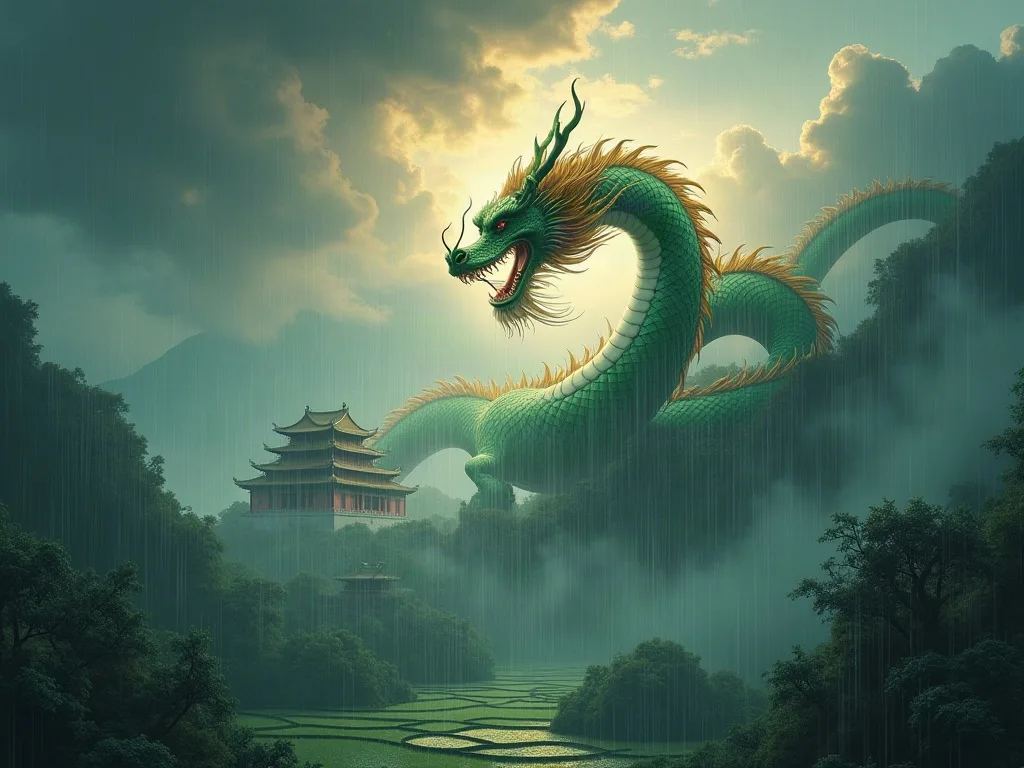
The Chinese dragon, written as lóng (龍), appears in oracle-bone inscriptions as early as the Shang dynasty, roughly 1600-1046 BC. Those early carved characters already show a sinuous, serpentine body, a large head with a gaping jaw, and no wings. The body would later accumulate a standardised list of parts that Chinese scholars catalogued in detail.
Wang Fu, a scholar writing during the Han dynasty (206 BC - 220 AD), described the dragon as having the horns of a deer, the head of a camel, the eyes of a demon, the neck of a snake, the belly of a clam, the scales of a carp, the claws of an eagle, the soles of a tiger, and the ears of a cow. This is not a single animal. It is a composite of every powerful creature that the natural world offered, assembled into one sovereign form.
The lóng controlled water. Not destructively, as a flood, but governmentally, as a regulator. It presided over rivers, lakes, seas, and most importantly, rain. Chinese agricultural society depended on predictable monsoon cycles, and the dragon was the supernatural official responsible for delivering them. Drought meant the dragon had withdrawn, was displeased, or was being obstructed. Communities held rain-petition ceremonies aimed directly at dragon shrines. The Dragon Boat Festival, still celebrated across East and Southeast Asia every fifth day of the fifth lunar month, traces its roots to water-spirit propitiation rites that long predated the story of the poet Qu Yuan, which was layered onto it later.
Chinese cosmology organised dragons into a bureaucratic hierarchy that mirrored the imperial court. The heavenly dragon Tianlong guarded the celestial palaces. The earth dragon Dilong controlled rivers and seas from below. The spirit dragon Shenlong governed wind and rain. At the apex sat the Dragon King, Lóng Wang, who held court in an underwater palace and commanded the weather over his designated territory. The sixteenth-century novel Journey to the West, written by Wu Cheng'en, portrays the Dragon King of the Eastern Sea, Ao Guang, as a powerful but bureaucratically fallible official who can be bullied, sued, and overruled by the celestial administration. He is mighty, yet embedded in a system of reciprocal obligations.
This bureaucratic dragon had a direct political function. The emperor of China was called the Son of Heaven, and his personal symbol was the five-clawed dragon. Robes, thrones, porcelain, and palace tiles all bore this mark. Lesser nobles could display four-clawed dragons; commoners none. The creature was not a metaphor for imperial power. It was the literal visual vocabulary through which power announced itself.
Japan, Korea, and Vietnam: Relatives of the Lóng
The Chinese tradition radiated outward. Japanese ryū (竜) and Korean yong (용) are cognate figures, sharing the serpentine body, the water-governance role, and the palaces beneath the sea. The Japanese Ryūgū-jō, Dragon Palace Castle, appears in the folklore of Urashima Taro, a fisherman who is brought underwater to a dragon king's realm and loses track of time in a way that echoes fairy time in Celtic stories.
Vietnamese mythology adds a twist with its founding legend. The ancestor of the Vietnamese people was Lạc Long Quân, the Dragon Lord of the Lạc, who married the mountain fairy Âu Cơ. Their union produced a hundred children from a single egg sac. Fifty went with the father to the coasts and rivers, fifty with the mother to the highlands. From this division came the Vietnamese people. The dragon is literally the origin point, the first parent.
In all these traditions, the dragon is approached with reverence mixed with relationship. You can negotiate with it, honour it, anger it, and appeal to its sense of duty. You share a world with it.
India's Nāga: the Serpent-Dragon Between Worlds
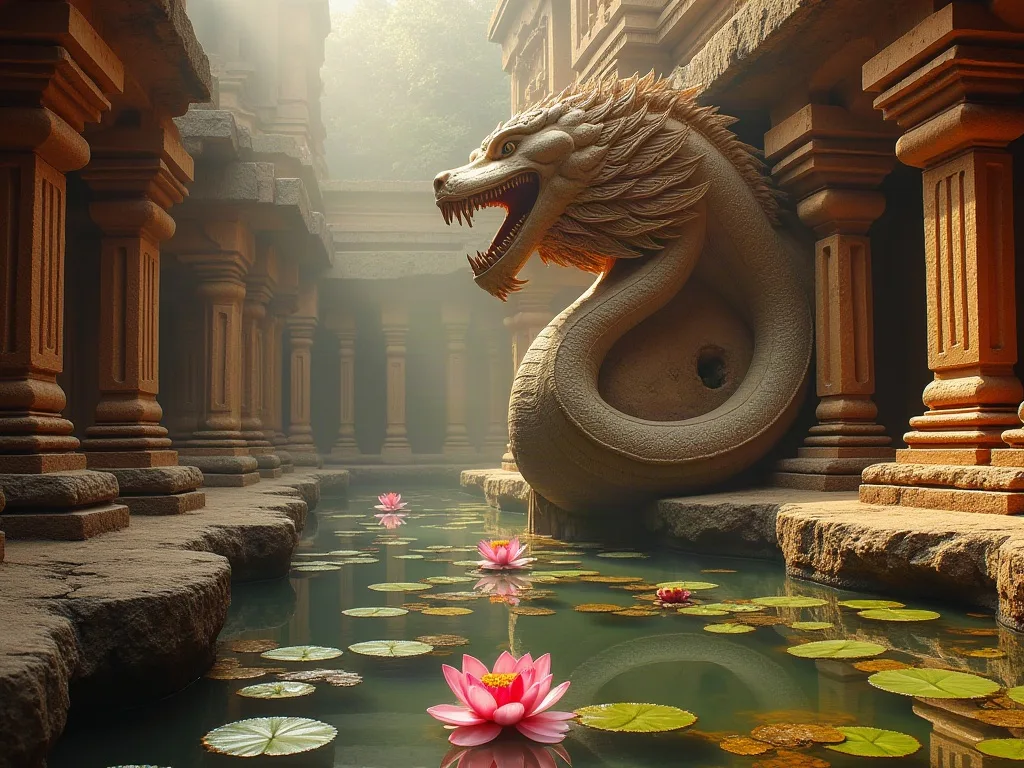
The Indian tradition offers a bridge figure. The nāga (Sanskrit for "serpent"), plural nāgās, are divine serpent beings described across Hindu, Buddhist, and Jain texts. They are immensely powerful, capable of taking human form, and they govern water, underground treasures, and fertility. The great Shesha Nāga, the cosmic serpent on whom Vishnu rests between cosmic cycles, holds the entire earth on its hoods. This is not a monster. It is a cosmic mattress, a foundational being.
Yet the nāga tradition also contains tension. The Mahabharata, the great Sanskrit epic compiled roughly between 400 BC and 400 AD, narrates the Sarpa Satra, the Snake Sacrifice, in which King Janamejaya tries to exterminate all serpents to avenge his father Parikshit, killed by the serpent Takshaka. The event requires divine intervention to stop. Serpents are dangerous, capable of lethal aggression, and yet their mass destruction would unbalance the cosmos. They cannot simply be killed without consequence.
The Buddhist tradition that spread from India to Southeast Asia carried the nāga along with it. Cambodian temple architecture, particularly at Angkor Wat built in the twelfth century, uses the nāga balustrade as the bridge between the human world and the sacred precinct. Crossing a nāga bridge means passing through a divine boundary. The creature marks thresholds. It is neither simply good nor simply evil. It is a power that must be crossed carefully.
The Sanskrit word nāga likely shares a root with the Proto-Indo-European word for serpent, connecting it distantly to the European tradition. But the cultural development went in opposite directions. The nāga remained a deity to be honoured. In Europe, the serpent-dragon became the enemy to be killed.
Mesopotamia's Tiamat: the First Monster
The oldest known dragon-killing story comes from ancient Babylon. The Enuma Elish, a Babylonian creation epic preserved on clay tablets and dated to at least 1200 BC, opens in a time before the sky and the earth had names. Two primordial waters mingled: Apsu, the fresh water, and Tiamat, the salt water. From their commingling the first gods were born.
When the younger gods grew too noisy and chaotic for Apsu's taste, he planned to destroy them. The gods struck first, killing Apsu. Tiamat, enraged, assembled an army of monsters to avenge him. She gave command to her new consort Kingu and fashioned eleven creatures of chaos to fight for her, including serpents, dragons, and the Mushhushshu, a composite beast with a serpent's head, a lion's forepaws, and an eagle's talons.
The young god Marduk agreed to fight Tiamat on the condition that the other gods make him their king. He met her in single combat. When she opened her vast mouth to swallow him, he drove the winds in to keep her jaws apart, then pierced her belly with his spear. From her divided body he made the sky above and the earth below. Her eyes became the sources of the Tigris and Euphrates rivers.
This is the structural template for the Western dragon: a primordial, watery, feminine chaos-power that must be overcome and literally dismembered in order for ordered creation to exist. The Mesopotamian mythological tradition passed this template into the cultures around it. The Hebrew Bible's Leviathan and Tehom (the deep, cognate with Tiamat's name) are echoes of the same fear. The Greek Python, the serpent that guarded Delphi before Apollo killed it, and the serpent of the Garden of Eden, both carry the same structural DNA.
Greece and Rome: Serpents at the Gates
Greek mythology handles dragon-like creatures, drakōn in Greek, as guardians of precious things or representatives of chthonic (underground) power. The Colchian dragon guarded the Golden Fleece and never slept. The Lernaean Hydra, with its regenerating heads, guarded the underworld entrance at Lerna. The dragon Ladon coiled around the tree of the Hesperides, protecting the golden apples that would eventually contribute to Heracles's labours.
Greek dragons are not sovereign rulers. They are obstacles. They guard things that heroes need to take. Their defeat is the proof of the hero's qualification, not a cosmic event in itself. When Heracles kills the Hydra, the universe does not reorganise. He just gets one step closer to completing his penance. When Jason gets past the Colchian dragon with Medea's help, he retrieves the Fleece. The dragon was a lock on a door.
Roman tradition inherited Greek dragon lore with minor modifications. The word draco entered Latin directly from Greek drakōn, and Roman military units carried dragon standards called dracones, long wind-filled windsocks in the shape of serpents. The Romans used the image militarily, as a symbol of ferocity and power, without much theological content attached.
Norse and Germanic Dragons: the Hoard and the Doom
The Norse tradition gives us two of the most fully realised dragon figures in Western myth. Both come with their own catastrophic implications.
Níðhöggr, the "Malice Striker" in Old Norse, gnaws eternally at the roots of Yggdrasil, the cosmic world tree that holds the nine realms together. The eagle at the top of the tree and Níðhöggr at the roots are in constant enmity, with the squirrel Ratatoskr carrying insults between them to keep the conflict alive. Níðhöggr is not trying to defeat anything. It is trying to unmake everything, chewing at the structural support of existence itself. The Poetic Edda, compiled in Iceland around 1270 AD from much older oral material, says that Níðhöggr survives Ragnarok, the end of the world, still gnawing.
The second great Norse dragon is Fafnir. Fafnir began as a dwarf, or possibly a man, who killed his father for a cursed hoard of gold. His greed transformed him physically into a serpent-dragon, coiled forever around the treasure he could not spend or share. The hero Sigurd (Siegfried in the German Nibelungenlied) killed Fafnir by digging a pit in the dragon's path and stabbing upward into its belly as it crawled over him. Sigurd then roasted and accidentally tasted the dragon's heart, which gave him the ability to understand the speech of birds, birds who immediately warned him he was about to be betrayed.
Fafnir is a morality tale wearing a monster's skin. He is what greed makes you: cold, heavy, immobile, sitting on treasure that poisons everyone who touches it. The dragon-as-cursed-hoarder feeds directly into later Western tradition, most explicitly into J.R.R. Tolkien's Smaug, who lies motionless on the dwarves' stolen gold in The Hobbit, speaking in riddles, unable to count exactly what he has, and utterly destroyed by the one scale left bare by his own obsession.
The Anglo-Saxon poem Beowulf, likely composed between the eighth and eleventh centuries, gives the genre its most ancient English expression. The dragon at the end of Beowulf is awakened because a single cup is stolen from its hoard. It responds by burning an entire kingdom. The old king Beowulf fights it alone, succeeds in killing it, but receives a mortal wound in the process. Dragon and hero destroy each other. Nobody wins. The poem's final image is of Beowulf's warriors staring into the funeral smoke, knowing the era of heroes is finished.
The Fire-Breathing Body: Where the Image Came From
Why does the Western dragon breathe fire, while the Eastern dragon does not?
The fire-breath almost certainly entered Western dragon iconography through the intersection of several strands. The venom of real serpents, understood as a burning, corrosive substance that destroyed tissue, was early associated with fire. Greek mythology gave serpents fiery breath in several accounts. But the fully articulated fire-breather appears most clearly in medieval Christian iconography, where the dragon became the explicit symbol of Satan.
The Book of Revelation, written in the first century AD, describes a great red dragon with seven heads and ten horns who sweeps a third of the stars from heaven with his tail. This identification of the dragon with the Devil hardened through the Middle Ages. Saint George killing the dragon, a story that probably entered Western Europe in its current form around the twelfth century, became the template image of Christian virtue defeating embodied evil. The dragon breathes fire because fire in medieval Christian symbolism meant hell.
The Eastern dragon, by contrast, has no equivalent theological enemy to embody. There is no figure in Chinese cosmology that corresponds to the Devil. The lóng controls water, not fire. Its breath, when described, is a luminous cloud or a mist. Even the most dangerous Eastern dragons are not evil in principle; they are powerful beings that can be angered, just as a river can flood, or a storm can wreck a harvest, without being morally wicked.
Eastern Dragon (Lóng)
- Serpentine, no wings, often multi-coloured
- Controls water: rain, rivers, floods
- Sovereign figure, celestial or divine official
- Symbol of imperial authority and prosperity
- Approached through ritual, petition, relationship
- Benevolent by default; destructive only when offended
- Associated with clouds, mist, and luminous pearl
- Survives into modernity as a positive cultural symbol
Western Dragon (Draco)
- Large, winged (in mature form), often reptilian and scaled
- Breathes fire; associated with destruction and hoarding
- Monster or chaos-figure, adversary to heroes and saints
- Symbol of greed, sin, primordial evil (medieval tradition)
- Approached through combat or slaying
- Evil by nature (post-Christian tradition) or morally ambiguous (Norse)
- Associated with underground treasure and death
- Survives into modernity as both villain and anti-hero
The Dragon Pearl and the Dragon Hoard: Two Different Relationships to Wealth
One small but telling detail separates the traditions further. Look at what each dragon carries.
The Eastern dragon is almost always depicted with or pursuing a luminous sphere called the flaming pearl or dragon pearl (lóng zhū in Chinese). This pearl represents wisdom, the moon, thunder, or the sun depending on the source. It is something the dragon shares with the heavens, something it plays with or illuminates. The dragon does not hoard the pearl. It holds it lightly, tosses it upward, catches it. The relationship is dynamic, generous.
The Western dragon, from Fafnir through Smaug, sits on top of the hoard and guards it to the death. It cannot use the gold. It cannot spend it. The act of keeping it is the point. The hoard is not a symbol of cosmic energy. It is a symbol of stagnation, of wealth that has been removed from circulation and made toxic. Even in Beowulf, the dragon's gold is cursed. When the Geats finally bury Beowulf with it, they throw most of it back into the barrow. Gold that a dragon has touched is no longer useful to the living.
This contrast maps onto the larger cosmological difference. A world where power is relational and circulates (East) produces dragons that play with their treasures. A world where power is contested and must be seized or defended (West) produces dragons that cannot let go.
Dragons Beyond China and Europe
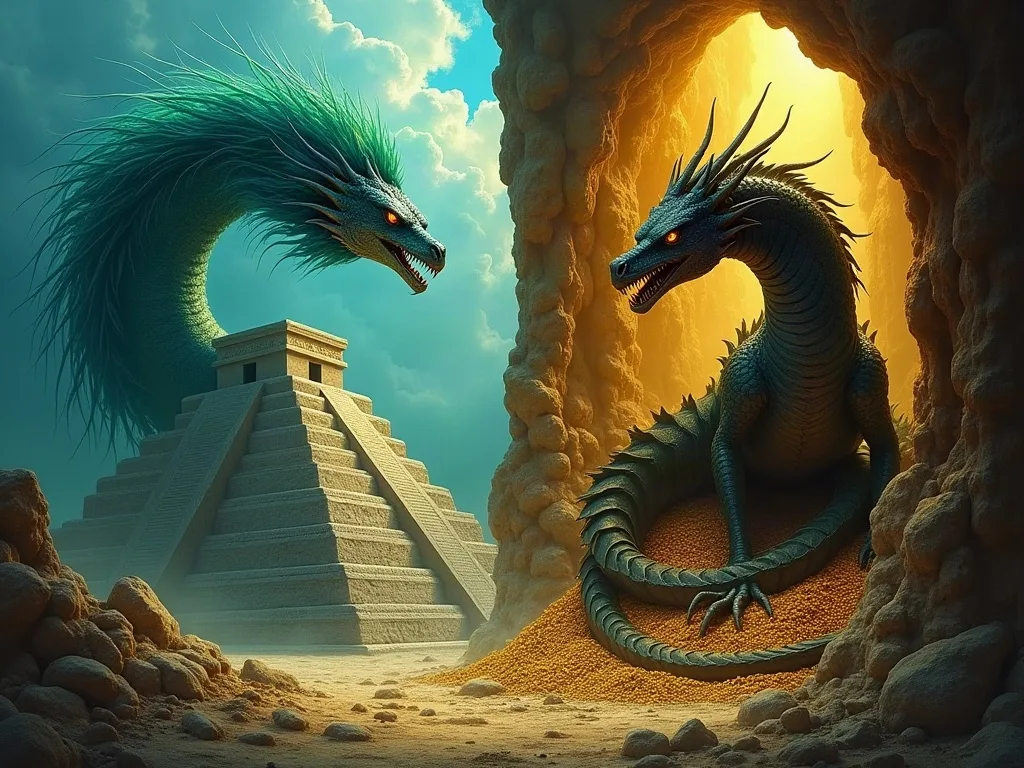
The Aztec tradition gave the world Quetzalcoatl, the Feathered Serpent, who combined serpent and bird in a single magnificent body, feathered like a quetzal, scaled like a serpent. Quetzalcoatl was not a dragon in the European sense, but the structural parallel is striking: a divine serpentine being associated with wind, rain, Venus, and the creation of human beings. In Mesoamerican cosmology he is a creator and a civiliser, much closer in temperament to the Chinese lóng than to the Germanic draco.
The Māori of New Zealand speak of the Taniwha, water-dwelling beings that can take the form of massive reptiles or sharks. Some Taniwha are guardians of specific rivers and coastal areas; others are dangerous predators. Communities with a guardian Taniwha regard it as a kind of ancestor, a power bound to their land and their welfare. The relationship is protective but demanding.
West African traditions carry the Rainbow Serpent Aido-Hwedo (in Fon mythology from the region now called Benin), a cosmic serpent that held the earth in its coils while the creator god Mawu shaped the world. Aido-Hwedo still coils beneath the earth and sea, and when it shifts, earthquakes happen. This is a sustaining force, not a malevolent one, though its power is immense and requires careful management.
These figures suggest that the binary is not simply East vs West. It is more precisely a split between traditions where the serpentine divine power is part of the cosmological order (China, Japan, Vietnam, Mesoamerica, West Africa, Māori) and traditions rooted in the Proto-Indo-European dragon-slaying myth complex (Mesopotamia, India partially, Greece, Norse, Germanic, Slavic) where the serpent represents a primordial chaos that must be overcome.
What the Proto-Indo-European Root Tells Us
Scholars of comparative mythology, particularly following the work of Georges Dumézil in the mid-twentieth century, and more recently scholars like Calvert Watkins who wrote How to Kill a Dragon: Aspects of Indo-European Poetics (1995), have traced a common narrative formula across multiple Indo-European languages: the hero slays the serpent, and from that act something creative follows.
In Vedic Sanskrit: the storm god Indra kills the serpent Vritra, who was blocking the cosmic waters, and releases the rivers. In Greek: Apollo kills Python and establishes his oracle at Delphi. In Norse: Thor fights the World Serpent Jörmungandr at Ragnarok, kills it, and walks nine steps before dying from its venom. In Hittite mythology: the storm god fights the serpent Illuyanka across two separate stories, winning the second time with help from his human-born son.
The pattern is old. It probably predates writing. And its persistence suggests something fundamental about the way certain cultures structured their understanding of cosmic order: it is achieved through conflict, not given. The world must be won against chaos, repeatedly. The dragon represents that chaos, and the hero represents the principle of order that must always be ready to fight again.
The Chinese tradition, arising outside the Indo-European family, never developed this template. The dragon was not chaos. It was part of the natural order itself, the wet and generative principle of a farming civilisation that desperately needed rain.
Frequently Asked Questions About Dragons in World Mythology East vs West
Frequently asked questions
Why do Western dragons have wings but Eastern dragons usually do not?
The winged dragon became standard in Western art largely through medieval European iconography, which drew on both the older serpent traditions and the image of flying demons or angels. Eastern dragons fly not through wings but through a magical substance called chi or through celestial breath, which reflects a different logic about divine power: it does not need mechanical means. Chinese art occasionally shows the dragon among clouds, which serve as its medium. The wing became visually important in Western art partly because flight needed a physical explanation in a tradition that prioritised the visual logic of the body.
Is the dragon-slaying myth really as widespread as scholars claim?
The Indo-European dragon-slaying pattern documented by Calvert Watkins in How to Kill a Dragon (1995) is very well supported across Vedic, Greek, Hittite, Norse, and Slavic traditions, and the structural similarities go beyond coincidence: the same formula of "hero confronts serpent and cuts it" recurs in texts separated by thousands of miles and centuries. However, scholars debate how much this tells us about a single origin versus parallel cognitive development. The pattern may reflect a common ancestral myth, but it may also reflect a near-universal human tendency to narrativise the conflict between order and natural destructive force.
Did the two traditions ever influence each other?
Contact points exist. Buddhist missionaries carried the nāga tradition from India into Central Asia, and from there it reached China, where it merged with existing lóng beliefs, adding the association of dragons with Buddhist temples and sacred waters. The Silk Road brought Chinese dragon imagery westward, and European accounts of Chinese dragons (from figures like Marco Polo in the thirteenth century) began entering Western consciousness, though they mostly registered as curiosities rather than reshaping the tradition. In the modern period, fantasy literature and film have blurred the traditions considerably: Chinese-style dragons appear in Western video games and Western-style fire-breathers appear in East Asian manga and anime.
What is the oldest dragon story ever recorded?
The Babylonian Enuma Elish, which features the dragonlike Tiamat, survives on clay tablets dated to roughly 1200 BC, though the story it records is certainly older, possibly reaching back to Sumerian traditions of the third millennium BC. The Chinese oracle-bone inscriptions that include the character for lóng date to the Shang dynasty, also around the second millennium BC. Both traditions are roughly contemporaneous in their earliest surviving written forms, though both clearly drew on oral traditions much older than the surviving texts.
Why is the dragon a good omen in China but a bad omen in much of European history?
The difference follows the logic of each culture's relationship to the natural power the dragon represents. Chinese agriculture depended on monsoon rain, controlled by the dragon. A dragon appearing in a vision or dream signalled that the rain-giver was present and favourable. In medieval Christian Europe, the dragon was explicitly identified with Satan through the Book of Revelation, making it a symbol of spiritual danger by theological decree. The earlier, morally ambiguous Norse dragons (Fafnir, Níðhöggr) were neutralised or overwritten in Christianised versions of the myths. Once the Church established the dragon as the Devil's image, the omen value was locked in as negative.
Is Quetzalcoatl considered a dragon in Mesoamerican mythology?
Mesoamerican scholars rarely use the word "dragon" for Quetzalcoatl, preferring "Feathered Serpent," which is the literal translation of his name in Nahuatl. However, the structural parallel is real: a divine serpentine being of enormous power, associated with sky phenomena (wind and rain), capable of taking human form, and responsible for creation and civilisation. The Mesoamerican tradition developed entirely independently of both the Chinese lóng and the European draco, which makes the convergence of a divine serpent with weather and creation all the more striking as a cross-cultural pattern.
The Dragon's Second Life: From Medieval Fear to Modern Longing
Something changed in the twentieth century. The Western dragon, which had spent roughly a thousand years as a symbol of evil to be slain, began attracting sympathy.
It started in the margins. Tolkien's Smaug, published in 1937, is genuinely terrifying but also genuinely interesting: a speaking, self-aware creature with a personality, a sense of irony, and an almost reasonable grievance about the theft of a single cup. He is evil, but he is not stupid or empty. In Tolkien's longer mythology, the great dragon Glaurung is a planner, a manipulator, a creature of cold calculation that nearly outsmarts every hero who faces him.
Ursula K. Le Guin's Earthsea cycle (beginning with A Wizard of Earthsea in 1968) went further. Her dragons were creatures of pure truth: they could not lie, because they spoke the Old Language in which the true names of things were recorded. Killing a dragon in Earthsea was always a moral question as much as a physical one. By the fourth book, Tehanu (1990), the dragon and the human had become almost continuous, two forms of a single kind of being.
This rehabilitation coincided with the period when Western readers were gaining access to Eastern dragon traditions, through academic translations, travel, and eventually global media. The dragon that could be wise, benevolent, and cosmically authoritative was there in Chinese and Japanese art all along. Western fantasy absorbed that possibility.
Today the dragon is perhaps the single mythological creature that genuinely belongs to both hemispheres of the world. The mother dragon Sisu in the Disney film Raya and the Last Dragon (2021), set in a Southeast Asian-inspired world, is playful, generous, and the source of her community's wellbeing: a perfect descendant of the lóng tradition. Daenerys Targaryen's dragons in Game of Thrones breathe fire and obey no master's law, ancient Western destroyers dragged into a television screen. Both traditions are alive, running in parallel, occasionally crossing paths, and between them they reveal the full range of what human beings have ever imagined when they looked at the horizon and asked: what is out there, larger than we are?
The answer was always the dragon. The question was only whether you lit a candle for it, or forged a sword.
Free 25-page sample
Want the whole story?
Take the first 25 pages free. If it pulls you in, the full edition is yours as an instant PDF download, with a paperback on Amazon for selected titles.

Mythology
The World Mythology Book: The Gods, Heroes and Myths of Every Culture
The Gods, Heroes and Myths of Every Culture, in One Volume
The whole of world mythology in a single volume: Greek, Norse, Egyptian, Japanese, Hindu, Celtic, Slavic, Mesoamerican and African myths gathered side by side, each drawn from the primary sources.