
Ymir the Primordial Giant: Creation from Chaos in Norse Myth
Ymir the primordial giant was the first being in Norse myth, slain by Odin to build the cosmos from his body. Learn what the Eddas really say about this world-shaping act.
Contents
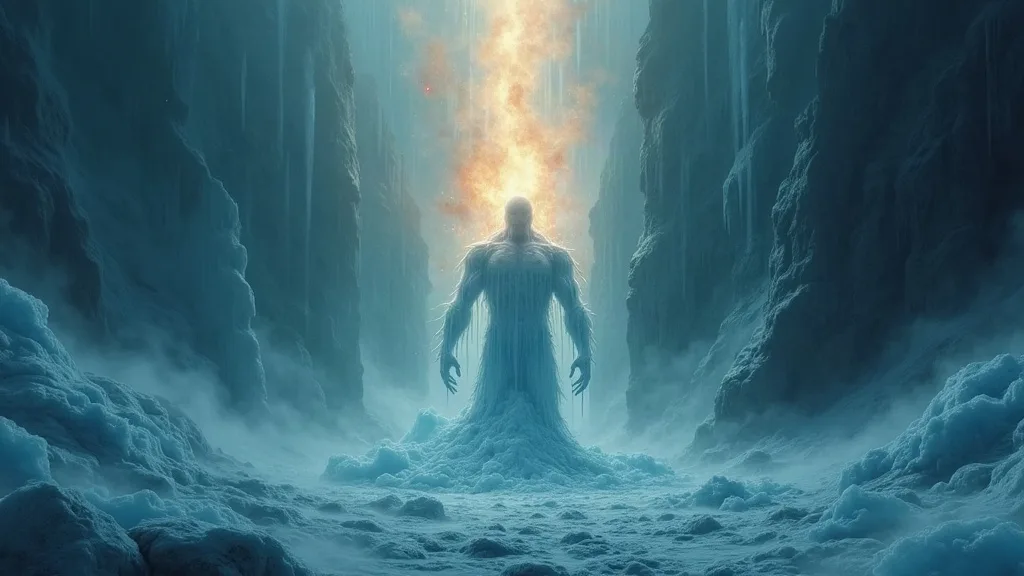
Before there was earth or sky, before fire and frost had anything between them, there was a gap. The Norse called it Ginnungagap, "the yawning void," and it sat empty between two realms: Niflheim to the north, where cold poured out of twelve rivers of venom, and Muspelheim to the south, where heat raged and sparks flew. When those two forces finally met at the centre of the void, something happened. Ice melted. Drops fell. And from those drops, life coalesced.
The first thing that lived was Ymir the primordial giant. He was not born of parents. He did not choose to exist. He simply formed, the way frost forms on a cold morning, natural and inevitable. His body was immense beyond measure, and from it would come every giant who ever walked the Norse cosmos. His death, at the hands of three young gods, would build the very world you are standing on.
This is not a minor creation story told at the edge of the tradition. The myth of Ymir sits at the absolute centre of Norse cosmology. It explains where mountains come from, why the sky holds, what the clouds are made of. It is one of the oldest creation narratives in Germanic literature, and it deserves to be read slowly.
The First Frost: How Ymir Came to Be
The two main sources for Ymir's story are the Prose Edda, written by the Icelandic historian and poet Snorri Sturluson around 1220 CE, and the Poetic Edda, a collection of older poems compiled around the same period but drawing on oral traditions several centuries older. The most important single poem is the Völuspá ("The Prophecy of the Seeress"), which opens with the creation of the world and returns to Ymir's end as a cosmic hinge point.
Snorri, writing in the section called Gylfaginning ("The Beguiling of Gylfi"), tells the story in the clearest prose. He describes Niflheim as the home of the spring Hvergelmir, from which the eleven rivers called the Élivágar flowed outward. These rivers carried a substance called éiter, a venom or poison, which hardened into ice as it spread into Ginnungagap. To the south, Muspelheim threw sparks and heat northward. When the two met, the ice softened and dripped, and those drops quickened with life.
The name Ymir is generally understood to mean "the Screamer" or "the Roarer," from the Proto-Germanic root connected to the sound of a great voice. Some scholars, including Jan de Vries in his work on Old Norse etymology, link it to the concept of twins or paired natures, which fits Ymir's hermaphroditic character: he did not need a partner to reproduce.
Snorri writes that while Ymir slept, sweat gathered under his left arm, and from that sweat a male and a female giant were born. His legs, pressing together, produced a son. Ymir was, in this sense, the ancestor of all the jötnar, the giants of Norse myth, a race that would stand in constant tension with the gods throughout the mythological age.
The Cow, the Salt, and the God Who Came After
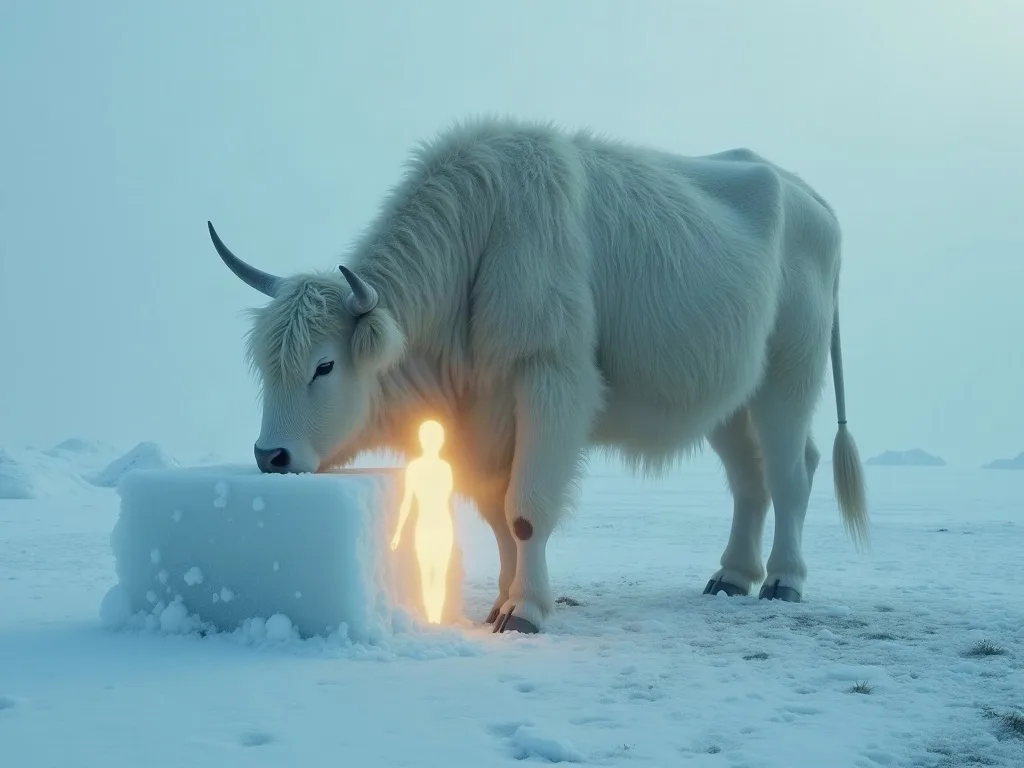
Ymir did not feed himself. Another being formed alongside him from the melting ice: a great cow named Auðumbla, "the hornless, rich one." She gave Ymir milk from her four rivers of sustenance, and she fed herself by licking the salty ice blocks that surrounded them both.
Auðumbla's licking is itself a creation act. On the first day, hair appeared on the ice block she licked. On the second day, a head emerged. On the third day, a whole figure stood free. His name was Búri, "the Producer." He was the first of the gods, handsome and powerful, and he would have a son named Borr, who would father three sons with a giantess named Bestla: Odin, Vili, and Vé.
This lineage matters enormously. The three brothers who will kill Ymir are themselves half giant on their mother's side. Bestla was a daughter of the giant Bölthorn, making Odin and his brothers the product of the same primordial lineage they would help destroy. The gods are not wholly separate from the giants. They are kin, mixed blood, standing on a border between two orders.
The Völuspá refers to Ymir simply as the being who existed "at the beginning of ages," before "sand or sea or cooling waves" existed, before earth or sky had formed. The poem is spare and archaic where Snorri is expansive. Both agree on what happened next.
The Killing of Ymir and the Building of the World
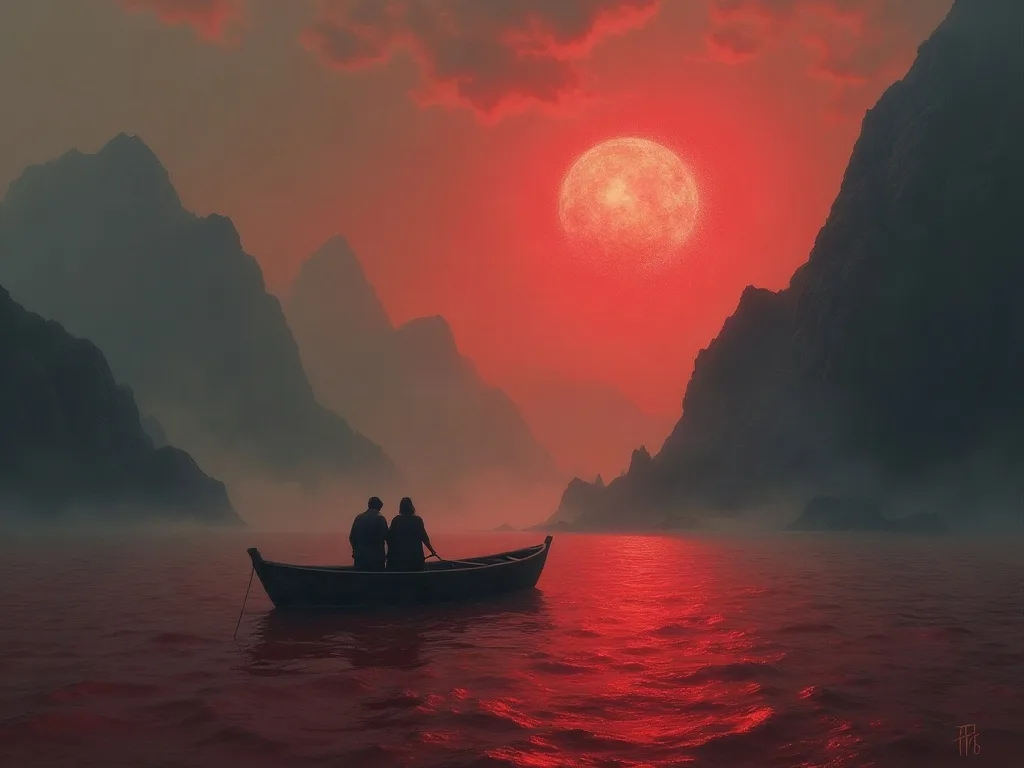
Odin, Vili, and Vé killed Ymir. The Eddas do not dwell long on the reasons. Snorri says simply that the brothers slew him, and that so much blood poured from his body that it drowned nearly all the frost giants except two: a giant named Bergelmir and his wife, who escaped on a wooden object (Snorri uses the word lúðr, which means a box, a trough, or possibly a boat) and survived to repopulate the giant race. This detail is the Norse mythology's own flood story, brief but structurally identical to the flood narratives of the ancient Near East.
Then the three brothers took Ymir's body and carried it to the middle of Ginnungagap. What followed was an act of world-building so methodical it reads almost like carpentry:
- His flesh became the earth.
- His blood and sweat became the seas and lakes.
- His bones became the mountains.
- His teeth and jaw fragments became rocks and boulders.
- His hair became the trees.
- His skull became the sky, held up at four corners by four dwarfs: Austri, Vestri, Norðri, and Suðri (East, West, North, South).
- His brain was scattered into the sky to form the clouds.
- Sparks from Muspelheim were fixed in the sky to become the stars, sun, and moon.
The earth they made was round and encircled by a deep ocean. The outer shores of that ocean were given to the giants as their territory, a place called Útgarðr, "the outer enclosure." The inner land was walled with Ymir's eyebrows to keep the giants out; this protected space became Miðgarðr, "the middle enclosure," the world of humans.
This is not metaphor softened for modern ears. The Eddas mean it literally. Every mountain you see is a piece of bone. Every sea is blood. The sky pressing down above you is the hollowed skull of the first being who ever lived.
Ymir and the Cosmic Body: A Cross-Mythological Pattern
Ymir the primordial giant does not stand alone in world mythology. The pattern of a cosmic being whose body becomes the physical universe appears across multiple unrelated traditions, and comparing them sharpens what is distinctive about the Norse version.
The closest structural parallel comes from ancient India. The Rigveda, composed roughly between 1500 and 1200 BCE, contains a hymn called the Purusha Sukta (Hymn 10.90), which describes Purusha, a cosmic man of a thousand heads, a thousand eyes, a thousand feet. The gods sacrifice him, and from his body come the sky, the earth, the animals, the four classes of human society, even the metres of poetry. Like Ymir, Purusha pre-exists the gods and is the material the cosmos is made from. Unlike Ymir, Purusha is sacrificed in a ritual sense, willingly offered; Ymir is simply killed.
Purusha and the Hindu creation represents a tradition where the cosmic sacrifice is framed as sacred and ordered. Ymir's death reads more like a coup. There is no ritual framing, no consent. The gods kill their ancestor and build their house out of him.
The ancient Mesopotamian Enûma Eliš, a Babylonian creation poem from around 1100 BCE, offers another version. The god Marduk defeats the chaos dragon Tiamat in combat, splits her body in two, and uses the halves to make heaven and earth. Here the cosmic body belongs to a monster, an enemy defeated in war. Ymir is somewhere between these poles: he is not exactly an enemy of the gods when he is killed, but he is the progenitor of those who will become their enemies.
In ancient China, the myth of Pangu tells of a giant who slept inside the cosmic egg for eighteen thousand years. When the egg broke, Pangu grew to hold sky and earth apart. When he died, his body became the landscape: his breath the wind, his eyes the sun and moon, his voice the thunder, his blood the rivers.
What makes Ymir distinctive is the blend of violence and practicality. The Norse gods are not transcendent beings performing a sacred rite. They are more like craftsmen who find the right material and use it. The world built from Ymir is not perfect; it is functional. And it will end. Ragnarök, the final battle, will unmake the world the gods built from Ymir's body, destroying and restarting the cycle.
Ymir (Norse)
The first being formed spontaneously from ice melt in Ginnungagap. Killed by Odin and his brothers without ritual consent. His body is raw material, used practically to construct earth, sky, and sea. The act is creative but violent, and the giants born from Ymir become permanent adversaries of the gods who killed their ancestor.
Purusha (Hindu)
The cosmic man of the Rigveda, described as containing everything that exists and will exist. Sacrificed by the gods in a sacred ritual. His body produces not just the physical world but the social and cosmic order: seasons, animals, the four varnas, and the metres of sacred verse. The sacrifice is framed as the foundational sacred act, not a killing but an offering.
Bergelmir and the Giant Flood: What the Eddas Almost Forgot
One of the strangest threads in the Ymir story is the one most readers skip over. When Ymir's blood poured out and drowned the frost giants, two survivors escaped. Snorri names one as Bergelmir, and the Völuspá calls him one of the most ancient beings the seeress can remember: "The first thing I remember is the giant Bergelmir, placed on his lúðr, his [box or cradle or boat]."
The word lúðr is genuinely difficult. Scholars have argued for generations whether it means a wooden box, a boat, a millstone cradle, or a hollow log. Rudolf Simek, in his Dictionary of Northern Mythology, acknowledges the uncertainty while noting that the survival narrative clearly mirrors flood myths from the ancient Near East. Whatever Bergelmir floated on, the point is survival and continuation: the giant race did not end with Ymir, and their continued existence is the source of the ongoing conflict that runs through all of Norse mythology, from the first frost to Ragnarök.
This detail also raises a question scholars have not fully resolved: did the Norse mythmakers know the Mesopotamian flood tradition, or did similar narrative logic produce similar shapes independently? The Viking Age brought Norse traders and settlers into contact with the Byzantine world and the wider Mediterranean. The Christianisation of Iceland (around 1000 CE) brought biblical flood narratives directly into the cultural sphere of the Eddas' compilers. Whether Bergelmir's lúðr is independent invention or cultural borrowing remains genuinely open.
Ymir in the Poetic Eddas: The Older Voice
The prose account in Snorri is vivid and systematic. But the Poetic Edda preserves older, rougher material that often contradicts or complicates Snorri's tidy synthesis. Two poems stand out.
The Völuspá opens with the seeress (völva) called back from the dead by Odin to recite the history and fate of the world. She describes the time before creation as a void where nothing existed, then names Ymir as the first being without much elaboration, moving quickly toward the gods and the building of the world. Her focus is not on Ymir himself but on the sequence of events his existence enabled. He is almost incidental to her narrative, which is precisely what makes him structurally important: he is the given, the foundation.
The second key poem is Grímnismál ("The Sayings of Grímnir"), where Odin, in disguise, recites cosmological knowledge to a king. Here the body-becomes-world passage appears in compact, dense verse: "From Ymir's flesh the earth was made, the mountains from his bones; the sky from the skull of the frost-cold giant, the sea from his blood." The verse is brisk and matter-of-fact, as though everyone listening already knows the basic story and Odin is reminding rather than explaining.
A third poem, Vafþrúðnismál ("The Sayings of Vafthrudnir"), features Odin in a wisdom contest with the giant Vafthrudnir, one of the oldest and most knowledgeable of the jötnar. Vafthrudnir speaks of Ymir as part of his deep cosmological knowledge, confirming the existence of Bergelmir and the flood of blood. The poem is structured as a test of cosmic memory, and Ymir sits at its deepest layer: to know Ymir is to know everything that came before the gods.
Why Ymir Still Matters: Mythology, Violence, and Making
Stories about cosmic creation through violence or sacrifice appear across human cultures, and they tend to carry a hidden message about the nature of the world they describe. A world built from a killed body is a world with a secret built in: the material it is made of had another life, another will, another set of relations. The giants who lived on its outer edges were not just enemies of the gods. They were, in the truest sense, heirs of their ancestor.
Ymir the primordial giant makes the Norse cosmos morally complicated from its first breath. The gods who order and protect Miðgarðr are the ones who committed the original act of cosmic violence. The giants who threaten and challenge the gods are the descendants of the being who was killed to make the world possible. Neither side is simply good or simply evil. They are locked in a relationship that began with kin-killing and runs, without resolution, until Ragnarök burns everything down.
This tension is what gives Norse mythology its particular texture, its sense of weight and doom. Unlike the Olympian gods of Greece, who generally preside over a stable cosmic order they inherited rather than created through bloodshed, the Norse gods live in a world they built themselves, out of a body they spilled. They know how it was made. And they know it will not last forever.
The world tree Yggdrasil, which holds the nine realms together, grows from the same earth made of Ymir's flesh. Thor, who spends much of his mythological life fighting giants, is fighting distant kin of the being his grandfather helped kill. Even Loki, the great trickster, is of giant ancestry, a reminder that the boundary between order and chaos in Norse myth is never a clean line.
Ymir is the point where Norse mythology acknowledges what it costs to make a world. Everything that exists came from something destroyed. The seas are old blood. The mountains are old bone. That knowledge sits underneath every Norse story, quiet and foundational, the way a skeleton sits underneath living skin.
Frequently Asked Questions About Ymir the Primordial Giant
Frequently asked questions
Who killed Ymir in Norse mythology, and why?
Ymir was killed by the three brothers Odin, Vili, and Vé, the grandsons of Búri, the first god who emerged from the ice. The Eddas give no detailed motive; Snorri Sturluson's Prose Edda presents it as the act that made creation possible rather than as revenge or war. The brothers then used Ymir's body as raw material to build the world, suggesting the killing was purposeful rather than spontaneous.
What are the primary sources for the Ymir creation myth?
The two main sources are the Prose Edda (around 1220 CE) by Snorri Sturluson, specifically the section called Gylfaginning, and the Poetic Edda, particularly the poems Völuspá, Grímnismál, and Vafþrúðnismál. The Poetic Edda preserves older, more fragmentary versions; Snorri provides the most systematic narrative. Both texts were compiled in Iceland after Christianisation, but they draw on pre-Christian oral tradition.
Is Ymir the same as a giant in other mythologies?
Ymir shares structural similarities with cosmic giants from other traditions, most notably Purusha from the Rigveda and Pangu from Chinese cosmogony, both of whom also become the physical universe after death. The Babylonian chaos dragon Tiamat, whose body Marduk splits to make heaven and earth, offers another parallel. These are independent traditions that arrived at similar logic: the universe is made of something that had to stop existing in its original form for the world to begin.
What happened to the giants after Ymir's blood flooded the cosmos?
Almost all the frost giants drowned in the blood that poured from Ymir's body when he was killed. The one survivor named in the sources is Bergelmir, who escaped with his wife on a wooden object (the Old Norse word lúðr, whose exact meaning scholars still debate). Bergelmir and his wife then repopulated the race of giants, which is why jötnar continued to exist and threaten the gods throughout the Norse mythological age.
What does the name Ymir mean in Old Norse?
The name Ymir is generally derived from a Proto-Germanic root connected to sound, meaning something like "the Screamer" or "the Roarer." Some scholars, including Jan de Vries, have also connected it to a root meaning "twin" or "dual," which would suit Ymir's dual or hermaphroditic nature: he reproduced without a partner, generating offspring from his own body. Both interpretations remain supported by different branches of Germanic philology.
How does Ymir's story connect to Ragnarök?
Ymir's story sets the stakes for Ragnarök, the Norse end-of-the-world battle. The giants who survive as Bergelmir's descendants carry an ancestral grievance: their progenitor was killed to build a world they were then excluded from (confined to Útgarðr, the outer lands). At Ragnarök, the giants storm Ásgarðr and the world burns. The world made from Ymir's body is destroyed, and some sources suggest a new, cleaner world rises after. Ymir's death and Ragnarök form the opening and closing brackets of the Norse cosmic cycle.
The Living Weight of Old Bone: Ymir in Modern Imagination
Ymir never fully disappeared from European cultural memory. His name surfaces in scholarly commentary from at least the Renaissance period onward, whenever Northern European antiquarians began recovering Old Norse texts from Icelandic manuscripts. But the 19th century brought him back with particular force. The Romantic movement, hungry for Northern alternatives to Greek mythology, found in the Eddas a creation story that felt elemental and unpolished, older somehow than Olympus.
Richard Wagner drew on Norse and Germanic mythology for his Ring Cycle (premiered between 1869 and 1876), though he worked more directly with the Nibelung tradition than with the cosmogonic material. Yet the atmosphere of primordial giants and doomed cosmic orders runs through his work. Later, J.R.R. Tolkien, who was a professional scholar of Old English and Old Norse, absorbed the Eddic tradition deeply. The cold, geological weight of his Middle-earth, the sense that the landscape has a history of violence buried in it, reflects a world-building logic not unlike the Eddic account: the land is made of something old and heavy.
In contemporary popular culture, Ymir appears in video games, graphic novels, and fantasy fiction, sometimes recognisably close to the Eddic source (the giant of frost and origin) and sometimes transformed into something newer. The anime series Attack on Titan features a character named Ymir Fritz as the ancestral origin of all Titans, a direct structural echo of the Eddic Ymir as the ancestor of all giants. The borrowing is not coincidental: the showrunners cited Norse mythology as a deliberate influence.
What survives in all these versions is the core logic: a primordial giant whose existence was necessary and whose destruction was the price of the world. That logic is not really about mythology. It is about what humans have always sensed about the places they live: that the ground underfoot was here before us, that it was something else before it was ours, and that what it was before carries weight we cannot fully put down.
Ymir the primordial giant is, in the end, the Norse answer to the oldest question: where did all this come from? The answer the Eddas give is unflinching. It came from a body. It cost a life. And every mountain and sea and cloud carries that origin inside it, quiet as old bone, heavy as frozen blood.
Free 25-page sample
Want the whole story?
Take the first 25 pages free. If it pulls you in, the full edition is yours as an instant PDF download, with a paperback on Amazon for selected titles.

Mythology
The World Mythology Book: The Gods, Heroes and Myths of Every Culture
The Gods, Heroes and Myths of Every Culture, in One Volume
The whole of world mythology in a single volume: Greek, Norse, Egyptian, Japanese, Hindu, Celtic, Slavic, Mesoamerican and African myths gathered side by side, each drawn from the primary sources.